

Neural Networks and Rules-based Systems used to Find Rational and Scientific Correlations between being Here and Now with Afterlife Conditions
Neural Networks and Rules-based Systems used to Find Rational and

Article Fingerprint
ReserarchID
99T9E
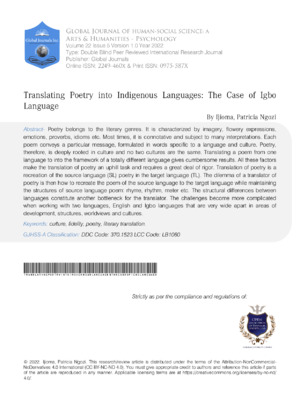
Poetry belongs to the literary genres. It is characterized by imagery, flowery expressions, emotions, proverbs, idioms etc. Most times, it is connotative and subject to many interpretations. Each poem conveys a particular message, formulated in words specific to a language and culture. Poetry, therefore, is deeply rooted in culture and no two cultures are the same. Translating a poem from one language to into the framework of a totally different language gives cumbersome results. All these factors make the translation of poetry an uphill task and requires a great deal of rigor. Translation of poetry is a recreation of the source language (SL) poetry in the target language (TL). The dilemma of a translator of poetry is then how to recreate the poem of the source language to the target language while maintaining the structures of source language poem: rhyme, rhythm, meter etc. The structural differences between languages constitute another bottleneck for the translator. The challenges become more complicated when working with two languages, English and Igbo languages that are very wide apart in areas of development, structures, worldviews and cultures.
Ijioma, Patricia Ngozi. 2026. \u201cTranslating Poetry into indigenous Languages: The Case of Igbo Language\u201d. Global Journal of Human-Social Science - A: Arts & Humanities GJHSS-A Volume 22 (GJHSS Volume 22 Issue A5): .
Crossref Journal DOI 10.17406/GJHSS
Print ISSN 0975-587X
e-ISSN 2249-460X
The methods for personal identification and authentication are no exception.
Total Score: 102
Country: Nigeria
Subject: Global Journal of Human-Social Science - A: Arts & Humanities
Authors: Ijioma, Patricia Ngozi (PhD/Dr. count: 0)
View Count (all-time): 161
Total Views (Real + Logic): 1692
Total Downloads (simulated): 23
Publish Date: 2026 01, Fri
Monthly Totals (Real + Logic):
Neural Networks and Rules-based Systems used to Find Rational and
A Comparative Study of the Effeect of Promotion on Employee
The Problem Managing Bicycling Mobility in Latin American Cities: Ciclovias
Impact of Capillarity-Induced Rising Damp on the Energy Performance of
Poetry belongs to the literary genres. It is characterized by imagery, flowery expressions, emotions, proverbs, idioms etc. Most times, it is connotative and subject to many interpretations. Each poem conveys a particular message, formulated in words specific to a language and culture. Poetry, therefore, is deeply rooted in culture and no two cultures are the same. Translating a poem from one language to into the framework of a totally different language gives cumbersome results. All these factors make the translation of poetry an uphill task and requires a great deal of rigor. Translation of poetry is a recreation of the source language (SL) poetry in the target language (TL). The dilemma of a translator of poetry is then how to recreate the poem of the source language to the target language while maintaining the structures of source language poem: rhyme, rhythm, meter etc. The structural differences between languages constitute another bottleneck for the translator. The challenges become more complicated when working with two languages, English and Igbo languages that are very wide apart in areas of development, structures, worldviews and cultures.
We are currently updating this article page for a better experience.

Lorem ipsum dolor sit amet, consectetur adipiscing elit. Ut elit tellus, luctus nec ullamcorper mattis, pulvinar dapibus leo.































































