



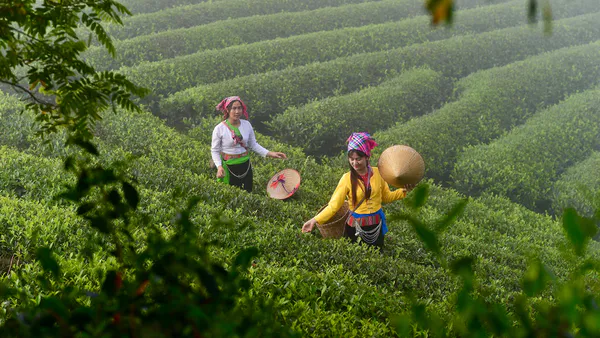

Introduction
Against the backdrop of global cultural diversity protection and heritage preservation, the international dissemination of intangible cultural heritage (ICH) has become an important aspect of cultural exchange and communication. As a unique carrier that integrates ecological wisdom, traditional techniques, and cultural beliefs, tea cultural landscapes have attracted increasing international attention. In September 2023, the Jingmai Mountain Ancient Tea Forest Cultural Landscape was inscribed on the UNESCO World Heritage List, marking the growing global recognition of Chinese tea culture and its heritage value (UNESCO, 2023).
As one of the birthplaces of tea culture, China possesses abundant tea-related intangible cultural heritage resources. Tea cultural landscapes embody the long-term interaction between human beings and nature and reflect the integration of ecological environments, production techniques, and spiritual traditions. UNESCO defines cultural landscapes as the combined works of nature and humankind, highlighting their cultural and historical significance (UNESCO, 1992). Therefore, the international communication of tea cultural landscapes requires not only the transmission of factual information but also the interpretation of the cultural meanings embedded within them.
Chawen Chashuo (《茶问茶说》, Tea: Questions and Answers) by Lan Zengquan, Shen Xiaojin and Hu Dianbi systematically introduces Chinese tea culture, covering tea production, ecological knowledge, and cultural practices. The proposed English translation of selected terms from the book provides a valuable case for examining how Chinese tea culture can be represented and communicated across languages. Existing studies have mainly focused on translation strategies and terminology equivalence, while less attention has been paid to how translation reconstructs the cultural meanings of tea-related heritage and communicates tea cultural landscapes as heritage narratives. Drawing on Nords functionalist approach (Nord, 1997) and Tymoczkos discussion of cultural representation in translation (Tymoczko, 2007), this study examines the translation of representative ICH-related terminology in Tea: Questions and Answers from the perspective of interlingual reconstruction. By analysing terms from the natural, technical, and spiritual dimensions of tea cultural landscapes, the paper explores how the translation of tea-related ICH terminology functions as heritage communication by making culturally embedded meanings more accessible across languages.
Theoretical framework
Cultural Landscapes
The concept of cultural landscape originated in cultural geography and was formally incorporated into the UNESCO World Heritage framework in 1992. According to UNESCO, cultural landscapes are the combined works of nature and humankind, reflecting the long-term interaction between people and their natural environment (UNESCO, 1992). Compared with traditional categories of cultural or natural heritage, cultural landscapes emphasise the dynamic relationship between ecological systems, human activities, and cultural values. As a result, they provide an important perspective for understanding living heritage that continues to evolve through social practices and cultural transmission (Taylor & Lennon, 2011).
Within this framework, tea cultural landscapes can be understood not merely as physical tea-growing environments but as integrated heritage systems that combine ecological resources, traditional knowledge, production techniques, and cultural beliefs. This perspective provides a useful foundation for examining how tea-related heritage is represented and communicated through translation.
Theoretical Dimensions of Tea Cultural Landscapes
Tea cultural landscapes are a distinctive form of cultural heritage that reflects the long-term interaction between human communities and tea-growing environments. Building on UNESCOs understanding of cultural landscapes, recent studies suggest that tea cultural landscapes can be understood through three interconnected dimensions: natural, technical, and spiritual.
The natural dimension refers to ecological systems associated with tea cultivation, including ancient tea forests, biodiversity, climate conditions, and sustainable agricultural practices. These elements constitute the environmental foundation of tea culture and reflect traditional ecological knowledge accumulated through human–nature interaction (Zhu, 2024).
The technical dimension encompasses tea cultivation, processing techniques, tea-making skills, and related forms of practical knowledge. As important components of intangible cultural heritage, these techniques are transmitted across generations and contribute to the continuity of tea culture.
The spiritual dimension includes beliefs, rituals, customs, aesthetic values, and symbolic meanings associated with tea culture. Concepts such as tea ancestor worship, tea-related rituals, and cultural expressions embody the social memory and cultural identity of tea-producing communities (Zhu, 2024).
These three dimensions are closely interconnected and together form the cultural significance of tea cultural landscapes. Accordingly, they also provide the analytical framework for the classification and discussion of tea-related terminology in this study.
Interlingual Reconstruction and the Translation of Heritage Terminology
Interlingual reconstruction refers to the process through which cultural meanings are reinterpreted and represented across different linguistic and cultural contexts. Rather than viewing translation as a simple transfer of linguistic forms, this perspective emphasises the reconstruction of cultural knowledge in ways that are accessible and meaningful to target audiences.
In translation studies, Nords functionalist approach highlights that translation should be guided by communicative purposes and the needs of target readers (Nord, 1997). Similarly, Tymoczko argues that cultural translation involves the representation and negotiation of cultural meanings rather than the direct transfer of information (Tymoczko, 2007). These perspectives suggest that the translation of heritage-related terminology requires translators to balance cultural specificity with intercultural comprehensibility.
This challenge is particularly evident in tea cultural landscapes, where many terms are deeply embedded in local ecological knowledge, traditional techniques, and cultural beliefs. The translation of such terminology therefore involves not only linguistic choices but also the communication of heritage values associated with tea culture. From this perspective, interlingual reconstruction can be understood as a process through which tea-related cultural meanings are reinterpreted and communicated to international audiences.
Based on this understanding, the present study adopts interlingual reconstruction as an analytical perspective for examining the translation of representative tea-related intangible cultural heritage terminology in Tea: Questions and Answers. By analysing selected terms from the natural, technical, and spiritual dimensions of tea cultural landscapes, the study explores how translation contributes to the communication and international dissemination of tea-related heritage.
Research design
Data Collection and Term Selection
The data for this study were collected from Tea: Questions and Answers, a comprehensive work that systematically introduces Chinese tea culture, including tea production, ecological knowledge, and tea-related cultural practices. Rather than focusing on isolated tea products or individual tea-making techniques, the book presents tea culture as an integrated heritage system involving interactions among natural environments, traditional practices, and cultural values. Therefore, it was selected as a representative case for examining how tea-related intangible cultural heritage terminology is reconstructed and communicated through translation.
Following the analytical framework established in Section 2, the collected terminology was classified into three dimensions: natural, technical, and spiritual. To ensure the representativeness and analytical value of the selected examples, terms were chosen according to four criteria: (1) significance within tea cultural landscapes; (2) translation complexity and cultural specificity; (3) clarity of textual context; and (4) relevance to heritage communication.
Based on these criteria, nine representative terms were selected for detailed qualitative analysis, with three terms representing each dimension of tea cultural landscapes, as shown in Table 1.
Table 1. Selected Tea-related ICH Terminology
| Category | Chinese Term | Proposed Translation | Translation Strategy |
|---|---|---|---|
| Natural | 森林茶园 | Forest Tea Gardens | Literal translation + explicitation |
| Natural | 茶园生态立体种植 | Three-dimensional Ecological Plantation | Literal translation + functional explanation |
| Natural | 古茶树 | Ancient Tea Trees | Literal translation + cultural annotation |
| Technical | 擂茶 | Lei Cha | Transliteration + explicitation |
| Technical | 茶艺表演 | Tea Art Performance | Literal translation + functional explanation |
| Technical | 杀青 | Fixation | Functional translation + technical explicitation |
| Spiritual | 茶寿 | Tea Longevity | Literal translation + cultural annotation |
| Spiritual | 茶祖 | Tea Ancestor | Functional translation + cultural annotation |
| Spiritual | 茶舞莲花雾 | Lotus-Mist Tea Dance | Creative translation + cultural reconstruction |
These terms represent the ecological, technical, and cultural dimensions of tea cultural landscapes and provide a basis for examining how tea-related heritage meanings are reconstructed and communicated through translation.
Analytical framework
To examine how tea-related intangible cultural heritage (ICH) terminology is communicated through translation, this study adopts a qualitative case-study approach. The selected terms are analysed through a five-dimensional framework consisting of: (1) source term, (2) textual context, (3) English translation, (4) translation strategy, and (5) heritage communication function.
First, each term is examined within its original textual context to identify its cultural significance in tea cultural landscapes. Second, the corresponding English translation is analysed with particular attention to the strategies employed, including literal translation, transliteration, explicitation, and cultural annotation. Finally, the analysis considers how these translation choices contribute to the communication of heritage-related meanings and facilitate intercultural understanding among international readers.
Rather than evaluating translations solely in terms of linguistic equivalence, the present study focuses on how translation mediates the natural, technical, and spiritual dimensions of tea cultural landscapes. Through this approach, the study explores the role of translation in communicating tea-related heritage values across cultural and linguistic boundaries.
Findings
Translation of the Natural Dimension
The natural dimension of tea cultural landscapes reflects the ecological knowledge and environmental practices that have developed through long-term interactions between tea-growing communities and their surroundings. Among the selected examples, Forest Tea Gardens (森林茶园) and Three-dimensional Ecological Plantation (茶园生态立体种植) illustrate how ecological concepts are represented and communicated through translation.
Forest Tea Gardens refers to a tea cultivation system embedded within well-preserved forest environments. In the translation, the term is rendered as Forest Tea Gardens, a largely literal translation that preserves the original ecological imagery. However, the concept extends beyond the simple coexistence of forests and tea plants. To enhance intercultural comprehensibility, the translation is supplemented with explanatory information describing tea trees growing under forest canopies and within relatively intact ecological systems. This strategy helps international readers understand the ecological characteristics that distinguish traditional tea forests from conventional tea plantations.
Similarly, the term茶园生态立体种植is translated as Three-dimensional Ecological Plantation. The translation combines literal rendering with functional explanation to convey the multilayered ecological structure of tea cultivation systems. The expression highlights the coexistence of trees, shrubs, and ground vegetation within a sustainable agricultural ecosystem. Rather than focusing solely on agricultural production, the translation communicates the ecological wisdom embedded in traditional tea-growing practices.
Another example illustrating the natural dimension is “古茶树” (Ancient Tea Trees). Unlike ordinary tea trees, ancient tea trees embody both ecological characteristics and cultural continuity, as they represent long-established tea-growing environments preserved through generations. Therefore, the translation of this term involves not only the transfer of botanical meaning but also the reconstruction of its heritage value.
The proposed translation “Ancient Tea Trees” adopts a literal translation strategy, retaining the core meaning of the original term. The adjective “ancient” conveys the temporal dimension associated with these trees and highlights their historical significance. However, since the term may not immediately evoke the cultural and ecological values attached to ancient tea trees among international readers, further contextual explanation is necessary in heritage communication contexts.
These three examples demonstrate that the translation of natural-dimension terminology requires attention not only to ecological meanings but also to the relationship between natural environments and cultural heritage values. Through appropriate translation choices and contextual explanation, natural elements of tea cultural landscapes can be made more accessible to international readers.
Translation of the Technical Dimension
The technical dimension of tea cultural landscapes encompasses traditional tea-making techniques, tea-related practices, and forms of practical knowledge that have been transmitted across generations. Among the selected examples, Lei Cha (擂茶), Fixation (杀青) and Tea Art Performance (茶艺表演) demonstrate how translation mediates the communication of culturally specific tea practices and technical knowledge to international audiences.
Lei Cha is a traditional tea-based food preparation popular in several ethnic communities in southern China. In the translation, the original Chinese term is retained through transliteration as Lei Cha, while an explanatory phrase, “pounded tea,” is added to clarify its basic meaning. This strategy preserves the cultural identity of the source term while simultaneously improving accessibility for readers unfamiliar with Chinese tea culture. Additional explanations of ingredients and preparation methods further help communicate the cultural and practical characteristics of Lei Cha, allowing international readers to understand it as more than a conventional tea beverage.
Fixation represents another important example of technical-dimension terminology related to tea production. Referring to the heat-treatment process that prevents enzymatic oxidation and preserves the quality of tea leaves, the term embodies specialized knowledge developed through traditional tea-making practices. Unlike terms that can be directly understood through their literal meanings, “杀青” contains technical implications that may not be immediately accessible to international readers.
The proposed translation “Fixation” adopts a functional translation strategy combined with technical explicitation. Although a literal rendering such as “kill-green” may retain the imagery of the source term, it may cause confusion among readers unfamiliar with Chinese tea processing. The term “fixation,” which is widely used in tea science, better conveys the technical function of this process. Additional explanation is therefore necessary to clarify its role in tea production and to facilitate intercultural understanding of traditional tea-making knowledge.
Tea Art Performance represents a different type of technical-dimension terminology, focusing on the performative and ritual aspects of tea practices. While the term itself clearly conveys the performative aspect of tea culture, the accompanying description highlights its integration of aesthetics, etiquette, and philosophical values. In this way, the translation communicates not only a tea-related activity but also the cultural meanings embedded in traditional tea practices. The translated term therefore functions as a bridge between observable practices and the broader cultural values they represent.
These examples suggest that the translation of technical-dimension terminology requires a balance between cultural preservation and communicative effectiveness. Different types of technical terms may involve not only procedural knowledge but also local practices and cultural meanings. By combining transliteration, literal translation, and explanatory strategies, translations can make tea-related knowledge more accessible to international audiences while retaining important elements of cultural specificity. By combining transliteration, literal translation, and explanatory strategies, the translations make tea-related knowledge more accessible to international audiences while retaining important elements of cultural specificity. As a result, translation can serve as a means in communicating the technical heritage embodied in tea cultural landscapes.
Translation of the Spiritual Dimension
The spiritual dimension of tea cultural landscapes encompasses beliefs, symbolic meanings, cultural values, and collective memories associated with tea culture. Compared with the natural and technical dimensions, the translation of spiritually loaded terminology presents greater challenges because such terms often carry culturally specific concepts that lack direct equivalents in the target language. Tea Longevity (茶寿) Tea Ancestor (茶祖) and Lotus-Mist Tea Dance (茶舞莲花雾) provide representative examples of this challenge.
Tea Longevity refers to a traditional cultural expression associated with longevity and good fortune. Its meaning originates from the symbolic interpretation of the Chinese character “茶,” which is traditionally linked to the age of eighty-eight. Since no widely established English equivalent exists, the translation adopts the expression Tea Longevity and supplements it with explanatory information regarding its cultural origins. This strategy allows the cultural symbolism embedded in the source term to be communicated while reducing the risk of misunderstanding among international readers.
Similarly, Tea Ancestor refers to the legendary figure regarded as the originator of tea culture, most commonly Shennong in Chinese tradition. The proposed translation adopts a functional rendering, Tea Ancestor, while further explaining its cultural and historical significance. Without such clarification, international readers may interpret the term literally as a family ancestor associated with tea rather than a symbolic cultural figure. The explanatory approach therefore helps preserve the cultural meaning attached to the concept while enhancing intercultural comprehensibility.
A further example of spiritually and aesthetically embedded terminology is “茶舞莲花雾” (Lotus-Mist Tea Dance). Unlike Tea Longevity and Tea Ancestor, which mainly represent cultural concepts and symbolic figures, this term integrates artistic expression, natural imagery, and emotional associations within a concise cultural expression. The elements “莲花” (lotus) and “雾” (mist) carry rich symbolic and aesthetic meanings in Chinese culture, representing purity, elegance, and an ethereal atmosphere.
The proposed translation “Lotus-Mist Tea Dance” adopts a creative reconstruction strategy rather than a purely literal translation. By retaining the key cultural images of “lotus” and “mist” while presenting them in an accessible English expression, the translation attempts to reproduce the aesthetic effect and symbolic associations of the original term. This case demonstrates that the translation of tea-related ICH terminology may require the recreation of cultural imagery and emotional resonance across languages.
These examples demonstrate that the translation of spiritually loaded terminology involves more than linguistic transfer. In many cases, cultural symbolism, historical memory, and community beliefs must also be communicated to target audiences. Through explanatory and reconstructive translation strategies, culturally specific concepts can be made more accessible while maintaining their heritage significance. Translation therefore serves as a means of representing and communicating the symbolic and cultural values embedded in tea cultural landscapes.
Discussion
Translation and Heritage Communication
The findings presented above demonstrate that the translation of tea-related intangible cultural heritage (ICH) terminology involves more than the transfer of lexical meanings. Across the natural, technical, and spiritual dimensions of tea cultural landscapes, translation functions as a process of cultural mediation through which heritage values are interpreted and communicated for international audiences.
The analysis shows that different categories of tea-related ICH terminology involve different layers of cultural meaning, requiring translation strategies that address their specific ecological, technical, and symbolic dimensions. For natural-dimension terms, explanatory translation helps reconstruct ecological knowledge embedded in traditional tea-growing systems. For technical-dimension terms, transliteration and functional explanation help represent tea-related skills and practices in ways accessible to target readers. For spiritual-dimension terms, additional cultural interpretation is often necessary to convey symbolic meanings and cultural values that may be unfamiliar to target readers. These findings support Nords view that translation should be guided by communicative purposes and the needs of target audiences (Nord, 1997). They also resonate with Tymoczkos argument that translation involves the representation and negotiation of cultural meanings rather than the simple transfer of information (Tymoczko, 2007).
From a heritage perspective, translation can be understood as an important form of heritage interpretation. Previous studies have emphasised that heritage communication involves helping audiences understand and engage with the meanings embedded in cultural resources rather than merely providing information about them (Smith, 2006; Timothy & Boyd, 2015). The translation of tea-related terminology performs a similar function by making culturally specific concepts accessible to international readers while preserving their heritage significance. In this sense, translation serves not only as a linguistic activity but also as a means of heritage communication that supports intercultural understanding and cultural representation.
The findings therefore suggest that the effective translation of tea-related ICH terminology may contribute to the broader representation and intercultural accessibility of tea cultural landscapes within global heritage discourse.
Translation and the Sustainable Communication of Tea-related Heritage
Beyond facilitating heritage communication, the translation of tea-related terminology also has the potential to support the sustainable communication of intangible cultural heritage. As cultural heritage increasingly enters global contexts, effective translation becomes essential for ensuring that culturally specific knowledge can be understood, appreciated, and transmitted across linguistic and cultural boundaries.
The findings of this study suggest that successful heritage translation requires a balance between cultural authenticity and intercultural accessibility. Excessive simplification may lead to the loss of cultural specificity, while overly literal translation may create barriers to comprehension. The examples analysed in this study demonstrate that strategies such as transliteration, literal translation, explicitation, and cultural annotation can work together to preserve heritage meanings while enhancing communicative effectiveness.
From the perspective of Ecotranslatology, translation can be viewed as a process of adaptation and selection within a particular cultural and communicative environment (Hu, 2021). Translators are required to adapt to the linguistic, cultural, and communicative needs of target readers while retaining essential features of the source culture. This perspective is particularly relevant to the translation of tea-related heritage terminology, where ecological knowledge, traditional techniques, and cultural values are closely interconnected. By making culturally embedded concepts more accessible to international audiences, translation helps create conditions for the wider recognition and continued communication of tea-related heritage.
As the global visibility of Chinese tea culture continues to increase, especially following the inscription of the Jingmai Mountain Ancient Tea Forest Cultural Landscape on the UNESCO World Heritage List (UNESCO, 2023), translation may provide increasing opportunities for intercultural dialogue and the communication of heritage meanings. The translation of tea-related terminology therefore contributes not only to linguistic communication but also to the representation and interpretation of tea-related cultural heritage across languages and cultures.
Conclusion
This study examined the translation of tea-related intangible cultural heritage (ICH) terminology in Tea: Questions and Answers from the perspective of interlingual reconstruction and heritage communication. By analysing representative terms from the natural, technical, and spiritual dimensions of tea cultural landscapes, the study explored how translation reconstructs and communicates ecological knowledge, traditional practices, and cultural values embedded in Chinese tea culture.
The findings indicate that different categories of tea-related ICH terminology involve different layers of cultural meaning and therefore require translation approaches that address their ecological, technical, and symbolic dimensions. Literal translation, transliteration, explicitation, and cultural annotation can be combined to improve intercultural comprehensibility while preserving cultural specificity. The study further suggests that the translation of tea-related terminology functions not only as linguistic transfer but also as a form of heritage communication that supports the representation and intercultural accessibility of tea cultural landscapes.
The research contributes to current discussions on the translation of intangible cultural heritage by highlighting the relationship between terminology translation and heritage communication. It also provides practical insights into the translation practices involved in presenting tea-related cultural heritage to international audiences.
This study is limited by its focus on a single text and its qualitative case-study design. Future research may expand the scope of analysis by examining additional tea-related heritage texts or by exploring audience reception of translated heritage terminology in different cultural contexts.


