

1. Introduction
N. Bohr was the first to derive the energy levels of a hydrogen atom [1]. Bohr considered the case where an electron moves in a circle at constant speed around the atomic nucleus (a proton). The following formula of motion of Newton holds when an electron moves at velocity on a circular orbit with radius .
This formula indicates that the centrifugal force acting on an electron (left side) is equal to the Coulomb attraction exerted on an electron by the atomic nucleus (right side). Here, is the rest mass of the electron.
Multiplying both sides of Formula (1) by 1/2 yields the following.
Incidentally, the potential energy of a hydrogen atom can be expressed with the following formula.
Therefore, Formula (2) can be written as follows.
Consider the case where an electron at rest in an isolated system in free space is attracted by the electrostatic attraction of the proton (hydrogen atom nucleus), and forms a hydrogen atom.
The electron at rest has a rest mass energy of . When this electron is taken into the region of the hydrogen atom, it acquires an amount of kinetic energy equivalent to the emitted photon energy .
At this time, the following relationship holds between the kinetic energy acquired by the electron and .
The source supplying these two types of energy is likely to be the rest mass energy of the electron. If the decrease in rest mass energy of the electron is represented here as , then an energy conservation law like the following holds.
Also, by taking Formula (5) into account, Formula (6) can be written as follows.
Since the relationship holds due to the virial theorem, Formula (7) can be written as follows.
Therefore,
We have obtained two formulas for the potential energy of an electron.
Formula (9) shows that the potential energy of an electron equals the decrease in rest mass energy of the electron.
Incidentally, Formula (3), the existing formula for potential energy, can be written as follows.
Also, is the classical electron radius of the electron, given by the following formula.
When Formula (9) is taken into account, the lower limit for potential energy becomes .
Also, the distance of closest approach of an electron becomes as follows.
The location that satisfies this relationship is the distance of closest approach , which indicates how close the electron comes to the center of the atom.
When an electron in a hydrogen atom approaches a point from the center of the atomic nucleus, the rest mass energy of the electron is depleted, and the electron cannot approach any closer to the atomic nucleus.
In Formula (3), there was no limit on the range of application of , but it can be seen that it actually has the following range of application.
The radius of the atomic nucleus (proton) in a hydrogen atom is thought to be about [2], and thus it is evident that quantum mechanics is not needed to explain the reason why the electron is not absorbed into the atomic nucleus.
In classical quantum theory, the total mechanical energy of a hydrogen atom is defined as the sum of the potential energy and kinetic energy of the electron. That is,
Here, is the principal quantum number.
Here, the relativistic energy of an electron, taking into account the existence of the electron’s rest mass energy, is defined as follows,
Here, is the relativistic energy of the electron, described with an absolute scale.
is the sum of the residual part of the rest mass energy of the electron and the kinetic energy .
Also, are the relativistic energy levels of a hydrogen atom. The “re” subscript of stands for “relativistic.”
In classical quantum theory, it was promised that the potential energy of an electron placed at the position would be zero. It was thought that the energy of an electron in this state would also be zero.
These energies can be illustrated as follows (see Fig. 1).
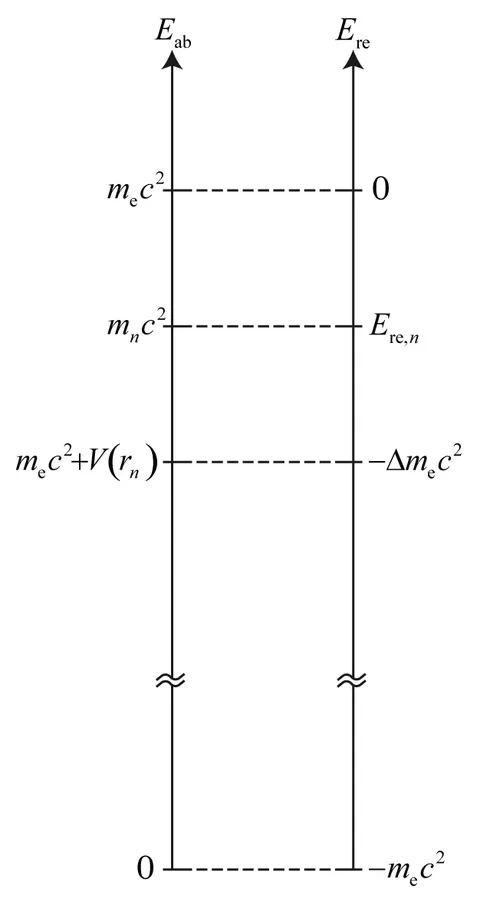
However, the energy of an electron placed at an infinitely distant position is not originally zero, it is (however, the potential energy is zero in this case too). Energy in its original sense should be described with an absolute scale. In classical quantum theory, the potential energy of an electron at an infinite distance and the energy of the hydrogen atom are both regarded as zero. However, that idea is mistaken. There is a problem with classical quantum theory which describes the energy levels of a hydrogen atom in relative terms, ignoring the special theory of relativity (STR).
This completes preparations for deriving an energy-momentum relationship applicable to an bound electron in a hydrogen atom.
The author has already derived an energy-momentum relationship applicable to the electron in a hydrogen atom using five types of methods [3, 4, 5, 6, 7, 8]. One of those is reviewed in Section~2.
2. Energy-momentum relationship applicable to an electron in a hydrogen atom
According to the STR, the following relation holds between the energy and momentum of a body moving in free space [9].
Here, is the rest mass energy of the body. And is the relativistic energy.
Incidentally, Einstein and Sommerfeld defined the relativistic kinetic energy as follows [10].
The “re” subscript of stands for “relativistic.”
Taking Formula (17) into account, Formula (16) can be rewritten as follows.
From this, the following formula for relativistic kinetic energy can be derived.
Here, the subscript “re” is attached to , just as in .
Incidentally, Einstein’s energy-momentum relationship (16) holds when the energy absorbed by a body is all converted to kinetic energy of that body. However, an electron in an atom acquires kinetic energy through emission of energy. Therefore, Einstein’s relationship (16) cannot be applied to an electron in an atom.
Here, the relativistic kinetic energy of an electron inside a hydrogen atom is defined as follows by referring to Formulas (17) and (19).
Here, is the relativistic momentum of the electron. (Due to the situation in this paper, is rewritten here as .)
The term “relativistic” as used in this paper is not based on the STR. It means that the fact that the mass of the electron changes due to the electron’s motion is taken into account. It must be noted that the mass of the electron decreases when the velocity of the electron inside the atom increases [11].
Linking the right sides of Formulas (20) and (21) with an equals sign and rearranging, the following relationship can be derived.
The following formula can be derived from Formula (22).
To change Formula (23) into a formula of quantum theory, the discreteness of energy must be incorporated into Formula (23).
Previously, the author has shown that the following relationship holds for an electron in a hydrogen atom [12, 13].
Here, is the following fine-structure constant.
is a dimensionless constant introduced by A. Sommerfeld in 1916.
Using the relationship in Formula (24), Formula (23) can be written as follows.
Taking Formula (26) into account, in Formula (15) can be written as follows.
Formula (27) gives the energy levels of a hydrogen atom, taking relativity into account (see Fig. 2).
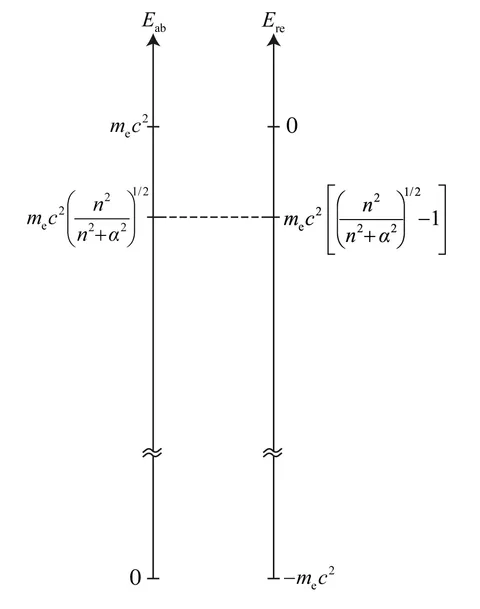
Formula (27) predicts the existence of a state with [14].
Next, when the part of Formula (27) in parentheses is expressed as a Taylor expansion,
Incidentally, the nonrelativistic energy levels of a hydrogen atom, derived by Bohr, are given by the following formula.
However, when discussing the energy levels of a hydrogen atom, it is best if the rest mass energy of the electron is included in the formula. Thus Formula (29) is rewritten as follows.
From this, it is evident that Formula (29) is an approximation of Formula (27).
Next, Table 1 summarizes the energies of a hydrogen atom obtained from Formulas (27) and (29) (see Table 1).
Table 1: Comparison of the energies of a hydrogen atom predicted by Bohr’s classical quantum theory and this paper
| n | Bohr’s Energy Levels, | This Paper, |
|---|---|---|
| 0 | — | -0.511 MeV |
| 1 | -13.6057 eV | -13.6052 eV |
| 2 | -3.4014 eV | -3.4014 eV |
| 3 | -1.51174 eV | -1.51174 eV |
Now, in preparation for the discussion in Section 3, let us rewrite Formula (22) as a relationship for momentum. To do that, it is enough to divide both sides of Formula (22) by . That is,
3. Physical quantities of electrons revealed by considering an ellipse
Formula (31) can be derived through considerations using an ellipse. This problem has already been discussed [7, 8].
However, at that time, the electron’s energy was discussed using an ellipse. In this paper, the momentum of an electron is discussed using an ellipse. By nature, energy is a scalar, but momentum is a vector. In discussion using an ellipse, it is thought better to focus on momentum than energy.
Let A and A’ be the points where the ellipse intersects the x-axis, and let B and B’ be the points where the ellipse intersects the y-axis. Also, let be the length of the line segment , be the length of the line segment , and be the length of the line segment (see Fig. 3).
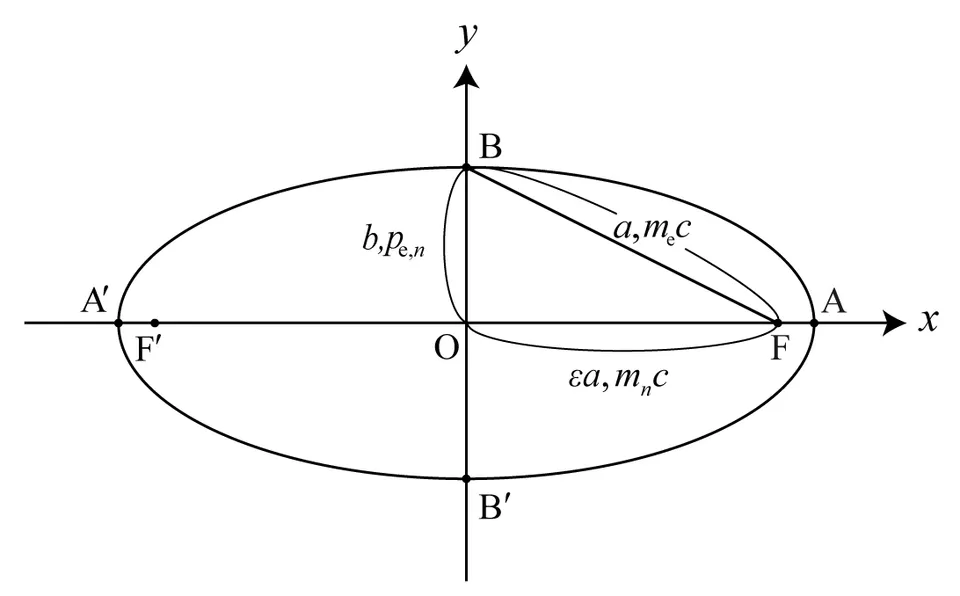
The reason why discussion using an ellipse is valid is likely because the momentum vector of the electron is orthogonal to the momentum vector of the photon possessed by the electron.
The eccentricity of the ellipse in this case is defined as follows.
The eccentricity of the ellipse can also be expressed using the following formula.
The following formula can be derived from Formula (33).
Here, the line segment is placed into correspondence with the momentum .
Let us express this as follows.
Also, it is assumed that the shape of an ellipse that can describe the state of an electron is the case satisfying the following conditions.
Taking Formulas (35) and (36) into account, can be expressed with the following formula.
Also, if Formula (35) and Formula (36) are taken into account, then the in Formula (32) is as follows.
Using Formulas (37) and (38),
Here, , so the following relationship holds.
Here, if Formula (26) is also taken into consideration, then Formula (37) can be expressed as follows.
Furthermore, if the relationship in Formula (24) is used for in Formula (41), the result is as follows.
Substituting this result for Formula (42) into Formula (39),
When is taken to correspond to the line segment , and Formula (36) is assumed, then Formula (31) can be derived from the right triangle OBF.
The purpose of the considerations using an ellipse in this section was to show that Formula (31) can be derived using multiple methods.
In past discussions, the ellipse line segment was taken to correspond to energy (a scalar), but in this paper the line segment was taken to correspond to momentum (a vector). The discussion in this paper is not a repetition of that past discussion.
4. Discussion
It is known that the momentum and wavelength of an electron have the following relation.
Here, if the momentum of the photon possessed by an electron in a state with principal quantum number is , and the momentum of a moving electron is , then these two types of momentum can be expressed as follows.
Here, is the wavelength of a photon whose momentum is , and is the wavelength of an electron whose momentum is .
From the above it can be predicted that a moving electron has two types of waves.
Also, the following formula can be obtained from the definition of the Planck constant [15].
Here, is the Compton wavelength of the electron.
The following relationship can be derived by substituting the three types of momentum in Formulas (45) to (47) into Formula (31) and rearranging [16].
Formula (48) holds because Formula (22) holds.
The three wavelengths in Formula (48) can be put into correspondence with the line segments of the ellipse in Figure 3 (see Fig. 4).
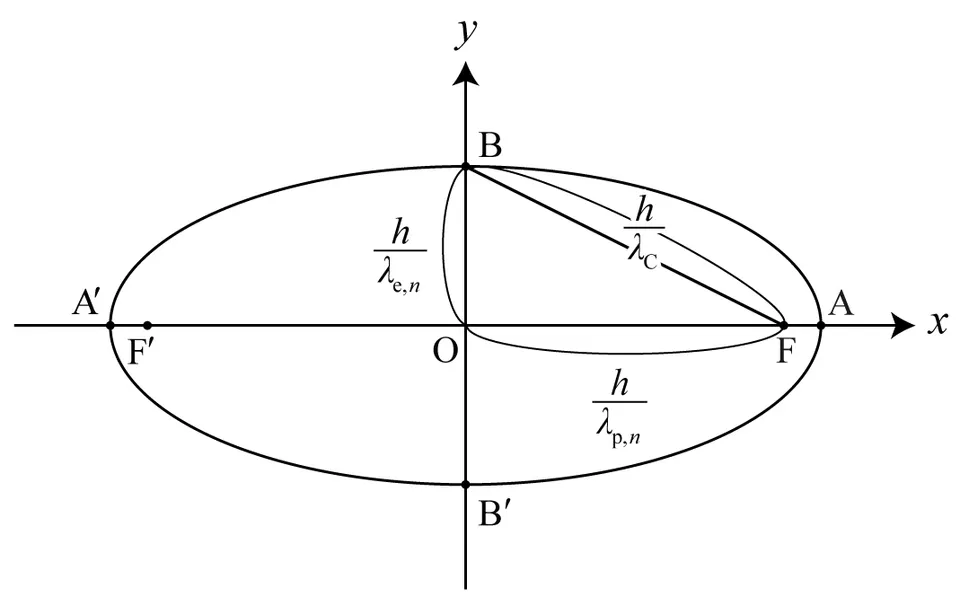
From Figure 4, it is evident that the following two relationships hold [17].
The following relationship can be derived from Formula (49) and Formula (50).
The physically permitted ellipses are limited only to those that satisfy the following condition.
In the case where ,
This paper concludes that Formula (24) holds because Formula (52) holds. Thus the quantum condition is Formula (52) not Formula (24).
The fine structure constant has previously been understood as the ratio of the velocity of an electron, as the particle in the ground state of a hydrogen atom, and the speed of light. However, it was not understood why the ratio of the two is so important for physics.
However, if the electron is considered as a wave, the fine structure constant can be understood as the ratio of the wavelength of light possessed by an electron in the ground state and the wavelength of a moving electron [18].
In the micro world, it is thought that treatment of wavelengths of electrons as waves is preferable to treatment of velocities of electrons as particles. It has already been known that , but this paper has promoted Formula (52) to a quantum condition.
This paper predicts that the momentum vector attributable to the electron’s motion is orthogonal to the momentum vector of the photon possessed by the electron.
5. Conclusion
The author previously derived Formula (22), a relationship applicable to the electron in a hydrogen atom, in place of Einstein’s energy-momentum relationship. Formula (22) also serves as a momentum relationship like the following.
Next, by applying de Broglie’s formula, the three types of momentum in Formula (55) can be written as follows.
Then the following relationship can be derived by substituting these momenta into Formula (55).
It has been well-known for more than a century that electrons, which were thought to be particles, also have a wave nature. However, this paper concludes, while also taking into account Figure 4, that the waves involved with the electrons in hydrogen atoms actually have two types rather than one type.
The relationship in Formula (59) holds between the wavelengths and of the two waves possessed by the electron. Assuming that these two waves exist independently, it can be predicted that the two are orthogonal.
Acknowledgements
I would like to express my thanks to the staff at ACN Translation Services for their translation assistance. Also, I wish to express my gratitude to Mr. H. Shimada for drawing figures.