I. INTRODUCTION: THE OFFICIAL HUNGARIAN POSITION REGARDING THE RUSSIAN MILITARY AGGRESSION AGAINST UKRAINE
The official Hungarian position regarding the Russian military aggression against Ukraine, which was launched on 24 February 2022 as a special military operation, can be summarized as follows: Russia essentially wants to prevent Ukraine from joining the Western world, to which we belong. As there are one and a half hundred thousand Hungarians living in
Ukraine, it is in the fundamental Hungarian national interest that Ukraine succeeds in its endeavor. We are therefore committed to getting Ukraine's EU accession process underway as soon as possible. So Russia's attempt to conquer Ukraine is an attack on Hungarian interests.
Nevertheless, Hungary's support for Ukraine is controversial. The official Hungarian position is that the Russian-Ukrainian war is "not our war". Hungary is not a belligerent party and does not intend to become one: it does not send troops, does not supply arms, and does not allow foreign arms shipments to pass through its territory. However, we support the EU's efforts, including EU arms supplies to Ukraine, the humanitarian aid program, and the wide range of economic and political sanctions against Russia. The only thing we cannot support is the complete severing of energy ties because this is a measure that would be more damaging to us than to Russia. However, we are not opposed to any EU Member State that can do so by cutting off its energy relations with Russia, even completely.
According to official Hungarian policy, it is not in our interest to get involved in this war, but it is in our interest that the war should end as soon as possible and that it should end without the Russian side achieving the objectives for which it started the war.
This approach is interpreted by the official Hungarian policy as Hungary's support for peace and the early start of peace negotiations, while the other states that are effectively supporting Ukraine militarily prefer the continuation of the war. The Hungarian official position ignores the fact that a negotiated settlement is conditional on the possibility of compromise between the parties. But Russia - after the failed peace talks in Brest and Istanbul (23, 8) and the accession of the occupied territories to the Federation - cannot, and Ukraine - still confident of regaining the lost territories - does not want to make any compromises.
Unfortunately, the position of the collective West is as contradictory as the official Hungarian position. While the states that militarily support Ukraine now agree that there is no military solution to the conflict, military support for Ukraine is only increasing. Of the two contradictory positions, the Hungarian position is the more acceptable to the ordinary Hungarian citizen.
There are many stereotypes circulating in the Hungarian press and social media, including that the Ukrainian aspirations are the product of some kind of anti-Russian US/NATO conspiracy. These publicists should not be taken as the position of the Hungarian government or parliament. According to the Hungarian Parliament's resolution, we cannot accept any narrative that would antagonize Hungarian public opinion against NATO. (1)
Unfortunately, the parliamentary resolution is contradicted by the statements of the Speaker of the Parliament himself. László Kővér believes that the real reason for the war in Ukraine, which Pope Francis called provoked, is not the Donbas region, nor the general tension and confrontation between Ukraine and Russia, but the American strategy of keeping the US in Europe, excluding Russia from Europe and "pushing Germany down" by preventing it from taking the lead in Europe. (22) In evaluating this statement, it should be noted that although the Speaker of the Parliament is the head of the supreme legislative body, he is not a policymaker in Hungary.
Despite the fact that the Hungarian ruling party (FIDESZ), which used to promote "opening to the East" and did a lot of business with Russia, and Prime Minister Viktor Orbán, who regularly met with Putin, won another two-thirds victory on 3 April 2022, this does not mean that the majority of Hungarians have sided with the Russian aggressor or support the maintenance of friendly relations with Russia. According to a survey by Závecz Research conducted between 20-23 May 2022, only of the population think it is a good policy to be friends with Russia. Even the ruling party camp is not unanimously pro-Russian, with only in favor of friendly relations with Russia. (19)
It is less accepted that portraying these military interventions merely as a struggle between "good" and "bad" is nothing more than a distorted simplification of real facts and contexts for one's own interests.
The aim of my analysis is to present, characterize and compare the prevailing views in Hungarian public opinion, as expressed in social media and the press without any distorted simplification, and to draw some conclusions that I consider acceptable.
In connection with the Russian military aggression against Ukraine, launched on 24 February 2022 as a special military operation, the following well-distinguished approaches have appeared in the Hungarian media and community platforms In addition to the aforementioned official position of the Hungarian Government:
The reason for the Russia-Ukraine war is Russia's strategy, rooted in its imperial past, that economic and military power derives from the size of the country, and therefore Russia must seize every means to expand.
According to this approach, both the Soviet and Russian political leadership followed the logic of Tsarist Russian great power, according to which economic and military power derives from the size of the country, and therefore all means must be used to expand. For Soviet-Russian politicians, except Gorbachev, people are just numbers and puppets for the ultimate goal of Russia's territorial expansion, while stressing that the human being is the greatest value.
What the more sane part of the world today calls genocide in Ukraine is a logical step in such an approach, because it is necessary to expel Ukrainians from their homes so that the Russians can manipulate the ethnic composition of the occupied Ukraine territories and the fake referendums there, that will legitimize the Russian annexation. So you can understand why the Baltic countries are worried and why Finland and Sweden wanted to join NATO.
Indeed, historical experience tells us that possible Russian aggression is not a mere fantasy, but a very real possibility. And it is not NATO that is expanding eastwards, but the Russians who are pushing their neighbors into NATO and the EU.
It would be very important for Ukraine to successfully defend itself and, as a consequence, for the Russians to remove from power President Putin, whose misguided policies have caused enormous bloodshed among the Ukrainian and Russian people and enormous economic damage to his country and the world. As for the eventual restoration of Ukraine, the bill for the cost of that restoration should be met from the Russian assets that have been frozen.
The Russian leadership does not realize that the time spent on the war is working against it, because Ukraine will use this time to create the conditions for the war to continue successfully, while the Russian people can understand what is really happening in Ukraine.
Although NATO member states are careful not to give the Russians a reason to use weapons of mass destruction, the escalation of war is inevitable, as the protection of foreign arms supplies and the enhancement of the combat capabilities of Ukrainian forces require decisive NATO actions.
This approach is popular among those who forget about the remarkable historical fact, that in the heyday of the Russian Empire, the Empire included the Baltic States, Ukraine, Belarus, most of Poland (Kingdom of Poland), Bessarabia, the Caucasus states, Finland, the territories beyond the Caucasus, Kazakhstan, Central Asia, Siberia, Alaska. Today, the Russian Federation has only Siberia left. The end result of Russia's supposedly permanent territorial acquisition efforts was an unprecedented loss of territory.
It is also highly questionable that "the Russians are pushing their neighbors into NATO." For two decades, the efforts of post-Yeltsin Russia have been aimed at curbing organized crime, reining in wild capitalism, eliminating separatist tendencies, and creating a functioning market economy and a developing economy with adequate social safety net. At the time when the first waves of NATO enlargement were taking place, Russia was preoccupied with itself, posing no external threat to any state.
The Russian-Ukrainian war - the reappearance and manifestation of Russian great power ambitions.
The essence of this approach can be summarized as follows: According to Carl von Clausewitz, the 19th-century Prussian military theorist, war is the continuation of politics by other means. In the context of the unexpected outbreak of the Russo-Ukrainian war on 24 February 2022, it is particularly pertinent to ask what motivated Moscow to take this risky step of pursuing its policy by other means.
For a proper response, we should return to the disintegration of the Soviet empire. The dissolution of the Soviet Union in December 1991 redrawn the balance of power. The states of Central and Eastern Europe, which once belonged to the Soviet sphere, were transferred to the Western sphere without exception, and the former Soviet member republics became independent states. The collapse of the Soviet empire caused an extremely serious economic-political and even moral crisis in the successor state, the Russian Federation. Despite the fact that the United States and Western Europe were the absolute victors in the Cold War, the leaders of these countries, at least between 1989 and 1991, approached the serious security issues arising in the new situation with an absolutely realistic mindset. US President George Bush Sr. and German Chancellor Helmut Kohl, as well as British Prime Minister Margaret Thatcher, French President François Mitterrand, and NATO Secretary-General Manfred Wörner, all assured the last Soviet leader, Mikhail Gorbachev, that the release of the Central European countries from the Russian sphere of interest would not be used to expand NATO's influence in the East and that Russian security interests would be respected. However, the means to achieve this were never set out in a binding international treaty.
During Boris Yeltsin's presidency in the 1990s, the post-Soviet crisis rocked Russia, the national economy and military collapsed, and the emerging, highly corrupt Russian 'oligarch-capitalism' fundamentally weakened the former superpower. Despite the promises of Western leaders, the United States, the only remaining superpower on the world political stage, sought to use the new situation on the ruins of the Soviet Union to further increase the US and Western European influence in the world (China had just begun its 'long march' in the early 1990s).
U.S. foreign policy has been trying to bring Ukraine into its sphere of interest since the 1990s. Zbigniew Brzezinski, a former chief national security adviser to President Jimmy Carter, the "Gray Eminence" of American Political Life in his 1997 study "The Great Chessboard," made it clear that "Ukraine, a new and important space on the Eurasian chessboard, is a geopolitical pivot because its very existence as an independent country helps to transform Russia. Without Ukraine, Russia ceases to be a Eurasian empire... However, if Moscow regains control over Ukraine, with its 52 million people and major resources as well as its access to the Black Sea, Russia automatically again regains the wherewithal to become a powerful imperial state, spanning Europe and Asia." (13) On this basis, he pointed out that it is in America's important medium-term strategic interest to separate Ukraine from Russia because, without Ukraine, the Russian Federation will never again be a Eurasian power. Ukraine's importance stems not from its strength but from its privileged position and internal weakness, which allows key geostrategic actors to influence the country. He also stated that gaining US influence over Ukraine is also key to preventing Russia and Western Europe from becoming too close. Brzezinski said the greatest potential threat would be a rapprochement between Germany and Russia because the combination of Russian raw material resources and German technology would create a center of power that would threaten America's global interests. (3)
The election of Vladimir Putin as President of the Federation on 7 May 2000 marked a turning point in the transformation of the adaptive and defensive foreign policy strategy of the Yeltsin era. Breaking with the Yeltsin decade, Putin has returned to the great-power approach of traditional Russian foreign policy thinking and the highly centralized exercise of power that, according to Richard Pipes, a Harvard historian and Russia expert, has always characterized Moscow. (14) As head of state, Putin has severely broken the power of pro-Western oligarchs and brought the country's strategic raw material treasures under state control. He took serious steps to strengthen and
develop the army. During his presidency, Russia once again fought back into the rank of military superpower. It also laid the foundations for the reassertion of traditional Russian imperial ambitions. The war in Dagestan, the second Chechen war, and then the Russo-Georgian war of 2008 were demonstrative and effective steps in the internal consolidation of the Russian Federation.
In 2008, there were several events that had an impact on Russia's security policy: - Kosovo declared independence and seceded from Serbia with strong US support, - South Ossetia and Abkhazia, predominantly Russian-populated territories, declared their independence and secede from Georgia with Russian support, - Georgia was granted NATO candidate status in April 2008.
As far as Russia's security policy is concerned, Russia has, since 1991, considered the neutrality of the two former Soviet republics, Belarus and Ukraine, directly bordering the NATO area, to be a vital security interest. In Belarus, Alexander Lukashenko's regime is in line with Moscow's vision of neutrality, and between 1991 and 2014, Ukraine was also dominated by governments that took into account Moscow's security policy needs.
The "revolution" that began in Ukraine on November 21, 2013, and resulted in a regime change in February 2014, commonly known as Maidan, did not bring any qualitative new inputs to Ukraine's social development.
The new pro-Western and anti-Russian Ukrainian regime, which resulted from the coup that overthrew Moscow-friendly President Viktor Yanukovych, did not overcome economic hardship and oligarchic capitalism very similar to Russia's, and hopes of swiftly joining the European Union also quickly disappeared.
The different governments in power since 2014 have not been able to solve the country's very significant problem, the issue of nearly eight million Ukrainian citizens of Russian nationality; on the one hand, they did not stop the anti-Russian actions of the strongly extremist Ukrainian nationalist groups, and on the other hand, they themselves were vigorously opposed to the autonomy aspirations of the Donetsk region inhabited by the Russian majority. Moscow's response to the Kyiv turnaround in 2014 was the annexation of the Crimean Peninsula to the Kosovo model and support for the separatist movements in Donetsk, which took the escalation of Russian-Ukrainian differences to a new level. Russia has essentially come to the same conclusion as Brzezinski.
Ukraine's potential membership of NATO (which America tried to force and which was understandably opposed by then French President Nicolas Sarkozy and then German Chancellor Angela Merkel) and the post 2014 Ukrainian government's policy of pushing for Western integration and deepening military cooperation with the United States excluded Ukraine's neutrality and undermined Russia's interests as a great power.
Already on 10 February 2007, Vladimir Putin stated in his speech at the Munich Security Conference in Germany that the US military presence along Russia's borders is contrary to the security interests of the Russian Federation. Putin criticized the monopolistic dominance and use of force by the United States in global relations. The result of such dominance, he said, is that no one feels safe. Because no one feels that international law is like a wall protecting them. (15)
The 2019 Ukrainian constitutional amendment, which declared the need for the country's membership in NATO at the constitutional level, was already too much for Moscow. The final step in the process leading to armed conflict was the rejection of Moscow's unacceptable security demands by the Biden administration. Although no one expected Russian intervention against Ukraine, it was one of the possible options in the process outlined above. (3)
Conclusions, comments
It is not surprising that Russia, which has once again become a great power, after having exhausted peaceful methods and options, is trying to impose by violent means (war) its security policy principles that are unacceptable to the West, namely the protection of the Russian minority abroad, the demand for the neutrality of the former Soviet republics neighboring Russia and the halting of NATO enlargement. It is also not surprising that the United States, together with its allies, is trying to prevent this, since it has a fundamental security interest in rejecting Russian security claims, in order to prevent Russia from becoming a superpower and to avoid endangering the hegemonic role of the United States in world politics. What is surprising is that none of the interested parties in the Russian-Ukrainian war (Russia, Ukraine, USA, EU, NATO) did essentially nothing to prevent the war.
It seems to me that with the certainty of victory, all the parties involved were anxiously awaiting the Russo - Ukrainian war, waiting for Russia's ambitions as a great power to reappear and manifest. Therefore, an approach that identifies the ultimate cause of the war as a revival of Russian great power ambitions is ultimately acceptable. However, it should be noted: - NATO's expansion towards Russia was a clear signal that the Alliance did not trust Moscow, that the Alliance considered Moscow a likely enemy. It is an obvious principle to strengthen defense capabilities in the direction from which the military threat comes. - However, this is not a problem in itself, as the Alliance is a defense alliance, and any country that agrees with the Alliance's objectives (including its enemy image) and meets the conditions for membership can join NATO. In simple terms, for a post-Soviet state this means that if you are a neighbor of Russia, but want to open up to the
West in the future and feel that you will be exposed to Russian threats because you do not respect Russia's basic security policy needs, you can reasonably apply to join the alliance to increase the security of your country if you agree with the objectives (for example, Ukraine, Georgia) and meet the membership requirements. - But even the NATO enemy image is not a problem, since the United States, as the leading force of NATO, and the Russian Federation - despite the spectacular and successful rapprochement of the two countries during the Gorbachev era - have always considered each other enemies. - The emphasis on NATO's defensive nature seems credible and acceptable to most European states, except Russia. Perhaps it would also be credible for Russia if the enlargement of the alliance were not accompanied by significant NATO infrastructure building and the deployment of non-explicitly defensive weaponry on the territory of the newly acceded states.
It is probably a statement that many will not like, but it has to be said: the different interpretations of NATO enlargement and the principle of indivisible security (no one can increase his security at the expense of the security of the other), as well as the lack of compromise and dialogue between the United States and the Russian Federation, have contributed significantly to the Russian military aggression in Ukraine.
Regarding Zbigniew Brzezinski's study, "The Great Chessboard", it should be noted that it is not specifically a study, but rather Brzezinski's personal political creed, which has never become an openly declared strategy for any US administration.
The Russian-Ukrainian war is ultimately an indirect manifestation of the US struggle for scarce resources and new markets. The US wants to fulfill its cherished dream of supplying Europe with shale gas. But to do so, the US needed this war to impose sanctions against Russia and break Europe's energy dependence on the Russians.
Proponents of this approach argue that the United States, as a single superpower, has in recent decades sharply declined in its policy of influence and intervention to defend democracy, known as the export of democracy, which has generally resulted in the acquisition of new resources and markets by exploiting its global hegemony.
Since the 1990s, the Middle East and Central Asia have played a key role in U.S. policy of intervention and influence because of mineral resources, primarily oil. The occupation of Iraq and Afghanistan after 9/11 was almost automatic, but the pacification of the region failed. Attempts by the United States to intervene and influence North African states (e.g. Libya) have had similar results. In the end, it had to be seen that U.S. "democracy exports" had failed in Islamic states. Deeply religious Arab and Afghan societies could not accommodate democratic values. Things turned out much worse than in Vietnam, where the necessities of the Western way of life were accepted, at least in the southern part.
After the Arab Spring in North Africa and the failure in Afghanistan, the rest of Africa became the focus of attention, where the growing Chinese influence and the still present French interests hindered American ambitions.
The Central American region has not proved a worthwhile venture either: it is not solvent enough and its mineral resources are increasingly difficult to access.
The United States needed a region, a solvent market, where it could still assert its influence, its "world leadership," and where there was hope for a successful "democracy export". This region became Europe, where there was no need to fear riots or acts of terrorism against the United States.
So Europe is the perfect platform for the United States to pursue its economic ambitions, namely to expand its economic influence in Europe, but there is a big problem, the energy dependence of most European countries on Russia. The main aim of US strategists is to break this dependence. To do this, however, they needed Ukraine, where the export of democracy has been successfully launched because Ukrainians have a high level of confidence in the EU, NATO, and the United States.
In the case of Ukraine, it should be noted that the Ukrainian population of 52 million in 1991 has shrunk to around 40 million today due to foreign employment. (Refugees from the Russian-Ukrainian war have reduced this figure by a further 6-7 million.) Social conditions in the country have hardly improved since independence, and corruption is one of the highest in Europe. Ukraine has seen the cause of the negative internal political, social, and economic phenomena in its relations with Russia, which is why it has destroyed these relations, why it has become extremely anti-Russian and why it wants to belong to the EU and NATO, despite the fact that this logic has not been proven.
The Western, mostly American intervention in state affairs, did not help Ukraine to step on the path of development. Only IMF loans saved the country from state bankruptcy.
Ukraine has not found itself in such a vulnerable, indebted situation even in the period of close relations with Russia. Unfortunately, the young Ukrainian state's own problems of self-organization led to an extremely weak state governance performance, which the United States in particular wanted and was able to take advantage of.
The political situation was complicated by the anti-minority actions of the post-Maidan Ukrainian governments, tacitly supported by the West (the language law), and their consequences: the atrocities of
Ukrainian semi-fascist extremists in Odesa, the eight-year civil war with the Russian inhabited separatist Donetsk and Luhansk, the Ukrainian sabotage of the implementation of the Minsk agreement to end the civil war, and the Russian response - the annexation of Crimea.
Washington certainly wanted to provoke a war, because this allows it to "rightly" launch worldwide anti-Russian propaganda, escalate sanctions against Moscow to the extreme, and acquire the European energy market through unprecedented sanctions and a united EU and NATO support. (4) Russia will be cut off from Europe, and the US realizes its cherished dream of having Europe supplied with shale gas by the United States. True, at a much higher price than Russian gas costs, but the Washington administration doesn't care. The bigger problem is that neither do EU bureaucrats. (5)
Conclusions, comments
The basic idea behind this approach is that the diversification of the EU's energy supply, i.e. the elimination of Russian energy dependence, creates the opportunity for the United States to acquire the European energy market, to supply the European energy market with US shale gas, is not entirely correct.
The truth is closer to the fact that it is very difficult to get rid of dependence on Russian gas: - American shale gas would not even be able to replace Hungary's annual gas consumption, let alone Germany's; - Qatari gas production has been tied up for years by India and China, and Norwegian gas production is already operating at full capacity; - the exploitation of the Middle East gas fields has been made impossible by the West with the wars in Iraq and Syria.
Despite all this, it seems that the majority of EU Member States were managing to get rid of the Russian gas with huge, unreasonable, unplanned financial expenditures that unfortunately slow down economic development and reduce living standards.
In relation to other elements of the approach, I think it is important to highlight the following: - It is difficult not to see the phenomenon that Ukraine, like many other Soviet successor states, finds the ultimate explanation for negative internal political, social, and economic phenomena in its relationship with Russia, which is why it destroys them, why it becomes anti-Russian, why it welcomes US support and why it wants to belong to the EU and NATO. This phenomenon has undoubtedly contributed to Russia's violent actions. - The specific anti-Russian actions of Ukrainian domestic policy after the Maidan revolution, such as the adoption of the Language Law and later the Law on the Indigenous Peoples of Ukraine, the support for the violent actions of Ukrainian extremists against the Russian minority, the termination of the Minsk agreement that ended the civil war against the separatists in Donetsk and Luhansk, are another trigger for the Russian attack. - Russia's response, the annexation of Crimea, the creation and later recognition of separatist republics, is a serious violation of Ukraine's territorial integrity and sovereignty by a country that, along with other major powers, gave Ukraine security guarantees in the Budapest Treaty in exchange for renouncing nuclear weapons. At the same time, the assumption that without the annexation of Crimea, there would already be US military bases on the peninsula is debatable, but not entirely unfounded.
The United States has unquestionably gained a great deal of political, economic, and military influence in Ukraine. However, it has used its influence not only to promote Ukraine's democratic development but also to advance US economic, political, and security interests. The American promotion of the development of the Ukrainian armed forces and the Ukrainian sabotage of the Minsk agreement led to the conclusion that Ukraine was preparing to take military action against Donetsk and Luhansk to restore its territorial integrity by force, which required a military counter-measure on the part of Russia.
Those who accept the approach described here believe that the often unfounded Russia-phobia of the United States in all areas, the thirty years of disregard for Russian security needs, the subordinate role of NATO and the EU vis-à-vis the United States, the "Russia is responsible for everything" phenomenon as the sole explanation for development problems in post-Soviet countries, anti-minority Ukrainian domestic policy and effective US military support to Ukraine (obviously for Ukrainian military action against the Russians inhabited separatist territories), were the factors that successfully provoked a bad Russian political decision - the Russian military aggression against Ukraine. This approach is supported by the fact that the only beneficiary of the Russian - Ukrainian war is the United States: Russia's political-economic - military importance is declining as much as the European Union's role in world economy and politics, and so American hegemony is only growing stronger.
The increase in non-dollar purchases of oil and gas by China and India from Russia, could threaten US financial hegemony. The US is forced to reassert its power against China and Russia, first by bringing the weaker Russia to its knees. Because of the mutual nuclear threat, the indirect war between the two powers is taking place in a buffer zone, currently Ukraine.
This narrative can be summarized as follows: Three superpowers are currently competing: the US, China, and Russia. China's economic performance poses a threat to US hegemony, as its economic predominance, especially in the oil trade, allows it to push for non-dollar settlements, which undermines the
U.S. dollar without gold backing. The value of some USD 30 trillion realized in the oil trade is due to the fact that, at the request of the US, Middle Eastern oil-producing countries can sell oil only for dollars. This ensures the value of the dollar, even without gold backing. Anyone breaking this selling rule is exposed to war by the US (e.g. Iraq).
However, China has agreed with Saudi Arabia to buy oil for yuan instead of dollars. India, on the other hand, buys Russian oil for roubles in multi-billion batches. Buying in other currencies is likely to spread rapidly in world trade, leading to the deterioration of the dollar and potentially destroying the entire US economy. In this situation, the United States can do one thing: restore power over the Chinese-Russian adversary group, forcing the weaker Russia to its knees. The US can achieve this with sanctions and war.
As the American and Russian sides avoid the direct military struggle with each other due to the mutual nuclear threat, the so-called war between the two great powers happens in a buffer zone. This is currently Ukraine. The war in Ukraine is, in fact, a clash between Russia and the United States.
Whoever was in control of Russia, the war would have started just the same, because no great power can tolerate the deployment of hostile military potential in the buffer zone. The US did not tolerate it (the Cuban missile crisis of 1962) and would not tolerate it today. The current President, Joe Biden said as early as 1997 that the only thing that could provoke a "vigorous and hostile" Russian response would be NATO expansion, i.e. the creation of a Western military presence in the buffer zone. (16)
The United States was fully aware that military action would be Russia's only possible response, and with this, in mind, it continued its "provocation" in Ukraine (supplying weapons, installing chemical laboratories, helping to bring to power a pro-western Ukrainian government, providing all possible support to this government that was unwilling to act against anti-Russian semi-fascist extremists). In addition, the US withdrew its forces committed abroad (sudden withdrawal from Afghanistan) in order to concentrate its military forces on confronting Russia if necessary.
The United States (and the European Union under its influence) is always seeking a war in a buffer zone to weaken Russia's economy and military potential. If this is achieved, there is little chance of the war spreading to the West. Further deepening the military confrontation will weaken Russia, so it is in the West's interest. If Ukraine's military potential collapses or Ukraine makes peace with Russia, a new buffer zone will certainly be needed where the Russian-American confrontation can continue (for example Armenia with French and EU assistance).
During the Russian - Ukrainian war the sanctions of Collective West have restricted Russia's access to the euro and the dollar. Moscow has accordingly encouraged its partners to switch to national currencies. However, apart from Russia, there is no evidence that the use of the dollar in the countries' foreign trade invoicing has declined significantly. Even among countries with close trade links with China, the use of the yuan is very limited.
The use of the dollar is also stable in global financial markets (40-50% of SWIFT payments are made in dollars, and the dollar is the main currency in 89% of foreign exchange buying and selling transactions). According to Oxford Economics, the dollar is likely to remain dominant until the yuan becomes a freely convertible currency. Until then, most countries - with the exception of a few that have limited barter trade with China - are not interested in accumulating large yuan balances. (7)
The explanation, saying that the United States and Russia avoid a direct military confrontation with each other because of their mutual nuclear threat, so war is fought in the so-called buffer zone in the post-Soviet states neighboring Russia, and the United States and the European Union under its influence, therefore, aim to encourage permanent wars in the so-called Russian "near abroad" to weaken the Russian economy and military potential, seems logical but not acceptable.
The United States has understandably always tried to intervene in the buffer zone, in the post-Soviet states neighboring the Russian Federation (Belarus, Ukraine, Georgia, Azerbaijan, Armenia, Kazakhstan) or in the territory of the Russian Federation (in Chechnya, Dagestan) in order to encourage wars or civil wars and to shape their outcome, but it "created" actual wars to weaken Russia only in Georgia and Ukraine. However, the Georgian involvement cannot be called successful, since it is Georgia, not Russia, that has been weakened. In addition, Georgia has lost South Ossetia, a region that is about to join the Russian Federation.
The constant US - Russian confrontation in the buffer zone does exist, as the United States has always supported the opposing side to Russia, but to say that this is a manifestation of continuous and ongoing war between the two powers is an exaggeration. To put it simply, the U.S. encouragement of "color revolutions" for democracy should not be confused with the U.S. encouragement and support for a war that results in the economic and military weakening of Russia. The latter is exemplified only in Ukraine today. Thus, the Russo-Ukrainian war is not a typical but a unique phenomenon of the great power confrontation in the buffer zone.
As for current US President Joe Biden's statement in 1997 that the only thing that would provoke a "strong and hostile" Russian response would be NATO enlargement, the quote is not entirely accurate. In that statement, Joe Biden merely warned that the accession of the Baltic States, namely Estonia, Latvia, and Lithuania, to NATO could result in hostile behavior from Russia. However, he stressed that he did not mean military retaliation. (17)
The Russo-American conflict in relation to the Russian-Ukrainian war is based on Moscow's intention to restore its former empire, while the US's interest in the opposite. Washington set itself three goals: to defend an independent and liberal Ukraine, to weaken and isolate Russia, and to build a strong, united, and determined West. The war will continue until Russia is defeated and punished.
This approach can be summarized as follows: Russia's defeat in the war against Ukraine is inevitable, because: - The country's rise under Putin is only apparent, and the Russian Federation remains underdeveloped, which has a negative impact on the Russian army and its combat value. The achievements in the field of arms development should not be overestimated; - The size of the Russian military-industrial complex and the financing of the army are not in line with the country's alleged status as a military superpower, and Russia is, therefore, unable to provide the backdrop for a high-tech war costing hundreds of millions of dollars a day. - Russia's military potential, which stands above Ukraine, has been offset by the persistent resistance of the Ukrainians and massive Western aid. This was also possible because there is a significant difference in development between the Russian and Western weapons systems, and the Russians are also far behind their Western rivals in military planning and fighting style. - The passivity with which Russia is waging its hybrid war against Ukraine is incomprehensible. The inaction in the military, economic, political, and diplomatic fields, as well as in public opinion persuasion, propaganda, intelligence, and information warfare, is clearly visible, and it is only a matter of time when Russia is defeated by Ukraine. - Moscow is trying to end the war as quickly as possible to keep what it has gained, but it will not succeed because the Russian Federation has lost its strategic superiority and its initiative. - Ukraine as a political community has been strongly divided. One-half of the country preferred close ties with the West, while the other half preferred close ties with Russia. However, this changed after the Russian annexation of Crimea: the Western camp began to gain strength, and the current war has created a completely new situation, with the country organized into an Anti - Moscow entity, which can only lead to the conclusion that Russia has lost Ukraine completely and permanently.
Russia is left without a strong ally. Its only influential ally, China, does not wish to enter into a close political and military alliance with Russia, as it has long considered Russian foreign policy too noisy and unnecessarily risky. It does not openly and violently criticize Russia's actions, on the contrary, it supports it politically and provides economic aid in certain areas, but Moscow can expect no more than that. China will increase its oil purchases in Russia for its own benefit, but it is unlikely to take a step that would put its companies under sanctions from the West. Beijing has no interest in Russia emerging from the war in Ukraine victoriously and spectacularly strengthened. This would mean that Russia could turn to the Central Asian region to annex the part of Central Asia where four sovereign states, Uzbekistan, Turkmenistan, Kyrgyzstan, and Tajikistan, are located today. It would be much better for Beijing to have a Russia that does not suffer a catastrophic defeat, but still weakens and becomes more vulnerable to China.
The Russo-American conflict in relation to the war is based on Moscow's desire to restore its former empire and the US's interest in the opposite. This is a confrontation that Washington will win, bringing to an end a new era of Cold War and: - Russia's political, economic, military, and diplomatic potential is being severely weakened, and it is becoming an isolated and punished country. - At the same time, Ukraine will leave Moscow's sphere of influence and become a member of the European Union. - The war will not only mean the loss of Ukraine, but also the loss of Russia's closest allies in the Collective Security Treaty Organization and the Eurasian Economic Community, except Belarus. In other words, the war has not brought the possibility of rebuilding the former empire closer, it has made it impossible. It has also made increasingly distrustful those states which, for various reasons, have been prepared to cooperate extensively with Moscow. In this new situation, a new wave of anti - Russianism is beginning to emerge in the states of the post-Soviet space, some of which will try to strengthen their relations with the West even more actively than before. - Russia will be ousted from many international organizations, while efforts to restructure the UN will intensify. - Japan and Germany, freed from post-World War II constraints, will begin to develop their military forces rapidly and significantly and will seek to achieve an international political status commensurate with their economic and military strength. (18)
This approach is a debatable but logical assessment of the possible cause, outcome, and consequences of the Russia-Ukraine war, and of the US aims in relation to the war.
There is, however, one generally acceptable counter-argument - history itself. The approach suggests that what Napoleon and Hitler failed to do, the alliance led by Ursula von der Leyen, Jens Stoltenberg and Joe Biden will succeed. Perhaps it will succeed in part and Moscow will be significantly weakened, but history shows that Russia has recovered from all the shocks much more quickly than political analysts thought.
Opinion polls among Hungarian citizens on the Russian-Ukrainian war show that the majority of the Hungarian public supports the official government narrative
At the beginning of the conflict a majority of EU citizens have supported EU policy, diversification of energy supply, and sanctions against Russia.
The well-known Hungarian public opinion research institute Ipsos conducted a survey on the Russia-Ukraine war between 25 March and 3 April 2022, covering 27 countries in Europe, Asia, and South America, which yielded the following results: - The Hungarian public was less afraid of Russia (68%) than the global public. - In Hungary, 38% of citizens would be willing to pay more for natural gas and oil in order to divert heavy money from financing the Russian military by stopping gas and oil import from Russia. This proportion was 76% for Polish citizens and 54% on average in the 27 countries.
According to a survey with the participation of 26,578 citizens of 27 EU Member States, conducted by the EU between 19 and 16 May 2022, a majority of EU citizens were satisfied with the responses of the EU and national governments to the Russian invasion of Ukraine (59% and 57% respectively). (21) On behalf of ATV, Hungarian Target-Pulzus Media Research Ltd. conducted a public opinion poll in Hungary on the first anniversary of the outbreak of the war on issues related to it. The results of the poll are as follows: - 49 percent of respondents believe that Russia is responsible for the war, 10 percent that Ukraine is responsible, and 33 percent that both sides are responsible; - 49 percent of respondents fear that the conflict will spill over to other countries outside Ukraine; - 50 percent of respondents support EU sanctions against Russia, 35 percent oppose them. - The sanctions hurt Russia more, according to of respondents, and the European Union more, according to . (12)
According to research by the Hungarian Századvég Europe Project, at the end of 2023, only one in five EU citizens agreed with the Brussels strategy and preferring the alternative of bringing the parties to the negotiating table and ending the war immediately. The most pro-peace countries are Hungary (89 per cent), Greece (87 per cent), Malta (86 percent), Cyprus and Slovenia (85-85per cent). A geographical factor is clearly visible: as we move away from Ukraine, public support for the war declines. (2)
According to a poll of 12 EU member states published on 21 February 2024 by the pan-European think tank European Council on Foreign Relations (ECFR) Hungary has the highest proportion of people in Europe who believe that the nearly two-year-long
Ukrainian-Russian war will end in victory for Moscow. And it is in our country that most people think Europe should encourage Kiev to negotiate peace with Russia. The survey also showed that Hungary has the highest proportion of people who would be happy if Donald Trump won the US presidential election and the highest proportion of people who think that Europe should also reduce its support to Ukraine if the US were to significantly cut back its support to Kiev. (10)
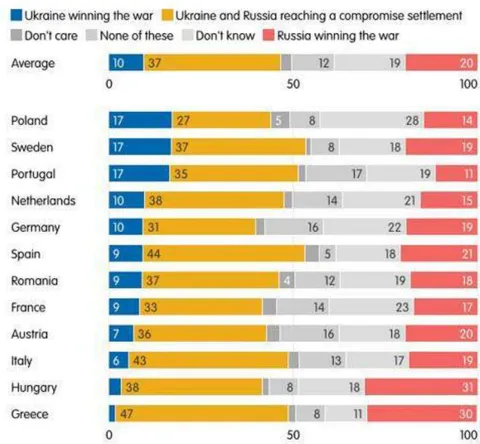
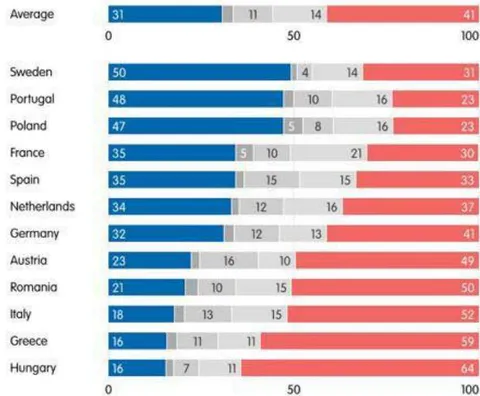
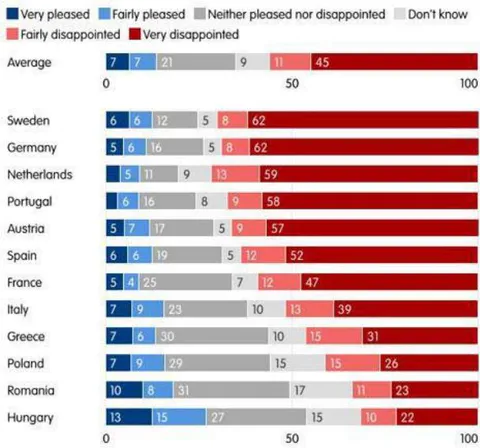
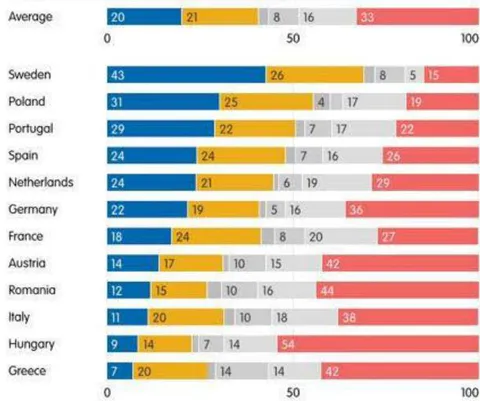
The reasons for public supports of the official government narrative are: - the effective propaganda of the far-right, illiberal Hungarian government rejecting the basic EU values, - the lack of effective EU action with this rejectionist attitude, - the unconditional support by the opposition of the EU and NATO policy in Ukraine, - official Ukrainian policy on the Hungarian national minority, - the complete lack of Russophobia in Hungary, - the realistic assessment of the state of the war (sanctions against Russia are ineffective; Ukraine cannot retake the territories occupied by Russia even with Western support; Western support will decrease after the American presidential election; the overthrow of the Putin regime is an unrealistic goal; based on the results of Russian special military operation in Ukraine it is hard to believe that the Russian military is a sirious threat to Europe).
II. CONCLUDING THOUGHTS
If we define the nature of the Russian-Ukrainian war on the basis of the acceptable elements of the above narratives, the Hungarian position can be summarised as follows: the Russian military aggression against Ukraine is the result of an unjustified, inappropriate Russian political decision, reflecting the re-emergence of Russian great power ambitions and aimed at forcibly changing Ukraine's Western-oriented policy. The aggression has been facilitated, unwittingly or unwittingly, by the successful US export of democracy to Ukraine, the US military presence in Ukraine, the Ukrainian Government's extreme anti-Russian and anti-minority policies, including the rejection of autonomy for the Donetsk and Luhansk regions, and the unconditional support of Ukraine by the EU and NATO, without any consideration of the possible consequences.
The Russian military aggression against Ukraine was a bad political decision, because: - Ukraine was not a real direct threat to the security of the Russian Federation. - Despite the fact that the United States, EU Member States, and international security organizations for whom democracy, human rights, and nondiscrimination are core values, did nothing to improve the Russian minority treatment in Ukraine, Russia still had peaceful means and options to protect the Russian population of Donetsk and Luhansk. - The Russian political leadership's calculation that the population of Ukraine would welcome Russian soldiers proved to be wrong; - Russia has suffered an extreme loss of prestige, it was declared an aggressor and lost the nimbus of peaceful power. (9) In my view, if Ukraine is willing to compromise (giving up Russian-occupied territory and accepting military neutrality or non-full NATO membership), the following indisputable results would allow the war to be brought to an end by Russia: - Russian forces have successfully established a land link between Crimea and the breakaway territories in eastern Ukraine; - They have blown up the dam in the Herszon area, which cut off the water supply to Crimea; - Several strategic cities, namely Herszon, Berdyansk, Mariupol, Melitopol, as well as several smaller settlements in the Donetsk and Luhansk People's Republics have been liberated; - At Mariupol, the far-right Ukrainian Azov National Guard unit has been defeated, thus cleansing Ukraine of far-right Ukrainians, the Ukrainian Nazis. (Of course, there are still Azov and other extreme right-wing elements in the rest of the country, but the Azov regiment was headquartered in Mariupol); - Russian forces completely cut Ukraine off from the Sea of Azov; - Ukraine's static military infrastructure was essentially destroyed, so
Ukraine was "demilitarized"; - Ukraine used up most of its strategic weaponry; - Russia took a number of prisoners of war accused of war crimes that is public evidence that the "Nazi" war criminals have been found.
Such a compromise could also be acceptable to Ukraine: - It would only lose territories with a Russian-speaking population where Ukrainian sovereignty would never be accepted; - It would create a united Ukraine in terms of political community; - Ukraine could become a member of the EU and NATO, while retaining its sea access via Odessa.
When will the moment come for compromise? - When it is no longer worth for Russia to waste further resources on the war against Ukraine, or when Ukraine's resources are exhausted despite Western support, and it would be more appropriate to end the war with a ceasefire agreement.
In other words, it depends fundamentally on when Western sanctions will weaken Russia "sufficiently", and when the repercussions of Western sanctions will "sufficiently" shake the economies of EU Member States. In the first case, "sufficient" refers to a situation where Russian forces can only occupy important territory at irrationally high cost. In the second case, "sufficient" refers to a situation where the tolerance of EU citizens for a decline in living standards reaches a critical level and their support for Ukraine and for sanctions against Russia ceases.
Closing the war is made more difficult by the fact that the West does not seem to have a unified concept of how to end the Russo-Ukrainian war, or how to shape and influence Russian policy and Russian-Chinese relations. This is evidenced by a statement to The Telegraph by the former Chief of Staff of the United Kingdom, General Lord Richards, on 10 June 2022: "A lack of a coherent Western strategy is apparent in Ukraine. It is a "let's see how it goes" "strategy", in other words, not really strategy at all. There is still little idea in London, Washington or elsewhere how "we" want the war to pan out, or what sort of Russia we are seeking to shape, especially on the vital long-term issue of relations with China. Is there an opportunity,....to persuade a weakened Russia to align with the West rather than having it pushed ineluctably into China's orbit? No one is thinking grand strategically because no one is brave enough to think beyond the political convention of the moment." (20)
NATO allies supporting Ukraine must decide 1. NATO will support Ukraine with direct military intervention.
NATO is merely helping Ukraine to create a military stalemate with the Russian army.
NATO allows the Ukrainians to be defeated.
Option 1 would provide an opportunity for Russia to start the first Russian-NATO war. In case 2, much of southern and eastern Ukraine would remain in Russian hands, but time could be gained for both European allies and Ukraine to rebuild credible deterrence, perhaps to prevent (or initiate) another Russo-Ukrainian war. Case 3 would mean a clear victory for Russia, the achievement of its goals.
What was the biggest mistake made by the collective West during the Russia-Ukraine war? I think the biggest problem was the fifteen thousand Western sanctions against Russia. The long-term persistence of these could lead to the fall of the Putin regime or to a strengthening of the perception that the problem for the Western world, and especially for America, is not the undemocratic, illiberal Russian regime, but the existence of the Russian Federation, the Russian people, Russian culture. It seems to me that the latter position already became dominant and the consequences of it will threaten the security of the whole world.
What will happen in next years? The lesson for 2022-2023 may be that Ukraine will not be able to retake the territory it has lost. As this is not understood by Kiev, in 2024-2025 the parties will not reach a ceasefire or some calmer state of affairs. (6)
Armed clashes are expected to continue with operationally insignificant successes and decreasing intensity until resources are exhausted, which could ultimately lead to a "freeze" of the conflict (armed activity simply stops without a ceasefire).
This situation favors Russia because it offers the opportunity to restore the combat capabilities of the armed forces. A new military operation against Ukraine will certainly happen, as Russia has not yet achieved its most important war aim, the change of Zelensky regime. An attack on NATO or any other state at the same time as an attack on Ukraine, unless Russia is successfully provoked, is very likely to be ruled out. Given the performance of Russian forces in Ukraine to date, even a restored or increased in combat capability Russian armed forces cannot fight two or more wars simultaneously. This period will also be marked, to a diminishing extent over time, by professionally conducted Ukrainian sabotage and terrorist actions on Russian territory and by Russian high-intensity missile and drone strikes against Ukrainian military and dual-use targets in response. But the course of the war will be determined in Moscow, Kyiv, Washington, Beijing, Tehran, and Pyongyang, not in Avdivka, Tokmak, or Kramatorsk.
- Zsolt Nemeth, "On Ukraine and Poland calmly", Highway - Literary Present, (09 May 2022), https://orszagut.com/kitekinto/ukrajnarol-es-lengyelorszagrol-higgadtan-2882?fbclid=lwAR1wtn1PrLawd4LyYZZVp2V6fbdv38dXjB7ggAGWlnMyl_iOoMsgjtNF2A&utm_source=mandiner&utm_medium=link&utm_campaign=mandiner_202205
- Dániel Kovács, "Europeans expect their leaders to end the Russian-Ukrainian war, interview with Századvég Director of Political Analysis",
- Novekedés.hu news portal, (06 January 2024), https://novekedes.hu/interju/keseru-kijozanodas-azeuropaiak-az-oroszukran-haboru-lezarasat-varjak-el-vezetoiktol
- Tamás Elter, "The decades-long battle between the United States and Russia continues in Ukraine", ORIGO, (09 March 2022), https://www.origo.hu/tud omany/20220306-valamennyi-szuperhatalmi-torekve st-a-nagyhatalmibirodalmi-gondolkodasmod-jellem zi-amihez-az.html
- Krisztian Pap, "Why Ukraine?", Demokrata, (17 April 2022), https://demokrata.hu/vilag/pap-krisztian-miert-eppen-ukrajna-521213/
- Gyula Nemeth, "The security situation of Ukraine in the light of the events on Maidan Square - PhD thesis", PhD School of Security Studies, University of Obuda Budapest, (2020), http://www.lib.uni-obuda.hu/sites/lib.uni-obuda.hu/files/Nemeth_Gyula_ertek ezes.pdf
- Atilla Papp, "Interview with Tamás Csiki Varga, expert at the University of Public Service: We will not reach the ceasefire in 2024 - assessing the failed Ukrainian counter-offensive", 24.hu, (30 November 2023), https://24.hu/kulfold/2023/11/30/orosz-ukran-haboru-ellentamadas-kudarc-avgyijivka-fekete-teng er-robotine-velika-novoszilka-volodimir-zelenszkij-Za porizzsja-kelet-ukrajna/
- Egor Aleyev, "RTVI", TASS website (08 June 2023), https://rtvi.com/stories/ekonomicheskaya-vojna-rossii-i-zapada-kogda-ona-zakonchitsya-i-kto-pobedit/
- Alexei Druzhinin, "Military operation in Ukraine - Ukraine was ready to sign a peace deal with Russia but gave up under US pressure", TASS RUSSIAN NEWS AGENCY, (8 Jun 2023), https://tass.com/politics/1629441
- Miklos Kenyeres, "Balance after two months", Facebook, (20 April 2022), https://www.facebook.com/miklos.kenyeres.3/posts/pfbid0R5js1mafdgcHx UD9S33yhBWpcETGFvwYf7RgPSCR9kcQYj5HXzm ThA6QMqAjpE1kl
- Gábor Tar, "Turns out Hungarians think Russia will win the war", Portfolio news portal, (21 February 2024), https://www.portfolio.hu/global/20240221/kid erult-a-magyarok-szerint-oroszorszag-nyeri-a-habor ut-670105
- Ildiko D. Kovács, "The majority of Hungarians think the war in Ukraine is Ukraine's problem", 24.hu news portal, (21 April 2022), https://24.hu/belfold/2022/04/21/orosz-ukran-haboru-magyarorszag-velemeny-szANKCIK-ipsos/
- Gyula Szabó, "One third of Hungarians believe that Ukraine is also responsible for the outbreak of the war", index news portal, (25 February 2023), https://index.hu/belfold/2023/02/25/orosz-ukran-konfliktuskozevemeny-kutatas-szankciok-brusszel/)
- Ultan Banan, "The Grand Chessboard: A cold and unemotional look at the US proxy war in Ukraine",