I. INTRODUCTION
Among the membrane separation processes (MSP), ultrafiltration (UF) is highlighted in the dairy industry, in the milk filtration, cheese production and in the recovery and concentration of whey proteins (Brans et al., 2004; Daufin et al., 2001). However, ultrafiltration has disadvantages due to the solute interaction (such as proteins) with the membrane surface causing an accumulation of these molecules on its surface, known as fouling, which leads to a reduction in permeate flux reflecting the decrease in performance and the increase in the number of cleanings (Brans et al., 2004; Makardij et al., 1999).
To reduce the effects of fouling, techniques based on physical and chemical methods are suggested. In this context, physical methods, such as plasma, are not very effective, as they are not stable and, chemicals methods, such as grafting, often require the use of toxic chemical reagents (Cheng et al., 2012; W. Xu et al., 2017). Thus, the mussel-inspired method (MI) was presented as a solution, due to its simplicity, versatility and stability, based on the deposition of dopamine (DA) on the membrane surface, which polymerizes in certain conditions and forms polydopamine (PDA). The PDA is able to adhere to the membrane surface and also to undergo reactions with other polymers giving specific properties (Cheng et al., 2012; H. C. Yang et al., 2016). The fact that the PDA has free functional groups for the aggregation of other polymers opens up a range of possibilities for carrying out promising studies. However, there are few studies on the codeposition of DA with hydrophilic polymers in ultrafiltration membranes (Lv et al., 2015; Y. C. Xu et al., 2016; Q. Yang et al., 2019) and studies on ultrafiltration membrane modification with DA and polyvinyl pyrrolidone (PVP) have not been found.
In view of the above, this study proposes to modify UF membrane surface by the muslin-inspired method, with the objective of increasing the degree of hydrophilicity and improving the permeate flux of protein solution. For this purpose, 50 kDa UF membranes were modified by the muslin-inspired method by codeposition of DA and different concentrations of PVP. The effects of the modification were evaluated for the degree of hydrophilicity and performance in the filtration of protein solution of bovine serum albumin (BSA).
II. MATERIAL AND METHODS
a) Material
To carry out the work, the UH050 membrane was acquired by Microdyn-Nadir (Germany). UH050 is a polymeric ultrafiltration membrane, made of polyethersulfone (PES) and molar weight cut-off (MWCO) equal to 50 kDa.
Ethanol P.A. (99%, Synth) was used to condition the commercial membrane prior to modification. The membrane remained immersed in ethanol for 2 h, rinsed with ultrapure water and immersed in ultrapure water for 12 h. This procedure was performed to remove possible preservatives and fill the membrane pores with water. The DA and PVP solution for modification was prepared with dopamine hydrochloride (DA), PVP (Mw = 40,000 Da) and Tris (hydroxymethyl) aminomethane (Tris), purchased from Sigma-Aldrich (Brazil). As a model protein solution, bovine serum albumin (BSA) with a concentration of 2.5 g L-1 and pH 6.5 was used and. BSA was acquired at Sigma-Aldrich (Brazil), with purity greater than 96% and a molar mass of 66 kDa. The cleaning procedures of the membrane after filtration of the model protein solution was used ultrapure water (physical cleaning) and sodium hydroxide (NaOH) 0.02% (pH 10, chemical cleaning, Lafan).
b) Methods
i. Membranes Modification
PVP was dissolved in 50 ml of Tris buffer solution (pH 8.5 and 5.0 mM) in concentrations 2, 4 and 16 mg mL-1 and the DA was added with a fixed concentration of 2mg.mL-1. The PVP and DA solution was placed on the petri dish together with the conditioned membrane and stirred in an orbital shaker (TECNAL TE-420) at 50 rpm and 23±2 °C for 2 hours. After completing the deposition time, the membrane was rinsed with ultrapure water to remove excess solution that did not adhere to its surface and then stored in ultrapure water. The concentration of the DA and PVP solution and the reaction time were based on previous tests by the research group. The modification procedure was performed in duplicate.
ii. Experimental apparatus
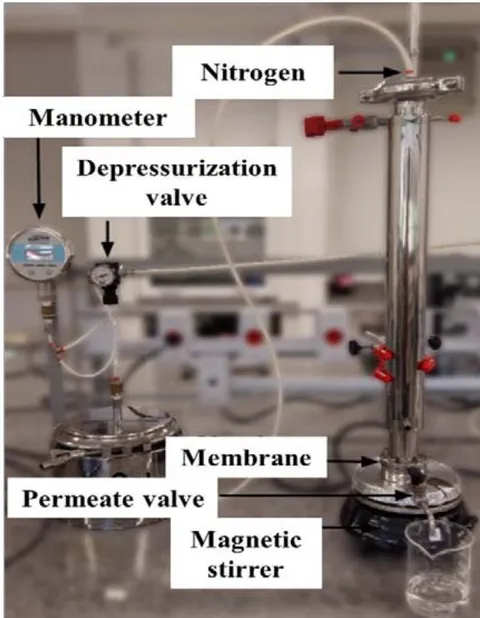
Permeation tests and fouling tests were carried out at room temperature (23±2 °C), with the modified and control membrane. The permeations were made in a pressurized cell on a stainless steel, laboratory scale, with a volumetric capacity of 500 mL and a filter area of 9.6 cm2, in the dead-end configuration. The pressure in the system was made by the injection of nitrogen in the upper part of the controlled cell through a manual manometer. The system was depressurized using a regulating valve. Figure 1 show the filtration system used.
iii. Contact angle
The contact angle measurements were made in a RAMÉ - HART goniometer (model 250-FI), using the sessile drop method at the Analysis Center of the Department of Chemical Engineering and Food Engineering at the Federal University of Santa Catarina (UFSC).
iv. Hydraulic permeance
First, the control and modified membranes were compacted at 5 bar. After the compaction time, three collections of permeate flux were made for 1 minute at pressures 4, 3, 2, and 1 bar. At each pressure change there was an interval of 10 minutes for system stabilization. The data of permeate volume (Lp, L) and data as the membrane area (Am, m2) and the collection time, t (h), it was possible to calculate the permeate flux, J (L h-1 m-2) given by Equation 1.
Thus, a graph of permeate flux versus pressure was generated. The angular coefficient obtained by linearizing the data corresponds to the hydraulic permeance of the membrane. The tests were performed in duplicate
v. Filtration tests
The filtration tests with BSA solution were performed with the control membrane and with the modified membrane that showed better hydraulic permeability. The cell was filled with 100 ml of BSA solution (2.5 g L-1 and pH 6.5), closed and pressurized to 4 bar. For the filtration tests the pressure was kept constant and aliquots of permeate were collected for 1 minute in an interval of 15 minutes totaling 2 hours of filtration. Permeation was carried out under stirring. At the end of the process, an aliquot of the retained and permeate was collected to determine the protein concentration by the Bradford method (Bradford, 1976), and then the membrane retention (R) was calculated by Equation (2).
Where, P is the protein concentration in the permeate (g L-1) and R is the protein concentration in the retained (g L-1). The tests were performed in duplicate.
After filtration tests, physical and chemical cleaning procedures were carried out on the membranes in order to recover their initial permeability. Physical cleaning was carried out by adding 100 mL of ultrapure water to the cell, without pressure and under agitation for 10 minutes. Chemical cleaning was carried out with 100 mL of sodium hydroxide solution 0.02% (pH 10) for 30 minutes, without pressure and under agitation. At the end of the 30 minutes, after removing the sodium hydroxide solution, 100 mL of ultrapure water was added under stirring for 5 minutes to remove the remaining excess alkaline solution.
After each cleaning procedure, water filtration tests were performed to assess the recovery of hydraulic permeance (Rf,%) calculated by Equation (3)
Where, Pi is the initial hydraulic permeance (L h-1 m-2 bar-1) and Pf is the hydraulic permeance obtained after cleaning procedures (L h-1 m-2 bar-1).
III. RESULTS AND DISCUSSION
a) Membrane modification
The membranes were modified by codeposition in a single step of DA and PVP with different concentrations (2.0: 2.0; 2.0: 4.0 and 2.0: 16.0 mg mL-1) and deposition time of 2 h. The deposition time of 2 h was chosen based on the study carried out by the researchers group from Membrane Processes Laboratory (LABSEM) of the Federal University of Santa Catarina (UFSC), in the modification of PES membranes with PDA and polyethyleneimine presented in the work of Marques (2017) and Proner et al. (2020). Proner et al. (2020) observed a drop in hydraulic permeance in long deposition times (24h) due to the formation of PDA/PEI aggregates on the membrane surface, which leads to obstruction the pores of the membrane. Similar results were presented by Jiang et al. (2013), polypropylene (PP) membrane modified with DA/PVP. For Marques (2017), among the tested times of 2, 4 and 6 h, the membrane with the best hydraulic permeance was the deposition time of 2 h.
The concentration of dopamine was fixed at 2 mg mL-1 because higher concentrations of dopamine interfere in the membrane permeability. According to Kasemset et al.(2013), increasing the concentration of dopamine generates a thicker coating of PDA, interfering in the water permeate flux for UF membranes that have smaller pore diameters compared to MF membranes.
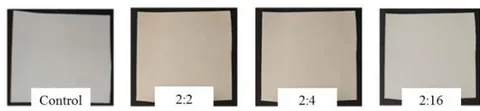
Figure 2 shows images of the modified and control membrane. Through a visual analysis, it can be seen that the PES commercial polymeric membrane (UH050) showed a homogeneous color throughout its surface indicating that the modification occurred uniformly. In addition, it can be observed that the modified membrane, regardless of the concentration of solution used, after 2 h of modification, presented a darker color than the control. Comparing between the modified ones, it is possible to notice a slight difference, the membrane with the highest PVP concentration (16mg mL-1) presented a slightly lighter color than the one with the lowest concentration (2 mg mL-1).
All membranes were evaluated for their hydrophilicity degree and hydraulic permeance. The control and modified membranes that performed best were evaluated with a fouling test, which comprises the initial hydraulic permeance, membrane retention, permeate flux of the protein solution and recovery of the hydraulic permeance after cleaning procedures.
b) Hydrophilicity degree and hydraulic permeance
i. Contact angle
In order to determine the hydrophilicity degree of the membrane, the angle of contact with ultrapure water was measured for the control and modified membranes. The results obtained are shown in Table 1.
| DA:PVP concentration (mg mL-1) | Contact angle (°) |
| Control | 71,2±0,2 |
| 2:2 | 59,6±0,4 |
| 2:4 | 58,1±0,8 |
| 2:16 | 53,4±0,3 |
According to the results (Table 1), the control membrane had a contact angle greater than . Membranes modified with 2:2; 2:4; 2:16 mg mL-1 of DA:PVP showed a reduction in the contact angle of 16, 18 and 25%, respectively, when compared to the control membrane. This reduction in the contact angle indicates an increase in the hydrophilicity degree of the membranes, resulting from the deposition of DA and PVP, which present in their structure groups of catechol and amine, conferring hydrophilic characteristics, which can lead to greater resistance the adhesion of hydrophobic components on the membrane surface and the increase in its wettability (affinity with water). Figure 3 shows the images of the drops obtained in the contact angle test of the UH050 control and modified membrane.

The only study of codeposition of DA/PVP in a commercial membrane present in the literature is by Jiang et al.(2013), who also showed results of reducing the contact angle after modifying the MF membrane of PP with DA/PVP and deposition time of 24 h. Proner et al.(2020), presented similar results in the modification of PES commercial polymeric membrane of ultrafiltration by codeposition of DA/PEI, showing a reduction in the contact angle of 25% in the modified membranes with higher concentration of PEI in relation to the control membrane. Marques (2017) modified the PES ultrafiltration membrane with codeposition of DA/PEI, showed a 30% reduction in the angle of contact with the modified membrane with a concentration of 2:16 mg mL-1 compared to the control and 2 h of deposition.
Thus, the modification of the PES UF membrane with higher concentrations of PVP showed a tendency to reduce the contact angle, which indicates an increase in its hydrophilicity, probably due to the presence of hydrophilic groups deposited on its surface.
ii. Hydraulic permeance
To evaluate the performance of PES membranes modified with different concentrations of DA/PVP water permeation tests were performed. The results obtained can be seen in Figure 4.
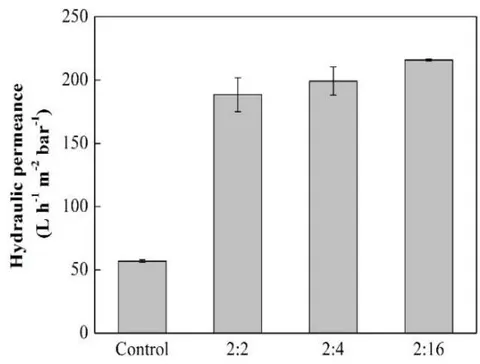
The control membrane showed hydraulic permeance of 56.85 L h-1 m-2 bar-1, 70% less than the hydraulic permeance of the modified membrane at 2:2 mg mL-1DA/PVP. Among the modified membranes, the modified membrane with 2:16 mg mL-1 of DA/PVP showed the best results of hydraulic permeance (215.85 L h-1 m-2 bar-1), 279% larger than the control membrane.
Therefore, the modified membrane with the concentration of 2 mg mL-1 of DA and 16 mg mL-1 of PVP showed the best results of hydraulic permeance, which reveals an increase in hydrophilicity in comparison to the control membrane. This change may have occurred because PVP is a hydrophilic polymer and strong hydrogen receptor. Thus, the PDA/PVP codeposition forms a hydrophilic coating on the membrane surface, improving its hydrophilicity which can reflect on the performance of the filtrations.
Due to the membrane modified with the concentration 2:16 mg mL-1 of DA/PVP having presented the best performance, it was chosen to perform the permeation tests with the protein solution.
c) Protein solution filtration performance
The permeation of the BSA protein solution with a concentration of 2.5 g L-1 and the cleaning procedures were performed, the results can be seen in Figure 5.
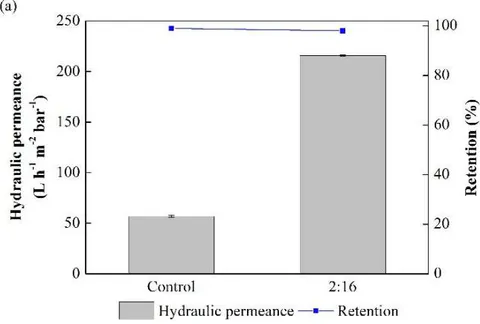
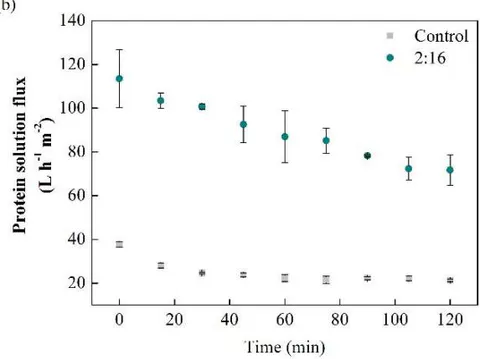
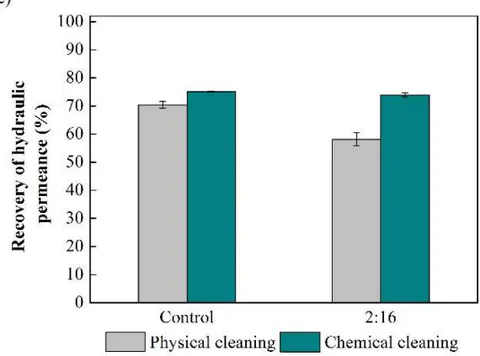
Figure 5a shows the results obtained from initial hydraulic permeance and retention of the control and modified UH050 membrane. The control membrane showed a hydraulic permeance of 56.85 L h-1 m-2 bar-2 and the modified membrane showed a hydraulic permeance of 215.5 L h-1 m-2 bar-1, four times larger than the control membrane. As shown in Figure 4, the PDA/PVP film formed on the membrane surface generates a hydrophilic character that facilitates the absorption of water on the surface, reducing the resistance to mass transfer, reflecting in the increase in the permeate flux.
The retention for the ultrafiltration membrane with MWCo of 50 kDA was approximately 99% and the modified membrane was 98%. After the modification, the membranes maintained retention of BSA molecules. Naturally it was expected, since the membrane has lower MWCO than the molecules of the BSA protein solution, and also it is an indication that the modification did not alter the membrane selectivity.
The results obtained by filtering the BSA protein solutions are shown in Figure 5b. It is possible to observe that the initial protein solution flux from the modified membrane was 113.50 L h-1 m-2, 200% greater than the control membrane flux. In addition, the results show that the first 20 minutes of filtration the control and modified membrane presented a permeate flux decay due to the adhesion of protein solution molecules on the membrane surface, and at the end of the 2 h of filtration the modified membrane showed flux of 71.72 L h-1 m-2, 240% greater than the control membrane.
This result indicates that the modified membrane presented a significant increase, not only in hydraulic permeability, but also in the BSA protein solution flux. The evaluation of the permeate flux in the protein solution filtration carried out by Jiang et al. (2013) showed good results. The PP MF membrane modified by DA/PVP increased the permeate flux in 220% in relation to the control membrane. According to the author, after the modification the water molecules were able to absorb on the membrane surface, reducing the resistance to mass transfer reflecting the increase in the permeate flux.
After the filtration tests with the protein solution and the physical and chemical cleaning, the hydraulic permeance of the control and modified control membranes were evaluated and the results shown in Figure 5c. The recovery of hydraulic permeance for the control membrane after physical cleaning was 70% and, for chemical cleaning 75%. For the membrane modified the recovery was 58% for physical cleaning and 74% for chemical cleaning.
Although the PVP modification led to an increase in the permeate flux, the recovery of hydraulic permeability was similar to the control membrane. Marques (2017), obtained a similar result, according to the author such behavior may reflect the change in the surface charges of the membrane after modification, because when depositing components rich in amine (DA/PVP) there is a tendency to increase charges positive on the surface (Lv et al., 2015; Y. C. Xu et al.,
2016), and since the protein solution is usually negatively charged does not reflect in improving the recovery of hydraulic permeance. However, in the filtration performance the change in the zeta potential of the membrane surface was probably less representative in terms of increasing the hydrophilicity degree, since the permeate flux increased considerably, the affinity for water increased in order to reduce resistance to mass transfer and intensify the permeate flux.
Thus, due to the results obtained for hydraulic permeance and contact angle of the ultrafiltration membrane modified by the DA/PVP codeposition are promising for application in filtration processes in the industry. In addition, the membrane modified at a concentration of 2:16 mg mL-1 of DA/PVP, due to its greater hydraulic permeability, smaller contact angle and excellent improvement in the permeate flux in the filtration of protein solution is interesting for application in protein solution process industries.
IV. CONCLUSIONS
The modification of the ultrafiltration membrane through the codeposition of DA and PVP resulted in a membrane with greater hydrophilic character, excellent performance in protein solution filtration, being a promising strategy in the production of membranes with anti-fouling properties. The results obtained showed that with a higher concentration of PVP (16 mg mL-1) in the modification membrane there is an excellent improvement in the permeate flux of protein solution, 200% greater than the control.