Um Recorte Das Eleições Municipais No Brasil: Candidaturas E Desempenho Eleitoral Das Mulheres

1
Carolini Gabriel da Silva

Send Message

To: Author

GJHSS Volume 21 Issue F5

Article Fingerprint

ReserarchID

51W5O

Um Recorte Das Eleições Municipais No Brasil: Candidaturas E Desempenho Eleitoral Das Mulheres Banner
  • English
  • Afrikaans
  • Albanian
  • Amharic
  • Arabic
  • Armenian
  • Azerbaijani
  • Basque
  • Belarusian
  • Bengali
  • Bosnian
  • Bulgarian
  • Catalan
  • Cebuano
  • Chichewa
  • Chinese (Simplified)
  • Chinese (Traditional)
  • Corsican
  • Croatian
  • Czech
  • Danish
  • Dutch
  • Esperanto
  • Estonian
  • Filipino
  • Finnish
  • French
  • Frisian
  • Galician
  • Georgian
  • German
  • Greek
  • Gujarati
  • Haitian Creole
  • Hausa
  • Hawaiian
  • Hebrew
  • Hindi
  • Hmong
  • Hungarian
  • Icelandic
  • Igbo
  • Indonesian
  • Irish
  • Italian
  • Japanese
  • Javanese
  • Kannada
  • Kazakh
  • Khmer
  • Korean
  • Kurdish (Kurmanji)
  • Kyrgyz
  • Lao
  • Latin
  • Latvian
  • Lithuanian
  • Luxembourgish
  • Macedonian
  • Malagasy
  • Malay
  • Malayalam
  • Maltese
  • Maori
  • Marathi
  • Mongolian
  • Myanmar (Burmese)
  • Nepali
  • Norwegian
  • Pashto
  • Persian
  • Polish
  • Portuguese
  • Punjabi
  • Romanian
  • Russian
  • Samoan
  • Scots Gaelic
  • Serbian
  • Sesotho
  • Shona
  • Sindhi
  • Sinhala
  • Slovak
  • Slovenian
  • Somali
  • Spanish
  • Sundanese
  • Swahili
  • Swedish
  • Tajik
  • Tamil
  • Telugu
  • Thai
  • Turkish
  • Ukrainian
  • Urdu
  • Uzbek
  • Vietnamese
  • Welsh
  • Xhosa
  • Yiddish
  • Yoruba
  • Zulu

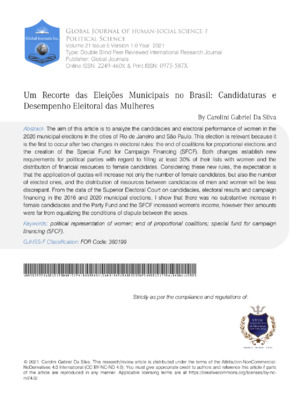
The aim of this article is to analyze the candidacies and electoral performance of women in the 2020 municipal elections in the cities of Rio de Janeiro and São Paulo. This election is relevant because it is the first to occur after two changes in electoral rules: the end of coalitions for proportional elections and the creation of the Special Fund for Campaign Financing (SFCF). Both changes establish new requirements for political parties with regard to filling at least 30% of their lists with women and the distribution of financial resources to female candidates. Considering these new rules, the expectation is that the application of quotas will increase not only the number of female candidates, but also the number of elected ones, and the distribution of resources between candidacies of men and women will be less discrepant. From the data of the Superior Electoral Court on candidacies, electoral results and campaign financing in the 2016 and 2020 municipal elections, I show that there was no substantive increase in female candidacies and the Party Fund and the SFCF increased women’s income, however their amounts were far from equalizing the conditions of dispute between the sexes.

Funding

No external funding was declared for this work.

Conflict of Interest

The authors declare no conflict of interest.

Ethical Approval

No ethics committee approval was required for this article type.

Data Availability

Not applicable for this article.

Carolini Gabriel da Silva. 2021. \u201cUm Recorte Das Eleições Municipais No Brasil: Candidaturas E Desempenho Eleitoral Das Mulheres\u201d. Global Journal of Human-Social Science - F: Political Science GJHSS-F Volume 21 (GJHSS Volume 21 Issue F5): .

Download Citation

Electoral trends and women's political participation insights from Brazil's municipal elections.
Journal Specifications

Crossref Journal DOI 10.17406/GJHSS

Print ISSN 0975-587X

e-ISSN 2249-460X

Keywords
Classification
GJHSS-F Classification: FOR Code: 360199
Version of record

v1.2

Issue date

September 28, 2021

Language

English

Experiance in AR

The methods for personal identification and authentication are no exception.

Read in 3D

The methods for personal identification and authentication are no exception.

Article Matrices
Total Views: 1970
Total Downloads: 893
2026 Trends
Research Identity (RIN)
Related Research

Published Article

The aim of this article is to analyze the candidacies and electoral performance of women in the 2020 municipal elections in the cities of Rio de Janeiro and São Paulo. This election is relevant because it is the first to occur after two changes in electoral rules: the end of coalitions for proportional elections and the creation of the Special Fund for Campaign Financing (SFCF). Both changes establish new requirements for political parties with regard to filling at least 30% of their lists with women and the distribution of financial resources to female candidates. Considering these new rules, the expectation is that the application of quotas will increase not only the number of female candidates, but also the number of elected ones, and the distribution of resources between candidacies of men and women will be less discrepant. From the data of the Superior Electoral Court on candidacies, electoral results and campaign financing in the 2016 and 2020 municipal elections, I show that there was no substantive increase in female candidacies and the Party Fund and the SFCF increased women’s income, however their amounts were far from equalizing the conditions of dispute between the sexes.

Our website is actively being updated, and changes may occur frequently. Please clear your browser cache if needed. For feedback or error reporting, please email [email protected]
×

This Page is Under Development

We are currently updating this article page for a better experience.

Request Access

Please fill out the form below to request access to this research paper. Your request will be reviewed by the editorial or author team.
X

Quote and Order Details

Contact Person

Invoice Address

Notes or Comments

This is the heading

Lorem ipsum dolor sit amet, consectetur adipiscing elit. Ut elit tellus, luctus nec ullamcorper mattis, pulvinar dapibus leo.

High-quality academic research articles on global topics and journals.

Um Recorte Das Eleições Municipais No Brasil: Candidaturas E Desempenho Eleitoral Das Mulheres

Carolini Gabriel da Silva

Research Journals