### a) Regional Power Integration Matters
Commitments to low carbon economy and adaptation to climate change, requiring total electrification of our society in the $21^{\text{st}}$ century, leveraged the efforts of electricity industry restructuring, strengthening power grid transmission, and regional /inter-regional electricity market integration [1].
- Interconnection: Initially involves two, and later - more jurisdictions, includes long-term bilateral power purchase agreements (PPA);
- Shallow integration: Involves a number of neighboring jurisdictions, includes long-term PPAs supplemented with short-term electricity markets;
- Deep integration: Full operation of a multi-jurisdictional interconnected system, enables competition achieved through a range of wholesale markets (e.g., day ahead and a series of real-time auctions, capacity auctions, ancillary services, transmission congestion contracts). Deep integration means comprehensive trade agreements regulating the business environment including competition policy, investor rights, product standards, public procurement and intellectual property rights [4].
Some challenges slowing progress and mitigating the full benefits of deeper integration may include difficulty aligning jurisdictional and regional investment decisions; differences in regulatory environments between jurisdictions; insufficient regional institutions; dearth of financing; changes in political frameworks; and jurisdictional and national sovereignty and energy independence concerns.
However, today regional power system integration within a country (e.g., states or provinces) and/or internationally is clearly understood as a critical, productive and much needed approach, and an important strategy to help provide reliable, affordable electricity to their economies and citizens [3]. Increased electricity cooperation and trade between jurisdictions leading to power sector reform and integration can enhance energy security, bring economies-of-scale in investments optimizing them on a regional basis, facilitate financing, enable greater renewable energy penetration, reduce emissions, ensure technical and regulatory harmonization, and allow for synergistic sharing of complementary resources.
### b) Deep Integration means Deep Decarbonization
As a critical component of climate change mitigation, deep decarbonization of electricity will enable a more efficient and rapid transition to a zero-carbon electricity system, and greatly contribute to deep decarbonization of our society [5]. Adopting deep integration at regional and inter-regional level will decarbonize regional power sectors at the lowest overall cost [6]. Improving integration and coordination of electricity systems to achieve deep integration levels and related deep decarbonization goals opens up key opportunities such as the higher potential to integrate renewable energy, and economic efficiency gains [7].
### c) Regional Transmission Organizations Lead
In North America restructuring of the electricity industry to successfully achieve deep regional integration benefits were demonstrated by the formation of Independent System Operator (ISO), and later - Regional Transmission Organization (RTO) solutions [9-12].
ISOs and RTOs are independent nonprofit organizations responsible for grid reliability, planning and competitive wholesale market operations. Roughly two-thirds of the United States and two major provinces in Canada (Alberta and Ontario) today are served by these organizations.
RTOs manage centralized regional markets for electric energy, ancillary services, capacity, and offer financial contracts for hedging congestion risks, while not taking a position in these wholesale power markets. They also manage the joint transmission assets on behalf of a number of transmission-owning electric utilities as their members while not owning any of these assets. RTO markets are independently monitored for market power abuses and manipulation.
RTOs enable the aggregation of generation resources for economic dispatch [9] by having generation resources over a number of utility control areas cost-optimized and dispatched jointly.
Federally regulated RTOs are governed by boards that are independent of any market participants [13].
The benefits of regional grid integration demonstrated by RTO include:
- Wholesale markets created: Highly liquid and competitive; this includes high competitiveness of the auction structure;
- Regional complementarities in demand: Non-coincident demand provided benefits to regional integration without massive investments in transmission upgrades while systems with highly coincident demands enabled more robust transmission infrastructure to support competition;
- Efficiencies: Increased efficiencies of low-cost baseload units in joint regional dispatch;
- Environmental effects: More intensive use of lower-cost resources in regional dispatch.
A successful example of using RTO for regional grid integration in North America is shown by New England. The New England States Committee on Electricity (NESCOE) representing the collective perspective of the six New England Governors in regional electricity matters, used ISO New England (ISO-NE) as a vehicle for government level planning and policy coordination. With technical coordination provided by ISO-NE NESCOE advanced the New England states' "common interest in the provision of electricity to consumers at the lowest possible prices over the long-term, consistent with maintaining reliable service and environmental quality" [14].
As the initial ISO-NE's mission and governing structure were established in mid-1990ies, New England's existing wholesale electricity markets are currently being modernized to support achievement of clean energy laws, while maintaining system reliability and fostering more affordable electricity for regional consumers. Today the New England States are committed to pursuing a new, regionally based market framework meeting the States' decarbonization mandates and maintaining resource adequacy at the lowest cost by using market-based mechanisms [15]. An example of the current regional wholesale market upgrade is a New England Forward Clean Energy Market (FCEM) [16,17], a centralized auction market that allows multiple bidders, including states and other entities, to purchase a variety of clean energy products from suppliers across New England. This includes transmission system planning to unlock onshore wind resources located far from load centers, to integrate significant levels of new offshore wind resources and new hydro resources, and to facilitate widespread adoption of DERs.
### d) Levering the Atlantic Energy Gateway Initiative
While Atlantic Canada and the northeastern US are bound together by natural economic ties, these regions are divided by a border which limits the development of transport and energy infrastructure and does not support the high degrees of economic integration and business co-operation that characterize the continent's key economic regions [18].
To address this major issue at a business community level, national and international discussions addressing this gap were made in 2004 [18-20]. The concept of Atlantica: the International Northeast Economic Region brought together Atlantic Canada; Maine, New Hampshire, Vermont, and upper state New York; as well as southeastern Quebec to enable full participation of these three areas in the North American growth strategy [18, 21]. The Atlantica region was defined chiefly by geography, economic trends and trade patterns; common problems and experiences; and politics.
To enable a significant competitive advantage of Atlantica in the continental and global economies of the future, new forms of overarching co-operation were requested to ensure that "goods, services and people can flow easily and efficiently to the places where the most value can be added to them".
Specifically, the Atlantica region discussions addressed a growing awareness of the importance of regional co-operation in energy, the value of electricity as a unique tradable commodity produced and consumed instantly, and regional power grid issues. An innovative mechanism to create a wholesale market was proposed based on a "natural benefit" for Atlantica. The region was seen as primed for the development of a competitive regional market for electricity, and "the adoption of identical laws in each participating province and state was required with more coordination and uniformity among regulatory authorities" [20, 22].
This effort was further promoted in the Atlantic Gateway and Trade Corridor Strategy, developed jointly by the governments of Canada and the provinces of Nova Scotia, New Brunswick, Prince Edward Island and Newfoundland and Labrador [23-25]. The Atlantic Gateway Memorandum of Understanding (MOU) of October 2007 directed the development of an Atlantic Gateway strategy that would benefit the Atlantic region and Canada through economic growth, increasing international trade and enhancing Canada's competitive position in the global economy. This included a current thrust to grow the energy sector by focusing on generating and exporting electricity from renewable sources, including hydro, wind, tidal, nuclear and biofuels.
Specifically, to leverage clean electricity, the Atlantic Energy Gateway (AEG) initiative was announced in March 2009 to enhance regional co-operation towards the development of Atlantic Canada's clean energy resources [26,27]. With emerging clean electricity opportunities in the region from large hydro, wind and tidal power, and green hydrogen production development, the Atlantic Energy Gateway was clearly seen as one of the strategic gateways to prosperity in Atlantic Canada and beyond [28-31].
The foundations for regional collaboration and planning through the AEG initiative by March 2012 contributed to the following decade of changes defined in the Clean Power Roadmap for Atlantic Canada [32,33] and further shaped by the Government of Canada's commitment to achieve an emissions-free grid ("Clean Grid") by 2035. By fully decarbonizing Canada's electricity grids, the country is enabling the rest of the economy to electrify by 2050 [34-37], and regional grid integration in Atlantic Canada is expected to contribute to effectively meeting the Clean Grid requirements for each of the utilities in the region.
### e) Regional Wholesale Market: Advancing a Strategic Step
Addressing the regional wholesale market needs, Nova Scotia demonstrated its leadership in the Atlantic region starting its Energy Reform 2024 as a potential "prelude" to an Atlantic wholesale market operated by an ISO/RO in the region.
energy sector [38,39]. The new legislation changed the way the electricity system in Nova Scotia is structured and regulated, making it more accountable, transparent and competitive by creating an independent energy system operator ("IESO") responsible for the oversight of wholesale market rules, interconnections, system planning and procurement. This decision supported continuing strong efforts of Nova Scotia's government to ensure provincial ratepayers have clean, reliable and affordable electricity.
Based on this decision, the wholesale market needs, the sources and experience with Newfoundland and Labrador, and socio-economic studies of a proposed DC grid from Sable Island offshore wind area to New England will define the requirements to and the skills of the IESO.
As Nova Scotia (and any province in Atlantic Canada) is too small to have their stand-alone wholesale electricity markets function competitively and efficiently in North America, a prompt next step may have to be made to advance regional grid integration opportunities by establishing a Regional Transmission Organization in Atlantic Canada to provide a much higher wholesale electricity level to play [20]. Such an Atlantic RTO representing the next phase of market restructuring in the region will present a critical opportunity for becoming a broad, regionally integrated wholesale electricity market player operating together with NYISO and ISONE in the American Northeast. This strategic step can lever the value of inter-regional coordination and transmission in decarbonizing the electricity industry and contributing to the clean electrification of low carbon economies in North America.
## II. MATERIALS AND METHODS
### a) RTO as a Deep Integration Toolset
The electricity industry has long been dominated by monopolies, but most of the historical justifications for monopoly no longer apply [13]. Regional solutions for transmission grids and wholesale electricity markets in North America represented by Regional Transmission Organizations (RTO) have been demonstrating substantial and well-documented benefits to the areas they service, including lower costs, improved reliability, and better environmental performance. The advantages brought by RTO make it a compelling option for the regions not yet served and trying to reshape their electricity landscapes; as a result, the areas serviced by RTO are continuously growing [13, 40].
## i. RTO History
Historically, wholesale electricity sales developed over time by jurisdictional utilities - regulated monopolies given rights to own and operate transmission and distribution networks in a given geographical area along with the responsibility to serve all loads in that same area [41]. These utilities were vertically integrated, owning the generation, transmission and distribution systems, and were responsible for the entire flow of electricity to consumers [42, 43].
The Energy Policy Act of 1992 (EPAct) [44] laid the initial foundation for the eventual deregulation of the North American wholesale electricity market. This Act called for utility companies to allow external entities fair access to the electric transmission systems. The act's intent was to allow large customers (and in theory, every customer) to choose their electricity supplier and subsequently pay for the transmission to deliver it from the generation to serve their load [42-44].
To satisfy the requirement of providing nondiscriminatory access to transmission and open the wholesale electricity market to competition, in April 1996 the Federal Energy Regulatory Commission (FERC) issued two orders that changed the landscape of how electricity is generated, transmitted, and distributed throughout the North America [10,11].
Order No. 888 (the "Open Access" order) defined its primary objective to establish and promote competition in the generation market, by ensuring fair access and market treatment of transmission customers. Among the key points outlined by FERC to accomplish this goal the Commission required all jurisdictional utilities within the U.S. to file an open-access transmission tariff (OATT) and promoted the concept of forming Independent System Operator (ISO) organizations at the direction or recommendation of FERC to coordinate, control, and monitor the operation of the bulk power system, and administer wholesale electricity markets within their areas of operations.
Order No. 889 (the "Standards of Conduct" order) defined in detail exactly how all participants in the electricity market should interact with transmission providers.
In December 1999 FERC followed up with its Order No. 2000, encouraging the voluntary formation of Regional Transmission Organizations (RTO) to administer the transmission grid and wholesale markets on a regional basis in a larger geographic area throughout North America (including Canada).
FERC's Orders No. 888, 889 and 2000 brought strong support from the power industry. As of today, there are nine ISO/RTO organizations operating in North America [12] and using competitive market mechanisms that allow independent power producers and non-utility generators to trade power.
In the U.S., six of these organizations: Southwest Power Pool, Inc. (SPP), PJM Interconnection, LLC (PJM), New York Independent System Operator, Inc. (NYISO), Midcontinent Independent System Operator, Inc. (MISO), ISO New England Inc. (ISO-NE), California Independent System Operator Corporation
(CAISO) are subject to the FERC's jurisdiction under sections 203, 205, or 206 of the Federal Power Act. The seventh - The Electric Reliability Council of Texas (ERCOT) serving as an independent system operator within the Texas Interconnection, which is not synchronously interconnected with any other interconnection in North America, is not subject to the FERC's jurisdiction.
In Canada there are two ISO organizations: Alberta Electric System Operator (AESO) serving the province of Alberta, and Independent Electricity System Operator serving the province Ontario.
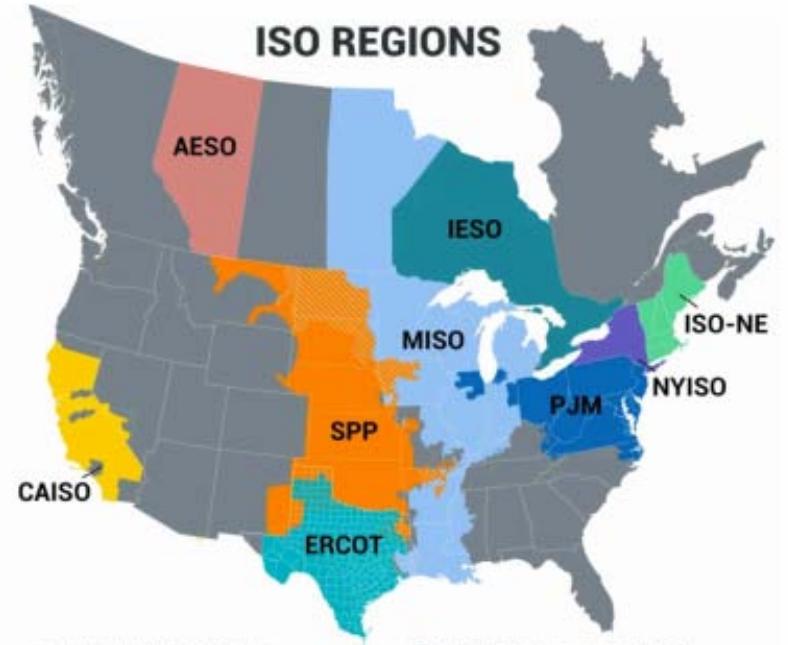
Fig. 1.1: ISO/RO in North America [12]
Alberta Electric System Operator (AESO) California Independent System Operator (CAISO) Electric Reliability Council of Texas (ERCOT) Independent Electricity System Operator (IESO)
PJM Interconnection (PJM)
Southwest Power Pool (SPP)
Midcontinent Independent System Operator (MISO)
New York Independent System Operator (NYISO)
ISO New England (ISO-NE)
Fig. 1.1 indicates what areas in North America are covered/serviced by RTO, and what areas (shaded in grey) are not serviced.
The major functions of RTO are administering competitive wholesale markets, and transmission services operations and planning.
ISO, RTO, and ISO/RTO acronyms in publications are often used interchangeably. The only difference between an ISO and an RTO is the size of its footprint (e.g., ISO for servicing one jurisdiction vs RTO for regional service) and the way it prices its services.
## ii. RTO Market Values
Wholesale Electricity Markets provide multiple benefits to customers and to the grid. A definition of the market value is clearly presented by an Independent Electricity System Operator covering the province of Ontario, Canada [45]:
- Markets enhance reliability: 'When system-wide problems do arise, RTOs enhance rather than
detract from reliability. They have superior situational awareness over a wider area than is possible for a single utility, so when challenging weather conditions occur or a large generator unexpectedly drops out of service, an RTO will know which generation and transmission resources are available to respond immediately. Although all utilities have contingency plans to maintain service during unexpected events, RTOs' access to a wider range of resources over a broader area offers a greater level of adaptability to more extensive issues, like when a weather event threatens large states or multiple states at once" [13].
- Markets drive economic growth: By offering opportunities for suppliers to earn profits, markets drive job creation and economic growth. Markets also make the pricing of electricity more transparent.
- Markets improve grid operability: Since electricity suppliers are only paid when they produce electricity, markets encourage suppliers to operate
within their limits. If suppliers are unable to supply electricity at any given time, they lose revenue.
- Markets level the playing field: By giving new market entrants a baseline for their decision-making.
RTO administer and evolve regional electricity markets in order to foster competition among suppliers and ensure fair and affordable pricing for ratepayers, which in turn drives innovation. As thoughtfully mentioned in [13], "Power generation and wholesale transmission operations are not natural monopolies; they are structurally competitive. The evidence from more than 20 years of RTO experience in Texas and the East shows that market competition has led to more efficient generator operations and better investment decisions. Without the guaranteed returns managed by monopoly utilities, market participants are more prudent in their spending and risk management".
"The economic and reliability advantages of RTOs are well documented and explain why consumers with growing electricity needs are at the forefront of promoting RTO expansion. In addition, many stakeholders favor RTOs for their environmental benefits, including accelerating clean investment that both displaces legacy fossil resources and better integrates renewable energy resources into the grid" [13].
## iii. RTO Products and Operations
RTOs have been discreetly described as an "air traffic control" system for the electric grid [13]. Indeed, "RTOs do not own electric generators or transmission wires, nor do they buy or sell electricity. Instead, they oversee the flow of electricity over the transmission system, ensuring that the amount of electricity generated and consumed stays in balance and that no component of the grid gets overloaded. Thus, the core task performed by RTOs is coordinating electricity power flows from producers to consumers in ways that minimize costs and respect the limits of the grid, and in so doing, help avoid blackouts and other problems."
RTOs benefit from their regional footprint which is much broader than a footprint of each utility when there is a need to address any external forces on the grid outside of an individual utility's control. This allows for enhancing RTO's ability to coordinate power production and consumption in advance of impending or unforeseen issues and keep the system working smoothly.
Today's RTOs operate on a system known as "security constrained, bid-based, economic dispatch." "Security constrained" refers to ensuring that power flows stay within safe operating levels. "Bid based" indicates that the system primarily relies on generator owners' voluntary offers to increase or decrease output. "Economic dispatch" indicates that the RTO seeks to minimize the overall cost to consumers by prioritizing the use of the lowest-cost generation resources available.
The "bid-based economic dispatch" part of the RTO system design works to find the cheapest-available generators to manage grid congestion. Before the day begins, an RTO's day ahead market enables the scheduling of the lowest-cost resources available capable of meeting forecasted demand consistent with safe, reliable operation of the grid. In real time, the RTO will update its economic dispatch every 5-10 minutes based on changes in consumption and production on the system, issuing instructions to generators to increase or decrease their output in consideration of grid limits, making the adjustments in the lowest-cost way as determined by generator offers into the system.
In addition to Energy Market with a day-ahead auction and a series of real-time auctions, RTOs offer other three market elements [46]:
- Ancillary Services and Operating Reserves Market providing flexibility and supporting robust transmission operations,
- Capacity Market addressing resource adequacy needs, and
- Transmission Congestion Contracts Market addressing locational price risks.
## iv. RTO Independence and Governance
### a. RTO Board Structure
Across the country, ISO/ROs are governed by boards of directors whose members vary in number from 5 to 10. In general, a nominating committee identifies new board members and their appointment is ratified by either a vote of the ISO/RO's members (e.g., PJM, MISO and SPP) or by a vote of the board (e.g., ISO-NE, NYISO). In contrast, the board members of the California Independent System Operator (CAISO) are nominated by the Governor of California and confirmed by the California State Senate - see Table 1.1 for details.
Table 1.1: ISO/RO Governing Entities (see Table 1 in [40])
<table><tr><td>ISO/RTO</td><td>Governing Entity</td><td>Composition</td><td>Board Member Selection</td></tr><tr><td>CAISO</td><td>Board of Governors</td><td>5 members</td><td>Nominated by Governor of California and confirmed by state senate.</td></tr><tr><td>ISO-NE</td><td>Board of Directors</td><td>9 independent directors plus president/CEO (non-voting.)</td><td>Slate nominated by a committee of NEPOOL and NECPUC. Final vote by board.</td></tr><tr><td>MISO</td><td>Board of Directors</td><td>9 independent directors plus president/CEO (non-voting.)</td><td>Identified by Nominating Committee, selected by board, and voted on by Members.</td></tr><tr><td>NYISO</td><td>Board of Directors</td><td>10 directors including president/CEO.</td><td>Identified by Stakeholder Management Committee, nominated by Governance Committee, and elected by board.</td></tr><tr><td>PJM</td><td>Board of Managers</td><td>9 voting managers plus PJM president (non-voting.)</td><td>Selected by Nominating Committee and elected by Members Committee.</td></tr><tr><td>SPP</td><td>Board of Directors</td><td>9 independent members plus the SPP president (non-voting on most matters).</td><td>Candidates nominated by Governance Committee and elected by members.</td></tr></table>
The RTO Board structure defines whether the decision-making responsibility is "done centrally" or "divided among many individuals." It also determines who will be held accountable when "things go wrong".
Today, the governing board of a new RTO may consider a mix of stakeholder and independent directors in an effort to address these issues provided the rules prevent any one stakeholder sector from gaining too much influence.
Jurisdictional (state or province) participation in RTOs does require a commitment of resources. Typically, a commissioner from each jurisdiction is assigned to serve on a market advisory committee. Jurisdictional participation also brings benefits as its planning, reliability and environmental policies can be met at lower costs to consumers when participating in a well-designed RTO.
### b. Jurisdictional Policy Autonomy
Several practical concerns emerge from the political differences across jurisdictions participating in an RTO. E.g., "politically conservative U.S. states worry that joining an RTO with a more politically progressive state may result in conservative state consumers subsidizing progressive state policies, particularly those related to clean energy mandates and other environmental goals. Conversely, some in progressive states are concerned that their policy goals might be hindered if they participate in a regional market with more conservative states. Both types of concerns amount to the desire that the state retain control over its own energy policy choices, especially their preferred generation mix" [13].
## c. Managing the Costs of Market Seams
A power system seam is a difference in the methods, rules, or designs of power system operations that can create transaction costs or externalities when crossing market boundaries [201].
RTOs dedicate significant resources to solving seams issues. The five key inefficiencies associated with power market seams within an RTO were summarized in [13] as follows:
1. Ineffective interregional transmission planning
2. Generator-interconnection delays due to information-sharing requirements
3. Reduced resource adequacy capabilities
4. Difficulty in managing unintended power flows
5. Inefficient trading across lines connecting two markets
Currently, increasing market efficiency can be achieved by intertie optimization [47]. Intertie optimization adjusts power transfers between two markets—that is, on lines connecting the two markets—in ways that maximize the use of the lowest-cost energy available in either market, or in ways that are always consistent with safe operating levels on the grid.
Now, with a better understanding of RTO principles, let's look attentively at RTO experiences in the U.S.
### b) Experiences of Regional Transmission Organizations
## i. RTOs in the American Northeast
Regional Transmission Organizations (RTO) in the American Northeast: NYISO and ISO-NE administer the region's wholesale markets, plan the transmission system, and operate the power system through collaboration and innovation to ensure reliable and competitively priced wholesale electricity is always available [48].
For over 20 years the RTOs have been consistently demonstrating that "competitive electric markets continue to provide the most powerful and least-cost vehicle available" [49]. These wholesale electricity markets are used as an important regional development tool to attract necessary investments to facilitate the transition of the grid in the coming decades.
With public policies in the Northeast increasingly prioritizing clean energy production and a rapid transition away from fossil fuels, the RTOs address policy-based, societal, or extreme weather challenges through maintaining adequate supply necessary to meet growing consumer demand for electricity, and strengthening electric system reliability as the top priority.
Responding to public policies in their regions that are driving rapid change in the electric system, and impacting how electricity is produced, transmitted, and consumed, the RTOs in the Northeast have been successfully addressing critical strategic issues including:
- Higher projected demand driven by Electrification programs and economic development initiatives,
- Expected changes in electricity peaking driven by electrification of space heating and transportation,
- Interconnection processes balancing generation developer flexibility with the need to manage the process to more stringent timeframes,
- Timely construction of new supply and transmission to support reliability of the grid,
- Increased dependence on variable renewable resources and batteries, and
- New emission-free resources needed to meet the regional goals.
Through necessary studies supporting and contributing to the power grid evolution towards the grid of the future the RTOs are continuously exploring the next steps for their 2035, 2040 and 2050 targets in competitive wholesale markets, transmission, reliability, operations, extreme weather events, and new technologies.
Specifically, ambitious market targets to reduce GHG emissions from economic activity throughout the economy are being considered (e.g., [50] including Forward Clean Energy Market ("FCEM"), compensating non-emitting resources via the development of a centralized, forward market for clean energy, with the corresponding costs allocated to electricity consumers; Net Carbon Pricing ("NCP"), pricing carbon emissions from generators and returning the carbon price revenues to electricity consumers; and Hybrid approaches combining FCEM and NCP.
Examples of innovative efforts in the Clean Energy Transition helping the RTOs adapt to evolving technologies and system conditions [48] include Inverter-Based Resource Integration and Modeling capturing the unique performance characteristics of inverter-based resources (e.g., solar and wind), and Integrated Market Simulator to better and more cost-effectively quantify the potential outcomes of future market design changes or potential changes in system supply and demand conditions.
## ii. The RTO West Concept
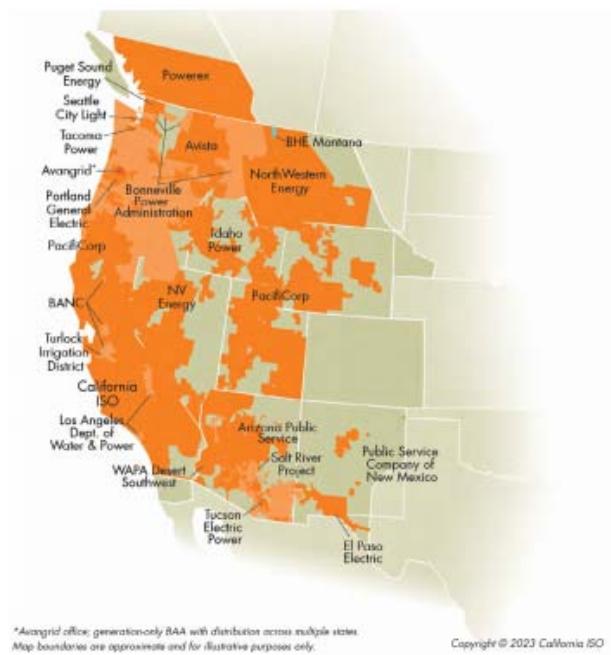
Positive experiences in the West are presented by real time power markets: the Western Energy Imbalance Market (WEIM) operated by California ISO (CAISO), launched in 2014 for participating utilities outside of the CAISO region [51](see Fig. 2.1 below), and a similar Western Energy Imbalance Service market (WEIS) operated by the Southwest Power Pool (SPP), launched in 2021 for other utilities in the West [52]. The current work being done to improve both the WEIM and WEIS by introducing day-ahead markets has strongly driven the concept of a West-wide RTO (or possibly two RTOs [13]) within the next few years.
 Active participant

Fig. 2.1: Western Energy Imbalance Market (WEIM) administered by CAISO
Source: "About," CAISO, last accessed July 17, 2024. https://www.westerneim.com/Pages/About/default.aspx.
Planned WEIM entry 2026
A part of this concept is related to improving regional resource adequacy and transmission with planning efforts in the western United States.
Besides the CAISO and SPP efforts towards an RTO West, related initiatives were presented by the
Western Resource Adequacy Plan (WRAP), the Western Transmission Expansion Coalition (WestTEC), and the West-Wide Governance Pathways Initiative (WWGPI).
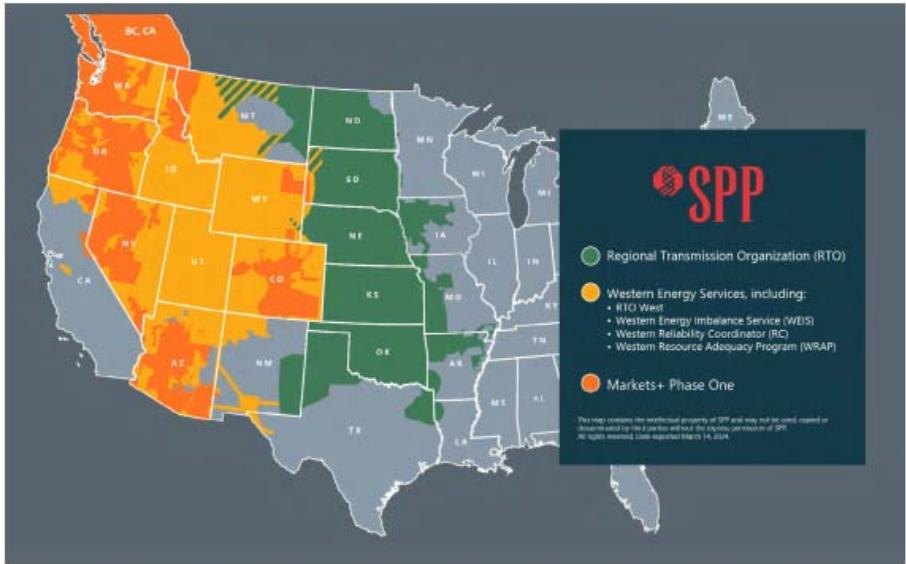
Fig. 2.2: SPP Proposal: Western Energy Services and Markets+
Source: "RTO Western Marketplace Map," Southwest Power Pool, last accessed July 17, 2024. https://www.spp.org/media/2072/rto-wes-marketsplus-map.jpg.
Specifically, most competitive today offering to provide an RTO in the Western Interconnection is presented by Markets+, a conceptual bundle of services proposed by SPP. Markets+ would centralize day-ahead and real-time unit commitment and dispatch and pave the way for the reliable integration of a rapidly growing fleet of renewable generation [53]. SPP filed its Markets+ tariff (the proposed market rules) with FERC in April 2024, and a decision by FERC is expected later this year. In June 2024, SPP proposed changes to its RTO tariff to enable full membership in the RTO for utilities in the Western Interconnection. Several small- and medium-sized utilities in the West have expressed interest in joining SPP as soon as early 2026.
As summarized in [13], "Establishing core RTO functions, namely those around organized markets and regional transmission planning and cost allocation, is a proven, equitable approach that has been shown to advance the core electricity objectives of both progressive and conservative states: lower costs, greater reliability, and environmental benefits. If the states in the West are able to embrace the idea of an RTO (or two) and work toward implementation, they will be on the most promising path for establishing a more comprehensive, efficient, and dynamic system of wholesale electric competition in the region".
## iii. Southeast Problems
The Southeast stands apart from the rest of the nation for its lack of any kind of regional competitive wholesale electricity market independent of incumbent vertically integrated utilities [54,60]. While two-thirds of electricity consumers in the United States live in a region with organized competitive wholesale power markets operated by a Regional Transmission Organization or Independent System Operator (RTO/ISO), and with much of the West being currently part of real-time Energy Imbalance Markets administered by CAISO and
SPP and moving promptly to an RTO solution, the Southeast largely retains the decades-old vertically integrated utility model, with each utility separately operating its own generating resources and transmission system.
While utilities in the Southeast are interconnected and there is limited trading of wholesale electricity between them, they each continue to rely almost exclusively on their own generation resources to meet customer needs.
Continuing with business as usual means the risk of generation overbuild is high and increasingly expensive [55]. To bring public attention to values and merits of an RTO in the Southeast, approaches to competitive pricing across the Southeast had been presented [55-57]. The analysis forecast the considerable positive impacts of a seven-state wholesale electricity market being set up in 2025, spanning Alabama, Florida, Georgia, Mississippi, North Carolina, South Carolina and Tennessee [58].
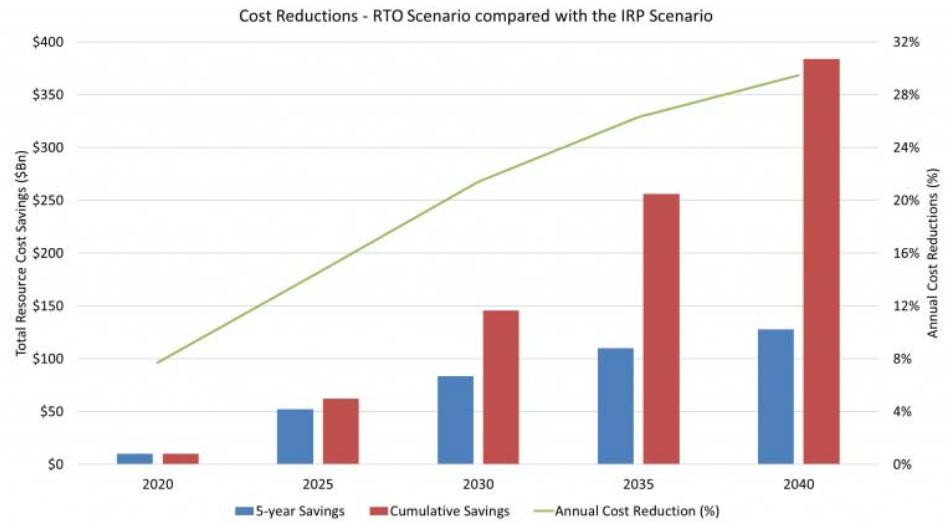
Fig. 2.2: Competitive Southeastern RTO economic savings scenario [58]
Seeing potential RTO benefits, Southeastern states started exploring ways to bring competition to the region's wholesale markets; e.g., the South Carolina legislature passed and the Governor signed Act No. 187 of 2020, which created an Electricity Market Reform Measures Study to consider establishing or joining a broader regional wholesale market such as an RTO or energy imbalance market [59].
However, in February 2021 a group of utilities including Duke, Dominion Energy South Carolina, Southern Company, Associated Cooperative and the Tennessee Valley Authority, submitted filings to FERC asking to approve a Southeast Energy Exchange Market (SEEM) – a regional energy market in the Southeast U.S. that uses a centralized intra-hour energy exchange to create bilateral trade among its trading participants every 15 minutes. SEEM presented a real-time market including Dominion Energy South Carolina, Duke Energy Carolinas, Southern Co. and 21 other participants [66,67].
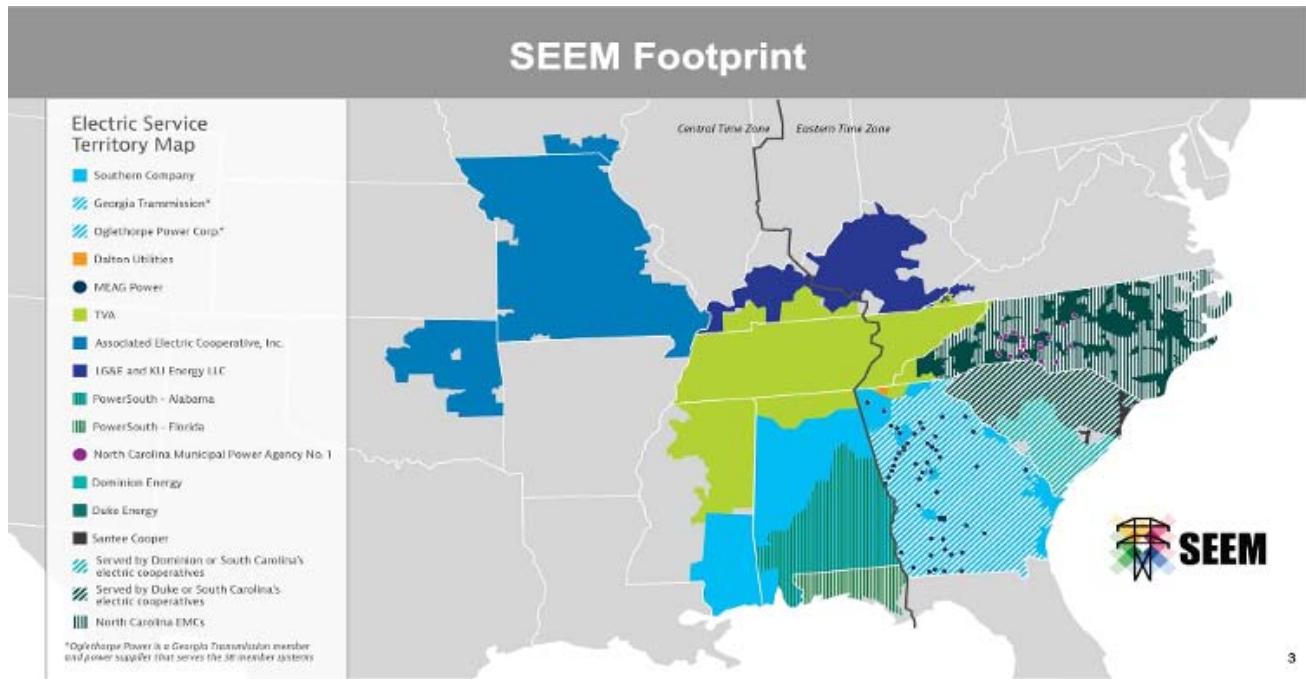
Fig. 2.3: Southeast Energy Exchange Market (SEEM) [54] In its filings to FERC SEEM was described not as an RTO/ISO, nor was it analogous to the EIM administered by CAISO or SPP. It just bore few similarities to other structural options for wholesale
energy markets, and took only very small competitive steps away from the vertically integrated status quo compared to the integrated RTO practice (see Fig. 2.4):
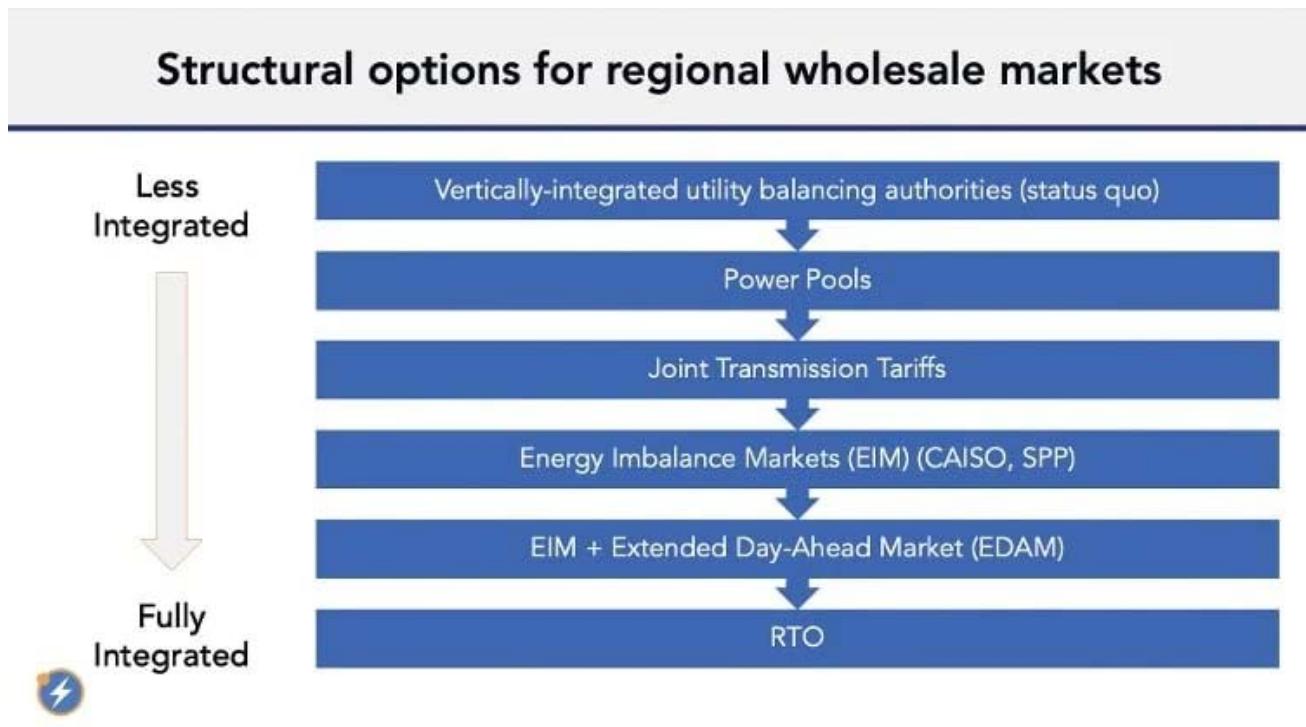
Fig. 2.4: Structural Options for Regional Wholesale Markets [54]
According to the prompt and clear SEEM critics, "With few non-utility generators able to operate in the region today and no clear path for them to join SEEM, the end result of the process is this: if no utility is offering excess generation, no utility is seeking additional generation, and no transmission capacity is sitting idle, no deal – and no savings for customers, even if in a competitive market such opportunities would be revealed....That this approach to power trading would serve utility interests above all" [60]. The critics argued that the benefits of SEEM are "paltry compared to a full organized market and that the proposal lacks the
independence and robustness needed to deliver benefits to consumers" [61].
In March 2021 a number of public interest organizations filed a protest asking the FERC not to approve SEEM [62,63]. However, after the SEEM applicants' response to two FERC's extensive deficiency letters and the FERC deadlocked 2-2 commissioners vote SEEM was allowed to take effect due to rules regarding tie votes by the agency as it "became effective by operation of law" because of the "absence of Commission action on or before October 11, 2021" [64-66]. While SEEM started its operations in November 2022 [67], in July 2023 a federal appeals court agreed with the critics, invalidating SEEM on the grounds that it violates federal regulations that require open access to such markets [61]. It addressed the key issue: while SEEM would be convenient for utilities, its limited structure would have provided little to no benefits to consumers. SEEM's participation requirements also unfairly discriminate against non-utilities that do or may have ongoing bilateral trading relationships with SEEM members but are ineligible to participate in the SEEM exchange. Following an appeals court ruling, the Federal Energy Regulatory Commission is reconsidering its approval of the Southeast Energy Exchange Market [68, 69]. At the same time, several states in the Southeast already started exploring full RTO membership.
Now having summarized RTO experiences in the U.S. in the end of 2024, let's review is today's contribution into regional integration in North America enabling its deep decarbonization.
### c) Regional Power Integration for Deep Decarbonization
## i. Leading on Deep Decarbonization Pathways
Deep Decarbonization Pathways (DDPs) are seen today as "sector-by-sector blueprints of changes over time in physical infrastructure such as power plants, vehicles, buildings, and industrial equipment—that inform decision makers about the technology requirements and costs of different options for reducing emissions" [70].
All deep decarbonization pathways incorporate "three pillars" of energy system transformation: energy efficiency and conservation, decarbonizing electricity and fuels, and switching end uses to low-carbon supplies. They present the process of improving infrastructure over time by replacing inefficient and carbon-intensive technologies with efficient and low-carbon technologies that provide the same (or better) energy services.
Canada's deep decarbonization pathways [71] present best-in-class regulations that strengthen existing policies for the electricity, buildings and transport sectors, including enhanced electric grid flexibility and storage to handle more intermittent renewables. Fuel switching to decarbonized electricity is the single most significant pathway toward achieving deep emissions reduction globally. However, to minimize both climate and economic risks, in Canada "we need to become global leaders in decarbonization policy and innovation in these sectors, not laggards" [71]. Canadian Electricity System playing a critical and very important role within the context of Deep Decarbonization, presents a critical priority in shaping its pathways.
## ii. Optimizing Canadian Electricity System
### a. Realities of Canadian Electricity System
An excerpt from a report prepared for Electricity Canada [72] defines Canadian Electricity System today as follows:
"The Canadian electricity sector is unique in generation mix, geography, and regulatory structure when compared with other North American jurisdictions. Regulation of the sector takes place at the provincial level with limited regulation of transmission lines that cross provincial boundaries. Except for Alberta, vertically integrated utilities develop the provincial transmission grid and generation resource mix to benefit the province and ratepayers as much as possible. In Alberta, transmission and distribution functions are provided by unbundled utilities and generation is provided in a competitive, energy-only market.
Given the provincial boundaries in Canada, the abundance of vertically integrated utilities, and the nature of regulation, transmission in provinces has largely been focused on North to South corridors connecting resources to load centers within each province, and from provincial load centers to US load centers on the other side of the border. Some connectivity exists between provinces; however, these connections are generally small relative to the size of the markets being connected. In addition, most extra-provincial interconnections have focused on international trade with the US as opposed to a trans-Canadian network. This is again a function of Canadian geography in that Canadian load centers are often much closer to US load centers on the other side of the international border than they are to other Canadian load centers in neighboring provinces.
Most Canadian provinces operate nearly as islands, with limited connectivity amongst Western Provinces (BC, Alberta, Saskatchewan, and Manitoba) and similarly limited connectivity between the Eastern Provinces (Ontario, Quebec, and Atlantic Canada).
Canada's generation mix is also unique with roughly $60\%$ of electricity generation coming from hydroelectric sources. B.C., Manitoba, Quebec, Newfoundland and Labrador, and Yukon all generate over $80\%$ of their electricity from hydropower, while Alberta, Saskatchewan, and Nova Scotia primarily generate their electricity from fossil fuels."
### b. Investments in the Grid a Priority
Reaching net-zero grid emission by 2035 and net-zero economy-wide emissions by 2050 to realize Canada's decarbonization ambitions requires initial investments focused on the electricity sector. Interconnected regions will play a crucial role in achieving net-zero in Canada. To ensure deep decarbonization transition, it is imperative that investments in the planned renewable generation and storage are optimized across jurisdictions using transmission upgrades. Addressing the uniqueness of the Canadian electricity system, its geography and provincial regulatory structure, a set of general recommendations in a report [72] commissioned by Electricity Canada in 2022 was as follows: (1) develop a clear inter-provincial planning process involving provinces, the federal government, and the First Nations; (2) establish a fair and reasonable cost allocation methodology to be used across Canada; and (3) to continue to explore Canada - U.S. transmission development that can provide financial benefits to Canada.
While Canada's electricity sector is backed by zero emission dispatchable hydroelectric and nuclear resources playing a central role in the country's current transition to a low emission economy, making next steps in deep decarbonization objectives requires major investments in new electricity infrastructure across the country.
As of 2022, while investment conditions at an aggregate level were perceived as favourable, they were patchy across provinces and technologies. Overall conditions for investment are relatively positive for nuclear power generation and for newer technologies such as smart grid and energy consumption management, but less so for renewable and hydrocarbon power generation [73]. Also, while public policy factors overall had a neutral impact on investment decisions, provincial regulatory frameworks for the electricity sector were viewed as having a somewhat negative impact. This highlighted the need for a strategic and coordinated approach to developing electrification policies, both within and between provinces, as well as strengthening regulatory conditions within all parts of the electricity sector value chain.
## c. Recommended Framework for Inter-Regional Grid Infrastructure
To lead on Canada's Deep Decarbonization Pathways, a collaborative framework to identify and financially support inter-regional electricity transmission projects was recommended by the Canada Electricity Advisory Council in 2024 [74] to outline their governance, cost allocation, and funding components. The European Union's Projects of Common Interest (PCIs) framework [75, 76] was proposed as a starting model.
## iii. Strengthening Inter-Regional Ties
a. Inter-Regional Power Sector Integration in the Northeast
An inter-regional integration approach for the North American Northeast (New York, New England in the Unites States and the Canadian provinces of Ontario, Québec and Atlantic Canada) leading deep decarbonization efforts in the power sector at the lowest overall cost was strongly promoted (e.g., [6]). Gains from such an inter-regional approach were seen critical due to the large amount of hydropower and reservoirs in Canada, which could be used to balance non-dispatchable renewable generation. The related aspects highlighted potential increase of transmission capacities between sub-regions, and coordination of capacity constraints (e.g., planning for available regional capacity instead of relying exclusively on the local generation capacity to meet peak demand, thus avoiding unnecessary peak capacity "duplication").
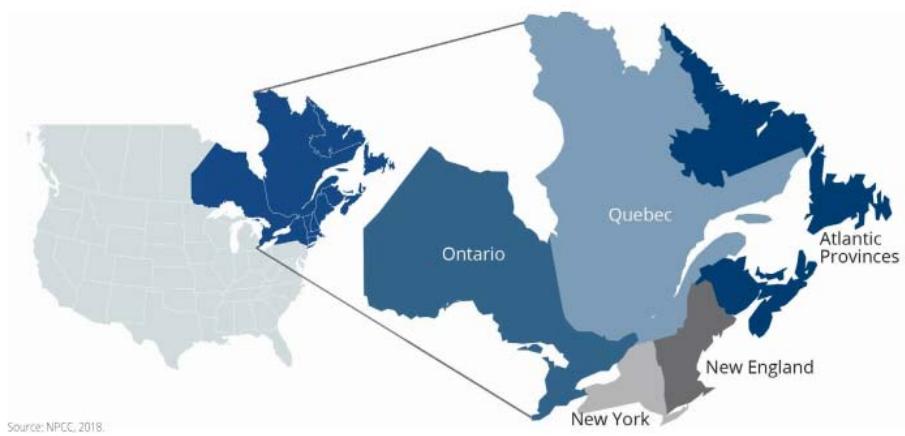
Fig. 3.1: Map of the region overseen by the Northeast Power Coordinating Council (NPCC) With the electricity sector playing a central role in decarbonization, better coordination in planning and operating the Northeast electricity sector could greatly facilitate GHG emission reduction through the dual challenge of electrifying many energy needs and decarbonizing electricity production. However, "Despite putting forward several ambitious GHG reduction and renewable deployment targets, policy efforts by subnational jurisdictions across the Northeast are falling short, and prospects for meeting renewable penetration levels required by long-term targets appear dim" [8].
To ensure significantly more attention to adjusting and upgrading electricity sector integration strategies across the region focused on variable renewable generation challenges, increased coordination and collaboration among adjacent jurisdictions is seen as immediate and critical. This involves different integration aspects such as physical infrastructure (e.g., interties - connections allowing electricity to flow between power systems), institutional and regulatory cooperation and harmonization (e.g., shared regulation, market design, and systems operation rules), and commercial integration (e.g., level of trade).
According to [8], to achieve such coordination and collaboration, significant institutional, political and social barriers must be overcome:
- Institutional barriers imply a need for subnational jurisdictions to give special attention to regulatory discrepancies across jurisdictions (e.g., market access or price levels). This is necessary to ensure that regional collaboration leads to a streamlining of efforts to harmonize and facilitate integration of grids across subnational jurisdiction borders.
- Political barriers often take the form of combining renewable deployment efforts with local industrial policy and job creation objectives.
- Social barriers materialize through opposition to projects (e.g. wind farms, dams, transmission lines). A viable path to regional integration must consider both the legitimate concerns in local areas and the regional goals to accelerate renewable energy deployment.
Strengthening regional collaboration through additional dialogue, sharing of information and data, and further technical and economic studies on the gains of and approaches to greater integration was seen as a largely recognized next step toward addressing these barriers."
This approach aligns with a broader vision of the U.S. inter-regional transmission expansion and coordination of planning and dispatch for renewable-energy integration [5, 77, 197, 202].
b. Two-way Electricity Trade Vision
Related studies promoting the benefits of interregional coordination in the Northeast showed a clear move from historical electricity export from Quebec to a "two-way electricity trade" vision.
An example of expanded inter-regional coordination with Hydro-Québec (HQ) for deep decarbonization in the Northeastern U.S. is presented in a related Deep Decarbonization Pathways study [78]. HQ for many years has been playing an important role in Northeast as a key electricity exporter, and there is a significant new resource potential for onshore wind and hydro at relatively low cost within close geographic proximity to the American Northeast. The existing transmission capacity benefits both the Northeast and Québec as it allows south to north exports at certain times during the year in combination with the predominantly north to south flow, keeping transmission utilization rates high. The HQ system, with its large reservoir capacity, has the latent flexibility to provide balancing on both a daily and seasonal scale.
The economic benefits of expanded coordination derive primarily from operating HQ's system as a "regional battery" with extensive south-north as well as north-south flows. This takes greater advantage of the flexibility of the HQ reservoir system and is an expected departure from the longstanding business model of "fixed schedule" HQ electricity exports.
The inter-regional system modeling indicated the daily pattern becoming more dynamic, with exports ramping down during sunrise and ramping up during sunset. This pattern reflects the high levels of solar PV generation in the American Northeast, with HQ importing electricity from the Northeast during daylight hours, particularly during the spring and summer, decreasing HQ hydro generation and increasing reservoir storage.
Another related study [77] concluded that in a low-carbon North American Northeast's future, it is optimal to shift the utilization of the existing hydro and transmission assets away from facilitating one-way export of electricity from Canada to the U.S. and toward a two-way trading of electricity to balance intermittent U.S. wind and solar generation.
For Northeastern U.S. states, a solution based on existing technology was proposed for the use of hydropower reservoirs in neighboring Quebec:
- The optimal use of U.S.-Canadian transmission lines will change drastically the role of Quebec hydro as a generation resource in Northeastern power systems as Northeastern states decarbonize their power systems.
- Expanding transmission enables Quebec hydro to play a greater balancing role in future low carbon power systems in the Northeast. The role of Quebec hydro as a storage resource suggests that building additional transmission is a complement to deploying clean energy in the Northeast, rather than a substitute.
- The Northeast state goals for zero-emission electricity will be achieved at a lower cost if transmission with Quebec is expanded.
## c. Inter-Regional Transmission Expansion
The current Canadian transmission system is much more focused on international transmission as opposed to interprovincial transmission, and the value of interprovincial transmission expansion has been underrepresented in historical cost-benefit analyses [79].
Expanding interprovincial transmission in Western Canada shows the most benefits in the reliability categories (risk mitigation, resource adequacy, and resilience) compared to the traditional benefit categories (production cost, emissions avoided, capital cost).
The levels of reliability benefits have to be promptly explored/modelled for the inter-provincial and inter-regional connections between Western and Eastern Canada (e.g., Manitoba and Ontario) and between the Eastern and Quebec interconnections (e.g., Ontario and Quebec, and Quebec and New Brunswick), and within Atlantic Canada.
## d. Slower Pace of Regional Integration in Canada
However, in Canada, contrary to leading regions in the U.S. (such as New York and New England) or in the European Union (such as the Nordic Region [80-82]), integration or harmonization reforms so far have been slow. Understanding of the historic evolution of electricity markets across Canada showed the economic and environmental costs resulting from the poor integration level in the country [83].
To address the slower pace of integration in the North American Northwest, key policymakers and stakeholders in eastern Canada, New York and New England were interviewed in 2020 to determine whether there is sufficient institutional and key stakeholder support in the region for an extended multistakeholder, multi-jurisdictional collaborative process dedicated to developing a comprehensive blueprint for such coordination and grid integration [84].
The results confirmed strong support for a broad-based collaborative effort to promote increased electric grid integration and coordination, and to obtain all the economic and environmental benefits that such integration and coordination is likely to yield. However, the inter-regional collaborative "cannot begin, much less succeed", unless three "must have" preconditions are met: support of the affected provincial and state governments, access to adequate data to support essential analytical and modeling activities, and sufficient resources to sustain the overall effort.
## iv. Enabling Market Opportunities
### a. Market Structures Vary
Electricity market structures in Canada widely vary in vertical integration level, in ownership (from public to private), and in competition level in generation and retail [7]. Having each of the provinces' regulatory bodies, by mandate, ignore what is going on in other provinces "creates uneven and self-centered provincial electricity markets that are not designed to collaborate and, consequently, are poorly positioned to support an efficient deep decarbonization of the economy".
Improving integration and coordination of provincially managed electricity systems in Canada opens "key opportunities: economic efficiency gains, the potential to integrate renewable energy, and improved regulation to support innovation" that can be seized through a more integrated electricity sector.
Proposed strategies inducing regional market integration include: "(1) enhancement of bilateral provincial projects through renewed federal support; (2) a bottom-up movement to provincial convergence, following a Nordic approach to collaboration [80-82]; (3) a negotiated free trade agreement in electricity, under the already established Canadian Free Trade Agreement, capitalizing on the existing "Regulatory Reconciliation and Cooperation" process; and finally (4) a federally led, healthcare-type process where key principles would be imposed on provinces to build the more integrated power system of tomorrow" [7].
### b. Benefits and Challenges of Electricity Market Integration
Generic benefits of regional electricity market integration were shown as follows [85]:
- Improving reliability and pooling reserves;
- Reduced investment in generating capacity;
- Improving load factors and increasing demand diversity;
- Economies of scale in new construction;
- Diversity of generation mix and supply security;
- Economic exchange;
- Environmental dispatch and new plant siting;
- Better coordination of maintenance schedules.
Major regulatory challenges experienced included [86]:
- Possibility to trade interconnection capacity day-ahead and intraday;
- Technical features (e.g. technical losses) properly modelled in the allocation process;
- Gate closure time as close to real time as possible;
- Integration of electricity balancing markets.
Important regional integration obstacles in Canada were recognized as follows [85]:
- Structure of political and electoral incentives in the provinces and the federal government
- Redistribution of the gains from a partial or complete integration
- Lack of recognition of the environmental benefits resulting from integration
c. Today's Realities of Inter-Regional Trade: RTO vs Regulated Monopoly
An important reason for slower decision-making on regional and inter-regional power integration in Canada is defined by the critical wholesale electricity market differences in deregulated and regulated monopoly jurisdictions.
Internal market pricing in a deregulated jurisdiction is defined by an RTO-administered wholesale electricity market at marginal cost, and in regulated monopoly jurisdiction - at average cost.
In inter-regional electricity trade the regulated monopoly always exports toward the deregulated jurisdiction pricing at marginal cost which may induce productive inefficiencies of the regulated monopoly. If both jurisdictions are deregulated, "integrated deregulation" in inter-regional electricity trade yields a decrease in overall consumption, which also brings GHG emission reduction [87].
An example of the market differences slowing regional and inter-regional integration is presented by ISO new England with its RTO-administered deregulated market, and New Brunswick and Nova Scotia as regulated monopoly utilities.
d. RTO Opportunities in Atlantic Canada
The electricity system will play a key role in achieving greenhouse gas emissions reduction targets of the Atlantic provinces (New Brunswick, Nova Scotia, Prince Edward Island and Newfoundland and Labrador) through decarbonization of energy supply and enabling electrification of buildings and transportation.
Some implications on the electricity system upgrade in the region, with an emphasis on the potential economic benefits of increased regional coordination, include the following aspects [88]:
- In-region renewable electricity generation: the Maritimes will require significant construction of in-region renewable energy to provide zero-carbon energy and decarbonize the electric power supply regardless of regional coordination measures to import dispatchable, clean energy from Newfoundland and Labrador, or/and from Quebec.
- Dispatchability needed for Deep Decarbonization: achieving very deep levels of decarbonization will require firm, dispatchable low-carbon energy and capacity to ensure reliability, which will be possible/ necessary only with broader regional coordination.
- Low carbon dispatchable energy has significant and growing value: "imported hydropower or other dispatchable, clean energy can meet the need for zero-carbon electricity and the need for firm capacity for system reliability, acts as a hedge against significant uncertainty in commercial development of low-carbon baseload and shows significant value under a wide variety of
uncertainties, in particular in scenarios examining 2030 coal retirement".
A clear curve of regional collaboration efforts and steps in Atlantic Canada was summarized in the presentation "Regional collaboration and infrastructure optimization in energy modelling" in 2024 [89]. It shows that an RTO in Atlantic Canada has been waited for, is required and much needed. Before looking attentively into deep integration opportunities that may allow Atlantic Canada to promptly and strongly contribute to deep decarbonization of the country, let's review the current situation with and upgrade of electricity wholesale efforts in Canada.
## III. EXPECTED RESULTS AND OUTCOMES
### a) Upgrading Electricity Wholesale in Canada
## i. Alberta and Ontario: Leading Competitive Wholesale
Canadian power industry paid serious attention to the development and deployment of competitive wholesale electricity markets in the U.S., and followed the rules and achievements established by FERC. The most industrialized provinces of the country – Alberta and Ontario – followed the experiences in the U.S., leading wholesale electricity market deployment in Canada in Western and Eastern interconnections.
a. Upgrading Operations
Alberta: Electricity policy in the province changed in 1996, with the province restructuring its electricity market away from traditional regulation to a market-based system [90]. The Alberta Electric System Operator (AESO) started operating in 2003 planning and operating the wholesale market and managing/planning the related power grid [91]. The market now includes an increasingly diverse infrastructure for multiple electricity buyers and sellers. AESO operates "independently of any industry affiliations and owns no transmission or market assets" [92].
Alberta's power system is undergoing the greatest transformation in its history, driven by new technologies, government policy and a societal shift toward cleaner forms of energy, and the AESO is playing a leadership role in enabling this transformation [93].
AESO is a member of the ISO/RTO Council (IRC), Western Electricity Coordinating Council (WECC), Western Power Pool (WPP) and North American Reliability Corporation (NERC).
Ontario: The Independent Electricity System Operator (IESO) was established in April 1999 as the Independent Electricity Market Operator (IMO) under the government of Ontario in preparation for deregulation of the province's electrical supply and transmission system [94]. The IMO was renamed to the IESO in January 2005. It is the Crown corporation responsible for operating the electricity market and directing the operation of the bulk electrical system in the province.
As a key service across the electricity sector the IESO manages the wholesale market in the province, including planning for the province's future energy needs, and designing a more efficient electricity marketplace to support sector evolution [95]. The IESO identifies system needs and planned actions from 2025 to 2050 that are needed to ensure the reliability, affordability and sustainability of Ontario's electricity system [96]. The IESO is a member of the ISO/RTO Council, NERC and Northeast Power Coordinating Council (NPCC).
### b. Restructuring Energy Markets
The electricity sector is in a time of fundamental change. Every jurisdiction, regardless of its framework, is experiencing reliability and affordability challenges that are becoming more significant as the pace of change increases [97].
AESO and IESO as the leading Canadian electricity wholesale market operators clearly defined the next steps in addressing these changes through restructuring energy markets.
As Alberta's current electricity system is being impacted by transformational change, the AESO Net-Zero Emissions Pathways Report (Net-Zero Report) [98,99] and the AESO 2023 Reliability Requirements Roadmap (Reliability Roadmap) [100,101] noted key operational and reliability challenges that are having implications on the sustainability of the electricity market as currently designed in Alberta.
The need for more structural change to the market design and provincial electricity policy is being driven, among other emerging trends, by technological shifts changing where and what type of resources power the grid:
- Alberta is experiencing a significant change in its generation fleet with the reduction in carbon-emitting generation sources and the increasing pace of development of variable renewable generation resources (i.e., wind and solar). The integration of these resources is important to support a carbon-neutral future. However, these resources must be operated with an accompanying mix of controllable resources.
- Increasingly, supply is not providing attributes that are required to maintain reliability without the need for additional ancillary services and/or technical requirements.
AESO's approach to restructuring energy markets to address this change including the AESO's study, observations and recommendations was presented to the Alberta government in January 2024 [102].
A key recommendation of AESO addresses the ability to procure contracts for controllable/dispatchable technologies[1] focused on the objectives of Reliability, Affordability, Decarbonization by 2050, and Reasonable Implementation. A set of different dispatchable technologies supporting these objectives and demonstrating the current and future role and potential, in AESO's opinion, includes carbon-abated natural gas power, full-scale nuclear, small modular reactors, hydrogen-fueled generation, hydroelectric power, and energy storage resources. Specifically, the reliability objective involves defining and establishing sound technical requirements for all technologies, especially a new and growing class of inverter-based resources (e.g., wind turbines, solar arrays, and batteries).
While AESO worked promptly in 2024 on the Restructured Energy Market design development and engagement (see [103, 104]), IESO also completed its Market Renewal Program [105]. The mission of the Market Renewal Program is to deliver a more efficient, stable marketplace with competitive and transparent mechanisms that meet system and participant needs at lowest cost. The Market Renewal Program (MRP) is modernizing Ontario's electricity markets to address inefficiencies and will be a building block to embrace the continued transition to new and diverse resources [106]. MRP will make improvements to the current electricity market design, by improving how electricity is supplied, scheduled and priced by IESO, leading to system efficiencies and supporting the grid of the future. This project will deliver significant value to the system and Ontario consumers - an expected $700 million in benefits in the first 10 years alone.
## c. Accommodating DER Aggregations
In parallel and in coordination with restructuring their energy markets, IESO and AESO have been collaborating with their stakeholders to understand the ways to accommodate DER aggregations (DERA) in their markets.
In response to FERC's Order 2222 [107], ISO/RO across the US are developing and implementing wholesale participation models for DERs that inform potential enhancements in IEASO and AESO. This includes:
- Opportunities to enable new and more diverse DER aggregations (DERAs) to better reflect existing and emerging DER potential in the province
- Potential to enable greater flexibility of aggregated demand-side resources
- Addressing barriers to participation for small resources (e.g., metering/telemetry processes and requirements)
The key areas include DERA participation (e.g., participation and aggregation models will be established
for DERs, maximum and minimum size thresholds needed for individual DERs and/or DERAs, etc.), eligible wholesale market services (e.g., energy, operating reserves and capacity) and metering and settlement for DERAs [108].
IESO sees DERs as emerging major players in the electricity sector in Ontario with at least 5000 MW* of DERs that IESO has visibility to as a result of markets, procurements, programs and initiatives have already been deployed in Ontario. IESO sees potential for substantial growth [109] with additional DERs being deployed to support customer and policy-driven electrification and decarbonization goals, and has been
determining cost-effective ways to enhance the value DERs can provide to Ontario's electricity system by expanding participation in the wholesale markets.
As an example, the IESO's Market Vision and Design Project [110] as a key focus area of DER integration activities explored with stakeholders "foundational" participation models for DER integration into wholesale markets as well as enhanced models to form future DER integration [111]. IESO also plans by 2026 to design in detail and implement the foundational wholesale participation models including market rule/manual amendments and process/tool updates [112].
Table 4.1: Key Features of Foundational and Enhanced Models [112] Key Features of Foundational and Enhanced Models
<table><tr><td>Key Focus Area</td><td>Foundational Model</td><td>Enhanced Model</td></tr><tr><td>Aggregation Details</td><td>·Enables aggregation at a single node
·Enables heterogeneous aggregation of certain resource types
·Aggregation of residential and small C&I consumers not enabled</td><td>·Enables sub-zonal (or multi-nodal) aggregation
·Enables heterogeneous aggregation of all resources except very small consumers which must be aggregated with resources similarly dependant on Smart Meters
·Aggregation of residential and small C&I consumers is enabled</td></tr><tr><td>Size</td><td>·Enables DER Aggregations (DER(A)) with a total size of 1 MW or more and will explore the possibility of reducing the threshold for the aggregation size; no minimum size for individual contributors</td><td>·Enables DER(A) of 100 kW or more; no minimum size for individual contributors to an aggregation</td></tr><tr><td>Products and Services</td><td>·Capacity, Energy and Operating Reserve</td><td>·Capacity, Energy, Operating Reserve and, if there is a system need, regulation service</td></tr><tr><td>Metering and Settlement</td><td>·Applies existing, relaxed IESO requirements for small resources to DER(A)</td><td>·Will allow for alternative requirements for residential/small C&I DER(A) (by utilizing the Smart Meter Entity for settlement purposes) that reflect the size of the resources and risk mitigation capabilities of participating in aggregate</td></tr></table>
Another example is collaboration of AESO with its stakeholders on the development of proposed Amendments to ISO rules related to the Operating Reserve ("OR") Market Review ("OR Market Review Rule Amendments") related to DER/DERA. By May 31, 2023, AESO received comments from its Stakeholders in response to its March 29, 2023 Letter of Notice for Development of Operating Reserves Market Review Rule Amendments [113], and by July 31, 2023 provided its feedback to the stakeholders.
## ii. British Columbia: Moving to Deep Integration
BC Hydro, a Crown Corporation of the province of British Columbia, participates in wholesale energy market activities in the Western Interconnection of North America via Powerex Corp., a wholly-owned subsidiary of BC Hydro [114]. The surplus capabilities of the BC Hydro generating system and Powerex's portfolio of transmission service rights enable Powerex to buy, sell and shape power deliveries to BC Hydro customers across the Western Electric Coordinating Council (WECC) region.
Powerex began its participation in the real-time Energy Imbalance Market (EIM) administered by California Independent System Operator (CAISO) on April 4, 2018, pursuant to Commission-approved agreements that recognize its status as a Canadian EIM entity [115]. Powerex has been participating in the EIM in the same format as many other EIM entities in the market managed by CAISO. This includes [116]:
- Flexible Generation - voluntary bids and offers from residual BC Hydro flexible generation;
- Generation and Load Imbalances - deviations from hourly base schedules;
- Transmission rights - set aside ahead of the hour to support EIM transfers.
In November 2022 after its careful review of the two competing alternatives for a fully-integrated RTO solution demonstrating deep integration in the Western interconnection: SPP's Markets+ and CAISO's Energy Day Ahead Market/Energy Imbalance Market (EDAM/EIM), Powerex concluded that SPP's Markets+ is the market platform that will provide Powerex with the
greatest economic, environmental and reliability benefits [117, 118]. Powerex announced that "it will not only participate in the funding of the development of Markets+, but it will also join Markets+ at inception, subject to applicable approval processes".
The following elements of the Markets+ Draft Service Offering were "particularly important to Powerex's decision to pursue Markets+:
- A durable and inclusive governance framework that is in palace from the outset, supported by an experienced and neutral market operator, and the independence of a Markets+ Independent Panel and the SPP Independent Board;
- An approach to GHG tracking that is expected to accurately apply GHG emissions costs to energy generated in, or imported into, jurisdictions with GFHG pricing programs, and in a manner that meets the full intent and spirit of the underlying environmental policy;
- A common resource adequacy requirement that will not only protect reliability, but do so in an equitable manner, leveraging the Western Resource Adequacy Program (WRAP);
- A transmission proposal that will maximize the transmission capability available to Markets+ while minimizing impacts on third-party transmission revenue and equitably allocating congestion revenue to OATT customers, and
- Application of industry best practices in price formation, consistent with FERC policy, ensuring that market prices accurately reflect grid conditions, which drives lower retail rates for consumers over the long-term while supporting reliability".
On Mar 25, 2024, SPP's Board of Directors and its members have approved the initial tariff for its Markets+ service offering in the Western Interconnection, clearing the way for its filing at FERC [119]. As of April 2, 2024, Markets+ is expected to go live in early 2027, pending FERC approval of the tariff [120].
## iii. Manitoba and Saskatchewan: Building RTO Alliances
Both Manitoba Hydro and SaskPower made important steps toward strengthening wholesale markets in North America via alliances with leading RTOs in the U.S.
Saskatchewan: In 2022, SaskPower signed a 20-year agreement starting in 2027 with the Southwest Power Pool (SPP) increasing its ability to sell and buy bulk power at the wholesale power market for the central United States managed by SPP [121]. SaskPower is SPP's first international member, and their membership represents both organizations' continued efforts to increase reliability through interregional coordination [122]. SPP and SaskPower have operated as adjacent entities since October 2015 when SPP's service territory
expanded to the North Dakota-Saskatchewan border, coordinating their reliability and transmission functions. SaskPower's participation in the SPP represents a commitment by both organizations to strengthen wholesale market opportunities across their borders.
Manitoba: Manitoba Hydro joined MISO in September 2001 through the execution of a Coordination Agreement [123]. With an installed capacity of close to 5700 MW of hydro power generation Manitoba Hydro operated as a strong contributor to clean electricity resources supplying its U.S. customers with power and energy via the wholesale market managed by MISO. In addition to participating in MISO as the Coordinating Owner, Manitoba Hydro also participates in the MISO Capacity, Ancillary Services, Energy and Financial Transmission Rights markets through which it delivers to the MISO footprint approximately 1000 MW of capacity and 10 TWh of energy on an annual basis.
## iv. Quebec Selling to Wholesale Markets in Northeast
### a. One Utility, One Interconnection
Hydro-Québec is a vertically integrated provincially-owned power utility established by the government of Quebec. Hydro-Québec's electricity transmission system is managed by its division - Hydro-Québec TransÉnergie (HQT). Quebec Interconnection covering the province of Quebec and operated by HQT is not synchronized with Eastern Interconnection or any other interconnections in North America [124]. TransÉnergie uses HVDC technology (back-to-back converters) to export or import electricity to other transmission grids in the neighbouring Eastern Interconnection.
HQ and the Quebec government have been working successfully (and not without hardships) to increase electricity exports to the U.S. via existing and proposed new transmission lines [125]. Major electricity supply provided by HQT to ISO/RTO wholesale markets in North America includes IESO (Ontario), ISO NE (New England) and NYISO (New York). Today, with the American Northeast committed to rapidly scale variable renewables, inter-regional collaboration between Quebec and the Northeastern U.S. is underway that may "fundamentally reconsider the role of hydropower on the grid" [126, 127].
Inter-regional efforts and opportunities for Quebec are proposed by leading universities in Quebec and well documented, e.g., [6-8, 83, 85, 87, 128-132].
b. The "Battery" of Northeastern America
According to Quebec's Framework Policy on Electrification and the Fight Against Climate Change [133, 134], "the provincial government is aiming to use our considerable hydroelectric resources to make Québec the "battery" of northeastern America. This involves the ability to use electricity exports to contribute to the fight against climate change beyond Québec's borders and the potential to attract even more
companies that want to take advantage of this clean, competitive energy".
"By 2030, the government has set its sights on increasing electricity exports to neighbouring markets under long-term contracts. It will propose energy alliances to neighbouring provinces and states in the American Northeast in order to promote Quebec's resources and increase electricity exports. These energy alliances will make the American Northeast a greener, more competitive region."
According to Hydro Quebec Action Plan 2035 [135], the utility plans to integrate 8,000 to 9,000 MW of new generation assets into the Hydro-Québec grid. As hydropower is the best option for firming up intermittent wind power in Quebec, from 3,800 to 4,200 MW of new hydropower will be added by increasing the capacity of the existing generating stations and building new hydropower facilities, including a pumped-storage facility.
Transmission infrastructure will be deployed to connect additional generating facilities and promising new projects for Québec. By 2035, Hydro-Québec plans to invest a total of $50 billion to install 5,000 kilometers of transmission lines to increase the capacity of our transmission system in order to maximize access to new generation. About half of which will be high voltage (735 kilovolts and 315 kilovolts) and the other half intermediate voltage (between 69 kilovolts and 315 kilovolts) for regional development and local loads [136]. Hydro-Québec plans to launch a major undertaking to upgrade 735-kV lines: the backbone of Québec's transmission system. The first phase will include the optimization of the existing system and the construction of almost 850km of new 735-kV or 315-kV lines, as well as 5 strategic new substations in 3 areas. This infrastructure will allow new generation to be integrated into the grid, transmit additional energy across Québec and increase grid reliability and resilience to increasingly intense weather phenomena [137, 138].
As the Reliability Coordinator for the Quebec's electricity system, Hydro-Québec on October 1, 2024 updated all the data and information it needs to monitor the transmission system of Quebec and meet its operational obligations, including to perform Operational Planning Analyses, Real-time monitoring, and Real-time Assessments, as Reliability Coordinator (RC), Balancing Authority (BA) and Transmission Operator (TOP), under the established by NERC reliability standards [139].
## c. Amping Up Electricity Regulation
On June 6, 2024 the Government of Québec tabled Bill 69, An Act to ensure the responsible governance of energy resources and to amend various legislative provisions, in the National Assembly [140]. The bill is essentially aimed at speeding up green energy production in the province, with the ambition of making Québec the first carbon-neutral jurisdiction in North America. Although electricity appears to be at the centre of Bill 69, some changes are also aimed at natural gas and other sectors of the energy supply chain of Québec. According to current strategies and plans, Quebec needs to double its energy production to support initiatives that will allow it to reach its climate targets [141].
Specifically, Bill 69's proposed amendments would [142]:
- Enable Hydro-Québec to enter into renewable electric power supply contracts without being subject to tendering obligations, as well as give Hydro-Québec the ability to sell certain production infrastructure;
- Allow private producers to sell and distribute electric power to other private entities located on a site adjacent to their production site; and
- Introduce a new governance model.
Bill 69, which aims to set up a legal framework to support the province's energy transition [143], is expected to be adopted by the end of 2024.
Keeping in mind the current wholesale electricity updates in all the provinces in Western Canada, Ontario and Quebec, the regional wholesale market reasons and solutions for Atlantic Canada contributing to deep decarbonization via Canada's Clean Grid are proposed in the following chapter.
### b) Atlantic RTO as the Energy Gateway Solution
## i. Atlantic Energy Gateway
In March 2009 Atlantic Canada made a next step in expanding regional clean electricity collaboration announcing the Atlantic Energy Gateway (AEG) to enhance the development of Atlantic Canada's clean energy resources. AEG represented a collaborative approach coordinated by the Federal Government (Natural Resources Canada and the Atlantic Canada Opportunities Agency), with participation from the governments of the four Atlantic Provinces, four of the major regional utilities, and the Region's two system operators [26, 27].
With emerging clean electricity opportunities in the region ranging from large hydro to wind and tidal power in clean electricity generation and green hydrogen production in clean consumption, the Atlantic Energy Gateway was seen as one of the strategic gateways to prosperity in Atlantic Canada and beyond [28-31].
In early 2011 energy ministers of the Atlantic provinces agreed to speed up regional co-operation efforts, identify priority opportunities and maximize benefits for the region [144]. By March 2012 strong advances were made in better understanding of the ways to move in regional clean electricity collaboration.
On September 10, 2012, the federal and provincial ministers announced the results of studies undertaken under the AEG. The research identified significant potential benefits of regional collaboration, including development and operating cost efficiencies, greater diversity in clean energy supplies, enhanced stability for ratepayers and lower greenhouse gas emissions in the Atlantic region. The research involved significant engagement of the power utilities in the four Atlantic provinces [27].
Specifically, the following understanding below was shared and agreed upon within the AEG initiative.
### a. Market Opportunities
The AEG team completed a review of provincial and state clean and renewable energy policies supporting clean and renewable energy targets [145]. The review highlighted that the Atlantic provinces will only cooperate, and truly "buy-in", if there is mutual gain. Greater interprovincial power cooperation was seen necessary for a successful export to New England.
The review highlighted a need for a Regional System Operator that could provide coordinated balancing and load following services for the region. A regional system operator could provide a more efficient and economic structure to facilitate interprovincial power flows. In addition to streamlining the tariff system, a regional system operator that had independence from individual provinces' political decision-making could improve market access for independent producers.
### b. Regional Electricity System Operations
The AEG initiative's review of Regional Electricity System Operations in Atlantic Canada was focused on the operations and requirements of a regional transmission system [26]. The review also included a description of the regulatory systems in place in the Atlantic Provinces, and also other relevant regulators including the U.S. Federal Energy Regulatory Commission (FERC), North American Electric Reliability Corporation (NERC), Northeast Power Coordinating Council (NPCC) and Canada's National Energy Board (NEB), regulating international power lines, and energy imports and exports in Canada.
It was indicated that "increasing regional electricity and clean renewable energy cooperation could achieve potential efficiencies and cost benefits to consumers and industry, and expand economic opportunities and benefits for the region. Implementation considerations and some areas that could be reviewed in exploring increased coordination are:
i. Existing generation and transmission structures and policies;
ii. Examining opportunities for regional planning for expanded renewable energy
iii. Sources to maximise market competitiveness;
iv. Planning for future system operations on a regional basis; and
v. Harmonizing certain regulatory functions, while ensuring the Atlantic region maintains its close regulatory, reliability, and business relationships with the Northeast USA and related agencies.
Increasing cooperation and coordination by the Atlantic Provinces' electricity sectors could become the start of an Atlantic Canada power market that is more competitive, both locally and internationally."
## c. Regional Transmission Upgrade Options
As a tighter integration of the regional Atlantic Canada electrical system was expected to lead to increased opportunities for inter-provincial energy trade, a resource assessment of the integrated regional system was done through the development of a representative model of the system [146]. The model was used to evaluate the current operation of the system and develop scenarios for increasing amounts of renewable and non-emitting energy sources for domestic and export electricity uses. Various potentially desirable transmission upgrade options and the key interfaces between New Brunswick and Nova Scotia, and New Brunswick and Prince Edward Island were identified to determine their approximate transfer capabilities and the costs to upgrade transmission facilities.
## d. Common Unit Commitment and Dispatch Functionality
The AEG initiative supported the development and testing of a regional system model, database, and skill set a common unit commitment and dispatch function for balancing electricity supply and demand in Atlantic Canada to be used for future studies [147]. This was a model upgrade from the New Brunswick System Operator balancing at that time New Brunswick, Northern Maine and Prince Edward Island systems as one balancing area. The results of the common unit commitment and dispatch functionality review were intended to inform policy makers on the appropriateness of pursuing a common system balancing function.
### e. Clean Electricity Resources
The AEG Resource Development Modeling Study was focused on regional integrated resource planning (IRP) of future electric generating resources rather than IRP done separately by each of the Atlantic utilities for their medium and long term future generation development for the period of 2015 through 2040 [148]. The objective of the study was to model a more integrated view of the region and determine the economic and environmental benefits compared to the individual provincial models.

f. Renewable Generation Supply Chain Opportunities in Atlantic Canada
The Atlantic Energy Gateway initiative examined a range of issues associated with opportunities for Atlantic Canadian firms in the supply chain for various renewable generation technologies, including onshore wind, offshore wind, tidal energy, biomass energy, and systems to power remote on- and off-grid communities [149].
A summary of Renewable Generation Supply Chain Opportunities included the following (see excerpts from [149] below:
- The supply chain for onshore wind is currently robust, but still offers a number of service-related opportunities to Atlantic Canada, including crane services for installations, operations and maintenance, and logistics services.
- Supply chain development for offshore wind and tidal power, had been limited in the region due to the nascent state of these technologies. However, should these technologies reach commercialization, the resulting supply chains, which have much in common, will offer significant opportunities to the economies of Atlantic Canada as Atlantic Canada is well positioned in both geography and industrial infrastructure to contribute substantially to these supply chains as they mature.
- A healthy biomass supply chain is already established in Atlantic Canada, but opportunity exists to expand this supply chain. Thermal energy applications, especially exports, present the greatest opportunity for growth, but electric generation appears to offer less potential.
- Potential supply chain opportunities also exist related to the development of systems to power on- and off-grid applications that displace diesel generation with renewable resources. Local firms involved in wind/hydrogen demonstration projects may benefit from forming partnerships to develop a standardized control system that would allow for turnkey replication of these wind/hydrogen facilities. The off-grid use of biomass for district heating and/or cogeneration was also analyzed and may offer further supply chain opportunities through greater application in district heating and remote communities.
g. Research, Development and Demonstration
The AEG initiative reviewed a complete picture of the clean and renewable energy RD&D activities in Atlantic Canada, both in terms of types of technologies being pursued, and the intellectual and institutional resources present in the region, to help direct future strategies [150]. The AEG RD&D review presented summaries of the current state of clean and renewable energy used in each of the four Atlantic Provinces, and of their research and development capacity. Potential areas of regional cooperation were presented, along with policy considerations intended to support the AEG's clean and renewable energy development initiatives.
## ii. Looking into a Clean Electricity Future in Atlantic Canada
a. Leveraging the Pan-Canadian Framework on Clean Growth and Climate Change
The next step in enhancing clean energy opportunities in the Atlantic region was made by the Pan-Canadian Framework on Clean Growth and Climate Change (PCF), a collective plan to grow the economy while reducing emissions and adapt to a changing climate [151]. In December 2016, the PCF, published the outline of a collaborative action plan to meet or exceed Canada's 2030 target of a 30 percent reduction below 2005 levels of greenhouse gas (GHG) emissions. Specific actions to transform regional electricity systems supported by PCF included: (1) increasing the amount of electricity generated from renewable and low-emitting sources; (2) connecting clean power with places that need it; (3) modernizing electricity systems; and (4) reducing reliance on diesel working with Indigenous Peoples and northern and remote communities.
Within PCF the federal government committed to investing in infrastructure through a number of national programs, negotiated agreements with provinces and through the Canada Infrastructure Bank, a federal Crown corporation using federal support to attract private sector and institutional investment to new revenue generating infrastructure projects that are in the public interest. Specifically, the Green Infrastructure stream, through Integrated Bilateral Agreements (IBA), allocated investments in the Atlantic provinces with a minimum of $45\%$ of a province's IBA Green Infrastructure stream allocation supporting greenhouse gas emission mitigation projects, such as new renewable electricity and transmission projects.
To update a regional infrastructure perspective, a regional study was conducted to identify promising electricity infrastructure projects in Atlantic Canada. Specifically, the governments, and their respective electric utilities, of Nova Scotia, New Brunswick, Prince Edward Island, Newfoundland & Labrador and the Atlantic Canada Opportunities Agency collaborated on a regional economic dispatch simulation model to examine promising electricity infrastructure projects to meet a set of carbon-constrained future scenarios.
The regional power grid infrastructure was looked at in terms of current and future diverse clean energy supply led by large hydro and nuclear.
Major hydro advances included the Newfoundland and Labrador Muskrat Falls Project, including its associated transmission projects, to make Newfoundland and Labrador's electricity generation $98\%$ renewable and provide Nova Scotia with 20 percent of the energy and capacity from the Muskrat Falls 824 MW generating station.
Considerations were given to electricity from Churchill Falls, a 5,428 MW hydro generating station operated in Labrador, that will be available for the Atlantic regional trade operations after a long-term power purchase agreement (PPA) with Hydro-Quebec expires August 31, 2041. The Government of Newfoundland and Labrador also saw the 2,250 MW Gull Island renewable energy project on the lower Churchill River as a potential future development opportunity.
In terms of nuclear, New Brunswick Power explored the possible use of Small Modular Reactors at the existing Point Lepreau Nuclear, a 660 MW Generating Station.
Modelling potential futures for the regional electric system showed that regional electricity transmission reinforcement is required enable the introduction of more sources of renewable energy, and that developing new non-emitting "dispatchable" resources is needed to provide firm capacity. It was confirmed that coordinated regional action can achieve deep GHG emissions reductions required. At that time, decision was made to further explore the Regional Hybrid Portfolio Scenario to identify optimal incremental changes to the regional system [88]. This includes investigating an appropriate amount of dispatchable firm generation capacity, and/or storage and demand-side management systems, and transmission reinforcement to support more sources of variable renewable generation for further GHG reduction.
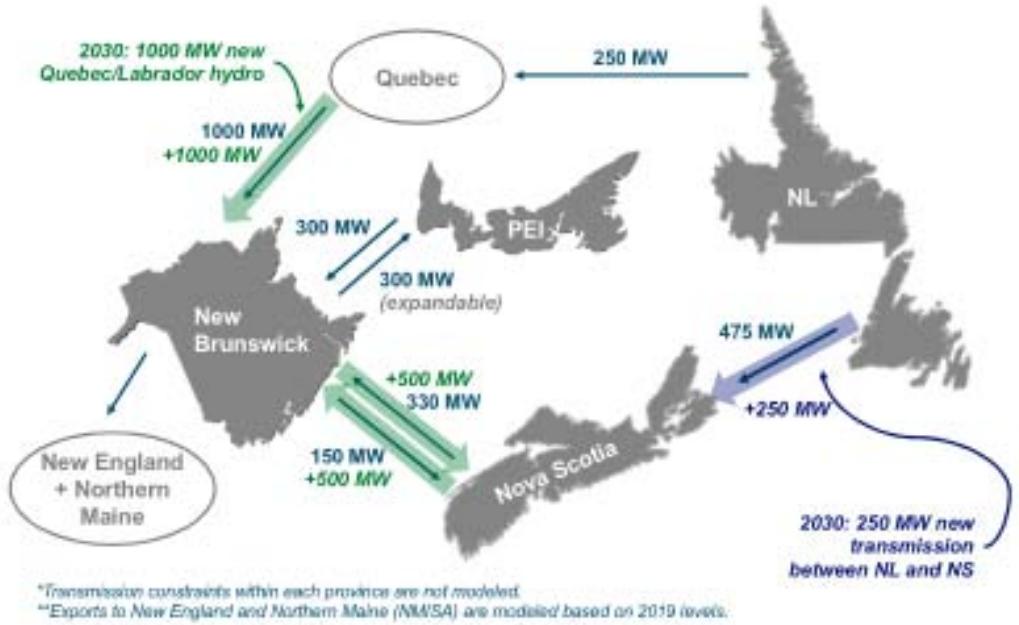
Fig. 5.1: Regional coordination scenarios: electric load zones and transmission capacities [88] b. Advancing a Clean Power Roadmap for Atlantic Canada
Building on a long history of collaboration, in March 2019, the Atlantic Provinces and the federal government agreed to develop a Clean Power Roadmap for Atlantic Canada. The Roadmap was intended to outline a collective vision for how the Atlantic provinces may collaborate over the coming decades to build a clean power superhighway across the region [32].
Specifically, a shared vision of an interconnected clean power grid was agreed to serve as the foundation for a competitive, electrified economy across the region. "The integrated grid would provide Atlantic Canadians with an affordable and reliable supply of clean power, underpinned by a regionally integrated, modern electricity system that better optimizes supply and demand through smart grid technology and energy storage. It could lead to more efficient investment and management of costs; more choices and economies of scale in building new sites; better coordination of system maintenance, and increased reliability" [32].
The transition planned for Atlantic Canada's power system was seen as significant, opening "new, untapped environmental and economic potential" [33].
A strengthened Atlantic Regional Transmission Loop approach was proposed as the backbone of the regional grid that would connect existing and new power supplies across the region to places that need it, along with smarter distribution networks that optimize supply and demand while maintaining reliability.
The initial Atlantic Loop concept was modified in October 2023 [152] with a focus on expanding "Clean, Reliable and Affordable Electricity Grids in New Brunswick and Nova Scotia" [153, 154]. As part of the first track of collaborative work, priority projects required to meet the 2030 timeline included the building of the Salisbury-Onslow Reliability Tie connecting Nova Scotia

and New Brunswick. Under the second track of work, the parties agreed to confirm and advance areas of critical importance and cooperation on the path to net-zero electricity by 2035, including the continued advancement of Small Modular Reactors, which is specific in New Brunswick, and offshore wind, which is specific in Nova Scotia. This also included further exploring regional transmission and energy exchange opportunities in partnership with neighboring utilities, in Quebec, Newfoundland and Labrador, and Prince Edward Island.
According to Nova Scotia's 2030 Clean Power Plan [155], "NS-NB Regional Transmission Nova Scotia's electricity system is only weakly connected to the North American grid, through New Brunswick. A new $345\mathrm{kV}$ line to NB is needed to manage renewables, boost reliability and resiliency. This NS-NB Reliability Tie will run from Onslow to Salisbury, enabling $500\mathrm{MW}+$ of imports/exports. This project is expected to be online in 2028. Extending this line to Point Lepreau would enable greater access to NB, New England, and Quebec. This new line and extension can be completed by 2029 at a total cost of $\sim$ 1.4B, far less than the Atlantic Loop. This supports regional population growth; enhances reliability; and enables more energy trading. Interprovincial & Federal talks are underway to support these transmission investments."
c. Atlantic Canada's Economy: Commitments and Opportunities
Atlantic governments and businesses have been significantly investing in the development of clean technologies to support the net-zero transition:
Clean Generation:
- Muskrat Falls Hydro: The Muskrat Falls Hydroelectric Project includes the hydroelectric generating facility on the lower Churchill River in Labrador, transmission infrastructure linking the facility to the Churchill Falls facility upstream, and the Labrador-Island Link (LIL) transmission line. Construction of the 824 MW Muskrat Falls facility began in 2013 and was commissioned in November 2021 [156]. The Labrador-Island Link was commissioned in April 2023 [157]. The station at Muskrat Falls has a capacity of over 824 MW and provides 4.5 TWh of electricity per year. [158, 159]
The Muskrat Falls Hydroelectric Project provides an opportunity to consider Phase Two of the Lower Churchill Project that would consist of the development of the 2,250 MW Gull Island generation facility and associated transmission to markets.
Completion of HVDC Power Transmission Lines
Labrador - Island Link (LIL) is a 1,100 km 900-megawatt (MW) high voltage direct current (HVDC) transmission line that carries electricity from a generating facility at Muskrat Falls to the island of Newfoundland [160].
Maritime Link involves a 500 MW (+/- 200 kV) high-voltage direct current (HVDC) transmission line, as well as a 230 kV HVAC (high-voltage alternating current) transmission line [161] that carry electricity from Newfoundland to Cape Breton, Nova Scotia. Maritime Link was commissioned in 2017 [162].
- Deployment of Utility-Scale Battery Storage
Demonstration of Atlantic Canada's leadership in growing utility-scale battery storage [163] includes:
Saint John Energy, New Brunswick: A utility-scale battery energy storage system used as a part of the 42 MW Burchill Wind Project in Saint John, New Brunswick.
The battery is the largest in New Brunswick. It consists of a 5.8 megawatt/11.6 megawatt-hour lithium-ion battery that can deliver 5.8 megawatts of energy to the Saint John Energy grid for a two-hour period on a full charge [164].
NB Power, New Brunswick: Procurement for 50 MW of new battery energy storage in 2023 [165].
Nova Scotia Power: Funding has been committed under the Smart Renewables and Electrification Pathways Program to Nova Scotia Power for three grid locations at White Rock, Bridge Water and Spider Lake, Nova Scotia to install and integrate battery energy storage and grid modernization assets and operating systems totalling 150 MW, 600 MWh in these locations. The Nova Scotia Utility and Review Board approval of three 50-megawatt four-hour duration lithium ion batteries in June 2024. The batteries are supposed to be operational by 2026 [166]. According to Nova Scotia Power Inc., these projects are expected to provide the required firm capacity, renewable integration, frequency and voltage support, and reliability services, to support the transition off coal and continue greening the Nova Scotia electricity system while maintaining a healthy and resilient grid. The utility sees utility-scale battery storage as "poised to play a key role in Nova Scotia's energy transition."
Expectation of clean electricity/clean grid opportunities in the region, according to [167], means that:
- "Future economic opportunities associated with clean technologies will depend on the direction of government regulation, resource availability and investment costs.
- Onshore wind investment is expected to grow strongly over the next decade. Economic opportunities are limited as most major wind farm components are imported.
- Offshore wind projects could create larger local benefits, compared to onshore wind projects, as a much bigger share of the work can be completed
locally. Efforts are underway to adapt the current regulatory environment to accommodate the management of offshore wind projects.
- New hydroelectricity projects in our region are largely limited to Newfoundland and Labrador. These projects would generate large economic benefits if they move forward, but challenges remain to lessen risks around costs and regional integration.
The following clean energy developments are currently considered in the region:
### Clean Generation
Offshore Wind Generation in Nova Scotia and Newfoundland and Labrador: The federal-provincial Clean Power Roadmap for Atlantic Canada has already recognized the opportunities for both onshore and offshore wind power [168], and Nova Scotia's provincial government has set a target to license 5 GW of offshore generation capacity by 2030 [169]. It is considered that offshore wind for Atlantic Canada could be "what oil was to Texas or hydro power to Quebec" [170].
In April 2022 the governments of Canada, Newfoundland and Labrador and Nova Scotia committed to expand the mandates of the Offshore Boards in Newfoundland and Labrador and in Nova Scotia to include the regulation of offshore renewable energy development, such as offshore wind [171]. An Act to amend the Canada-Newfoundland and Labrador Atlantic Accord Implementation Act and the Canada-Nova Scotia Offshore Petroleum Resources Accord Implementation Act and to make consequential amendments to other Acts (Bill C-49 [172]) passed third reading in the House of Commons in May 2024 and in the Senate on October 1, 2024, and received royal assent on October 3, 2024. This legislation enables the development of the offshore wind industry in the region.
The Draft Regional Assessment Report for Offshore Wind Development in Nova Scotia was presented to Indigenous Peoples and the public for review and comments on October 31, 2024 [198-200].
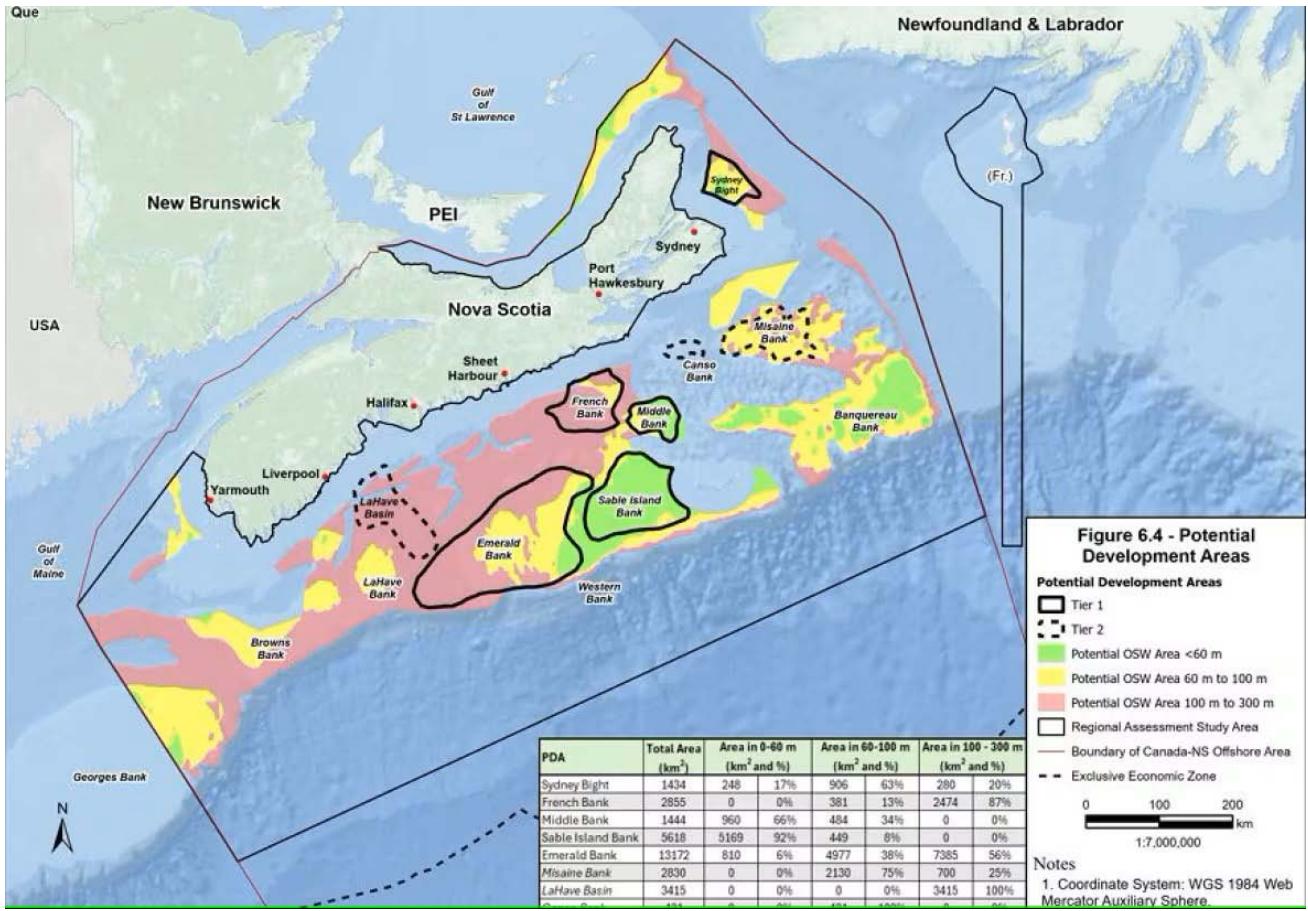
Fig. 5.2: A map of potential development areas for offshore wind on the Scotian Shelf [200]
According to Nova Scotia Regional Energy and Resource Table Framework for Collaboration on the Path to Net-Zero [173], as of August 29, 2024, focused collaboration in the short-term included the following vision:
Work planned to advance the Point Lepreau-Salisbury-Onslow Transmission Line as part of a modified Atlantic Loop connecting Nova Scotia and
New Brunswick, with a target in-service date of 2029.
Explore regional transmission and energy exchange opportunities in partnership with utilities in New Brunswick, Quebec, Newfoundland and Labrador, and Prince Edward Island.
As well, socio-economic studies of a New England - Maritimes Offshore Energy Corridor [174] are being considered. This Corridor presents a new HVDC transmission intertie between Nova Scotia and New England to connect two distinct offshore wind resource areas with the two load centers in each respective region, highlighting the economic and environmental benefits.
#### Consumption
Green Hydrogen and Clean Ammonia Production in Nova Scotia: Nova Scotia is actively pursuing the development of a green hydrogen sector, positioning itself as a leader in clean economic growth and environmental stewardship [175].
In alignment with its environmental and climate change goals, the Province is exploring the vast potential of offshore wind energy to produce green hydrogen and its derivatives such as green ammonia.
Nova Scotia is being engaged in ongoing discussions with Natural Resources Canada regarding Nova Scotia's role in meeting Canada's export ambitions under the Canada-Germany Hydrogen Alliance [176-178]. The province is also reviewing the environmental assessments for the EverWind Point Tupper Green Hydrogen/Ammonia Project - Phase 1 [179] and the Bear Head Energy Green Hydrogen and Ammonia Production, Storage and Loading Facility projects [180]. The approval of each project is contingent on each proponent fulfilling a series of terms and conditions to ensure the environment and human health remain protected.
## d. Nova Scotia's Energy Reform 2024
New legislation introduced on February 27, 2024, allowed for modernizing Nova Scotia's electricity system and enhancing public utility regulation in the energy sector [38, 39]. Supporting continuing strong efforts of Nova Scotia's government to ensure provincial ratepayers have clean, reliable and affordable electricity, the new legislation is changing the way the electricity system in Nova Scotia is structured and regulated, making it more accountable, transparent and competitive. Nova Scotia's government refers to a similar approach to managing and regulating the electricity system in other Canadian provinces [39]. The legislation reflects most significant recommendations of the Clean Electricity Solutions Task Force report of January 31, 2024 [181].
According to a legislation summary, The Energy Reform (2024) Act (the "ERA") includes the following [182]:
1. The ERA creates two new statutes: More Access to Energy Act ("MAEA") and Energy and Regulatory Boards Act ("ERBA"). The ERA also repeals the Utility and Review Board Act and amends the Public Utilities Act, Electricity Act and other legislation.
2. The MAEA will create an independent energy system operator ("IESO"), which will be responsible for the electricity grid system operator functions, including oversight of wholesale market rules, interconnections, system planning and procurement. The IESO is to be a non-profit corporation, with management and control being vested in a Board of Directors initially appointed by the Governor in Council, and later in accordance with its by-laws. The Nova Scotia Department of Natural Resources and Renewables expects the IESO to be fully operational by late 2025.
The MAEA provides that the IESO is to pursue the following objects:
- Enter into agreements with transmitters giving the IESO the authority to direct the operations of their transmission systems;
- Direct the operation of the IESO-controlled grid;
- Establish and enforce criteria and standards relating to the reliability of the integrated electricity system;
- Maintain the adequacy and reliability of the bulk electricity system;
- Enter into interconnection agreements with transmitters; and
- Facilitate the operation of a competitive electricity market.
In support of the above-noted objects, the IESO is to perform the following functions:
- Carry out competitive procurements, including for electricity supply, capacity, energy storage, ancillary services and "hybrid peaking resources", or as prescribed by regulation or considered appropriate in accordance with the Province's 2030 Clean Power Plan;
- Issue administrative penalties in accordance with market rules and procedures; and
- Carry out transmission interconnection studies.
Under the MAEA, a license will be required to own or operate a transmission system, direct the operation of transmission systems in the province, provide electricity or ancillary services or engage in an "electricity-related activity".
3. The ERBA will split the existing Nova Scotia Utility and Review Board ("NSUARB") into two new boards. The newly formed Energy Board ("EB") will be tasked with the regulation of energy.
The ERBA requires the EB to consider a broad array of factors when exercising its authority including:
- Competition and innovation in the provision of energy resources in the province;
- Development of a competitive electricity market;
- Safe, secure, reliable and economical energy supply in the province; and
- Sustainable development (as defined in the Environment Act [183] and sustainable prosperity as defined in the Environmental Goals and Climate Change Reduction Act [184]).
## iii. Atlantic RTO - the Next Step
With existing regional solutions for transmission grids and wholesale electricity markets represented by Regional Transmission Organizations (RTO) in North America demonstrating lower costs, improved reliability, and better environmental performance, an RTO concept applied to the Atlantic Canada region (the Atlantic RTO, or ARTO) is seen as a compelling high priority in leveraging the Clean Grid 2035 target in Canada.
The New York Independent System Operator (NYISO) and Independent System Operator New England (ISO-NE), the Regional Transmission Organizations (RTO) in the American Northeast, have been consistently demonstrating that "competitive electric markets continue to provide the most powerful and least-cost vehicle available" [49]. These RTOs have been used in their regions as an important regional development tool facilitating the transition to the clean grid. The historical ties of Atlantic Canada (specifically, the Maritimes) and New England present an important opportunity to learn the ISO-NE lessons, vision and continuous advancements to promptly build a leading North American RTO in Atlantic Canada leveraging an inter-regional integration approach of the second quarter of the $21^{\text{st}}$ century.
The Atlantic RTO should be seen today as a key advancement in Canada's deep decarbonization pathways presenting best-in-class regulations that strengthen existing policies for the electricity sector. The Canadian Net-Zero Emissions Accountability Act of June 2021 shaped Canada's commitment to achieve net-zero emissions by 2050 [185].
Building on the actions in Canada's strengthened climate plan [186] and the Pan-Canadian Framework [187], the 2030 Emissions Reduction Plan [188] reflects the Canadian input to reduce emissions by 40-45 per cent from 2005 levels by 2030 (see the Emission Reduction Plan Progress Report [189] published by the Government of Canada in December 2023).
Strong connection between Deep Decarbonization and Deep Regional/Inter-regional Electricity Market Integration concepts and practices reinforces the role of the Atlantic RTO in realizing the 2030 Emissions Reduction Plan, and ensures the benefits of electricity market integration in Atlantic
Canada such as improved reliability, increased demand diversity, diversity of generation mix and supply security.
The proposed Atlantic RTO is clearly seen as a key upgrade and an important component of the Canadian Electricity System addressing its generation mix, geographical structure and regulatory framework, and advancing inter-regional East-West and North-South power integration.
A special reason for supporting the Atlantic RTO by all the provinces of Atlantic Canada is the necessary and critical avoidance of the current realities of "electricity islands" in the region.
Strengthening regional grid through high voltage alternate current (AC) transmission between Nova Scotia and New Brunswick, and direct current (DC) transmission between Nova Scotia and New England, and having ARTO administer a wholesale electricity market will allow the region to benefit from an attractive set of flexible power opportunities at competitive wholesale level in:
- Generation - to better sell hydro power of Newfoundland and Labrador, and offshore wind power of Nova Scotia;
- Consumption - to better buy commercial power needed in Prince Edward Island, and industrial power (e.g., for green hydrogen) needed in Nova Scotia, and
- Bi-directional power (both generation and consumption) in Nova Scotia and New Brunswick – to address the needs of Atlantic Canada and New England.
The Atlantic RTO is seen as a strategic step in the evolution of the Atlantic Energy Gateway initiative demonstrating a new and more advanced regional leadership example in Canada. As prompt deployment and operation of the Atlantic RTO will make the region more competitive nationally and internationally, increasing cooperation and coordination by the Atlantic Provinces' electricity sectors is currently strongly required. According to a recommendation of the Canada Electricity Advisory Council's "Powering Canada: A Blueprint for Success" report in May 2024 [74], a collaborative framework for the ARTO decision-making can be used to identify and financially support inter-regional electricity transmission projects and outline their governance, cost allocation, and funding components.
industry in New Brunswick (with its New Brunswick System Operator created on October 1, 2004 and amalgamated with the NB Power Corporation on October 1, 2013 [191], as well as its current Transmission and System Operator [192]) and Nova Scotia (through its new Independent Energy System Operator (IESO) [38,39] as well as the skills of the Nova Scotia Power System Operator (NSPSO) [193]).
Also, the civil sub-sector (represented by the organizations that act in the public's interest but are not motivated by government or profit) that has not yet been fully involved, should be promptly engaged to leverage personal, organizational, and societal developments in the region [194]. Deep participation of Canada's indigenous peoples, or First Nations, as a part of the civil electricity sub-sector, makes compelling sense. This engagement would ensure electricity buyers/end users contribution to establishing a competitive wholesale electricity market in Atlantic Canada.
## IV. CONCLUSIONS AND RECOMMENDATIONS
1. To ensure successful steps to a low carbon economy and total electrification, commitments to deep decarbonization in North America require regional power system integration. Regional integration ensures a critical, productive and timely approach and strategy to provide reliable and affordable electricity anywhere, anytime. It can leverage economies, enhance energy security, and reduce greenhouse gas emissions.
2. The most efficient solution for regional power integration, enabling competitive electricity wholesale is proven by Regional Transmission Organizations (RTO). The RTO concept and practices ensure high efficiency and reliability of regional electricity markets and power transmission system operations. Advanced results of regional integration have been continuously demonstrated by New York Independent System Operator (NYISO) and Independent System Operator New England (ISO-NE) - the leading RTO in the American Northeast, and may be used to learn from their experience.
3. To improve power integration of regional and interregional electricity trade using an RTO approach, the last frontiers for organized wholesale markets in North America should be identified, addressed and resolved.
In the U.S., the key RTO frontiers being currently publicly discussed are the American West and Southeast regions:
- The current work is being done in the West on establishing a more comprehensive, efficient, and dynamic system of wholesale electric competition in the region. This work has strongly driven an
advanced concept of a West-wide RTO (or two RTOs) within the next few years.
- In the Southeast, the initial approach of large utilities to create real-time bilateral trade via an energy exchange market demonstrated only very small competitive steps away from the vertically integrated status quo compared to the integrated RTO practice. This approach (e.g., Southeast Energy Exchange Market (SEEM)) was not accepted by non-utility generating companies. Today, several states in the Southeast already started exploring full RTO membership.
In Canada, all provincial jurisdictions in western Canada as well as Ontario participate in or manage competitive wholesale electricity markets, and Quebec is considering the next steps in inter-regional integration. Atlantic Canada is the last RTO frontier for competitive regional electricity wholesale in the country that requires detailed public discussion.
4. An Atlantic RTO (ARTO) proposed here manifests a key upgrade and an important component of the Canadian Electricity System addressing its generation mix, transmission structure and regulatory framework, and advancing inter-regional East-West and North-South power integration. The ARTO would enable best-in-class regulations that strengthen existing policies for the electricity sector, and should be seen as a compelling high priority in leveraging the Clean Grid 2035 target in Canada.
5. The Atlantic RTO is seen as a strategic step in the evolution of the Atlantic Energy Gateway (AEG) initiative demonstrating a new and more advanced regional leadership example in Canada. Announced in 2009, the AEG initiative by March 2012 made strong advances in better understanding of the ways to move in regional clean electricity collaboration. This included regional electricity market opportunities, regional electricity system operations, regional transmission upgrade options, clean electricity resources, renewable generation supply chain opportunities in Atlantic Canada, and research, development and demonstration needs. The results of the AEG initiative were further promoted in the Clean Power Roadmap for Atlantic Canada (2022), outlining a collective vision for how the Atlantic provinces may collaborate over the coming decades to build a clean power superhighway across the region.
6. A collaborative framework for the ARTO decision-making should be used to increase cooperation and coordination by the Atlantic Provinces' electricity sectors. This would identify and financially support inter-regional electricity transmission projects and outline their governance, cost allocation, and funding components. According to Canada Electricity Advisory Council's report of May 2024:
- "Powering Canada: A Blueprint for Success" [ARTO42], constructing a Framework for InterRegional Grid Infrastructure is recommended to support inter-regional electricity transmission projects.
7. The ARTO is positioned as a critically important regional integration advancement in Canada's deep decarbonization pathways. Strong connection between Deep Decarbonization and Deep Regional/Inter-regional Electricity Market Integration concepts and practices reinforces the role of the Atlantic RTO in realizing Canada's 2030 Emissions Reduction Plan. It ensures the benefits of electricity market integration in Atlantic Canada such as increased diversity of generation mix, improved system reliability, increased supply security and demand diversity. Prompt deployment and operation of the Atlantic RTO would make the region more competitive nationally and internationally.
8. Timely coordination and cooperation of the government, private, academic, and civil electricity sub-sectors on multiple levels in the Atlantic region is suggested so as to achieve the ARTO deployment within the 2025-2035 timeframe. To ensure that this coordination on multiple levels is in place, that the planned work is moving at accelerated pace, and the Atlantic RTO development and deployment milestones are met on time, socio-psychological tools for dedicated groups across all the four sectors should be used.
9. As a part of the cooperative action, the ARTO development and deployment would greatly benefit from the existing electricity system operator skillset of the industry in New Brunswick and Nova Scotia. Including New Brunswick Power Transmission and System Operator, Nova Scotia Power System Operator, and Nova Scotia's new Independent Energy System Operator.
10. The civil electricity sub-sector should be promptly engaged with deep participation of Canada's First Nations so as to leverage personal, organizational, and societal developments in the region, and to ensure that electricity buyers/end users contribute to establishing a competitive wholesale electricity market in Atlantic Canada.
### ACKNOWLEDGMENTS AND CONFLICTS OF
#### INTEREST
Conflicts of Interest: The author declares no conflict of interest.
Generating HTML Viewer...
References
117 Cites in Article
G Morgan,J Apt,L Lave (2005). The U.S. Electric Power Sector and Climate Change Mitigation.
Hector Sarmiento,Miguel Avila Rosales (2006). Issues associated with international power grid interconnections in Mexico.
(2010). Regional power sector integration: lessons from global case studies and a literature review: Solving energy challenges through regional cooperation.
S Claar,A Nolke (2010). Deep Integration.
Patrick Brown,Audun Botterud (2020). The Value of Inter-Regional Coordination and Transmission in Decarbonizing the US Electricity System.
F Bouffard,S Debia,N Dhaliwal,P.-O Pineau (2018). A Decarbonized Northeast Electricity Sector: The Value of Regional Integration.
P.-O Pineau (2021). Unknown Title.
P.-O Pineau,S Langlois-Bertrand (2020). Northeast Decarbonization: Opportunities and Challenges of Regional Electricity Sector Integration for High Renewable Penetration, report prepared for the Northeast Electrification and Decarbonization Alliance.
S Blumsack (2007). Measuring the benefits and costs of regional electric grid integration.
(2024). Regional transmission organization (North America).
Gustavo Cuello-Polo,James Mccalley (2024). Enhancing Grid Development through Integration of ISO/RTO Planning Functions.
M Giberson (2024). An RTO for the West: Opportunities and Options.
(2023). New England Forward Clean Energy Market (FCEM). Proposed Market Rules.
(2023). Clean Energy Markets. Supporting the Financing of New and Existing Clean Energy Resources. Forward Clean Energy Market Design Proposal.
B Lee (2004). Free trade and globalization are driving the demand for north-south trade routes.
D Kelderman,D Kelderman (2004). Atlantic Provinces Chambers of Commerce.
B Lee (2004). Plugging in the International Northeast: A Canada-US dialogue on solving regional electricity challenges.
S Sinclair,J Jacobs (2007). Canadian centre for Policy Alternatives.
G Weil,B Crowley,B Norris (2003). The Atlantica power market: a plan for joint action.
T Canada (2007). Atlantic provinces, Canada in a Changing Climate: regional perspectives report [infographic].
T Canada (2011). The Government of Canada announces the Atlantic Gateway and Trade Corridor Strategy.
(2012). Atlantic Energy Gateway Report on regional electricity system operations.
Jeff Johnson (2012). A Plethora Of Clean Energy.
Ministers to announce funding for Atlantic Canada Venture Gateway.
C Mcmillan (2006). Embracing the Future: The Atlantic Gateway and Canada's Trade Corridor.
(2023). Ports of Call: the gateways to prosperity in Atlantic Canada and beyond.
N Canada (2020). https://www.canada.ca/content/dam/phac-aspc/documents/services/reports-publications/canada-communicable-disease-report-ccdr/monthly-issue/2020-46/issue-11-12-nov-5-2020/ccdrv46i1112a02-eng.pdf.
N Canada (2022). A Clean Power Roadmap for Atlantic Canada.
(2023). Canada Plan: Affordable Energy, Good Jobs, and a Growing Clean Economy.
(2010). Le Canada dans un climat en changement : infographie du rapport de synthèse.
(2024). Net-zero emissions by.
N Canada (2023). CO2 capture - gasification at clean coal electricity plant.
(2024). Project of the Century -Public Policy Forum.
Leblannm (2024). Unknown Title.
(2024). Legislation to modernize electricity system, improve regulation.
R Binz (2016). Regional Economic Outlook, April 2016, Western Hemisphere Department.
(2024). OASIS: Open Access Same-Time Information System.
(2012). Electric prices: FERC forecast shows electric prices rising in many regions.
(2024). Energy Policy Act of 1992.
(2023). Intertie Optimization FAQs and Implementation Principles.
R Ethier,Iso-Ne Public (2021). Transition to the future grid.
NYISO Releases Power Trends 2024 -NYISO.
I England (2013). New England's Future Grid Initiative key project.
Markets+ Unknown Title.
J Chen (2020). Evaluating options for enhancing wholesale competition and implications for the Southeastern United States.
(2024). The Southeast is the Last Frontier of Organized Wholesale Electricity Markets. Here are the best options moving forward -R Street Institute.
(2020). How voluntary electricity trading can help efficiency in the southeast.
None None (2020). Energy Savings Potential of Solid State Lighting in General Illumination Applications.
G Alvarez (2023). Economic and clean energy benefits of establishing a Southeast U.S. competitive wholesale electricity market.
J Dennis,(n.D (2024). the Southeast U.S., Is SEEM What It Seems, or More Utility Monopoly?.
(2023). SEEMs like a problem -R Street Institute.
(2021). SEEM filing: Limited protest and comment of public interest organizations -SACE | Southern Alliance for Clean Energy.
Institute Street (2024). Street.
M Shober (2021). FERC deadlocked, SEEM moves forward -SACE | Southern Alliance for Clean Energy.
Elibrary Unknown Title.
Kimberly Bose (2021). Notice of Filing Taking Effect by Operation of Law.
D Patton (2023). Southeast Energy Exchange Market | Potomac Economics.
(2024). Dissent in Alabama Power Company.
(2014). Pathways to deep decarbonization -2015 Report Executive Summary.
C Bataille,D Sawyer,N Melton,Cmc (2015). Pathways to deep decarbonization in Canada.
(2022). Reforming Korea’s Electricity Market for Net Zero.
(2022). Electrification and investment in electricity infrastructure.
(1986). The geosciences in Canada, 1985, part 2: report of the Canadian Geoscience Council Advisory Committee on mineral deposits research at the Geological Survey of Canada.
(2023). Procuring Services from Distributed Energy Resources. Part 1 -Foundational Topics: Grid Services, Coordination Frameworks, Value Stacking Scenarios.
R Walton (2024). SPP files Markets+ tariff in 'significant step' to expanding Western market options.
La Flèche,E (2022). Unknown Title.
J Pfeifenberger,K Graham,Doe,Tufts,P Delosa (2024). Cost-Effective Transmission between Canada and the US Northeast.
J Lamson (2024). Québec, New England see shifting role for Canadian hydropower.
M Yuan,K Tapia-Ahumada,J Reilly (2021). The role of cross-border electricity trade in transition to a low-carbon economy in the Northeastern U.
P Pineau (2012). Integrating electricity sectors in Canada: Good for the environment and for the economy.
E De Villemeur,P Pineau (2015). Integrating Thermal and Hydro Electricity Markets: Economic and Environmental Costs of not Harmonizing Pricing Rules.
J Rodríguez-Sarasty,S Debia,P.-O Pineau (2021). Deep decarbonization in Northeastern North America: The value of electricity market integration and hydropower Energy Policy.
P.-O Pineau,J Rodríguez,S Debia (2021). (2021) Volume 2, Issue 4 Cultural Implications of China Pakistan Economic Corridor (CPEC Authors: Dr. Unsa Jamshed Amar Jahangir Anbrin Khawaja Abstract: This study is an attempt to highlight the cultural implication of CPEC on Pak-China relations, how it will align two nations culturally, and what steps were taken by the governments of two states to bring the people closer. After the establishment of diplomatic relations between Pakistan and China, the cultural aspect of relations between the two states also moved forward. The flow of cultural delegations intensified after the 2010, because this year was celebrated as the ‘Pak-China Friendship Year’. This dimension of relations further cemented between the two states with the signing of CPEC in April 2015. CPEC will not only bring economic prosperity in Pakistan but it will also bring two states culturally closer. The roads and other communication link under this project will become source of cultural flow between the two states. Keyswords: China, CPEC, Culture, Exhibitions Pages: 01-11 Article: 1 , Volume 2 , Issue 4 DOI Number: 10.47205/jdss.2021(2-IV)01 DOI Link: http://doi.org/10.47205/jdss.2021(2-IV)01 Download Pdf: download pdf view article Creative Commons License Political Persona on Twittersphere: Comparing the Stardom of Prime Minister(s) of Pakistan, UK and India Authors: Maryam Waqas Mudassar Hussain Shah Saima Kausar Abstract: Political setup demands to use Twittersphere for preserving its reputation because of significant twitter audience, which follows celebrities and political figures. In this perspective, political figures frequently use twitter to highlight their political as well as personal lives worldwide. However, political figures take the stardom status among the twitter audience that follow, retweet and comment by their fans. The purpose of this study is, to analyze what kind of language, level of interest is made by political figures while communicating via twitter, text, phrases and languages used by political figures, and do their tweets contribute in their reputation. The qualitative content analysis is used for evaluation of the interests shared by PM Imran Khan, PM Boris John Son and PM Narendra Modi with the key words of tweets. A well-established coding sheet is developed for the analysis of text, phrases and words in the frames of negative, positive and neutral from March 2020 to May 2020. The results are demonstrating on the basis of content shared by Prime Ministers of three countries i.e., From Pakistan, Imran Khan, United Kingdom, Johnson Boris and India, Narendra Modi on twitter. The findings also reveal that varied issues discussed in tweets, significantly positive and neutral words are selected by these political figures. PM Imran tweeted more negative tweets than PM Boris Johnson and PM Narendra Modi. However, PM Boris Johnson and PM Narendra Modi make significant positive and neutral tweets. It is observed that political figures are conscious about their personal reputation while tweeting. It also revealed that the issues and tweets shared by these leaders contribute to their personal reputation. Keyswords: Imran Khan, Johnson Boris, Narendra Modi, Political Persona, Stardom, Twittersphere Pages: 12-23 Article: 2 , Volume 2 , Issue 4 DOI Number: 10.47205/jdss.2021(2-IV)02 DOI Link: http://doi.org/10.47205/jdss.2021(2-IV)02 Download Pdf: download pdf view article Creative Commons License An Empirical Relationship between Government Size and Economic Growth of Pakistan in the Presence of Different Budget Uncertainty Measures Authors: Sunila Jabeen Dr. Wasim Shahid Malik Abstract: Relationship between government size and economic growth has always been a debated issue all over the world since the formative work of Barro (1990). However, this relationship becomes more questionable when policy uncertainty is added in it. Hence, this paper presents evidence on the effect of government size on economic growth in the presence of budget uncertainty measured through three different approaches. Rather than relying on the traditional and complicated measures of uncertainty, a new method of measuring uncertainty based on government budget revisions of total spending is introduced and compared with the other competing approaches. Using time series annual data from 1973-2018, the short run and long run coefficients from Autoregressive Distributed Lag (ARDL) framework validate the negative effect of budget uncertainty and government size on economic growth of Pakistan regardless of the uncertainty measure used. Therefore, to attain the long run economic growth, along with the control on the share of government spending in total GDP, government should keep the revisions in the budget as close to the initial announcements as it can so that uncertainty can be reduced. Further, the uncertainty in fiscal spending calculated through the deviation method raises a big question on the credibility of fiscal policy in Pakistan. Higher will be the deviation higher will be the uncertainty and lower the fiscal policy credibility hence making fiscal policy less effective in the long run. Keyswords: Budget Uncertainty, Economic Growth, Government Size, Policy Credibility Pages: 24-38 Article: 3 , Volume 2 , Issue 4 DOI Number: 10.47205/jdss.2021(2-IV)03 DOI Link: http://doi.org/10.47205/jdss.2021(2-IV)03 Download Pdf: download pdf view article Creative Commons License Despair in The Alchemist by Ben Jonson Authors: Dr. Fatima Syeda Dr. Faiza Zaheer Numrah Mehmood Abstract: This research aims to challenge the assumption that The Alchemist by Ben Jonson is one of the greatest examples of the “explicit mirth and laughter” (Veneables 86). The paper argues that The Alchemist is a cynical and despairing play created in an atmosphere not suitable for a comedy. This is a qualitative study of the text and aims at an analysis of the theme, situations, characters, language, and the mood of the play to determine that Jonson is unable to retain the comic spirit in The Alchemist and in an attempt to “better men” (Prologue. 12) he becomes more satirical and less humorous or comic. This research is important for it contends that the play, termed as a comedy, may be read as a bitter satire on the cynical, stinky, and despairing world of the Elizabethan times. Keyswords: Comedy, Despair, Reformation Pages: 39-47 Article: 4 , Volume 2 , Issue 4 DOI Number: 10.47205/jdss.2021(2-IV)04 DOI Link: http://doi.org/10.47205/jdss.2021(2-IV)04 Download Pdf: download pdf view article Creative Commons License Analysis of Principles of Coordinated Border Management (CBM) in articulation of War-Control Strategies: An Account of Implementation Range on Pakistan and Afghanistan Authors: Dr. Sehrish Qayyum Dr. Umbreen Javaid Abstract: Currently, Border Management is crucial issue not only for Pakistan but for the entire world due to increased technological developments and security circumstances. Pakistan and Afghanistan being immediate states have inter-connected future with socio-economic and security prospects. Principles of Coordinated Border Management (CBM) approach have been extracted on the basis of in-depth interviews with security agencies and policymakers to understand the real time needs. The current research employs mixed method approach. Process Tracing is employed in this research to comprehend the causal mechanism behind the contemporary issue of border management system. A detailed statistical analysis of prospect outcomes has been given to validate the implication of CBM. Implication range of CBM has been discussed with positive and probably negative impacts due to its wide range of significance. This research gives an analysis of feasibility support to exercise CBM in best interest of the state and secure future of the region. Keyswords: Afghanistan, Coordinated Border Management, Fencing, Pakistan, Security Pages: 48-62 Article: 5 , Volume 2 , Issue 4 DOI Number: 10.47205/jdss.2021(2-IV)05 DOI Link: http://doi.org/10.47205/jdss.2021(2-IV)05 Download Pdf: download pdf view article Creative Commons License The Belt and Road Initiative (BRI) vs. Quadrilateral Security Dialogue (the Quad): A Perspective of a Game Theory Authors: Muhammad Atif Prof. Dr. Muqarrab Akbar Abstract: Containment is the central part of the U.S.'s foreign policy during the cold war. With the application of containment Policy, the U.S. achieved much success in international politics. Over time China has become more powerful and sees great power in international politics. China wants to expand and launched the Belt and Road Initiative (BRI). The primary purpose of The Belt and Road Initiative (BRI) is to achieve support from regional countries and save their interests from the U.S. In 2017, the American administration launched its Containment policy through Quadrilateral Security Dialogue (the Quad) to keep their interest from China. The Quadrilateral Security Dialogue (Quad) is comprising of Australia, the United States, Japan, and India. This Study is based on Qualitative research with theoretical application of Game theory. This research investigates both plans of China (BRI) and the U.S. (the Quad) through a Game Theory. In this study, China and the U.S. both like to act as gamers in international politics. This study recommends that Game theory can predict all developments in the long term. Keyswords: Containment, Expansionism, Quadrilateral Security Dialogue, The Belt and Road Initiative (BRI) Pages: 63-75 Article: 6 , Volume 2 , Issue 4 DOI Number: 10.47205/jdss.2021(2-IV)06 DOI Link: http://doi.org/10.47205/jdss.2021(2-IV)06 Download Pdf: download pdf view article Creative Commons License Narendra Modi a Machiavellian Prince: An Appraisal Authors: Dr. Imran Khan Dr. Karim Haider Syed Muhammad Yousaf Abstract: The comparison of Narendra Modi and Machiavellian Prince is very important as policies of Modi are creating problems within India and beyond the borders. The Prince is the book of Niccolo Machiavelli a great philosopher of his time. If Indian Prime Minister Narendra Modi qualifies as a Prince of Machiavelli is a very important question. This is answered in the light of his policies and strategies to become the undisputed political leader of India. Much of the Machiavellian Prince deals with the problem of how a layman can raise himself from abject and obscure origins to such a position that Narendra Modi has been holding in India since 2014. The basic theme of this article is revolving around the question that is following: Can Modi’s success be attributed to techniques of The Prince in important respects? This article analyzed Narendra Modi's policies and strategies to develop an analogy between Machiavellian Prince and Modi in terms of characteristics and political strategies. This research work examines, how Narendra Modi became the strongest person in India. Keyswords: Comparison, India, Machiavelli, Modus Operandi, Narendra Modi Pages: 76-84 Article: 7 , Volume 2 , Issue 4 DOI Number: 10.47205/jdss.2021(2-IV)07 DOI Link: http://doi.org/10.47205/jdss.2021(2-IV)07 Download Pdf: download pdf view article Creative Commons License Analyzing Beckett's Waiting for Godot as a Political Comedy Authors: Muhammad Umer Azim Dr. Muhammad Saleem Nargis Saleem Abstract: This study was devised to analyze Samuel Beckett’s play Waiting for Godot in the light of Jean-Francois Lyotard’s theory of postmodernism given in his book The Postmodern Condition (1984). This Lyotardian paradigm extends a subversive challenge to all the grand narratives that have been enjoying the status of an enviable complete code of life in the world for a long time. Even a cursory scan over the play under analysis creates a strong feel that Beckett very smartly, comprehensively and successfully questioned the relevance of the totalizing metanarratives to the present times. Being an imaginative writer, he was well aware of the fact that ridicule is a much more useful weapon than satire in the context of political literature. There are so many foundationalist ideologies that he ridicules in his dramatic writing. Christianity as a religion is well exposed; the gravity of philosophy is devalued; the traditional luxury that the humans get from the art of poetry is ruptured and the great ideals of struggle are punctured. He achieves his artistic and ideologically evolved authorial intentions with a ringing success. It is interesting to note that he maintains a healthy balance between art and message. Keyswords: Beckett, Lyotard, The Postmodern Condition, Waiting for Godot Pages: 85-94 Article: 8 , Volume 2 , Issue 4 DOI Number: 10.47205/jdss.2021(2-IV)08 DOI Link: http://doi.org/10.47205/jdss.2021(2-IV)08 Download Pdf: download pdf view article Creative Commons License Effect of Parenting Styles on Students’ Academic Achievement at Elementary Level Authors: Hafsa Noreen Mushtaq Ahmad Uzma Shahzadi Abstract: The study intended to find out the effect of parenting styles on students’ academic achievement. Current study was quantitative in nature. All elementary level enrolled students at government schools in the province of the Punjab made the population of the study. Multistage sampling was used to select the sample from four districts of one division (Sargodha) of the Punjab province i.e., Sargodha. A sample size i.e., n=960; students and their parents were participated in this study. Research scales i.e. Parenting Styles Dimension Questionnaire (PSDQ) was adapted to analyze and measure parents’ parenting styles and an achievement test was developed to measure the academic achievement of the elementary students. After pilot testing, reliability coefficient Cronbach Alpha values for PSDQ and achievement test were 0.67 and 0.71 Data was collected and analyzed using frequencies count, percentages, mean scores and one way ANOVA. Major findings of the study were; Majority of the parents had authoritative parental style, a handsome number of parents keep connection of warmth and support with their children, show intimacy, focus on discipline, do not grant autonomy to their children, do not indulge with their children and as well as a handsome number of students were confident during their studies and study, further, found that parental style had positive relationship with academic achievement. Recommendations were made on the basis of findings and conclusion such as arrangement of Parents Teachers Meetings (PTM‘s), parents’ training, provision of incentives and facilities to motivate families might be an inclusive component of elementary education program. Keyswords: Academic Achievement, Elementary Education, Parenting Styles Pages: 95-110 Article: 9 , Volume 2 , Issue 4 DOI Number: 10.47205/jdss.2021(2-IV)09 DOI Link: http://doi.org/10.47205/jdss.2021(2-IV)09 Download Pdf: download pdf view article Creative Commons License Kashmir Conflict and the Question of Self-Determination Authors: Izzat Raazia Saqib Ur Rehman Abstract: The objective of this paper is to explore relations between Pakistan and India since their inception in the perspective of Kashmir conundrum and its impact on the regional security. Kashmir is the unfinished agenda of partition and a stumbling block in the bilateral relations between Pakistan and India. After the partition of sub-continent in 1947, Pakistan and India got their sovereign status. Kashmir conflict, a disputed status state, is the byproduct of partition. Pakistan and India are traditional arch-foes. Any clash between Pakistan and India can bring the two nuclear states toe-to-toe and accelerate into nuclear warfare. Due to the revulsion, hostility and lack of trust between the two, the peaceful resolution of the Kashmir issue has been long overdue. Ever-increasing border spats, arms race and threat of terrorism between the two have augmented anxiety in the subcontinent along with the halt of talks between India and Pakistan at several times. Additionally, it hampers the economic and trade ties between the two. India, time and again, backtracked on Kashmir issue despite UN efforts to resolve the issue. Recently, Indian government has responded heavy-handedly to the Kashmiri agitators’ demand for sovereignty and revocation of ‘Special Status’ of Kashmir impacting the stability of the region in future. Keyswords: India, Kashmir Conundrum, Pakistan, Regional Security, Sovereignty Pages: 111-119 Article: 10 , Volume 2 , Issue 4 DOI Number: 10.47205/jdss.2021(2-IV)10 DOI Link: http://doi.org/10.47205/jdss.2021(2-IV)10 Download Pdf: download pdf view article Creative Commons License Exploring Image of China in the Diplomatic Discourse: A Critical Discourse Analysis Authors: Muhammad Afzaal Muhammad Ilyas Chishti Abstract: The present study hinges on the major objective of analyzing Pakistani and Indian diplomatic discourses employed in portrayal of image of China. Data comprises the official discourse which is used in diplomatic affairs of both the states. The extensive investigation seeks insights from the fundamentals of Critical Discourse Analysis propounded by van Dijk, Fairclough and Wodak with a special focus on Bhatia’s (2006) work. The study reveals that the image of China has always been accorded priority within Indian and Pakistani diplomatic discourse even though nature of bilateral relations among China, India and Pakistan is based on entirely different dynamics; Indian and Pakistani diplomatic discourses are reflective of sensitivities involved within the bilateral relations. Through employment of linguistic techniques of ‘positivity’, ‘evasion’ and ‘influence and power’, Indian diplomats have managed not to compromise over the fundamentals in bilateral relations with China despite Pakistan’s already strengthened and deep-rooted relations with China. While Pakistani diplomatic fronts have been equally successful in further deepening their already strengthened relations in the midst of surging controversies on CPEC, BRI and OBOR. Hence, diplomatic fronts of both the counties, through employment of ideologically loaded linguistic choices, leave no stone unturned in consolidation of the diplomatic relations with China. Keyswords: CDA, China Image, Corpus, Language of Diplomacy, Political Discourse Analysis Pages: 120-133 Article: 11 , Volume 2 , Issue 4 DOI Number: 10.47205/jdss.2021(2-IV)11 DOI Link: http://doi.org/10.47205/jdss.2021(2-IV)11 Download Pdf: download pdf view article Creative Commons License Students’ Perception about Academic Advising Satisfaction at Higher Education Level Authors: Rukhsana Sardar Zarina Akhtar Shamsa Aziz Abstract: The purpose of the study was to examine the students’ perception about academic advising satisfaction at higher education level. All the students from two years master (M.A) degree programme and four years (BS) degree programme of eight departments from International Islamic University Islamabad (IIUI), Faculty of Social Sciences were taken as a population of the study. 475 students were randomly selected as a sample of the study. The Academic Advising Inventory (AAI) was used to assess Academic Advising Style. For measuring level of the satisfaction, descriptive statistics was used. To compare the mean difference department-wise and gender-wise about academic advising satisfaction t.test was applied. It was concluded that from the major findings of the study those students who received departmental academic advising style are more satisfied as compared to those students who provided prescriptive academic advising style. Female students seemed more satisfied as compared to male students regarding the academic advising style provided to them. Students who satisfied from developmental academic advising style and they were also highly satisfied from the advising provided to them at Personalizing Education (PE) and this is the subscale of developmental academic advising whereas students who received prescriptive academic advising they were also satisfied from the advising provided to them regarding personalizing education and academic decision making but their percentage is less. It is recommended to Universities Administration to focus on Developmental Academic Advising Style and establish centers at universities/department level and nominate staff who may be responsible to provide developmental academic advising. Keyswords: Academic Advising, Higher Level, Students’ Perception Pages: 134-144 Article: 12 , Volume 2 , Issue 4 DOI Number: 10.47205/jdss.2021(2-IV)12 DOI Link: http://doi.org/10.47205/jdss.2021(2-IV)12 Download Pdf: download pdf view article Creative Commons License Perceptions of Sexual Harassment in Higher Education Institutions: A Gender Analysis Authors: Ruhina Ghassan Dr. Subha Malik Nayab Javed Abstract: Sexual harassment is a social issue which is present in every society, globally, which interferes in an individual’s social and professional life. It happens almost everywhere i.e. at workplaces, public places or institutes as well. The focus of the present study was to explore the differences of male and female students’ perception of sexual harassment. This study was a quantitative research. Sample of the study included of 400 students (200 males and 200 females) from two government and two private universities. In the present study, Sexual Harassment Perception Questionnaire (SHPQ) was used to find out these differences in perceptions as every person has his own view for different situations. The study revealed the significant differences in perception of students. Study showed that both genders perceived that female students get more harassed than male students. The factors that affect the perception frequently were gender and age. The findings recommended that regulations for sexual harassment should be implemented in universities; laws should be made for sexual harassment in higher education institutes. Students should be aware of sexual harassment through seminars, self-defense classes and awareness campaigns. And every institute should have a counseling center for the better mental health of students. Keyswords: Gender Differences, Higher Educational Institutions, Sexual Harassment Pages: 145-158 Article: 13 , Volume 2 , Issue 4 DOI Number: 10.47205/jdss.2021(2-IV)13 DOI Link: http://doi.org/10.47205/jdss.2021(2-IV)13 Download Pdf: download pdf view article Creative Commons License Role of IMF Over the Governance Structure and Economic Development of Pakistan Authors: Ali Qamar Sheikh Dr. Muhammad Imran Pasha Muhammad Shakeel Ahmad Siddiqui Abstract: Developing countries like Pakistan seeks for financial assistance in order to fulfil their deficits. IMF is one of the largest financial institution who give loans to countries who need it. This research has studied the IMF role and the effects of IMF conditions on the economy of Pakistan. To carry out this research, both quantitative data from primary sources has been gathered and qualitative analysis has been made to signify whither this borrowing creating and maintaining dependency of Pakistan on West and financial and governance structure constructed to curtail Countries like Pakistan. The results concluded that there is negative and insignificant relationship between GDP and IMF loans in the long run. The short-term dynamic shows that weak economic and Political Institutions in Pakistan. The Development dilemma constitutes dependency even today. The Current Budget Deficit Pakistan's fiscal deficit climbs to Rs 3.403 trillion in 2020-21 needs to be readdressed in such a manner that Pakistan can counter Balance of Payments and import/export imbalance. Keyswords: Dependency, Development, IMF, Loans, Debt, Pakistan, Governance structure Pages: 159-172 Article: 14 , Volume 2 , Issue 4 DOI Number: 10.47205/jdss.2021(2-IV)14 DOI Link: http://doi.org/10.47205/jdss.2021(2-IV)14 Download Pdf: download pdf view article Creative Commons License Climate Change and the Indus Basin: Prospects of Cooperation between India and Pakistan Authors: Sarah Saeed Prof. Dr. Rana Eijaz Ahmad Abstract: Climate change is transforming the global societies. The shift in average temperature is putting negative impacts on human health, food production and the natural resources. In the wake of the altered climate, water flow in the river systems is experiencing variability and uncertainty. This paper aims at studying the negative impacts of climate change on the water resources of the Indus Basin and investigate the prospects of cooperation between India and Pakistan; two major riparian nations sharing the basin. Adopting the case study approach, a theoretical framework has been built on the ‘Theory of the International Regimes’. It has been argued that institutional capacity and the dispute resolution mechanism provided in any water sharing agreement determine the extent of cooperation among the member states. Since India and Pakistan are bound by the provisions of the Indus Waters Treaty, this study tries to assess the effectiveness of this agreement in managing the negative consequences of the climate change. Keyswords: Climate Change, Cooperation, Dispute Resolution Mechanism, Institutional Capacity Pages: 173-185 Article: 15 , Volume 2 , Issue 4 DOI Number: 10.47205/jdss.2021(2-IV)15 DOI Link: http://doi.org/10.47205/jdss.2021(2-IV)15 Download Pdf: download pdf view article Creative Commons License Translation, Cultural Adaptation and Validation of Behavioral-Emotional Reactivity Index for Adolescents Authors: Saima Saeed Farah Malik Suzanne Bartle Haring Abstract: Measuring differentiation of self in terms of behavioral/emotional reactivity towards parents is important because of the complex parent-child connection. This needs a valid and reliable measure to assess the differentiation of self particularly in a relationship with parents. Behavior\Emotional Reactivity Index is such a tool that fulfills this purpose. The present study was carried out to culturaly adapt and translate BERI into the Urdu language and establish the psychometric properties of Urdu version. A sample of 303 adolescents of age (M = 16.07, SD = 1.77) was taken from different schools and colleges. Scale was split into Mother and father forms for the convenience of respondents. Findings supported the original factor structure of the BERI-original version. Higher-order factor analysis showed good fit indices with excellent alpha ranges (α= .91 to α=.80). BERI scores were compared for the adolescents who were securely attached with parents and insecurely attached with parents which showed a significant difference between the groups. BERI-Urdu version was found to be a valid and reliable measure in the Pakistani cultural context which gives researchers new directions to work with adolescents. Keyswords: Adolescence, Differentiation of Self, Behavioral, Emotional Reactivit, Index, Parental Attachment Pages: 186-200 Article: 16 , Volume 2 , Issue 4 DOI Number: 10.47205/jdss.2021(2-IV)16 DOI Link: http://doi.org/10.47205/jdss.2021(2-IV)16 Download Pdf: download pdf view article Creative Commons License Notion of Repression in Modern Society: A Comparative Analysis of Sigmund Freud and Herbert Marcuse Authors: Khadija Naz Abstract: One of the fundamental issues for modern civilized man is how to adapt a modern society without losing his individual status. Is it possible for an individual to adjust in a society where he/she loses his/her individuality and becomes part of collectivity? One point of view is that for society to flourish, man needs to be repressed. But to what extent is repression necessary for societies to rise and survive? This paper shall examine the above given questions from the standpoint of two thinkers who greatly influenced twentieth-century thought: Sigmund Freud and Herbert Marcuse. To undertake this task, first the term Repression shall be examined and then the notions of Freud and Marcuse will be discussed to determine the degree of repression required for the development of modern society. Keyswords: Modern Society, Performance Principle, Repression, Surplus-Repression, The Pleasure Principle, The Reality Principle Pages: 201-214 Article: 17 , Volume 2 , Issue 4 DOI Number: 10.47205/jdss.2021(2-IV)17 DOI Link: http://doi.org/10.47205/jdss.2021(2-IV)17 Download Pdf: download pdf view article Creative Commons License Perceptions of Teacher Educators about Integration of (ESD) in Elementary Teachers Education Program Authors: Dr. Rukhsana Durrani Dr. Fazal ur Rahman Dr. Shaista Anjum Abstract: Education and sustainable development have a close relationship as education provides sustainability to society. This study explored the perceptions of teacher educators for integration of Education for Sustainable Development (ESD) in B.Ed. 4 years’ elementary program. Four major components of ESD i.e., Education, Social & Culture, Economic and Environment were included in study. 127 teacher educators from departments of education were randomly selected from public universities of Pakistan who were offering B.Ed. 4 years’ elementary program. Data was collected through questionnaires from teacher educators. The findings recommended the inclusion of the components of Education for Sustainable Development (ESD) in curriculum of B.Ed. 4 years’ elementary program. Keyswords: B.Ed. 4 Years Elementary Curriculum, Sustainable Development, Integration, Teacher Education Pages: 215-225 Article: 18 , Volume 2 , Issue 4 DOI Number: 10.47205/jdss.2021(2-IV)18 DOI Link: http://doi.org/10.47205/jdss.2021(2-IV)18 Download Pdf: download pdf view article Creative Commons License Exploring TPACK skills of prospective teachers and challenges faced in digital technology integration in Pakistan Authors: Tariq Saleem Ghayyur Dr. Nargis Abbas Mirza Abstract: The current study was aimed to explore TPACK skills of prospective teachers and challenges faced in digital technology integration in Pakistan. The study was qualitative in nature and semi structured interview schedule was developed to collect data from prospective teachers. Purposive sampling technique was employed to collect data from 20 prospective teachers of 7 public sector universities. It was concluded that majority of the prospective teachers used general technological and pedagogical practices (GTPP), technological knowledge practices (TKP), Technological Pedagogical Knowledge practices (TPKP), Technological Content Knowledge practices (TCKP). Majority of prospective teachers reported multiple challenges in integration of digital technology in teacher education programs including lack of teacher training as one of the largest hurdle in digital technology integration, lack of digital technology resources or outdated digital technology resources, inadequate computer lab, lack of learning apps (courseware), financial constraints, lack of teachers’ motivation to use digital technology, slow computers available at computer labs, and unavailability of technical support. It was recommended that digital technology infrastructure should be improved across all teacher education institution and it was further recommended that TPACK model of digital technology integration should serve digital technology integration in teacher education programs in Pakistan. Keyswords: Challenges, Digital Technology Integration, Digital Technology Resources, Digital Technology, TPACK Pages: 226-241 Article: 19 , Volume 2 , Issue 4 DOI Number: 10.47205/jdss.2021(2-IV)19 DOI Link: http://doi.org/10.47205/jdss.2021(2-IV)19 Download Pdf: download pdf view article Creative Commons License Revisiting the Linkage between Money Supply and Income: A Simultaneous Equation Model for Pakistan Authors: Zenab Faizullah Dr. Shahid Ali Muhammad Imad Khan Abstract: A reliable estimate of the money supply is an important sign of the Gross Domestic Product (GDP) and many other macroeconomic indicators. It is widely discussed that over a long period of time, there is a strong link between GDP and money supply. This link is significantly important for formation of monetary policy. The main aim of this study is to estimate the income-money supply model for Pakistan. This study estimates the income-money supply model for Pakistan over the period of 2009 to 2019. The study uses Two Stage Least Square (2SLS) econometric technique due to the presence of endogeneity problem in the model under consideration. The existence of simultaneity between money supply (M2) and income (GDP) is also clear from the results of Hausman Specification test for simultaneity between M2 and GDP. The results further show that there exists a strong money-income relationship in case of Pakistan. Keyswords: Money Supply, Income, Simultaneous Equations Pages: 242-247 Article: 20 , Volume 2 , Issue 4 DOI Number: 10.47205/jdss.2021(2-IV)20 DOI Link: http://doi.org/10.47205/jdss.2021(2-IV)20 Download Pdf: download pdf view article Creative Commons License Analyzing the Mechanism of Language Learning Process by the Use of Language Learning Strategies Authors: Shafiq Ahmad Farooqi Dr. Muhammad Shakir Sher Muhammad Awan Abstract: This analytical research study involves the use of learning strategies to know the mechanism of learning a second language. People acquire their native language (L1) without any conscious effort and they have a complete knowledge of L1 and are competent in their native language even without going to school. It is believed that language learning is a process as well as an outcome and the focus of current study is to understand the process of learning a second language. The population in this study comprised of 182 boys and Girls Govt. Higher Secondary Schools studying at intermediate level in the 11 Districts of the Southern Punjab. The sample was selected through random probability sampling and consisted of 40 subject specialists teaching the subject of English in Govt. higher secondary schools with 400 students studying English at Intermediate level. A questionnaire comprising some common and easily accessible learning strategies was designed to determine the frequency of these strategies used in the classrooms by the language learners through the specialists of the subject. The data was collected from the selected sample through the subject specialists teaching in these schools. The data was collected quantitatively and was analyzed in the statistical package for social sciences (SPSS) version 20. The most common 27 language learning strategies (LLS) were applied to analyze the process of language learning. In the light of the results of the study, it was concluded that application of the learning strategies according to the nature of the text is helpful in understanding the language functions and its application. Keyswords: Language Acquisition, Learning Strategies, Mechanism of Language Learning Pages: 249-258 Article: 21 , Volume 2 , Issue 4 DOI Number: 10.47205/jdss.2021(2-IV)21 DOI Link: http://doi.org/10.47205/jdss.2021(2-IV)21 Download Pdf: download pdf view article Creative Commons License Secondary School Science Teachers’ Practices for the Development of Critical Thinking Skills: An Observational Study Authors: Dr. Muhammad Jamil Dr. Yaar Muhammad Dr. Naima Qureshi Abstract: In the National curriculum policy documents, to produce rationale and independent critical thinkers, different pedagogical practices have been recommended like cooperative learning, questioning, discussion, etc. This qualitative case study aimed at analyzing secondary school science teachers’ practices for the development of critical thinking skills in secondary school students. There were twelve classrooms (four from each subject of Physics, Chemistry and Biology) selected as cases. Video recording was used for the observations for six lessons in each classroom. In this way, a total of 72 observations were conducted lasting for approximately 35 minutes. Qualitative content analysis was used for data analysis through Nvivo 12. The findings of the observations revealed that all the teachers used the lecture method. They used this to cover the content at a given specific time. There was not much focus on the development of critical thinking. In a few of the classrooms, the students were engaged and active during learning different specific topics. Whiteboard was used as a visual aid by most of the teachers. Furthermore, to some extent, discussion, questioning, and daily life examples were used in different classrooms. It is recommended that teachers’ professional development should be conducted to focus on the development of critical thinking skills through pedagogical practices which have been recommended by the national education policy documents. Keyswords: Analysis, Critical Thinking, Curriculum Policy, Pedagogy, Secondary Level Pages: 259-265 Article: 22 , Volume 2 , Issue 4 DOI Number: 10.47205/jdss.2021(2-IV)22 DOI Link: http://doi.org/10.47205/jdss.2021(2-IV)22 Download Pdf: download pdf view article Creative Commons License Historical Development of Clinical Psychology in Pakistan: A Critical Review-based Study Authors: Muhammad Nawaz Shahzad Dr. Mushtaq Ahmad Dr. Muhammad Waseem Tufail Abstract: Clinical Psychology is clinical and curing psychological practices in Pakistan. The present research study endeavors to examine the contemporary status of Clinical Psychology in the country and descriptively analyzes the significant contribution of various psychologists in its development. The study also elaborates the emergence of Clinical Psychology and its treatment aspects in the country. The experimental approach of the treatment psychology has also been defined. The role of different scholars to set and promote the Clinical Psychology as discipline and dealing about treatment of Human mind has also been discussed here. The study also presented the scenario of the issues of legislative acknowledgment, qualifications mandatory for practice, communal awareness of cerebral treatment, the tradition of ethnic and native practices about the clinical psychological treatments has also been discussed. Keyswords: Approaches, Clinical Psychology, Psychologist, Therapist Pages: 266-272 Article: 23 , Volume 2 , Issue 4 DOI Number: 10.47205/jdss.2021(2-IV)23 DOI Link: http://doi.org/10.47205/jdss.2021(2-IV)23 Download Pdf: download pdf view article Creative Commons License Impact of Devolution of Power on School Education Performance in Sindh after 18th Constitutional Amendment Authors: Abdul Hafeez Dr. Saima Iqbal Muhammad Imran Abstract: Devolution of the authority from central units of empowering authorities to the local level to develop and exercise policies at local or organizational level is under debate in various countries of the world. The legation in with the name of 18th constitutional amendment in constitution of 1973 of Pakistan ensures more autonomy to federal units. The difference between province and federation mostly creates misunderstanding in the belief of cooperation and universalism of education standards, expenditures and service delivery. Very currently the ministry of education and local government encoring principles and headmasters to adopt self-management skills to be updated to accept the spin of power from higher authorities to lower authorities’ pedagogical and local schools. In this qualitative research semi structured questioner were incorporated as data collection tool equally, the data was analyzed by usage of NVivo software. In this regard Government of Sindh has introduced various reforms and new trends like objectives and policy pillars, better government schools, improved learning outcomes and increased and improved funding in the education sector Sindh government has so far been unable to effectively use its resources to implement effective governance system which provides quality and sustained education in the province. To achieve this basic universal education, equally fourth objective of Sustainable Development Goal (SDG) the educational leaders must develop a comparative education setup that help to educate planers to plan and design standards for school leaders, instruction, appropriate professional development of teachers, ways to support school leaders to change in mission. Parallel, develop new program for early childhood, school and class size and ensure school enrollment. Keyswords: 18th Constitutional Amendment, Devolution of Power, Sindh Education Performance Pages: 273-285 Article: 24 , Volume 2 , Issue 4 DOI Number: 10.47205/jdss.2021(2-IV)24 DOI Link: http://doi.org/10.47205/jdss.2021(2-IV)24 Download Pdf: download pdf view article Creative Commons License Legal Aspects of Evidence Collected by Modern Devices: A Case Study Authors: Muhammad Hassan Zia Alvina Ali Abstract: This paper is a qualitative research of different case laws dealing with modern technological evidence. Courts were required to adopt new methods, techniques and devices obtained through advancement of science without affecting the original intention of law. Because of modern technology, a benefit could be taken from said technology to preserve evidences and to assist proceedings of the Court in the dispensation of justice in modern times. Owing to the scientific and technological advancements the admissibility of audio and visual proofs has grown doubtful. No doubt modern evidence assist the court in reaching out to the just decision but at the same time certain criteria need to be laid down which must be satisfied to consider such evidence admissible. Different Case laws are discussed here to show how the cases were resolved on the basis of technological evidence and when and why such evidence have been rejected by the court, if it did. Moreover, legal practices developed in various countries allow our Courts to record evidence through video conferencing. The Honorable Supreme Court of Pakistan directed that in appropriate cases statement of juvenile rape victims and other cases of sensitive nature must be recorded through video conferencing to avoid inconvenience for them to come to the Court. Nevertheless, it has some problems. The most important among them is the identification of the witness and an assurance that he is not being prompted when his statement is recorded. In this paper protocols that are necessary to follow while examining witness through video link are discussed Keyswords: DNA Profiling, Finger Prints, , Telephone Calls, Video Tape Pages: 286-297 Article: 25 , Volume 2 , Issue 4 DOI Number: 10.47205/jdss.2021(2-IV)25 DOI Link: http://doi.org/10.47205/jdss.2021(2-IV)25 Download Pdf: download pdf view article Creative Commons License The Political Economy of Terrorisms: Economic Cost of War on Terror for Pakistan Authors: Muhammad Shakeel Ahmad Siddiqui Dr. Muhammad Imran Pasha Saira Akram Abstract: Terrorism and its effect on contemporary society is one of the core and vital subjects of International Political Economy (IPE) during the last years. Despite the fact that this is not a new phenomenon, special attention has been given to this issue, specifically after the terrorist attacks of 9/11, 2001. The objective of this paper analyzes to what dimensions terrorism affects the global economy mainly the two predominant actors of the conflict i.e. Pakistan and the United States. For this purpose, this article will take a look at the financial cost of War for Pakistan and how Pakistan’s decision to become frontline State has affected its Economy, its effect on agriculture, manufacturing, tourism, FDI, increased defense costs The normative and qualitative methodology shows a significant disadvantage between terrorist activities and economic growth, social progress, and political development. The results shows that Pakistan has bear slow economic growth while facing terrorist activities more than US. In this last section, the paper suggests ways and means to satisfy people around the world not to go in the hands of fundamentals and terrorists. Keyswords: Cost of War, Economic Growth, Frontline States, Pak Us Relations, Terrorism Pages: 297-309 Article: 26 , Volume 2 , Issue 4 DOI Number: 10.47205/jdss.2021(2-IV)26 DOI Link: http://doi.org/10.47205/jdss.2021(2-IV)26 Download Pdf: download pdf view article Creative Commons License A Comparative Study of Grade 10 English Textbooks of Sindh Textbook Board and Cambridge “O Level” in the perspective of Revised Bloom’s Taxonomy Authors: Mahnoor Shaikh Dr. Shumaila Memon Abstract: The present study evaluated the cognitive levels of reading comprehension questions present in grade 10 English Textbooks namely English Textbook for grade 10 by Sindh Textbook Board and compared it to Oxford Progressive English book 10 used in Cambridge “O Level” in the perspective of Revised Bloom’s Taxonomy. Qualitative content analysis was used as a methodology to carry out the study. To collect the data, a checklist based on Revised Bloom’s taxonomy was used as an instrument. A total of 260 reading comprehension questions from both the textbooks were evaluated. The findings of the study revealed that reading comprehension questions in English textbook for grade 10 were solely based on remembering level (100%) whereas the questions in Oxford Progressive English 10 were mainly based on understanding level (75.5%) with a small percentage of remembering (12.5%), analyzing (11.1%) and evaluating level (0.74%). This suggests that the reading comprehension questions in both the textbooks are dominantly based on lower-order thinking skills. Keyswords: Bloom’s Taxonomy, Content Analysis, Reading Comprehension, Textbook Evaluation Pages: 310-320 Article: 27 , Volume 2 , Issue 4 DOI Number: 10.47205/jdss.2021(2-IV)27 DOI Link: http://doi.org/10.47205/jdss.2021(2-IV)27 Download Pdf: download pdf view article Creative Commons License Assessing the Preparedness of Government Hospitals: A Case of Quetta City, Balochiatan Authors: Sahar Arshad Syed Ainuddin Jamal ud din Abstract: Earthquake with high magnitude is often resulting in massive destruction with more causalities and high mortality rate. Timely providence of critical healthcare facilities to affected people during an emergency response is the core principle of disaster resilient communities. The main objective of this paper is assessing the hospital preparedness of government hospitals in Quetta. Primary data was collected through questionnaire survey. Total of 165 sample size chosen via simple random sampling. Relative important index (RII) is used to analyze the overall situation of hospitals preparedness in term of earthquake disaster. Findings of the study showed that the preparedness level of government hospitals in Quetta is weak to moderate level. Based on the findings this study recommends the necessary measures to minimize the risk of earthquake disaster including training and exercise programs for the staff of hospital, proper resource management to efficiently use the existing machinery and equipment in the meeting of disaster to enhance employee’s performance and preparedness of government hospitals in Quetta to deal with earthquake disaster. Keyswords: Earthquake, Preparedness, Relative Important Index Pages: 321-329 Article: 28 , Volume 2 , Issue 4 DOI Number: 10.47205/jdss.2021(2-IV)28 DOI Link: http://doi.org/10.47205/jdss.2021(2-IV)28 Download Pdf: download pdf view article Creative Commons License Development of Reasoning Skills among Prospective Teachers through Cognitive Acceleration Approach Authors: Memoona Bibi Dr. Shamsa Aziz Abstract: The main objectives of this study were to; investigate the effects of the Cognitive Acceleration approach on the reasoning skills of the prospective teachers at the university level and compare the effects of the Cognitive Acceleration approach and traditional approach concerning reasoning skills of prospective teachers’ at the university level. The study was experimental and followed a pre-test post-test control group experimental design. The sample of the study included the experimental group and control group from the BS Education program in the Department of Education at International Islamic University Islamabad. A simple random sampling technique was used to select the sample after pre-test and pairing of prospective teachers. CTSR (classroom test for scientific reasoning) developed by A.E. Lawson (2000) was used to collect the data through pre-tests and post-tests. The experimental group’s perception about different activities of the experiment was taken through a self-made rating scale. Collected data were analyzed by calculating mean scores and t-test for hypothesis testing by using SPSS. The main findings of the study revealed that the Cognitive Acceleration teaching approach has a significant positive effect on the reasoning skills development of prospective teachers at the university level. Findings also showed that participants found this teaching approach effective and learned many new concepts and skills with the help of thinking activities. Based on findings it has been concluded that the Cognitive Acceleration teaching approach might be encouraged for training prospective teachers at the university level and training sessions about the use of the Cognitive Acceleration approach must be arranged by teacher education programs and institutions. Keyswords: Cognitive Acceleration Approach, Prospective Teachers, Reasoning Skills, Traditional Approach Pages: 330-342 Article: 29 , Volume 2 , Issue 4 DOI Number: 10.47205/jdss.2021(2-IV)29 DOI Link: http://doi.org/10.47205/jdss.2021(2-IV)29 Download Pdf: download pdf view article Creative Commons License Spatial Injustice in Shamsie’s Kartography Authors: Syeda Hibba Zainab Zaidi Dr. Ali Usman Saleem Sadia Waheed Abstract: Social space under postmodernism and wave of globalization have suffered in and its idealistic representations are lost and deteriorated which ultimately led to discursiveness in the lives of postmodern man, especially Karachiites. The boundaries of geographies play a significant role in shaping fates, biographies, social superstructures and shared collective histories of its residents. Considering this, Henri Lefebvre and Edward William Soja, argue that space is something which determines the living circumstances within the particular social framework and instigates and controls various societal happenings. City space of Karachi suffers from appalling distortions as a part of postmodern, globalized and capitalist world. By employing Lefebvre’s idea of spatial triad and Soja’s views of the trialectrics of spaciality, this paper foregrounds how social space enforces spatial injustice and serves for the inculcation of spatial cleansing in the lives of inhabitants of urban space. Using Shamsie’s Kartography as an interpretive tool for contemporary urban environment, this paper inquires the engrafting of spatial cleansing in the lives of Karachiites resulting in multiple standardization and segregation on the basis of living standards among different social strata. This research substantiates how in Kartography, Materialism nibbles the roots of social values and norms while sequentially administering Spatial Injustice in the lives of Karachiites. This paper proclaims the scarcity of execution of Spatial Justice in the lives of common people in this postmodern globalized capitalist era. This paper urges the possibility of a utopian urban space with enforced spatial justice where people can be saved from dilemmas of injustice and segregation, especially Karachiites. Keyswords: Capitalistic Hegemony, City Space, Globalization, Spatial Cleansing, Spatial Injustice Pages: 343-352 Article: 30 , Volume 2 , Issue 4 DOI Number: 10.47205/jdss.2021(2-IV)30 DOI Link: http://doi.org/10.47205/jdss.2021(2-IV)30 Download Pdf: download pdf view article Creative Commons License A Quasi-Experimental Study on the Performance and Attitudes of Pakistani Undergraduate Students towards Hello English Language Learning Application Authors: Wafa Pirzada Dr. Shumaila Memon Dr. Habibullah Pathan Abstract: With the advancement of technology, more and more avenues of bringing creativity and innovation in language learning have opened up. These exciting advances have given rise to a new field of study within linguistics, termed Mobile Assisted Language Learning (MALL). This paper aims to fill the gap of MALL research in the area of grammar teaching in the Pakistan. Two BS Part 1 classes from University of Sindh, Jamshoro, were chosen for this quasi-experimental study. In total, 62 out of 101 students volunteered to use the Hello English application for 2 months, making up the experiment group, and the remaining 39 students were put in a control group. Paired Samples T-Test was run on pretest and posttest results which revealed no significant difference in both groups’ performances, proving that Hello English application could not significantly improve students’ grammar performance. However, in spite of the lack of a significant difference between the test results, the data gathered through the attitudinal survey showed that students still found mobile application very easy to use and effective in language learning. Keyswords: Attitudes, Grammar Learning, Hello English, Mobile Language Learning, Technology In Language Learning Pages: 353-367 Article: 31 , Volume 2 , Issue 4 DOI Number: 10.47205/jdss.2021(2-IV)31 DOI Link: http://doi.org/10.47205/jdss.2021(2-IV)31 Download Pdf: download pdf view article Creative Commons License Impact of Determinants on the Profile Elevation of Secondary School Teachers in Pakistan Authors: Zahida Aziz Sial Dr. Farah Latif Naz Humaira Saadia Abstract: The foremost purpose of this research paper was to interrogate the effects of determinants on the educational and social profile of secondary school teachers in Pakistan. The key question taken was related to determinants that affect teachers’ profile. The Population of the study was secondary school teachers of Punjab province. A questionnaire was used as research instrument. The researcher personally visited the schools to administer the questionnaire. E-Views software was used for data analysis. Moreover, OLS regression model and LOGIT regression model were carried out. It was found that the variable years of teaching experience (EXPYR) (*** 0.03) can have a vital concrete effect upon the societal figuration of teachers as the experience of teachers grows, so does their social interactions with officials, colleagues, students and friends increases. The said variable is significant at 10 percent level. The variable, Residence (RESIDE) (** 0.53) have a significant impact upon civic links. This obviously associated with less community connection of country side teachers than the teachers residing in urban areas. Keyswords: Determinants, Elevation, Educational Profile, Social Profile, Secondary School Teacher Pages: 368-372 Article: 32 , Volume 2 , Issue 4 DOI Number: 10.47205/jdss.2021(2-IV)32 DOI Link: http://doi.org/10.47205/jdss.2021(2-IV)32 Download Pdf: download pdf view article Creative Commons License Impact of War on Terror on the Tourism Industry in Swat, Pakistan Authors: Sabir Ihsan Prof. Dr. Anwar Alam Aman Ullah Abstract: The present study was designed to ascertain the status of tourism before insurgency, during insurgency and after insurgency in District Swat-KP Pakistan. The study is quantitative and descriptive in nature. A diverse sample size of 370 out of 9014 was selected through convenient sampling strategy. Notwithstanding, the objectives of the study was achieved through structured questionnaire. Data was analysed through chi-square at Bi Variate level. Findings of the study revealed that earning livelihood in swat was significantly associated (P=0.016), (P=0.003) with tourism industry prior 2009 and present time respective, but the same statement was observed non-significant (P=0.075) at the time of insurgency. Arranging different festivals in the study area and establishment of different showrooms for local handcrafts, artificial jewellery and woollen shawl are some of the recommendations of the study. Keyswords: Business, Insurgency, Swat, Tourism Pages: 373-385 Article: 33 , Volume 2 , Issue 4 DOI Number: 10.47205/jdss.2021(2-IV)33 DOI Link: http://doi.org/10.47205/jdss.2021(2-IV)33 Download Pdf: download pdf view article Creative Commons License Challenges and Prospects of Pak-China Economic Corridor Authors: Muhammad Mudabbir Malik Prof. Dr. Muqarrab Akbar Abstract: Pak-China has historic relationships from the emergence of both states, and were proved long-lasting in every thick and thin times. In initial times they supported each other in foreign policies and regional issues. Pakistan and China have border disputes with India, which forced them to come close to counter India, letter on the economic interests strengthened these relations. In order to maximize the economic benefits, China announced economic corridor with the name China Pakistan Economic Corridor (CEPC). It was thought it will boost the economic growth of China, and as a prime partner Pakistan will also get economic benefits. In order to completely understand how Pakistan and China came on the same page and decided to put CPEC into reality we have to understand the Geo-political Importance of Pakistan, Strategic and economic importance of CPEC for China and Pakistan, Influence and concerns of West and neighboring countries including India. Domestic limitations and all the possible benefits and risks involved in this project for both Pakistan and China, this research acknowledges all these questions. Keyswords: Challenges, China, CPEC, Domestic Limitations Economic Growth, Pakistan, Western and Regional Concerns Pages: 386-404 Article: 34 , Volume 2 , Issue 4 DOI Number: 10.47205/jdss.2021(2-IV)34 DOI Link: http://doi.org/10.47205/jdss.2021(2-IV)34 Download Pdf: download pdf view article Creative Commons License An Analysis of Learning Practices and Habits of Children at Early Childhood Education: Students’ Perspective Authors: Masood Ahmad Sabiha Iqbal Shaista Noreen Abstract: The study was designed to analysis learning practices and habits of children at early childhood education. The major objective of the study was to find out the learning practices and habits of children. Problem was related to current situation, so survey method was exercised, 220 students were selected with the help of convenient sampling technique. Self-constructed questionnaire were exercised. The collected data was analyzed and calculate frequency, percentage, mean score, standard deviation and t-test of independent variable. The major findings of the study were; students learn from the pictures, cartoons and funny face; student’s eyes get tired of reading. When student read context continuously then they feel that their eyes get tired. There was a significance difference between male and female student about learning practices and habits of children. Keyswords: Early Childhood Education, Learning Practices and Habits, Pre-School Students Pages: 405-416 Article: 35 , Volume 2 , Issue 4 DOI Number: 10.47205/jdss.2021(2-IV)35 DOI Link: http://doi.org/10.47205/jdss.2021(2-IV)35 Download Pdf: download pdf view article Creative Commons License Gender Identity Construction in Akhtar’s Melody of a Tear Authors: Dr. Amna Saeed Hina Quddus Abstract: This study aims to discuss the notion of gender in terms of performativity and social construction. It also draws upon the idea of gender identity construction and how it relates to the society, performativity and biology. As its theoretical framework, the study relies upon the Performative Theory of Gender and Sex (1990) presented by Judith Butler and studies the gender identity construction in the female protagonist of Akhtar’s Melody of a Tear. Zara is a girl who is raised as a boy from his father and there is a kind of dilemma in Zara’s personality related to being masculine and feminine. The cultural norms of a particular gender are also a cause of this dilemma. Throughout the novel, she is in a conflicting state whether she should behave feminine or masculine. She is being depicted as an incomplete person until she finds and resolves this issue of gender identity. The paper discusses the gender performativity, social construction, cultural norms and identity as these are all contributing to the confusion and construction of the protagonist’s identity. Character analysis is used as the methodology of analysis. Keyswords: Cultural Norms, Femininity And Identity Confusion, Gender, Performativity, Masculinity, Social Construction Pages: 417-427 Article: 36 , Volume 2 , Issue 4 DOI Number: 10.47205/jdss.2021(2-IV)36 DOI Link: http://doi.org/10.47205/jdss.2021(2-IV)36 Download Pdf: download pdf view article Creative Commons License The Level of Impulsivity and Aggression among Crystal Meth and Cannabis Users Authors: Dr. Umbreen Khizar Muhammad Shafique Sana Nawab Abstract: Cannabis and crystal meth use is pervading in our society. Present study was conducted to explore the relationship between level of impulsivity and aggression among crystal meth and cannabis users. The sample of the present study was comprised of 100 participants. There were 50 cannabis and 50 crystal meth users who were diagnosed on the basis of DSM-V without any comorbidity. The sample were taken from all age range of population. The minimum education level was primary and maximum education level was graduation and above. The sample was selected from different drug rehabilitation centers of Rawalpindi and Islamabad, Pakistan. Demographic Performa was used to collect the initial important information, The “Barratt Impulsiveness Scale was used to measure the impulsivity and “Aggression Questionnaire” were used to measure the level of aggression. Finding of the study showed that there are significant differences among crystal meth and cannabis users on level of aggression. The calculated mean value for crystal meth user and for cannabis users indicates that crystal meth users have higher level of aggression as compared to the cannabis user. Over all analysis indicates a significant positive correlation of impulsivity with the variable aggression. The alpha coefficient value for all scale is acceptable. Keyswords: Aggression, Cannabis Users, Crystal Meth, Impulsivity Pages: 428-439 Article: 37 , Volume 2 , Issue 4 DOI Number: 10.47205/jdss.2021(2-IV)37 DOI Link: http://doi.org/10.47205/jdss.2021(2-IV)37 Download Pdf: download pdf view article Creative Commons License Impact of Social Factors on the Status of Tribal Women: A Case Study of the (Erstwhile) Mohmand Agency Authors: Sadia Jabeen Prof. Dr. Anwar Alam Muhammad Jawad Abstract: This study investigates the impact of socio-economic and cultural factors on the status of tribal women in the erstwhile Mohmand agency of the Ex-Federally Administered Tribal Area (FATA), Pakistan. Cultural practices and illiteracy impede the role of women in socio-economic development. The respondents were randomly selected from tehsil Ekka Ghund and Pindialai with a sample size of 370, through stratified random sampling. Data collected through structured interview schedule, FGD and observation technique. The study reveals that tribal practices early marriages, joint family system, tradition of forced marriages, compensation/Swara, exchange, purchase marriages, hampers women’s socioeconomic status. The illiteracy rate is high among the tribal women and it further undermines their role and negatively affects their socio-economic status. However, improvement in women status needs peace and stability, reforms in the constitution for women empowerment and active participation, improvement in the quality and quantity of education, women employability, skills development and women entrepreneurship Keyswords: Empowerment and Education, Marriage Types, Tribal Women Role, Tribal Women Status, Violence against Women Pages: 440-455 Article: 38 , Volume 2 , Issue 4 DOI Number: 10.47205/jdss.2021(2-IV)38 DOI Link: http://doi.org/10.47205/jdss.2021(2-IV)38 Download Pdf: download pdf view article Creative Commons License Effects of Heavy School Bags on Students’ Health at Primary Level in District Haveli (Kahutta) Azad Jammu and Kashmir Authors: Dr. Muhammad Mushtaq Shamsa Rathore Mishbah Saba Abstract: Heavy school bags is a very serious issue for the health of the primary level students throughout the world particularly in Azad Jammu and Kashmir. This study intends to explore the effect of heavy school bags on students’ health at primary level in district Kahuta. Naturally the study was descriptive and survey method was used, the population consists of one hundred ninety teachers and a sample of one hundred twenty seven teachers was selected using non probability sampling technique. A likert scale questionnaire was developed validated and distributed among the sampled respondents. The researcher personally visited the schools and collected the filled questionnaire. The data was coded and fed to the SPSS to analyze and interpret. The Chi Square test was applied to see the effect of heavy school bags on student’s health and academic achievement. The study found that heavy bags have negative effect on their health as well as their academic achievement. Students were found complaining their sickness, body and back pain. They were also found improper in their gait and their body postures. The researcher recommended the policy makers to take and develop strategies to decrease the heavy school bags. The school administration needs to make alternate days’ time tables of the subjects. Keyswords: Health, Primary Level, School, Bags, Students Heavy Pages: 456-466 Article: 39 , Volume 2 , Issue 4 DOI Number: 10.47205/jdss.2021(2-IV)39 DOI Link: http://doi.org/10.47205/jdss.2021(2-IV)39 Download Pdf: download pdf view article Creative Commons License Exploring the ‘Civil Repair’ Function of Media: A Case Study of The Christchurch Mosques Shootings Authors: Ayaz Khan Dr. Muhammad Junaid Ghauri Riffat Alam Abstract: This research endeavor is an attempt to explore and analyze the discourse produced by The New Zealand Herald; a newspaper from New Zealand and by The News International; a Pakistani newspaper. The researchers intend to determine whether and to what extent both the newspapers have the role of ‘civil repair’ played after the Christchurch mosques shootings. The researchers have incorporated the ‘lexicalization’ and the ‘ideological square’ techniques proposed by Tuen A. van Dijk within the scope of Critical Discourse Analysis. The findings of this study show that both the selected newspapers assuming the social status of ‘vital center’ performed the role of ‘civil repair’ in the aftermath of the shootings by producing the ‘solidarity discourse’. The ‘solidarity discourse’ has been produced in terms of the ‘we-ness’, harmony, understanding, and by mitigating the conflicting opinions. Keyswords: Christchurch Mosque Shootings, Civil Repair, Civil Sphere Theory, Lexicalization, Solidarity Discourse Pages: 467-484 Article: 40 , Volume 2 , Issue 4 DOI Number: 10.47205/jdss.2021(2-IV)40 DOI Link: http://doi.org/10.47205/jdss.2021(2-IV)40 Download Pdf: download pdf view article Creative Commons License China Pakistan Economic Corridor: Regional Dominance into Peace and Economic Development Authors: Tayba Anwar Asia Saif Alvi Abstract: The purpose of this qualitative study was to investigate the true motivations behind CPEC idea and the advantages it delivers to Pakistan and China. It also recognizes the Corridor's potential for mixing regional economies while dissolving geographical borders. The study is deductive in character, since it examines financial, political, and military elements of Pakistan and China's positions and situations. Enhancing geographical linkages through improved road, train, and air transport systems with regular and free exchanges of development and individual’s interaction, boosting through educational, social, and regional civilization and wisdom, activity of larger quantity of investment and commerce flow, generating and moving energy to provide more optimal businesses for the region. Keyswords: Geographical Linkages, Globalized World, Landlocked, Regional Connectivity, Regionalization Pages: 485-497 Article: 41 , Volume 2 , Issue 4 DOI Number: 10.47205/jdss.2021(2-IV)41 DOI Link: http://doi.org/10.47205/jdss.2021(2-IV)41 Download Pdf: download pdf view article Creative Commons License China’s New Great Game in Central Asia: Its Interest and Development Authors: Bushra Fatima Rana Eijaz Ahmad Abstract: Central Asia is rich in hydrocarbon resources. It’s geostrategic, geopolitical, and geo-economic significance has grasped the attention of multiple actors such as China, the USA, Russia, Turkey, the European Union, Pakistan, Afghanistan, and India. Due to its location, the Central Asian region appeared as a strategic hub. In the present scenario, China’s strategy is massive economic development, energy interest, peace, and stability. This article highlights China’s interest, political and economic development, and its role as a major player in the New Great Game in Central Asia. Shanghai Cooperation Organization (SCO) which presents as a platform where China is playing an active role in political, economic, and security concerns for achieving its objectives in Central Asia. The new step of the Belt and Road Initiative (BRI) sheds light on China’s progressive move in this region via land and sea routes, which creates opportunities for globalization. Keyswords: Belt and Road Initiative, Central Asia, China, New Great Game Pages: 498-509 Article: 42 , Volume 2 , Issue 4 DOI Number: 10.47205/jdss.2021(2-IV)42 DOI Link: http://doi.org/10.47205/jdss.2021(2-IV)42 Download Pdf: download pdf view article Creative Commons License Personality Traits as Predictors of Self-Esteem and Death Anxiety among Drug Addicts Authors: Umbreen Khizar Saira Irfan Iram Ramzan Abstract: This study seeks to investigate whether personality traits predict self-esteem and death anxiety among drug addicts. The sample consisted of 100 drug addicts taken from the two hospitals in Multan city. Only men between the ages of 20 and 65 were included in the study. Data was collected through reliable and valid questionnaires. Results revealed positive relationship between conscientiousness, openness to experience and self-esteem. Moreover, findings showed positive relationship between extraversion and death anxiety, and negative correlation between neuroticism and death anxiety. Findings also showed that self-esteem and death anxiety are significantly and negatively correlated. Additionally, findings revealed that conscientiousness positively predicted self-esteem and neuroticism negatively predicted death anxiety. Furthermore, significant differences were observed in self-esteem, and death anxiety based on age. Significant differences were also found in extraversion, agreeableness, openness to experience, and death anxiety based on location. Understanding how personality traits affect behavior can help drug addicts get the support they need to live a better life and reduce their risk of death anxiety and premature death. Keyswords: Death Anxiety, Drug Users, Personality Traits, Self- Esteem Pages: 510-524 Article: 43 , Volume 2 , Issue 4 DOI Number: 10.47205/jdss.2021(2-IV)43 DOI Link: http://doi.org/10.47205/jdss.2021(2-IV)43 Download Pdf: download pdf view article Creative Commons License Middle East: A Regional Instability Prototype Provoking Third Party Interventions Authors: Waseem Din Prof. Dr. Iram Khalid Abstract: Third party interventions always prolong the interstate or civil wars with unending sufferings and devastations. The entire Middle East region is fraught with tensions, conflicts, civil wars and rivalries. From strategic interests to power grabbing, sectarian divisions, flaws in the civil and social structure of the state and society, ethnic insurrections, and many other shapes of instability syndromes can be diagnosed in this region. In the post-Arab Spring, 2011, the emerging new regional hierarchical order for power/dominance, in addition to the weakening/declining dominant US power in the region, changed the entire shape of already conflict-ridden region. New weak or collapsing states and bifurcation of the ‘status quo’ and ‘counter-hegemonic’ states along with their respective allies, made this region a prototype of instability in the regional security complex of the Middle East, as a direct result of these developments. The perpetuation of these abnormalities would not recede this instability conundrum from the region, provoking third party intervention, if not contained. Keyswords: Conflicts/Civil Wars, Dominant Power, Instability, Intervention, Middle East, Middle Powers, Regional Hierarchy, Regional Powers, Security Complex, Weak State Pages: 525-542 Article: 44 , Volume 2 , Issue 4 DOI Number: 10.47205/jdss.2021(2-IV)44 DOI Link: http://doi.org/10.47205/jdss.2021(2-IV)44 Download Pdf: download pdf view article Creative Commons License Impact of Classroom Environment on Second Language Learning Anxiety Authors: Zohaib Zahid Abstract: Second language learning anxiety has attained the attention of the researchers in almost every part of the world. Pakistan is a country where English is taught as a second language from the very beginning of school education. Second Language learning anxiety is a phenomenon which has been prominently found among the learners because of their less proficiency in learning English language. This study has been conducted to investigate the effect of anxiety in learning and using English language in classroom, university and outside the classroom. There are variables that affect language learning performance of the learners but this paper has solely investigated the effect of anxiety. The paper has concluded that anxiety is a variable which has a striking affect in second language learning and its use inside classrooms. Keyswords: Effect of Anxiety, Proficiency, Second Language Learning Anxiety, Striking Affect Pages: 485-497 Article: 45 , Volume 2 , Issue 4 DOI Number: 10.47205/jdss.2021(2-IV)45 DOI Link: http://doi.org/10.47205/jdss.2021(2-IV)45 Download Pdf: download pdf view article Creative Commons License Struggling for Democracy: A Case of Democratization in Pakistan Authors: Ammara Tariq Cheema Dr. Rehana Saeed Hashmi Abstract: The objective of this research paper is to review the challenges for democratization in Pakistan. The problem of democratization and consolidation refers to the structure of democracy following the collapse of non-democratic regime. Ten factors as given by Michael J. Sodaro are considered effective in helping a democratically unstable state to stabilize its system in other words helps in the democratic consolidation. It is argued in this research that the ten factors of democratization as given by Michael J. Sodaro have been absent in the political system of Pakistan and working on these factors can lead Pakistan to the road of democratization. This study uses qualitative method of research and proposes a novel framework for the deed of parliament, because the effectiveness of parliament can contribute positively to democratization/consolidated democracy. Keyswords: Electoral Politics, General Elections, Political Participation, Women Empowerment Pages: 554-562 Article: 46 , Volume 2 , Issue 4 DOI Number: 10.47205/jdss.2021(2-IV)46 DOI Link: http://doi.org/10.47205/jdss.2021(2-IV)46 Download Pdf: download pdf view article Creative Commons License Impact of Dependency Ratio on Economic Growth among Most Populated Asian Countries Authors: Dilshad Ahmad Salyha Zulfiqar Ali Shah Abstract: Demographic transition through different channels significantly influences economic growth. Malthusian view postulated as dependency ratio adversely affects economic growth while Julian Simon's view is quite different, highlighted the long-run benefits of the population in the range of 5 to15 years on economic growth. This study can be a valuable addition in research to analyzing the association of dependency ratio and economic growth of the five most populated Asian countries (Bangladesh, China, Indonesia, India, and Pakistan). Empirical findings of the study indicated that a total dependency and younger dependency ratio has a positive and significant influence on economic growth in both short-run and long-run scenarios while the old dependency ratio shows a negative influence on economic growth in the long run while short-run results are unpredictable. There is a need for state-based proper policy measures in focusing the higher financing in human capital development specifically in education and health. Keyswords: Economic Growth, Gross Saving, Old Dependency Ratio, Young Dependency Ratio Pages: 563-579 Article: 47 , Volume 2 , Issue 4 DOI Number: 10.47205/jdss.2021(2-IV)47 DOI Link: http://doi.org/10.47205/jdss.2021(2-IV)47 Download Pdf: download pdf view article Creative Commons License Chinese Geo-Strategic Objectives and Economic Interests in Afghanistan under President Xi Jinping Authors: Farooq Ahmed Prof. Dr. Iram Khalid Abstract: China has its own distinctive interests, concerns and strategies with respect to the changing security dynamics in Afghanistan. China has taken an active interest, though retaining a low profile and avoiding direct military interaction. China has exclusively relished on economic engagement actively and provided numerous financial aid and financial support in the rebuilding of Afghanistan's economy. The aim of this research study is to analyze the geo-strategic objectives and economic interests of China under the leadership of President Xi Jinping. This study looks at the actual diplomatic, economic and protection commitments of both countries as well as the basis of the geopolitical complexities – core variables that form China's current foreign policy to Afghanistan. Keyswords: Afghanistan, BRI, China, NATO Withdrawal Pages: 580-592 Article: 48 , Volume 2 , Issue 4 DOI Number: 10.47205/jdss.2021(2-IV)48 DOI Link: http://doi.org/10.47205/jdss.2021(2-IV)48 Download Pdf: download pdf view article Creative Commons License The Argument Structure of Intransitive Verbs in Pashto Authors: Abdul Hamid Nadeem Haider Bukhari Ghani Rehman Abstract: This study focuses on the description and categorization of intransitive verbs in terms of its argument structure. The study concludes that the unaccusative verbs only project an internal argument. It does not require the event argument. However, the said verb can be causativised by adding external argument and at the same time the event argument gets included in the valency of the derived causative of the unaccusative root. The unergative, on the other hand, requires an external argument as an obligatory argument while the internal argument is not the obligatory argument of the verb. The event argument is also a part of the valency of the verb. The APFs require one argument which is the internal argument of the verb. However, since the external argument is not available, the internal argument of the verb gets realized as the subject of the verb. The verb does not project event argument. The ergative predicates are derived by the suppression of the external argument and by the externalization of the internal argument. Keyswords: Argument Structure, Ergative Case, Event Argument, External Argument, Internal Argument, Valency Pages: 593-610 Article: 49 , Volume 2 , Issue 4 DOI Number: 10.47205/jdss.2021(2-IV)49 DOI Link: http://doi.org/10.47205/jdss.2021(2-IV)49 Download Pdf: download pdf view article Creative Commons License Positive, Negative and Criminal Orientation of Beggars in Okara: Perspective of Students Authors: Shahzad Farid Saif-Ur-Rehman Saif Abbasi Hassan Raza Abstract: This study aimed to measure the perspective of students about the criminal orientation of beggars. The sample size of the study (i.e., 100 students) was explored using Taro Yamane’ equation from the university of Okara, Punjab, Pakistan. The respondents were approached using simple random sampling and interviewed using face to face interview schedule. The data was collected using a structured questionnaire. The analysis was administered through SPSS-20.The study explored that parental illiteracy is associated with the high criminal and negative orientation of students towards beggars. It was also explored that females and respondents from rural background have low negative orientation towards beggars. However, males and respondents from urban background have medium criminal orientation and low positive orientation towards beggars, respectively. The study is useful for the government of Punjab, Pakistan campaign and policy for anti-begging. The study introduced the geometrical model of youth’s orientation toward begging. The study also contributed to the literature on begging by extending its domain from Law and Criminology to sociology as it incorporated social variables e.g., parents’ education, gender, etc., to explore their association with the youth’s socialization about begging. Keyswords: Begging, Crime, Education, Gender, Students Pages: 611-621 Article: 50 , Volume 2 , Issue 4 DOI Number: 10.47205/jdss.2021(2-IV)50 DOI Link: http://doi.org/10.47205/jdss.2021(2-IV)50 Download Pdf: download pdf view article Creative Commons License Relationship between Entrepreneurial Export Orientation and Export Entrepreneurship through Mediation of Entrepreneurial Capabilities Authors: Muhammad Saqib Nawaz Masood ul Hassan Abstract: Export led growth is prominent paradigm in developing world since decades. Exports play vital role in the economy by improving the level of balance of payments, economic growth and employment. Due to strategic importance of exports, organizational researchers focused on finding antecedents of export performance of the organizations. To line with this, current study aims to find the impact of entrepreneurial export orientation on export entrepreneurship through mediation of entrepreneurial capabilities in the Pakistani context. For this purpose, data was collected from 221 exporting firms of Pakistan by using questionnaire. Collected data was analyzed with the help of Smart PLS. In findings, measurement model confirmed the validity and reliability of measures of variables. Additionally, structural model provides the positive impact of entrepreneurial export orientation on export entrepreneurship. Similarly, entrepreneurial capabilities mediate the relationship between entrepreneurial export orientation on export entrepreneurship. The findings provide important implications for the managers of exporting firms to improve export performance. Keyswords: Entrepreneurial Capabilities, Entrepreneurial Export Orientation, Export Entrepreneurship Pages: 622-636 Article: 51 , Volume 2 , Issue 4 DOI Number: 10.47205/jdss.2021(2-IV)51 DOI Link: http://doi.org/10.47205/jdss.2021(2-IV)51 Download Pdf: download pdf view article Creative Commons License China Pakistan Economic Corridor: Explaining U.S-India Strategic Concerns Authors: Nasreen Akhtar Dilshad Bano Abstract: Regional and International political and economic landscape is being changed owing to China Pakistan Economic Corridor (CEPEC)-the new security paradigm has taken place-that has increased the strategic concerns of the U.S. and India. This research paper attempts to re-examine China-Pakistan relations in the new emerging geo-political compass. This paper has investigated the question that how regional, and global developments have impacted the China-Pakistan relationship? And why China – Pakistan have become partners of CPEC? In the global context, this paper assesses the emerging International Order, Indo-U. S strategic narrative vis-à-vis CPEC, and the containment of China through the new alliances and their impacts on China -Pakistan vis-à-vis the Belt Road Initiative (BRI). Quadrilateral (Quad) alliances is shaping the new strategic political and security paradigms in the world politics. Keyswords: BRI, China, CPEC, India, Pakistan, Silk Road, Strategic Concerns Pages: 637-649 Article: 52 , Volume 2 , Issue 4 DOI Number: 10.47205/jdss.2021(2-IV)52 DOI Link: http://doi.org/10.47205/jdss.2021(2-IV)52 Download Pdf: download pdf view article Creative Commons License The Structure of Domestic Politics and 1973 Constitution of Pakistan Authors: Dr. Fida Bazai Dr. Ruqia Rehman Amjad Rashid Abstract: Pakistan is located in a pivotal region. Its geo-strategic location affects its national identity as a nation state. Unlike Europe in South Asia security dilemma, proxy warfare and nuclear arms race are consistent features of the regional politics. The identity of Pakistan as security-centric state gives its army disproportional power, which created institutional imbalance that directly affected constitutionalism in the country. The constitution of Pakistan is based on principles of civilian supremacy and separation of power but in reality Pakistan’s army is the most powerful institution in country. This paper argues that the structure of Pakistani politics; created institutional imbalances by the disproportionate distribution of resources is the key variable in creating dichotomy. The structure of domestic politics is based upon the principles of hostility to India, use of Islam for national unity and strategic alliances with major powers to finance defense against the neighboring countries. Keyswords: Constitutionalism, Identity, Islam, South Asia Pages: 650-661 Article: 53 , Volume 2 , Issue 4 DOI Number: 10.47205/jdss.2021(2-IV)53 DOI Link: http://doi.org/10.47205/jdss.2021(2-IV)53 Download Pdf: download pdf view article Creative Commons License National Integration and Regionalism in Pakistan: Government’s Strategy and Response toward Regionalist Demands 1947-77 Authors: Najeeb ur Rehman Mohammad Dilshad Mohabbat Muhammad Wahid Abstract: The countries of South Asian region have pluralistic societies with different language, religious, and ethnic identities. Pakistan is no exception who is facing the challenge of regionalism since its inception. Different ethnic groups have been consistently raising their voices for separatism or autonomy within the frame work of an existing territorial state. The issues of provincialism, ethnicity, and regionalism is posing a serious challenge to the integrity of the country. This paper aims to explore the causes of the regionalism in Pakistan and intends to analyze the policies and strategies of different political governments which they launched to tackle this all important issue. The paper follows the historical method of research and analyzes different types of qualitative data to conclude the finding of the research. The paper develops the theory of “Regionalists Demand and Government Response” which shows how different regionalist forces put their demands and how the governments react on these demands. It recommends the grant of greater regional autonomy to the regionalists to enhance internal security and to protect the country from disintegration. Keyswords: Demands, Ethnicity, Government Strategy, National Integrity, Nationalism, Regionalism Pages: 662-678 Article: 54 , Volume 2 , Issue 4 DOI Number: 10.47205/jdss.2021(2-IV)54 DOI Link: http://doi.org/10.47205/jdss.2021(2-IV)54 Download Pdf: download pdf view article Creative Commons License Fostering Entrepreneurial Mindset through Entrepreneurial Education: A Qualitative Study Authors: Saira Maqbool Dr. Qaisara Parveen Dr. Muhammad Hanif Abstract: Research on entrepreneurial mindset has flourished in these recent years. Its significance lies in a critical suspicion and its matters for inventive behavior. Entrepreneurship joined with innovative abilities, seen as one of the most wanted in this day and age. This study aims to determine the perceptions about entrepreneurial mindset, its importance, and the role of entrepreneurship education and Training in developing the entrepreneurial mindset. This is a qualitative study based on interviews conducted by professors of Pakistan and Germany. The analysis was determined through content analysis. The results determine that 'Making Entrepreneurial Mindset' assists with seeing better all parts of business venture, which will undoubtedly influence their view of business venture, pioneering abilities, and mentalities. Keyswords: Entrepreneurship Education, Entrepreneurial Mindset Pages: 679-691 Article: 55 , Volume 2 , Issue 4 DOI Number: 10.47205/jdss.2021(2-IV)55 DOI Link: http://doi.org/10.47205/jdss.2021(2-IV)55 Download Pdf: download pdf view article Creative Commons License Benefits of Implementing Single National Curriculum in Special Schools of Lahore city for Children with Intellectual Disability: Teachers’ Perception Authors: Dr. Hina Fazil Khurram Rameez Sidra Ansar Abstract: Single national curriculum (SNC) is an important issue across the Punjab Province of Pakistan. Making and implementing SNC is not only focusing the education of normal pupils, but also focusing students with disabilities (SWD). The field of special education experienced an increased discussion of curriculum for students with intellectual disabilities (SID). The present research aimed to know the benefits to implement first stage of single national curriculum for students with Intellectual disability and to know the differences about the benefits between public and private schools regarding SNC for students with ID based on demographic characteristics. Likert type researchers-made questionnaire with reliability) Cronbach alpha .922) was used. 90 special educationists from public and private schools were chosen through random sampling technique. The findings raised some benefits such as: SNC will bridge the social and economic disparities which will increase the acceptance of ID students. It was recommended that SNC should include areas of adaptive skills, motor, and vocational skills to get involved in work activities. Keyswords: Benefits, Children with Intellectual Disability, Single National Curriculum Pages: 692-703 Article: 56 , Volume 2 , Issue 4 DOI Number: 10.47205/jdss.2021(2-IV)56 DOI Link: http://doi.org/10.47205/jdss.2021(2-IV)56 Download Pdf: download pdf view article Creative Commons License Last Rituals and Problems Faced by the Hindu Community in Punjab: A Case Study of Lahore Authors: Sabir Naz Abstract: Lahore is the provincial capital of Punjab, where a sizeable population of the Hindus has been residing there since the inception of Pakistan. There had been many crematoriums in the city but with the passage of time, one after another, disappeared from the land after partition of the Sub-continent. Those places were replaced by commercial or residential sites. There is also a graveyard in the city which is in the use of Hindu Valmik Sect. However, it was encroached by some Muslims due to very small size of population and indolence of the Hindus. Later on, the encroachments were removed by the District Government Lahore in compliance of order of the Supreme Court of Pakistan. Presently, there is a graveyard as well as a crematorium in the city. The community remained deprived of a place to dispose of a dead body according to their faith for a long period which is contravention with the guidelines of the Quaid-e-Azam, founder of the nation Keyswords: Crematorium, Graveyard, Hindu community, Last Rituals Pages: 704-713 Article: 57 , Volume 2 , Issue 4 DOI Number: 10.47205/jdss.2021(2-IV)57 DOI Link: http://doi.org/10.47205/jdss.2021(2-IV)57 Download Pdf: download pdf view article Creative Commons License Estimating Growth Model by Non-Nested Encompassing: A Cross Country Analysis Authors: Benish Rashid Dr. Shahid Razzaque Dr. Atiq ur Rehman Abstract: Whether models are nested or non-nested it is important to be able to compare them and evaluate their comparative results. In this study six growth models have been used for analyzing the main determinants of economic growth in case of cross countries, therefore by using these six models we have tested them for non-nested and nested encompassing through Cox test and F-test respectively. Data from 1980 to 2020 were used to analyze the cross country growth factors so therefore, the current study looked at about forty four countries with modelling these different comparative studies based on growth modelling. So, we can make these six individual models and we can estimate the General Unrestricted Model with the use of econometric technique of Non-Nested Encompassing. By evaluating the data using the Non-Nested Encompassing econometric technique, different sets of economic variables has been used to evaluate which sets of the economic variables are important to boost up the growth level of the country. And found that in case of nested model or full model it is concluded that model with lag value of GDP, trade openness, population, real export, and gross fix capital formation are the main and potential determinants to boost up the Economic Growth in most of the countries. Keyswords: Cross Country, Economic Growth, Encompassing, Nested, Non-nested Pages: 714-727 Article: 58 , Volume 2 , Issue 4 DOI Number: 10.47205/jdss.2021(2-IV)58 DOI Link: http://doi.org/10.47205/jdss.2021(2-IV)58 Download Pdf: download pdf view article Creative Commons License Assessment of Youth Buying Behaviour for Organic Food Products in Southern Punjab: Perceptions and Hindrances Authors: Ayousha Rahman Asif Yaseen Muhammad Arif Nawaz Abstract: This research examined the cognitive antecedental effects on organic food purchase behaviour for understanding the perceptions and hindrances associated with purchasing organic food products. Theory of Planned Behaviour (TPB) was adopted as a theoretical framework. A total of 250 young consumers in the two cities of Southern Punjab, Pakistan was randomly sampled and data were collected via a face-to-face survey method. Partial least square technique was employed to test the model. The results showed that attitude towards organic food purchasing motivated when moral norms were activated to consume organic food products. Further, environmental knowledge moderated the relationship of organic food purchase intentions and behaviour significantly. The findings highlighted the importance of moral norms as a meaningful antecedent that could increase the TP-based psychosocial processes if consumers have sufficient environmental knowledge. Therefore, farmers, organic products marketers, government administrators, and food retailers should take initiatives not only to highlight the norms and values but also when promoting organic food production and consumption. Keyswords: Environmental Knowledge, Organic Food Purchase Behaviour, Personal Attitude, PLS-SEM, Subjective & Moral Norms Pages: 728-748 Article: 59 , Volume 2 , Issue 4 DOI Number: 10.47205/jdss.2021(2-IV)59 DOI Link: http://doi.org/10.47205/jdss.2021(2-IV)59 Download Pdf: download pdf view article Creative Commons License An Analysis on Students Ideas about English and Urdu as Medium of Instructions in the Subjects of Social Sciences studying in the Colleges of the Punjab, Pakistan Authors: Ashiq Hussain Asma Amanat Abstract: The worth and usefulness of English education as a foreign language is of great concern to language rule and planning (LRP) researchers compared to teaching their native language globally in higher education. The study under research examines the perspectives of two similar groups of the final year students of at Higher Education Institutions of Pakistan. The first group consists of art students who received the Urdu medium of instruction (UMI), and the second group received the English medium of instruction (EMI). An empirical methodology was carried out in the present year, students answered questionnaires to find out the benefits and challenges of learning subject-based knowledge, what subject-based knowledge means to them, and their understanding of language as a teaching language. Interviews were conducted with the selected group of students who wished to participate in research. Additional information is available from the tests and results obtained in the two equivalent courses. Although many similarities have been identified between the two groups, the overall knowledge of disciplinary knowledge of English medium instruction students was not very effective, while that of UMI students was very effective. It explains the implications of the findings to continue the language rule as policy experience for teaching in higher education institutions. Keyswords: English as Medium of Instruction (EMI), Higher Education Institutions (HEIs), Urdu as Medium of Instruction (UMI) Pages: 749-760 Article: 60 , Volume 2 , Issue 4 DOI Number: 10.47205/jdss.2021(2-IV)60 DOI Link: http://doi.org/10.47205/jdss.2021(2-IV)60 Download Pdf: download pdf view article Creative Commons License Environment and Women in Kurt Vonnegut’s ‘Happy Birthday Wanda Juny’: An Eco- Critical and Feminist Analysis Authors: Dr. Muhammad Asif Safana Hashmat Khan Muhammad Afzal Khan Janjua Abstract: This is an Eco-feminist study of Vonnegut’s ‘Happy Birthday Wanda Juny’ and focuses on how both women and environment are exploited by patriarchy. Ecofeminism critiques masculine dominance highlighting its role in creating and perpetuating gender discrimination, social inequity and environmental degradation. Women suffer more because of power disparity in society. Environmental crises affect women more than men because of their already precarious existence and subaltern position. There is affinity between women and nature are victims of climate change and other environmental hazards. Cheryl Glotfelty introduced interdisciplinary approach to the study of literature and environment. Literary ecology as an emerging discipline explores the intriguing relationship between environment and literature. Ecofeminism draws on feminist critique of gender inequality showing how gender categories inscribed in power structure exploit both women and nature. Francoise d‘Eaubonne coined the term ecofeminism to critique the prevalent exploitation of both women and environment. Ecofeminism asserts that exploitation of women and degradation of the environment are the direct result of male dominance and capitalism. Ecofeminism argues for redressing the plight of women and protection of environment. Vonnegut’s play ‘Happy Birthday Wanda June’ was written at a time when the movement for the right of women and protection of environment were gaining momentum. The play shows how toxic masculinity rooted in power and capitalism exploit both women and environment. Keyswords: Eco-Feminism, Eco-Criticism, Ecology, Environment, Exploitation Pages: 761-773 Article: 61 , Volume 2 , Issue 4 DOI Number: 10.47205/jdss.2021(2-IV)61 DOI Link: http://doi.org/10.47205/jdss.2021(2-IV)61 Download Pdf: download pdf view article Creative Commons License Critical Analysis of Social Equity and Economic Opportunities in the Light of Quranic Message Authors: Prof. Dr. Muhammad Yousuf Sharjeel Mahnaz Aslam Zahida Shah Abstract: This study critically evaluated the key verses of Surah Al-Baqarah -the second chapter of Quran, a sacred scripture of Islam- which specifically relates to social equity opportunities and a code of conduct in the context of economics. The Quran claims that it is a book which explains every situation; therefore, the aim of this study remained to extract those verses of Surah Al-Baqarah which can guide us in Economics. The authentic and approved Islamic clerics and their translations were consulted for the interpretations of the Holy verses. The researchers chiefly focused and studied Surah Baqarah with regards to social equity and economic opportunities. The translations were primarily in the regional language Urdu so the interpretations must not be related exactly equitable in English. The study engaged the document analysis research strategy. This study is only an endeavour to decipher Holy Quran’s message from Allah for the mankind so it must not be considered as the full and complete solution to the all the economic issues, challenges and opportunities. Ahadees and the saying of the Holy prophet were referred to where ever required and available. The researcher also considered the Tafasir (detail intellectual interpretations) of the Quran done by the well-known scholars of Islam for the verses studied therein and any statements and/or material - such as ideas, studies, articles, documentation, data, reports, facts, statistics etc. For the study, data was collected and analyzed qualitatively. On the basis of the study, recommendations were also primed. Keyswords: Economic Issues and Challenges, Social Equity, Surah Al-Baqarah, Al Quran Pages: 774-790 Article: 62 , Volume 2 , Issue 4 DOI Number: 10.47205/jdss.2021(2-IV)62 DOI Link: http://doi.org/10.47205/jdss.2021(2-IV)62 Download Pdf: download pdf view article Creative Commons License A Critical Discourse Analysis of Dastak by Mirza Adeeb Authors: Muhammad Afzal Dr. Syed Kazim Shah Umar Hayat Abstract: The present research aims to explore ideology in Pakistani drama. The drama, “Dastak”, written by Mirza Adeeb, has been taken for exploration ideologically. Fairclough’s (1992) three-dimensional model has been used for analyzing the text of the above-mentioned drama which includes textual, discursive practice and social practice analyses. The linguistic and social analyses of the drama reveal the writer’s ideology about socio-cultural, conventional and professional aspects of life. The study has also explored the past and present states of mind of Dr. Zaidi, the central and principal character of the drama, Dastak. The text implies that the writer has conveyed personal as well as social aspects of his times through the drama of Dastak. Keyswords: Dastak, Drama, Ideology, Semiotics Pages: 791-807 Article: 63 , Volume 2 , Issue 4 DOI Number: 10.47205/jdss.2021(2-IV)63 DOI Link: http://doi.org/10.47205/jdss.2021(2-IV)63 Download Pdf: download pdf view article Creative Commons License Linking Job Satisfaction to Employee Performance: The Moderating Role of Islamic Work Ethics Authors: Dr. Shakira Huma Siddiqui Dr. Hira Salah ud din Khan Dr. Nabeel Younus Ansari Abstract: The most pervasive concern in public sector organizations is declining employee performance and workforce of these organizations are less satisfied with their jobs. The aim of this study is to investigate the impact of Job Satisfaction on employee’s performance and how Islamic work ethics moderates the above mentioned direct relationship in the public sector organizations of Pakistan. The data were collected from the sample of 193 permanent employees working in public sector organizations through stratified sampling technique. The results revealed that employees Job satisfaction is significantly related to higher performance. Further, the findings indicated that Islamic work ethics moderates the relationship between job satisfaction and employee performance. The present research has some theoretical and empirical implications for academicians, policymakers, especially of public sector organizations, for the improvement of performance of their workforce. Keyswords: Employee Performance, Islamic Work Ethics, Job Satisfaction, Person-Environment Fit Theory Pages: 808-821 Article: 64 , Volume 2 , Issue 4 DOI Number: 10.47205/jdss.2021(2-IV)64 DOI Link: http://doi.org/10.47205/jdss.2021(2-IV)64 Download Pdf: download pdf view article Creative Commons License Semantics of Qawwali: Poetry, Perception, and Cultural Consumption Authors: Rao Nadeem Alam Tayyaba Khalid Abstract: Semantics is about meanings and meanings are arbitrary and shared. Understanding qawwali context requires comprehension of semantics or process of meaning creation and meaning sharing among the qawwal party and the audience. This interactive activity might frequently be hindered when interrupted by subjective meanings creation during cultural consumption. Qawwali is a cultural tradition, its semantics are conditioned by axiological premises of poetry and perceptions which are transforming. The previous researches revealed that qawwali is associated with religion which provides the religious message by singing hamd and naat. It was a means to experience Divine; therefore, semantics are multi-layered and often crossroad with values and subjective experiences. It is novel due to its ritual of Sama. It has the therapeutic power that helps mentally disturbed people and they find refuge. This study is exploratory having a small sample size of twenty purposively selected audiences. This phenomenological inquiry used ethnographic method of conversational interviews at selected shrines and cultural spaces in Islamabad. The results indicate that qawwali is a strong refuge for people facing miseries of life and they attend Sama with a belief that attending and listening will consequently resolve their issues, either psychological or physiological. They participate in Sama which teaches them how to be optimistic in a negative situation; this paper brings forth this nodal phenomenon using the verbatim explanations by the interlocutors. Semantics of Qawwali are conditioned and some of these elements are highlighted including poetry and axiology based perceptions and cultural consumption of a cultural realm. Keyswords: Cognition, Culture, Poetry, Qawwal, Qawwali, Semantics Pages: 822-834 Article: 65 , Volume 2 , Issue 4 DOI Number: 10.47205/jdss.2021(2-IV)65 DOI Link: http://doi.org/10.47205/jdss.2021(2-IV)65 Download Pdf: download pdf view article Creative Commons License Political Economy of Smuggling: The Living Source for the Natives (A Case Study of Jiwani-Iran Border, Baluchistan) Authors: Abdul Raheem Dr. Ikram Badshah Wasia Arshed Abstract: This study explores the political economy of smuggling on Jiwani-Iran border. The natives are majorly involved in illegal transportation of goods and objects, therefore; the study sets to explain how significant smuggling for the local people is. It describes the kinship role in reciprocity of their trade and transportation. The qualitative methods such as purposive sampling and interview guide were employed for data collection. The research findings revealed that local people were satisfied with their illegal trading which is depended largely on their expertise and know-how of smuggling at borders. They disclosed that their total economy was predominantly based on smuggling of stuff like drugs, diesel, oil, gas, petrol, ration food from Iran, and human trafficking. They also enjoyed the privilege of possessing Sajjil (Iranian identity card), thus; the dual nationality helped them in their daily business and rahdari (border crossing agreement), enabling them to travel to Iran for multiple purposes. Keyswords: Drugs, Human, Navigation, Political Economy, Reciprocity, Smuggling, Trafficking Pages: 835-848 Article: 66 , Volume 2 , Issue 4 DOI Number: 10.47205/jdss.2021(2-IV)66 DOI Link: http://doi.org/10.47205/jdss.2021(2-IV)66 Download Pdf: download pdf view article Creative Commons License The Vicious Circles of System: A Kafkaesque Study of Kobo Abe’s The Woman in the Dunes Authors: Imran Aslam Kainat Azhar Abstract: This paper analyses the Kafkaesque/Kafkan features of Kobo Abe’s novel The Woman in the as formulated by Kundera in “Kafka’s World.” For Kundera, in a Kafkaesque work human existence is bleakly represented through intermingling of tragedy and comedy in an indifferent world dominated by hegemonic systems. The Kafkaesque is characterised by the following: World is a huge forking labyrinthine institution where the man has been thrown to suffer its complexities, confrontation with the labyrinth makes his existence meaningless because freedom is a taboo in no man’s land, he is punished for an unknown sin for which he seeks justification from the superior authorities, but his efforts are viewed as ludicrous or comic despite the underlying sense of tragedy. (5) The Kafkaesque tendency to present tragic situation comically is also explored in Abe’s novel. The paper studies the effect of higher authorities exercising their power over man and the inscrutability of cosmic structures continuously undermining human freedom in nightmarish conditions. The paper establishes Kobo Abe in the literary world as a writer who portrays the hollowness and futility of human lives with a Kafkaesque touch. Keyswords: Authority, Institutions, Kafka, Kafkaesque, Kafkan, Kobo Abe, Kundera, The Trial, The Woman in the Dune Pages: 849-861 Article: 67 , Volume 2 , Issue 4 DOI Number: 10.47205/jdss.2021(2-IV)67 DOI Link: http://doi.org/10.47205/jdss.2021(2-IV)67 Download Pdf: download pdf view article Creative Commons License Subjectivity and Ideological Interpellation: An Investigation of Omar Shahid Hamid’s The Spinner’s Tale Authors: Hina Iqbal Dr. Muhammad Asif Asia Saeed Abstract: Louis Althusser’s concept of interpellation is a process in which individuals internalize cultural values and ideology and becomes subject. Althusser believes that ideology is a belief system of a society in which ideological agencies establish hierarchies in society through reinforcement and discrimination for cultural conditioning. These agencies function through ideological state apparatuses. These ideological agencies help to construct individual identity in society. The undesirable ideologies promote repressive political agendas. The non-repressive ideologies are inhaled by the individuals as a natural way of looking at the culture and society. This research seeks to investigate Omar Shahid Hamid’s novel The Spinners Tales through the lens of Althusser’s ideology and interpellation. This study examines how the characters of Shahid’s novel inhaled ideology and became its subjects. This research also depicts the alarming effects of cultural hegemony that creates cultural infidelity and hierarchies between the bourgeoisie and proletariat classes. Keyswords: Cultural Hegemony, Ideological State Apparatus, Ideology, Interpellation, Repressive Factors Pages: 862-872 Article: 68 , Volume 2 , Issue 4 DOI Number: 10.47205/jdss.2021(2-IV)68 DOI Link: http://doi.org/10.47205/jdss.2021(2-IV)68 Download Pdf: download pdf view article Creative Commons License Blessing in Disguise: Recommendations of Indian Education Commission (1882) and Christian Missionaries’ Educational Policy in the Colonial Punjab Authors: Mohammad Dilshad Mohabbat Muhammad Hassan Muhammad Ayaz Rafi Abstract: Woods Education Despatch is considered to be the Magna Carta of Indian Education. It controlled the Indian education field till the establishment of Indian Education Commission, 1882. The Despatch provided space to Christian missionaries by promising government’s gradual withdrawal from the education in favour of missionaries. It also facilitated the missionaries by offering system of ‘grants on aid’ to the private bodies. Consequently, the missionaries fancied to replace the government institutions in the Punjab and initiated their efforts to increase the number of their educational institutions. They tried to occupy the educational field by establishing more and more educational institutions. But after the Recommendations of the Indian Education Commission 1882, a change in their policy of numeric increase of educational institutions is quite visible. With the turn of the century, they are found to be eager to establish a few institutions with good quality of education. This paper intends to analyse different factors behind the change of their policy of quantitative dominance to qualitative improvement. It also attempts to evaluate how their change of policy worked and what steps were taken to improve the quality of their educational institutions. Following the historical method qualitative data comprising educational reports, missionaries’ autobiographies, Reports of missionaries’ conferences, and the other relevant primary and secondary sources has been collected from different repositories. The analysis of the data suggests that the attitude of the administration of the education department and the recommendations of Indian Education Commission were the major driving forces behind the change of missionaries’ educational policy in the 20th century. The missionaries, after adopting the new policy, worked on the quality of education in their institutions and became successful. Keyswords: Christian Missionaries, Indian Education Commission, Missionary Schools, Numeric Increase, Quality of Education. The Punjab, Woods Education Despatch Pages: 873-887 Article: 69 , Volume 2 , Issue 4 DOI Number: 10.47205/jdss.2021(2-IV)69 DOI Link: http://doi.org/10.47205/jdss.2021(2-IV)69 Download Pdf: download pdf view article Creative Commons License Basic Life Values of Prospective Special Education Teachers Authors: Dr. Maria Sohaib Qureshi Dr. Syeda Samina Tahira Dr. Muhammad Irfan Arif Abstract: Future teachers' preconceived values about how to live their lives and how that affects the lives of their students were the focus of this study. Descriptive research was used by the researchers. The study was carried out by using Morris's Ways to Live Scale. Researchers used this scale to study prospective special education teachers' gender, social status, personal relationships, aesthetics and mental approach using purposive sampling method. Descriptive and inferential stats were used to analyse the data collected from those who participated in the study on basic life values of prospective teachers. Results indicated that being social and sympathetic are the most important values among prospective special education teachers. It was also found that male and female prospective special education teachers living in urban and rural areas had no significant differences in their basic life values. Keyswords: Special Education, Teacher, Values Pages: 888-896 Article: 70 , Volume 2 , Issue 4 DOI Number: 10.47205/jdss.2021(2-IV)70 DOI Link: http://doi.org/10.47205/jdss.2021(2-IV)70 Download Pdf: download pdf view article Creative Commons License Perception of Dowry: Effects on Women Rights in Punjab Authors: Dr. Bushra Yasmeen Dr. Muhammad Ramzan Dr. Asma Seemi Malik Abstract: Dowry is a common tradition in south Asian countries, especially in Pakistan and India. Daughters became curses and liability for parents causing serious consequences. For control, there are legal ban/restrictions (Dowry and Wedding Gifts (Restriction) Act, 1976; Amendment in Act, 1993) on its practice in Pakistan. Despite the legal cover, the custom has been extended. Dowry amount seems to be increasing due to changing lifestyle and trends of society. To understand males’ and females’ perceptions about dowry; impacts of dowry; why dowry is essential; and how it is affecting women’s rights and eventually affecting women’s autonomy. A qualitative study was conducted. Data was collected by using unstructured interviews from males and females including social activists, economists, and married couples about wedding expenses, demands, society pressure, men’s support, and perception against dowry especially with regards to women’s rights and autonomy. The study concluded heavy dowry especially in terms of furniture, electronics, kitchenware, car, furnished houses, and cash highly associated with women’s development and their rights. General people’s perception showed that dowry is no longer remained a custom or tradition in Asian countries. It is just a trend and people follow it as a symbol of respect for parents and women as well. Keyswords: Dowry, Effects, Impacts Of Dowry, Perceptions, Women Autonomy, Women Rights Pages: 897-909 Article: 71 , Volume 2 , Issue 4 DOI Number: 10.47205/jdss.2021(2-IV)71 DOI Link: http://doi.org/10.47205/jdss.2021(2-IV)71 Download Pdf: download pdf view article Creative Commons License NCOC-An Emblem of Effective Governance: An analysis of Pakistan’s Counter Strategy for Covid-19 as a Non-Traditional Security Challenge Authors: Dr. Iram Khalid Abstract: COVID -19 affected the world unprecedentedly. Lack of capacity and poor standards of governance caused nontraditional security challenges to Pakistan too. The NCOC is the central nerve center to guide the national response to COVID-19 by Pakistan and can be best analyzed in the light of the decision-making theory of Naturalist Decision Making (NDM). The study points out the effective role performed by NCOC at policy formation through a more prosaic combination of science, data, decision making and execution of decisions at the level of federalism. The study highlights the changing patterns of government’s approach during the pandemic at various levels. Pakistan faced economic, political and social crisis during this phase. This study uses a survey and key informant interviews as the source of analysis for qualitative data collection. By applying the decision- making theory, the paper extends that there is a need to use a model to balance the existing gap within the system, to meet challenges. The study suggests a coordinating approach among various units and center; that might raise the level of performance to meet the nontraditional security challenges with innovation, creativity and boldness. Keyswords: COVID-19, Decision Making Theory, Governance, Nontraditional Threats, Strategy Pages: 910-930 Article: 72 , Volume 2 , Issue 4 DOI Number: 10.47205/jdss.2021(2-IV)72 DOI Link: http://doi.org/10.47205/jdss.2021(2-IV)72 Download Pdf: download pdf view article Creative Commons License Comparative Implications of Wednesbury Principle in England and Pakistan Authors: Safarat Ahmad Ali Shah Dr. Sara Qayum Arzoo Farhad Abstract: Wednesbury principle is one of the most important and useful grounds of the Judicial Review. Judicial review is a remedy provided by the public law and is exercised by the superior and higher courts to supervise administrative authorities' powers and functions. The main objective of the judicial review is to ensure the fair and transparent treatment of individuals by public authorities. The ground of the judicial review, i.e., Unreasonableness or irrationality or popularly known as Wednesbury Unreasonableness was introduced by lord Greene in the Wednesbury Corporation case in 1948. Initially, the scope of this ground of judicial review was very narrow and was allowed only in rare cases. However, with the development of administrative law and Human rights, it also developed. Its development resulted in different controversies and issues about the application of this ground. The main issue is about its encroachment in the jurisdiction of other branches of the government i.e., the parliament and executive. The free and loose application of this principle results in confusion and conflict between different organs of the government. The present paper is based on the implications of the limitations on the ground of Wednesbury Unreasonableness both on the judicial and administrative bodies in Pakistan to avoid the chaos and confusion that results in the criticisms on this ground of judicial review. Keyswords: Administrative Authorities, Critical Analysis, Illegality, Judicial Review, Pakistan, Wednesbury Unreasonableness Pages: 931-946 Article: 73 , Volume 2 , Issue 4 DOI Number: 10.47205/jdss.2021(2-IV)73 DOI Link: http://doi.org/10.47205/jdss.2021(2-IV)73 Download Pdf: download pdf view article Creative Commons License Water Sharing Issues in Pakistan: Impacts on Inter-Provincial Relations.
P Dionne,F Nolet-Lévesque,C Durocher,S Gaudette-Richard,V Hébert-Ferrat (2024). Déclaration sur le projet de loi 21 au Québec visant à supprimer les symboles religieux des travailleurs du secteur public québécois.
N Mousseau (2024). Québec is preparing its energy transition.
W Toolkit (2011). Atlantic Energy Ministers agree to speed up regional cooperation efforts.
(2012). Regional clean and Renewable energy market opportunities.
Liu Jicheng,Yu Jing,Yan Suli (2012). ENVIRONMENTAL VALUE ANALYSIS OF WIND ENERGY CURTAILMENT-HYDROGEN ENERGY STORAGE- ELECTRIC VEHICLES ENERGY USE SYSTEM BASED ON VALUE CHAIN.
(2012). Research, development and demonstration: challenges and opportunities.
N Canada (2021). Governments of Canada, Nova Scotia and New Brunswick Show Progress Toward Phasing Out Coal by 2030 and Expanding Their Clean, Reliable and Affordable Electricity Grids.
E Canada (2023). Figures 1–5 from: Lopes-Andrade C, Webster RP, Webster VL, Alderson CA, Hughes CC, Sweeney JD (2016) The Ciidae (Coleoptera) of New Brunswick, Canada: New records and new synonyms. In: Webster RP, Bouchard P, Klimaszewski J (Eds) The Coleoptera of New Brunswick and Canada: providing baseline biodiversity and natural history data. ZooKeys 573: 339–366. https://doi.org/10.3897/zookeys.573.7445.
T Grant (2024). Regulator OKs Nova Scotia Power's $354M battery project.
N Canada (2022). Clean Power Roadmap for Atlantic Canada.
P Nicholson (2023). Public Policy Forum.
N Canada (2023). LEGISinfo.
N Canada (2024). Nova Scotia Regional Energy and Resource Table -Framework for collaboration on the path to Net-Zero.
Dnv,A Watson,Mike (2023). A new England -Maritimes offshore energy corridor builds regional resilience for a clean energy future.
N Canada (2021). Reset for renewables: Nova Scotia overhauls energy regulation and governance in advance of influx of renewable energy -Stewart McKelvey.
D Beck (2014). Sustainable Cultures, Sustainable Planet: A Values System Perspective on Constructive Dialogue and Cooperative Action. Integral Leadership Review.
(2007). Market Procedure MP-05 Amendments to market Rules, Standards, Codes and Market Procedures.
A Pavlovski,(n.D The future grid in a dynamic spiral.
F Côté,D Sosland (2024). The Northeast Grid Planning Forum.
(2024). US Northeastern RTOs ISO-NE/NYISO/PJM inter-regional transmission planning landscape (By Daymark Energy Advisors.
Explore published articles in an immersive Augmented Reality environment. Our platform converts research papers into interactive 3D books, allowing readers to view and interact with content using AR and VR compatible devices.
Your published article is automatically converted into a realistic 3D book. Flip through pages and read research papers in a more engaging and interactive format.
Our website is actively being updated, and changes may occur frequently. Please clear your browser cache if needed. For feedback or error reporting, please email [email protected]
Thank you for connecting with us. We will respond to you shortly.