Entrepreneurship has been an interesting concept in business and has created an important tie in all facets of human life. With these, this paper is aimed at exploring the origin of entrepreneurship as well as categorising the conceptual stand. The paper adopted the exploratory research method. The paper reviewed the different concepts of entrepreneurship, reviewed its origin and identified the key processes use by experts. The study concluded by focusing on the processes underlying the “activity-based” concepts.
## I. INTRODUCTION
Technology advancement and the various change in the global environment have caused changes in the way and manner people carry out their business activities. The volatile, uncertain, complex and ambiguous (VUCA) environment is causing countless global challenges for industries and businesses. However, to survive and uphold the constant growth in the global corridor as well as opening up doors of opportunities, experts and business owners and managers have decided to embrace and applied entrepreneurship in their day-to-day activities. Entrepreneurship, which is the most powerful economic drive known to humanity, is empowering individuals to seek opportunity where others find pig-headed problems. Entrepreneurship is the representation of business drive and attainment. Entrepreneurs, with intrinsic acumen, energy and hard-work, have made best use of the opportunities within their disposal. Historically, entrepreneurs have destroyed the old custom in the national economies and markets; invented new products, developed businesses, and initiated upsurge in new technologies (Idemobi, 2016). The emergence of entrepreneurship and the benefit therewith has raise a lot of questions to whether the concept existed in a vacuum, how has entrepreneurship evolved? how are the key definition categorised, since no accepted definition has been adopted. What are the entrepreneurship processes adopted by scholars and enterprises? These forms the aim for this paper.
### a) Entrepreneurship Origin
Scholars have extensively written on the origin of entrepreneurship, but what is fascinating is that most of the scholars who have contributed to these write-ups about the origin of entrepreneurship are either economists or historians. It is important to highlight that the term entrepreneurship is used to define the activities of an entrepreneur (Hamilton, 2015:19). Bouwer (2015: 32) notes that "entrepreneurship is derived from a French word entrepandre" which means "to begin" or "to undertake". From a business point of view, "to undertake simply means to start a business" (McGuinness & Hogan, 2016: 21).
Historically, Schumpeter (1951) stated that the French economist, Richard Cantillon, was the first to introduce the concept of an entrepreneur in his work in 1755. At this stage, an entrepreneur was viewed as a risk taker (Burnett, 2000). Scholars, such as Idemobi (2016:3) as well as Nzewi, Onwuka and Onyesom (2017) hold that the economist, Jean-Baptiste Say, further defined the concept in 1821 when he identified the entrepreneur as a new economic phenomenon. Jean-Baptiste Say posited that entrepreneurship referred to activities surrounding the change of resources from an area of lower yield to an area of higher yield. At the start of the 20th century, Joseph Schumpeter unglued entrepreneurship from its the capitalistic position arguing that entrepreneurs were sociologically distinct individuals associated with newly started businesses (Bäckbro & Nystrom, 2006; Carland, Hoy & Carland, 1988; Krueger, 2002; McDaniel, 2002). Bjerke and Hultman (2002) contended that entrepreneurs are risk takers and innovators which are found in all profession including: education, basic medicine and pharmaceuticals, law and arts, engineering and architecture, to name but a few. Having discussed the origin of entrepreneurship, the next section explores the meaning of entrepreneurship as a concept.
### b) Definitions of Entrepreneurship
Given that researchers have set forth several and diverse renditions of what entrepreneurship precisely means, the concept remains rather vague (Botha & Musengi, 2012: 24). Mahadea and Youngleson (2013: 3) as well as Botha and Musengi (2012: 24) concur that, despite the frequency with which the term is used, it lacks a crisp definition. Risker (2012: 28) submits that one of the factors which contributed to this lack of an acceptable definition is that trait-based literatures have failed to develop a set of common traits applicable to entrepreneurs across empirical studies. Additionally, Hamilton (2015: 20) claims that there is not much difference between what constitutes an entrepreneur and entrepreneurship. This results in an entrepreneur often being defined in terms of entrepreneurship. Hosworth, Tempest and Coupland (2005: 29) concur that entrepreneurship is inherently a dynamic concept and definitions thereof should be based upon what entrepreneurs do. As noted earlier, many authors (e.g. Davidsson, 2015: 38; Hewitt & Van der Bank, 2014: 4; Nieman & Nieuwenhuizen, 2014: 9; Onuoha, 2007: 20) have defined entrepreneurship in terms of: new business activity, risk avoidant activity, innovative process and opportunity. A similar approach is to isolate key dimensions of the entrepreneurship concept to primarily reveal the complexity of this phenomenon.
### c) Entrepreneurship as opportunity
Many scholars, such as Hewitt and Van der Bank (2014: 4), Lee and Peterson (2000), Oviatt and McDougall (2005), Schaper and Volery (2004) as well as Shane and Venkataraman (2000), support the view that entrepreneurship is opportunity-driven. This prompts the need to understand what an opportunity actually is. For example, Shane and Venkataraman (2000: 220) assert that opportunities are situations in which new goods, services, raw materials, markets and organising methods can be introduced through the formation of new means, ends or means-ends relationships. Within the enterprise, the entrepreneur thus constructs the means, the ends, or both in response to entrepreneurial situations (Shane & Venkataraman, 2000).
An external view of opportunity, however, focuses on the environmental conditions in which one, or more, new products or services are introduced into the marketplace by an entrepreneur, or entrepreneurial team, via an existing or newly created venture (Shane & Venkataraman, 2000: 220). Problems faced by consumers, technological changes and government regulations affecting supply and demand as well as market shifts or unmet needs thus exemplify opportunity as being external to an enterprise. Opportunity thus refers to a need in the market which can be vaguely defined as a lack, or misuse, of certain resources and/or capabilities. Opportunities are not static but dynamic and thus suggestive of the metaphoric window of opportunity (Nieman & Nieuwenhuizen, 2014: 9). Nieman and Nieuwenhuizen (2014: 9) define entrepreneurship as a process whereby individuals' innovations, in response to opportunities in the marketplace, result in changes in the economic system. Stevenson and Jarillo (1990: 23) consider entrepreneurship as "a process by which individuals; either on their own or inside organisations, pursue opportunities without regard to the resources they currently control". For a firm to initiate, create, build, expand and sustain a venture, or build an entrepreneurial team, and gather the necessary resources, opportunity exploitation in the marketplace is very important (Hewitt & Van der Bank, 2014: 4). Entrepreneurship is "an activity that involves the discovery, evaluation and exploitation of opportunities to introduce new goods and services, ways of organising, markets, processes and raw materials through organising efforts that previously had not existed" (Shane & Venkataraman, 2000: 218). This brings to the fore questions of whether an opportunity is created or discovered. These questions are relevant, but do not address the core of this study and, as such, they are not pursued in detail.
### d) Entrepreneurship as New Business Activity
It is notable that entrepreneurship is commonly associated with action and the creation of a new organisation by an entrepreneur. The newly created organisation may, or may not, become self-sufficient with substantial earnings. However, when individuals create a new business, they resort under the entrepreneurship paradigm. Several authors, including Onuoha (2007: 20), Davidsson (2015) as well as Hewitt and van der Bank (2011: 4) have defined entrepreneurship in relation to the creation or invention of new business. This suggests that entrepreneurship is any form of business activity initiated, or performed, by individuals or organisation in order to start up a new form of business. For example, Onuoha (2007: 20) defined entrepreneurship as "the practice of starting new organisations or revitalizing mature organisations, particularly new businesses generally in response to identified opportunities". Similarly, Hewitt and van der Bank (2014: 4) simply associate "entrepreneurship with starting one's own business". Additionally, Richard Cantillon, who is arguably viewed as the father of entrepreneurship in the 18th century, defined entrepreneurship as "a process of a self-employment with an uncertain return" (Cantillon, 1755: 9). However, these scholars fail to understand that people are not involved in entrepreneurial activities primarily because they want to start a business but rather to identify opportunities and/or solve problems which others in the same line of business have not been able to solve. This highlights the notion that entrepreneurship includes a social dimension, thus entrepreneurial opportunities create social value rather than commercial value to ultimately achieve a social mission.
### e) Entrepreneurship as Risk Taking Activity
According to the general perception, entrepreneurs are perceived as people who take risks. Wärenydt (1988: 407) noted that "there seems to be a general agreement that risk bearing is a necessary...prerequisite for being called an entrepreneur". Scholars (e.g. Drucker, 1985; Lowe & Marriott, 2006) who denote entrepreneurial activity as taking risks consider risks associated with price fluctuation inherent to the buying and selling of goods and services. In this respect, Lowe and Marriott (2006:15) define an entrepreneur as "an individual who consciously make decisions about resource allocation, in that certain prices are paid, while bearing in mind the risks of the enterprise". This implies that entrepreneurship encompasses the risk of purchasing at definite prices and selling at indefinite prices. Drucker (1985) further expands upon this notion by stating that entrepreneurship is risky mainly because very few so-called entrepreneurs know what they are doing. Entrepreneurs have to take risks. However, these risks should be typically manageable and calculated, especially if the entrepreneur pledges considerable resources to opportunities which might yield a costly failure. In this regard it is interesting to note that the European Commission (1996) expanded the scope of entrepreneurship to include the attributes of innovation, creativity and sound management. The commission, as reported by Idemobi, affirms that "entrepreneurship is the mindset and process to create and develop economic activity by blending risk-taking, creativity and/or innovation with sound management, within a new or an existing organization" (Idemobi, 2016: 8). Arguably, this view is interesting and unique as it explicitly includes sound management and innovation as key concepts to define entrepreneurship.
### f) Entrepreneurship as an Innovative Process
An entrepreneur is an individual who finds and acts upon inventions and/or technology to translate them into new products. Thus, the entrepreneur is able to recognise the commercial potential of the invention and organise the capital, talent, and other resources to turn an invention into a commercially viable innovation (Audretsch, 2002: 14). Thus, the term entrepreneurship can also describe innovative activities by well-established or new businesses.
Joseph Schumpeter first defined entrepreneurs as individuals who carry out new combinations or innovations. In light of this assertion, it is evident that Kreiser, Marino and Weaver (2002), Kuratko (2017), Kuratko and Hodgetts (2004), Lounsbury et al. (2019), Lowe and Marriott (2006) as well as Morris and Kuratko (2014) support Schumpeter's assumption of entrepreneurs as innovators. Innovativeness is the search of creative, uncommon or novel answers to problems and needs. These answers may include novel technologies and practices as well as new products and/or services. Entrepreneurship is a complex field which reaches beyond innovation because an innovative firm can only survive in an environment where there is opportunity.
The different views of entrepreneurship, as evident in literature, reveal two distinct viewpoints (Sabrina, 2013). The first viewpoint describes entrepreneurship in terms of independently owned, and often smaller, ventures and their owner-managers. The second viewpoint holds that the development and/or renewal of an economy, society or organisation needs micro-level role-players who are inventive and who can persevere in order to make things happen (Igwe, Icha-ltuma & Madichie, 2018). This study defines entrepreneurship as the management of risk and the process by which opportunities to innovatively create future goods, services and ideas are discovered, appraised and utilised. This resonates with Nieman and Nieuwenhuizen (2014: 9) who assert that entrepreneurship entails more than the idea of starting a business but also involves the willingness to accept the risk of a new business enterprise when exploiting an opportunity of profit and growth.
# g) The Nature of Entrepreneurship Process
Entrepreneurship, as a process, comprises a set of decisions which entrepreneurs make when developing their businesses (Hamilton, 2015: 24). Nieman and Nieuwenhuizen (2014:15) assert that an entrepreneurial process is made up of steps. These steps reflect the process of starting a business and also constitute an overview of the entrepreneur's responsibilities. It is crucial for an entrepreneur to have a clear understanding of this process (De Coulon & Baltar, 2013: 322). One characteristics of the entrepreneurial process is that it is time consuming and may be challenging to an entrepreneur. Furthermore, the process constitutes an interaction of multidimensional, unique, complex and dynamic factors and circumstances which need to be considered as a whole before the actual business startup (Deakins & Freel, 2003: 55).
There are several models which illustrate entrepreneurial process. These include: Carol Moore's model (Moore, 1986; Pearce II & Robinson, 1994; Bygrave, 2004), the motivation-opportunity-ability MOA model (Maclinnis & Jaworski, 1989; Olander & Thogersen, 1995) and Timmons' entrepreneurship model (Timmons 1999; Timmons & Spinelli, 2009: 110).
### h) Carol Moore Model of Entrepreneurial Process
Carol Moore's model of entrepreneurial process was first defined by Carol Moore in 1986 to describe the entrepreneurial process and how it influences business growth. According to Moore (1986), there are four significant cycles in entrepreneurial process namely: growth, innovation, implementation and triggered event. The thrust of this model is that it offers a shift from the social scientific view of entrepreneurship to management (Bygrave, 2004). This model presents many explanations of the entrepreneurial process and stresses the activity and function-based viewpoints as critically significant to the success of the entrepreneurial process. Additionally, it focuses on the innovation and implementation of said innovative idea and the growth of the business (Bygrave, 2004: 5).
In addition, the entrepreneurial process model presents several critical factors (e.g. opportunity, role models, creativity, competitor and government) which propel the growth of the business at each stage (Bygrave, 2004). According to Bygrave (2004: 5), as is the case with most human behaviour, entrepreneurial traits are shaped by personal qualities and the environment. Personal qualities are those attributes of entrepreneurs which distinguish them from non-entrepreneurs. The descriptive entrepreneurial process model has stages and events which follow one other, and which are vital to research into entrepreneurship. However, the major criticism against this model is that entrepreneurship is principally defined by personal and situational factors. This is contrary to Timmons' framework in which reward is the major determinant. Reward is thus not the principal determinant in the Moore model which covers new business enterprises ranging from part-time pursuits, with little or no financial rewards, to high-potential start-ups which are expected to create considerable wealth. This model focuses on entrepreneurship and marketing researchers' attention on innovation and the implementation of triggered innovative ideas in a business. The MOA model, which is discussed next, focuses on cycles, or stages, in the entrepreneurial process with regard to consumer behaviour.
### i) The Motivation, Opportunity and Ability Model (MOA)
The MOA model focuses on consumer experience in order to understand motivation, opportunity and ability as determinants of consumer behaviour. The MOA model was originally conceptualised by MacInnis and Jaworski (1989), within the context of information processing, and further expanded upon by Olander and Thogersen (1995). The MOA model has been used by several scholars in a wide range of subject matter (e.g. Japson, Clarke & Ragsdell, 2014; Hung, Sirakaya-Turk & Ingram, 2011). For example, the MOA model in the organisational context assumes that worker performance can be influenced by a firm's ability to leverage the three MOA (motivation, opportunity and ability) components in a win-win manner (Olander & Thogersen, 1995). By win-win they mean that both the workers and the firm would benefit from efforts to apply the MOA model in the workplace. There are certain commonalities uncovered in debates regarding the MOA model. These include that all participants in the studies were involved in information processing, or decision-making processes, and that their decisions were largely influenced by three components: motivation, opportunity and ability (MOA).
By motivating a worker, his/her needs and wants can be influenced and this will result in he/she behaving in a certain way. Motivation is thus the incentive for individuals to behave in the way that they ought to have behaved in real time. For opportunity relevant factors or challenges, such as time and resources, may also facilitate behaviour. For instance, an individual seeks opportunities to complete a task that may result in short or long-term benefit. Abilities are the financial, cognitive, physical, emotional and/or social resources an individual can employ to perform a specific behaviour.
However, for an employee of an organisation, motivation is provided by rewards and incentives for certain types of behaviour and results gained by the organisation (Dobre, 2013). Opportunities, such as engaging employees in activities that make them feel as if they are contributing to the organisational success, may include the acquisition of abilities through training as well as an augmenting knowledge and skills used on the job (Delaney & Royal, 2017). Studies have shown that organisations which focus on these three components (motivation, opportunity and ability) achieve better organisational performance and growth in the form of increased quality delivery, profitability, productivity, customer satisfaction and growth of market share. The major downfall of this model lies in that it is difficult to theoretically justify the precise direction of all causal relationships in MOA. In the domain of entrepreneurial process, this model offers insight into how an entrepreneur may use motivation, ability and opportunity to influence the behaviour of consumers.
### j) The Timmons' Entrepreneurship Model
Timmons' entrepreneurship model considers resources, teams and opportunities as the three significant factors which can help an entrepreneur obtain success, dependant on his/her ability to balance these significant factors. The entrepreneur seeks an opportunity and, upon finding it, he/she transforms this opportunity into a high-potential undertaking by assembling a team and other required resources to attain his/her entrepreneurial goal. In many instances, the entrepreneur risks his/her career, net worth and personal cash flow.
Bygrave and Zacharakis (2011: 54) define an entrepreneur "as an individual who identifies an opportunity and create a team/organisation to pursue the identified opportunity". A person is said to have entrepreneurial qualities if he/she has a strong internal locus of control, possesses managerial skills and is a risk taker. Bygrave and Zacharakis (2011) employed the Timmons model to identify three critical factors which contribute to business success namely: opportunity, entrepreneur/the management team and resources. Minniti in Ko and Liu (2015) asserts that the entrepreneurship model of Timmons can be conceived as a triangle which consists of opportunity, resources and the management team. The entrepreneur is situated outside this triangle and attempts to create equilibrium amongst the factors, as per Figure 1.
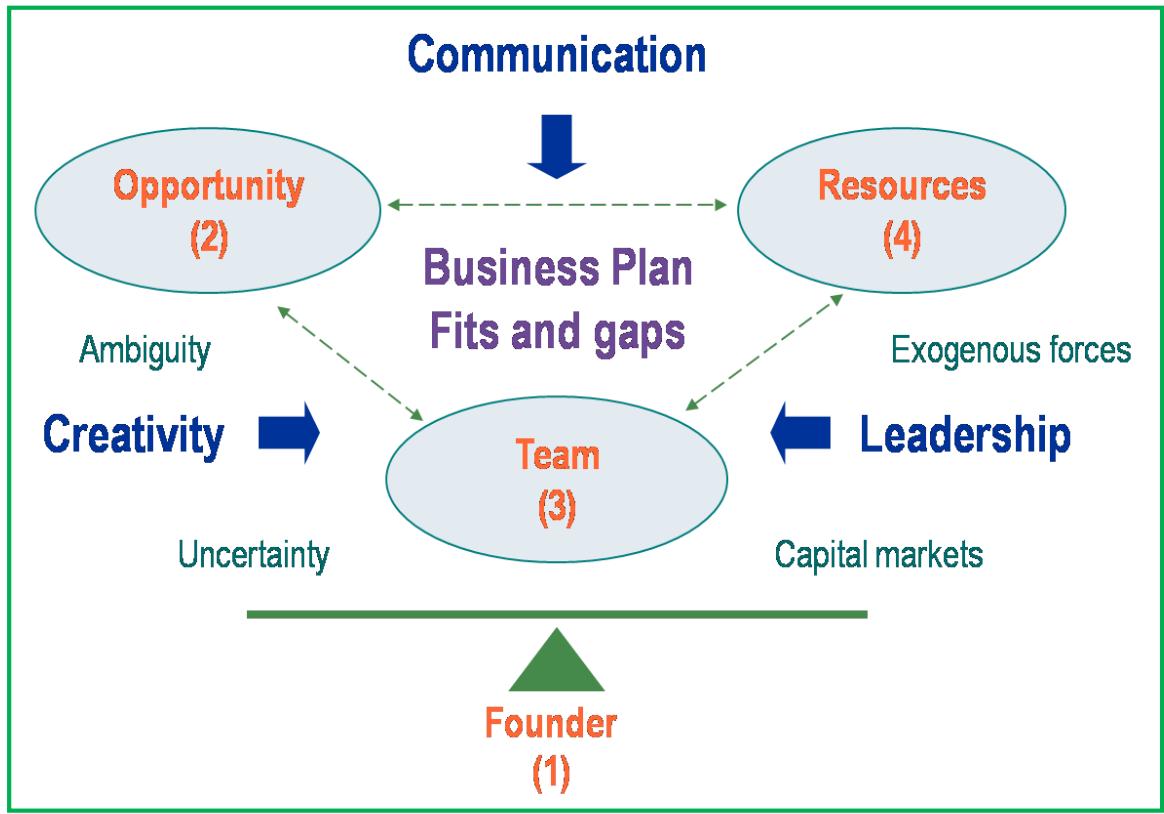 Figure 1: The Entrepreneurial Process
Source: Adopted from Timmons (1999); Timmons & Spinelli (2009: 110)
This next section discusses the four key elements of the entrepreneurial process as included in Timmons' entrepreneurship model.
## i. Opportunity Identification and Evaluation
There are many misconceptions regarding new ventures including the idea that an owner-manager must have a new idea to start a business. This is simply not true (Nieman & Nieuwenhuizen, 2014). Instead, Idemobi (2016: 23) argues that an owner-manager just needs to identify an opportunity, develop a business idea to successfully address the identified opportunity and then meticulously implement that idea and to create a successful business. Once an owner-manager recognises an attractive opportunity, he/she can then step out to assess the external environment and identify an appropriate time to launch and run the business successfully (Brem, 2011).
However, Nieman and Nieuwenhuizen (2014: 15) maintain that identifying opportunity is challenging with sound business opportunities often stemming from an entrepreneur's vigilance to potential opportunities. Smith and Chimucheka (2014: 161) observed that the identification and utilisation of business opportunities are part of a creative process which requires some level of expertise. Van Aard (2011: 30) argued that creativity is needed for an entrepreneur to identify an opportunity with the potential of generating economic value in the market. The process of changing ideas into plausible business concepts, otherwise known as opportunity recognition, includes three stages (Venter, Urban & Rwigema, 2008: 132). In the first stage the market needs to be identified. The second stage denotes a comparison of new market needs with those of previous markets. The third stage is the identification of resources in the form of a business concept. Smith and Chimuchekka (2014: 161) note that entrepreneurs should concentrate on seeking new ideas which can then be converted into opportunities. However, Timmons and Spinelli (2009: 111) caution that while opportunities are based on an idea, not all ideas are viable, and thus entrepreneurs require the necessary dexterity to identify those ideas which are, in fact, feasible and which could yield opportunities that would eventually birth a successful business. Creativity is thus fundamental to the successful assessment of a business ideas. It is key in opportunity assessment to identify the strengths and weaknesses of a single idea and then compare these to the overall strengths of several ideas. In this way one can determine which opportunities would, most likely, result in success. This is critical, as opportunities are ambiguous (Nieman & Nieuwenhuizen, 2014). A reasonable assessment of external factors (such as customers, suppliers, timing and competition) and
internal factors would highlight which resources are necessary in meeting customer needs in the market. This process is necessary if the entrepreneur wishes to obtain a proper understanding of where the best opportunities are situated (Nieman & Nieuwenhuizen, 2014).
The emerging entrepreneur's past training, experience, education and skills all impact on the creation of business ideas. Therefore, it is essential to evaluate business ideas successfully (Nieman & Nieuwenhuizen, 2014:15), particularly in the case of SMEs. Many SME owner-managers lose focus and fail to identify and/or evaluate business opportunities, causing them to stagnate. As Nieman and Nieuwenhuizen (2014) note, not all SMEs are entrepreneurial, and some operate without any strategic growth objectives and/or innovation.
## ii. The Management Team and the Entrepreneur
An entrepreneur is the active force which draws together all the various mechanisms contained in the entrepreneurial process. To begin a new business venture, Zeng, Bu and Su (2011) maintain that mere identification of a business opportunity and generation of an idea is not enough. Owner-managers need to ascertain whether or not they possess the necessary entrepreneurial and management skills. To initiate and sustain a new venture, owner-managers need to be productive, growth-oriented and innovative. They must possess the knowledge and confidence to efficiently and effectively turn mere ideas into useful resources. This particular set of owner-managers must be able to take risks and, in this way, turn business ideas into profits (Ko & Liu, 2015). Owner-managers also need to exert enough effort and ensure that they are involved in all levels of the business. This involvement includes: identifying the target market, carrying out market research, making prediction regarding future market movements, evaluating the accessibility of various technology and choosing the appropriate technology for their business. An owner-manager sets up a vision, organises and inspires a team of skilled individuals to run the business and ensures that the business vision is achieved (Park & Krishnan, 2010). As advocated in Timmons' framework, the creation of an effective team is fundamental to the entrepreneurial process. The owner-manager needs to tactically put together a capable and knowledgeable management team who can accomplish the day-to-day operations of the organisation in a VUCA environment.
## iii. The Resource Requirement
To startup a new business, an individual needs to identify different resources required to initiate and manage the business. Starting a new business is always unpredictable and an owner-manager should thus endeavour to keep the initial overhead costs at a minimum. He/she should also try to increase productivity while maintaining minimum ownership of capital assets to keep the initial investment low and thus grow the business (Kuratko, 2011). Furthermore, establishing a new business venture requires that the owner of such an enterprise obtain the necessary resources (including funds, land, labour, technologies and other form of resources) to achieve the set objectives. It is pivotal that the entrepreneur understands that resources can be either assets which are tangible (e.g. physical, human, financial) or intangible (e.g. knowledge). Resources can thus further be categorised in terms of threshold and distinctive capabilities helpful to gain a competitive advantage (Johnson et al., 2017). Threshold capabilities are those needed for an organisation to meet the necessary requirements to compete in a given market and achieve parity with competitors in that market (qualifiers) (Johnson et al., 2017). On the other hand, dynamic capabilities are those that are required to achieve competitive advantage. These include the ability to reconfigure a firm's resources and routines to gain a competitive advantage. Generally, capabilities refer to what one can actually do with resources and/or assets. Distinctive or unique capabilities are those that are of value to customers and which competitors find difficult to imitate (winners) (Johnson et al., 2017).
Owner-managers thus need certain resources which are useful in the exploitation of the identified opportunity. Notably, in business start-ups, SME owners/managers need to carefully manage the limited resources at their disposal. Hence, in this stage of entrepreneurial process, SME owner-managers must determine the kind of resources needed to achieve the set goals and strategies (Nieman & Nieuwenhuizen, 2014: 127). This process commences with the owner-manager assessing current resources and then securing the resources needed in a timely manner. This should be done without giving up control because, as the business grows, more resources will be needed and control may therefore be relinquished (Nieman & Nieuwenhuizen, 2014: 16). The owner-manager needs to assess and identify those valuable, rare and inimitable resources needed by the organisation (VRISO) to deliver a competitive advantage (Johnson et al., 2017). Value arises when resources: become pivotal in taking advantage of opportunities and neutralising threats, provide value to customers and, are provided at a cost that still allows an organisation to make an acceptable return (Johnson et al., 2017). If resources and capabilities are not valuable, they create competitive irrelevance (Johnson et al., 2017). However, valuable resources and capabilities create competitive parity (Johnson et al., 2017). A temporary competitive advantage arises from the use of resources and capabilities, which are valuable and rare, but easy to imitate (Johnson et al., 2017). A sustainable competitive advantage is achieved not only when resources and capabilities are valuable, rare and inimitable, but also when the organisation is setup to exploit these resources and capabilities (Johnson et al., 2017).
According to Timmons and Spinelli (2009: 377), it is crucial for the owner-manager to specifically understand all the different types of resources required for starting a business as well as the various types of competitive advantages. After the required resources have been acquired by the owner-manager, plans must be properly implemented to achieve the set goals (Timmons & Spinelli, 2009: 112). Thus, having discussed the three factors of Timmons' model, one can affirm that entrepreneurship is a vibrant process which starts when an owner-manager recognises an opportunity. He/she then decides the type and size of the team required and identifies other resource requirements including technologies, funds and labour necessary to exploit the known opportunity (Whitehead, 2011). Arguably, these three factors need to be balanced if the business is to be successful (Bygrave & Zacharakis, 2011). Minniti, as cited in Ko and Liu (2015) states that a certain level of risk ensues when the owner-manager is unable to maintain an absolute balance between all three factors. Any adjustment to any one of the three factors will directly, or indirectly, affect the other factors. For example, the mere identification of opportunity will not lead to success if an owner-manager is unable to scout for the required resources (Zarei, Nasseri & Tajeddin, 2011). The model of entrepreneurship by Timmons can be utilised to effectively appraise the potential opportunity by recognising the size, demand, structure of the market and the margin breakdown of the new business enterprise (Bygrave & Zacharakis, 2011).
Ko and Liu (2015) note that the Timmons model of entrepreneurship presents a borderline interpretation as to the process of entrepreneurship. The model shapes the basic capabilities of the entrepreneur to ascertain opportunities, purchase resources and develop an efficient management team. Minniti, as cited in Ko and Liu (2015), asserts that the Timmons model presents an all-inclusive view of the entrepreneurship process which rests on three interconnected factors as key to a successful business. Supporting the view, Bygrave and Zacharakis (2011) opined that another significant element in the Timmons model is the importance afforded to creativity, leadership and communication. According to them, the model demonstrates that an entrepreneur's leadership ability is important if growth of the entrepreneurial process is to take place. The model replicates the significant responsibility of the leader to effectively balance the three components of the entrepreneurship process to establish a perfect fit.
Smith, Mathews and Schenkel (2009) concur that a leader is also responsible for the formulation of an effective vision and for communicating this vision to the entire team, or organisation, to achieve its goals. If the vision is not spelt out clearly to the team, or if it is not successfully communicated, the survival of the new business will hang in the balance. Scally (2015) observed that failure by the leader to cascade vision to other members of the team might create difficulties within the operational structure of the business. The entrepreneur thus, in essence, assumes the duty of persuading the team and building an efficient working environment.
Bhalerao and Kamble (2015) posit that the Timmons model of entrepreneurial process is normative in nature. That is, the three model components (team, resources and opportunity) form the basis, and the entrepreneur needs to strike a balance between these factors by utilising creativity, effective communication and leadership in the ambiguous external environment (Wahl & Prause, 2013). Wahl and Prause (2013) further maintain that there are numerous factors, other than creativity, effective communication and leadership, which may impact upon the success, or failure, of a start-up business. Some of these factors are external in nature (e.g. seasonal change in demand, power of suppliers) and cannot be controlled by the entrepreneur whilst some are internal and lie within the entrepreneur's sphere of control. An example of an internal factor is an entrepreneur's in capability to inculcate trust with regards to a business idea. He/she would thus be unable to gain commitment and/or support of others (Tracey, Phillips & Jarvis, 2011). Other factors include copied business ideas or selecting a very narrow market segment which may already be overloaded. A further factor which may inhibit the performance of a new business enterprise is the rigidity of the entrepreneur's plans. When a business enterprise is in its early stages, it is essential that the entrepreneur be flexible in his/her strategy to expand the business and make it succeed. A new business enterprise can often face catastrophe such as rapidly using all its capital which may result in burn out. In this case, the organisation will require extra funds, highlighting the dangerous initial stage of any new start up (Zhou & Rosini, 2015). Many scholars, including Bhalerao and Kamble (2015), Ko and Liu (2015) as well as Johnson et al. (2017), have highlighted the basic skills that an entrepreneur must acquire in order to successfully balance all three factors contained in the Timmons model of entrepreneurship process. Entrepreneurs need to be: ambitious, risk-takers, focused, good at building and maintaining social relationships, creative and inspirational. They need to rally their team towards achieving the firm's goals.
## II. CONCLUSION
The fact that entrepreneurship is moving beyond the behavioural phase concentrating not on the personality of entrepreneurs, but on the activities they engage (Timmons 1999), it is evident that this paper focused on the processes underlying the "activity-based" concepts in order to reach more clarity on creativity and innovation in the entrepreneurship domain. The concept of entrepreneurship and definition of entrepreneurship have developed over time as the world's economic structure has changed and become more complex. Since its beginnings in the Middle Ages, when it was used in relation to specific occupations, the concept of the entrepreneur has been broadened to include the characteristics like risk taking, innovation, and creation of wealth. There are number of virtues like creativity, leadership, team building, motivation, problem solving, commitment and goal orientation that characterised most successful entrepreneurs.
Generating HTML Viewer...
References
69 Cites in Article
(2023). Open Access Journals: The Global Movement.
D Audretsch (2002). Entrepreneurship: A survey of the literature for the European commission, enterprise directorate general.
J Bäckbrö,H Nyström (2006). Entrepreneurial marketing: innovative value creation.
Dipanjay Bhalerao,B Kamble (2015). Online Marketing Strategy of Lady n Baby Retail-A Case Study.
B Bjerke,C Hultman (2002). Entrepreneurial Marketing: The Growth of Small Firms in the New Economic Era.
S Botha,S Musengi (2012). Introduction to business management fresh perspectives.
S Bouwer (2015). Entrepreneurs in water governance: Strategies for change.
Alexander Brem (2011). Linking innovation and entrepreneurship – literature overview and introduction of a process-oriented framework.
D Burnett (2000). Private Entrepreneurship:.
W Bygrave,A Zacharakis (2011). Entrepreneurship.
W Bygrave (2004). The Portable MBA in Entrepreneurship.
R Cantillon (1755). Essai sur la nature du commerce en general.
James Carland,Frank Hoy,Jo Carland (1988). “Who is an Entrepreneur?” Is a Question Worth Asking.
P Davidsson (2015). Entrepreneurial opportunities and the entrepreneurship nexus: A re-conceptualization.
M Delaney,M Royal (2017). Breaking engagement apart: The role of intrinsic and extrinsic motivation in engagement strategies.
D Deakins,M Freel (2003). Entrepreneurship and small firms.
S De Coulon,F Baltar (2013). Learning to be an entrepreneur.
O Dobre (2013). Employee motivation and organizational performance.
P Drucker (1985). Innovation and entrepreneurship.
(1996). Unknown Title.
Luzaan Hamilton,Natasha De Klerk (2015). GENERATION Y FEMALE STUDENTS PERCEIVED BARRIERS TOWARDS ENTREPRENEURSHIP: A COMPARATIVE STUDY.
M Hewitt,J Van Der Bank (2014). Entrepreneurship and new venture management.
Carole Howorth,Sue Tempest,Christine Coupland (2005). Rethinking entrepreneurship methodology and definitions of the entrepreneur.
E Idemobi (2016). Minding your own business.
P Igwe,A Icha-Ituma,N Madichie (2018). An evaluation of CSR and social value practices among UK commercial and social enterprises.
Allan Jepson,Alan Clarke,Gillian Ragsdell (2014). Integrating “self-efficacy” theory to the Motivation-Opportunity-Ability (MOA) model to reveal factors that influence inclusive engagement within local community festivals.
Gerry Johnson,Richard Whittington,Kevan Scholes (2017). The Strategy Lenses.
Wai Ko,Gordon Liu (2015). Understanding the Process of Knowledge Spillovers: Learning to Become Social Enterprises.
P Kreiser,L Marino,K Weaver (2002). Assessing the psychometric properties of the Global Journal of Management and Business Research Volume XXIII Issue III Version I Year 2023 ( ) A entrepreneurial orientation scale: A multi-country analysis.
Donald Kuratko (2011). Entrepreneurship theory, process, and practice in the 21st century.
D Kuratko,R Hodgetts (2004). Entrepreneurship: Theory, process, practice mason.
Donald Kuratko (2017). Middle managers: the lynchpins in the corporate entrepreneurship process.
N Krueger (2002). Entrepreneurship, critical perspectives on business management.
Sang Lee,Suzanne Peterson (2000). Culture, entrepreneurial orientation, and global competitiveness.
Michael Lounsbury,Joep Cornelissen,Nina Granqvist,Stine Grodal (2019). Culture, innovation and entrepreneurship.
R Lowe,S Marriot (2006). Commercialization.
D Macinnis,B Jaworski (1989). Information processing from advertisements: Toward an integrative framework.
D Mahadea,J Youngleson (2013). Entrepreneurship and small business management.
Bruce Mcdaniel (2002). Entrepreneurship and Innovation: An Economic Approach.
Gerard Mcguinness,Teresa Hogan (2016). Bank credit and trade credit: Evidence from SMEs over the financial crisis.
Carol Moore (1986). Understanding Entrepreneurial Behavior: A Definition and Model..
Michael Morris,Donald Kuratko (2014). Building University 21st Century Entrepreneurship Programs that Empower and Transform.
G Nieman,C Nieuwenhuizen (2014). Entrepreneurship: A South African perspective.
H Nzewi,E Onwuka,M Onyesom (2017). Entrepreneurship evolution and the growth of smallscale businesses in Nigeria.
Folke Ölander,John Thøgersen (1995). Understanding of consumer behaviour as a prerequisite for environmental protection.
G Onuoha (2007). Entrepreneurship.
Benjamin Oviatt,Patricia Mcdougall (2005). Defining International Entrepreneurship and Modeling the Speed of Internationalization.
Daewoo Park,Hema Krishnan (2010). Global corporate entrepreneurship: a conceptual model.
J Pearce,R Ii & Robinson (1994). Strategic management, formulation, implementation and control.
D Risker (2012). Toward an Innovation Typology of Entrepreneurs.
Andrew Osborne,Stuart Marsden,Simon Caporn,Emma Coulthard (2013). Cutting peat: The historical ecology and dissection of the Chat Moss ecosystem.
William Scally (2015). Project Workflow Management: A Business Process Approach.
M Schaper,T Volery (2004). Entrepreneurship and Small business a Pacific Rim perspective.
J Schumpeter (1951). Essays on entrepreneurs, innovation, business cycles, and evolution of capitalism.
Scott Shane,S Venkataraman (2000). The Promise of Entrepreneurship as a Field of Research.
Wilhelmina Smith,Tendai Chimucheka (2014). Entrepreneurship, Economic Growth and Entrepreneurship Theories.
Brett Smith,Charles Matthews,Mark Schenkel (2009). Differences in Entrepreneurial Opportunities: The Role of Tacitness and Codification in Opportunity Identification*.
Howard Stevenson,J Jarillo (1990). A Paradigm of Entrepreneurship: Entrepreneurial Management*.
J Timmons (1989). New venture creation.
J Timmons,S Spinelli (2009). New venture creation: entrepreneurship for the 21st century.
Paul Tracey,Nelson Phillips,Owen Jarvis (2011). Bridging Institutional Entrepreneurship and the Creation of New Organizational Forms: A Multilevel Model.
I Van Aardt (2011). Creativity and generating new business ideas.
R Venter,B Urban,H Rwigema (2008). Entrepreneurship: Theory in Practice.
Mike Wahl,Gunnar Prause (2013). Toward understanding resources, competencies, and capabilities: business model generation approach.
K Wärneryd (1988). Handbook of Economic Psychology.
Jack Whitehead (1989). Creating a Living Educational Theory from Questions of the Kind, ‘How do I Improve my Practice?’.
Behrouz Zarei,Hoda Nasseri,Mahdi Tajeddin (2011). Best practice network business model for internationalization of small and medium enterprises.
Fan‐qi Zeng,Xiang‐zhi Bu,Li Su (2011). Study on entrepreneurial process model for SIFE student team based on Timmons model.
W Zhou,E Rosini (2015). Entrepreneurial team diversity and performance: Toward an integrated model.
No ethics committee approval was required for this article type.
Data Availability
Not applicable for this article.
How to Cite This Article
Cosmas Anayochukwu Nwankwo. 2026. \u201cUnderstanding Entrepreneurship Origin and Process\u201d. Global Journal of Management and Business Research - A: Administration & Management GJMBR-A Volume 23 (GJMBR Volume 23 Issue A3): .
Explore published articles in an immersive Augmented Reality environment. Our platform converts research papers into interactive 3D books, allowing readers to view and interact with content using AR and VR compatible devices.
Your published article is automatically converted into a realistic 3D book. Flip through pages and read research papers in a more engaging and interactive format.
Entrepreneurship has been an interesting concept in business and has created an important tie in all facets of human life. With these, this paper is aimed at exploring the origin of entrepreneurship as well as categorising the conceptual stand. The paper adopted the exploratory research method. The paper reviewed the different concepts of entrepreneurship, reviewed its origin and identified the key processes use by experts. The study concluded by focusing on the processes underlying the “activity-based” concepts.
Our website is actively being updated, and changes may occur frequently. Please clear your browser cache if needed. For feedback or error reporting, please email [email protected]
Thank you for connecting with us. We will respond to you shortly.