
I. INTRODUCTION
In France, the review of policy initiatives led by Y. Clot et al. (2021), spanning from the 2015 law on society's adaptation to ageing to the "Ségur de la santé" of May 2020, underscores a growing political and social awareness of the urgent need to address the complexity of the issues surrounding the population ageing. However, there is an undeniable neglect of this urgency at the operational level, as highlighted by the recent postponement of the proposed "Ageing Well" law (2023). This law aims to ensure the right to age with dignity and prepare society for its ageing population. Stakeholders in the sector have expressed their frustration with what appears to be a lack of concrete action following promises. Despite assurances from the minister that a law on the elderly will be passed by the end of 2024, these announcements have been met with significant skepticism from various organizations and federations in the sector. They face with a decrease in the attractiveness of professions for the elderly despite a growing demand (El Khomri, 2019). The issue of staff shortages, although already studied for years (Archambault, 2006) continues to worsen the situation.1 However, any potential for improvement in the future must draw upon the accumulated experience and expertise of those working in nursing homes. They are essential "to rebuild their profession" (Clot et al., op. cit., p. 64) and make it attractive and fulfilling again.
This study, initiated in January 2021, responds to an urgent context, and is based on a structured and comprehensive set of humanities and social sciences. It approaches issues with a complexity-based perspective, enabling human engagement in activities without relying solely on subjective interpretations. J. Rheaume asserts that human activity, and by extension work, reflects the ontological essence of human beings. As beings capable of "living, imagining and thinking" (2017, p. 249), humans possess to acquire knowledge or develop an understanding of activities based on lived experiences. This study seeks to delve into these inquiries by adopting a relatively unexplored anthropological approach, particularly in understanding activities within nursing homes. This approach prompts fundamental inquiries into human nature and the preservation of human agency. Accordingly, we will begin by outlining our research problem, followed by its theoretical underpinnings. Subsequently, we will detail our methodology and analytical framework, concluding with a discussion of our findings.
a) Problematic
Supported by professionals in gerontology, "family caregivers" endeavor to keep their elderly relatives at home. However, this assistance reaches a critical point when the demands of caring for a dependent loved one become overwhelming. Despite public policies aimed at promoting home care, many situations become unmanageable, leading to the use of Residential Establishments for Dependent Elderly People (EHPAD). Although these facilities serve as a final place of residence for many individuals, they are criticized for providing a poor quality of life to residents (Vercauteren & Connangle, 2021, p. 72).
In this research, we will explore the role of health professionals as subjects of their own activity (Barber, 2017), providing care and support to the elderly. We will investigate the extent to which these professionals can harness their intrinsic energy to maximize their engagement in their "to be present and available" (Norberg et al., 2001) work and thus influence outcomes in terms of adequate care. We will examine how these existential characteristics directly impact the quality of care provided and the experience of older adults in nursing homes. Additionally, we will question the ability of professionals to express their existential traits in a genuine manner, aiming to enhance their dedication and effectiveness in their roles.
Through an anthropological approach, we aim to comprehend how to infuse humanity into the involvement of professionals in their work. We will analyze the shift from a humanized, individual-focused approach to an activity centered on human agency, highlighting the power of individuals to act as the subjects of their activities.
Central to our research is the notion of the subject, as professionals primarily operate as such. Drawing from M. Sachot's work, we understand that the word "subject" comes from Latin subjectum ("submissive", "submissive") and that this term translates in the fifth to sixth century the Greek hypokeimenon which has no connotation of submission or subjection. It means (...) 'which is underlying" (Sachot, in, Ancoriet al., 2014, pp. 77-100).
Therefore, our research hypothesis posits that the subject possesses an intrinsic capacity to engage in activities, constituting a fundamental anthropological asset for the subject's ability to act in a work environment. These existential traits significantly influence the quality of care and the well-being of the elderly individuals they assist.
II. THEORETICAL FRAMEWORK
a) Epistemological Choice of our Approach
This study is grounded in the framework of pragmatic anthropology, drawing inspiration from Kant's work (1993) which explores the individuals' actions and their influence on their personal evolution. We investigate how individuals perform their tasks and how they affect their personal development. With this in mind, we will consider the "way of being", a priori, abstract according to Cicero[^1] yet universally relevant to all human activity. We also incorporate insights from the sociology of work and the clinic of activity to enrich our analysis.
Educational sciences also contribute significantly by providing a conceptual framework, including emphasizing the close links "between education and care" (Honoré, 2003; Di Patrizio, 2020, p. 185). This point of view enriches our reflection on work in nursing homes.
Our theoretical framework focuses on professional status, viewing individuals as employees engaged in the overarching "establishment project" of their employing nursing home.
b) The Professional
A professional is defined as "an active being" (Durrive, 2019) whose work generates goods or services. He or she performs "socially useful value-producing tasks" (Vernant, 1996, p. 274), hence deserving a salary.
However, it's crucial to acknowledge that in the professional environment, not all actions necessarily ensure success; they may also lead to mistakes or failures, as pointed out by Malgraive (2005, p. 77) To reduce the risk of errors, "good practice frameworks" have been established with the aim of improving the quality of care for the elderly in institutions. (Puisieux (Coord.), 2007, p. 4). Nevertheless, it should be recognized, in line with Y. Clot's perspective, that these frameworks can sometimes falsely ensure the professionalization of individuals by artificially rationalizing their performance. Indeed, according to him, the application of these "good practices" is often a response to the difficulties encountered in reality, thus seeking to standardize professional actions (2015).
c) Knowledge Mobilized for the Activity
The knowledge necessary for practice in the field of gerontology is clearly defined. To ensure the relevance and effectiveness of their work, professionals mobilize organized and operational knowledge, which Malgraive describes as "knowledge in use" (2005, p. 87-106).
i. Necessary Unification
Through engagement in complementary activities, professionals offer a service that must be adapted to the specific needs of an environment where vulnerable people reside. To achieve this, each professional makes operational decisions that are necessary in a given context, requiring the synthesis of the following elements:
- "Theoretical knowledge" which defines the necessary actions based on a framework of fundamental knowledge for any justified practice.
- "Procedural knowledge" which addresses the "how". This adds an analytical dimension that leading to the selection of an appropriate procedure. This is professional intelligence, understanding and connecting specific circumstances to theoretical knowledge.
- "Practical knowledge" concerning the implementation of the action. This contributes to the construction of
professional experience by associating contingency and operationality.
- A singular "know-how" updating the performed practice.
Thus, it is obvious that good practice frameworks have their limits, because the professional does not enact an action according to a pre-established protocol and directed towards an objective external to their own situation. It is also the responsibility of each professional to commit to mobilizing this knowledge, reflecting a concentrated act of responsibility in their complex activity.
ii. Knowledge of use and Professionalism
In professional domains involving human interactions, especially those faced with situations of high dependency, professional action is based on a combination of relationships inherent to the activity itself, without reducing the professional to the simple performance of a utilitarian task. The concept of knowledge in use implies that individuals are not seen as mere instruments for carrying out tasks, but rather as essential participants in the performance of those tasks.
Consequently, what constitutes "good" practice, often perceived as mere adherence to procedural norms, brings forth a practical ethical dilemma regarding the professional's dedication within the work milieu. It prompts reflection on the underlying significance of honed skills, such as reflexivity. Professionality is then defined as the quality of the professional in the activity in which he participates, thus going beyond the simple notion of competence to encompass the pleasure resulting from his commitment to work. (Dejours & Gernet, 2012).
iii. A Step towards the Notion of Experience
In this way, the professional continuously develops his competence not only through the acquisition of knowledge and know-how, but also by fully investing his commitment in his work, as emphasized by Clot (2015), integrating it into an experiential learning process. In this way, work acquires a deeper dimension than the mere performance of prescribed tasks, because its achievements also contribute to the fulfillment of existential ends.
Work with and for others then becomes intrinsically linked to the individual, forming a set of experiences that enriches the value of individual and collective action. Consciously or unconsciously, this can generate a "power to act at work", according to P. Roche's concept (2016). This experience is characterized by:
- Reflection - because, according to Dewey (2018), knowledge devoid of thoughtful action remains inert, weighing heavily on the mind.
- Reciprocity - emerging from interpersonal interactions,
Autonomy - where the acknowledgment of past influences and responsibility for future consequences integrates symbolically and subjectively into the present, echoing Ricoeur's insights (1990).
III. RESEARCH METHODOLOGY
We have chosen a two-phase approach for gathering data. In the first phase, we will establish a descriptive reference system through an ethnographic approach. This descriptive framework will serve as the foundation for the subsequent analysis in the second phase, which will involve two distinct groups of professionals from various institutions. Prior to these exchanges, the researcher will introduce the established analytical framework to assess the relevance of the hypotheses.
a) Use of the Field: an Ethnographic Approach
According to F. Laplantine, without an ethnographic description, anthropology is not feasible (2021, p. 49). Therefore, we adopted this precautionary measure as our starting point before proceeding further. Our aim was to gather diverse situations that highlight dysfunctions within the working environment of professionals in nursing homes. To achieve this, we accessed a directory of emails belonging to healthcare executives in these facilities and randomly selected five to reach out to. We communicated our intention to analyze work scenarios featuring various dysfunctions. Two of them promptly agreed to participate in interviews2.
At the outset of the non-directive interviews, we instructed the respondents to organize their responses as freely as possible, as outlined by Sauvayre (2021, p. 23). The focus was on description without immediate attempts at explanation or analysis of the identified dysfunctions. The events recounted during these two 45-minute interviews were meticulously recorded and transcribed. Drawing from all available data, we constructed a narrative interweaving "beautiful cases," "thorny cases," and "borderline cases," forming a composite of "typical configurations" as described by Passeron and Revel (2005, p. 12).
The resulting "textbook case" did not emerge from immediate, intuitive insight but rather from mediated, distanced, deferred, and re-evaluated knowledge, as elucidated by Laplantine (op.cit., p. 50). This document underwent review by the two healthcare executives interviewed, with their feedback duly incorporated. The final text was validated for its credibility, emphasizing the significance of the dysfunctions identified as pertinent for a "textbook case" intended for presentation and reflection among practicing professionals.
b) Presentation of the "Textbook Case"
The subsequent reference text will exclusively incorporate relevant elements essential for analysis, adhering strictly to the structural constraints of a scientific presentation. The focus of the examined scenario revolves around team workflow, commencing with their involvement in the "transmissions" conducted by the preceding team and concluding with the handover of transmissions to the succeeding team at the end of their shift.
i. Nursing Home Overview
- Facility housing 63 residents
- Caregiver staff scheduled from 6:30 a.m. to 2 p.m.: 7 caregivers
ii. Distribution of female professionals across services3
- Ground floor: Sandrine (AS) and Aline (alternate)
- 1st floor: Bénédicte (AS) and Marjorie (AMP)
- 2nd floor: Sophie (AMP) and Valentine (alternate)
- All sectors: Isabelle (IDE)
iii. Unfolgingevents
6:45 a.m. Béniédicte phone to explain her "slight delay of 10 minutes due to her son...
In the locker room, the first contencious topic revolves around absenteeism.
Marjorie Remarked: "Well, that is a relief; we will have ample staff today as the manager has substituted for the absent colleagues."
Sophie commented: "What a reinforcement... They're two newcomers who are unfamiliar with the residents or the facility!"
Sandrine: "Let's not discuss individualized care because it'll be rushed this morning!"
In the treatment room, the IDE informs everyone about Bénédicte's slight delay and takes charge of the crucial "transmission" gathering. She provides updates on the morning's significant events, specifically highlighting the various appointments scheduled:
- Mrs. Dumont (1st floor): Scheduled hairdresser appointment on-site at 9 a.m.
- M. Collombier (DRC): Pedicure appointment on-site at 9:30 a.m.
- Mrs. Tartuffe (2nd floor): Physiotherapy session in her room at 8:45 a.m.
- Ms. Michelet (1st floor): Ambulance pick-up at 10:00 a.m.
- Mrs. Tartampion (DRC): Advised not to have breakfast before blood sugar level test this morning.
Three additional categories of situations contribute to the complexity of the work.
1. Adverse events
- Mrs. Cocasse (ground floor) was found on the floor in the toilet of her room with head injury.
- Mr. Lorrain (2nd floor) ripped his protective padding, resulting in significant stool contamination on his body, bed, and bed rails (stool ++ + on the body, the bed and the rails).
- Planned activities for today
- Vegetable peeling workshop at 9:30 a.m.
- Mass at 10:30 a.m.
At 7:25 a.m., the caregivers arrive at their respective wards.
Ground floor: Sandrine immediately instructs Aline (substitute) "Join me for the 8 challenging toilet tasks first... We'll tackle them first since they're the most demanding... After that, things should calm down and relaxed."
- 1st floor: Bénédicte and Marjorie start their treatments as usual. Marjorie said to Sandrine before going upstairs, "I'll lend you a hand on the ground floor as soon as I am able."
- 2nd floor: Valentine asks Sophie, "Could you please advise me on what tasks I can manage alone?" Sophie provides her with a list of 6 residents who require assistance with toilet tasks at the sink. Then, she goes her own way. Valentine doesn't know exactly which rooms she has to go to do her work.
The manager begins her shift at 8:30 a.m.
Upon her arrival on the ground floor, Sandrine called out to her: "Do you believe it's helpful to assign replacements who are unfamiliar with the tasks? I'm doing my best, but please don't expect miracles... I fear I might fall ill too!" Aline, standing nearby, blushes and appears visibly embarrassed.
iv. Issues and explanations
Relief and transmissions commence during the afternoon shift at 1:30 p.m., with both morning and afternoon caregivers present.
Nurse Isabelle expresses her frustration to the executive:
- "The paramedics were furious with me because Mrs. Michelet wasn't ready for her radiology appointment!"
- "The pedicurist waited 15 minutes for Mr. Collombier to arrive, only to scold me about the sorry state of his feet... It's shameful! If the family found out, it would have caused a scandal!"
- "We'll see tomorrow about Mr. Tartampion's blood sugar. It's been forgotten for the past two mornings.
It's baffling that nobody understands he shouldn't have breakfast before I can take his blood test...
- "And isn't it wonderful that Mrs. Larivière was bathed!... Despite having her hair done yesterday at the salon... The family will surely be pleased to pay the stylist for nothing!"
- "Let's not forget about Mr. Lafond, who was left behind and missed Mass."
- Reactions:
- Sandrine (DRC) retorted angrily, "In any case, it's impossible to handle everything, especially with Mrs. Cocasse falling this morning! There was blood everywhere... I can't be in two places at once!"
- The executive intervened, stating firmly "It is unacceptable not to review and approve the care plans of each resident!"
- Sophie (2nd floor) responded sarcastically, "Oh naturally...! As if we don't already struggle to attend to the residents, now we have to find time to review care plans...!!"
She, then, became irritated, suggesting to the nurse, "Perhaps I should have left Mr. Lorraine in his room to accompany Mr. Lafond to Mass?"
- Bénédicte (1st floor) chimed in, "You should have notified me! I could have assisted some accompaniments on the 2nd and the ground floors...
c) Analytical framework developed by the researcher
We used the plural realm model of anthropological sociology by L. Boltanski, L. Thévenot and É. Chiapello(Boltanski, L. & Chiapello, E. 2011; Boltanski, L. & Thévenot, L., 1991) as the basis of our analytical framework.
We will retain the division of these common realms for their relevance to aspects of human experience. These divisions will serve as analytical benchmarks to understand whether the "concept of presence at the activity" can be derived from this typology. Nevertheless, However, our aim is to move from an action within multiple realms to an action from multiple realms that constitute the subject. Without intending to narrow the extensive scope of the original model, we describe these realms as follows:
- In the "realm of inspiration", individuals have access to ways of being and acting that foster values such as creativity, authenticity, imagination, and openness- essential for embracing the similar as well as the different.
- In the "domestic realm", individuals conduct themselves according to values of loyalty, propriety and discretion which are ingrained in their habits and define their character (Boltanski, L. & Thévenot, L., op. cit., p. 210).
- In the "realm of opinion", individuals are motivated by self-esteem and measure their worth based on
the regard others hold for them. Priorities include fame, glory and recognition.
- In the "civic realm", emphasis is placed on the collective rather than the individual. Personal commitment to collective endeavors defines one's greatness, achieved through surpassing oneself for the common good. Actions initiated within this framework focus on activities contributing to joint projects, rather than merely coexisting with others.
- In the "market realm", individuals showcase their greatness by their ability to acquire goods or services. Values such as self-interest, selfishness, and competition prevail, with individual interests outweighing collective ones.
- In the "industrial realm", efficiency, performance, and functionality reign supreme. However, this pursuit sometimes comes at the cost of dehumanizing individuals, treating them as mere objects (Boltanski, L. & Thévenot, L., op. cit., p. 262). In addition, as V. de Gaulejac highlights it, efforts to resolve contradictions in this realm often overshadow opportunities for collaboration and synergy (2011, p. 304).
- In the "projects-based realm", individuals demonstrate their capacity to form or integrate into networks. Success requires effective communication, trust, adaptability, and compelling presence. As failure to embody these traits may result in exclusion.
d) Facing the "textbook case"
To gain insight into the underlying dynamics of practices and functioning within nursing home environments, a proposal was made to the management of two establishments. The suggestion was to present a "textbook case" for study by professionals over a 90-minute session. Upon validation, this participation was extended to recognized professionals involved in assisting residents with daily tasks, though representation from other professions like doctors, psychologists, occupational therapists, and technical staff was absent. Consequently, two groups, each comprising six employees from various functions, were formed.
Respecting the modalities of the collective interview approach (Haegel, 2005) or "focus group" (Sauvayre, 2021, p. 26-27), the discussions of the 2 groups of professionals were recorded and transcribed with a view to our operation.
Event:
- Groupe 1 (G1) Constitution: 5 women + 1 man (2 ASH, AMP, 2 AS, 1 IDE)
- Groupe 2 (G2) Constitution: 5 women + 1 man (2 AS, 2 AS, 1 facilitator and 1 IDE)
Award:
Individual reading (duration: about 15 minutes for the 2 groups)
We facilitated the explanation the of the plural realms4 and acted as moderator occasionally prompting participants to contribute or inquire (Duration of the presentation of the realms: nearly 30 minutes (G1) and more than 20 minutes (G2)).
We conducted an analysis of the "textbook case", enabling participants to share their reactions to the mornings' events, based on the presented realms. These discussions lasted approximately 40 minutes for G1 and 50 minutes for G2.
IV. RESULTS
a) Reviewing the Thematic Units of Meaning Associated to the Realms
The gathered data underwent empirico-inductive processing to present the findings and comprehend the issues concerning the quality of attendance at the activity.
Our thematic analysis commenced with identifying thematic units (UTs) in which a reference to realms appeared.
The table below illustrates the occurrences for each realm.
| UT(Realm) | G1 | G2 |
| UTP/projects-based) | 3 | 4 |
| UTD(domestic) | 2 | 3 |
| UTw(work) | 3 | 3 |
| UTC(civic) | 2 | 4 |
| UM(mercantile) | 3 | 4 |
| UTo(judgment) | 4 | 7 |
| UTI(inspiration) | 3 | 2 |
| TOTAL UT | 20 | 27 |
Considering the speaking time allocated to discussions and the number of occurrences of Thematic Units, it becomes evident that the characterization of realms makes sense for professionals since it is used for comprehensive purposes. The verbatim excerpts we will utilize in the subsequent analysis demonstrate that the conducted work can be examined from this typology, thereby providing a concrete and anthropological approach to dysfunctions.
b) Qualitative Analysis: The Subject as it is constituted, characterization of plural realms
We will present them below in the order in which they appeared during the exchanges.
i. The Projects-based Realm
The "projects-based realm" has been apprehended in a different way from that defined by the authors. For the professionals interviewed, this is the "realm where projects requiring action are carried out" (IDE G1).
The tasks performed by professionals are essential both for healing and caring. Primarily focused on satisfying physiological needs such as "Grooming", "Giving breakfast", "Attending to diaper changes, and all related tasks... (AS G2). These supportive actions are geared towards preserving the residents' autonomy. The statement: "our job is to do everything for the well-being of the elderly" (ASH ff G2) s suggests that relational aspects also influence their actions to address diverse needs. Hence, it is imperative that the technical tasks of professionals be executed with a keen focus on the person. These tangible aspects highlight how the activities of professionals significantly shape the life trajectories of nursing home residents, positioning professionals at the forefront of action. This is illustrated by AS G1's reference to Mr. Lafond's situation: "If a resident wishes to attend Mass, it holds significance for him. It's our responsibility to facilitate it... It's part of the plan. Oops, Sophie!"
Each one is engaged in a structured set of activities, scheduled at specific moment within this projects-based realm.
The projects-based realm plays a pivotal role in shaping the individual and in justifying the professional in their activity.
ii. The Domestic Realm
It includes occurrences in the professional's personal sphere that may persistently preoccupy their thoughts even beyond their home life. In the context of this study. This is exemplified by "Bénédicte's son", who impacts the projects-based realm by even before assuming her position (delay).
No one in the two focus groups points out this aspect in the analysis. Therefore, we posed an open-ended question ourselves: "And what do you think about Bénédicte's delay?" In the G1 an AS responds: "It can really happen to anyone" we noted four knowing glances directed towards her. In the G2, the response "I is still thoughtful to have given a heads-up, not everyone does that" (AS) received similar approval. And the G2 facilitator asks (himself) without waiting for an answer
"So, Bénédicte's son represent the domestic realm, doesn't he?
In an era where the concept of quality of life at work emphasizes the importance of better balancing "personal and professional life", the domestic realm, with its shared concerns regarding health, family, personal organization, and other related risks, is collectively the most cherished.
However, can we hypothesize that Bénédicte, potentially unsettled and still concerned about her child's circumstances, might consequently disrupt her participation in the activity and alter her behavior? This question has not been raised, as it would have exceeded the scope of our methodology and its objectives.
iii. The Realm of Work
While the project-based realm pertains to the array of required activities and each individual's specific tasks at any given time, the industrial realm encompasses the political, social, organizational, and material framework within which work is conducted.
It constitutes a regulatory component of the nursing home environment where "I" am working. This aspect is referenced during group discussions when it is remarked "we must not hide our faces, we work so much on a just-in-time basis. Replacements are not helpers if they are not colleagues who take their rest, the squad is full as Marjorie says, but it's not enough, that's clear..." (IDE G2).
Consequently, the industrial realm can intrude upon the project-based realm. This is what a G1 AS justified by saying that "the life project meeting, even if it has to be done, should have been postponed, that's for sure!"
In both groups, it was unanimously suggested to replace the term "industrial realm" with "realm of work" because "one does not work in factories, although..." (AMP G1).
iv. The Civic Realm
In a complex operation where the pace of actions directly impacts the core of the business, announcements statements like, "I'll lend you a hand on the ground floor as soon as I am able" offer reassurance and support to a overwhelmed colleague. However, an ASH ff G2 asks, "But did actually do it? It's good to speak like that, but if it's not followed through... These nice words are heard everywhere. But sometimes, when you ask for help, colleagues say no! That's even worse!"
Consequently, the civic realm questions the individual inclination of colleagues to give priority to the collective functioning, as "in any case, it is for the resident that we do it", responds the G2 facilitator, citing an example of his involvement in a treatment. An ASH G1 adds, "I must admit that for me, I don't mind stepping in at short notice, I live right next door. It's convenient."
If the civic realm of the subject calls for unity, it's because it enables us to act collectively. "Mutual support always enhances the situation," remarks the IDE and an ASH ff from G2. Is the civic realm wisely engaged, or is its omission that limits the positive contribution to the functioning of the collective that serves efficiency in the accompaniment and care provided?
v. The Mercantile Realm
An AS G1 asks: "Doesn't Sandrine's exasperated statement, I'm doing my best, but please don't expect miracles... I fear I might fall ill too!" reflect this sentiment?
This intention to do as much as possible reveals, in a sense, a desire to maintain self-respect to ensure personal well-being. The IDE G2 acknowledges: "For everyone, absenteeism serves a protective measure when the workload becomes overwhelming. We shouldn't let it lead to burnout! I've seen it happen to some colleagues. Supporting another perspective, this G1 ASH relativizes the previous protective interpretation by declaring: "What about those colleagues who gossip instead of offering help? Is that self-preservation, or just selfishness?"
Doesn't this observation shed light on another aspect of the same self-preservation instinct, no longer as a protective measure but rather in its individualistic and self-centered form? Consequently, individual interests may sometimes take precedence over the needs of collective functioning. So, would its mastery promote a commitment to give and receive support in the workplace, thus fostering service in a mutual and more balanced manner?
vi. The realm of Judgment
Ideas and opinions regarding certain facts often vary and can even diverge among colleagues, particularly concerning issues related to support and care. While having a variety of viewpoints can contribute to the ongoing improvement of the overall functioning of tasks within projects, it's important to acknowledge that when these opinions turn into judgments of practices or individuals, they can lead to compartmentalization of relationships among professionals, hindering collaborative efforts between both the sender and receiver, who share a common humanity. Opinion becomes problematic when it transforms into judgment.
This concern is precisely highlighted by an AS from G2: "You know, there aren't many judgments expressed here, but in general, it's the gossip: 'and then she said this,' 'she didn't do it,' 'it's always the same....' you know... That's the worst!" The group participants chuckled and confirmed this observation.
Sandrine's comment gains significance when she mentions, in front of an embarrassed colleague, the use of "people who know nothing about it". An ASH G1 remarked: "That's just the tip of the iceberg." Although she doesn't elaborate further, the IDE G1 quickly interjects, specifying: "You know, ASH often feel belittled by the judgments of caregivers, either because they lack diplomas or when they exceed their roles." Another colleague AS G1 adds, "It's true, I've heard it before, and sometimes they know the residents better than we do. It's also women among themselves...
The realm of judgment poses a risk of undermining the individual's engagement in their tasks by fostering a mental disposition that weakens their actions.
vii. The Realm of Inspiration
Sandrine's comment "because it'll be rushed this morning!" is highlighted in both groups:
- "You know, when I hear that, it makes my hair stand on end. We haven't started yet, and some of them are leaving with these negative ideas... It's not everyday thing, but it still occurs (...). Personally, I tell myself that I wouldn't want to place my parents in a nursing home. That's why I always come in with a positive attitude! It's crucial! (AS Man G1).
- "You can immediately sense the tension... Why is she starting the day like that? Moreover, later, she tells the intern, "We'll tackle them first since they're the most demanding... After that, things should calm down and relaxed." But what example does this set for?" (ASH ff G2).
Does this suggest that, in contrast to these two situations, the realm of inspiration could generate positive energy to invest more in the activity "with enthusiasm" (AS homme G1)?
Could it be an inspiration seeking to give meaning to the practice? Would it trigger an action that verifies how much doing is an anthropological gesture, enabling the subject to construct his or her professional (presence at the activity) identity (power to be)?
c) Modelling the impact of the constituent realms of the subject on the projects-based realm (cf. Fig. 1)
Taken together, these findings confirm our hypothesis. Indeed, it seems possible possible to comprehend, in an anthropological sense, the presence of the professional in the activity through the underlying realms that constitute the subject in all his humanity. We have seen that the projects-based realm is central to the constitution of the subject because it encompasses everything that he does at the time he does it, in his participation in the project of support of the nursing home. It specifically pertains to the present moment of an activity and all these moments. The other realms are directly linked to it and are always present, as they are inherent to human existence. Their impact varies depending on what the subject experiences, encounters and, above all, interprets.
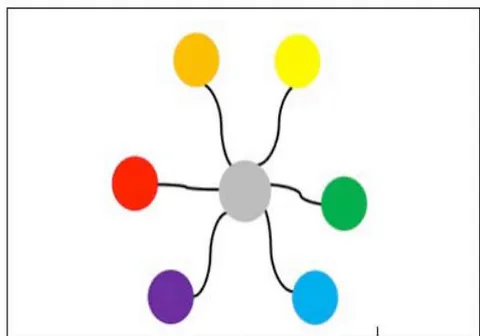
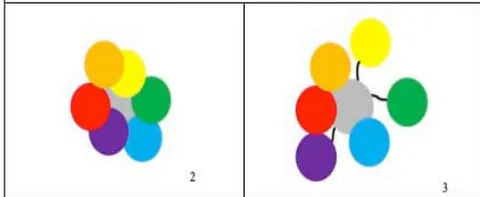
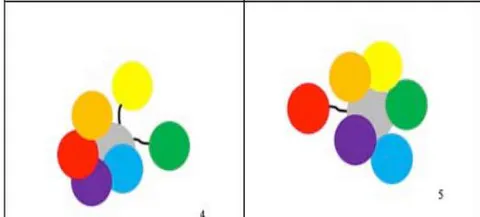

Legend: The 5 diagrams that we propose in Figure 1, depict the seven various realms, each represented by a distinct color. The primary projects-based realm is depicted in grey. Collateral realms are represented as follows: in orange, the realm of work (industrial); in yellow, the domestic realm; in green, the realm of inspiration; in blue, the realm of judgment (opinion); in purple, the mercantile realm and in red, the civic realm.
Figure 1 illustrates the composition of the 7 underlying realms influencing the subject's activity. The central realm projects-based one to which the other 6 are interconnected.
Diagrams 2, 3, 4, 5 represent 4 hypotheses outlining the mental disposition of "presence at activity," based on the anthropological impact of these realms on 4 different subjects at the "moment t" of their participation in the projects-based realm where the power to act is concretized (depicted by remaining gray area). Subject 3 demonstrates a greater capacity for action compared to Subject 5, which surpasses Subject 4, and then Subject 2 in terms of power to act.
The anthropological reality underlying each professional's activity is likely to influence the activity to varying degrees, thus impacting the professional's actions and, consequently, the outcome.
The constituent realms of the subject directly shape their presence in the activity (cf. Fig. 1). Therefore, it is this "presence at the activity" that can either diminish or augment the "power to act," thereby influencing the quality of the activity itself.
V. INTERPRETATION
The model of "acting from several realms" can make sense to professionals who analyze their activities, for two reasons. First, it allows for a "reflexive awareness", and secondly, it declines an anthropological form of "parasitism" of activity.
a) Reflective Awareness
This referential model of "acting from several constitutive realms of the subject" can facilitate "perlaboration, i.e. the possibility for the subject to elaborate, psychically and mentally" (V. de Gaulejac, 2011, p. 309), a logic of action for which he is the primary architect.
The concept of presence in activity does not imply a fixed state, but rather suggests the potential for engaging in a reflective process of awareness. This process enables individuals to enhance their effectiveness in activity by acknowledging the "unnecessary" pregnancy of certain realms and deciding for themselves their relevance in a given moment.
The presence in activity represents the subject's responsibility in the current moment of their action. This process involves two types of self-reading:
- An "ex-" interpretation positions the subject with benevolence "outside" of himself, enabling self-observation as an object.
- A "peri-" interpretation fosters reflexive awareness "around" the impact of different realms. Recognizing an excessive influence of certain realms might prompt the subject to seek a more balanced engagement.
Reflexive awareness implies transcending the instinctive understanding of reality to engage in critical analysis. By viewing themselves as a comprehensible entity, the subject adopts an epistemological and ultimately ontological stance, enabling them to observe their own anthropological role in their work.
The process of reflection brings a certain lucidity to all professionals, irrespective of their roles, functions, or positions. Does it also uncover the "origin of this 'deliberate' energy that is essential for engaging in the actual work of organizing activity 'in the ground" as described by Y. Clot (2015, p. 177)? The occupational psychologist asserts that "[n]o formal organization of work can replace the employees themselves in this regard, despite what many companies still believe" (ibid.).
b) Other Issues
Let's propose three additional extrapolations from the model:
Could it aid in understanding how teamwork is typically perceived, interpreted, and supported in nursing homes? If "working as a team" is a component of the project-based realm, to what extent can the presence of team members at the activity be optimized to ensure that professionals are the most effective partners?
Could it offer management an additional perspective on understanding individuals, both men and women, to facilitate achieving results by guiding professionals through illuminating aspects that may disrupt underlying work that needs to be addressed?
And finally, could this model of "presence at the activity" serve as a resource for each professional to optimize their ability to manage themselves by actively deciding, through voluntary effort, how to navigate the peripheral realms without being consumed by them? Thus, the complexity of agency appears to be linked to achieving a balance upon which subjects possess these knowledges and take action can exert influence.
c) The Ingenium in Action
All movement originates from within the individual, making self-observation crucial. This starting point brings us to the concept of ingenium, described by G. Vico as the intrinsic force that allows for the connection of disparate elements (Grassi & Graziani, 2001). Ingenium serves as the active substance of a pragmatic anthropology, enabling self-reflection—an essential aspect emphasized throughout this research.
Therefore, it is essential to underscore, at the conclusion of this research, that workplace well-being is intertwined with the individual's ability to self-structure within their tasks. In this regard, isn't being fully engaged in one's activities a means to enhance the precision of one's actions and, consequently, promote better health at work? From this perspective, as individuals experience this mindful approach to work, the focus of workplace quality of life transitions from mere well-being to a deeper concept of "human-being-beauty at work", where self-care and action coexist harmoniously.
VI. CONCLUSION
J.-P. Vernant highlights in Homer's Odyssey (XIV, 228) the assertion by Ulysses that "To each the activity that suits him" (1996, p. 288). Beyond the hierarchical structure of ancient Greek society, this emphasizes the subject's ability to consciously determine their level of engagement in the work. in which he is employed.
The hermeneutic process of reflexive consciousness leads to a humanization of activity that machines or artificial intelligence cannot replicate. In the workplace, this consciousness manifests in the actions themselves, as well as in recognizing both the other and oneself "in the possibility of finding oneself in what one does" (Clot, 2015, p. 176). Also, from this anthropological perspective, would all gerontology professions be valued in the same way in nursing homes.
Our study focuses on two institutions, and its applicability should be tested more broadly in this sector, which currently faces challenges. Furthermore, its validity should be verified across other professions.
Despite the inherent difficulties of working in nursing homes, it is possible to prevent burnout and maintain a vibrant and empowered professionalism through the experiential practice of presence.
Footnotes
ASH stands for hospital services officer, followed by ff which specifies that this agent performs a function as a caregiver without being qualified. (p.6) ↩
In the end, the 5 people responded favorably to our request. But the 3 later responses were not converted into research interviews. (p.3) ↩
Lists of abbreviations used: AS (nursing assistant), AMP (medical-psychological assistant), IDE (state-certified nurse) (p.4) ↩
A document was projected onto a board with the following clarifications so that participants could refer to it as needed. Realm of inspiration: what would be of the order of creativity or openness; domestic realm: what would come from home, from home; realm of judgment: what would concern opinions about people or work; civic realm: what would be in the nature of mutual aid and helping out between colleagues; mercantilerealm: that which would be of selfish interest; realm of work: what would be related to the organization, expectations, institutional objectives; projects-based realm: which would show desires for evolution. (p.6) ↩