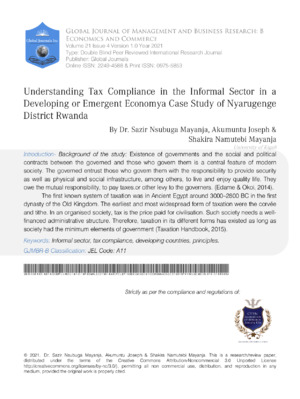
Understanding Tax Compliance in the Informal Sector in a Developing or Emergent Economy a Case Study of Nyarugenge District Rwanda

Dr Sazir Nsubuga Mayanja
Akumuntu Joseph
Akumuntu Joseph
Shakira Namutebi Mayanja
University of Kigali

Send Message

To: Author

Understanding Tax Compliance in the Informal Sector in a Developing or Emergent Economy a Case Study of Nyarugenge District Rwanda

Article Fingerprint

ReserarchID

5H1E7

Understanding Tax Compliance in the Informal Sector in a Developing or Emergent Economy a Case Study of Nyarugenge District Rwanda Banner

AI TAKEAWAY

Connecting with the Eternal Ground
  • English
  • Afrikaans
  • Albanian
  • Amharic
  • Arabic
  • Armenian
  • Azerbaijani
  • Basque
  • Belarusian
  • Bengali
  • Bosnian
  • Bulgarian
  • Catalan
  • Cebuano
  • Chichewa
  • Chinese (Simplified)
  • Chinese (Traditional)
  • Corsican
  • Croatian
  • Czech
  • Danish
  • Dutch
  • Esperanto
  • Estonian
  • Filipino
  • Finnish
  • French
  • Frisian
  • Galician
  • Georgian
  • German
  • Greek
  • Gujarati
  • Haitian Creole
  • Hausa
  • Hawaiian
  • Hebrew
  • Hindi
  • Hmong
  • Hungarian
  • Icelandic
  • Igbo
  • Indonesian
  • Irish
  • Italian
  • Japanese
  • Javanese
  • Kannada
  • Kazakh
  • Khmer
  • Korean
  • Kurdish (Kurmanji)
  • Kyrgyz
  • Lao
  • Latin
  • Latvian
  • Lithuanian
  • Luxembourgish
  • Macedonian
  • Malagasy
  • Malay
  • Malayalam
  • Maltese
  • Maori
  • Marathi
  • Mongolian
  • Myanmar (Burmese)
  • Nepali
  • Norwegian
  • Pashto
  • Persian
  • Polish
  • Portuguese
  • Punjabi
  • Romanian
  • Russian
  • Samoan
  • Scots Gaelic
  • Serbian
  • Sesotho
  • Shona
  • Sindhi
  • Sinhala
  • Slovak
  • Slovenian
  • Somali
  • Spanish
  • Sundanese
  • Swahili
  • Swedish
  • Tajik
  • Tamil
  • Telugu
  • Thai
  • Turkish
  • Ukrainian
  • Urdu
  • Uzbek
  • Vietnamese
  • Welsh
  • Xhosa
  • Yiddish
  • Yoruba
  • Zulu
Font Type
Font Size
Font Size
Bedground

References

65 Cites in Article
  1. Abdul Jabbar,H Pope,J (2008). Exploring the relationship between tax compliance costs and compliance issues in Malaysia.
  2. Adam Smith (1776). An Inquiry into the Nature and Causes of the Wealth of Nations.
  3. A Adesoji,F Chike (2016). The effect of internal revenue generation on infrastructural development.
  4. Ajay Mehrotra (2018). Fiscal Forearms: Taxation as the Lifeblood of the Modern Liberal State, American Bar Foundation Northwestern University Pritzker School of Lawakm@abfn.
  5. M Ali,O Fjeldstad,I Sjursen,I (2013). Factors affecting tax compliance attitude in Africa: Evidence from Kenya, Tanzania, Uganda and South Africa, Chrva.
  6. Bismark Ameyaw,Amos Oppong,Lucille Aba Abruquah,Eric Ashalley (2016). Informal Sector Tax Compliance Issues and the Causality Nexus between Taxation and Economic Growth: Empirical Evidence from Ghana.
  7. Douglas Candia,Claire Ashaba,James Mukoki,Peter Jehopio,Brenda Kyasiimire (2005). NON-SCHOOL FACTORS ASSOCIATED WITH SCHOOL DROPOUTS IN UGANDA.
  8. Andy Mckay (2019). The tax elasticity of formal work in African Countries.
  9. Anirudh Tagat (2019). Behavioral Insights for Tax Compliance.
  10. O Atawodi,S Ojeka (2012). Factors That Affect Tax Compliance among Small and Medium Enterprises (SMEs) in North Central Nigeria.
  11. F Bakkabulindi (2004). Research methods by example.
  12. William Camp (2001). Formulating and Evaluating Theoretical Frameworks for Career and Technical Education Research.
  13. Jeff Casey,John Scholz (1991). Beyond Deterrence: Behavioral Decision Theory and Tax Compliance.
  14. Chowdhury Samia,Tarannum (2015). Bangladeshi Professionals' Tax-Paying Behavior in Convergence with the Principles of Taxation?.
  15. A Dekoya,A Olaoye,Samuel (2020). Informal Sector and Tax Compliance in Nigeria-Challenges and Opportunities.
  16. Ken Devos (2014). Tax Compliance Theory and the Literature.
  17. Greg Edame,Willie Okoi (2014). The Impact of Taxation on Investment and Economic Development in Nigeria.
  18. Federico Balbiano (2018). Tax Diversity and Tax Integration January 2018.
  19. Finn Bridgid (2015). Measuring Motivation in Low-Stakes Assessments.
  20. Cynthia Grant,Azadeh Osanloo (2014). Understanding, Selecting, and Integrating a Theoretical Framework in Dissertation Research: Creating the Blueprint for Your “House”.
  21. B Guillermo,F Deyve (1995). The informal economy and its impact on tax revenues and economic growth: The case of Peru, Latin American and OECD countries.
  22. Hamed Taherdoost (2016). Validity and Reliability of the Research Instrument; How to Test the Validation of a Questionnaire/Survey in a Research.
  23. Keith Hart (1973). Informal Income Opportunities and Urban Employment in Ghana.
  24. Heang Boong,Taing&yongjin Chang (2020). Determinants of Tax Compliance Intention: Focus on the Theory of Planned Behavior.
  25. J Herrera,M Kuepie,C Nordman,X Oudin,F Roubaud (2012). Informal Sector and Informal Employment: Overview of Data for 11 Cities in 10 Developing Countries.
  26. Ioana Horodnic (2018). Tax morale and institutional theory: a systematic review.
  27. (2002). Social health protection and the informal economy.
  28. (2017). Regional Economic Outlook, October 2017, Sub-Saharan Africa.
  29. Clifton Fleming,J Robert,J Peroni& Stephen,E Shay (2001). Fairness in International Taxation: The Ability-to-Pay Case for Taxing Worldwide Income FLORIDA TAX REVIEW VOLUME.
  30. Johnson Rukundo,Bosco (2015). Productivity and Informality in Rwanda:.
  31. John Mikesell,Liucija Birskyte (2007). The Tax Compliance Puzzle: Evidence from Theory and Practice.
  32. Wilson Joshi Anuradha,Christopher Prichard,Heady (2013). Taxing the Informal Economy: Challenges, Possibilities and Remaining Questions.
  33. M Joppe (1998). The Research Process.
  34. Ravi Kanbur,Michael Keen (2014). Thresholds, informality, and partitions of compliance.
  35. M Keen (2012). Tax and development -Again.
  36. Kent Smith,Karyl Kinsey (1987). Understanding Taxpaying Behavior: A Conceptual Framework with Implications for Research.
  37. Kshitij Srivastava,Ravi Gupta*,Manu Khare (2004). 5S Methodology Implementation in the laboratories of University.
  38. Lutfi Hassen,Ali Al-Ttaffi,*,Hijattulah Abdul-Jabbar (2015). A CONCEPTUAL FRAMEWORK FOR TAX NON-COMPLIANCE STUDIES IN A MUSLIM COUNTRY: A PROPOSED FRAMEWORK FOR THE CASE OF YEMEN.
  39. Mcleod Alexander,Jeffrey Sonja Pippin,Wong (2011). Revisiting the Likert scale: can the fast form approach improve survey research.
  40. G Michael,Agnar Allingham,Sandmo (1972). INCOME TAX EVASION: A THEORETICAL.
  41. Teodora Tompea (2016). Handling Techniques. Definition, Typologies and Applications in Television.
  42. J Neill (2000). The benefit and sacrifice principles of taxation: A synthesis.
  43. Enya Enya Anna Otini,Tamunonimim Ngerebo-A (2010). Board of Directors Structuring and Intellectual Capital Disclosure of Public Limited Liability Insurance Companies in Nigeria.
  44. Stephen Nkundabanyanga,Philemon Mvura,David Nyamuyonjo,Julius Opiso,Zulaika Nakabuye (2017). Tax compliance in a developing country.
  45. Nisr (2014). Unknown Title.
  46. Lawyer Obara,Efeeloo Nangih (2017). Tax Compliance Barriers and Internally Generated Revenue in Nigeria: Empirical from Small and Medium Enterprises in Portharcourt Metropolis.
  47. O Ochieng,T Hinako,A Motohiro,K Masako,N Keiko (2007). Unknown Title.
  48. J Oduwole,A Sanni (2014). Policy brief on expanding the tax base in the informal sector in Nigeria.
  49. Jerome Olsen,Minjo Kang,Erich Kirchler (2018). Tax Psychology.
  50. J Peter,Helen Lambert&,Naughton (2009). The equal absolute sacrifice principle revisited.
  51. Philippe Aghion,Ufuk Akcigit,Matthieu Lequien,Stefanie Stantcheva (2017). Tax Simplicity and Heterogeneous Learning.
  52. O Pimhidazai,L Fox (2012). The Role of Local Governments in Promoting Local Economic Development in Uganda.
  53. C Sandford,M Godwin,P Hardwick (1989). Administrative and compliance costs of taxation.
  54. D Polit,B Hungler (1999). Nursing Research: Principles and Methods6.
  55. Friedrich Schneider,Andreas Buehn,Claudio Montenegro (2007). Shadow Economies All Over The World : New Estimates For 162 Countries From 1999 To 2007.
  56. E Saez,J Slemrod,S Giertz (2012). The Elasticity of Taxable Income with Respect to Marginal Tax Rates: A Critical Review.
  57. U Sekaran (2003). Advanced organic chemistry Third edition), by G. W. Wheland. Pp. xi + 871. John Wiley & Sons Inc., New York; John Wiley & Sons Ltd, London. 1960. E7 net.
  58. Çiçek Serdar,Hüseyin Güçlü,Çiçek,Elif Ayşe,Şahin-İpek (2019). Behavioral Approach to Tax Compliance Process: Taxpayer Behaviors and Typologies.
  59. Mohd Sellywati Mohd Faizal,Ruhanita Rizal Palil,Rosiati Maelah,Ramli (2017). Perception on justice, trust and tax compliance behavior in Malaysia.
  60. M Shuttleworth (2015). Reliability - Random Error & Internal Consistency.
  61. (2015). Uganda - Taxation.
  62. J Thomas (2002). Promoting growth with decent work.
  63. Tuan Minh,Le (2016). Measuring Efficiency and Productivity of Taxation: A Review of Tax System in Mozambique.
  64. Wilson Prichard,Anna Custers,Roel Dom,Stephen Davenport,Michael Roscitt (2019). Innovations in Tax Compliance: Conceptual Framework.
  65. (2017). FROM REGULATORS TO ENABLERS THE ROLE OF CITY GOVERNMENTS IN ECONOMIC DEVELOPMENT OF GREATER KAMPALA.

Funding

No external funding was declared for this work.

Conflict of Interest

The authors declare no conflict of interest.

Ethical Approval

No ethics committee approval was required for this article type.

Data Availability

Not applicable for this article.

How to Cite This Article

Dr Sazir Nsubuga Mayanja. 2021. \u201cUnderstanding Tax Compliance in the Informal Sector in a Developing or Emergent Economy a Case Study of Nyarugenge District Rwanda\u201d. Global Journal of Management and Business Research - B: Economic & Commerce GJMBR-B Volume 21 (GJMBR Volume 21 Issue B4).

Download Citation

Comprehensive study on tax laws in Nyarugenge district.

Journal Specifications

Crossref Journal DOI 10.17406/GJMBR

Print ISSN 0975-5853

e-ISSN 2249-4588

Keywords
Classification
GJMBR-B Classification JEL Code: A11
Version of record

v1.2

Issue date
August 3, 2021

Language
en
Experiance in AR

Explore published articles in an immersive Augmented Reality environment. Our platform converts research papers into interactive 3D books, allowing readers to view and interact with content using AR and VR compatible devices.

Read in 3D

Your published article is automatically converted into a realistic 3D book. Flip through pages and read research papers in a more engaging and interactive format.

Article Matrices
Total Views: 2064
Total Downloads: 902
2026 Trends
Related Research
Our website is actively being updated, and changes may occur frequently. Please clear your browser cache if needed. For feedback or error reporting, please email [email protected]

Request Access

Please fill out the form below to request access to this research paper. Your request will be reviewed by the editorial or author team.
X

Quote and Order Details

Contact Person

Invoice Address

Notes or Comments

This is the heading

Lorem ipsum dolor sit amet, consectetur adipiscing elit. Ut elit tellus, luctus nec ullamcorper mattis, pulvinar dapibus leo.

High-quality academic research articles on global topics and journals.

Understanding Tax Compliance in the Informal Sector in a Developing or Emergent Economy a Case Study of Nyarugenge District Rwanda

Dr Sazir Nsubuga Mayanja
Dr Sazir Nsubuga Mayanja <p>University of Kigali</p>
Akumuntu Joseph
Akumuntu Joseph
Shakira Namutebi Mayanja

Research Journals