

I. INTRODUCTION
It is an undeniable fact that diversity has become the part of social reality in modern Western societies (essentially due to globalization and migration). This is a modern and organizational phenomenon inevitably reflecting itself in the real labor force. In the past two decades, there has been an intense interest in diversity among both organizational researchers and practitioners. Its underlying reasons include numerous factors such as the change in global dynamics, globalization, free movement of the workforce, mergers around the world, international agreements, legal obligations, differentiation of the socio-cultural structure in business life, the participation of women in business life in terms of numbers and acquiring higher positions, employees with different political, religious and cultural identity. This overall transformation replaced uniform and homogeneous organizational structures with other organizations shaped under the predominance of heterogeneous structures. In this context, organizations need to manage these differences correctly instead of ignoring them.
People are born in various shapes, sizes and colors. These differences are features that distinguish people from others. Individual differences are widely accepted as important predictors of behavior, attitudes and outcomes in the workplace. At this point, it is very important for organizations to understand which features are considered as sources of diversity by their employees. In this context, there are two interconnected scientific studies in this article. The first study is a quantitative research conducted to measure employees' perception of diversity. The second study, guided by the results of the first, is a study in which the results of the research articles that examine the relationship between differences and personality are evaluated in a holistic way.
This article provides an important resource for future studies since it evaluates the scholastic development of relationship between diversity and personality in working life in an holistic approach. It is also important for researchers, academics and business world who are interested in the subject.
II. LITERATURE REVIEW
Defining diversity requires an intensive effort. The term has more than one overlapping and often contradictory meaning (Avery et al. 2004, 33). However, it is necessary to make a definition to determine the framework of our discussion. Various definitions related to the concept of diversity have been made. The term difference is generally related to the size of differences between human groups. However, the difference was previously conceptualized by researchers with a narrow approach. In particular, it is limited to issues of race, ethnicity and gender. However, the definiton of diversity was later expanded by adding qualities such as gender, age, race, ethnicity, socio-economic status, social class, personality, religion, education, sexual orientation, language, disability status, national origin, learning style, lifestyle and geographical region (Yeo, 2006, 10). This definition of diversity actually reveals the category of difference at a superficial and deep level. Superficial differences include demographic characteristics such as gender, age, language and deep differences include attitudes such as sexual orientation, political opinion, lifestyle, personality (Harrison, Price and Bell, 1998, 96). All definitions made about the topic vary according to the focus dimension.
People are born in a variety of shapes, sizes and colors. This diversity is what distinguishes people from others. Human beings are separated from each other as individuals and groups due to their biological and environmental differences. This situation, which forms the spectrum of human diversity, reveals a wide range of physical and cultural differences. This diversity consists of a range differences from people when evaluated as a whole (Hubbard, 2004, 29). There are many different sizes in the range of differences. The following figure 1 summarizes these dimensions. These dimensions were summarized in Table 1.
Tablo 1: Dimension of Diversity Source: Alay, H.K. (2020), Awareness Of Diversity In Organizations: Evaluation Of Individual And Organizational Outcomes, PhD dissertation thesis, p:2, Yıldız Technical University, İstanbul
| Factor approach | Two-Category Factor Approach | Primary and Secondary Diversity |
| Highly Job Related and Less Job Related Diversity | ||
| Readily DetectableDiversity and Less Observable Diversity | ||
| Surface and Deep face Diversity | ||
| Multi-Category Factor Approach | Mc Grathi Berdahl and Arrow (1995) Classification | |
| Jehn, Northcraft and Neale (1999) Classification | ||
| Point and Singh (2003) Classification | ||
| Hubbard (2004) S Classification | ||
| Mannix and Neale (2005) Classification | ||
| Ratio Approach | Minority and Majority Groups | Uniform Groups |
| Skewed Groups | ||
| Tilted Groups | ||
| Balanced Groups |
Most of the time, people limit differences to what they can see because what appears includes what people know before they start talking. People are generally more sensitive when they have stereotyped judgment based on primary dimensions, but more insensitive to secondary dimensions. Secondary differences are our differences in which we choose or have the power to change (Hubbard, 2004, 32). From this point of view, differences that can be observed (readily detectable attributes) and not observed (underlying attributes) at work are discussed in two groups, with a mission-oriented and relationship-oriented focus by Jackson, May and Whitney (1995, 2004). Task-oriented differences that can be easily observed are classified as tenure in the organization, tenure in the team, department/unit studied, official credentials and level of education, while relationship-oriented differences are classified as gender, culture (race, ethnic identity, national origin), age, membership in official organizations (religious or political) and physical characteristics. Unobserved task-oriented differences are classified as knowledge, skills, talent (cognition and physical) and experience, while relationship-oriented differences are classified as social status, attitudes, values, personality, behavior and spatial social bonds. Visibly differences dimensions as educational status, marital status, work experience, religious belief and political ideologies. As all these assessments can be understood, diversities are divided into two and classified as factors and ratios approach. Factor approach is examined under two headings: two categories and multi-categories. The ratios approach is an alternative to the factor approach. Classifications made by different authors in different ways have a great importance to understand what subjects people differ from.
In this research article, the personality differences of the employees are examined. There are many studies in the literature that address personality in different ways from a typeological point of view. These include Myers-Brigs's sixteen-personality type, Eysenck's five large personality types and Friedman and Roseninan's Type A and B personality types (Schwarzkopft and his friends, 2016).
All individuals have their own personality and these personality traits turn into behaviors due to internal and external factors. Personality is the sum of the characteristics that individuals bring in birth and the characteristics of living in society afterwards. The values in the society in which individuals live in the moral values that individuals see in the family, age and beliefs are effective in the formation of personality (Golpayegan, 2017). The five factors of personality developed by McCrae and Costa (1985) consist of openness, conscientiousness, extraversion, agreeableness dimensions and are seen as an approach that covers the whole personality traits. The structure of five factors personality is shown in table 2.
| Personality dimension | Characteristics |
| Conscientiousness | These people are careful, reliable and meticulous. Their working life is planned and their targeted behaviors are clear. |
| Agreeableness | These people are trustworthy, easygoing, self-sacrificing, they are straightforward and humble. |
| Neuroticism | This dimension is defined by features such as excited, insecure, and angry, and the emotional balance of these types of people can change frequently. |
| Openness | They are open to innovations. They are imaginative, adventure-loving, curious and creative. |
| Extraversion | Their social communication skills are strong and therefore stand out in social groups. They are positive, energetic, social, cheerful and dominant. |
People's way of thinking, behavior, emotions, appearances, abilities, ways of detecting events and their reactions to these events and facts are always different. These differences are often caused by personality traits. It is a result of personality that different people react differently to the same event. Even in individuals who receive the same educaiton, who grow up in the same social environment, who grow up in the same cultural environmen, they approach the same event differently. The structure that affects people's relationship with their environment and guides their behavior is called personality (Durna, 2005).
III. METHODOLOGY AND DATA ANALYSIS
a) Study 1
The sample of the study is the employees in Istanbul. It chose Istanbul since this metropolis provides the dynamic engine of Turkish economy, has a multicultural structure, offers opportunities to people with different religions, languages, races and nations to live together. Yazicioğlu and Erdoğan (2004, 50) states that for the universe whose population is over 1 million and with ± 0.05 sampling error for α = 0.05, the sample size of 384 should be sufficient. In this study, the data obtained from 532 employees subjected to the analysis. It used snowball sampling style in the process of quantitative data gathering. In order to measure the perception of diversity among employees it utilized multiple-choice questions developed by Tatlı and Özbilgin (2012). To structurally define the data obtained from the sample group of the research, it evaluated the frequency distribution. In this context, Table 1 below shows the data on the socio-economic characteristics of employees.
| Identity Structures | Frequency | Percentage | |
| Cultural Identity | Turkish | 274 | 51.5 |
| Kurdish | 173 | 32.5 | |
| Immigrant | 43 | 8.1 | |
| Armenian | 42 | 7.9 | |
| Total | 532 | 100 | |
| Religious Identity | Sunni Muslim | 300 | 56.5 |
| Alevi | 72 | 13.5 | |
| Atheist | 64 | 12.1 | |
| Deist | 53 | 9.9 | |
| Christian | 22 | 4.1 | |
| Agnostic | 21 | 3.9 | |
| Total | 532 | 100 | |
| Political Identity | Conservative | 60 | 11.2 |
| Nationalist | 75 | 14.2 | |
| Social Democrat | 136 | 25.6 | |
| Liberal | 94 | 17.6 | |
| Socialist | 167 | 31.4 | |
| Total | 532 | 100 | |
| Gender | Women | 296 | 55.6 |
| Men | 236 | 44.4 | |
| Total | 532 | 100 | |
| Sexual Orientation | Heterosexual | 451 | 84.7 |
| Homosexual | 81 | 15.3 | |
| Total | 532 | 100 | |
Table 2 shows the data regarding the perception of diversity among employees who were included in the research sample.
| Difference | Frequency | Rate% |
| Sex | 24 | 4.5 |
| Ethnic Origin | 49 | 9.2 |
| Age | 30 | 5.6 |
| Disability | 20 | 3.8 |
| Education | 139 | 26.2 |
| Culture | 162 | 30.5 |
| Religion | 37 | 6.9 |
| Origin Country/Region/City | 91 | 17.1 |
| Sexual Orientation | 30 | 5.6 |
| Marital status | 14 | 2.6 |
| Using religious symbols | 35 | 6.6 |
| Personality | 360 | 67.6 |
| All of them | 51 | 9.5 |
| None of them | 152 | 28.5 |
In the first question that was devised to measure the perception of diversity among employees, when we examine the data about what distinguishes people from each other, a very small percentage of the participants see the primary (observable) features as a source of diversity. According to the data, while 26.2%
| Difference | Frequency | Rate% |
| Sex | 37 | 6.9 |
| Ethnic Origin | 45 | 8.4 |
| Age | 15 | 2.8 |
| Disability | 7 | 1.3 |
| Education | 21 | 3.9 |
| Culture | 31 | 5.8 |
| Religion | 76 | 14.2 |
| Origin Country/Region/City | 12 | 2.2 |
| Sexual Orientation | 83 | 16.1 |
| Marital status | 10 | 1.8 |
| Using religious symbols | 3 | 0.5 |
| Personality | 226 | 42.4 |
| All of them | 15 | 2.8 |
| None of them | 189 | 35.5 |
When we examine the data on the fact that the participants do not want to be in the same team with the people who have the characteristics that they see as a difference, it is seen that the religious identity (14.2%) stands out compared to other differences. Given that Turkish people have a predominantly Sunni Muslim religious identity, this is not surprising. Similarly, the difference in sexual orientation (16.1%) is thought as a source of undesired difference in the same team. Moreover the personality of the employees is considered as a significant difference and employees with different personality traits (42.4%) tend to be not accepted in team work. Those who answered that none of the listed difference features prevent being in the same team constitute 35.5% of the participants.
| Difference | Frequency | Rate% |
| Sex | 6 | 1.2 |
| Ethnic Origin | 11 | 2.1 |
| Age | 8 | 1.4 |
| Disability | 3 | 0.5 |
| Education | 27 | 5.1 |
| Culture | 30 | 5.6 |
| Religion | 10 | 1.8 |
| Origin Country/Region/City | 3 | 0.5 |
| Sexual Orientation | 39 | 7.1 |
| Marital status | 1 | 0.1 |
| Using religious symbols (turban,mustache,etc.) | 1 | 0.1 |
| Personality | 245 | 46.1 |
| All of them | 5 | 1.1 |
| None of them | 275 | 51.6 |
When we examine the perception of differences that participant keep their distance in their lives outside work, it is observed that the personality is the most dominant difference with 46.1%. On the other hand, 51.6% of the participants prefer not to be distant to any of the listed categories. This situation reveals the fact that differences are evaluated in the context of personality, which directs people's attitudes and behaviors in the category of deep difference, regardless of superficial differences (gender, age, educational status, marital status, disability, Country of Origin /Region/City) as dealt in the literature.
b) Discussion for Study 1
When the data obtained from multiple choice questions to measure the perception of difference of the research participants are examined, a remarkable result indicating that the personality is considered as a source of difference came into the forefront.
| Which option do you think makes people different from others? | Personality | 360 | %67.6 |
| Which aspects of a different person make you want to be not part of the team? | Personality | 226 | %42.4 |
| In your life outside work place, which aspects of people make you keep your distance with them? | Personality | 245 | %46.1 |
| Total=532 | |||
Although the personality is in the category of invisible differences, its sphere of influence is quite wide. As is known, personality is all of the ways that an individual uses to react or interact with other individuals (Robbins and Judge, 2015, 89). According to the various studies, it is observed that personality is a result of both hereditary and environmental factors. However, there is no clear conclusion about which one is more dominant.
There are many dimensions play in role in the construction of human personality. An impressive number of studies support the thesis that there are five more comprehensive dimensions that form the basis of all other dimensions (Digman, 1990, 417). These five basic dimensions are listed as openness, conscientiousness, extraversion, agreeableness, neuroticism. It is known that these personality traits greatly affect the behaviors in working life. For example, emotional determination of the individual decreases the stress level, extraversion increases the performance, compatibility creates a collaborative and reliable image, and responsibility improves the leadership ability (Robbins and Jugde, 2015, 123). Having evaluated in this context, it is not a coincidence that personality is seen as a factor that differentiates people more than superficial differences.
Besides, the participants do not see any of the elements listed at high rates as a difference. The table below summarizes these rates.
| Which option do you think makes people different from others? | None of them | 152 | %28.5 |
| Which aspects of a different person make you want to be not part of the team? | None of them | 189 | %35.5 |
| In your life outside work place, which aspects of people make you keep your distance with them? | None of them | 275 | %51.6 |
| Total=532 | |||
After people responded to the questions above that were designed with the purpose of measuring the perception of diversity among employees and defining the source of diversity as "none of them", it became necessary to re-examine the four approaches to differences in organizations that Moore (1999) has introduced. These approaches are; ignoring differences, hostility to difference, realizing differences natural and integration with differences. In the first approach, differences do not have any reference point in the organization, hence differences mean nothing. The organization is neutral against these differences. Thus, there is no attempt in any organizational area to integrate these differences. When evaluated within the framework of this approach, differences in the organization are not regarded as either an advantage or a disadvantage. There are no organizational areas where opportunities and/or problems related to differences are discussed and/or revealed. In this context, neutralizing the differences is interpreted as a rather negative situation.
c) Study 2
The aim of the second study is to present the academic development of the relationship between personality and diversity in the first study in a holistic way. Thus, the paper will try to fill the gap in the literature by conducting a systematic review of empirical research in diversity and personality. The following steps were followed to reach the purpose of the research:
Development of research methodology
Scanning of the relevant electronic database
Synthesis of diversity and personality studies
In this context, 21 empirical research articles published in the ISI Web of Knowledge database were analyzed using the systematic review method. The research has some limitations. In this context, as seen in Table 7 below, 21 articles were included in the research.
Tablo 7: Result of the Electronic Database Search
| Name of the Electronic Database | Key Terms Searched in | Additional Limitations | Number of Articles Found |
| Web of Knowledge | Title=Personality and Diversity | 1975-2020+Article+english language | 21 |
This research provides information about the theories that those articles examined based on, the variables used, the research method, the unit of analysis, the results obtained. In addition, it makes contributions to studies on diversity in organizations in various dimensions. In doing so; first, it acts as a lens to see how changes are perceived over time. Secondly, it combines current studies on "diversity and personality" to review variables that affect the perception of diversity in organizations. Third, it provides guidelines to future studies with the holistic perspective it creates for the relationship between "diversity and personality".
The fields of articles reviewed under the scope of this study includes psychology, business economics, computer science, communication, sociology. These articles were published in journals such as: Journal Of Applied Psychology, Plos One, European Journal of Personality, The Journal of Psychology, Australian Psychologist, Emotion and PErsonality, International Journal of Conflict Management, Group Decision and
Negotiation, International Journal of Intercultural Relations, Human Computer Interaction Series. Table 8 provides detailed information on these articles reviewed in this study.
Tablo 8: The Evolution of Diversity and Personality Research
| NO | Source Title | Dimension | Theory | Unit of Analysis | Country | N of sample | Methodology | Outcomes |
| 1 | Timmer et al. (2002) | Personality, Diversity | Information Systems Theories | Information System Development team members | USA | 88 | Survey, statistical analysis | Task and Relationship Conflict, Team effectiveness |
| 2 | Van Der Zee et al (2004) | Personality, Cultural Diversity | Social Identity Theory | Students | UK | 228 | Survey, statistical analysis | Commitment, Performance, Well-Being, Social Identification |
| 3 | Molleman (2005) | Personality, diversity, team autonomy | Social categorization theory, Faultline theory | Students | Netherlands | 396 | Survey, statistical analysis | Cohesion, Conflict |
| 4 | Van Der Zee and Van Der Gang (2007) | Personality, Diversity, Threat Conditions | Terror Management Theory, Self-Categorization Theory | Students | Netherlands | 162 | Survey, statistical analysis | Emotional stability, Social Initiative |
| 5 | Newman and Lyon (2009) | Personality, Diversity, Recruitment effort | Expectancy theory, Racial formation theory | Students | USA | 594 | Survey, statistical analysis | Job performance, Adverse Impact |
| 6 | Emmanuelle and Davidson (2009) | Individual Differences | Trait theory | Translators | UK | 20 | Process Research | Translation quality |
| 7 | Yakunina et al (2012) | Multicultural Personality | Students | USA | 341 | Survey, statistical analysis | Opennes to diversity, adjustment | |
| 8 | Inbar and Lammers (2012) | Political Diversity, Personality | Cognitive-motivational theory | Psychologists | Netherlands | 800 | Survey, statistical analysis | Hiring discriminaton |
| 9 | Fisher et al (2012) | Personality and Diversity | Students | USA | 186 | Survey, statistical analysis | Performance, Coordination, Composition | |
| 10 | Butrus and Witenberg (2013) | Personality | Social cognitive theory, Five-factor Theory | Individuals | Australia | 118 | Survey, statistical analysis | Tolerans to Diversity |
| 11 | Ackerman and Arckerman (2015) | Personality, Ethnic Diversity | Contact theory | Immigrants | Switzerland | 1157 | Survey, statistical analysis | Equal Opportunities |
| 12 | Alshamsi et al (2016) | Personality and Diversity | Personality theory | Italian native speakers | Italy | 3094 | Statistical analysis | Economic wellbeing, Communication |
| 13 | Pogson (2016) | Personality and Diversity | Agent-based model | Parameter Values | 1000 random combination of parameter values | Sensitivity Analysis with Python | Consensus Decision Making, Aggregation | |
| 14 | Han and Pistole (2017) | Personality | Intergroup threat theory | Students | USA | 514 | Survey, statistical analysis | Opennes to diversity, Agreeableness |
| 15 | Shira et al (2018) | Personality, Culture, Ancestry Diversity | Personality theory | Students | 56 different cultures | 17837 | Survey, statistical analysis | Tolerans to Differences, Facilitates cooperation |
| 16 | Wu et al (2018) | Personality, Behavior History | Psychometric Theory, LaBarrie theory | Douban Interest Group social media site | China | 1706 users | User survey | Recommender system Diversity |
| 17 | Bhatti et al (2019) | Personality, Psychological diversity climate | Social Exchange Theory | Faculty members | Saudi Arabia | 258 | Survey, statistical analysis | Job satisfaction, Performance |
| 18 | Anglim et al (2019) | Personality, cognitive ability | Role congruity theory | Working adults | Australia | 731 | Survey, statistical analysis | negative attitudes to workplace diversity |
| 19 | Lukaszewski et al (2019) | Personality, Diversity | Commentary | Socioecological Complexity | ||||
| 20 | Seong and Hong (2020) | Personality, Diversity | Role congruity theory | Manufacturing company employees | Korea | 1265 | Survey, statistical analysis | Conflict |
| 21 | Smaldino et al (2019) | Personality, Diversity | Socioecological theory | Global sample | 19000 | Computational model | Social and ecological niches | |
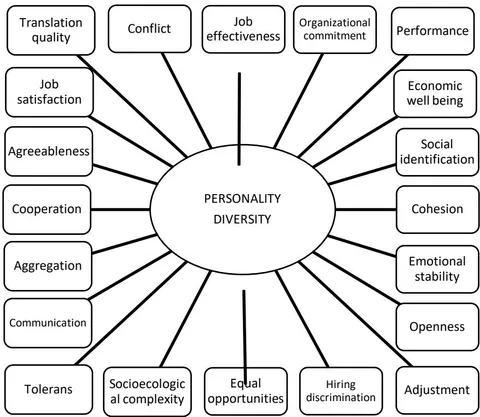
d) Major Finding of Diversity and Personality Research
In the articles reviewed under the scope of this study, personality-based differences are examined as one of the most important factors that affect individual and organizational outputs. The personality traits of employees have impact on working environment and group behaviors. In this regard, some important and interesting results of the study can be summarized as follows:
Personality traits subjected to examination based on the categories Openness, Conscientiousness, Extraversion, Agreeableness, Neuroticism (Big Five personality traits). Also some of the reviewed articles used HEXACO model of personality structure (Honesty-Humility, Emotionality, Extraversion, Agreeableness, Conscientiousness, and Openness to Experience).
In organizational terms, both the demographical quality and personality traits of employees have impact on the possibility of conflicts within working teams.
■ Differences in personality have strong impact on the efficiency and performance of working groups in organizations.
■ Personality traits (Emotional Stability and Flexibility) have a positive effect on organizational outcomes under high intercultural diversity conditions.
The role of personality is important in the process of cultural adaptation. Emotional stability, open-mindedness, and flexibility facilitates the adaptation process of international students.
Compatibility personality traits are significantly correlated with the performance and outcomes of working teams consisting of different ethnic origins.
■ Personality traits have a differentiating effect on communication.
■ Stable personality traits have an impact on unanimous decision making.
■ Stable personality traits increase job satisfaction and performance in multicultural settings.
■ Individuals with personality traits such as honesty, modesty, extraversion and openness, have been associated with more positive attitudes towards diversity in workplace.
- Attaching much more weight to power, security and tradition, and underrating humanism have been associated with more negative attitudes towards diversity in workplace.
e) Discussion for Study 2
Human differences demonstrate themselves in almost all areas of life. In this context, differences in working life are of great importance. If we briefly summarize the results we obtained as a result of our evaluation and synthesis;
The vast majority of studies examined in this study deal with the issue of personality in the context of the Big Five personality traits. Based on the fact that the personality traits are not independent from the geography and culture, it could be said that culture shapes attitudes and behaviors developed against these differences.
It can be said that the personality traits mostly associated with differences are openness and compatibility.
It has been determined that personality traits affect individual and organizational outputs. The flexibility and compatibility of individuals affect openness to differences and tolerance in a positive way. Extroverted and closed personalities strengthen the environment of conflict by negatively affecting organizational outcomes in multicultural teamwork. Similarly, personality traits affect outcomes such as commitment to the organization, job satisfaction, and performance. In this context, it can be said that multicultural international organizations should pay attention to diversity management practices in recruitment process.
However, it must be noted that all these evaluations were carried out under the limitation of the articles in the relevant database. It is hoped that our study based on the evaluation and synthesis of the relationship between diversity and personality relationship would be a reference for further studies.
IV. CONCLUSION
This article combines two studies interrelated with each other. The first study aims to contextualize the source of diversity as perceived by employees. The data set we analyzed demonstrates that personality is the most important source of difference. In addition, it is determined that people tend to neutralize differences by ignoring them. At this point it raises this question: Is it right to see and accept the differences or to ignore them? Within the framework of this approach, differences in the organization are not regarded as either an advantage or a disadvantage. There are no organizational areas where opportunities and/or problems related to differences are discussed and/or revealed. In this context, the neutralization of diversity is interpreted as a rather negative situation.
In the second study, the one guided by the results of the first study, evaluations and syntheses were made for independent research articles in which the relationship between difference and personality was examined. According to its results, the first study based on survey method which was conducted in Turkey case has significant equivalence in global level. As a result, personality come into the light as a primary source of individual difference in the light of the evaluations we made by means of aforementioned articles.
The first study, in which personality is perceived as the most important source of difference, and second study shows us the importance of personality differences in terms of working life. It was also revealed in the systematic review that instead of ignoring the differences and awareness of the differences affected individual and organizational outcomes. Ignoring the differences of employees reduces productivity and effectiveness. In addition, considering the differences as an advantage, creating a space for different employees affects positively the individual and organizational outcomes.
This research is important for researchers, academics and business world who want to examine the differences in work life and personality relationship as a holistic evaluation of the academic development on the subject.
V. ETHICS DECLARATIONS
Funding: No grant funding was obtained or utilized for the completion of this study.
Conflict of interest: The authors declare that they have no conflict of interest.
Ethical Approval: All procedures performed in studies involving human participants were in accordance with the ethical standards of the institutional and/or national research committee and with the 1964 Declaration of Helsinki and its later amendments or comparable ethical standards.
Informed Consent: Informed consent was obtained from all individual participants included in the study.