Unipolar Induction in the Concept of the Scalar-Vector Potential

§ B.I. Verkin Institute

Send Message

To: Author

Unipolar Induction in the Concept of the Scalar-Vector Potential

Article Fingerprint

ReserarchID

RE8D604

Unipolar Induction in the Concept of the Scalar-Vector Potential Banner

Key Research Insights

Synthesized scholarly intelligence & interactive research assistant
  • English
  • Afrikaans
  • Albanian
  • Amharic
  • Arabic
  • Armenian
  • Azerbaijani
  • Basque
  • Belarusian
  • Bengali
  • Bosnian
  • Bulgarian
  • Catalan
  • Cebuano
  • Chichewa
  • Chinese (Simplified)
  • Chinese (Traditional)
  • Corsican
  • Croatian
  • Czech
  • Danish
  • Dutch
  • Esperanto
  • Estonian
  • Filipino
  • Finnish
  • French
  • Frisian
  • Galician
  • Georgian
  • German
  • Greek
  • Gujarati
  • Haitian Creole
  • Hausa
  • Hawaiian
  • Hebrew
  • Hindi
  • Hmong
  • Hungarian
  • Icelandic
  • Igbo
  • Indonesian
  • Irish
  • Italian
  • Japanese
  • Javanese
  • Kannada
  • Kazakh
  • Khmer
  • Korean
  • Kurdish (Kurmanji)
  • Kyrgyz
  • Lao
  • Latin
  • Latvian
  • Lithuanian
  • Luxembourgish
  • Macedonian
  • Malagasy
  • Malay
  • Malayalam
  • Maltese
  • Maori
  • Marathi
  • Mongolian
  • Myanmar (Burmese)
  • Nepali
  • Norwegian
  • Pashto
  • Persian
  • Polish
  • Portuguese
  • Punjabi
  • Romanian
  • Russian
  • Samoan
  • Scots Gaelic
  • Serbian
  • Sesotho
  • Shona
  • Sindhi
  • Sinhala
  • Slovak
  • Slovenian
  • Somali
  • Spanish
  • Sundanese
  • Swahili
  • Swedish
  • Tajik
  • Tamil
  • Telugu
  • Thai
  • Turkish
  • Ukrainian
  • Urdu
  • Uzbek
  • Vietnamese
  • Welsh
  • Xhosa
  • Yiddish
  • Yoruba
  • Zulu
Reading Preferences
Font Size
Line Spacing
Background
This converted HTML version may contain rendering inconsistencies. Please refer to the PDF for the authoritative version, or click here to provide feedback.

Abstract

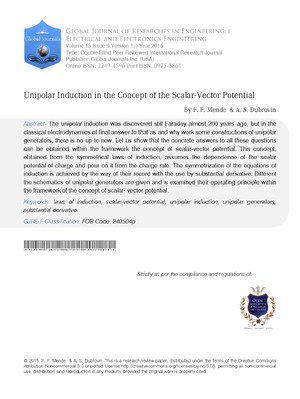
The unipolar induction was discovered still Faraday almost 200 years ago, but in the classical electrodynamics of final answer to that as and why work some constructions of unipolar generators, there is no up to now. Let us show that the concrete answers to all these questions can be obtained within the framework the concept of scalar-vector potential. This concept, obtained from the symmetrical laws of induction, assumes the dependence of the scalar potential of charge and pour on it from the charge rate. The symmetrization of the equations of induction is achieved by the way of their record with the use by substantial derivative. Different the schematics of unipolar generators are given and is examined their operating principle within the framework of the concept of scalar-vector potential.

References

11 Cites in Article
  1. 1. A Ampere (1954). Electrodynamics. Electrodynamics
  2. 2. R Feynman,R Leighton,M Sends (1977). Unknown Title. Feynman lectures on physics, 6
  3. 3. F Mende (2012). New electrodynamics. Revolution in the modern physics, 172.
  4. 4. F Mende (2014). Consideration and the Refinement of Some Laws and Concepts of Classical Electrodynamics and New Ideas in Modern Electrodynamics. International Journal of Physics, 2(6), 231-263.
  5. 5. F Mende (2014). Concept of Scalar-Vector Potential in the Contemporary Electrodynamic, Problem of Homopolar Induction and Its Solution. International Journal of Physics, 2(6), 202-210.
  6. 6. F Mende (2013). Consideration and the Refinement of Some Laws and Concepts of Classical Electrodynamics and New Ideas in Modern Electrodynamics. International Journal of Physics, 2(6), 231-263.
  7. 7. F Mende (2015). The Classical Conversions of Electromagnetic Fields on Their Consequences AASCIT Journal of PhysicsVol. The Classical Conversions of Electromagnetic Fields on Their Consequences AASCIT Journal of PhysicsVol, 1, 11-18.
  8. 8. F Mende (1988). Abstracts of articles deposited at VINITI. Radiophysics and Quantum Electronics, 20(5), 554-556.
  9. 9. F Mende (2013). On thephysical basis ofunipolar induction. A new type of unipolar generator. Engineering Physics, 6, 7-13.
  10. 10. F Mende (2014). Concept of Scalar-Vector Potential in the Contemporary Electrodynamic, Problem of Homopolar Induction and Its Solution. International Journal of Physics, 2(6), 202-210.
  11. 11. F Mende (2013). The problem of contemporary physics and method of their solution. The problem of contemporary physics and method of their solution

Funding

No external funding was declared for this work.

Conflict of Interest

The authors declare no conflict of interest.

Ethical Approval

No ethics committee approval was required for this article type.

Data Availability

Not applicable for this article.

How to Cite This Article

F. F. Mende. 2016. "Unipolar Induction in the Concept of the Scalar-Vector Potential". Global Journal of Research in Engineering - F: Electrical & Electronic GJRE-F Volume 15 (GJRE Volume 15 Issue F9).
Download Citation

Journal Specifications

Crossref Journal DOI 10.17406/gjre

Print ISSN 0975-5861

e-ISSN 2249-4596

Keywords
Classification
GJRE-F Classification FOR Code: 240504p
Version of record

v1.2

Issue date
January 15, 2016

Language
English
Order Article Reprint
Experiance in AR

Explore published articles in an immersive Augmented Reality environment. Our platform converts research papers into interactive 3D books, allowing readers to view and interact with content using AR and VR compatible devices.

Read in 3D

Your published article is automatically converted into a realistic 3D book. Flip through pages and read research papers in a more engaging and interactive format.

Article Matrices
Total Views: 1.5K
Total Downloads: 80
All Trends

Request Access

Please fill out the form below to request access to this research paper. Your request will be reviewed by the editorial or author team.
X

This is the heading

Lorem ipsum dolor sit amet, consectetur adipiscing elit. Ut elit tellus, luctus nec ullamcorper mattis, pulvinar dapibus leo.


High-quality academic research articles on global topics and journals.

Unipolar Induction in the Concept of the Scalar-Vector Potential

F. Mende
F. Mende <p>B.I. Verkin Institute</p>