The Chinese crime film Wu Sha (Manslaughter), released on 13 December 2019 and directed by Sam Quah, explores the story of a father protecting his daughter after she accidentally kills the son of the mayor and police chief. Despite receiving a 7.5 rating on Douban, the film generated significant discussion, particularly around its dialogues. However, this paper argues that understanding the film’s message requires considering multiple modes beyond dialogue. Through a multimodal analysis, this study investigates how visual and acoustic modes influence the translation of film titles, using Wu Sha as a case study. Multimodality, the integration of different communication modes, is extended to translation theory in this paper. Previous research on film title translation has often neglected multimodal elements, focusing primarily on the text itself. This paper addresses this gap by examining how visual and acoustic modes impact the translation process.
## I. INTRODUCTION
On December 13, 2019, the crime film Wu Sha (Manslaughter), directed by Sam Quah and produced by Chen Sicheng, premiered in China. A remake of the Indian film *Drishyam*, it primarily tells the story of a father protecting his elder daughter, who accidentally "killed" the son of the mayor and police chief due to his sexual assault and blackmail, from being caught by the police. The film, with a rating of 7.5 out of 10 on the Chinese website Douban, ignited heated discussions, most of which focused on the film's dialogues. However, it is important to recognize that what is said is only a part of the overall message. The manner in which it is conveyed, along with auditory and visual elements, constitutes an integral part of the message (Pettit, 2004). To fully comprehend the message, one needs to consider multiple modes, i.e., multimodality.
Multimodality, as defined by Dressman, refers to the deliberate integration of two or more modes of communication (Dressman, 2010). The term "mode" is central to understanding multimodality and is often equated with the concept of a channel (Borrillo, 2000). Numerous scholars have recognized the importance of multimodality in the field of translation. Jeremy Munday, for instance, contends that translation theory has increasingly turned its focus towards multimodal texts, driven by advancements in technology (Munday, 2016). Katharina Reiss, similarly, introduces the concept of audio-medial text types or multimodal texts to address the growing demand for media translation. This demand necessitates the supplementation of textual content with images, music and other elements (Reiss, 1989). However, Reiss primarily advocates for a "supplementary" approach, wherein visual and auditory elements enhance written text (Munday, 2016). While Reiss's emphasis on the communicative function of translation has significantly contributed to the functionalist school, her assumption that visual and auditory components are merely supplementary may be inadequate. In reality, the functions of images and music can vary, and written language does not always dominate in the translation of audio-medial texts. Despite written language historically serving as the primary form of communication for millennia, the visual has often been relegated to a subordinate role in Western societies (Kress & Van Leeuwen, 2021).
Overemphasizing the written language may impede the advancement of film title translation by placing undue emphasis on the linguistic aspect. It is of paramount significance for translators to be conscious of the other semiotic systems in the film and how they redound to the development of the story as a whole (Díaz-Cintas & Remael, 2014). Hence, translating a film title requires operating within a multimodal framework, wherein the translator actively engages with the film as a viewer. When translating dialogue, it is essential for translators to not only consider the visual modes but also the acoustic ones, which cannot be simply equated with the non-verbal and verbal signs (Díaz-Cintas & Remael, 2014). To substantiate this viewpoint, Delabastita outlines four distinct categories: visual mode-verbal signs, visual mode-non-verbal signs, acoustic mode-verbal signs and acoustic mode-non-verbal signs (Delabastita, 1989).
The sign is, described by Keller, anything that can be perceived and interpreted (Risko & Pircher, 2008). However, the visual mode-verbal signs, which contain the framing devices such as the credit titles, documents such as newspapers and graphic representations of linguistic signs such as road signs that appear on the screen (Delabastita, 1989), will not be analyzed in the case of Wu Sha because the newspaper, examination paper, summer camp admission and so forth in this film hardly bear any direct relation to the sheep or the shepherd that are elements in the translated film title. The paper will focus on how the visual mode-non-verbal signs, acoustic mode-verbal signs and acoustic mode-non-verbal signs in the film exert influence on the translation of its title through the case of Wu Sha.
## II. REVIEW OF THE TRANSLATION OF FILM TITLES
Translation theory and practice have been tremendously influenced by the existence and proliferation of new technologies (Munday, 2016). In recent years, audiovisual translation (AVT) has emerged as a dominant force and is swiftly becoming the standard reference point. From its inception, film translation has been a significant facet of AVT (Díaz-Cintas & Remael, 2014). Within this context, the translation of film titles stands out as a crucial element deserving meticulous attention, with its function being of paramount importance. This assertion is substantiated by the fact that film titles often serve as the initial source of information for viewers (Wang & Huang, 2020). However, as the following discussions will indicate, few scholars have delved into the translation of film titles from the perspective of multimodality.
First and foremost, scholars such as He Ying, as well as Wang Jianhua and Huang Jie, prioritize functional equivalence in their approach to translation. According to He Ying, this entails faithfully preserving the informative, cultural and aesthetic value of the original work while appropriately emphasizing its commercial viability (He, 2001). When discussing film title translation, Wang Jianhua and Huang Jie echo these sentiments, suggesting that translators should not only focus on linguistic shifts but also prioritize the transmission of cultural meaning and artistic impact (Wang & Huang, 2020). However, their emphasis on linguistic and cultural aspects suggests an overemphasis on the film title itself, potentially neglecting other crucial modes that could influence the translation process. This tendency to isolate the title from the broader context of the film is evident in their approach.
Secondly, scholars such as Cao Qunying, Liang Jian and Li Lu, delve into film title translation from the perspective of its skotos, a concept introduced into translation theory by Hans J. Vermeer (Munday, 2016). While these scholars have analyzed the skotos, Liang and Li provide a more comprehensive overview of the skotos theory, offering detailed research that is simultaneously highly descriptive due to the numerous definitions provided. However, they diverge in their interpretations of the skotos in film title translation. Cao
Qunying suggests that the skotos aims to convey the essence of the original film information to target language viewers, ultimately capturing the audience's attention (Cao, 2012). In contrast, Liang Jian and Li Lu propose that the skotos of film title translation involves prioritizing the informative, aesthetic and marketing functions of the translated title while remaining faithful to the film's content (Liang & Li, 2009). Nonetheless, both approaches share a common shortcoming: they present numerous cases without proper classification. The categorization of different film genres is crucial because the expectations of the target audience may vary between, for instance, a crime film and a romance film, thereby impacting the marketing function of the translated title.
Last but not least, scholars have explored film title translation through the perspective of rewriting, motivated by either ideological or poetological considerations (Munday, 2016). José Santaemilia Ruiz and Betlem Soler Pardo, for example, touch upon film title translation from an ideological perspective. They reference Santoyo's classification of film title translations as 'commercial', 'picaresque' and 'alarmist', framing them as potential subjects for ideological examination (Santaemilia Ruiz & Soler Pardo, 2014). However, their treatment of the topic remains superficial, lacking a detailed explanation. In contrast, Wang Jia delves into the issue with a broader scope, considering both ideological and poetological motivations stemming from the social background, cultural environment of the target-language society, local aesthetics and traditional conventions (Wang, 2011). Nonetheless, terms such as convention and aesthetics may pose challenges in definition, and the research might lack persuasiveness without sufficient supporting evidence.
To conclude, there is a conspicuous gap in all previous research: scholars have neglected the fact that the film is an audiovisual text and it is inappropriate to analyse such a text merely from the film title itself. In other words, they are prone to separate the translation of the film title from the whole film. Therefore, the perspective of multimodality will be adopted in the paper to delve into how different modes influence the translation of the film title.
## III. THE INFLUENCE OF DIFFERENT SIGNS TRANSMITTED BY DISPARATE MODES ON THE TRANSLATION OF THE FILM TITLE
Influenced by the different signs delivered by dissimilar modes in the film, the translator decides to translate Wu Sha into Sheep Without a Shepherd. If the Chinese title Wu Sha is translated word for word, it will generate the English title Manslaughter, meaning the crime of killing someone illegally but not deliberately (Hornby, 2009). Such a translation method, however, is restricted to the linguistic level and may cast aside the information of different signs transmitted by dissimilar modes, thus making the translated title unattractive and thwarting the acceptance of foreign moviegoers. In order to produce a novel and felicitous translated film title, the translator carefully takes the different signs transmitted by various modes into consideration.
Before interpreting these signs, the translator has to choose the translation of 羊 \[sheep, goat and so on\](Zhong, 2010) because they are important signs instead of decorations in the film and have different cultural implications. Even though what appears in the film is the goat, the translator decides to translate 羊 into sheep rather than goat, which cannot be understood if one has little understanding of their cultural differences. Kaindl raises doubts about the notion of the 'visual Esperanto' and suggests that images may be highly dependent on culture (Kaindl, 2004). Moreover, Liu Weifeng comments that in the course of cultural development, the symbolic meanings of 羊 differ in China and the West (Liu, 2015). It can be noticed that different countries may have disparate understandings of this animal. In China, a single Chinese character 羊 can describe all kinds of sheep and goats, so the Chinese dubber does not need to consider adopting 山羊 [goat] or [sheep]. However, in order to deliver the message more specifically, the translator has to narrow down the concept of 羊 into either the sheep or the goat. The translator finally translates it into sheep because of its cultural meaning. According to the dictionary, if people behave like sheep, they follow others and lack independent thinking (Hornby, 2009). In the film, they are blind and lacking in individual thinking, thus resembling the sheep. Under such circumstances, what matters is not the denotative meaning or the appearance of 羊, but its connotative meaning: representing the blindness of the public, which can be better represented by the sheep in the English culture. In the following discussion, the sheep will be used to describe 羊 despite the fact what appears in the screenshot may be the goat, thus making the argumentation clearer.
# a) The
The visual is 'of or connected with seeing or sight' (Hornby, 2009), and the non-verbal means 'not involving words or speech' (Hornby, 2009). The following discussion will delve into how the visual moden-non-verbal signs influence the film title translation of Wu Sha.
On the one hand, having noticed the bloodstain, a visual mode-non-verbal sign which indicated the fact that Su Cha might be killed deliberately, the translator decided not to translate Wu Sha into Manslaughter. When Ping Ping, the daughter of Li Weijie, intended to destroy the phone which recorded her video of being sexually assaulted, she accidentally hit Su Cha with a weapon. Having been attacked by her, he lost consciousness and fell onto the ground. Ping Ping and her mother thought that Su Cha was dead, so they put him into the coffin. However, he did not lose his life at that time, which could be proven by the non-verbal sign transmitted visually. When the policemen opened the coffin where the body of Su Cha had been placed, onlookers were staring at the sack in the coffin. All of them ignored the bloodstain, which was an important sign indicating that Su Cha was not dead when he was placed in the coffin. Otherwise, there would be no bloodstain, which was possibly left by hand, on the upper wall of the coffin. It was likely that the translator caught such a non-verbal sign conveyed visually as such a scene lasted for seconds in the film. Consequently, Manslaughter might not be an appropriate English title because the final death of Su Cha was not caused by Ping Ping.
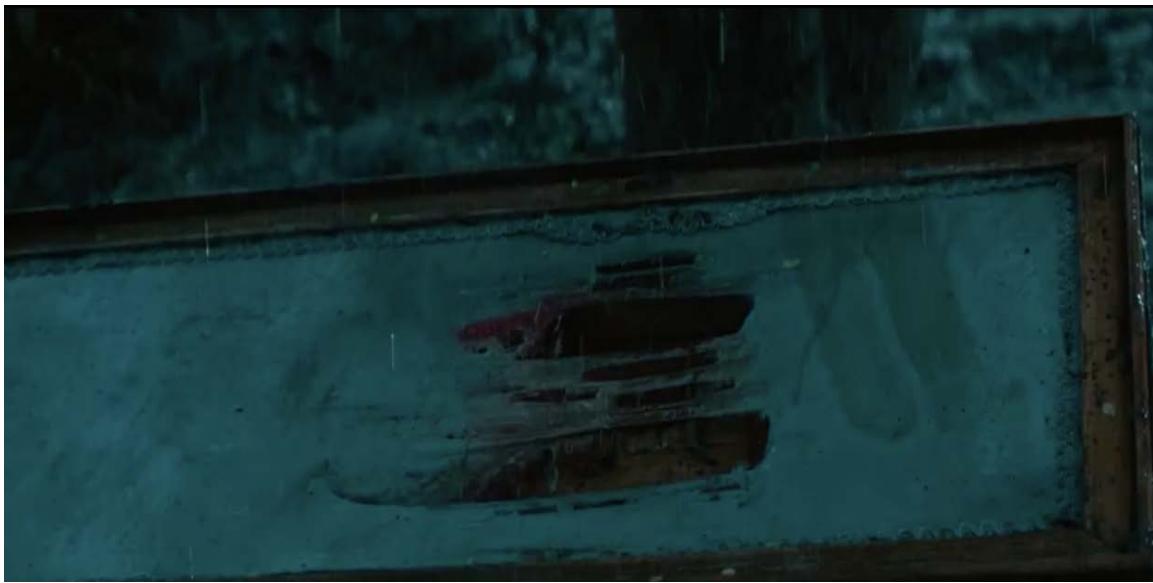 Figure 1: Screenshot in the film Wu Sha
On the other hand, taking the visual mode-non-verbal signs into consideration, the translator translated Wu Sha into Sheep Without a Shepherd because the non-verbal sheep, as significant signs transmitted visually, appeared five times in total and delivered disparate information each time, prompting the translator to encode them properly and accurately.
Firstly, the sign of the sheep represented the kindness and benevolence of the public, and such information could be received by the translator through the appearance of the sheep when Li Weijie gave alms to the monks. Living next to the cemetery, he was by no means affluent. However, he was willing to offer alms, indicating that he was a kind and benevolent man. The monks were accompanied by the sheep when Li Weijie provided alms, and the elder monk accepted his alms as well as wished him a long and healthy life filled with power. After the death of Su Cha, Li Weijie came to provide alms again. The elder monk, however, was not accompanied by the sheep and was reluctant to receive the alms because he thought that such donors would not have unlimited merits and virtues. In this example, it could be concluded that the sheep, typical of the visual mode-non-verbal sign, represented kindness and benevolence of the public.
 Figure 2: Screenshot in the film Wu Sha
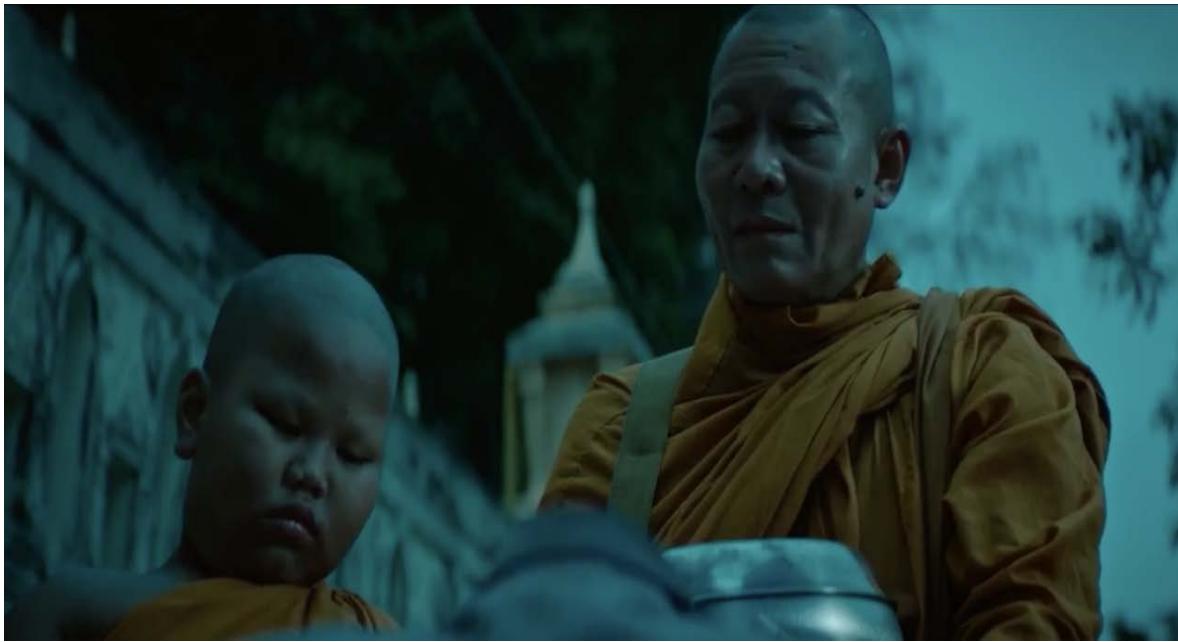 Figure 3: Screenshot in the film Wu Sha
Secondly, the sign of the sheep represented the negative features, or the blindness and weakness, of the public, and such information could be grasped by the translations through the following three scenes when the sheep appeared.
The first scene when the sheep appeared delivered the blindness of the public, which could be witnessed by its response when it saw Li Weijie pull the car of Su Cha into the water. In order not to be caught by the police, Li Weijie made huge attempts to get rid of the things of Su Cha. When Li Weijie pulled the car and it was about to sink below the surface of the water, a middle-aged man and a group of sheep came past him.
Among the sheep, one seemed to have noticed the car because it cast its eyes tightly into that direction. However, it was more or less like an onlooker because it did not produce any sound when watching the scene. The sheep (shown in Figure 4), typical of the visual mode-non-verbal sign, represented the blindness and ignorance of the public.
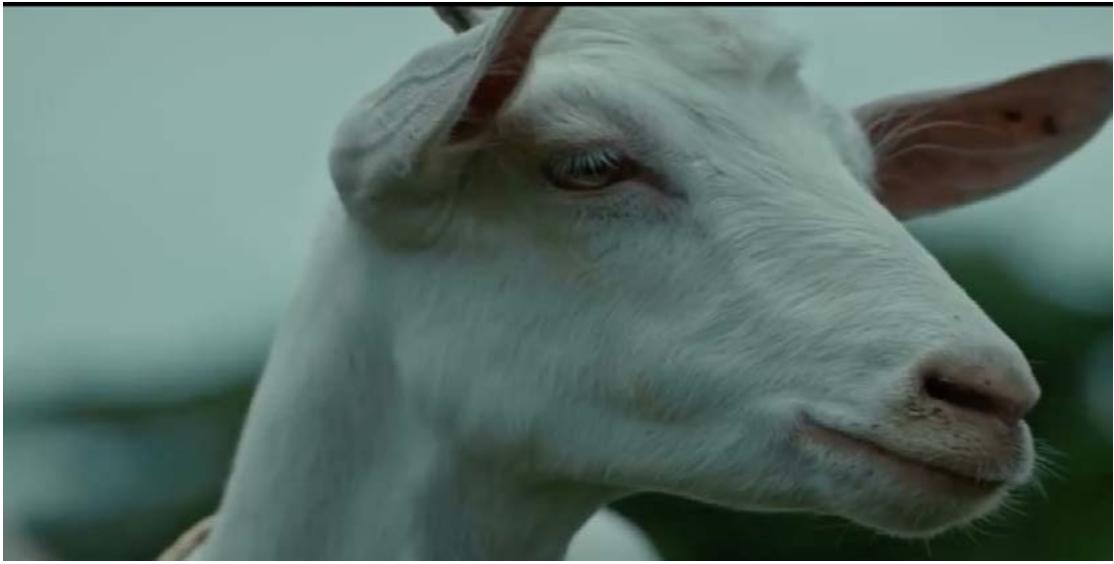 Figure 4: Screenshot in the film Wu Sha
Moreover, the second scene when the sheep appeared delivered the blindness of the public as well, which could be witnessed by the response of the public when the body of Su Cha turned out to be a sheep in the coffin. As the police chief, La Wen was unable to find any substantial evidence to convict the families of Li Weijie when interrogating them for the first time. Extremely desperate to find her son, she arrested them again and resorted to violence. She commanded the policemen and policewomen to give Li Weijie, his wife and their elder daughter bashes and kicks as well as dragged their younger daughter whose name was An An into a separate room. Threatened by La Wen, An An told her the truth and all family members of Li Weijie were taken to the place where the body of Su Cha had been buried, which piqued the attention of the public. Nevertheless, what was hidden in the coffin turned out to be a dead sheep as Li Weijie had secretly replaced the body with it. The public was unconscious of this fact, so they bore more hatred against the authority and the conflicts between different social classes could not be mediated any longer. The sheep (shown in Figure 5), typical of the visual mode-non-verbal sign, became the blasting fuse that intensified the class contradictions and reflected the blindness of the public.
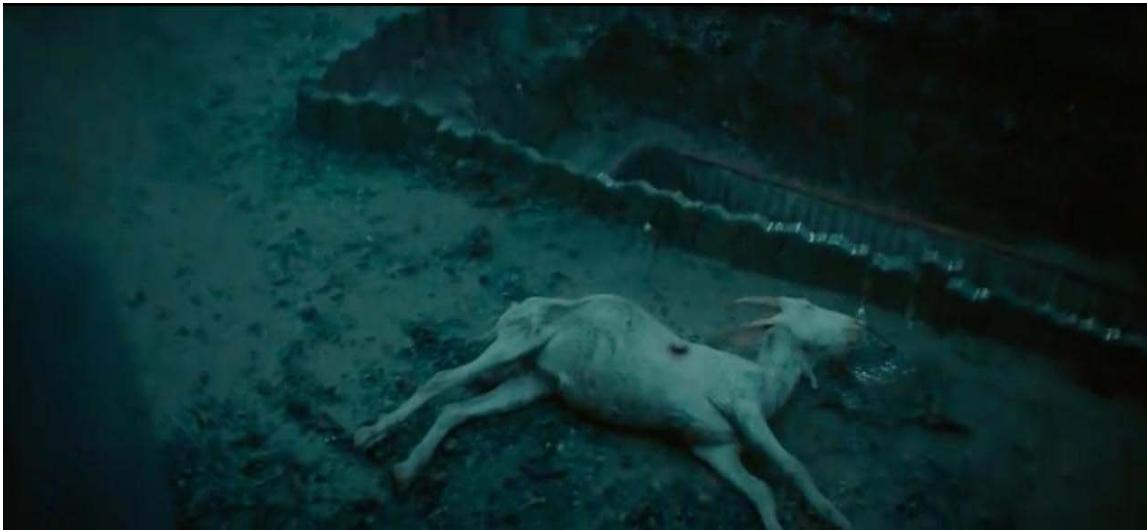 Figure 5: Screenshot in the film Wu Sha
Furthermore, the third scene when the sheep appeared delivered the weakness of the public, which could be witnessed by the distressing death of the sheep. In the film, the local policeman whose name was Sang Kun frequently fleeced and bullied the public. When the grandson of an old man almost lost an eye for being beaten up by Su Cha, his mother offered 100,000 bahts to compensate the old man. Sang Kun negotiated with the old man, but he merely provided 6,000 bahts as compensation money. The negotiation between them was noticed by Lei Weijie and Pu Lang, and the latter was battered because he anonymously reported the local policeman. In order to protect Pu Lang, Li Weijie assaulted the policeman. Completely infuriated, he mercilessly shot the innocent sheep to death. Nevertheless, no people around showed sympathy for it and what was left in the scene was the dead sheep lying in a pool of blood. The sheep (shown in Figure 6), typical of the visual mode-non-verbal sign, represented the weakness and helplessness of the public.
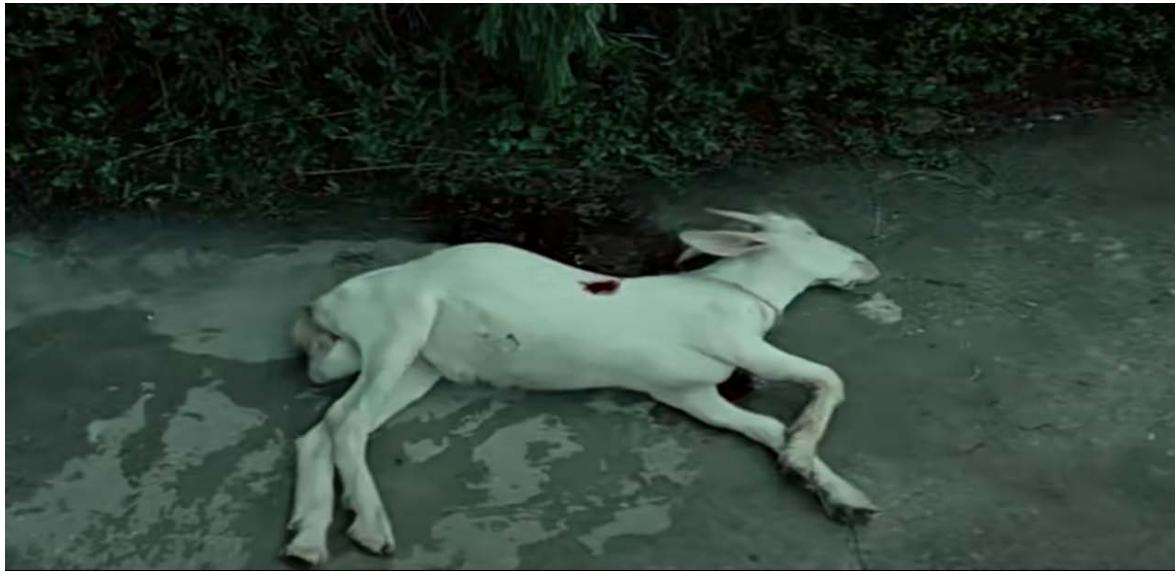 Figure 6: Screenshot in the film Wu Sha
Thirdly, the sign of the sheep represented salvation, and such information could be received by the translator through the appearance of the sheep when Li Weijie confessed his sins. Eventually, the male protagonist Li Weijie decided to surrender himself to the police, and he went to the temple to confess his sins.
Compared with the former scenes, the colour became brighter, reflecting the mind of Li Weijie as well. At this time, a living sheep was roaming freely under the sun. In this example, it could be concluded that the sheep (shown in Figure 7), typical of the visual mode-non-verbal sign, represented purity and salvation.
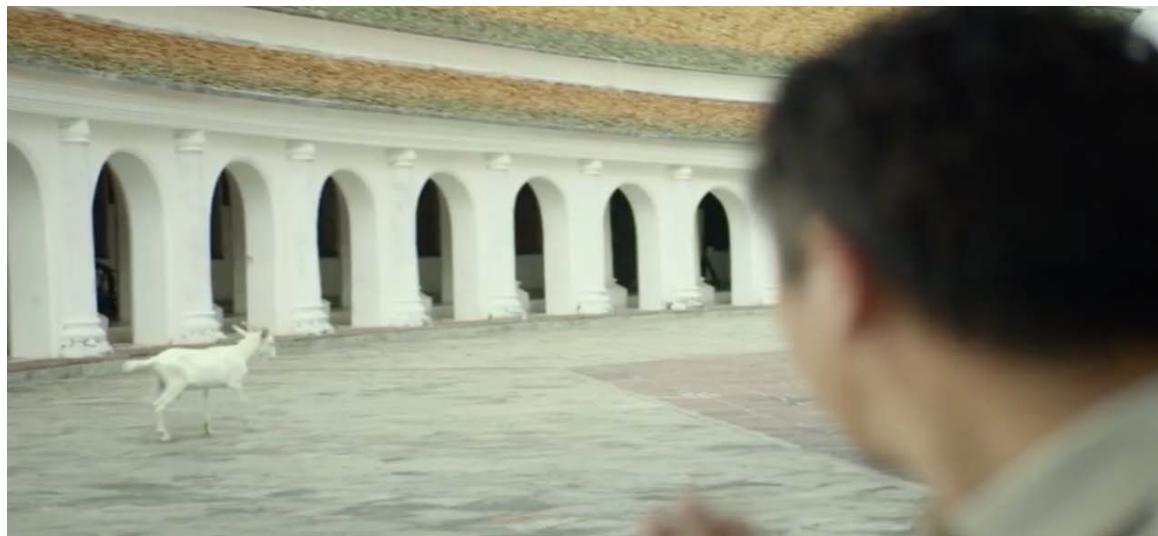 Figure 7: Screenshot in the film Wu Sha
In conclusion, despite the fact that the sheep were non-verbal, they transmitted disparate sorts of information to the translator through the visual mode and enabled the translator to perceive their symbolic meaning: representing the masses in the film Wu Sha. They were kind and benevolent, but they were blind and
weak as well. Compared with the information about kindness, the negative information was more in quantity, highlighting the blindness and weakness of the public. The translator grasped the pieces of information about the sheep transmitted visually and took them into consideration when translating the film title.
# b) The
Basically, the acoustic mode-verbal signs include the dialogue exchanges and songs (Díaz-Cintas & Remael, 2014). The following discussion will delve into how they influence the film title translation of Wu Sha.
Firstly, having heard the two dialogue exchanges which were significant verbal signs indicating the fact that Su Cha might be killed deliberately, the translator decided not to translate Wu Sha into Manslaughter. The first important dialogue exchange was between Li Weijie and his life. When Su Cha came to meet their elder daughter again, Li Weijie was watching a boxing match in another place. While Ping Ping and her mother were fighting with Su Cha, the two boxers in the boxing match were fighting as well. After one boxer lost consciousness, Li Weijie explained the reason why the judge pried his mouth open: to prevent him from swallowing his tongue and suffocating to death. When Li Weijie came back home, he asked his wife whether there was a trace of blood. Having heard the response of 'no', he knew that Su Cha was probably alive. Hence, the death of Su Cha might not be a 'manslaughter'. Another significant dialogue exchange was at the time when Li Weijie went to confess his sins in the temple. He came across the parents of Su Cha and they begged him to tell them whether their son was still alive or not. Li Weijie responded that he had to protect his family from being hurt again, so he might be the last person who caused the death of Su Cha. It can be concluded from these two dialogue exchanges, which were important verbal signs transmitted acoustically, that Su Cha might not be killed accidentally.
Secondly, taking the acoustic mode-verbal signs into consideration, the translator translated Wu Sha into Sheep Without a Shepherd because the two dialogues containing the sheep in the film represented the blindness and weakness of the public. The first one was between the teacher and students in class. The teacher said that sheep with poor eyesight could easily stray, so they were often eaten by large animals. This description, however, had both a denotative and a connotative meaning, with the latter being more important. In other words, the sheep were compared to the public. They were blind and weak, and, if they went astray, they could be hurt or even killed by the authority. After Li Weijie confessed his sins and was put into prison, he managed to escape. However, it turned out that the person who coordinated with him got killed and they were both buried in the coffin. Li Weijie was separated from the public, so his fate of being 'eaten by large animals' was inevitable. Another one was between a man and a reporter. After Li Weijie confessed his sins, a reporter interviewed the public. Among them, one man expressed his opinion that sheep were happy as long as they had grass to graze, and they did not care if their wool was shorn. This description, however, had both a denotative and a connotative meaning as well, with the latter being more significant. In other words, the sheep were compared to the masses again, showing their weakness and blindness. They were conscious of the fact that they were oppressed, but they chose to tolerate the pain. When the families of Li Weijie were bullied without any evidence, they got to know that their basic needs of survival might not be ensured under such circumstances.
Last but not least, the translator probably translated Wu Sha into Sheep Without a Shepherd because of the song with regard to the sheep in the film, which showed the blindness and weakness of the public. The theme song whose title was 亡羊 [Stray Sheep] overtly revealed the significance of such a sign: the sheep. Following the others with blindfolded eyes, the sheep was bewildered and panicked, and finally, it got astray into the wrong direction. In fact, what these words describe were both the sheep and the public. The latter, resembling the sheep, was blind and panicked, and eventually went astray. Hence, the verbal song delivered acoustically gave prominence to the sign of sheep as well.
Therefore, the dialogues and the song regarding the sheep, as acoustic mode-verbal signs, represented the weakness and blindness of the public. The translator realized the significance of these important verbal signs transmitted acoustically and took them into account when translating the film title.
### c) The influence of the acoustic mode-non-verbal signs
The acoustic mode–non-verbal signs contain instrumental music and background noises (Díaz-Cintas & Remael, 2014), which cannot be neglected and have their unique meaning when transmitting the information. Since all pieces of music in the film were verbal, the following discussion will merely delve into how the background noises influence the film title translation of Wu Sha.
On the one hand, the translator decided not to translate Wu Sha into Manslaughter because the noises made by a fork indicated the fact that Su Cha might be killed deliberately. When Li Weijie was having a meal with his family members, his younger daughter An An kept scratching the table with the fork. The frequency of scratching was increasing, and other family members were using chopsticks. Hence, it could be implicated that the younger daughter might have heard something from the coffin. The noises of scratches made by the fork corresponded to the scratches in the coffin and transmitted the information that Su Cha might not be killed by Ping Ping. Otherwise, the younger daughter of Li Weijie would not have behaved in such a strange manner.
On the other hand, taking the acoustic mode-non-verbal signs into consideration, the translator translated Wu Sha into Sheep Without a Shepherd because noises, as important acoustic mode-non-verbal signs, further reflected the blindness of the public. As mentioned above, Li Weijie stealthily replaced the body with the sheep, and the public, unconscious of the truth, reckoned that the masses were hurt unreasonably and eventually rebelled against the authority, resulting in a mass riot. Miscellaneous noises could be heard in the film, including but not limited to burning and explosion. Although they contained no words, they delivered significant information: the sheep had lost the shepherd, becoming blinder and more credulous. All the persons in the gathering shared the same sentiment, and their conscious personality disappeared, becoming the crowd from the psychological perspective. Since the crowd was anonymous, the sense of responsibility vanished completely, turning the honest man into a criminal (Le Bon, 1896). The parents of Li Weijie, as described in the film, were killed in the riot when he was still a child. Hence, he was an orphan and he completely knew the serious aftermath of the riot. The noises coming from the riot, typical of the acoustic mode-non-verbal signs, further represented the blindness of the public and should not be neglected, finally prompting the translator to translate Wu Sha into Sheep Without a Shepherd.
## IV. CONCLUSION
Based on the analysis above, it can be concluded that the reason why the translation of Manslaughter is abandoned and Sheep Without a Shepherd is adopted is that the translator realizes the great importance of the sheep and intends to interpret them for foreign moviegoers in a clear and understandable manner. It is important to note that the use of these signs, transmitted through visual and acoustic modes, is crucial in understanding the plot of the film and represents the public in a novel way.
Although the director may have devoted more attention to the visual mode-non-verbal signs since the sheep have appeared five times, the acoustic mode containing both verbal and non-verbal signs cannot be ignored. In fact, these signs further emphasize the blind obedience and gullibility of the masses, shaping them into a crowd with the same feeling, or resentment towards the authority. Therefore, the visual mode-non-verbal signs, acoustic mode-verbal signs and acoustic mode-non-verbal signs in Wu Sha are all concerned with the sheep and are essential in conveying the information about them, thus affecting the translation of the film title.
All these sign systems work together in the creation of a coherent film story (Díaz-Cintas & Remael, 2014), and their implied meanings become explicit (Pettit, 2004). Although the perspective of multimodality provides a brand new approach for translators, interpreting signs through different modes can pose challenges for them as well, as it can be time-consuming and require deliberate consideration. In the future, with the assistance of modern techniques and quantitative research methodology, it may become easier for translators to identify and interpret signs conveyed through different modes, thus enabling them to offer more appropriate and engaging translated titles to foreign moviegoers.
Generating HTML Viewer...
References
20 Cites in Article
Joseph Borrillo,Marco (2000). Register Analysis in Literary Translation.
Cao Qunying (2012). Translation of English Film Titles from the Perspective of Skopos Theory.
Dirk Delabastita (1989). Translation and Masscommunication: Film and T.V. Translation as Evidence of Cultural Dynamics.
No ethics committee approval was required for this article type.
Data Availability
Not applicable for this article.
How to Cite This Article
Yin Ming. 2026. \u201cUnlocking Symbolism: A Multimodal Analysis of Title Translation in Wu Sha\u201d. Global Journal of Human-Social Science - A: Arts & Humanities GJHSS-A Volume 24 (GJHSS Volume 24 Issue A1): .
Explore published articles in an immersive Augmented Reality environment. Our platform converts research papers into interactive 3D books, allowing readers to view and interact with content using AR and VR compatible devices.
Your published article is automatically converted into a realistic 3D book. Flip through pages and read research papers in a more engaging and interactive format.
The Chinese crime film Wu Sha (Manslaughter), released on 13 December 2019 and directed by Sam Quah, explores the story of a father protecting his daughter after she accidentally kills the son of the mayor and police chief. Despite receiving a 7.5 rating on Douban, the film generated significant discussion, particularly around its dialogues. However, this paper argues that understanding the film’s message requires considering multiple modes beyond dialogue. Through a multimodal analysis, this study investigates how visual and acoustic modes influence the translation of film titles, using Wu Sha as a case study. Multimodality, the integration of different communication modes, is extended to translation theory in this paper. Previous research on film title translation has often neglected multimodal elements, focusing primarily on the text itself. This paper addresses this gap by examining how visual and acoustic modes impact the translation process.
Our website is actively being updated, and changes may occur frequently. Please clear your browser cache if needed. For feedback or error reporting, please email [email protected]
Thank you for connecting with us. We will respond to you shortly.