Article Fingerprint
ReserarchID
QMU9V
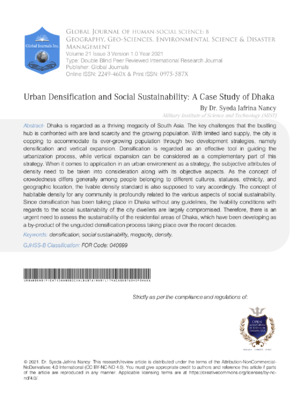
Dhaka is regarded as a thriving megacity of South Asia. The key challenges that the bustling hub is confronted with are land scarcity and the growing population. With limited land supply, the city is copping to accommodate its ever-growing population through two development strategies, namely densification and vertical expansion. Densification is regarded as an effective tool in guiding the urbanization process, while vertical expansion can be considered as a complementary part of this strategy. When it comes to application in an urban environment as a strategy, the subjective attributes of density need to be taken into consideration along with its objective aspects. As the concept of crowdedness differs generally among people belonging to different cultures, statuses, ethnicity, and geographic location, the livable density standard is also supposed to vary accordingly. The concept of habitable density for any community is profoundly related to the various aspects of social sustainability. Since densification has been taking place in Dhaka without any guidelines, the livability conditions with regards to the social sustainability of the city dwellers are largely compromised. Therefore, there is an urgent need to assess the sustainability of the residential areas of Dhaka, which have been developing as a by-product of the unguided densification process taking place over the recent decades.
Syeda Jafrina Nancy. 2021. \u201cUrban Densification and Social Sustainability: A Case Study of Dhaka\u201d. Global Journal of Human-Social Science - B: Geography, Environmental Science & Disaster Management GJHSS-B Volume 21 (GJHSS Volume 21 Issue B3): .
Crossref Journal DOI 10.17406/GJHSS
Print ISSN 0975-587X
e-ISSN 2249-460X
Explore published articles in an immersive Augmented Reality environment. Our platform converts research papers into interactive 3D books, allowing readers to view and interact with content using AR and VR compatible devices.
Your published article is automatically converted into a realistic 3D book. Flip through pages and read research papers in a more engaging and interactive format.
Total Score: 106
Country: Bangladesh
Subject: Global Journal of Human-Social Science - B: Geography, Environmental Science & Disaster Management
Authors: Assistant Professor Dr. Syeda Jafrina Nancy (PhD/Dr. count: 1)
View Count (all-time): 216
Total Views (Real + Logic): 1933

Total Downloads (simulated): 910

Publish Date: 2021 10, Fri
Monthly Totals (Real + Logic):
This paper attempted to assess the attitudes of students in
Advances in technology have created the potential for a new
Inclusion has become a priority on the global educational agenda,
Dhaka is regarded as a thriving megacity of South Asia. The key challenges that the bustling hub is confronted with are land scarcity and the growing population. With limited land supply, the city is copping to accommodate its ever-growing population through two development strategies, namely densification and vertical expansion. Densification is regarded as an effective tool in guiding the urbanization process, while vertical expansion can be considered as a complementary part of this strategy. When it comes to application in an urban environment as a strategy, the subjective attributes of density need to be taken into consideration along with its objective aspects. As the concept of crowdedness differs generally among people belonging to different cultures, statuses, ethnicity, and geographic location, the livable density standard is also supposed to vary accordingly. The concept of habitable density for any community is profoundly related to the various aspects of social sustainability. Since densification has been taking place in Dhaka without any guidelines, the livability conditions with regards to the social sustainability of the city dwellers are largely compromised. Therefore, there is an urgent need to assess the sustainability of the residential areas of Dhaka, which have been developing as a by-product of the unguided densification process taking place over the recent decades.
Lorem ipsum dolor sit amet, consectetur adipiscing elit. Ut elit tellus, luctus nec ullamcorper mattis, pulvinar dapibus leo.