
Introduction
Educational inclusion has become one of the central axes of contemporary education policies, especially when considering the right to participation of people with disabilities, deaf students, autistic students, people with neurodevelopmental conditions, racialized subjects, migrants, students in situations of socioeconomic vulnerability, and other historically minoritized groups. Despite legal and institutional advances, the mere presence of these students in educational spaces does not, by itself, guarantee retention, learning, belonging, or effective participation.
A significant part of educational exclusion does not appear through immediately visible barriers, such as stairs, the absence of ramps, or lack of equipment. Many barriers operate silently, routinely, and cumulatively: low teacher expectations, absence of linguistic mediation, inaccessible communication, inflexible assessment systems, statistical invisibility, lack of listening, inaccessible technologies, difficulties in belonging, and institutional policies unable to identify patterns of inequality before they become dropout, suffering, or school failure.
In this article, invisible barriers are understood as the set of pedagogical, communicational, attitudinal, institutional, digital, and informational obstacles that hinder educational participation but do not always appear in traditional management indicators. These barriers are not invisible because they do not exist; they become invisible because educational systems often do not know where, how, and with whom to look. Artificial Intelligence, in this context, may contribute to expanding institutional analytical capacity, provided that it is used as a decision-support instrument rather than as a deterministic mechanism for classifying students.
Recent literature already points to significant relationships between AI, education, inclusion, and disability. Studies on autism and discourse ethics discuss the risks of reducing subjects to computational profiles (Paiva and Carneiro, 2024), while research on atypical learners and inclusive education highlights possibilities for pedagogical personalization and trajectory monitoring (Dutra et al., 2025). In the field of deafness, debates on rights, technologies, and AI show the potential of digital resources to expand communicational accessibility, provided that the linguistic and cultural specificities of the deaf community are respected (Assis et al., 2026; Amaral, Pereira, and Damatto, 2025).
At the same time, the expansion of AI in education requires caution. Literature on ethics, regulation, data protection, and pedagogical uses of AI warns of risks related to surveillance, reproduction of biases, algorithmic opacity, and replacement of human mediation by automated decisions (Jardim et al., 2025; Miranda and Souza, 2022; Eller and Santos, 2024). Therefore, the guiding question of this study is: how does recent scientific literature articulate Artificial Intelligence, inclusive education, and the identification of invisible barriers affecting people with disabilities and other minority groups?
The general objective of this article is to analyze, through an exploratory bibliographic review, the scientific production retrieved from the CAPES Journals Portal between 2020 and 2026 on Artificial Intelligence and inclusion, focusing on pathways for detecting invisible barriers in inclusive education, especially those affecting people with disabilities, deaf students, autistic students, atypical learners, and other minority groups.
Methodology
This study is characterized as an exploratory bibliographic review of qualitative and descriptive nature, with the organization of the search and screening process inspired by the PRISMA protocol. The choice of an exploratory bibliographic review is justified by the recent and dispersed nature of scientific production on Artificial Intelligence, inclusive education, people with disabilities, and minorities, allowing the mapping of trends, gaps, and possibilities for application without claiming the status of a strict systematic review.
The search was conducted in the CAPES Journals Portal through CAFe access linked to the Instituto Federal do Paraná (IFPR). The strategy considered the articulation between the descriptors Artificial Intelligence and inclusion, followed by refinement by publication year and peer review.
The search expression, registered here as a bibliographic location strategy/prompt, was: "artificial intelligence" AND "inclusion". The filters applied were publication period 2020-2026 and peer-reviewed articles. The initial search returned 147 results; after applying the period and peer-review filters, 55 records remained and were exported in BibTeX format for thematic screening. This procedure was adopted to ensure minimal traceability of the review and to distinguish between records retrieved by the broad strategy and studies effectively aligned with the objective of the article.
Table 1 - Search strategy and selection criteria
| Step | Description |
|---|---|
| Database consulted | CAPES Journals Portal, accessed through CAFe/IFPR. |
| Initial search | Broad strategy based on the terms "artificial intelligence" and "inclusion". |
| Initial result | 147 records retrieved. |
| Filters applied | Publication period 2020-2026 and peer-reviewed articles. |
| Result after filters | 55 records exported in BibTeX format. |
| Thematic screening | Classification by title, bibliographic metadata, and adherence to AI, education, inclusion, people with disabilities, minorities, ethics, and data protection. |
| Inclusion criteria | Articles related to AI in educational contexts, inclusive education, people with disabilities, deafness, autism, atypical learners, minorities, ethics, equity, assistive technology, or data protection. |
| Exclusion criteria | Studies without sufficient relation to education, inclusion, disability, minorities, or educational barriers; papers focused only on health, industry, labor, bidding processes, insurance, logistics, or technical applications without an inclusive educational dimension. |
| Applied search strategy/prompt | "artificial intelligence" AND "inclusion"; filters: 2020-2026 and peer-reviewed articles. |
Source: Prepared by the authors based on the records exported from the CAPES Journals Portal.
After organizing the records, titles and available metadata were read and classified into four groups: core corpus, theoretical support, lateral adherence, and outside the scope. The core corpus included articles directly linked to the interface between AI, inclusion, and people with disabilities. The theoretical support group included studies on AI in education, ethics, regulation, data protection, teacher education, and emerging technologies, used to broaden the discussion. Articles classified as lateral adherence or outside the scope were excluded from the main synthesis because they did not directly respond to the study objective.
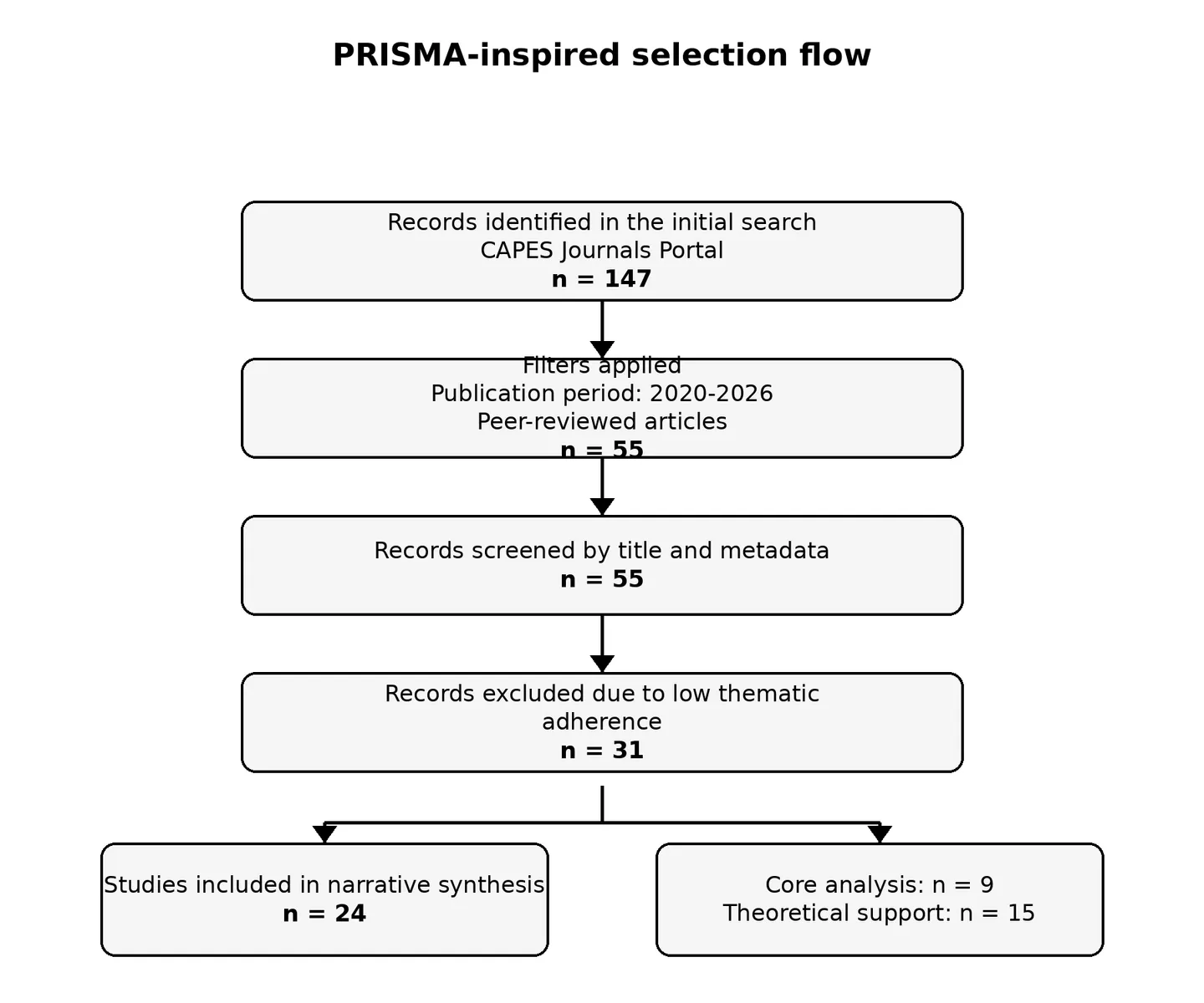
Table 2 - Record selection flow
| Phase | Procedure | n |
|---|---|---|
| Identification | Records found in the initial search in the CAPES Journals Portal | 147 |
| Filtering | Records remaining after applying the 2020-2026 and peer-review filters | 55 |
| Screening | Records assessed by title and bibliographic metadata | 55 |
| Exclusion | Records excluded due to low thematic adherence | 31 |
| Inclusion | Records included in the narrative synthesis | 24 |
| Core synthesis | Records directly related to AI, inclusion, and people with disabilities | 9 |
| Theoretical support | Records used for contextual grounding and ethical/pedagogical discussion | 15 |
Results
The analysis of the 55 records revealed a temporal concentration in 2024, which accounted for 26 publications, followed by 2023 with 13 publications and 2025 with 9 publications. This movement suggests a recent intensification of interest in Artificial Intelligence in educational, ethical, and social contexts, especially after the popularization of generative AI systems and the expansion of debates on digital transformation.
The thematic screening showed that only part of the records retrieved through the broad search on AI and inclusion directly addressed people with disabilities or inclusive education. This finding is methodologically relevant because it shows that the term inclusion is used in multiple fields, such as health, management, migration, public administration, labor, digital transformation, and technological innovation. Therefore, the distinction between a broad search corpus and a corpus effectively adherent to the research objective proved essential.
Table 3 - Temporal distribution of records
| Year | Retrieved records (n=55) | Included in synthesis (n=24) | Core records (n=9) |
|---|---|---|---|
| 2020 | 2 | 0 | 0 |
| 2021 | 1 | 0 | 0 |
| 2022 | 3 | 1 | 0 |
| 2023 | 13 | 1 | 0 |
| 2024 | 26 | 13 | 4 |
| 2025 | 9 | 8 | 4 |
| 2026 | 1 | 1 | 1 |
Chart 1 shows that the highest concentration of publications occurred in 2024. However, the number of studies directly related to people with disabilities remained proportionally small, which indicates a relevant research gap in the specific articulation between AI, disability, inclusive education, and minority groups.
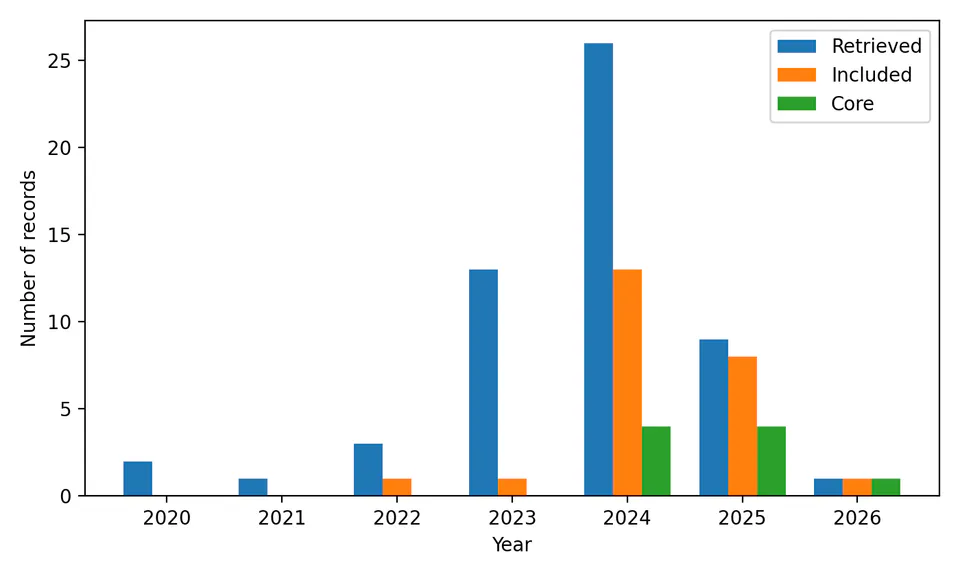
Chart 1 - Distribution of retrieved and included records by year
The core corpus comprised 9 articles directly related to AI, inclusion, and people with disabilities, including studies on deaf education, autism, atypical learners, assistive technologies, and AI applied to disability data. Another 15 articles were used as theoretical support because they addressed AI in education, ethics, regulation, data protection, teacher education, and pedagogical processes.
Table 4 - Articles in the core corpus of the review
| ID | Year | Title | Journal | Adherence to scope |
|---|---|---|---|---|
| 4 | 2024 | Ética discursiva, inclusão do autismo e inteligência artificial | Logeion Filosofia da Informação | AI, inclusion, and people with disabilities/atypical learners |
| 6 | 2026 | Os direitos da comunidade surda no brasil: avanços legais, inclusão e o papel da inteligência artificial | Revista Foco | AI, inclusion, and people with disabilities/atypical learners |
| 10 | 2025 | Inteligência artificial como ferramenta para a promoção da inclusão educacional: desafios éticos, estratégias pedagógicas e impactos na aprendizagem de estudantes atípicos | Revista Foco | AI, inclusion, and people with disabilities/atypical learners |
| 12 | 2024 | Modelo de Inteligência Artificial aplicado à análise de dados de pessoas com deficiência: utilização de LangChain | Revista de Gestão e Secretariado (Management and Administrative Professional Review) | AI, inclusion, and people with disabilities/atypical learners |
| 19 | 2024 | Educação 5.0 e inclusão: explorando o potencial das tecnologias emergentes para pessoas com deficiência | Revista Políticas Públicas & Cidades | AI, inclusion, and people with disabilities/atypical learners |
| 20 | 2025 | Inteligência artificial na inclusão | Logeion Filosofia da Informação | AI, inclusion, and people with disabilities/atypical learners |
| 28 | 2025 | Tecnologia e inteligência artificial na educação de pessoas surdas | Fiep Bulletin - online | AI, inclusion, and people with disabilities/atypical learners |
| 33 | 2024 | uso da IA para pessoas com deficiência considerando aspectos da propriedade intelectual | Educação | AI, inclusion, and people with disabilities/atypical learners |
| 36 | 2025 | TEA HelpBot - Avaliação de um Assistente Pedagógico Conversacional no Ensino de Matemática para Estudantes Autistas das Series Finais do Ensino Fundamental | RENOTE | AI, inclusion, and people with disabilities/atypical learners |
Table 5 - Theoretical support articles used in the discussion
| ID | Year | Title | Axis of contribution |
|---|---|---|---|
| 1 | 2024 | Inteligência artificial e arte generativa: descolonização, inclusão e reflexividade em estudos com migrantes | Minorities, inclusion, and reflexivity |
| 2 | 2025 | Uso ético da IA (inteligência artificial) como geração de significado e inclusão | Ethics, regulation, and data protection |
| 3 | 2025 | Desafios e potencialidades da inteligência artificial na educação profissional: tecnologias digitais, gestão e inclusão | AI, education, and pedagogical practice |
| 5 | 2025 | Tecnologias Digitais na Educação Linguística: Foco na Gamificação e na Inteligência Artificial para Promover a Inclusão | AI, education, and pedagogical practice |
| 8 | 2025 | Avaliação regulatória de software como dispositivo médico com foco na inclusão e equidade nas aplicações da inteligência artificial em saúde | Ethics, regulation, and data protection |
| 11 | 2023 | O uso da inteligência artificial na educação com ênfase à formação docente | AI, education, and pedagogical practice |
| 21 | 2024 | O papel da Inteligência Artificial no Ensino Tecnológico | AI, education, and pedagogical practice |
| 25 | 2024 | Os impactos da inteligência artificial na sala de aula | AI, education, and pedagogical practice |
| 26 | 2024 | Gestão e mídia do conhecimento: Educação em rede e os desafios da IAG na escrita acadêmica | AI, education, and pedagogical practice |
| 27 | 2022 | Legislação global sobre inteligência artificial: uma análise crítica sobre o papel da unesco | Ethics, regulation, and data protection |
| 29 | 2024 | A aplicação de inteligência artificial e robótica assistiva no cuidado de idosos: uma revisão sistemática | Assistive technology and care |
| 32 | 2024 | Inteligência artificial: panorama da produção científica no contexto educacional | Contextualization of AI |
| 45 | 2024 | A Evolução Recente da Inteligência Artificial | Contextualization of AI |
| 46 | 2024 | Coleta, proteção e uso de dados pessoais em negócios: a quem pertencem, como podem ser protegidos e explorados? | Ethics, regulation, and data protection |
| 48 | 2024 | Contributos da IA nos Processos Pedagógicos e no Desenvolvimento Profissional e Organizacional: Percepções de Professores Portugueses | AI, education, and pedagogical practice |
Discussion
The results allow the discussion to be organized into complementary axes: AI as a support technology for the inclusion of people with disabilities; AI as an instrument for reading educational trajectories; ethics, data protection, and the risk of bias; human and community validation of algorithmic findings; and, specifically, the implications of AI for the linguistic accessibility of deaf people who use Brazilian Sign Language (Libras). (Dutra et al., 2025; Lima et al., 2024; Possato et al., 2024; Assis et al., 2026; Amaral, Pereira, and Damatto, 2025).
Artificial Intelligence, disability, and educational inclusion
The core corpus of the review indicates that the relationship between AI and the inclusion of people with disabilities has developed on several fronts. In the field of deafness, the studies by Assis et al. (2026) and Amaral, Pereira, and Damatto (2025) connect technology, rights, and deaf education, allowing AI to be discussed not only as a technical resource but also as a potential mediation for communicational accessibility. This dimension is essential because the exclusion of deaf students is often not located in the absence of enrollment, but in the absence of effective linguistic conditions for participation. (Assis et al., 2026; Amaral, Pereira, and Damatto, 2025; Santos et al., 2025; Santos et al., 2026).
Santos et al. (2025), in reviewing scientific production on Libras and Artificial Intelligence between 2019 and 2025, demonstrate that the interface between AI and sign languages has been concentrated especially in three areas: automatic translation and digital avatars, assistive technologies and Libras teaching, and sign recognition through computer vision. This contribution directly dialogues with the present review, as it shows that the inclusion of deaf people cannot be reduced to the presence of digital tools. The central challenge remains linguistic, cultural, and pedagogical: AI must recognize Libras as a language, respect its visual modality, its own grammar, its facial and bodily expressions, and not treat it as a simple mechanical conversion from Portuguese into signs. (Santos et al., 2025; Amaral, Pereira, and Damatto, 2025; Assis et al., 2026).
In the same direction, the qualitative study by Santos et al. (2026), conducted with deaf Libras users in Brazil, points to a relevant issue for the discussion of invisible barriers: many participants demonstrated limited knowledge, mistaken associations, or restricted use of AI, although they also expressed interest in learning more about the technology. This finding reinforces that digital exclusion is not limited to access to a device or the internet. It involves critical digital literacy, mediation in an accessible language, continuing education, and real opportunities for technological appropriation. In the case of deaf people, the invisible barrier may lie precisely in the distance between the promise of innovation and the way this innovation reaches, or fails to reach, the community in Libras. (Santos et al., 2025; Santos et al., 2026).
Regarding autism, Paiva and Carneiro (2024) and Barboza, Catabriga, and Cury (2025) contribute to understanding both the ethical limits and the pedagogical possibilities of conversational assistants and intelligent systems. The presence of studies on autistic students is relevant because many barriers faced by this population are interpreted in an individualizing way, as behavior or personal difficulty, when they may reveal failures in pedagogical organization, communication, predictability, reception, and institutional adaptation. (Paiva and Carneiro, 2024; Barboza, Catabriga, and Cury, 2025).
In the broader field of people with disabilities, Lima et al. (2024), Possato et al. (2024), Marques, Silva, and Santos (2024), and Pizzi, Porto, and Kolmar (2025) indicate that AI may contribute to data analysis, assistive technology, inclusion, and the identification of needs. However, the contribution of these studies must be read with caution: AI only becomes inclusive when guided by a conception of rights, participation, and accessibility. Intelligent systems that merely classify, rank, or predict risk without pedagogical intervention may reinforce inequalities under the appearance of technological neutrality. (Lima et al., 2024; Possato et al., 2024; Marques, Silva, and Santos, 2024; Pizzi, Porto, and Kolmar, 2025).
Invisible barriers and institutional reading of patterns
The main conceptual contribution of this article is to argue that AI can help educational institutions identify invisible barriers when applied to the reading of collective and structural patterns. This may include, for example, cross-analysis of attendance, performance, participation in activities, support requests, service records, communicational accessibility, use of virtual environments, retention, and dropout. The goal should not be to label students as problems, but to reveal situations in which the institution fails to guarantee equitable learning conditions. (Dutra et al., 2025; Lima et al., 2024; Possato et al., 2024; Barboza, Catabriga, and Cury, 2025).
Dutra et al. (2025) discuss AI as a tool for promoting the educational inclusion of atypical learners, pointing to ethical challenges, pedagogical strategies, and impacts on learning. This perspective approaches the proposal of the present article: to use AI as an institutional radar for barriers. The term radar is important because it moves AI away from the position of judge and places it in the position of signaler. Educational decision-making must remain human, contextual, participatory, and pedagogical. (Dutra et al., 2025).
The supporting literature on AI in education also contributes to this reading. Souza (2025), Marcom and Porto (2023), Menta and Brito (2024), Pacheco et al. (2024), Reis, Souza, and Müller (2024), Barin and Ellensohn (2024), and Madureira and Batista (2024) show that AI has been discussed in teacher education, classrooms, technological education, academic writing, and pedagogical processes. These studies help to understand that inclusion does not depend only on the existence of a tool, but on the institutional capacity to train teachers, interpret data, and transform information into pedagogical action. (Souza, 2025; Marcom and Porto, 2023; Menta and Brito, 2024; Pacheco et al., 2024; Reis, Souza, and Müller, 2024; Barin and Ellensohn, 2024; Madureira and Batista, 2024).
Ethics, data, and the risk of reproducing inequalities
The ethical dimension appears as an unavoidable axis. Jardim et al. (2025) discuss the ethical use of AI as meaning-making and inclusion, while Miranda and Souza (2022) analyze global AI legislation and the role of UNESCO. Jambor (2025), although situated in the field of health, contributes to the debate on regulation, inclusion, and equity in AI applications. Eller and Santos (2024), in turn, expand the discussion on the collection, protection, and use of personal data. Taken together, these studies indicate that educational AI must be conceived from the perspectives of governance, transparency, legitimate purpose, data minimization, security, and human control. (Jardim et al., 2025; Miranda and Souza, 2022; Jambor, 2025; Eller and Santos, 2024).
This caution is decisive when dealing with people with disabilities and minorities. Educational data are sensitive not only because they reveal performance, attendance, or academic history, but also because they may expose vulnerabilities, diagnoses, accessibility conditions, trajectories of exclusion, and power relations. An institution using AI to predict dropout, for example, needs to ask: who will benefit from this prediction? What intervention will be carried out? Will the student be supported or marked? Will the data be used to expand rights or to justify exclusions? (Jardim et al., 2025; Miranda and Souza, 2022; Eller and Santos, 2024; Lima et al., 2024).
Thus, AI applied to inclusion must obey at least five principles: explicit inclusive purpose; anonymization and data protection; bias auditing; participation of affected subjects; and institutional commitment to intervention. Without these principles, AI risks transforming historical inequalities into elegant but scarcely transformative statistics. (Jardim et al., 2025; Miranda and Souza, 2022; Dutra et al., 2025; Eller and Santos, 2024).
Analytical matrix for detecting invisible barriers
Based on the review conducted, an analytical matrix is proposed to guide educational institutions interested in using AI in a critical and inclusive way. The matrix organizes possible indicators, barriers, and institutional responses. Its purpose is not to offer a closed model, but a reading pathway so that educational data can be interpreted in light of inclusion, accessibility, and educational justice. (Dutra et al., 2025; Lima et al., 2024; Possato et al., 2024; Pizzi, Porto, and Kolmar, 2025).
Table 6 - Matrix for the ethical use of AI in identifying invisible barriers
| Dimension | Possible indicators | Invisible barrier signaled | Recommended institutional response |
|---|---|---|---|
| Communicational and linguistic accessibility | Class participation, use of accessible materials, linguistic mediation, access to Libras, captions, visual resources, and assistive technologies. | The student is enrolled but does not fully participate because of communication and accessibility failures. | Map linguistic needs, guarantee accessible resources, strengthen mediation, and review materials and assessment practices. |
| Academic trajectory | Attendance, performance, repetition, dropout, recurring delays, and low submission of assignments. | The system notices failure only at the end, when exclusion has already consolidated. | Create early pedagogical alerts, activate support teams, offer tutoring, and provide evidence-based flexibility. |
| Participation and belonging | Participation in projects, interactions in virtual environments, presence in extracurricular activities, records of isolation or low interaction. | Formal retention does not guarantee social and educational belonging. | Promote listening circles, mentoring, anti-ableist actions, and psycho-pedagogical support. |
| Institutional support | Requests to NAPNE/CNAPNE, response time, referrals, adaptations provided, and case follow-up. | The barrier lies in institutional slowness, not in the student. | Reduce response time, standardize flows, record interventions, and evaluate the effectiveness of actions. |
| Ethics and data governance | Consent, anonymization, purpose limitation, transparency, bias auditing, and human review of results. | Sensitive data may generate surveillance, stigma, or unfair automated decisions. | Establish a governance committee, review models, ensure participation of affected groups, and prevent exclusively automated decisions. |
Deafness, Libras, and Artificial Intelligence: from promised accessibility to effective participation
The discussion on deafness deserves emphasis because it clearly reveals the difference between formal access and effective participation. An institution may claim to be inclusive because it enrolls deaf students or provides some technological resource; however, inclusion only occurs when communication, curriculum, assessment, digital environments, and institutional interactions are effectively accessible in Libras and in written Portuguese as a second language. At this point, AI can help map gaps, but it cannot replace the institution’s language policy. (Assis et al., 2026; Amaral, Pereira, and Damatto, 2025; Santos et al., 2025; Santos et al., 2026).
The studies retrieved in this review indicate that AI applied to deafness tends to appear in association with automatic translation, sign recognition, signing avatars, the creation of teaching materials, and communication support. These uses are relevant, but they need to be analyzed critically. An automatic translation system that fails to recognize regional variations, nonmanual expressions, discourse rhythm, classifiers, and cultural aspects of Libras may produce only apparent accessibility. In other words, the system seems to include, but delivers an impoverished, unnatural, or inadequate mediation for the linguistic experience of the deaf community. (Santos et al., 2025; Amaral, Pereira, and Damatto, 2025; Assis et al., 2026).
For this reason, AI should be conceived as support rather than as a replacement for the Libras translator/interpreter, bilingual teacher, deaf instructor, or communicational accessibility policies. The risk of automatic replacement is particularly serious when managers interpret technology as a cheaper solution to complex demands. The linguistic inclusion of deaf people involves qualified human presence, visual pedagogical planning, accessible materials, fair assessment, and recognition of deaf culture. AI may assist these processes, but it must not be used to make them precarious. (Assis et al., 2026; Santos et al., 2025; Santos et al., 2026; Amaral, Pereira, and Damatto, 2025).
The contribution of Santos et al. (2025) strengthens this interpretation by showing that scientific production on Libras and AI is still strongly concentrated on technical solutions, but needs to advance in evaluations carried out with the participation of the deaf community itself. Similarly, Santos et al. (2026) show that the appropriation of AI by deaf people depends on training, linguistic access, and cultural mediation. These findings dialogue with the notion of invisible barriers because they reveal that a tool may be available and still remain distant from the user when it is not presented in their language, context, and real needs. (Santos et al., 2025; Santos et al., 2026).
Thus, in the specific case of deaf students, AI could support important institutional diagnoses: which subjects show a greater drop in performance? In which components is there less participation in forums and virtual environments? Is there an interpreter in all activities? Are materials made available in advance? Do assessments consider Portuguese as a second language? Do videos include a Libras window, adequate captions, and visual description when necessary? These questions demonstrate that the invisible barrier is not in the deaf student, but in the communicational architecture of the institution. (Assis et al., 2026; Amaral, Pereira, and Damatto, 2025; Santos et al., 2026).
Therefore, the main contribution of AI to the inclusion of deaf people should not be merely to "translate signs", but to help the institution see where communication is failing. When used ethically, with deaf participation and human validation, AI can function as an instrument of pedagogical auditing of linguistic accessibility. When used without these precautions, it may merely automate superficial inclusion, producing the appearance of modernization without confronting the linguistic ableism that still marks many educational spaces. (Santos et al., 2025; Santos et al., 2026; Assis et al., 2026; Amaral, Pereira, and Damatto, 2025).
From data to intervention: pathways for a responsive institutional policy
The expanded discussion makes it possible to affirm that the usefulness of AI in inclusive education depends less on the technical sophistication of the model and more on the institutional capacity to transform indicators into actions. A dashboard that shows risk of dropout, low participation, or performance inequality only has value if it triggers a concrete response. Otherwise, technology merely produces a more elegant picture of exclusion that remains intact. In pedagogical terms, the central question is not whether AI can detect patterns, but whether the institution is prepared to act on them. (Dutra et al., 2025; Lima et al., 2024; Barin and Ellensohn, 2024; Marcom and Porto, 2023).
A responsive institutional policy should articulate at least four levels of action. The first is the preventive level, focused on early identification of exclusion signals. The second is the pedagogical level, which reorganizes curriculum, assessment, materials, timeframes, and methodologies. The third is the communicational level, responsible for ensuring linguistic, visual, digital, and informational accessibility. The fourth is the political-institutional level, which defines responsibilities, budget, staff training, and continuous monitoring. Without this articulation, AI risks becoming just another attractive tool in meetings, one that shines in PowerPoint and disappears in practice. (Dutra et al., 2025; Jardim et al., 2025; Souza, 2025; Madureira and Batista, 2024).
Another decisive element is the return of results to the educational community. Students, teachers, and inclusion teams need to understand what was identified, which data were analyzed, what limits exist, and which actions will be adopted. Transparency prevents AI from being perceived as a surveillance mechanism and strengthens its role as an instrument of institutional care. In contexts involving minorities, disability, and deafness, this feedback must be accessible, translated when necessary, collectively discussed, and open to contestation. (Jardim et al., 2025; Eller and Santos, 2024; Santos et al., 2026; Dutra et al., 2025).
In this way, the bibliographic review supports a central thesis: AI can help detect invisible barriers, but inclusion remains a human, ethical, and collective responsibility. The algorithm may indicate that something is repeated; the educational community must interpret why it is repeated; and management must decide what will be transformed. Technology alone includes no one. It only expands the capacity to perceive problems that were often already before the institution but had been naturalized by routine, bureaucracy, or lack of listening. (Dutra et al., 2025; Jardim et al., 2025; Pizzi, Porto, and Kolmar, 2025; Possato et al., 2024; Santos et al., 2026).
Implications for inclusive educational policies
The review indicates that the use of AI in inclusive education may contribute to three levels of institutional action. The first is the diagnostic level, in which intelligent systems help identify patterns of exclusion that do not appear clearly in conventional reports. The second is the preventive level, in which risk signals are used to activate pedagogical support before dropout or academic failure occurs. The third is the evaluative level, in which the institution monitors whether its own accessibility, retention, and inclusion policies produce concrete effects.
In this sense, AI can support the construction of more responsive retention policies. Instead of waiting for the student to seek help, the institution can identify patterns of low participation and offer proactive support. Instead of treating dropout as an individual decision, it can recognize that certain trajectories reveal accumulated barriers. Instead of understanding disability only as a characteristic of the subject, it can investigate how the educational environment produces or reduces impediments.
For this use to be legitimate, however, AI must be linked to teacher education, ethical data governance, and the participation of students and inclusion professionals. Intelligent tools should not replace the teacher, interpreter, pedagogue, support professional, NAPNE, or collective decision-making spaces. The role of AI is to expand the visibility of problems; the role of the educational community is to transform this visibility into institutional justice.
Limitations of the study
This study has limitations. The first refers to the fact that the search was conducted on a single platform, the CAPES Journals Portal, although this database brings together a wide diversity of journals. The second concerns the exploratory character of the screening, based on exported bibliographic records and on the thematic adherence of titles and metadata. The third limitation relates to the breadth of the terms Artificial Intelligence and inclusion, which retrieve publications from very different areas, not always linked to inclusive education or people with disabilities. For this reason, the core corpus was separated from the theoretical support articles.
Despite these limitations, the study offers a relevant contribution by organizing a recent corpus, identifying trends, and proposing an analytical matrix for the ethical use of AI in detecting invisible barriers. Future research may expand the search to databases such as Scopus, Web of Science, ERIC, SciELO, and Google Scholar, in addition to conducting full-text reading of the articles, in-depth thematic analysis, and empirical validation of the proposed matrix in educational institutions.
Final considerations
The analysis of recent scientific production allows us to affirm that Artificial Intelligence has the potential to contribute to inclusive education, especially when used to identify institutional patterns of exclusion that remain invisible in traditional analyses. However, this potential is not automatic. AI may either expand educational justice or reinforce inequalities, depending on the principles, purposes, and forms of governance that guide its use.
The 55 records retrieved after the period and peer-review filters demonstrate that the theme of AI has been growing rapidly, but they also reveal thematic dispersion. Only 9 articles composed the core corpus directly related to the interface between AI, inclusion, and people with disabilities, while another 15 were used as theoretical support. This finding reinforces the need for more specific scientific production on AI, inclusive education, deafness, autism, disability, and minorities.
It is concluded that AI can function as a support tool for identifying invisible barriers, provided that it is used with ethics, transparency, data protection, community participation, and institutional commitment to intervention. Its value does not lie in replacing human listening, but in expanding the capacity of institutions to perceive what, for a long time, remained naturalized: the silent exclusion of students who were present in the system but absent from the real conditions of participation.
Appendix A - Screening of the 55 retrieved records
The table below presents the classification of the records exported from the CAPES Journals Portal. The classification was used to separate core corpus articles, theoretical support texts, and records excluded from the synthesis due to low thematic adherence.
| ID | Year | Title | Category | Decision |
|---|---|---|---|---|
| 1 | 2024 | Inteligência artificial e arte generativa: descolonização, inclusão e reflexividade em estudos com migrantes | Theoretical support | Included as contextual support |
| 2 | 2025 | Uso ético da IA (inteligência artificial) como geração de significado e inclusão | Theoretical support | Included as contextual support |
| 3 | 2025 | Desafios e potencialidades da inteligência artificial na educação profissional: tecnologias digitais, gestão e inclusão | Theoretical support | Included as contextual support |
| 4 | 2024 | Ética discursiva, inclusão do autismo e inteligência artificial | Core corpus | Included in the core analysis |
| 5 | 2025 | Tecnologias Digitais na Educação Linguística: Foco na Gamificação e na Inteligência Artificial para Promover a Inclusão | Theoretical support | Included as contextual support |
| 6 | 2026 | Os direitos da comunidade surda no brasil: avanços legais, inclusão e o papel da inteligência artificial | Core corpus | Included in the core analysis |
| 7 | 2024 | Inteligência artificial generativa no ensino de programação: um mapeamento sistemático da literatura | Lateral adherence/excluded from synthesis | Excluded from the main synthesis; use only if necessary |
| 8 | 2025 | Avaliação regulatória de software como dispositivo médico com foco na inclusão e equidade nas aplicações da inteligência artificial em saúde | Theoretical support | Included as contextual support |
| 9 | 2020 | Transliteracias: A Terceira Onda Informacional nas Humanidades Digitais | Outside the scope | Excluded |
| 10 | 2025 | Inteligência artificial como ferramenta para a promoção da inclusão educacional: desafios éticos, estratégias pedagógicas e impactos na aprendizagem de estudantes atípicos | Core corpus | Included in the core analysis |
| 11 | 2023 | O uso da inteligência artificial na educação com ênfase à formação docente | Theoretical support | Included as contextual support |
| 12 | 2024 | Modelo de Inteligência Artificial aplicado à análise de dados de pessoas com deficiência: utilização de LangChain | Core corpus | Included in the core analysis |
| 13 | 2022 | Tecnologias para o cuidado em saúde mental e enfermagem: Revisão integrativa | Outside the scope | Excluded |
| 14 | 2023 | Inteligência artificial e saúde: ressituar o problema | Outside the scope | Excluded |
| 15 | 2024 | Reflexões e práticas críticas na educação a distância: perspectivas contemporâneas | Outside the scope | Excluded |
| 16 | 2023 | Educação híbrida e cultura digital: reflexões sobre docência, aprendizagem e tecnologias na contemporaneidade | Outside the scope | Excluded |
| 17 | 2024 | A razão estratégica e as relações contemporâneas de trabalho | Outside the scope | Excluded |
| 18 | 2024 | Novas tecnologias e seus impactos no mundo do trabalho e do processo do trabalho | Outside the scope | Excluded |
| 19 | 2024 | Educação 5.0 e inclusão: explorando o potencial das tecnologias emergentes para pessoas com deficiência | Core corpus | Included in the core analysis |
| 20 | 2025 | Inteligência artificial na inclusão | Core corpus | Included in the core analysis |
| 21 | 2024 | O papel da Inteligência Artificial no Ensino Tecnológico | Theoretical support | Included as contextual support |
| 22 | 2024 | Utilização de tecnologias digitais na educação infantil em comunidades de baixa renda | Lateral adherence/excluded from synthesis | Excluded from the main synthesis; use only if necessary |
| 23 | 2024 | A interação homem-máquina na psicoterapia | Outside the scope | Excluded |
| 24 | 2023 | Transformação digital e seguro: uma revisão sistemática da literatura | Outside the scope | Excluded |
| 25 | 2024 | Os impactos da inteligência artificial na sala de aula | Theoretical support | Included as contextual support |
| 26 | 2024 | Gestão e mídia do conhecimento: Educação em rede e os desafios da IAG na escrita acadêmica | Theoretical support | Included as contextual support |
| 27 | 2022 | Legislação global sobre inteligência artificial: uma análise crítica sobre o papel da unesco | Theoretical support | Included as contextual support |
| 28 | 2025 | Tecnologia e inteligência artificial na educação de pessoas surdas | Core corpus | Included in the core analysis |
| 29 | 2024 | A aplicação de inteligência artificial e robótica assistiva no cuidado de idosos: uma revisão sistemática | Theoretical support | Included as contextual support |
| 30 | 2023 | Análise comparativa dos processos de avaliação da qualidade do Ensino Superior | Outside the scope | Excluded |
| 31 | 2023 | Uso da inteligência artificial na predição do risco de sepse pós-ureteroscopia flexível: uma revisão sistemática | Outside the scope | Excluded |
| 32 | 2024 | Inteligência artificial: panorama da produção científica no contexto educacional | Theoretical support | Included as contextual support |
| 33 | 2024 | uso da IA para pessoas com deficiência considerando aspectos da propriedade intelectual | Core corpus | Included in the core analysis |
| 34 | 2021 | Cenário da publicação científica sobre a Indústria 4.0 no Brasil: Uma revisão bibliométrica | Outside the scope | Excluded |
| 35 | 2023 | “Implementação” da Logística Hospitalar 4.0 no Brasil: benefícios e desafios | Outside the scope | Excluded |
| 36 | 2025 | TEA HelpBot - Avaliação de um Assistente Pedagógico Conversacional no Ensino de Matemática para Estudantes Autistas das Series Finais do Ensino Fundamental | Core corpus | Included in the core analysis |
| 37 | 2024 | Cultura na era da educação 5.0 | Lateral adherence/excluded from synthesis | Excluded from the main synthesis; use only if necessary |
| 38 | 2024 | Aplicação de Inteligência Artificial na Predição da Obesidade Adulta: Inovações e Desafios no Setor de Saúde | Outside the scope | Excluded |
| 39 | 2023 | Inteligência artificial e violência doméstica: a garantia à integridade física por meio da relativização da privacidade. | Lateral adherence/excluded from synthesis | Excluded from the main synthesis; use only if necessary |
| 40 | 2024 | Uso de inteligência artificial no processo avaliativo do residente multiprofissional de saúde: uma revisão da literatura | Outside the scope | Excluded |
| 41 | 2023 | Monitoramento de integridade estrutural em rotores dinâmicos usando inteligência artificial com aprendizado continuado | Outside the scope | Excluded |
| 42 | 2024 | Desafios contemporâneos e novas fronteiras do direito e da sociedade | Outside the scope | Excluded |
| 43 | 2023 | Inovação, Internacionalização e Inclusão | Lateral adherence/excluded from synthesis | Excluded from the main synthesis; use only if necessary |
| 44 | 2024 | Mapeamento de algoritmos de inteligência artificial para gerenciamento de serviços de oncologia hospitalar | Outside the scope | Excluded |
| 45 | 2024 | A Evolução Recente da Inteligência Artificial | Theoretical support | Included as contextual support |
| 46 | 2024 | Coleta, proteção e uso de dados pessoais em negócios: a quem pertencem, como podem ser protegidos e explorados? | Theoretical support | Included as contextual support |
| 47 | 2024 | Entre continuidades e rupturas: a representação do cientista e da ciência a partir de imagens geradas pelo ChatGPT | Outside the scope | Excluded |
| 48 | 2024 | Contributos da IA nos Processos Pedagógicos e no Desenvolvimento Profissional e Organizacional: Percepções de Professores Portugueses | Theoretical support | Included as contextual support |
| 49 | 2024 | Educação visual sobre o Holocausto: | Outside the scope | Excluded |
| 50 | 2023 | Instrumentos para avaliação e tratamento de Lesões por Pressão: revisão da literatura | Outside the scope | Excluded |
| 51 | 2025 | As inovacoes da lei 14.133/2021 na conducao das licitacoes | Outside the scope | Excluded |
| 52 | 2020 | A inteligência artificial e a eficiência na administração pública | Outside the scope | Excluded |
| 53 | 2023 | Aprendizagem ativa: experiências e pesquisas com metodologias ativas | Outside the scope | Excluded |
| 54 | 2023 | O estado da arte da aplicação da inteligência artificial no esfregaço de sangue periférico | Outside the scope | Excluded |
| 55 | 2022 | Administração pública digital e a implementação dos objetivos do desenvolvimento sustentável | Outside the scope | Excluded |