

Neural Networks and Rules-based Systems used to Find Rational and Scientific Correlations between being Here and Now with Afterlife Conditions
Neural Networks and Rules-based Systems used to Find Rational and

Article Fingerprint
ReserarchID
CSTSDE0M16E
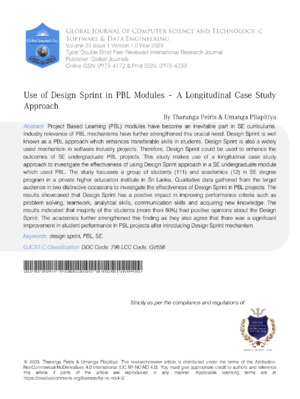
Project Based Learning (PBL) modules have become an inevitable part in SE curriculums. Industry relevance of PBL mechanisms have further strengthened this crucial need. Design Sprint is well known as a PBL approach which enhances transferable skills in students. Design Sprint is also a widely used mechanism in software industry projects. Therefore, Design Sprint could be used to enhance the outcomes of SE undergraduate PBL projects. This study makes use of a longitudinal case study approach to investigate the effectiveness of using Design Sprint approach in a SE undergraduate module which used PBL. The study focusses a group of students (111) and academics (12) in SE degree program in a private higher education institute in Sri Lanka. Qualitative data gathered from the target audience in two distinctive occasions to investigate the effectiveness of Design Sprint in PBL projects. The results showcased that Design Sprint has a positive impact in improving performance criteria such as problem solving, teamwork, analytical skills, communication skills and acquiring new knowledge. The results indicated that majority of the students (more than 80%) had positive opinions about the Design Sprint. The academics further strengthened this finding as they also agree that there was a significant improvement in student performance in PBL projects after introducing Design Sprint mechanism.
Tharanga Peiris. 2026. \u201cUse of Design Sprint in PBL Modules– A Longitudinal Case Study Approach\u201d. Global Journal of Computer Science and Technology - C: Software & Data Engineering GJCST-C Volume 23 (GJCST Volume 23 Issue C1): .
Crossref Journal DOI 10.17406/gjcst
Print ISSN 0975-4350
e-ISSN 0975-4172
The methods for personal identification and authentication are no exception.
Total Score: 102
Country: Sri Lanka
Subject: Global Journal of Computer Science and Technology - C: Software & Data Engineering
Authors: Tharanga Peiris, Sobhani Pilapitiya (PhD/Dr. count: 0)
View Count (all-time): 267
Total Views (Real + Logic): 2231
Total Downloads (simulated): 37
Publish Date: 2026 01, Fri
Monthly Totals (Real + Logic):
Neural Networks and Rules-based Systems used to Find Rational and
A Comparative Study of the Effeect of Promotion on Employee
The Problem Managing Bicycling Mobility in Latin American Cities: Ciclovias
Impact of Capillarity-Induced Rising Damp on the Energy Performance of
Project Based Learning (PBL) modules have become an inevitable part in SE curriculums. Industry relevance of PBL mechanisms have further strengthened this crucial need. Design Sprint is well known as a PBL approach which enhances transferable skills in students. Design Sprint is also a widely used mechanism in software industry projects. Therefore, Design Sprint could be used to enhance the outcomes of SE undergraduate PBL projects. This study makes use of a longitudinal case study approach to investigate the effectiveness of using Design Sprint approach in a SE undergraduate module which used PBL. The study focusses a group of students (111) and academics (12) in SE degree program in a private higher education institute in Sri Lanka. Qualitative data gathered from the target audience in two distinctive occasions to investigate the effectiveness of Design Sprint in PBL projects. The results showcased that Design Sprint has a positive impact in improving performance criteria such as problem solving, teamwork, analytical skills, communication skills and acquiring new knowledge. The results indicated that majority of the students (more than 80%) had positive opinions about the Design Sprint. The academics further strengthened this finding as they also agree that there was a significant improvement in student performance in PBL projects after introducing Design Sprint mechanism.
We are currently updating this article page for a better experience.

Lorem ipsum dolor sit amet, consectetur adipiscing elit. Ut elit tellus, luctus nec ullamcorper mattis, pulvinar dapibus leo.































































