

I. DEVICE AND THE PARAMETERS OF THE EJECTING PUMPS
The operating principle of ejecting pump is based on the use of a law Of benulli for the moving fluid flows. The law of Bernoulli (also the Bernoulli equation, Bernoulli's theorem or Bernoulli's integral) establishes dependence between by the speed stationary fluid flow and it by the pressure. According to this law, if lengthwise flow line the pressure of liquid grows, then rate of flow diminishes, and vice versa. The quantitative expression of the law in the form of Bernoulli's integral is the result of the integration the equations the hydrodynamics the ideal fluid (i.e., without the viscosity and the thermal conductivity). The schematic of the simplest ejector pump is shown in Fig. 1.
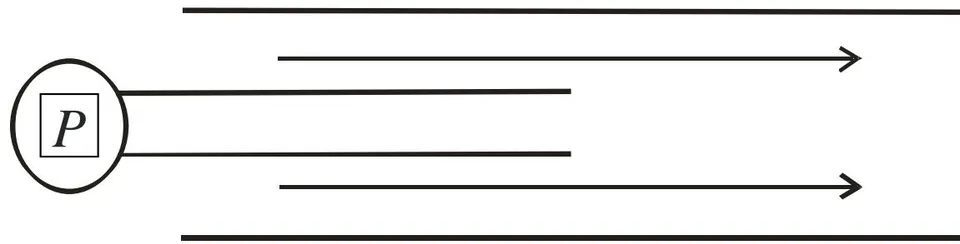
If along the pipe, into which it is inserted the pipe of smaller diameter, moves liquid, then is the manometer, established at the beginning of the pipe of smaller diameter, negative pressure in comparison with the external pressure will show. The degree of the vacuum, which ensures this pump, depends on the speed of liquid in the pipe and the pressure of the saturated vapors of the utilized liquid. If water is used as the liquid, then in the limits of temperatures, pumped out from the bore hole water (10-20 s) this pressure varies in the limits of ten mm. the mercury column. Consequently, if this pump is used as the external pump, connected to the pipe of that oppressed into the soil, then this pump can ensure the rise of water from the depth not more than 10 m.
II. SCHEMATICS OF THE USE OF AN EJECTOR PUMP FOR THE PUMPAGE FROM THE BORE HOLE
In Fig. 2 is shown one of the possible the schematics of the use of an ejector pump for the pumpage from the bore hole when pump it is established outside the pipe, oppressed into the soil.
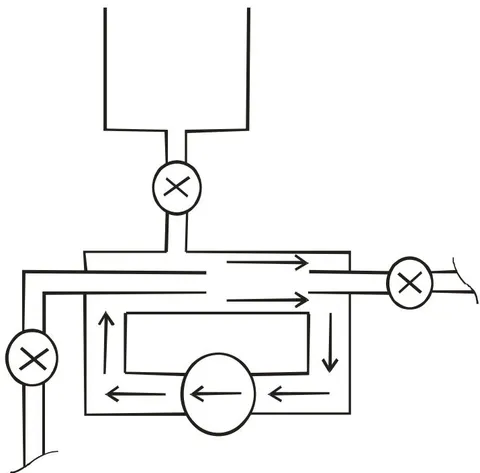
The starting of pump is achieved as follows. Pours water into the flood tank (it is located in the upper part of the figure) and they fill the cavity of pump with water. In this case the crane, which connects flood tank with the pump should be left those opened. After this, they start the mechanical pump (it is designated krzhkom with the pointer) and is opened left crane. From the pipe of bore hole in this case begins to be pumped out air, which leaves through the flood tank. After the water, pumped out, will begin to enter into the pump, the water level in the flood tank will begin grow from the bore hole. After this, is shut the crane, which connects flood tank with the pump and they open the right crane, from which will begin to enter the water, pumped out from the bore hole. A drawback in this pump is, as we already indicated, the fact that with its aid it is not possible to pump out water from the bore hole, in which the water level is located at the depth more than 10 m.
In Fig. 3 the diagram is represented the pump of free from this deficiency. This is reached by the fact that the ejector pump is established in the lower part of the pipe.
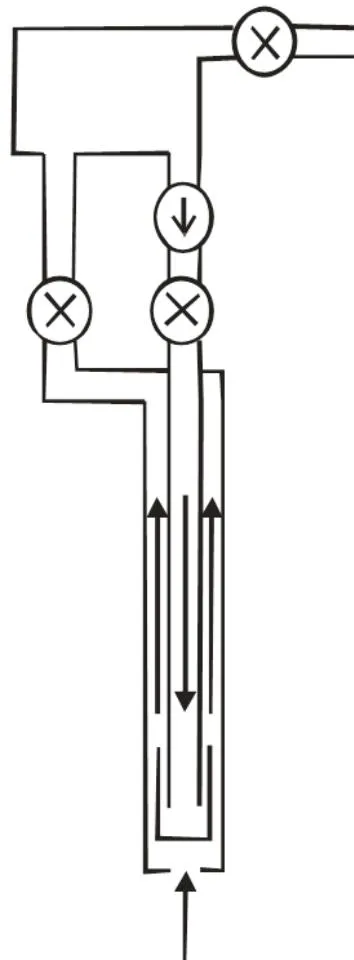
Represented construction of pump gives the possibility to pump out water from any depths. Pump is started as follows. Through the upper edge flood tank and cavity of pump are flooded. Then they start the mechanical pump (it is shown by circle with the pointer) and after this simultaneously are opened lower cranes. After a certain time the water, pumped out from the bore hole, will begin to leave through the upper edge and the pump it is ready to operation.
III. CONCLUSION
In private life frequently appears need the guarantee of individual water supply on the place of residence or on the dacha. For these purposes are used the water-bearing bore holes, which are carried out with the aid of the drilling rigs. This is the expensive operation, since it requires not only the presence of drilling rig, but also requires installation in the bore hole of the well casings of large diameter. The large diameter of pipes is caused by the need for the installation in them of immersion water pumps. In the article several versions of the use of water ejector pumps for the solution of this problem are proposed.