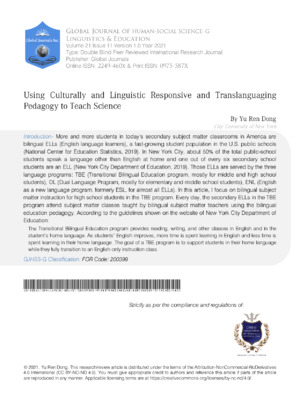
Using Culturally and Linguistic Responsive and Translanguaging Pedagogy to Teach Science

Article ID

T6076

Accessible multilingual education strategies.

Using Culturally and Linguistic Responsive and Translanguaging Pedagogy to Teach Science

Yu Ren Dong
Yu Ren Dong
DOI

Abstract

ore and more students in today’s secondary subject matter classrooms in America are bilingual ELLs (English language learners), a fast-growing student population in the U.S. public schools (National Center for Education Statistics, 2019). In New York City, about 50% of the total public-school students speak a language other than English at home and one out of every six secondary school students are an ELL (New York City Department of Education, 2019). Those ELLs are served by the three language programs: TBE (Transitional Bilingual Education program, mostly for middle and high school students), DL (Dual Language Program, mostly for elementary and middle school students), ENL (English as a new language program, formerly ESL, for almost all ELLs). In this article, I focus on bilingual subject matter instruction for high school students in the TBE program. Every day, the secondary ELLs in the TBE program attend subject matter classes taught by bilingual subject matter teachers using the bilingual education pedagogy. According to the guidelines shown on the website of New York City Department of Education

Using Culturally and Linguistic Responsive and Translanguaging Pedagogy to Teach Science

ore and more students in today’s secondary subject matter classrooms in America are bilingual ELLs (English language learners), a fast-growing student population in the U.S. public schools (National Center for Education Statistics, 2019). In New York City, about 50% of the total public-school students speak a language other than English at home and one out of every six secondary school students are an ELL (New York City Department of Education, 2019). Those ELLs are served by the three language programs: TBE (Transitional Bilingual Education program, mostly for middle and high school students), DL (Dual Language Program, mostly for elementary and middle school students), ENL (English as a new language program, formerly ESL, for almost all ELLs). In this article, I focus on bilingual subject matter instruction for high school students in the TBE program. Every day, the secondary ELLs in the TBE program attend subject matter classes taught by bilingual subject matter teachers using the bilingual education pedagogy. According to the guidelines shown on the website of New York City Department of Education

Yu Ren Dong
Yu Ren Dong

No Figures found in article.

Yu Ren Dong. 2021. “. Global Journal of Human-Social Science – G: Linguistics & Education GJHSS-G Volume 21 (GJHSS Volume 21 Issue G11): .

Download Citation

Journal Specifications

Crossref Journal DOI 10.17406/GJHSS

Print ISSN 0975-587X

e-ISSN 2249-460X

Classification
GJHSS-G Classification: FOR Code: 200399
Keywords
Article Matrices
Total Views: 2034
Total Downloads: 908
2026 Trends
Research Identity (RIN)
Related Research
Our website is actively being updated, and changes may occur frequently. Please clear your browser cache if needed. For feedback or error reporting, please email [email protected]

Request Access

Please fill out the form below to request access to this research paper. Your request will be reviewed by the editorial or author team.
X

Quote and Order Details

Contact Person

Invoice Address

Notes or Comments

This is the heading

Lorem ipsum dolor sit amet, consectetur adipiscing elit. Ut elit tellus, luctus nec ullamcorper mattis, pulvinar dapibus leo.

High-quality academic research articles on global topics and journals.

Using Culturally and Linguistic Responsive and Translanguaging Pedagogy to Teach Science

Yu Ren Dong
Yu Ren Dong

Research Journals