
I. INTRODUCTION
The Contemporary African Art musicians have been faced with the task of providing the relevance of African characteristics and backgrounds and practices to their numerous audiences through authentic art idiom (Agu, 2009:50). In response to this task, Contemporary African and Nigeria musicians/Art music composers as well as musicians went back to existing cultural musical archives and musical heritage for inspirations and techniques which is evident in the titles of their compositions, the use of African/Nigerian texts, setting of traditional melodies and elements such as tonality and tonal constructs, melodic configuration, pentatonic modes, antiphony, ostinato, instrumentation and instrumental ensemble formats (orchestration), harmonic principles, voice leading techniques, cadential formulae, to mention but a few.
In Africa/Nigeria, indigenous traditional music and or folk tunes including repertoires of traditional ensembles (vocal and instrumental or both) as ethno-compositional materials of various cultural milieus have been used to compose enormous stylistic pedigree by contemporary musicians (those without formal academic training) and art composers/musicians (those who have received formal/academic training in both African and western music idioms) who can express themselves in terms of music logically and structurally either consciously or unconsciously bearing in mind all the intricacies associated with the process of composition such as the melodic contour, rhythmic pattern, motifs, textual/tone colour, performance media, style and so on.
Composition usually involves individual's innovative potentials which in turn involve contact and exposure to a wide spectrum/gamut of meaningful information on musical concepts and contents, coherent organization of ideas, synthesis and analysis of the compositional process. On the other hand, compositional works communicates certain ideas, thoughts, content, meaning or claim to which the composer is predisposed to and influenced normally based on prevailing theories of tonality, thematic structures, form, rhythmic patterns, tempo and use of musical instruments. Different ethno-compositional materials represent and reflect the culture of a people. Idolor (2002) stated that, compositional techniques such as statement of themes and their developments with sequences, repetitions, tonal shifts, orchestration, dynamic shadings, part singing, text, texture, rhythm and cadential formulae are all representative of a culture. The culture of a people represents the people. Therefore, the discourse, using ethno-compositional materials for contemporary composition: 'Ovie' (E flat Saxophone and Piano Accompaniment as a musical example) would not be complete without first, relating it to its ethnographic location. This study is situated in Oghara community, one of the ethnic groups in Urhobo clan. Oghara community is made up of Urhobo speaking people, geographically located with Edo State to the North and East, Koko North Local Government Area to the East and Jesse clan to the South.
'Ovie' is the title of the song text in a series of a traditional choral-dance style known as 'Ekha re Abere'. It was performed by the KingsWay Cultural Group of Oghareki, Oghara in Ethiope West Local Government Area of Delta State, Nigeria. It is essentially a social music associated with coronation ceremony performed solely for the 'Ovie' (king) during an ordination ceremony of a king. As an indigenous music, it is one of a series of performances performed mainly for entertainment purposes.
For the actualization of ethno-compositional theory, thematic materials were drawn from the transcription of the melodic configurations of the traditional song titled 'Ovie' and the rhythmic configurations of the 'agogo' (metal gong) from the instrumental ensemble of 'Ekha Re Abere'-these formed the source material for the new composition titled 'Ovie' E flat Alto Saxophone and Piano Accompaniment; thus emerging a new stylistic idiom. Focal point was on the pre-compositional considerations and compositional techniques used in the composition.
II. PRE-COMPOSITIONAL CONSIDERATIONS AND ANALYSIS OF 'OVIE' E FLAT ALTO SAXOPHONE AND PIANO ACCOMPANIMENT
Pre-compositional considerations are simply guide lines akin to compass or chart which a composer bear in mind during the process of music composition. Pre-compositional considerations help and guide the composer in making informed choices from the embryonic stages of a composition to its completion. These include but not limited to the following: title of composition, form, melodic and harmonic structure of the composition, text(s), key(s) to be used, texture/tone colour/mood, motif of the composition, meter/signature, scale, rhythmic configuration(s), length, dynamics – tempo/timbre, tonic/tonality, vocal/instrumental typology, performance guide, sonic sound and targeted audience. The following pre-compositional considerations were employed for the purpose of this discourse. These include title of composition, medium, instrumentation, style, form, meter/signature, tempo, length, tonality, mood, and performance guide.
a) Title
It is a prefix or suffix added to a name or position. In Africa and Nigeria in particular titles became important when there was a need to fashion an alcove and national idealism in a bid to preserving the musicality and uniqueness of the people. Through the century to the present contemporary times, titles and names have been affixed to a particular composition by composers of various nationalities which are used to identify such composition, the composer, epoch and cultural affiliation. Instances are titles such as 'lyere'siri', 'Krisimasi Ede Ra'ghogho' 'Asiko', 'Igirigi Hermon', 'Ore- ofe Jesu Kristi', 'Zidata Mo Nso Gi', 'Otu Nkwu', 'Eje Ka Jumo Gbagbo o', 'Orin Ijosin 54', 'Akinla', 'Ekpri Ekanem for Flute Solo and Piano Accompaniment', 'Ikemefuna', 'Ahudiya', 'Wian', 'Oyoma for String Trio', 'Sanu dezuwa' to mention a few. The above explanation informed the choice of the title used as musical example of the discourse 'Ovie' E flat Alto Saxophone and Piano Accompaniment. 'Ovie' whose syllabic structure is written and pronounced o/vi/ea/ is an Urhobo word meaning (king). In Urhobo culture, the king is the symbolic head and traditional head presiding over matters concerning the culture and traditions of a nomenclature within the State.
b) Instrumentation/Medium/Accompaniment
Instrumentation here is referred to the use or adaptation of an instrument other than the primary source as a medium of musical and artistic expression. Akpabot (1986:79, 80) opined that;
'African instrumental melody in many instances derives from, and makes use of folk tunes... many African folk tunes grow out of the melody formed by the speech inflection which corresponds to the high, low and sometimes medium tones of African languages, and the stress placed on certain words in sentence, controls the interval of the notes of a melody and dictate its rhythm'.
Though contextually, Akpabot was referring to African musical instruments' construction, function and performance capabilities, the first two lines of the above assertion 'African instrumental melody in many instances derives from, and makes use of folk tune' is applicable and is in direct consonance with the adopted melodic structure of 'ovie' traditional song used for the composition of an instrumental idiom.
Primarily, the artistic medium for the performance of the traditional music titled 'ovie' is both vocal and instrumental, however, for stylistic preference, the E flat Alto Saxophone was employed by the composer. Another reason the composer opted for one of the Saxophone family is that saxophones are now employed in contemporary orchestral settings. The E flat Alto Saxophone is a transposing instrument classified sometimes under woodwinds and sometimes classified under the brass wind normally placed between the woodwinds and brass wind instruments on the orchestral page. The piano on the other hand, is sometimes classified under the string and percussion (because of its percussive function) - these were adapted by the composer.
These instruments (E flat alto saxophone and pianoforte) functioned as principal and subordinate function to one another. While the E flat alto saxophone served as the principal (solo) supplying the melodic contrast, the piano accompaniment served mainly as subordinate, background and contrasting instrument supplying harmonic and rhythmic contrast to the principal instrument. This is vividly captioned by Randel (2001) when he explained that;
Accompaniment is used in somewhat two different ways, one referring to the manner of performance, the other to texture. The first is appropriate when the performers of a musical work are divided into two components of contrasting and complimentary function: a principal part in which musical interest and the listener's attention are mainly centered and the accompaniment, subordinate to it, whose main purpose is somewhat supportive. The principal part may be one or more Solo performer(s), vocal or instrumental, or a group of performers, such as chorus. The relation between accompaniment and principal part can vary from a completely and unobtrusively subordinate role for the accompaniment, like that of guitar chord strummed with a song or that of the church organist in congregational singing, to what is called obligato accompaniment, found in more complex music, where the accompaniment is an essential part of the texture.
c) Style
In this context 'style', referred to a manner, the summation of (external and internal) features such as tonal center which may be tonal or atonal, monophonic, dyad, homophonic, polyphonic/contrapuntal etc in which the composition was presented or made up of. The composition 'ovie' E flat alto saxophone and piano accompaniment is in polyphonic style.
d) Form
The structural design adopted for the composition of 'ovie' E flat alto saxophone and piano accompaniment is a quasi-sonata format comprising A - (prelude and statement of theme), B – (exposition 1), C – (exposition 2) and A – (restatement of theme and climax). It also featured the use of call and response form which is characteristics of African/Nigerian music.
e) Meter/Time signature/Tempo
Rhythmic fragments equaled to the proportion of segmented mille-units to each bar, made up the entire composition of 'ovie' E flat alto saxophone and piano accompaniment. It is in six eight time; an example of the compound duple time signature derivation commonly used in African/ Nigerian music compositions. On the other hand, the tempo signifying the dynamics for speed assigned to the composition for performance purposes is in Allegreto (meaning rather fast and lively). Note: 'Allegreto' it is neither an African nor a Nigerian term.
f) Mood/Length
As the term entailed, the mood of a composition is derived from the summation of the internal and external artistic components such as melodic structure, texture, key, tempo, rhythm and tonality of a composition therefore the suggested mood for the composition 'ovie' E flat alto saxophone and piano accompaniment is Gaily (meaning merrily). While the length consisted of 173 bars comprising of 8+9+1+9+1+23+3+14+4+15+2+25+19+6+25+9.
g) Tonality
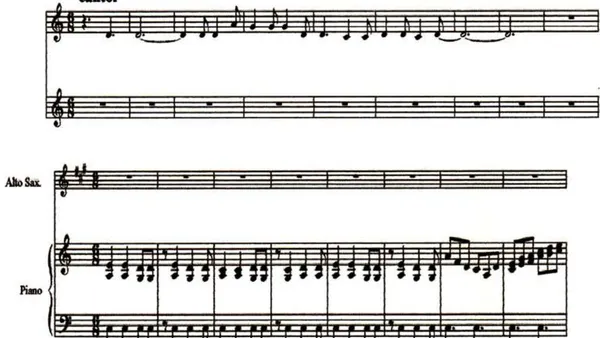
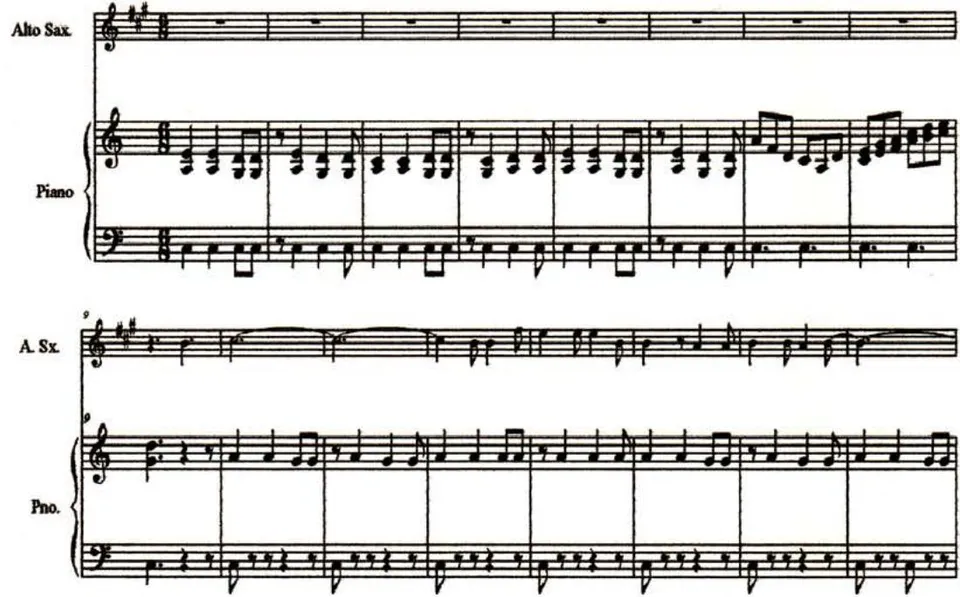
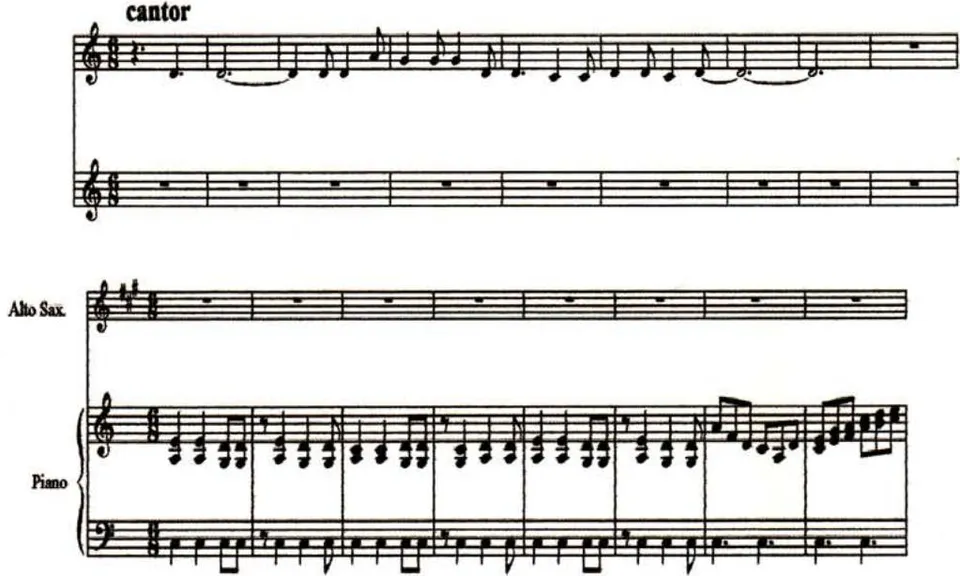
From observations, determining the exact tonal center of a given African/Nigerian music or ensemble performance have been ambiguous reasons being that in African/Nigerian musical tradition, tonal centers often fluctuate even within a given musical composition depending on the fluctuations in performance-situation and other non-musical factors. Therefore, for the avoidance of ambiguity and establishing a tonal center for the purpose of clarity for the transcription of the melodic lines of song title 'ovie' and the composition of instrumental music titled 'ovie' E flat alto saxophone and piano accompaniment these keys were used – C major and A major. See musical example.
Below is the excerpt of the transcribed vocal example of song title 'ovie' and excerpt of instrumental music of the music title 'ovie' E flat alto saxophone and piano accompaniment respectively.
h) Climax
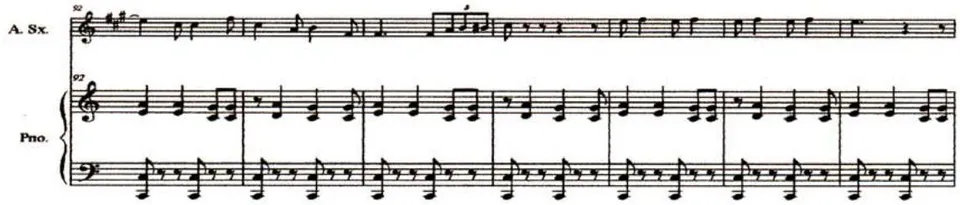
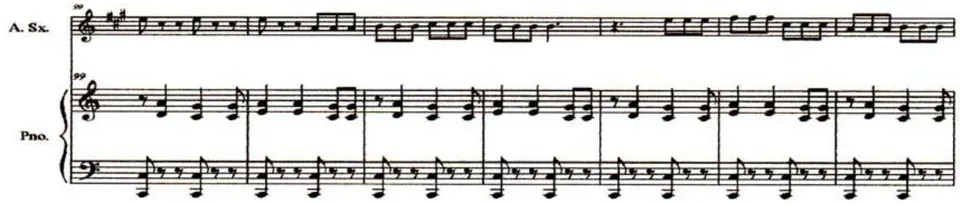
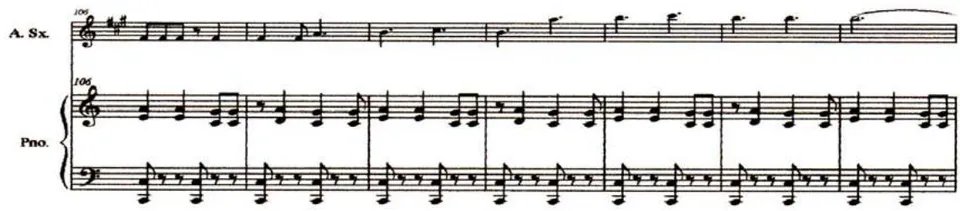
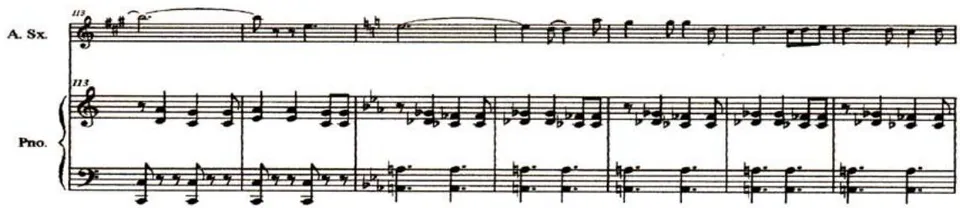
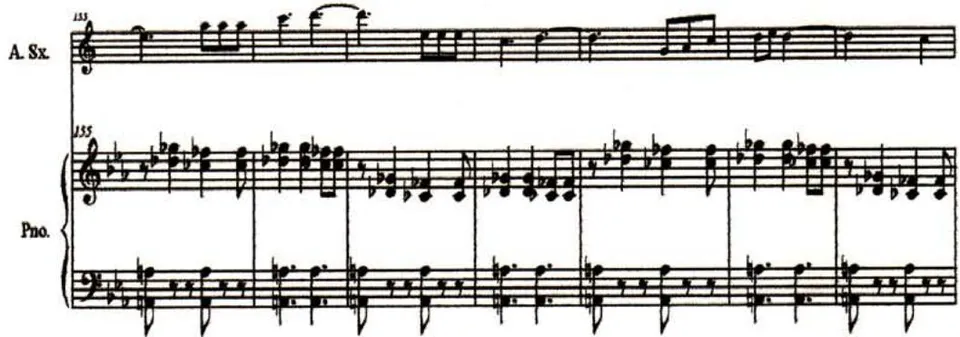
The climax which is generally viewed as the point of greatest intensity, where the highest note is sounded in the composition or the exciting points where the audience either encores a repeat of performance or a striking portion that intrigues the memory of the listeners is found between bars 71-87, 96-113 and 156-157 of the work. See musical examples (a), (b) and (c).
i) Targeted Audience
The target audience is the composer's end expectations where the composer intend his/her composed work to be performed. Hence, the targeted audience for the performance of the composition titled 'Ovie' E flat Alto Saxophone and Piano Accompaniment include schools, music conservatory, and social gatherings, television and radio houses, and concert hall.
j) Performance Guide
The composition is purely instrumental written for the E flat alto saxophone and the pianoforte. The music should be performed on the E flat alto saxophone and the pianoforte in place of the voice. The saxophonist should note that the E flat alto saxophonlays principal or leading role in the performance of the composition, as such, care should be taken in proper cueing in of each entry points. Since the piano accompaniment acts as the subordinate or contrasting role to the principal role of the E flat alto saxophone (both complimenting each other), the pianist or accompanist, should note necessary entry points in order to maintain smooth flow of rhythm. The pianist should also take particular cognizance of the bell rhythm of both left and right hand; therefore, effort should be made to interpret correctly and to maintain the harmonic flow.
III. COMPOSITIONAL TECHNIQUES EMPLOYED
For the realization of the composition, the following devices were employed – these include solo and refrain pattern, iambic, trochaic and spondee rhythmic fragmentations, diminution and argumentation, leaps, ostinato, sequences, scaly passages, arpeggios, modulation and chromatic alterations, intervals of seconds, thirds, sixths, fourths and octave, linear motions, similar and contrary motions.
The composition began with a piano prelude from measures 1 - 9, introducing the opening theme with a dotted crochet note on the second beat on measure 9 after a dotted crochet rest note with the E flat alto saxophone. This was followed by piano interlude from measures 52 – 54. Exposition 1 commenced from measures 55 – 68 after a dotted crochet rest note on measure 55, followed by another piano interlude from measures 69 – 72. Exposition 2, began on measures 73 – 87 with a short piano interlude from measures 88 – 89 while the restatesment of subject (theme) followed with a dotted crochet note after a dotted crochet rest note from measures 90 – 173. Modulation occurred between measures 113 – 114, which was maintained to the end of the piece – concert key C major to E flat major for the pianoforte and A major to C major for the E flat alto saxophone instrument.
Summarily, the structure of the work is as follows;
| Style | - | Polyphonic |
| Form | - | Quasi-sonata |
| Tonal center | - | C major concert key |
| Length | - | 173 bars |
Division of measure(s)
A: Mm 1-54 (prelude and statement of theme)
B: Mm 55-72 (exposition 1)
C: Mm 73-89 (exposition 2)
A1: Mm 90-173 (restatement of theme and climax)
IV. CONCLUSION
Having being faced with the tasks of providing relevance to the African characteristics in their compositions, contemporary musicians and art music composers/musicians turned to their musical heritage for inspirations and techniques which had been evidenced in their compositions. By using ethno-compositional materials and musical elements in their artistic expressions contemporary composers have produced varied repertoires of musical compositions. The composition titled 'Ovie' E flat alto saxophone and piano accompaniment was a vivid musical example of the use of ethno-compositional materials as source(s) for contemporary composition and in retrospect, attempt have been made to provide appropriate musical examples where necessary and explanations made on the composition. From the transcription of the melodic structure of the vocal text of 'ovie' and through careful study, it was observed that the song was in the pentatonic mode.
Furthermore, over the years it is noteworthy that through the untiring effort of African/Nigerian contemporary musicians and art music composers/musicians, a wide spectrum of African/Nigerian music types which are distinguished on stylistic basis, a masterpiece which can stand on their own have evolved in this 21 century. Conclusively, while this is commendable and applaud-able, it is highly recommended that contemporary musicians and art music composers/musicians in Africa and Nigeria should continue and not relent in their endeavors to making meaningful musical contributions to our economy and rapidly advancing global world.