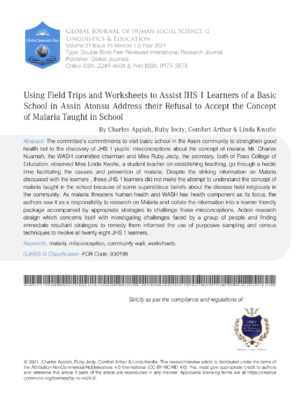
Using Field Trips and Worksheets to Assist JHS 1 Learners of a Basic School in Assin Atonsu Address Their Refusal to Accept the Concept of Malaria Taught In School

α
Ruby Jecty
Ruby Jecty
σ
Charles Appiah
Charles Appiah
ρ
Comfort Arthur
Comfort Arthur
Ѡ
Linda Kwofie
Linda Kwofie

Send Message

To: Author

Using Field Trips and Worksheets to Assist JHS 1 Learners of a Basic School in Assin Atonsu Address Their Refusal to Accept the Concept of Malaria Taught In School

Article Fingerprint

ReserarchID

TRV66

Using Field Trips and Worksheets to Assist JHS 1 Learners of a Basic School in Assin Atonsu Address Their Refusal to Accept the Concept of Malaria Taught In School Banner

AI TAKEAWAY

Connecting with the Eternal Ground
  • English
  • Afrikaans
  • Albanian
  • Amharic
  • Arabic
  • Armenian
  • Azerbaijani
  • Basque
  • Belarusian
  • Bengali
  • Bosnian
  • Bulgarian
  • Catalan
  • Cebuano
  • Chichewa
  • Chinese (Simplified)
  • Chinese (Traditional)
  • Corsican
  • Croatian
  • Czech
  • Danish
  • Dutch
  • Esperanto
  • Estonian
  • Filipino
  • Finnish
  • French
  • Frisian
  • Galician
  • Georgian
  • German
  • Greek
  • Gujarati
  • Haitian Creole
  • Hausa
  • Hawaiian
  • Hebrew
  • Hindi
  • Hmong
  • Hungarian
  • Icelandic
  • Igbo
  • Indonesian
  • Irish
  • Italian
  • Japanese
  • Javanese
  • Kannada
  • Kazakh
  • Khmer
  • Korean
  • Kurdish (Kurmanji)
  • Kyrgyz
  • Lao
  • Latin
  • Latvian
  • Lithuanian
  • Luxembourgish
  • Macedonian
  • Malagasy
  • Malay
  • Malayalam
  • Maltese
  • Maori
  • Marathi
  • Mongolian
  • Myanmar (Burmese)
  • Nepali
  • Norwegian
  • Pashto
  • Persian
  • Polish
  • Portuguese
  • Punjabi
  • Romanian
  • Russian
  • Samoan
  • Scots Gaelic
  • Serbian
  • Sesotho
  • Shona
  • Sindhi
  • Sinhala
  • Slovak
  • Slovenian
  • Somali
  • Spanish
  • Sundanese
  • Swahili
  • Swedish
  • Tajik
  • Tamil
  • Telugu
  • Thai
  • Turkish
  • Ukrainian
  • Urdu
  • Uzbek
  • Vietnamese
  • Welsh
  • Xhosa
  • Yiddish
  • Yoruba
  • Zulu

Abstract

The committee’s commitments to visit basic school in the Assin community to strengthen good health led to the discovery of JHS 1 pupils’ misconceptions about the concept of malaria. Mr. Charles Nuamah, the WASH committee chairman and Miss Ruby Jecty, the secretary, both of Foso College of Education, observed Miss Linda Kwofie, a student teacher on establishing teaching, go through a hectic time facilitating the causes and prevention of malaria. Despite the striking information on Malaria discussed with the learners , these JHS 1 learners did not make the attempt to understand the concept of malaria taught in the school because of some superstitious beliefs about the disease held religiously in the community. As malaria threatens human health and WASH has health component as its focus, the authors saw it as a responsibility to research on Malaria and collate the information into a learner friendly package accompanied by appropriate strategies to challenge these misconceptions. Action research design which concerns itself with investigating challenges faced by a group of people and finding immediate resultant strategies to remedy them informed the use of purposive sampling and census techniques to involve all twenty eight JHS 1 learners.

References

28 Cites in Article
  1. Kristin Harper,George Armelagos (2001). The Changing Disease-Scape in the Third Epidemiological Transition.
  2. Robert Sallares (2002). Malaria and Rome.
  3. P Mcckissack,F Mcckissack (1995). The Royal Kingdoms of Ghana, Mali and Songhay life in Medieval Africa.
  4. Teodoro Kaufman,Edmundo Rúveda (2005). The Quest for Quinine: Those Who Won the Battles and Those Who Won the War.
  5. J Achan,Talisuna Erthart,A Yaka,A Tibenderana,J Baliraine,F Rosenthal,P,D 'alessandro,U (2011). Quinine, an Old Anti Malarial drug in a modern world 7.
  6. W Krepel,C Durral (1981). The project for an energy-enriched curriculum: Final report.
  7. T Tal,O Morag (2009). Reflective Practice as a Means for Preparing to Teach Outdoors in an Ecological Garden.
  8. M Michie (1998). Factors influencing secondary science teachers to organise and conduct field trips.
  9. S Lei (2010). Field trips in college biology and ecology courses: Revisiting benefits and drawbacks.
  10. Rik Scarce (1997). Field Trips as Short-Term Experiential Education.
  11. Paola Rodari (2009). Learning science in informal environments: people, places and pursuits. A review by the US National Science Council.
  12. L Rennie (2007). Learning outside of school.
  13. R D Mawdsley (1999). Legal issues involving fieldtrips.
  14. Paul Hudak (2003). Campus Field Exercises for Introductory Geoscience Courses.
  15. Tommye Hutson,Susan Cooper,Tony Talbot (2011). Describing Connections between Science Content and Future Careers: Implementing Texas Curriculum for Rural At-Risk High School Students Using Purposefully-Designed Field Trips.
  16. M Behrendt,T Franklin (2014). A Review of Research on School Field Trips and their Value in Education.
  17. D Kalvaitis (2007). A recipe for outdoor classroom management.
  18. James Kisiel (2003). Teachers, Museums and Worksheets: A Closer Look at a Learning Experience.
  19. M Wilson (2011). Financial Analysts’ Second European Field Trip.
  20. Tali Tal,Laura Steiner (2006). Patterns of teacher‐museum staff relationships: School visits to the educational centre of a science museum.
  21. M Scribner-Maclean,L Kennedy (2007). More than just a day away from school: Planning a great science field trip.
  22. Avi Hofstein,Sherman Rosenfeld (1996). Bridging the Gap Between Formal and Informal Science Learning.
  23. C Hoisington,N Sableski,I Decosta (2010). A Walk in the woods.
  24. J Kisiel (2006). Making field trips work.
  25. D Kolb (1983). Experiential learning, experiences as the source of learning and development.
  26. Leonie Rennie,Terence Mcclafferty (1995). Using visits to interactive science and technology centers, museums, aquaria, and zoos to promote learning in science.
  27. M Pasquier,P Narguizian (2006). Nature as a resource: Effectively planning an outdoor field trip.
  28. Kevin Hefferan,Neil Heywood,Michael Ritter (2002). Integrating Field Trips and Classroom Learning into a Capstone Undergraduate Research Experience.

Funding

No external funding was declared for this work.

Conflict of Interest

The authors declare no conflict of interest.

Ethical Approval

No ethics committee approval was required for this article type.

Data Availability

Not applicable for this article.

How to Cite This Article

Ruby Jecty. 2022. \u201cUsing Field Trips and Worksheets to Assist JHS 1 Learners of a Basic School in Assin Atonsu Address Their Refusal to Accept the Concept of Malaria Taught In School\u201d. Global Journal of Human-Social Science - G: Linguistics & Education GJHSS-G Volume 21 (GJHSS Volume 21 Issue G15): .

Download Citation

Using field trip worksheets to help students understand basic school concepts and connect to global research.
Issue Cover
GJHSS Volume 21 Issue G15
Pg. 41- 59
Journal Specifications

Crossref Journal DOI 10.17406/GJHSS

Print ISSN 0975-587X

e-ISSN 2249-460X

Keywords
Classification
GJHSS-G Classification: FOR Code: 930199
Version of record

v1.2

Issue date

January 15, 2022

Language
en
Experiance in AR

Explore published articles in an immersive Augmented Reality environment. Our platform converts research papers into interactive 3D books, allowing readers to view and interact with content using AR and VR compatible devices.

Read in 3D

Your published article is automatically converted into a realistic 3D book. Flip through pages and read research papers in a more engaging and interactive format.

Article Matrices
Total Views: 1891
Total Downloads: 866
2026 Trends
Related Research

Published Article

The committee’s commitments to visit basic school in the Assin community to strengthen good health led to the discovery of JHS 1 pupils’ misconceptions about the concept of malaria. Mr. Charles Nuamah, the WASH committee chairman and Miss Ruby Jecty, the secretary, both of Foso College of Education, observed Miss Linda Kwofie, a student teacher on establishing teaching, go through a hectic time facilitating the causes and prevention of malaria. Despite the striking information on Malaria discussed with the learners , these JHS 1 learners did not make the attempt to understand the concept of malaria taught in the school because of some superstitious beliefs about the disease held religiously in the community. As malaria threatens human health and WASH has health component as its focus, the authors saw it as a responsibility to research on Malaria and collate the information into a learner friendly package accompanied by appropriate strategies to challenge these misconceptions. Action research design which concerns itself with investigating challenges faced by a group of people and finding immediate resultant strategies to remedy them informed the use of purposive sampling and census techniques to involve all twenty eight JHS 1 learners.

Our website is actively being updated, and changes may occur frequently. Please clear your browser cache if needed. For feedback or error reporting, please email [email protected]

Request Access

Please fill out the form below to request access to this research paper. Your request will be reviewed by the editorial or author team.
X

Quote and Order Details

Contact Person

Invoice Address

Notes or Comments

This is the heading

Lorem ipsum dolor sit amet, consectetur adipiscing elit. Ut elit tellus, luctus nec ullamcorper mattis, pulvinar dapibus leo.

High-quality academic research articles on global topics and journals.

Using Field Trips and Worksheets to Assist JHS 1 Learners of a Basic School in Assin Atonsu Address Their Refusal to Accept the Concept of Malaria Taught In School

Charles Appiah
Charles Appiah
Ruby Jecty
Ruby Jecty
Comfort Arthur
Comfort Arthur
Linda Kwofie
Linda Kwofie

Research Journals