I. INTRODUCTION
The Decree of the President of the Republic of Uzbekistan Shavkat Mirziyoyev "On measures to further improve the provision of the population with medicines and medical products" dated October 31, 2016 is an important factor in expanding the scope of work in the pharmaceutical industry. This document outlines important tasks for increasing the localization of pharmaceutical production by expanding the use of local raw materials, in particular, medicinal plants, and improving the delivery of quality medicines to the population at affordable prices.
One of the tasks provided for in the Decree of the President of the Republic of Uzbekistan dated April 10, 2020 No. 4668 "On additional measures for the development of traditional medicine in the Republic of Uzbekistan" and No. PP-4670 "On measures for the protection, cultural cultivation, processing of wild medicinal plants and rational use of available resources" is the organization of cultivation and harvesting of plants and raw materials of non-plant species used in traditional medicine, conducting laboratory and scientific research in this direction, increasing the export potential of the industry, as well as integrating education, science and production processes. In this regard, the Tashkent Pharmaceutical Institute is carrying out consistent work to ensure the implementation of the priority tasks outlined in the resolutions.
One of the promising directions in the field of drug development is the creation of phytopreparations for the treatment and prevention of these diseases. More active usage of phytopreparations, both alone and in combination with synthetic drugs, depending on the severity and nature of diseases, will contribute to the use of drug-saving technologies in clinical practice. Natural biologically active substances of plants are evolutionarily closer to the human body than synthetic ones, they are easily included in metabolic processes and have practically no side effects, and many of them are precursors of physiologically active substances (hormones, mediators). Recent studies have shown that the healing properties of medicinal plants depend on the harmonious interaction of all active substances, which together have a broader effect than individually.
In this regard, studies on the conversion of collections and individual plants used in the form of infusions and decoctions into total preparations-extracts are very promising, since the possibility of their wider use is limited by the imperfection of the dosage form [1,2].
Summarizing the above, we can conclude that the creation of medicines and dietary supplements based on medicinal plant materials using a resource-saving extraction method (due to the maximum depletion of raw materials) is timely and relevant and corresponds to the social order of clinical medicine.
Given the above, the Tashkent Pharmaceutical Institute has developed a choleretic collection "Triflos", consisting of the following types of herbal medicinal raw materials: flowers of tansy false yarrow, flowers of chamomile, yarrow herb. To date, studies are carried out on its standardization, the establishment of quality standards, as well as the study of specific activity and safety. Cholagogue collection when tested on laboratory rats showed more than increase in bile secretion [3]. The pharmacotherapeutic effects of this collection, which mainly consist in the regulation of phospholipid metabolism in the liver and the normalization of bile flow due to the antispasmodic effect on the sphincter of the gallbladder, according to the opinion prevailing in the literature, is determined by the presence of a number of phenolcarboxylic acids and flavonoid compounds. So, in the composition of the collection components, along with essential oils, terpenoids, bitter and tannins, resins, organic acids and mineral salts, the presence of chlorogenic, rosmarinic, caffeic, ferulic acids and their corresponding glycosidic derivatives, as well as flavonoids: quercetin, luteolin, acacetin, apigenin and their glycosides. These literature data were confirmed by us experimentally [4].
The purpose of our research is to develop an optimal technology for obtaining a dry extract from this collection using the method of mathematical planning of the experiment.
II. EXPERIMENTS AND ITS RESULTS
Currently, there are a large number of various extraction schemes designed to increase the yield of active substances, ensure maximum depletion of raw materials and enrichment of the extract with target biologically active substances (BAS). These extraction schemes also include factors that affect the completeness of extraction of biologically active substances, such as the nature and concentration of the extractant, the ratio of raw materials and extractant, temperature, type of extraction, etc. [5-18].
In order to facilitate the laborious process of finding the optimal conditions for extraction, we decided to apply the method of mathematical planning. Based on the characteristics of the technology for obtaining a dry extract, we chose a four-factor experimental plan based on a 5x5 Greek-Latin square. At the same time, the influence of the degree of grinding of raw materials (factor A), the concentration of ethyl alcohol (factor B), the hydromodulus (factor C) and the temperature regime (factor D) on the completeness of the yield of the sum of flavonoids in terms of quercetin in extraction is studied [19].
Factors and their levels are given in Table 1.
| Factor and its levels | Factor value | Factor and its levels | Factor value |
| The degree of grinding of raw materials (factor A) | Ethyl alcohol concentration (factor B) | ||
| a1 | 2-4 mm | b1 | 50% |
| a2 | 5-7 mm | b2 | 60% |
| a3 | 8-10 mm | b3 | 70% |
| a4 | 11-13 mm | b4 | 80% |
| a5 | 14-16 mm | b5 | 90% |
| Hydromodulfactor (factor C) | Temperature factor (D) | ||
| c1 | 1:5 | d1 | 40°C |
| c2 | 1:10 | d2 | 50°C |
| c3 | 1:15 | d3 | 60°C |
| c4 | 1:20 | d4 | 70°C |
| c5 | 1:25 | d5 | 80°C |
The 5x5-experiment plan and the results of determining the quantitative content of biologically active substances (the sum of flavonoids in terms of quercetin) are presented in Table 2.
| Factor A | Factor B | Totala1 | |||||
| b1 | b2 | b3 | b4 | b5 | |||
| a1 | C1d1 | c2d2 | c3d3 | c4d4 | c5d5 | ||
| 1,22 | 2,15 | 2,14 | 1,36 | 1,04 | |||
| 1,28 | 2,09 | 2,17 | 1,41 | 1,09 | |||
| 1,21 | 2,19 | 2,11 | 1,33 | 0,99 | |||
| 3,71 | 6,43 | 6,42 | 4,1 | 3,12 | 23,78 | ||
| a2 | c2d3 | c3d4 | c4d5 | c5d1 | c7d2 | ||
| 2,15 | 1,89 | 2,02 | 1,56 | 1,62 | |||
| 2,11 | 1,93 | 2,06 | 1,52 | 1,59 | |||
| 2,17 | 1,84 | 1,97 | 1,6 | 1,67 | |||
| 6,43 | 5,66 | 6,05 | 4,68 | 4,88 | 27,7 | ||
| a3 | c3d5 | c4d1 | c5d2 | c1d3 | c2d4 | ||
| 1,3 | 1,55 | 1,76 | 1,67 | 1,62 | |||
| 1,34 | 1,61 | 1,71 | 1,74 | 1,67 | |||
| 1,26 | 1,52 | 1,8 | 1,66 | 1,59 | |||
| 3,9 | 4,68 | 5,27 | 5,07 | 4,88 | 23,8 | ||
| a4 | c4d2 | c5d3 | c1d4 | c2d5 | c3d1 | ||
| 1,3 | 1,69 | 1,56 | 1,5 | 1,24 | |||
| 1,34 | 1,65 | 1,61 | 1,52 | 1,2 | |||
| 1,26 | 1,73 | 1,51 | 1,47 | 1,27 | |||
| 3,9 | 5,07 | 4,68 | 4,49 | 3,71 | 21,85 | ||
| a5 | c5d4 | c1d5 | c2d1 | c3d2 | c4d3 | ||
| 1,01 | 1,24 | 1,76 | 1,37 | 1,57 | |||
| 1,09 | 1,29 | 1,73 | 1,41 | 1,59 | |||
| 1,02 | 1,18 | 1,77 | 1,32 | 1,52 | |||
| 3,12 | 3,71 | 5,26 | 4,1 | 4,68 | 20,87 | ||
| Total | Bi | 21,06 | 25,55 | 27,68 | 22,44 | 21,27 | 118 |
| Ck | 22,05 | 27,49 | 23,79 | 23,41 | 21,26 | ||
| Dl | 22,04 | 24,58 | 27,67 | 22,44 | 21,27 | ||
Before carrying out the analysis of variance, the homogeneity of the variance was checked using the Cochran test. The tabular value of the Cochran test for and is 0.22, i.e., uexp, equal to 0.0709, is less than the tabular one, which confirms the equal accuracy of the experiments. Analysis of variance of the obtained results is presented in Table 3.
| Source of dispersion | Number of degrees of freedom (f) | Sum of squares (SS) | Mean squares (MS) | F expert | F0,05 | Hypothesis |
| Factor A | 4 | 2,245 | 0,56125 | 328,0885 | 2,56 | a≠0 |
| Factor B | 4 | 1,82652 | 0,45663 | 266,931 | 2,56 | b≠0 |
| Factor C | 4 | 1,538827 | 0,384707 | 224,887 | 2,56 | c≠0 |
| Factor D | 4 | 1,782227 | 0,445557 | 260,4579 | 2,56 | d≠0 |
| Remainder | 8 | 0,15216 | 0,01902 | 11,11847 | 2,13 | res≠0 |
| Errorinsidecell | 50 | 0,085533 | 0,001711 | |||
| Totalamount | 74 | 7,630267 |
The obtained values , which indicates the statistical significance of all four studied factors. The value of Fres.in.cell indicates the presence of an interaction between the factors.
Using Duncan's multiple rank test, the differences in the average values of the data on the yield of the total flavonoids in the obtained extracts are studied. It is established that according to the influence of the degree of dispersion of plant raw materials on the response, they can be arranged in the following row: a1 = a2 = a3 > a4 > a5, i.e. the optimal degree of grinding of raw materials, providing the maximum yield of the sum of flavonoids, are 2-4 mm, 5-7 mm and 8-10 mm. However, taking into account the fact that the excessive dispersity of plant raw materials will ensure the release of not only biologically active, but also ballast substances, which, accordingly, will lead to a contaminated extract, we decided to use raw materials in further studies, the dimensions of which are in the range of 5-7 mm [20, 21].
The influence of the next studied factor - the concentration of ethanol used as an extractant, can be arranged in the following row: , Thus, ethanol at a concentration of and is the optimal extractant. For the purpose of economic feasibility, our choice was stopped at ethyl alcohol.
It is known that the ratio of vegetable raw materials and extractant has a significant impact on the yield of biologically active substances in the obtained extracts. This was confirmed by the results of our mathematical planning. It was found that almost the same output with a slight difference was obtained with a hydromodulus of 1:10, 1:15, 1:20. In order to save the extractant, we recommend the use of a hydromodule equal to 1:10.
The application of the Duncan rank criterion also helped to reveal the influence of the temperature factor on the yield of the sum of flavonoids, this series can be represented as follows: , thus, the temperature of 500C was chosen as the optimal one.
An analysis of domestic and foreign literary sources indicates that the short-term use of ultrasound in the extraction of plant materials stimulates the release of biologically active substances [22, 23]. Given the above, we carried out extraction from the composition of medicinal raw materials, culminating in 10 minutes of ultrasonic exposure. At the same time, an increase in the yield of the total flavonoids in terms of quercetin is observed from to (1.11 times).
Thus, the proposed technology for obtaining a dry extract from the Triflos choleretic collection is tested under industrial conditions at BALZAM LLC.
The industrial extractor, on which the proposed technology was tested, consists of:
Main tank. This is the extraction tank, which is the main element of this system. It mainly serves to extract biologically active substances from medicinal plant materials;
A condenser, which serves to cool and return the condensed liquid to the extraction tank;
A vacuum condenser, which serves to concentrate and collect the resulting extract;
A tank for collecting the extractant (used as a collection) (Fig. 1).
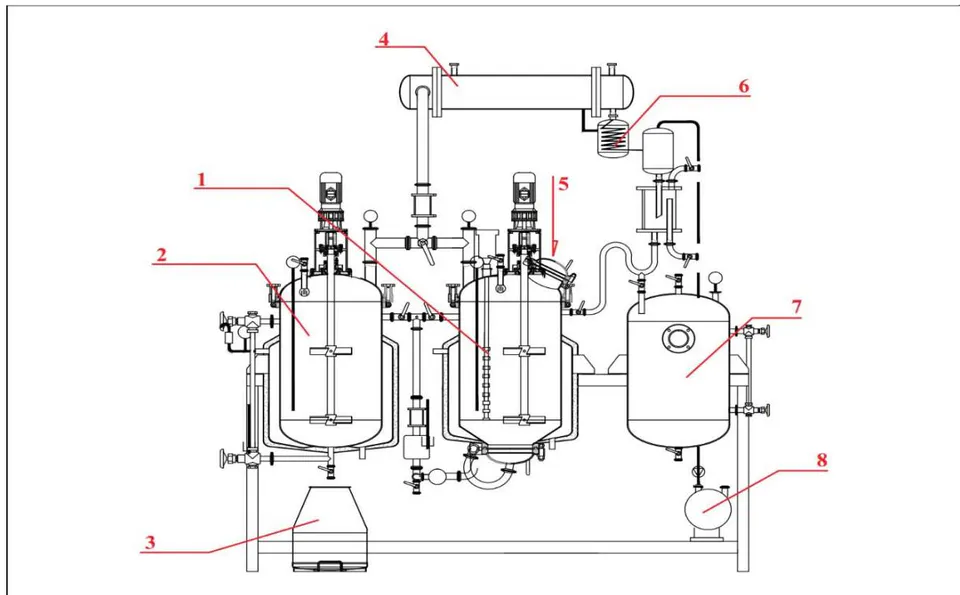
This equipment can carry out several operations simultaneously; control and regulation of the temperature regime of the extraction process, use ultrasound, create a vacuum, condense the extractant, recover alcohol, etc.
To obtain a dry extract, medicinal plant raw materials, crushed to a size of , are weighed and mixed in the ratio: tansy flowers - 15 parts, chamomile flowers - 10 parts, yarrow herb - 10 parts. The mixture of vegetable raw materials was loaded into a special container and soaked with half the amount of ethyl alcohol until a "mirror surface" is formed, left for 24 hours. After soaking, the soaked raw material is transferred to the extractor and ethanol was added, bringing the raw material-extractant ratio to 1:10, the mixture was heated to , and circulation extraction was carried out in the RuianXuanli Machinery Tank extractor. Next, ultrasonic extraction is performed for 10 minutes. After the vacuum extraction process is completed, the liquid extract is pumped through the filter into the reactor and left for 24 hours to settle. Purification of the distillation residue of the water-alcohol extract is carried out by filtration.
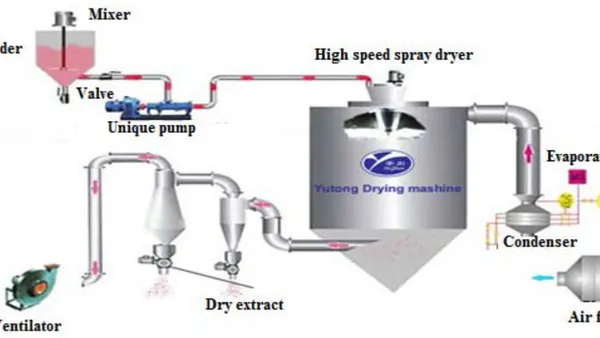
Then, the extractant was distilled off in the reactor using vacuum for 3 hours. The extract remaining after distillation of the extractant was spray dried in a high-speed spray dryer "LPG-15 Spray Dryer" (manufactured by RuianXuanli Machinery Co., LTD). (Fig. 2).
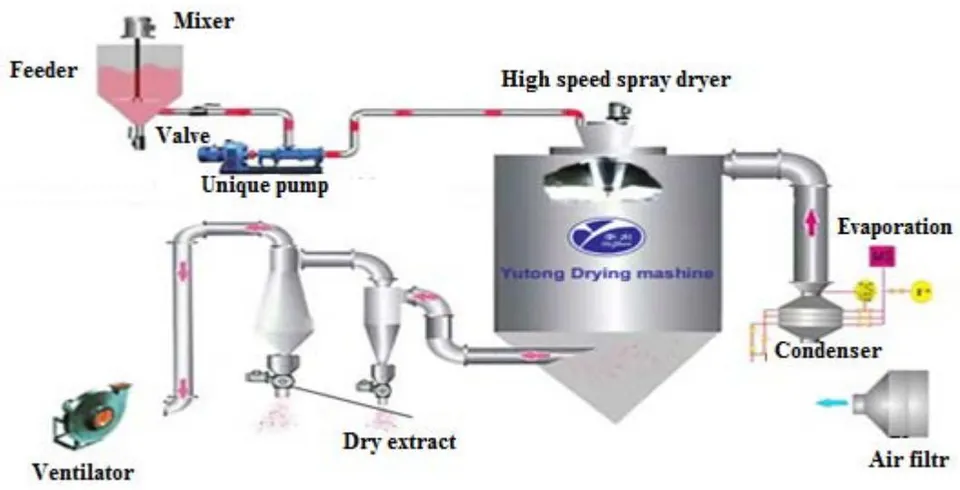
As a result of the research, a light brown dry extract with a weak specific odor and a bitter taste is obtained. The dry extract yield is .
III. CONCLUSIONS
Using the method of a four-factor experimental plan based on a 5x5 Greek-Latin square, the choice of the degree of grinding of raw materials, the concentration of ethanol, the ratio of raw materials and extractant, the temperature regime in the development of the technology of dry extract of the choleretic collection "Triflos" is carried out. The results of dispersion analysis shows that the most complete yield of the sum of flavonoids is observed with the following indicators of the above factors: dispersion of raw materials -5-7 mm, ethyl alcohol, hydromodulus 1:10, temperature 500C.
The expediency of using ultrasonic treatment for a more complete recovery of target biologically active substances is scientifically substantiated.
This technology of circulating extraction using ultrasound is tested in industrial conditions. A dry extract is obtained, the yield of which was .