Value Added Tax Remittance: Observations from Developing Country

§ University of Nigeria,Nsukka

Send Message

To: Author

Value Added Tax Remittance: Observations from Developing Country

Article Fingerprint

ReserarchID

MBRY3RBU

Value Added Tax Remittance: Observations from Developing Country Banner

Key Research Insights

Synthesized scholarly intelligence & interactive research assistant
  • English
  • Afrikaans
  • Albanian
  • Amharic
  • Arabic
  • Armenian
  • Azerbaijani
  • Basque
  • Belarusian
  • Bengali
  • Bosnian
  • Bulgarian
  • Catalan
  • Cebuano
  • Chichewa
  • Chinese (Simplified)
  • Chinese (Traditional)
  • Corsican
  • Croatian
  • Czech
  • Danish
  • Dutch
  • Esperanto
  • Estonian
  • Filipino
  • Finnish
  • French
  • Frisian
  • Galician
  • Georgian
  • German
  • Greek
  • Gujarati
  • Haitian Creole
  • Hausa
  • Hawaiian
  • Hebrew
  • Hindi
  • Hmong
  • Hungarian
  • Icelandic
  • Igbo
  • Indonesian
  • Irish
  • Italian
  • Japanese
  • Javanese
  • Kannada
  • Kazakh
  • Khmer
  • Korean
  • Kurdish (Kurmanji)
  • Kyrgyz
  • Lao
  • Latin
  • Latvian
  • Lithuanian
  • Luxembourgish
  • Macedonian
  • Malagasy
  • Malay
  • Malayalam
  • Maltese
  • Maori
  • Marathi
  • Mongolian
  • Myanmar (Burmese)
  • Nepali
  • Norwegian
  • Pashto
  • Persian
  • Polish
  • Portuguese
  • Punjabi
  • Romanian
  • Russian
  • Samoan
  • Scots Gaelic
  • Serbian
  • Sesotho
  • Shona
  • Sindhi
  • Sinhala
  • Slovak
  • Slovenian
  • Somali
  • Spanish
  • Sundanese
  • Swahili
  • Swedish
  • Tajik
  • Tamil
  • Telugu
  • Thai
  • Turkish
  • Ukrainian
  • Urdu
  • Uzbek
  • Vietnamese
  • Welsh
  • Xhosa
  • Yiddish
  • Yoruba
  • Zulu
Reading Preferences
Font Size
Line Spacing
Background
This converted HTML version may contain rendering inconsistencies. Please refer to the PDF for the authoritative version, or click here to provide feedback.

Abstract

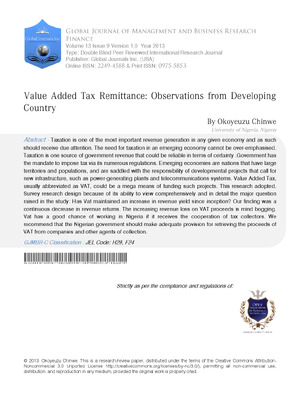
Taxation is one of the most important revenue generation in any given economy and as such should receive due attention. The need for taxation in an emerging economy cannot be over-emphasised. Taxation is one source of government revenue that could be reliable in terms of certainty .Government has the mandate to impose tax via its numerous regulations. Emerging economies are nations that have large territories and populations, and are saddled with the responsibility of developmental projects that call for new infrastructure, such as power-generating plants and telecommunications systems. Value Added Tax, usually abbreviated as VAT, could be a mega means of funding such projects. This research adopted. Survey research design because of its ability to view comprehensively and in detail the major question continuous decrease in revenue returns. The increasing revenue loss on VAT proceeds is mind bogging. Vat has a good chance of working in Nigeria if it receives the cooperation of tax collectors. We recommend that the Nigerian government should make adequate provision for retrieving the proceeds of VAT from companies and other agents of collection.

References

22 Cites in Article
  1. 1. Oboh Adedeji (2012). This tax system/administration. This tax system/administration
  2. 2. Moses Abiola,Asiweh (2012). Impact of Tax Administration on Government Revenue in a Developing Economy -A Case Study of Nigeria. International Journal of Business and Social Science, 3
  3. 3. Matthew Dada,Sunday Posu,Adedayo Adedeji,Esther Ndarake-Osibamowo,Alexander Oguntuase,Bamidele Abalaba (2012). Re-investigating Tax Effects on Economic Growth in Nigeria: A Disaggregated Analysis. Journal of Economics and Policy Analysis, 7(2), 90-109.
  4. 4. S Adereti,J Adesina,M Sanni (2011). Value added tax and economic growth of Nigeria. European Journal of Humanities and Social Sciences, 10, 455-471.
  5. 5. J Anyanwu (1993). Monetary Economics Through Policy and Instructions. Monetary Economics Through Policy and Instructions
  6. 6. P Ekeocha (2010). modelling the potential economic effects of tax policy reform in Nigeria: Simulation analysis using the computable general equilibrium analysis. modelling the potential economic effects of tax policy reform in Nigeria: Simulation analysis using the computable general equilibrium analysis
  7. 7. James Emejo (2011). FIRS Hunts Down Nine Hoteliers in Abuja. 7. FIRS Hunts Down Nine Hoteliers in Abuja. 7
  8. 8. T Gloria (2012). Revenue generation in Nigeria through e-taxation (a study of selected states). European Journal of Economics, 126-132.
  9. 9. P Golit (2008). Appraising Nigeria's Tax Effort: A Comparative Econometric Analysis. Economic and Financial Review, Central Bank of Nigeria, 46(1), 69-103.
  10. 10. S James,C Nobes (2008). The Economics of Taxation, 8th Ed. The Economics of Taxation, 8th Ed
  11. 11. N John (2012). FIRS sues Jimoh Ibrahim, Air Nigeria, for forgery, N5 billion Tax Fraud-NAN. FIRS sues Jimoh Ibrahim, Air Nigeria, for forgery, N5 billion Tax Fraud-NAN
  12. 12. A John,J Olabisi (2012). Tax administration and revenue generation of Lagos state government, Nigeria. Research Journal of Finance and Accounting, 3(5), 133-139.
  13. 13. (2009). Value Added Tax" Federal Inland Revenue Services. Value Added Tax" Federal Inland Revenue Services
  14. 14. G Ogbonna,E Appah (2012). Impact of tax reforms and economic growth in Nigeria: A time series analysis. Current Research Journal of Social Sciences, 4(1), 62-68.
  15. 15. Dele Olajide,David Ndegwa (2012). Main Issues in Mental Health and Race. Olajide Associates Nigeria tax reform
  16. 16. Olasunkanmi,Akoni (2011). Unknown Title.
  17. 17. Sanni Olatunde (2010). Unknown Title.
  18. 18. S Owolabi,A Okwu (2011). Empirical Evaluation of Contribution of Value Added Tax to Development of Lagos State Economy. Empirical Evaluation of Contribution of Value Added Tax to Development of Lagos State Economy
  19. 19. Adegun, Caleb,Akinbo M. (phd) (2006). Organizational Wellbeing Practices and Employee Work Behavior in Selected Manufacturing Company, Lagos, Nigeria. International Journal of Scientific Research Studies, 2(06)
  20. 20. S Thackers (2009). Taxation in the Gulf:Introduction of a Value Added Tax. Journal of International law, 17(3)
  21. 21. E Unwabuike (1998). Value Added Tax in Nigeria. Value Added Tax in Nigeria
  22. 22. Unegbu Angus,Irenfin David (2011). Impact of VAT on economic development of emerging nations. Journal of Economics and International Finance, 3(8), 492-503.

Funding

No external funding was declared for this work.

Conflict of Interest

The authors declare no conflict of interest.

Ethical Approval

No ethics committee approval was required for this article type.

Data Availability

Not applicable for this article.

How to Cite This Article

Okoyeuzu Chinwe. 2013. "Value Added Tax Remittance: Observations from Developing Country". Global Journal of Management and Business Research - C: Finance GJMBR-C Volume 13 (GJMBR Volume 13 Issue C9).

Download Citation

Journal Specifications

Crossref Journal DOI 10.17406/GJMBR

Print ISSN 0975-5853

e-ISSN 2249-4588

Keywords
Classification
GJMBR-C Classification JEL Code: H29
F24
Version of record

v1.2

Issue date
September 18, 2013

Language
English
Order Article Reprint
Experiance in AR

Explore published articles in an immersive Augmented Reality environment. Our platform converts research papers into interactive 3D books, allowing readers to view and interact with content using AR and VR compatible devices.

Read in 3D

Your published article is automatically converted into a realistic 3D book. Flip through pages and read research papers in a more engaging and interactive format.

Article Matrices
Total Views: 1.8K
Total Downloads: 121
All Trends

Request Access

Please fill out the form below to request access to this research paper. Your request will be reviewed by the editorial or author team.
X

This is the heading

Lorem ipsum dolor sit amet, consectetur adipiscing elit. Ut elit tellus, luctus nec ullamcorper mattis, pulvinar dapibus leo.


High-quality academic research articles on global topics and journals.

Value Added Tax Remittance: Observations from Developing Country

Okoyeuzu Chinwe
Okoyeuzu Chinwe University of Nigeria,Nsukka