
I. INTRODUCTION
Concern about the impact of playing computer games on behaviour has generated a substantial literature (Burnay, Bushman & Laroi, 2017), which at the extreme suggests that game playing can become a behavioural addiction (Salguero & Moran, 2002; Triberti et al., 2018). Some other researchers caution against applying the label of addiction to game-playing (Dowsett & Jackson, 2019; Pontes & Griffiths, 2015). The main sources of concern are at least two-fold, a) the amount of time spent on game playing and the impact it may have on other life domains (Triberti, et al., 2018), and b) the potential impact of violent and sexual content on the player's behaviour (Moller & Krahe, 2009; Saleem, Anderson, & Gentile, 2012).
The debate about the impact of violent video games on behaviour has raged back and forth since the 1980s (Elson, & Ferguson, 2014; Przybylski, & Weinstein, 2019; Snodgrass, Dengah, Polzer & Else, 2019). On one hand there is a literature suggesting that violent video games cause aggressive behaviour (Anderson, & Bushman, 2001; Anderson, et al., 2010), and another literature that suggests they do not cause aggressive behaviour (Ferguson, 2015; Ferguson, & Kilburn, 2010). It appears that these differences cannot be put down to methodological differences since meta-analytic reviews on the same studies come to different conclusions (Kuhn et al., 2019).
Kuhn et al., (2019) in a longitudinal experimental study with adults found no negative effects of violent game playing. This was a robust study but might be questioned on the basis that participants were selected because they had not previously played video games. There is some evidence that personality characteristics my predispose individuals to game playing and aggressive behaviour may be jointly influenced by predisposing personality and video game content (Braun, Stopfer, Muller, Beutel, & Egloff, 2016; Kiraburun & Griffiths, 2018). In addition, the fact that participants were not video-game players suggests that it did not have psychological relevance for them which is essential as part of the Elaboration Likelihood Model of attitude change (Petty & Brinol, 2012). In other words, the ecological validity of the study could be challenged as unlikely to lead to actual behaviour change.
When we look at recent and relatively recent longitudinal studies, we find a consist strong relationship between violent video games and aggression (Anderson et al, 2008; Greitemeyer, 2019; Greitemeyer, & Mugge, 2014; Prescott, Sargent, & Hull, 2018; Teng et al, 2019; Verheijen et al, 2018; Willoughby, Adachi, & Good, 2012) and even evidence that aggression may be increased in non-video game playing peers (Verheijen et al, 2018). The common denominator among these studies is that they looked at video game playing over older childhood through emerging adulthood, a stage when behaviour may be more malleable (Arnett, 2000; Nelson, & Padilla-Walker, 2013).
Kuhn et al., (2018) also explored the impact of violent video game playing on empathy using a longitudinal fMRI methodology. They found no impact on empathy, though the same criticism could be levelled at this study as applied above to aggression. When we look at longitudinal studies where game playing has begun in childhood, we find a consistent link between violence in games and reduced empathy and prosocial behaviour (Anderson et al, 2010; Coyne, Warburton, Essig, & Stockdale, 2018). The evidence would suggest that playing violent video games in adolescence or emerging adulthood is likely to increase aggression and reduce empathy (Anderson et al, 2010; Greitemeyer, & Mugge, 2014; Prescott, Sargent, & Hull, 2018). This fits well with the maturity-stability hypothesis in personality research which suggests that adult stable personality traits or behaviour patterns are crystallised over adolescence and emerging adulthood (Arnett, 2000; Bleidorn et al., 2013; Blonigen, Carlson, Hicks, Krueger, & Iacono, 2008; Branje, Vam Lieshout, & Gerris. 2007; Elkins, Kassenboehmer, & Schurer, 2017). Within that framework playing violent video games during adolescence and emerging adulthood might be expected to have a bigger impact that during older adulthood (Arnett, 2000; Nelson, & Padilla-Walker, 2013).
The other issue of concern, which is inevitably difficult to separate out from effects of violence, is the amount of screen time spent playing videogames (Przybylski, & Weinstein, 2017). A systematic review of reviews concluded that there is considerable evidence of a damaging effect of excessive screen time on children and young people's health and wellbeing (Stiglic & Viner, 2019). It has also been linked with obesity (Fang, Mu, Liu, & He, 2019), lower wellbeing (Lobel, Engels, Stone, Burk, & Granic, 2017), fear of social rejection in children and young people (Weinstein, Abu, Timor & Mama, 2016). However, most studies are cross sectional and cannot establish direction of causality, and also fail to account for type of media, type of use, and other confounders (Orben, 2020). In addition, there is growing evidence of beneficial effects of the use of screen time for some types of media and activities (Halbrook, O'Donnell & Msetfi, 2019; Linebarger, & Vaala, 2010; Linebarger, & Walker, 2005; Pallavicini, Ferrari, & Mantovani, 2018; Radesky, Schumacher, & Zuckerman, 2015), and evidence that screen time can be utilised to promote the development and health of children and young people (Canadian Paediatric Society, 2017).
There are a percentage of those who play videogames who display symptoms like the DSM IV criteria for Gambling Addiction (Salguero, & Moran, 2002). The terms problem videogame playing are used by these authors as there is insufficient evidence to label this a psychiatric condition. The behaviour observed includes preoccupation with playing, an inability to avoid playing, interference with other life activities, and feelings of withdrawal when not playing (Forrest, King, &
Delfabbro, 2016). Another approach taken has been to assess experience of game playing, termed game engagement (Brockmyer et al, 2009). These authors argue that deep involvement in the game may be important in relation to the impact of violence, along the lines of the Elaboration Likelihood Model of attitude change (Petty & Brinol, 2012). The thesis being that central processing might be more likely to lead to aggressive or low empathy behaviour than peripheral processing. Engagement is measured in terms of four dimensions, absorption, flow, presence and immersion (Brockmyer et al, 2009). This is akin to being in the zone in relation to sport performance (Stamatelopoulou, Pezirkianidis, Karakasidou, Lakioti, & Stalikas, 2018). While there is clearly a relationship, the essential difference is that addictive tendencies concern attachment to game playing, while engagement describes the experience of game playing.
There is evidence that videogame playing can enhance and also have a negative impact on wellbeing in children and young people (Johnson, Jones, Scholes, & Carras, 2013; Jones, Scholes, Johnson, Katsikitis, & Carras, 2014; Lobel, Engels, Stone, Burk, & Granic, 2017; Pallavicini, Ferrari, & Mantovani, 2018). Inevitably those who display symptoms of addictive behaviour regarding game playing also tend to score higher on distress and lower on wellbeing (Saquiba et al., 2017).
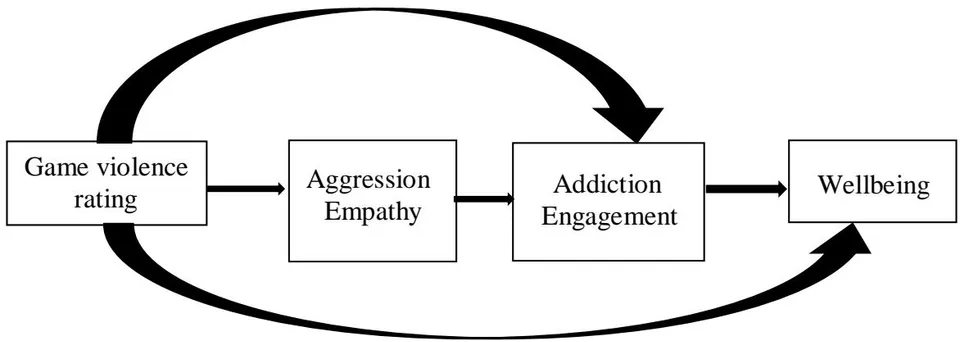
Given the evidence above the model shown in Figure 1 is proposed as a test of the relationships between violent video game playing, addictive tendencies, game engagement, aggression, empathy and wellbeing. The main outcome variable was wellbeing since there has been little previous research on gameplay and wellbeing. As there is strong evidence of a relationship between game playing aggression and empathy the latter two variables were included as possible moderators. Level of involvement in game playing has been shown to mediate the impact on aggression and empathy and this was included in terms of addictive tendencies and game engagement as mediators in the model.
II. METHODS
Design: A survey was conducted to explore the relationship between playing violent video games, addictive tendencies, game engagement, aggression, empathy and wellbeing using self-report online questionnaires.
Measures: After reporting on age and sex, participants were asked to list up to 10 video games that they play regularly. These games were rated for level of violent content using the Entertainment Software Rating Board ratings (https://www.esrb.org/ratings-guide/). The following standard measures were then completed.
The Problem Video Game Playing scale (Salguera & Moran, 2002). This is a 12-item measure of obsession with/addiction to playing video games based on criteria for addiction in the literature and DSM-IV. The authors prefer to use the descriptor problem video game playing because of the pathological connotations of the term addiction. The scale was found to have good internal consistency, and validity, and they found that extreme video game playing resembled addiction. The scale had a Cronbach's Alpha of.87 in the current data.
The Game Engagement Questionnaire (Brockmyer et al, 2009). This is an 18-item measure of how engaged the person becomes in playing video games. This scale had good reliability, and validity for predicting video game engagement. The scale had a Cronbach's Alpha of.74 in the current data.
The Warwick-Edinburgh Mental Well-being Scale- Short Form (WEMWBS). This is a 7-item measure of mental wellbeing. It was found to have good test-retest reliability and good content validity (Tennant et al, 2007). The scale had a Cronbach's Alpha of.87 in the current data.
The Brief Aggression Questionnaire (Webster et al, 2014) is another reliable measure with convergent validity. This is a 12-item measure of aggressive tendencies. The scale had a Cronbach's Alpha of.91 in the current data.
The Toronto Empathy Questionnaire (Spreng, McKinnon, Mar & Levine, 2009). This is a 16-item measure of empathic tendencies. This measure has high test-retest reliability, good internal consistency and convergent validity. The scale had a Cronbach's Alpha of.93 in the current data.
Participants & Sampling Procedures: A total of 304 emerging adults aged between 18 and 24 years of age (mean = 20.37, SD = 1.66), 124 males and 180 females. They were recruited through opportunity and snowball sampling within the university and using various social media outlets. Gender and age were the only personal details taken in order to achieve full anonymity of participants so there would be no ethical considerations.
Data analysis: Path analysis using AMOS 25 software on SPSS 25 was used to test the model and Hierarchical Multiple Regression Analysis (HMRA) then unpicked the relationships.
III. RESULTS
The aim of this study was to explore the relationship between violent video game playing, addictive tendencies, game engagement, aggression, empathy and wellbeing, as displayed in Figure 1.
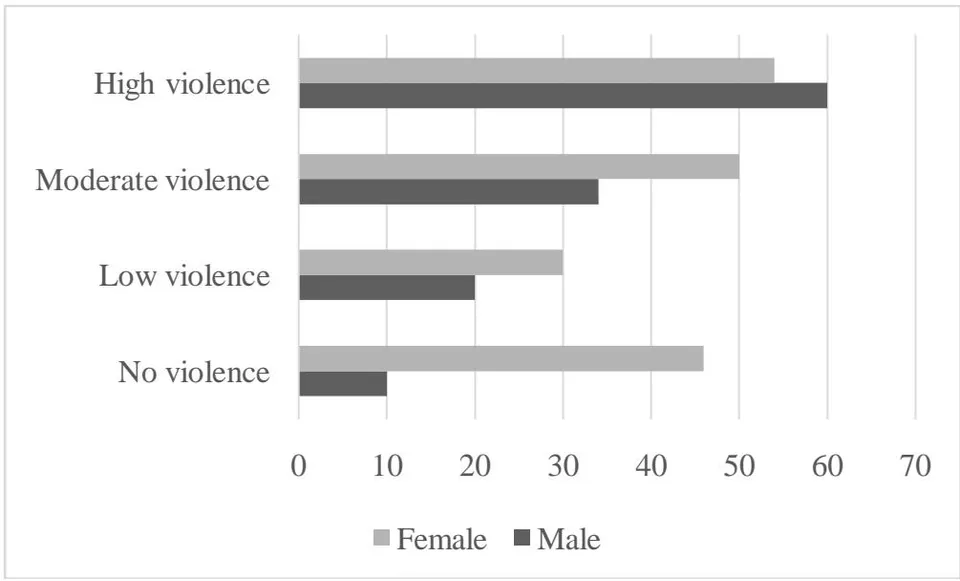
Only twenty participants did not play videogames at all and these were females, all males played games. Games were categorised using the Entertainment Software Rating Board ratings (https:// www.esrb.org/ratings-guide/) into no violence , low violence , moderate violence , and high violence . Using crosstabulation the distribution of levels of violence against sex was shown to be significant (chi-square , ). The distribution is illustrated in Figure 2 and shows more females play non-violent games while more males play violent games.
Before further analysis some bivariate correlations were calculated as shown in Table 1.
| 1 | 2 | 3 | 4 | 5 | |
| Game Violence Rating | |||||
| Problem gaming | .47** | ||||
| Engagement in gaming | .41** | .43** | |||
| Aggression | .21** | .06 | .21** | ||
| Empathy | -.41** | -.06 | -.24** | -.33** | |
| Wellbeing | -.29** | -.15** | -.15** | -.41** | .58** |
| **p<.01 | |||||
Level of violence in games was positively correlated with problem gaming , engagement in gaming , aggression , and inversely with empathy , and wellbeing . Problem gaming was positively correlated with engagement , and inversely with wellbeing .
To test the model in Figure 1 path analysis with AMOS 25 was conducted as shown in Figure 3. The model was an excellent fit for the data (chi-square , , CMIN/DF = 1.37, GFI =.99, NFI =.97, IFI =.99, CFI =.99, RMSEA =.035, PCLOSE =.486).
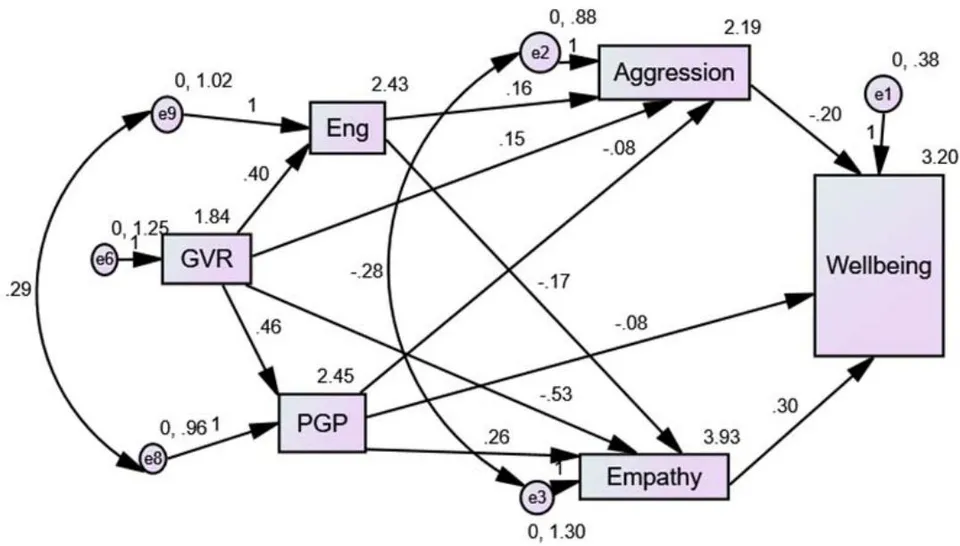
To unpick the direct predictors of wellbeing a hierarchical multiple regression analysis (HMRA) was conducted with wellbeing as the dependent variable. Game violence rating was entered on the first step as a predictor and accounted for of the variance in wellbeing . Problem gaming and engagement in gaming were added on step 2 but didn't account for any significant variance. On step 3 aggression and empathy were entered and added to explained variance, aggression , and empathy .
It would appear that considering the path model (Figure 3) and the HMRA (Table 2) that the main impact on wellbeing is from reduced empathy and increased aggression as a result of problem gaming and engagement in violent game play. Engagement and problem gaming both impact on aggression and empathy in predicted ways and thus have an indirect effect on wellbeing. Problem gaming does have a direct relationship with wellbeing, but game engagement does not. Violent game playing doesn't have a direct relationship with wellbeing but has an indirect effect through increased aggression and reduced empathy, an effect which is mediated by problem gaming and engagement. In more simple terms it would appear that the more violent the games played, the more likely there is an increase in aggression and a reduction in empathy. Also, the more violent the game the more likely to be stronger engagement and increased levels of problem gaming, both of which also contribute to increased aggression and reduced empathy.
| B | SE. B | □ | |
| Step 1: R2 =.09, F(1,302) = 29.44, p =.001 | |||
| Game Violence Rating | -.211 | .039 | -.298*** |
| Step 2: R2 Δ =.001, F(2,300) = 0.85, p =.832 | |||
| Game Violence Rating | -.198 | .046 | -.281*** |
| Problem gaming | -.006 | .047 | -.008 |
| Engagement in gaming | -.024 | .045 | -.034 |
| Step 3: R2 Δ =.314, F(2,298) = 78.58, p <.001 | |||
| Game Violence Rating | -.006 | .040 | -.008 |
| Problem gaming | -.102 | .039 | -.143** |
| Engagement in gaming | .061 | .037 | .086 |
| Aggression | -.206 | .039 | -.254*** |
| Empathy | .308 | .032 | .500*** |
| Total R2 =.39* | |||
| p <.05. ** p <.01 | |||
IV. DISCUSSION
While there is considerable agreement in the literature regarding the impact of playing violent video games on empathy and aggression, the impact on wellbeing is less explored. In order to test the relationship the model shown in Figure 1 was proposed whereby the impact of violent video games on wellbeing is mediated by the level of engagement in game play and the level of problem gaming (additive tendencies) exhibited and moderated by aggressive behaviour and empathy. The data supports the model and shows it to be an excellent fit. The path model produced and HMRA suggest that playing violent video games may not necessarily reduce wellbeing directly but there is evidence that any impact is associated with increased aggression, and substantially with reduced empathy. This supports some more recent studies (Anderson et al, 2010; Anderson et al, 2008; Coyne, Warburton, Essig, & Stockdale, 2018; Greitemeyer, 2019; Teng et al, 2019; Verheijen et al, 2018; Willoughby, Adachi, & Good, 2012). It is also associated with more addictive tendencies (problem-gaming) and more engagement with gaming. Problem gaming does seem to be related to reduced wellbeing, but engagement didn't have a significant direct relationship. However increased engagement and problem game play seems to offer a route whereby playing violent video games may influence aggression and empathy and ultimately wellbeing.
What emerged from the literature was that the link between violent video game play and increase aggression and reduced empathy was more consistently demonstrated in samples of adolescents or emerging adults (Anderson et al, 2010). The current study sample were emerging adults. It is our contention that future research should distinguish between younger and older samples, particularly in terms of the developmental stage in which they engaged in violent video games. This might help to clarify the currently very muddy literature. Our contention is based on the importance of emerging adulthood as a stage in development where characteristics and behaviour might be more malleable (Arnett, 2000; Bleidorn et al., 2013; Blonigen, Carlson, Hicks, Krueger, & Iacono, 2008; Branje, Vam Lieshout, & Gerris. 2007; Elkins, Kassenboehmer, & Schurer, 2017; Nelson, & Padilla-Walker, 2013).
The role of engagement in the process perhaps points to an important area for future investigation and clarification. In line with the Elaboration Likelihood Model of persuasion, where an experience is processed more centrally, it is more likely to lead to stable change in attitudes and behaviour. Many studies have shown a weak link between violent video games and aggression, or a short-term increase in aggression. It would be interesting to see if game engagement explains the difference between weak short-term effects and longer more lasting effects.
This study was cross sectional so while we can discuss relationships, we cannot discuss causality. We cannot ignore the evidence that there may be predisposing factors in relation to violent video game play (Teng, 2008). Given the maturity-stability hypothesis we might suggest reciprocal relations of causality. We have, however, raised some questions about factors that might be usefully explored and provided some theoretical base for them.