Article Fingerprint
ReserarchID
9Y235
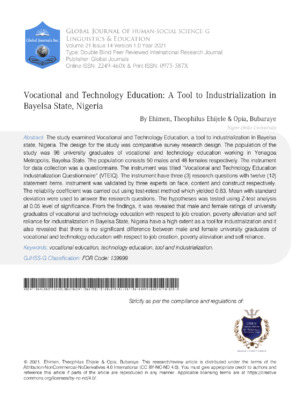
The study examined Vocational and Technology Education, a tool to industrialization in Bayelsa state, Nigeria. The design for the study was comparative survey research design. The population of the study was 98 university graduates of vocational and technology education working in Yenagoa Metropolis, Bayelsa State. The population consists 50 males and 48 females respectively. The instrument for data collection was a questionnaire. The instrument was titled “Vocational and Technology Education Industrialization Questionnaire” (VTEIQ). The instrument have three (3) research questions with twelve (12) statement items. instrument was validated by three experts on face, content and construct respectively. The reliability coefficient was carried out using test-retest method which yielded 0.83. Mean with standard deviation were used to answer the research questions. The hypotheses was tested using Z-test analysis at 0.05 level of significance. From the findings, it was revealed that male and female ratings of university graduates of vocational and technology education with respect to job creation, poverty alleviation and self reliance for industrialization in Bayelsa State, Nigeria have a high extent as a tool for industrialization and it also revealed that there is no significant difference between male and female university graduates of vocational and technology education with respect to job creation, poverty alleviation and self reliance.
Ehimen, Theophilus Ehijele. 2022. \u201cVocational and Technology Education: A Tool to Industrialization in Bayelsa State, Nigeria\u201d. Global Journal of Human-Social Science - G: Linguistics & Education GJHSS-G Volume 21 (GJHSS Volume 21 Issue G14): .
Crossref Journal DOI 10.17406/GJHSS
Print ISSN 0975-587X
e-ISSN 2249-460X
Explore published articles in an immersive Augmented Reality environment. Our platform converts research papers into interactive 3D books, allowing readers to view and interact with content using AR and VR compatible devices.
Your published article is automatically converted into a realistic 3D book. Flip through pages and read research papers in a more engaging and interactive format.
Total Score: 104
Country: Nigeria
Subject: Global Journal of Human-Social Science - G: Linguistics & Education
Authors: Ehimen, Theophilus Ehijele, Opia, Bubaraye (PhD/Dr. count: 0)
View Count (all-time): 163
Total Views (Real + Logic): 1909

Total Downloads (simulated): 838

Publish Date: 2022 01, Sat
Monthly Totals (Real + Logic):
This paper attempted to assess the attitudes of students in
Advances in technology have created the potential for a new
Inclusion has become a priority on the global educational agenda,
The study examined Vocational and Technology Education, a tool to industrialization in Bayelsa state, Nigeria. The design for the study was comparative survey research design. The population of the study was 98 university graduates of vocational and technology education working in Yenagoa Metropolis, Bayelsa State. The population consists 50 males and 48 females respectively. The instrument for data collection was a questionnaire. The instrument was titled “Vocational and Technology Education Industrialization Questionnaire” (VTEIQ). The instrument have three (3) research questions with twelve (12) statement items. instrument was validated by three experts on face, content and construct respectively. The reliability coefficient was carried out using test-retest method which yielded 0.83. Mean with standard deviation were used to answer the research questions. The hypotheses was tested using Z-test analysis at 0.05 level of significance. From the findings, it was revealed that male and female ratings of university graduates of vocational and technology education with respect to job creation, poverty alleviation and self reliance for industrialization in Bayelsa State, Nigeria have a high extent as a tool for industrialization and it also revealed that there is no significant difference between male and female university graduates of vocational and technology education with respect to job creation, poverty alleviation and self reliance.
Lorem ipsum dolor sit amet, consectetur adipiscing elit. Ut elit tellus, luctus nec ullamcorper mattis, pulvinar dapibus leo.