Vysikaylo’s Laser for De Broglie Waves of Electrons to Protect the Earth from Asteroids: Interdisciplinary Research of Incongruent Electric Field Shock Waves
We have proposed a mechanism that explains all phenomena observed in nature during lightning propagation and all phenomena during the fall of the Chelyabinsk meteorite in the Russian Federation. These positively charged cumulative-dissipative plasma systems (+CDS), as we have established, are surrounded by incongruent shock waves of the Vysikaylo electric field (VSW). We demonstrate that de Broglie waves of free electrons arising in the plasma tail behind the meteoroid behave similarly to electromagnetic waves in a laser. There, a cumulative jet of high-energy electrons (CJ) is formed, which breaks into the meteoroid, causing it to collapse according to the Coulomb mechanism. The formation of VSW in the atmosphere is due to the peculiarities of the chemical kinetics of negative ions at the boundary of the plasma tail. The time of Vysikaylo-Poisson’s structural turbulence, providing the formation of CJ in the plasma tail, was ≈ 1.5 s.
## I. INTRODUCTION
Louis de Broglie suggested: "Particles can behave like waves". The author claims that the movement of free electrons in the plasma trail of the asteroid is similar to the movement of electromagnetic waves in a laser. As a result, a CJ occurs, which catches up with and explodes the asteroid. The time of Vysikaylo-Poisson's turbulent relaxation, which ensures the formation of CJ in the plasma tail behind the Chelyabinsk asteroid, was $\approx 1.5$ s. These phenomena occur when the energetic threshold is reached. In the case of the Chelyabinsk asteroid, its energy was sufficient to form CJ that fragmented the asteroid when it hit from behind using a Coulomb explosion. We have calculated the velocities of meteoroids and asteroids necessary to generate such processes. We have proved that the virial theorem is performed in this process: half of the asteroid's total kinetic energy (converted into capacitor energy) is spent on creating a CJ catching up with the asteroid, and the other half is spent on ejecting positive ions along the plasma tail behind the meteoroid, in the direction opposite to its movement. The process of transforming the kinetic energy of the meteoroid into the energy of a radial capacitor and, during its breakdown, into the electric energy of a polarized electric cord - an analogue of linear lightning - is considered. Electrons escaping from the trail create a positive Coulomb barrier similar to that which occurs in ordinary lightning [1]. This barrier leads to radial self-focusing (cumulation) of the trail.
Based on this, a new 4D cumulative-dissipative inertial-polarization-wave mechanism for fragmentation of asteroid, meteoroid and comets was proposed and investigated. This mechanism is based on a similar behavior of electrons in pulsed lightning from negatively charged clouds [1-3]. The formation of a CJ in front of a pulsed lightning was studied in the experiments of Shenland [4]. A explanation for such behavior of lightning was first given in [1]. Based on the model [1] and the results of observations of the Chelyabinsk meteoroid, I developed a theoretical concept that explains all the accompanying processes.
### a) Date and methods observations of events near chelyabinsk
On 15 February 2013, NASA scientists reported that an explosion near Chelyabinsk. As is known [5], sensors installed on geostationary satellites operating in the interests of the US Department of Defense and Department of Energy can track both airborne nuclear explosions and measure the luminosity curves of fireballs burning up in the atmosphere. On 1 March 2013, NASA became aware of updated data on the total luminosity of the super-bolide, which amounted to $E_0 = 3.75 \times 10^{14}$ J or 90 kt, from which, according to the empirical formula for the total energy of the explosion, follows $E = 8.2508 \times 10^{0.885}$, which is 440 kt. The speed of the fireball according to the same data at the moment of maximum brightness was 18.3 km/s, and the event occurred at an altitude of 23.3 km. The estimated mass and size of the meteoroid at a density of 3.6 t/m3 were 11,000 tons and a diameter of about 18 meters. NASA estimates that it is the largest known celestial body to hit Earth since the Tunguska meteorite fell in 1908. Where the bulk and energy of the meteoroid went is still a mystery to mechanical astrophysicists.
Only Marat Akhmetvaleev, a nature lover of his region, and another photographer unknown to me managed to photograph and present to the public the unique details of this event (Fig. 1). Based on his photographs and our knowledge of the physics of the Vysikaylo's cumulative dissipative plasma systems (CDS), we will explain where the main part of the meteoroid went and how kinetic energy was dissipated in the atmosphere and ionosphere of the Earth. We detail the pulse-periodic mode of execution of the virial theorem.
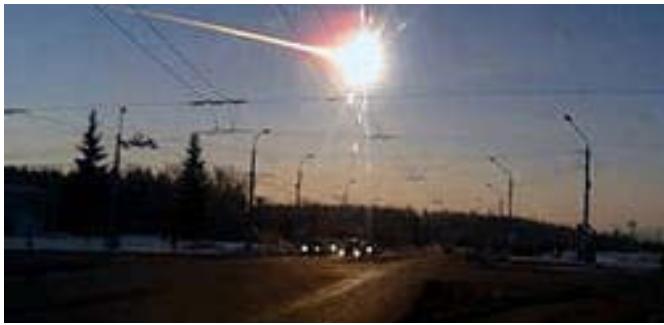
Fig. 1: Photographic evidence of plasma cumulation in a meteoroid's wake. This is a photograph (Marat Akhmetvaleev, 2013) of the Coulomb explosion (see [3] for more details) In photo 1 we see that the length of the plasma tail $(L)$ significantly, by 1.5 times, exceeds the explosion height of $23\mathrm{km}$, i.e. the length $L\approx 30\mathrm{km}$. This indicates the existence of plasma for $\sim 1.5$ seconds after the passage of the meteoroid. The plasma does not dissipate as a neutral medium, but is focused by the forces of cylindrical cumulation, as in the case of linear cylindrical lightning. Of particular interest is the behavior of the meteoroid fragments (photo 1). They fly apart not only in different directions from the meteoroid, but also forward, accelerated by some force acting behind the meteoroid. This clearly indicates a new mechanism of meteoroid fragmentation. The speed of the meteoroid at the moment of its destruction is $18.3 \, \text{km/s}$. This significantly exceeds the speed of any detonation waves of any explosives known to mankind. Therefore, such speeds can only occur in electron beams accelerating in an electric field following a meteoroid! These phenomena and interactions occur at the speed of light or close to this speed with an increase in the characteristic dimensions of positively charged Vysikaylo's cumulative-dissipative systems (+CDS) [1-3].
Several dozen witnesses reported that during the passage of the meteoroid, several minutes before the arrival of the shock wave, they heard a hissing sound similar to the sound of burning sparklers. This means that we are talking about the phenomenon of "electrophone ball lightning". This phenomenon can only be explained by the electromagnetic interaction of polarized charged system or the runaway electrons from $+\mathrm{CDS}$ such as lightning [1,3](Fig. 1). These phenomena and interactions occur at the speed of light or close to it as the characteristic dimensions of these system increase.
A few days after the fall of the Chelyabinsk meteorite, there were reports of observations of anomalous noctilucent clouds at altitudes of $75 - 80\mathrm{km}$. A similar phenomenon was observed in 1908 after the fall of the Tunguska meteorite. This time, ground observations of noctilucent clouds were confirmed by satellite data. Mechanical models cannot explain the release of water vapor from the meteoroid to such an altitude. As a result of the search for the remains of the meteorite, a mass was discovered that did not exceed 1 ton ( $\sim 0.01\%$ of the total mass of the meteoroid).
According to RIA News 03/21/2013, the Chelyabinsk fireball caused magnetic storms in the Earth's ionosphere, similar to storms that occur when solar wind penetrates into the Earth's ionosphere. According to IZMIRAN RF, the disturbances affected almost the entire ionosphere. Thus, fluctuations in the concentration of electrons in the F2 ionospheric layer (about 250 kilometers high) were recorded $5.5\mathrm{h}$ after the explosion at the ionospheric station in Yekaterinburg $(V_{\mathrm{a}} = 10\mathrm{m / s})$, $6\mathrm{h}$ later in Rostov-on-Don $(V_{\mathrm{a}} = 79\mathrm{m / s})$ and $7\mathrm{h}$ later in Moscow $(V_{\mathrm{a}} = 60\mathrm{m / s})$. The speed of longitudinal propagation of plasma disturbance along the trajectory of the meteoroid in the direction of Moscow (it was flying from Omsk) after its destruction is equal to $1,500~\mathrm{km / 7}$ hours $= 214~\mathrm{km / hour} = 60~\mathrm{m / s}$. This speed is more than 4 times less than the speed of sound at altitudes from 20 to $500~\mathrm{km}$. This velocity corresponds well to the possible velocity of ambipolar drift in gas-plasma in breakdown fields [1].
The disturbance zone was local—it was a long "tongue" moving westward, the width of which in the Yekaterinburg region was about 100 km, and on the Moscow-Rostov meridian was about 500-600 kilometers. Without considering the violation of electrical neutrality and the formation of cumulative oppositely directed jets of electrons and positive ions, none of the astrophysicists for 12 years could explain all these phenomena. I prove that flows of charged particles in the atmosphere and ionosphere are created by electric fields. The influence of magnetic fields is small compared to electric fields (by the parameter $v/c$ ).
## II. MECHANICAL MODELS AND THEIR
### PROBLEMS IN EXPLAINING THE
### PHENOMENA OF METEOROID
#### DESTRUCTION
The problem of the asteroid-comet threat has received considerable attention (in words). Scientific conferences are held, hundreds of articles and a number of books have been published see [6-13].
The state of the question of mechanical destruction of cosmic bodies upon entering the atmosphere in the times before the Chelyabinsk meteoroid was presented by the mechanic S.S. Grigoryan (Institute of Mechanics, Lomonosov Moscow State University, Moscow) in [10-12]. He made quantitative estimates of all the effects accompanying the motion of bodies in the atmosphere at cosmic speeds.
According to Bronshtein [13]: "we still have a poor understanding of how the fragmentation process itself occurs. To clarify this issue, special experiments are needed...." And so we are presented with experiments of nature in the form of the Chelyabinsk meteoroid (Fig. 1).
Mechanics still do not have clear explanations for all the phenomena that were observed when the Chelyabinsk asteroid entered the Earth's atmosphere. My research is based on electrical phenomena.
Comparison of Grigoryan's model (Fig. 2) with the photograph in Fig. 1 shows that:
1) When a meteoroid disintegrates, its parts gain additional acceleration not only in the direction perpendicular to its velocity vector, but also in the direction of its motion. The meteoroid's velocity is $18.3 \mathrm{~km} / \mathrm{s}$. The propagation speed of detonation waves in explosives is significantly lower (less than $10 \mathrm{~km} / \mathrm{s}$ ). Within the framework of the mechanical model (Fig. 2), such behavior of the meteoroid explosion (Fig. 1) is inexplicable! To explain such behavior of the meteoroid's parts, something must be moving behind the meteoroid at speeds significantly exceeding the meteoroid's velocity (18.3 km/s). Only electrons can be such particles due to their low mass;
2) The plasma tail (train) of the meteoroid in Fig. 1 clearly does not correspond to Grigoryan's mechanical model with an expanding tail (Fig. 2). All mechanical models fail to explain the clearly
observed phenomenon of plasma cumulation in the meteoroid tail over 1.5 s (Fig. 1). According to the mechanical model, the characteristic size of the meteoroid tail should increase with the speed of the Mach shock wave (Fig. 2).
3) Grigoryan's model does not take into account or discuss the virial theorem. According to this theorem, half of the meteoroid's potential energy should return to the region of its arrival. We describe this process in detail in the section "Introduction of asteroids and meteoroid bodies into the planet's atmosphere".
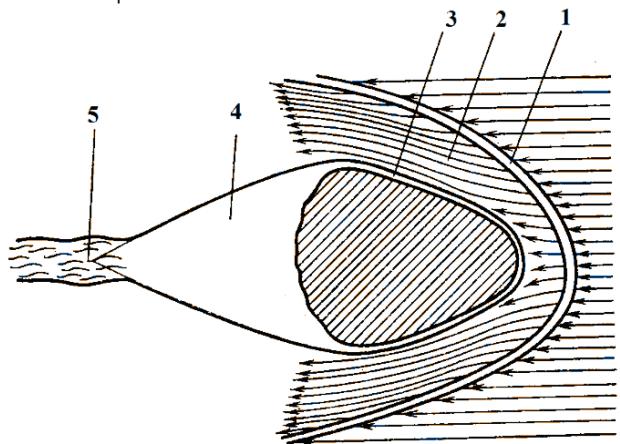
Fig. 2: General 3D diagram of shock wave elements: 1 - shock wave front, 2 - shock (compressed) layer, 3 - boundary layer, 4 - stagnant zone, 5 - trail
Comparison of photograph 1 with Fig. 2 shows the inadequacy of the Grigoryan's mechanical model to explain the photograph. Other modifications of his theory, including those made by Chernogor for other meteoroids [14,15], do not deserve close attention. His research led to the conclusion: "The role of the dust component of the plasma was insignificant" [15]. In his works, only Mach shock waves are considered. Mach shock waves compress bodies penetrating the Earth's atmosphere (Fig. 2), and thus destroy this body, acting on it from the front.
The author draws attention to the formation of Vysikaylo'sshock waves of the electric field, leading to the action of CJ on such bodies from behind!
## III. VYSIKAYLO'S CLASSIFICATION OF SHOCK
### WAVES
In the modern world, there are three types of shock waves:
1. Mach'sshock waves, also known as parameter jumps, in the field of gas dynamics. Their study began with his work of in 1881.
2. Magnetic field shock waves were described by R.Z. Sagdeev;
3. Shock waves of the electric field, described theoretically and experimentally in detail in (https://ieeexplore.ieee.org/document/10875031).
Based on theoretical and experimental works on the study of Vysikaylo's shock waves of the electric field in gases, in this work we will formulate a model of Vysikaylo's incongruent shock waves in electronegative gases (air). These waves surrounded the plasma tail behind the Chelyabinsk asteroid and limited the radial expansion of the plasma and thus lead to the formation of a CJ, spraying the asteroid with a Coulomb explosion. This is how the virial theorem in the Earth's atmosphere is solved according to the Vysikaylo's model.
## IV. GENERAL ANALYSIS OF THE CHELYABINSK'S 2013 METEOROID PHENOMON
According to NASA calculations, the Chelyabinsk meteoroid, about 18 meters in diameter and weighing 11,000 tons, entered the Earth's atmosphere at a speed of about $18.3\mathrm{km/s}$ and almost completely disappeared in the Earth's electronegative (air) atmosphere. The kinetic energy of the meteoroid is $W_{\mathrm{M}} \approx 2 \cdot 10^{15}\mathrm{J}$. How was all this energy and mass of the meteoroid focused and where did they go? The destruction was a series of phenomena accompanied by the spread of shock waves and crackling sounds, creating the impression that someone was shooting at the meteoroid. This is also indicated by the features of the dispersion of the meteoroid parts in Fig.
1. The entire "West" does not have effective anti-missile defense against Russian supersonic missiles, the speed of which is only $2.7\mathrm{km/s}$. And here the speed is 7 times higher ( $18.3\mathrm{km/s}$ ). This is fast hypersonic ( $12.3 \div 30.7\mathrm{km/s}$ ). Neither Russia nor Iran have achieved such speeds yet. This paper proposes a new mechanism for such missiles with $50\%$ efficiency, but the author hopes that it will not be implemented for special purposes for another 20-30 years. During this time, the elites in the United States will realize Hegel's law of the unity and struggle of opposites (and their mutual development, not destruction).
According to NASA estimates, $20\%$ of the total energy of the meteoroid goes to radiation - 90 kt. This means that the energy of the meteoroid is used to destroy itself. The plasma tail not only wags the meteoroid (the dog), but also participates in its destruction. The mechanical model, in principle, cannot explain this phenomenon. The total energy received by air molecules due to collisions with a meteoroid during the entire flight of the meteoroid (before its destruction) does not exceed $8 \cdot 10^{6}$ J. Moreover, the energy received by one air molecule during a collision with a meteoroid is about $50~\mathrm{eV}$. This energy is sufficient for complete ionization and dissociation of all air molecules in the meteoroid's wake. In this case, the temperature of the electrons in the plasma tail of the meteoroid will be about $50 - 25 = 25\mathrm{eV}$ or $250 \div 300$ thousand degrees. At this temperature, electrons leave the area of collision of air molecules with a meteoroid in a microsecond. Wake polarization occurs, in which a significant portion of the plasma energy in the wake of the meteoroid is retained in the form of potential Coulomb energy. Due to the polarization of the plasma in the meteoroid's wake, dynamic Coulomb surface tension is generated. This tension localizes energy in the plasma tail. This creates a cylindrically symmetrical tube of fully ionized plasma behind the meteoroid. The potential energy of a meteoroid at a small angle of entry into the Earth's gravitational field is no more than $10^{10}$ J. All these energies are significantly less than the kinetic energy of the meteoroid $2 \cdot 10^{15}$ J and the radiation energy recorded by NASA - $4 \cdot 10^{14}$ J. This means that the energy external to the meteoroid is not enough for such a glow, observed at the moment of its spraying. Thus, we, on the basis of the photograph in Fig. 1, have proven that, according to the law of conservation of energy and the directions of explosion fragments in Fig. 1, the mechanical model (Fig. 2) in principle cannot explain such a spray of a meteoroid in all directions (at a speed greater than the speed of the meteoroid) (Fig. 1).
## V. GENERAL ANALYSIS OF PHENOMENA AND CRITICISM OF THE MECHANICAL MODEL
We will consider in detail the problems of electrical phenomena indicated in [8]. In [8], many errors were made in the explanation, which we will dwell on in detail:
1. The appearance of noctilucent clouds at a height of $75 - 80 \mathrm{~km}$ after the destruction of the meteoroid was ignored in [8]. This was due to the lack of a decent model in mechanics for the cumulative transfer of positively charged ions to the upper layers of the atmosphere through a cylindrical plasma channel (Fig. 1). According to my model, they are dropped through a huge pipe that radially focuses the flows of positive ions to an altitude of $75 - 80 \mathrm{~km}$;
2. The mechanism of obtaining an additional "mysterious" impulse by a number of meteoroid fragments in [8] is not explained. The additional "mysterious" impulse does not lead to the deceleration of all possible fragments in accordance with the action of the shock wave according to (Fig. 2), but to their powerful acceleration (see Fig. 1). The detonation velocity of octogen alone is 9.1 km/s, but this velocity is many times less than the meteoroid velocity. In plasma, only electrons have a velocity of more than 18 km/s. The author proves that it is the accelerating (runaway) electrons, which are formed into cumulative jets, overtaking the meteoroid by inertia, that cause all the recorded "mysterious" phenomena (Fig. 1);
3. In [8] it is not explained (ignored) the nature of the explosion that scattered parts of the meteoroid in different directions with enormous speeds, clearly exceeding the initial speed of the meteoroid as a whole (Fig. 1). Within the framework of the classical mechanical model, the meteoroid is compressed by the main shock wave from the front and sides (Fig. 2), and is not accelerated by it from behind! Such scattering of meteoroid fragments, as observed in Fig. 1, in principle cannot occur only due to compression of the meteoroid by the shock wave. To explain such an explosion (see Fig. 1), we formulated a new model of Coulomb initiation of fragmentation of the rear part of the meteoroid;
4. In [8] the characteristic time intervals are given: formation of turbulence $(10^{-2} - 10^{-1}\mathrm{s})$, attachment of electrons to oxygen molecules and recombination with meteoric ions $(10^{-2} - 10^{-1}\mathrm{s})$. The frequency of electron attachment to oxygen molecules is dissociative and is 4 orders of magnitude greater than that indicated in [8] and about $10^{-6}$ s. The lifetime of plasma in the meteoroid tail is 1.5 s. This clearly indicates the presence of not only dissipative (scattering) processes from the plasma tail, but also cumulative flows into the plasma tail, which cumulate energy, mass, momentum and angular momentum. The solution to this paradox is given in the section "Vysikaylo's incongruent shock wave of the electric field in the Earth's atmosphere and Vysikaylo-Poisson's turbulence".
5. In [8] the discussion of sudden, sometimes pulsating, local increase in the brightness of the bolide is ignored. I will quote the text from [16] in full: "At present, there is no gas-dynamic model of a bolide flare... Perhaps one of the causes of flares is fragmentation... The question of the nature of the flare can be resolved only by the joint efforts of observers and specialists in mathematical modeling."
The answers to these questions are based on the cumulation (self-focusing) of plasma flows and the formation of CJ [1-3]. Here, a new cumulative-dissipative plasma-beam mechanism of Coulomb initiation and maintenance of cascade fragmentation of large meteoroids is proposed. The feedback mechanism is based on the phenomenon of coherence of de Broglie waves of electrons and ions in positively charged plasmoids in the electronegative atmosphere of the Earth. As a result of these phenomena, a beam of high-energy "runaway" electrons is formed, penetrating the meteoroid from behind. This leads to a Coulomb explosion of a part of the meteoroid. At the first moment when electrons in CJ hit the meteoroid, it is weakly fragmented, since the energy concentrated in the air is insufficient. When the mechanism of acceleration of small parts of the meteoroid by CJ is turned on, they can move faster than the main meteoroid (Fig. 1). The cumulation of all the kinetic energy of powerful explosions of small meteoroid particles and its transformation into the energy of electrons falling into the meteoroid closes the feedback loop in the process of Coulomb fragmentation. This energy already corresponds to the density of the meteoroid and is $\sim$ 200 eV per meteoroid atom. This leads to a catastrophic fragmentation of the meteoroid. Its parts explode and are completely ionized. By the virial theorem, $1/2$ of the potential and internal energy of the plasma trail returns to the meteoroid, and the other half is ejected into the upper layers of the atmosphere through a channel with plasma self-focusing.
The presence of explosions of small fragments behind the meteoroid and the transformation of their energy into the energy of CJ electrons contributes to the further destruction of the meteoroid, changes in its trajectory and even the acceleration of its fall. According to this scheme, a self-organizing pulsed plasma jet engine with an efficiency of $50\%$, sparkling with radiation (Fig. 1), is formed behind the fast-moving object, dropping mass due to the fragmentation of the back side of the meteoroid;
6. In [8] the mechanisms that ensure the fulfillment of the virial theorem or Newton's third law in a continuous medium (air) when a meteoroid penetrates at a speed of about $10 \, \text{km/s} - 70 \, \text{km/s}$ into the Earth's atmosphere and "mysteriously" disappears before reaching the surface of the Earth have not been studied;
7. In explaining the electrophonic effect in [8], Gauss's theorem in 3D space is ignored.
I am detailing point 7). The electrophonic effect is understood as the audibility of crackling sounds by a person at large distances from the meteoroid and long before the acoustic disturbance created by the body's movement reaches the observer. It is believed that the theory of this three-dimensional phenomenon, occurring at a speed close to the speed of light, has not been developed in detail [8]. The basics of this theory are presented in the work [3], based on coherent phenomena in the case of a violation of electrical neutrality in the meteoroid's trail. According to the erroneous ideas in [8](based mainly on the mechanical model), there are two (I and II) probable mechanisms that can qualitatively explain the electrophonic effect that was observed by several eyewitnesses of the phenomenon in Chelyabinsk in 2013.
1) According to [8], when a cosmic body falls in the atmosphere, it becomes electrified. This causes a charge of the opposite sign to flow down from the Earth's surface. The process is accompanied by an acoustic effect. According to estimates in [8], the charge leakage begins at a field strength of about several kV/m, and in the case of the Chelyabinsk meteorite, the intensity reached 0.5–5 MV/m.
In this mechanism, the author [8] does not take into account that fields with an intensity of $0.5 - 5\mathrm{MV / m}$ are formed quasi-stationary only in the meteoroid area. I note that these fields at an altitude of $20~\mathrm{km}$ are 50 times higher than the breakdown fields. Even with nanosecond discharges, the breakdown values of the $E / N$ parameter can only be increased by 2 times to 150 Td. At distances $L$ of about $20~\mathrm{km}$ or more from the meteoroid, the electric fields from the meteoroid become negligibly small due to the geometric reduction coefficient following from the Gauss theorem, $\xi = (R / L)^2 \approx 10^{-6}$. There will be no "chirping" from these fields at distances $L \sim 23~\mathrm{km}$ (or more). In Moscow, there is the Lenin Institute of Higher Power Engineering, which has a setup that imitates lightning. There the electric field strength is of the same order ( $\sim 3\mathrm{MV / m}$ ), and its dimensions are about $10~\mathrm{m}$, but Moscow residents, even on the next street, do not experience any "chirping" in their ears.
2) According to [8]: "Electromagnetic waves of the sound range are transformed into sound due to the piezoelectric effect in objects surrounding the observer or in the person himself. At a frequency of f $\sim 1\mathrm{kHz}$, the electric field strength should be no less than hundreds of V/m. Such fields arise on the surface of the earth with a current strength in the trace of I = $5^{*}10^{4}$ A." Here in [8] there is a trace along which "mysterious" currents flow, which in principle cannot be in its initially neutral mechanistic model without consider the electrical imbalance in the trace. Such a sharp transition from a mechanical model to a cylindrical and electrodynamic model with currents looks somewhat strange when explaining the electrophonic effect. In mechanism II, author [8] relies on Tesla's frequency discharge and again sets the necessary condition for "chirping" - more than 100 V/m, which, in principle, is not realized according to the mechanical model at distances more than 23 km from the meteoroid due to the same geometric reduction coefficient $\xi \approx 10^{-6}$. And in this case, author [8] does not take into account the size of the plasma positively charged tail of about 30 km, observed in Fig.
1.
During the Chelyabinsk meteorite, the electrophonic effect was observed at a distance of more than 23 kilometers. Two mechanisms proposed in [8] based on the neutral mechanical model do not explain the observed phenomenon due to the small spatial coefficient $\xi \approx 10^{-6}$.
All two mechanisms of the electrophonic effect proposed by the author in [8] do not stand up to criticism. This always happens when the researcher does not understand the essence of the main phenomenon. Therefore, all the phenomena in 8 are not collected into a single picture. The author of [8] is forced to throw out some of the phenomena. He does not discuss and does not understand the phenomenon of periodic powerful fragmentation of the meteoroid, which is accompanied by explosions (as if someone is shooting at the meteoroid with a machine gun) and a simultaneous pulsed increase in the brightness of the glow of the fireball. In the work [8], the author does not mention this main problem of all mechanical models. They cannot explain the main pulse phenomena caused by detonation (shock) waves of electron gas in plasma in a positively charged trace of the meteoroid at $30~\mathrm{km}$. The speed of detonation waves of electron gas is several times greater than the speed of the meteoroid.
With the "arrival" of such amateurs of their region as Marat Akhmetvaleev (https://uraloved.ru/fotomarata-ahmetvaleeva?ysclid=lpig4qi5dl786130180) and others in the research field, the current state of the problem of the destruction of large cosmic bodies upon entering the Earth's atmosphere has shone with renewed vigor (Fig. 1). This completely new phenomenon falls outside the framework of the mechanical model. To describe the photographically recorded phenomena, we need to use synergetics (coherent processes) in plasma dynamics in the tail of meteoroids, see [3].
## VI. COULOMB SELF-FOCUSING OF A PLASMA TRAIL
If the speed of the asteroid reaches $20~\mathrm{km / s}$, then the energy that the air molecules receive is approximately 50 eV. An energy of 50 eV per molecule is sufficient for complete dissociation and ionization of molecules and atoms. About 20 eV remain for each electron. The air (in the form of a plume) becomes an electropositive gas in which electrons are not attached to atoms. Electrons, as a more mobile gas, leave the plasma plume faster than positive ions. This is how the plasma is polarized behind the meteoroid and a potential Coulomb radial barrier for electrons is formed (Fig. 3). The radial potential blocking the movement of electrons in the radial direction increases logarithmically depending on the effective length of the cylindrical positively charged plasmoid. Outside the plasma trail, the electrons lose energy and stick to oxygen molecules. In this case, a layer of negative ions is formed, which move into the positively charged plasma trail at a significantly lower speed. Negative ions cumulate entering into the plasma trail with excited plasma are destroyed and electrons are released. This leads to the cumulation of the plasma tail. These electrons are affected by the 3D electric field of a positively charged cylindrical column. The radial component cumulates the electrons to the center of cumulation, and the longitudinal field behind the meteoroid accelerates them to catch up with the meteoroid. This further cumulates plasma in the tail behind the meteoroid. In the area limited by the positively charged cylindrical radial barrier with the
Coulomb potential, not only all the kinetic energy received by the air molecules is concentrated, but also the kinetic energy of the meteoroid's parts during its gradual and then catastrophic destruction. The self-focusing plasma column with high conductivity participates in the 4D scattering of all the kinetic energy of the meteoroid. (The return of negative ions to the plasma tail of the meteoroid is carried out at the speed of the negative ions). Self-focusing of highly conductive plasma structures allows to extend relaxation processes hundreds of times (up to 1.5 seconds) and return half of the kinetic energy of the entire meteorite through a cylindrical plasma channel to the upper layers of the atmosphere and ionosphere. This explains the influence of the meteoroid tail on the parameters of the ionosphere and demonstrates a three-dimensional structural implementation of the virial theorem in a pulse-periodic process.
Coulomb self-focusing is observed in various plasma formations, from atoms and molecules to electric arcs, lightning, meteor trails and intergalactic lightning. In cylindrical systems, transverse electric fields effectively cumulate electrons toward the center. Longitudinal electric fields, although weaker but longer, form and accelerate cumulative flows in the plasma trail along the trajectory of the meteoroid. In a gas discharge or linear lightning, electrons move toward the anode by a similar principle. In a plasmoid limited by the Coulomb potential, electrons collide during complete ionization of atoms, transferring energy to the tail of the velocity distribution. The high energy of electrons leaving the plasmoid causes electrophonic effects when meteoroids enter the Earth's atmosphere.
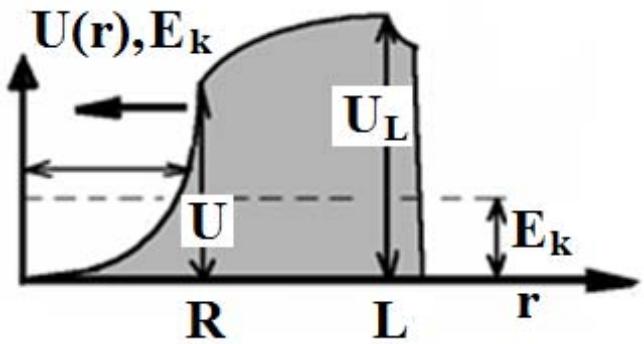
Fig. 3: This is a potential barrier
$U(r)$ for electrons in a cylindrical plasmoid with a positive charge. The characteristic transverse size of the potential well in this case is greater than the radius of the system and is determined by its length ( $\approx L$ ), and not by the radius ( $R$ )
## VII. COULOMB MECHANISM OF METEOROID
### (ASTEROID) FRAGMENTATION
The plasma tail behind the meteoroid transmutes the kinetic energy of the asteroid into the electric energy of the cylindrical capacitor. The positively charged cylindrical polarized tail grows linearly with the velocity of the asteroid. The radial capacitor is therefore broken through by a CJ. CJ behaves coherently, like laser radiation. Electrons catching up with the meteoroid periodically explode it and accelerate parts, including the asteroid itself. We estimated the parameters of the electron beam for lightning ( $\sim 5$ MeV) and the plasma tail of the Chelyabinsk asteroid ( $\sim 100$ GeV).
1/2 of the kinetic energy of the asteroid is spent on acceleration and destruction of fragments by the CJ, the other $\frac{1}{2}$ is spent on the emission of positive ions into the upper layers of the atmosphere (up to 70-80 km) along the cylindrical trail. Our research explains all the phenomena observed during the destruction of the Chelyabinsk asteroid at an altitude of 23 km.
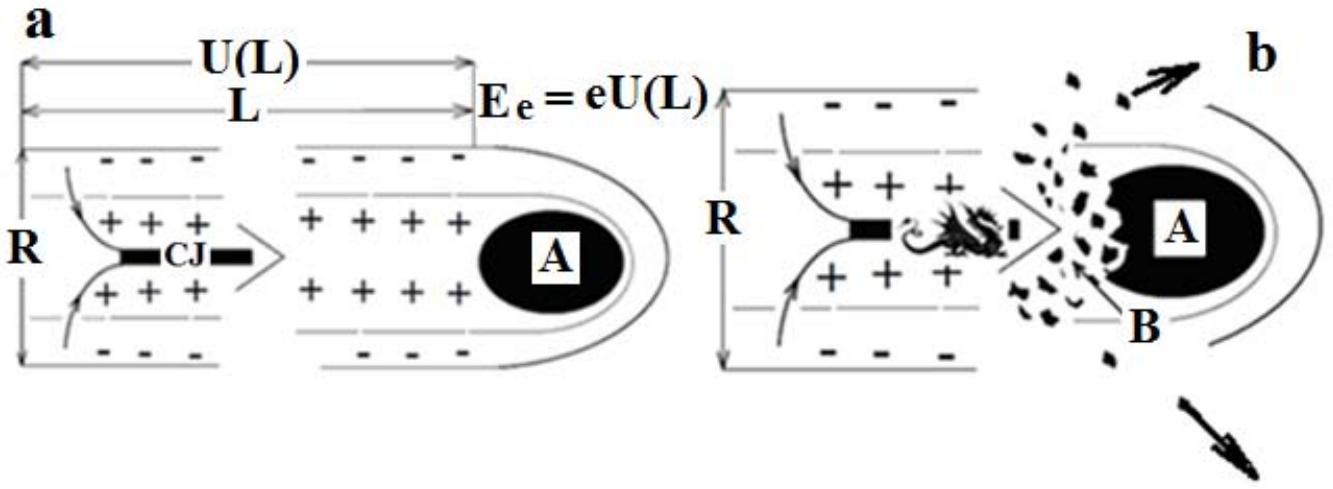
Fig. 4: 2D diagram
a) In Vysikaylo's gun, the spatial charge (polarization) of the plasma behind a fast-moving object – A in the medium is divided. This division is indicated by the signs "+" and "-". A positively charged plasma column forms a CJ, transforming the energy of polarization (the energy of the asteroid) into the energy of the CJ;
b) A new method of destruction of meteoric bodies based on the cumulative plasma mechanism of fractal fragmentation. This mechanism is triggered by Coulomb explosions. B - these are fragments that explode and create a jet thrust behind object A, simultaneously destroying it from behind.
## VIII. CUMULATIVE-DISSIPATIVE SYSTEMS
In nature, convective cumulation (focusing) processes were discovered long ago. Gravitational cumulation processes were studied by Newton, Kepler, Euler (1767), Lagrange (1772), Besant (1858), Rayleigh (1917), Guderli (1942, compression shock wave), Zababakhin (1965) and others. We are most interested in the studies of unlimited cumulation processes in the works of E I Zababakhin [18]. In the conclusion of this book, the authors (V A Simonenko) say that "despite the instability of cumulation in continuous media, it remains a very useful idealization that allows one to find exact solutions and indicates how to approach it in practice, without relying, however, on self-focusing" [17,18]. And now, more than 36 years have passed, and we are successfully solving the problems of self-focusing (cumulation) of electrons de Broglie waves in quantum resonators in the most "subtle experiments", both at the level of nanometer sizes, and also in the mesoworld of huge plasma trails behind meteorites penetrating the Earth's atmosphere. Atomism and the associated size limit indicated in the works of Zababakhin are already coming to the forefront and have even been overcome in nuclear physics (https://ojs.acad-pub.com/index.php/N-C/article/view/1297). But the definition given by Ya.B. Zeldovich to the concept of cumulation for continuous media remains a very useful and fairly general definition of this phenomenon, observed from the fem to world of atomic nuclei to the world of stars and galaxies. "Cumulation, that is, the concentration of force, energy or other physical quantity in a small volume, is the most important phenomenon of nature," asserted Ya. B.
Zeldovich in his preface to the book "Phenomena of Unlimited Cumulation" [17]. The definition of cumulation given by Ya. B. Zeldovich is the most successful, clear and at the same time quite complete definition of the phenomenon of self-focusing in natural, physical, social, political, economic and other phenomena and the Vysikaylo'sCDSformed by them, which differ significantly from the dissipative structures of Prigogine-Turing-Kolmogorov-Fisher [3].
E.I. Zababakhin was the closest to the discovery of cumulative-dissipative systems (CDS), which differ significantly from Prigogine's dissipative structures (PDS). PDS are formed by diffusion and birth processes. CDS are formed by convective and diffusion processes of self-focusing of energy, mass and momentum flows. During cumulation, new degrees of freedom are excited: 1) rotation, 2) violation of electroneutrality and 3) generation of electromagnetic fields. CDS exist as a result of structural dissipation of a certain energy source and therefore belong to a new class of dissipative systems discovered by Vysikaylo [1-3].
## IX. ARCHITECTURE AND SUPER-PROPERTIES OF THE VYSIKAYLO'S CUMULATIVE-DISSIPATIVE SYSTEMS
CDS have long been observed in nature (Fig. 5). However, these phenomena were considered paradoxical, since they had no explanation. The basic provisions of the theory of gravitational structures were presented in the works of Euler, Lagrange, Roche (Fig. 6). The Kepler problem has long been solved in the general case for the Coulomb and gravitational potentials. However, the discovery of cumulation and libration points in plasma between positively charged systems (Fig. 5) was discovered by me in 2009. Here we will analyze the architecture of the cumulation and dissipation processes in Vysikaylo's CDS based on Fig.
6. To do this, we will mentally fill the Roche lobe of the Sun and Jupiter (Fig. 6) with ordinary dust and hit the dust (in the Roche lobe) to the left of the Sun with a large palm. The dust will move in the direction of the
Roche lobe of Jupiter. After passing the dust particles through the region of the Sun, the equipotential will focus at the cumulation point $L_{1}$. This means that the points discovered by Euler (1767) are not libration (Lagrange) points, but are in fact Euler's cumulation points [2]. After passing the cumulation point $L_{1}$, dust flows from the solar Roche lobe penetrate into the Roche region of Jupiter and expand there.
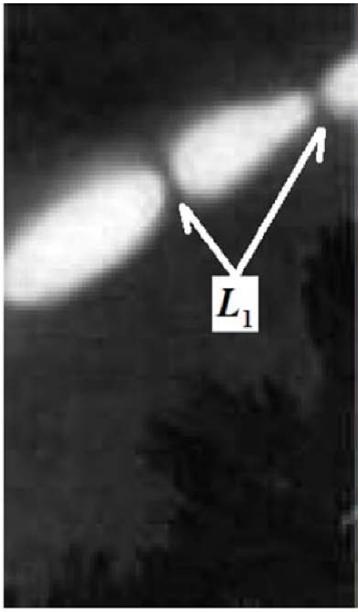
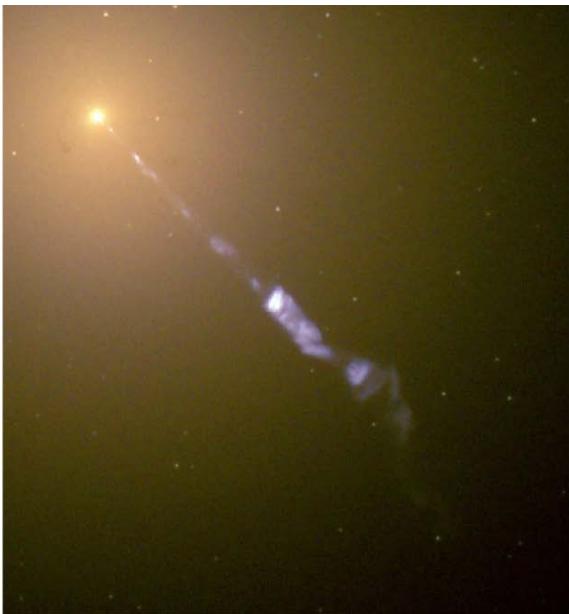
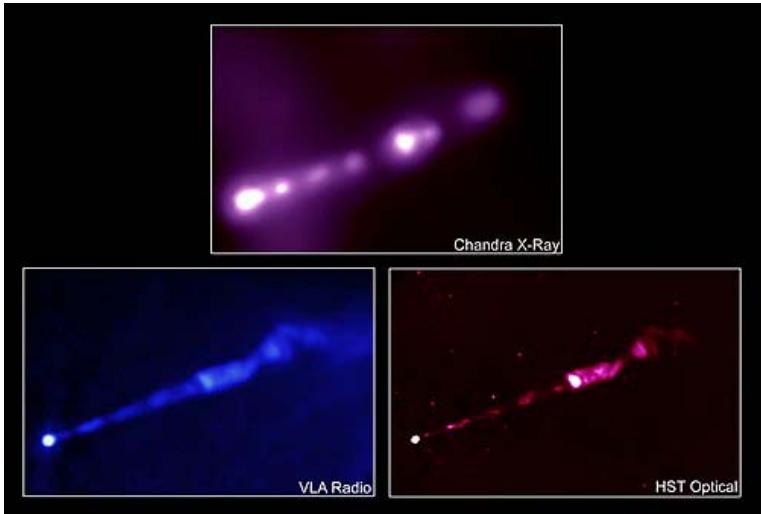
Fig. 5: Photo of energy cumulation due to dynamic surface tension in plasmoids:
a) Dotted lightning in the electronegative Earth's atmosphere. $L_{1}-$ cumulation points [2,3].
b) The central region of the M 87 galaxy with an active nucleus. Jet size $\sim$ 1.5 kpc. Hubble Telescope (NASA). We observe jet stratification and formation of cumulation regions
The formation of Vysikaylo's bicyclones, discovered in [1-3], can also be explained based on the Euler-Vysikaylo's model (Fig. 6). To do this, it is necessary to simultaneously hit the dust with large "palms" from opposite sides on the Roche lobes. In this case, dust from the Roche lobe of the Sun will penetrate into the Roche lobe of Jupiter, and dust from the Roche lobe of Jupiter will tend to get into the Roche lobe of the
Sun. This problem of the frontal collision of dust flows from the Roche lobe of the Sun and Jupiter at the cumulation point $L_{1}$ is solved in 4D space-time by generating rotation of these flows in opposite directions. Such bicyclones with constrictions in $L_{1}$ are complete analogues of Cooper pairs discovered in the nanoworld, so the author called such bicyclones quasi-Cooper bicyclones. The idea of the joint organization of Cooper pairs led to the discovery of quasi-Cooper cyclones or Vysikaylo's bicyclones in the micro-, meso- and macroworlds. On this basis, the joint co-organization of cyclonic and anticyclonic flows into a single system, a bicyclone, was discovered. Double currents enhance each other's rotation and transform any kinetic and potential energy into rotation, distributing these energies equally between cyclonic and anticyclonic movements.
The idea of such a joint organization of double convective (not diffusion) flows made it possible to discover Vysikaylo's structural turbulence and to explain and describe analytically all the phenomena observed during the formation of tropical cyclones [1-3](these phenomena observed in nature are collected in the works of Erokhin and Artekha).
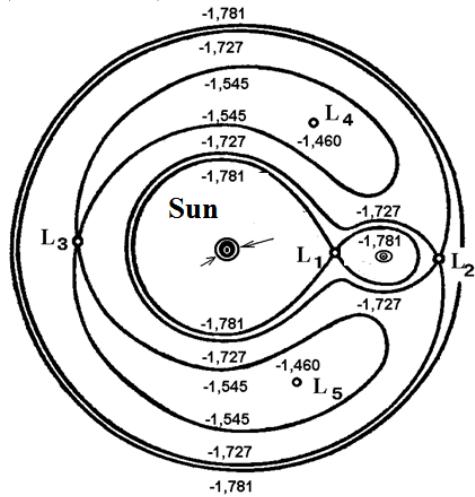
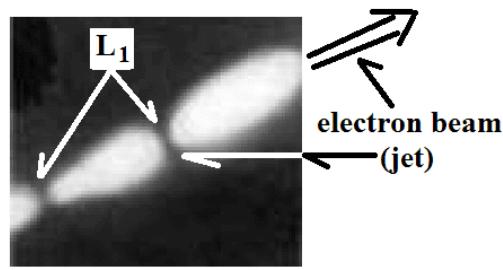
Fig. 6: This is a 2D cross-sectional diagram of equipotential surface profiles (3D Roche' cavities) surrounding:
a) The gravitating system of two attractors (Sun and Jupiter), taking into account the centrifugal potential in the Euler problem of linear cumulation points $L_{1,3}$ and triangular Lagrange libration points $L_{4,5}$,
b) This is the formation of Vysikaylo's cumulation points in a beaded lightning between the luminous positively charged cumulative-dissipative Vysikaylo's systems.
Similar phenomena of structural cumulation are observed at the libration point $L_{1}$ when ordinary stars are consumed by quantum stars in stellar pairs [2](the phenomena and paradoxes that arise are described in [19,20]. They still don't understand Vysikaylo's structural turbulence). The main achievement within the framework of the Vysikaylo's structural turbulence model was the description of the eye (eye) of a tropical cyclone, which is not described in the Rossby's models and other, as AAVlasov said, inferior models. The second discovered property of structural turbulence or bicyclones is an increase in the cumulation of such a structure with an increase in rotation and an increase in rotation during cumulation [1-3].
## X. CUMULATION AND LIBRATION POINTS FOR ELECTRONS BETWEEN POSITIVELY
### CHARGED SYSTEMS
Euler was the first to think about the interaction of gravitational and centrifugal potentials when he analyzed the two-dimensional motions of a small third body in the plane of rotation of two massive objects. His idea of cumulation points $L_{1}$, which was already known to Newton, and the discovery of three linear cumulation points $L_{1-3}$, arising from the influence of the centrifugal potential, were the result of the analysis on the line connecting the two massive bodies. Lagrange, developing this idea, derived the results of the analysis in the plane of rotation of Jupiter around the Sun, which led to the discovery of two triangular points $L_{4}$ and $L_{5}$. These classical discoveries allowed me to discover the libration and cumulation points of electrons around positively charged Coulomb centers.
The study of flows in 4D space-time revealed to me that the gradients of potentials: 1) gravitational, 2) Coulomb and 3) pressure form flows of energy, mass and momentum in a similar way. This allowed me to classify the points discovered by Euler in 1767 as cumulation points, and the points discovered by Lagrange in 1772 as libration points [2]. Generalization of the works of Euler, Lagrange, Roche and other researchers of the system of gravitational attractors allowed me to explain a number of "puzzling" experiments, for example, the pulsed propagation of lightning in the experiments of Schonland (1937) (jets are formed in the same way, Figs. 3-6) and other paradoxes in gas-discharge plasma in laboratories, the ionosphere, the heliosphere and galaxies.
Research [1-3] led me to the creation of the generalized mathematical transposition method
(GMTM). This method allows the transfer of mathematical models from well-studied areas of science to less explored areas. With the help of GMTM, knowledge of gravitational systems can be used to describe electrodynamic processes with violation of electrical neutrality, and vice versa. This opened up new possibilities for testing general theories in the natural sciences and making discoveries. The method is also applicable to hydrodynamic and quantum-mechanical phenomena. Thus, within the framework of synergetics, the science of the interaction of many elements, a new section devoted to CDS appeared [1-3].
## XI. VYSIKAYLO'S PERTURBATION THEORY FOR DESCRIBING PHENOMENA IN PLASMA WITH CURRENT
We have already explained all the phenomena that occurred when the Chelyabinsk meteoroid entered the Earth's atmosphere, based on experiments with lightning and plasma systems. When air molecules collide with a meteoroid, plasma is formed - a gas consisting of positive ions and electrons. We have developed a mathematical model to describe the transition layers in a non-uniform plasma with current. However, numerical modeling of such plasma causes difficulties due to the lack of experimental data on the rate of processes of plasma particle generation and transfer from the parameter $E / N$. According to Vysikaylo's perturbation theory, in the system of Poisson equations for the electric field and the transfer of ions and electrons, one can obtain one four-dimensional equation for the transfer of plasma parameters. This equation takes into account the smallness of the current of positive ions compared to the current of electrons:
$$
\partial n_{\mathrm{e}} / \partial t - \partial [ (I_{\mathrm{E0}} / \mu_{\mathrm{e}}) \nabla ] (\mu_{\mathrm{e}} n_{\mathrm{e}}) / \partial t + (j / e) \nabla (\mu_{+0} / \mu_{\mathrm{e0}}) - \nabla \{ (\mu_{+0} E_{0} / \mu_{\mathrm{e0}}) (I_{\mathrm{E0}} \cdot \nabla) (\mu_{\mathrm{e0}} n_{\mathrm{e}}) \} = I_{+0} - R_{+0},
$$
Herein the zeroth approximation of our perturbation theory, the drift velocity of electrons and ions is described by the relations: $V_{\mathrm{e0}} = \mu_{\mathrm{e0}}E_0$, $V_{+0} = \mu_{+0}E_0$, here are the mobility of electrons - $\mu_{\mathrm{e0}}$ and ions - $\mu_{+0}$, respectively, $I_{\mathrm{E0}} = E_0 / (4\pi n_{\mathrm{e}})$ vectorized characteristic size of electric field strength change. Since the plasma in the trail is completely ionized, the length of the violation of electrical neutrality is small and a sharp jump is formed along the entire boundary of the luminous plasma trail (Vysikaylo's shock wave of the electric field) [1-3]. The four-dimensional Vysikaylo's equation is derived from the ion concentration equation $\partial n_{+} / \partial t + \mathrm{div}(n_{+}V_{i}) = I_{+} - R_{+}$, where the $n_{+}$ is replaced by $n_{\mathrm{e}} - (I_{\mathrm{E0}}\nabla)(n_{\mathrm{e}}\mu_{\mathrm{e0}}) / \mu_{\mathrm{e0}}$. This change takes into account the violation of electroneutrality described by the Poisson equation for the electric field. The second term in the equation, containing mixed derivatives with respect to time and space, has no analogues in hydrodynamics. The fourth term is similar to the diffusion one. In hydrodynamics, a similar transition from convective to diffusion transport is observed during the formation of shock waves discovered by Mach. The term due to the violation of electrical neutrality suggests the presence of shock waves of the electric field in the plasma. These waves form the dynamic surface tension of plasmoids ranging in size from 10 cm to 1.5 kpc (Fig.5). Shock waves of the electric field in a gas discharge were discovered and visualized by Vysikaylo and his colleagues in 1985-1987. The second and fourth terms of the equation with mixed derivatives allow us to describe stationary and traveling shock waves of the electric field - strata (parameter $E/N$ ) both in a conventional gas discharge plasma and in the ionosphere and heliosphere, where global currents flow.
During discharge in pure nitrogen, the ambipolar drift in the positive plasma column reaches 70 m/s. It moves from areas with low values of the $E/N$ parameter to high ones. This drift promotes plasma cumulation in the centers or lines [1-3]. In air, the ambipolar drift can exceed 100 m/s. As a result, the plasma self-focuses behind the meteoroid, causing disturbances to spread in the ionosphere at a speed of $V_{a}$ (according to RIA News 03/21/2013).
When a meteoroid moves through the atmosphere, it leaves behind a plasma trail. Highly energetic electrons leaving this trail create a positively charged column with electric forces acting on the positive ions moving away from the meteoroid and on the electrons moving toward the meteoroid. The radial Coulomb barrier (Fig. 3 and 4) prevents the flow of electrons from the plasma cylinder and thus focuses it radially. This plasma system, 30 to 80 kilometers in size, sprays the meteoroid substance, including water vapor, into the upper layers of the atmosphere in the form of positive ions. One of the indications of cylindrical plasma cumulation in the trail is the registration of noctilucent clouds at altitudes of up to 75 kilometers.
## XII. DISCUSSION OF RESULTS
In this section we argue that the cylindrically symmetric plasma system (hose behind the meteoroid (Fig. 1)) is formed by the processes of ambipolar drift (the third term in (1)). According to our theoretical and experimental studies, this type of ambipolar drift (caused by different dependences of the electron and positive ion mobilities) is directed from small values of the parameter $E / N$ to the region of large values of this parameter. In the case of a limited (droplet model) plasma positively charged system, the ambipolar drift is directed toward the self-forming boundary of the plasmoid (Fig. 7). Thus, plasma disturbances are directed toward the boundaries of the plasmoid and such solutions are stitched together by the formation of Vysikaylo's shock wave of the electric field with a characteristic size $I_{\mathrm{E}}$ [3].
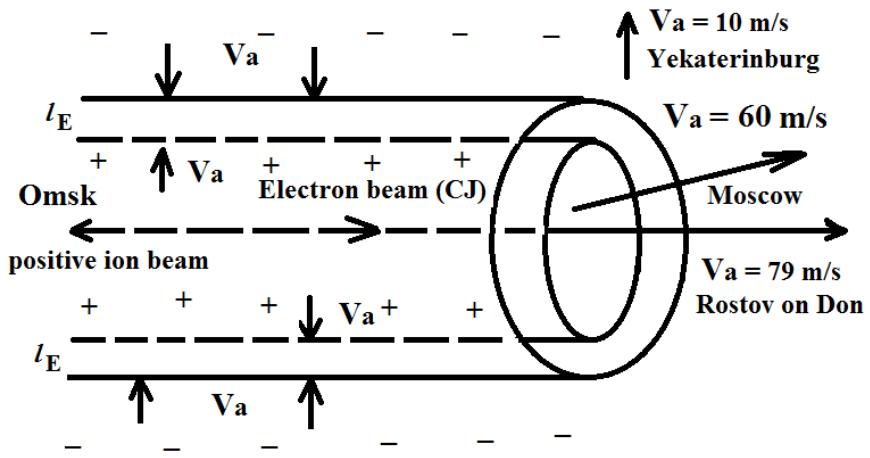
Fig. 7: 3D schemes: formation of the Vysikaylo's laser-gun by ambipolar drifts directed towards the boundaries of the plasma system and the propagation of plasma disturbances in the ionosphere at the speed of ambipolar drift
$V_{\mathrm{a}}$ (these are analogs of Mach's shock waves) of plasma disturbances after the destruction of the meteoroid according to the Vysikaylo's fragmentation scheme
Fig. 7 shows the formation scheme of a partially open in the direction of the asteroid motion (closed from the sides) cumulative-dissipative polarized Vysikaylo's systems. All the kinetic energy of the meteoroid and ionized air molecules is converted into the energy of a cylindrical electric capacitor, limited by a Coulomb cylindrical barrier (Fig. 7). When the capacitor energy reaches a critical value, it is broken down by CJ. The introduction of CJ into the meteoroid leads to a Coulomb explosion and fragmentation of the meteoroid from behind according to the Vysikaylo model (Fig. 4b). Limitation of the radial propagation of the plasma disturbance occurs due to converging waves of ambipolar drift (the third term in (1)), directed to the boundaries of the self-forming cylindrically symmetric plasmoid. This occurs in complete analogy with the formation scheme of ordinary linear lightning and other Vysikaylo's positively charged cumulative-dissipative systems(+CDS) [1-3]. At the boundary of the plasmoid, a Vysikaylo's shock wave of the electric field is formed, compressing +CDS.
After the final Coulomb fragmentation of the meteoroid (to ions and electrons) according to the Vysikaylo's scheme (Fig. 4b), as shown by the experimental data presented to RIA News 03/21/2013, the electron beam pulse continues its movement in the form of plasma ambipolar waves with different velocities
$V_{a}$, depending on their direction of movement. Such a dependence of the propagation speed of disturbances clearly indicates the ambipolar nature of the momentum transfer in the direction of the meteoroid movement. This once again proves the electrical nature of the effect of $+\mathrm{CDS}$ (Fig. 4,7) on the entire ionosphere and atmosphere of the Earth. According to the diagram (Fig. 4b, 7), the virial theorem may be fulfilled earlier than the meteoroid collides with the Earth's surface. This occurs when the Vysikaylo's $+\mathrm{CDS}$ is broken through by a cumulative electron jet in a pulse-periodic mode, which corresponds to the meteoroid being periodically shot (destruction) by its tail.
## XIII. VYSIKAYLO'S INCONGRUENT SHOCK WAVE OF THE ELECTRIC FIELD AND VYSIKAYLO-POISSON'S TURBULENCE
Air (the Earth's atmosphere) is an electronegative gas. In electronegative gases, along with ionization processes (the creation of free electrons and positive ions), there is an intensive creation of negatively charged ions. Negative ions in the air are formed as a result of two processes: 1) dissociative attachment of a free electron to an oxygen molecule. Here, the $\mathrm{O}^{-}$ ion is formed. The $\mathrm{O}^{-}$ ion can be modified into the $\mathrm{O}_{3}^{-}$ ion; 2) three-body attachment of a free electron to an electronegative oxygen molecule. Here, the $\mathrm{O}_2^-$ ion is formed. The $\mathrm{O}_2^-$ ion can be modified into the $\mathrm{O}_4^-$ ion. At an altitude of $23\mathrm{km}$, the number density of molecules is 24 times lower than at sea level. This means that the frequency of three-body electron attachment is less by more than 500 times. Therefore, the main negative ion outside the plasma tail behind the asteroid can be considered the $\mathrm{O}^-$ ion. The speed of the $\mathrm{O}^-$ ion return to the positively charged cylinder - the plasma tail behind the asteroid is about $10^{5}\mathrm{cm/s}$. This corresponds to characteristic times of $9[\mathrm{m}] / 10^{-3}[\mathrm{m/s}] \approx 10^{-2}$ s. The negative ion returning to the plasma tail is destroyed in collisions with any excited particle and turns into a free electron, which gains energy in electronelectron collisions in the plasma tail and again escapes from the plasma tail of the asteroid. And again, with dissociative attachment to an oxygen molecule, it turns into a negative ion. Thus, one electron can form a negative ion up to $10^{2}$ times. This is how Vysikaylo-Poisson's turbulence is formed at the boundary of the plasma tail behind the Chelyabinsk asteroid. Not only ionized air particles but also asteroid particles transformed into nanodust by a beam of highly excited electrons via a Coulomb explosion take part in the formation of this structural turbulence (Fig.7).
The electrons and negative ions returning to the center (of the positively charged tail) hold the positively charged ions in a cylindrical plasmoid behind the asteroid with their pressure. Their pressure leads to the preservation of the characteristic radial size of the plasma tail behind the Chelyabinsk asteroid at $30~\mathrm{km}$ (Fig. 1).
All kinetic energy received by air molecules (during the collision with the Chelyabinsk asteroid) is spent on their destruction into ions, and then its remains at the level of $25\mathrm{eV}$ (in the electric field of positive ions) flow into the energy of electrons. Electrons have a small mass compared to ions and therefore leave the plasma tail of the meteoroid faster. This is how a dynamic capacitor is formed behind the meteoroid. All the energy remaining after the destruction of molecules flows into this dynamic cylindrical capacitor.
The frequency of dissociative attachment of electrons to an oxygen molecule $\nu_{\mathrm{a}}$ for electrons with an energy of 25 eV is of the order of $(10^{-11} \times 10^{17})$ [32] $10^{6} \, \mathrm{s}^{-1}$. The speed of electrons $(V_{\mathrm{e}})$ with an energy of $\approx 25 \, \mathrm{eV}$ in air is of the order of $3 \cdot 10^{7} \, \mathrm{cm/s}$. Where does the characteristic radial size of the plasma tail increment in the mode of destruction of air molecules only come from: $L \sim V_{\mathrm{e}} / \nu_{\mathrm{a}} \approx 0.3 \, \mathrm{m}$?
This means that the radius of the plasma systems where the plasma with the particle energy of 25 eV is concentrated is about the radius of the Chelyabinsk meteoroid $\sim 9 + 0.3\approx 9\mathrm{m}$.
At the boundary of this capacitor, free electrons leave the plasma tail behind the Chelyabinsk asteroid, as a result of dissociative adhesion to oxygen molecules they turn into $O^-$. The $O^-$ ion returns back to the positively charged tail at a speed hundreds of times less than the speed of electrons.
Fig. 7 shows a diagram of the implementation of a cylindrically symmetric electric field shock wave surrounding the plasma in the tail of a meteoroid (asteroid). According to the diagram, the shock wave separates the plasma with negative ions and the plasma where these ions are destroyed in collisions with excited particles and thus turned into atoms, positive ions and free electrons, capable of being accelerated by the electric field in $+\mathrm{CDS}$ (in a positively charged electric cord) more quickly than negative ions.
The presence of plasmas with different contents of negative ions at the boundary of the shock wave allows us to classify such shock waves as incongruent jumps of plasma parameters.
In Fig. 7, we detailed how the Le Chatelier – Brown's principle is implemented in such jumps: the medium is polarized, forms a capacitor, which, when destroyed, fragments the disturber of the equilibrium of the medium and throws off its remains in the form of positive ions in the direction opposite to the direction of its movement (Fig. 7).
The movement of positive ions in their own electric field (Fig. 7) (in the opposite direction to the movement of the Chelyabinsk asteroid) solves in a pulse-periodic mode (periodic breakdown of a cylindrical capacitor by CJ the problem of fulfilling the virial theorem during the complete destruction of the asteroid in the upper layers of the atmosphere.
## XIV. CONCLUSION
The Chelyabinsk meteoroid of 2013 showed the fragility of our civilization, which is not yet able to understand, comprehend and apply in practice all the phenomena recorded on video cameras by amateurs in their region. "Classical" science was unable to explain all the observed effects. The press suggested that we are being protected by some higher intelligence that is shooting at the Chelyabinsk meteoroid.
Having analyzed these visualized phenomena, I come to the understanding that these: photographs (Fig. 1); data presented by NASA on all the parameters of the explosion (in particular, the transition of a significant part of all the kinetic energy of the asteroid into electromagnetic radiation); data on the spread of plasma disturbances at the speed of ambipolar drift, presented by RIA News 03/21/2013 and all the videos and eyewitness accounts of the event collected on the Internet, are undoubtedly worthy of the highest awards and praise, since they completely overturn the "classical" mechanical ideas about many natural phenomena (Fig. 1,5). These data allow me to claim that I have created for the first time a model of meteoroid and asteroid fragmentation that takes into account their destruction into dust down to electrons and positive ions. This model explains how a flow of energy in the form of CJ can carry out this fragmentation and direct half of the kinetic energy of a celestial body after it for its further destruction.
We were the first to propose a model of the Coulomb explosion of a meteoroid based on the model of ordinary linear lightning. We were the first to propose a model of the Coulomb explosion of asteroid, meteoroid - its fragmentation and described in detail how such fundamental principles as the Le Chatelier-Brown principle and the virial theorem, formulated in 1870 by Clausius for gravitating systems, Fock for quantum physics, are fulfilled in this process.
Our pulse-periodic mechanism that destroys meteoroids solves the problem of fulfilling the virial theorem for any meteoroid speeds - from 10 km/s to 70 km/s and more - even before their collision with the Earth's surface.
In the case of a positively charged plasmoid (see Fig. 1), the analogue of a fully reflecting mirror is the end of its tail, which is located at a distance of approximately 30 kilometers from the meteoroid.
The analogue of a transparent mirror is the area near the asteroid, the movement and destruction of which generates a new element of the positively charged plasmoid (Fig. 4b). All the kinetic energy of the asteroid initially passes into the electrical energy of the radial capacitor (Fig. 7), and when it is broken down by CJ, into the electrical energy of a highly conductive line polarized in the longitudinal motion of the meteoroid (Fig. 7). All this is accompanied by bright explosions and radiation.
Within the framework of mechanical models alone [6-16, 21-33] or the charging of the meteoroid alone [34,35], it is impossible to explain the entire spectrum of amazing phenomena that occurred during the penetration of the Chelyabinsk meteoroid in 2013 into the electronegative atmosphere of the Earth (Fig. 1). As for the libration (cumulation) points $L_{1}$ between binary stars, in modern works the structural Vysikaylo-Poisson'sturbulence is taken into account at all [3]. The results [1-3] are useful for making discoveries that were previously not possible, resolving controversies, and creating innovative technologies such as the use of a plasma tail or an external combustion engine.
Our research proves the validity of the further development of Louis de Broglie's hypothesis: "particles behave like waves" and can form their flows similarly to electromagnetic waves in a conventional laser (in the plasma tail of an asteroid or meteoroid). In this case, the role of Vysikaylo's incongruent shock waves of the electric field restraining the radial expansion of the plasma tail behind the asteroid is significant.
The mechanism we proposed [1-3] explains all the observed phenomena during the propagation of electric arcs, lightning, and the 2013 Chelyabinsk meteorite entering the Earth's atmosphere, and proves that de Broglie electron-wave lasers with a resonator length of 10 cm to 30 km and a diameter of about 18 m are realized in nature and can be described theoretically. This gives us grounds to use this mechanism to explain the joint organization of opposite proton jets from black holes [3] and electrons into black holes. These laser-like jets have already been observed in Hubble-type telescopes and have a length of up to 1.5 kpc (Fig. 5). Thus, our cumulative-reactive mechanism is capable of explaining the increased velocities of active neutron stars. We have described in detail for the first time the chemical kinetics of nanoparticles in incongruent Vysikaylo's shock waves of electric field for protecting the Earth from asteroids and explained in detail the pure transmutation of the kinetic energy of the asteroid into opposite jets of charged particles by analogy with ordinary lightning.
In this paper, we present a new interdisciplinary approach that combines plasma physics, quantum theory, and atmospheric observations. Our model, based on cumulative-dissipative systems and the application of Vysikaylo's mechanisms for co-organization of cumulation and dissipation processes of energy-mass-momentum flows (EMMF), offers an innovative view of meteoroid fragmentation and observed phenomena associated with the Chelyabinsk event.
To prove the correctness of our approach, we provide the necessary detailed theoretical explanations and references to historical and recent observational data. Analogies drawn between lightning discharge mechanisms, astrophysical jets, and plasma behavior in laboratory conditions help us convincingly unite various physical phenomena and thus prove that the world from femto-structures to the world of galaxies is governed by fairly general laws of cumulation and dissipation of EMMF [36].
Despite the richness and technical component of the article, the presentation retains the clarity of the main scientific arguments.
Readers with experience in plasma dynamics and field theory will likely find our ideas interesting and thought-provoking.
The author believes that this paper will make a significant contribution to the ongoing debate about natural high-energy atmospheric events and the mechanisms that protect planet Earth.
Generating HTML Viewer...
Funding
No external funding was declared for this work.
Conflict of Interest
The authors declare no conflict of interest.
Ethical Approval
No ethics committee approval was required for this article type.
Data Availability
Not applicable for this article.
Dr. P.I. Vysikaylo. 2026. \u201cVysikaylo’s Laser for De Broglie Waves of Electrons to Protect the Earth from Asteroids: Interdisciplinary Research of Incongruent Electric Field Shock Waves\u201d. Global Journal of Science Frontier Research - A: Physics & Space Science GJSFR-A Volume 25 (GJSFR Volume 25 Issue A4): .
We have proposed a mechanism that explains all phenomena observed in nature during lightning propagation and all phenomena during the fall of the Chelyabinsk meteorite in the Russian Federation. These positively charged cumulative-dissipative plasma systems (+CDS), as we have established, are surrounded by incongruent shock waves of the Vysikaylo electric field (VSW). We demonstrate that de Broglie waves of free electrons arising in the plasma tail behind the meteoroid behave similarly to electromagnetic waves in a laser. There, a cumulative jet of high-energy electrons (CJ) is formed, which breaks into the meteoroid, causing it to collapse according to the Coulomb mechanism. The formation of VSW in the atmosphere is due to the peculiarities of the chemical kinetics of negative ions at the boundary of the plasma tail. The time of Vysikaylo-Poisson’s structural turbulence, providing the formation of CJ in the plasma tail, was ≈ 1.5 s.
Our website is actively being updated, and changes may occur frequently. Please clear your browser cache if needed. For feedback or error reporting, please email [email protected]
×
This Page is Under Development
We are currently updating this article page for a better experience.
Thank you for connecting with us. We will respond to you shortly.
Lorem ipsum dolor sit amet, consectetur adipiscing elit. Ut elit tellus, luctus nec ullamcorper mattis, pulvinar dapibus leo.
Vysikaylo’s Laser for De Broglie Waves of Electrons to Protect the Earth from Asteroids: Interdisciplinary Research of Incongruent Electric Field Shock Waves