Wave or Particle? Quantum Behavior of Solar System

Article ID

SFRCHO36

Solar system quantum wave behavior, particle, wavefunction, quantum, scientific research.

Wave or Particle? Quantum Behavior of Solar System

Zhong-Cheng Liang
Zhong-Cheng Liang Nanjing University of Posts and Telecommunications
Ling-Hai Xie
Ling-Hai Xie
DOI

Abstract

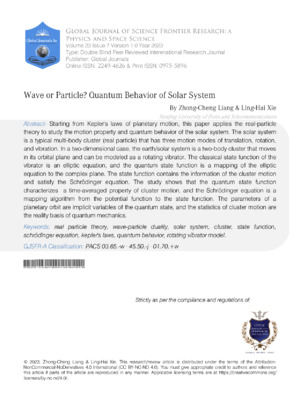
Starting from Kepler’s laws of planetary motion, this paper applies the real-particle theory to study the motion property and quantum behavior of the solar system. The solar system is a typical multi-body cluster (real particle) that has three motion modes of translation, rotation, and vibration. In a two-dimensional case, the earth/solar system is a two-body cluster that moves in its orbital plane and can be modeled as a rotating vibrator. The classical state function of the vibrator is an elliptic equation, and the quantum state function is a mapping of the elliptic equation to the complex plane. The state function contains the information of the cluster motion and satisfy the Schrödinger equation. The study shows that the quantum state function characterizes a time-averaged property of cluster motion, and the Schrödinger equation is a mapping algorithm from the potential function to the state function. The parameters of a planetary orbit are implicit variables of the quantum state, and the statistics of cluster motion are the reality basis of quantum mechanics.


Wave or Particle? Quantum Behavior of Solar System

Starting from Kepler’s laws of planetary motion, this paper applies the real-particle theory to study the motion property and quantum behavior of the solar system. The solar system is a typical multi-body cluster (real particle) that has three motion modes of translation, rotation, and vibration. In a two-dimensional case, the earth/solar system is a two-body cluster that moves in its orbital plane and can be modeled as a rotating vibrator. The classical state function of the vibrator is an elliptic equation, and the quantum state function is a mapping of the elliptic equation to the complex plane. The state function contains the information of the cluster motion and satisfy the Schrödinger equation. The study shows that the quantum state function characterizes a time-averaged property of cluster motion, and the Schrödinger equation is a mapping algorithm from the potential function to the state function. The parameters of a planetary orbit are implicit variables of the quantum state, and the statistics of cluster motion are the reality basis of quantum mechanics.

Zhong-Cheng Liang
Zhong-Cheng Liang Nanjing University of Posts and Telecommunications
Ling-Hai Xie
Ling-Hai Xie

No Figures found in article.

Zhong-Cheng Liang. 2026. “. Global Journal of Science Frontier Research – A: Physics & Space Science GJSFR-A Volume 23 (GJSFR Volume 23 Issue A7): .

Download Citation

Journal Specifications

Crossref Journal DOI 10.17406/GJSFR

Print ISSN 0975-5896

e-ISSN 2249-4626

Classification
GJSFR-A Classification: PACS 03.65.-w · 45.50.-j · 01.70.+w
Keywords
Article Matrices
Total Views: 1085
Total Downloads: 25
2026 Trends
Research Identity (RIN)
Related Research
Our website is actively being updated, and changes may occur frequently. Please clear your browser cache if needed. For feedback or error reporting, please email [email protected]

Request Access

Please fill out the form below to request access to this research paper. Your request will be reviewed by the editorial or author team.
X

Quote and Order Details

Contact Person

Invoice Address

Notes or Comments

This is the heading

Lorem ipsum dolor sit amet, consectetur adipiscing elit. Ut elit tellus, luctus nec ullamcorper mattis, pulvinar dapibus leo.

High-quality academic research articles on global topics and journals.

Wave or Particle? Quantum Behavior of Solar System

Zhong-Cheng Liang
Zhong-Cheng Liang Nanjing University of Posts and Telecommunications
Ling-Hai Xie
Ling-Hai Xie

Research Journals