
I. INTRODUCTION
The wave-particle duality is a fundamental assumption of quantum mechanics. Since its inception in the early 20th century, quantum mechanics has undoubtedly achieved great success, but the binary paradox of quantum has always puzzled humans. Is quantum a wave or a particle? The debate over this question has risen from the field of physics to the metaphysical level and has reached philosophical heights.
As is well known, the particle in classical mechanics is a spatially discrete mass point. The mass point is an idealized mathematical model whose defining feature is it has mass but no spatial extension and can be called a pseudo particle. The particle in quantum mechanics is a wave-particle duality, possessing both the continuity of a wave and the discreteness of a particle, and is simply called a quantum. Realism advocates, represented by Einstein, insist on the existence of objective entities behind the quantum representation, so they do not recognize the completeness of quantum mechanics [1]. Empiricists, represented by Bohr, believe there is no need to delve into the existence of the entity behind quantum, and the binary paradox of quantum does not affect the effectiveness and completeness of quantum mechanics [2]. Recently, the author's established theory of real particles provides a realistic interpretation of the essence of quantum. The real-particle theory is an axiomatic system [3-11] including the field theory of real particles [3-8], the theory of matter states [3-5,9, 10], and the thermodynamics of clusters [3-5,10,11]. A real particle is defined as a particle cluster with intrinsic attributes including mass, volume, and shape, and their prototypes are elastic particles in the real world. The mass point, quantum, and cluster have different motion characteristics and represent three different theoretical paradigms of the classical physics, modern physics, and real physics, respectively.
The motion of the solar system is an exemplar in classical mechanics. Astronomical observations show that planets orbit the sun under the influence of the sun's gravity, forming a stable cluster. In classical mechanics, the solar system is abstracted as a system of mass points consisting of the sun and planets, and the motion of the planets follows Newton's laws of motion. This paper studies the motion property and quantum behavior of the solar system based on the theory of real particles, starting from Kepler's laws. By mapping the classical orbit equation onto complex space, we obtain the quantum state function for describing the statistical behavior of the cluster and thus derive the Schrödinger equation for the motion of the earth/solar system. Through the realistic interpretation of cluster's quantum behavior, this paper demonstrates the unity of physical laws in the macroscopic and microscopic worlds.
II. MOTION OF SOLAR SYSTEM
a) Real particle model
A mass point has only mass but no volume and is a fictitious pseudo-particle. The curvilinear motion of a mass point includes three modes: real translation, pseudo rotation, and pseudo vibration. Real translation is the positional movement of the mass point, pseudo rotation is the circular motion of the mass point around the center of curvature, and pseudo vibration refers to the variation in curvature radius during the position movement. A real particle is a cluster containing multiple particles and has the attributes of mass, volume, and shape. The motion of a cluster includes three modes: real translation, real rotation, and real vibration. The real translation is the displacement of the cluster's barycenter, real rotation is the sum of the pseudo rotations of particles within the cluster, and real vibration is the superposition of the pseudo vibrations of particles within the cluster. The real rotation of a cluster is also known as self-rotation (spin), and the real vibration is also known as self-vibration (elastic vibration). In three-dimensional real space, a mass point has only three degrees of freedom for real translation, while a cluster has nine degrees of freedom for its three real modes of motion. The real-particle model is one of the fundamental assumptions of real physics, and the perspective of real-particle motion is the primary starting point of real-particle theory.
b) Kepler's laws
Kepler proposed the laws of planetary motion based on astronomical observations. According to these laws, the orbits of the planets around the sun are elliptical, with the sun at one focus of the ellipse. In classical mechanics, the solar system is abstracted as a system of mass points: the mass of the sun, denoted as , is located at the center of mass , while the mass of the planet, denoted as , is located at the center of mass . The motion trajectory of planet is shown in Fig. 1, which is an ellipse with the sun at one of the foci of the ellipse. Taking as the origin, the equation of the elliptic orbit represented in polar coordinates is given by
In the above equation, is the ellipse semi-major axis, is the eccentricity, and is the focal distance. The polar radii of the planet's perihelion and aphelion are given by and .
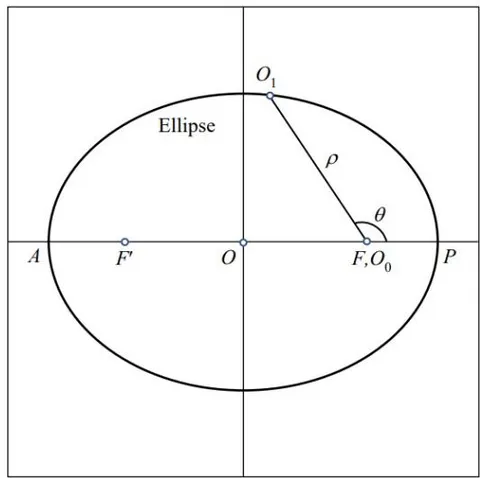
As shown in Fig. 2, in the Cartesian coordinate system with the ellipse center as the origin, the circle with radius is called a rotating circle, the azimuth angle is called a rotating angle, and the ellipse orbit can be expressed by parameters as [12]
The relationship between polar angle and rotating angle is
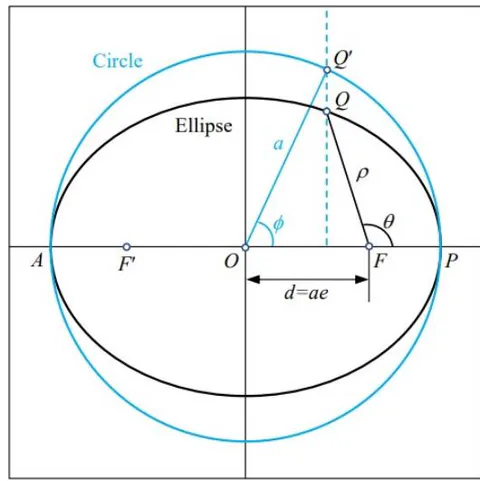
Thus, the elliptic orbit can be decomposed into two modes: pseudo rotation and pseudo vibration. In one period , the polar angle and the rotating angle change by , which is the pseudo-rotation mode. The average angular frequency of rotation is , with the direction perpendicular to the orbital plane and determined by the right-hand screw rule. In one period, the amplitude of the change in polar radius is , which is the pseudo-vibration mode. The vibration frequency is equal to the rotation frequency .
The motion of a planet on an elliptic orbit can be viewed as that of a rotating vibrator with a length of . One end of the vibrator is fixed at , and the mass is concentrated at the other end at , with an equilibrium length of . The rotating vibrator rotates about at the frequency of in a plane (like a rotor) and vibrates along its length direction (like an oscillator). The rotating and vibrating frequencies are , and the vibrating amplitude is . The speeds of rotation and vibration are given by
The stiffness of the vibrator is
Therefore, the rotational energy and vibrational energy of the planet are, respectively
Because may not be constant, the oscillation of the rotating vibrator is not a simple harmonic motion. If the rotation period is used as the unit of time, then . It is known that the masses of the sun and the earth are and respectively, the rotation period of the earth is , the equilibrium distance between the earth and the sun is , and the vibrating amplitude is . Therefore, the rotation energy of the earth is , the vibration energy is , and the vibrator's stiffness is .
c) Two-body cluster
Now, let's discuss the two-body problem starting from Kepler's laws based on the perspective of real-particle motion. Assuming that the center of the planet/sun cluster is at the barycenter , the reduced mass of the cluster is defined as
If the distance from the sun to the planet is , then the spaces from the barycenter of the cluster to and are, respectively
It can be proven that both and move around the barycenter in elliptic orbits.
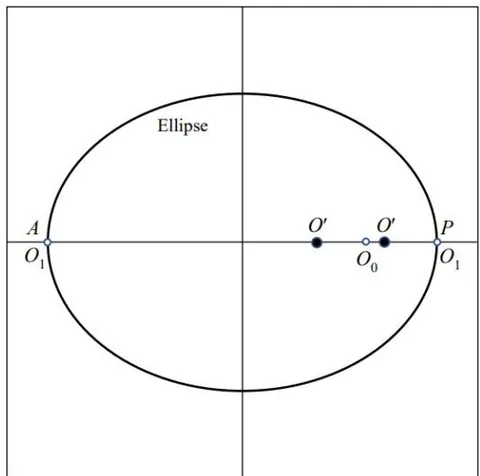
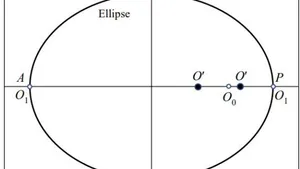
As shown in Fig. 3, when planet is located at the perihelion and the aphelion , the barycenter is situated to the right and left of , respectively. When is at the perihelion, , and the spaces from to the sun and the planet are and , respectively. When is at the aphelion, , and the spaces from to the sun and the planet are and , respectively.
The rotating radius and vibrating amplitude of the sun's orbit are given by
The rotating radius and vibrating amplitude of the planet's orbit are given by
Where and are the rotating radius and vibrating amplitude of for as the origin, and they have the following relationship
Therefore, the two-body cluster can be viewed as two pseudo-rotating vibrators with the rotating radii of and and the masses of and . They rotate and vibrate at the same frequency relative to the barycenter with a fixed phase difference of .
At this point, the pseudo-rotation energy and pseudovibration energy of the sun and the planet are, respectively
Therefore, the real-rotation energy and the real-vibration energy of the two-body cluster can be expressed as
Where is the cluster's rotating momentum, and is the cluster's stiffness. At this point, we call the two-body cluster a real rotating vibrator, and and are the self-rotation energy and self-vibration energy, respectively.
In this case, is the potential energy of the cluster. Since and , we have . It indicates a bound state and a necessary condition for cluster stability. The self-vibration energy is the system's Hamiltonian.
Given the reduced mass of the earth/sun system as , we can calculate and according to formula (14). Since , we have and , so the cluster's energy mainly comes from the earth's motion.
d) Multi-body cluster
Consider a multi-body cluster consisting of the sun and planets, where the mass of the sun and each planet are denoted by and , respectively. Taking the sun's center as the reference point, the orbital equation for the planet is given by
Where are respectively the rotating radius, angular frequency, vibrating amplitude, and initial phase of the planet to the reference point of the sun.
The system can be regarded as real-rotating vibrators, and each vibrator consists of a planet and the sun. The center of the -th vibrator is located at and has a reduced mass of
According to formula (14), the rotation energy and vibration energy of the -th vibrator and are, respectively
The rotation energy and vibration energy of a cluster containing planets are given by
| mi1024kg | ωi10-9rad/s | ai106km | di106km | Ki1032J | Hi1029J | |
| 1. Mercury | 0.3301 | 826.677 | 57.9091 | 11.9079 | 3.7826 | 159.94 |
| 2. Venus | 4.8675 | 323.639 | 108.208 | 0.73100 | 29.848 | 1.3622 |
| 3. Earth | 5.9722 | 199.099 | 149.598 | 2.49957 | 26.490 | 7.3955 |
| 4. Mars | 0.6417 | 105.858 | 227.956 | 21.3055 | 1.8683 | 16.321 |
| 5. Jupiter | 1898.2 | 16.7849 | 778.478 | 37.8785 | 1618.9 | 3832.8 |
| 6. Saturn | 568.34 | 6.75904 | 1433.53 | 80.9750 | 266.71 | 850.99 |
| 7. Uranus | 86.820 | 2.36968 | 2870.98 | 135.415 | 20.091 | 44.698 |
| 8. Neptune | 102.41 | 1.20811 | 4498.41 | 38.8950 | 15.123 | 1.1306 |
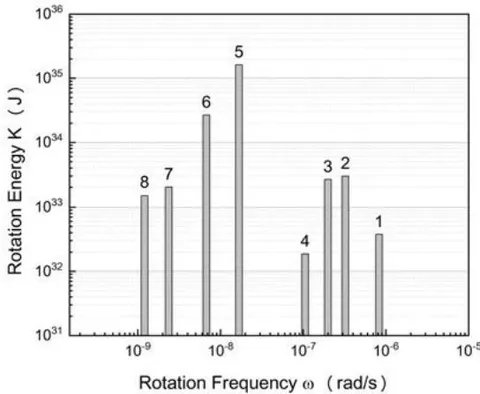
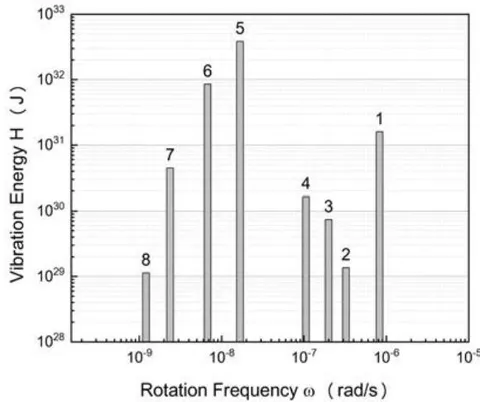
The relationship between and is called the rotation spectrum of the cluster, and the relationship between and is called the vibration spectrum.
Table 1 lists the data of mass, angular frequency, rotating radius, and vibrating amplitude of the eight major planets. The rotational and vibrational energies are calculated according to equation (17). Fig. 4 shows the rotational energy spectrum, and Fig. 5 shows the vibrational energy spectrum of the solar system.
III. QUANTUM THEORY OF CLUSTER
a) Scale and quantum
Physical quantities in real physics are expressed using real quantities. The form of a real quantity is ( ), where is the scale and is the digit. The principle of objectivity in real physics requires that physical formulas must satisfy the following conditions
In the above formulas, the scale relation stands for the covariance of physical units, and the digital relation stands for the invariance of mathematical relation. The number of independent scales (base scales) is limited to three by the covariance con
dition. Scale is a generalization of the concept of unit and quantum. The essential difference between classical and modern physics lies in using different scale bases.
Classical mechanics adopts the base scales: mass (kilogram), space (meter), and time (second). Other scales can be derived based on covariance: velocity , momentum , angular momentum , and energy . It can be seen that scale covers the concept of physical units. The International System of Units (SI) specifies the quantity values of basic units, and derived units are invariant.
Quantum mechanics adopts the base scales: velocity (speed of light), angular momentum (Planck constant), and frequency (variable). Derived scales include: time , space , momentum , mass , and energy . Since and are constants, there are the scale uncertainty relations: and . Because the frequency scale is variable in base scales, the derived scales are also varying. Systems containing varying scales are generalized quantum systems.
Relativistic mechanics adopts the base scales: mass , time , and velocity (speed of light). The constancy of the speed of light is the fundamental assumption of relativity, shows the effects of time dilation and length contraction, and indicates that the essence of the mass-energy relationship is a scale relationship.
A reasonable choice of independent scales can facilitate analysis and calculation. For example, specifying base scales as
we have the derived scales . Because , the energy of the solar system can be calculated using the following equation
b) State function
The relationship between the position and time of the rotating vibrator can be written as
According to equation (3), the rotating frequency of the vibrator is
The formulas (22) and (23) are the classical state functions of the rotating vibrator.
Consider the following questions: As , what is the probability distribution of finding the earth in the orbital plane? Are there any other stable orbits for the earth in the solar system? Are the energies between these orbits continuous? These questions do not have support from observational data, but can be theoretically analyzed and statistically answered.
Let's take the base scales of the system as , then, the derived scales are . At this point, the digital equation corresponding to the physical equation (22) can be written as
Mapping the left end of the digital equation to the complex plane and representing it with a complex function , we have
The in is the imaginary unit. The complex function is called the quantum state function of the rotating vibrator, is called the stationary state function, and is called the probability amplitude. The mapping relation is
The conversion from (24) to (25) is not a one-to-one mapping and cannot be expressed as a functional relation. The parameters hidden in the quantum state function are the frequencies, focal length, and semi-major axes of the elliptic orbit. The quantum state function contains information about the cluster's self-rotation and self-vibration and is a description of the state of motion of the cluster.
From the scale-free equation (24), it can be seen that should be finite. In addition, the state function is required to be square-integrable over the entire space, that is
In this case, there is a distribution function
represents the probability of finding the particle in the range , and this is the statistical interpretation of the quantum state function. Physics requires statistical descriptions like the state function because it is impossible to obtain unknown orbital parameters of the earth and electronic orbital data in all atoms.
c) State equation
The quantum state function of the cluster, represented by the real quantities, is
Where . We define the operators as follows
The symbol represents the gradient operator, and represents the Laplace operator. is the momentum operator, is the kinetic energy (rotation energy) operator, is the Hamiltonian (vibration energy) operator, and is the potential energy operator.
According to the energy relation , the following operator equation must hold
The differential equation obtained by applying the operator equation to the state function is as follows
Formula (32) is called the quantum state equation. Substituting into the quantum state equation yields the time-independent stationary state equation
The above equation, , is the eigen equation with eigenvalue . The eigen solution represents the time-averaged effect of the system, and each eigenstate corresponds to one possible orbital configuration. Equations (32) and (33) have the same form as the Schrödinger equation and can be generalized to three dimensions and multi-body systems.
The quantum state equation is a linear differential equation, and its general solution can be expressed as a linear combination of all eigenfunctions
The function is the normalized eigenfunction with energy , and represents the probability of the occurrence of the state . The above superposition principle requires a complete set of eigenstates and is not valid for partial state superpositions.
If does not depend on , i.e., , it can be verified that . This shows that is the image of , i.e., . When , there must be . Thus, solving the state function from the potential energy is a kind of mapping , where is the original image, is the mapped image, and the quantum state equation is the mapping relation .
The quantum state function is a probabilistic description of the time-avareged effect of the cluster, not the instantaneous behavior of individual particles. To emphasize this fact, we usually refer to the quantum state as the cluster state and the quantum state equation as the cluster state equation. The parameter in the state equation is the reduced mass of the system, and the angular momentum scale is a system constant, not a universal constant. The value used in quantum mechanics is . If the angular momentum of the earth/sun system is taken as the base scale, then .
d) Plane central force Field
The universal gravitational field and the Coulomb field are both central force fields, and the gravitational potential and Coulomb potential have similar forms. Taking the plane coordinates as an example, it has
Where is the universal gravitational constant, , and is the vacuum permittivity. In real-particle field theory [6], the potential includes a mass potential and a momentum potential. The mass potential is a spatial convolution of mass density, which causes an attractive interaction. The momentum potential is a spatial convolution of momentum density, which causes a repulsive interaction. The repulsion between particles arises from relative motion and does not require particles to have opposite charge signs. If the charges are all positive, then charge and mass are equivalent. It is known that the electron charge is and the electron mass-charge ratio is . By introducing the transformation coefficient , the relation be tween charge and mass is , and the relation between the Coulomb potential and the gravitational potential is .
The hydrogen atom and the earth/sun system are both two-body clusters with only one particle outside the kernels, and their energy eigen equations are given by
where , and the Laplace operator is
According to the theory of quantum mechanics, the eigenfunction of the two-body cluster is [13]
Where is the eigensolution of the following equation
The second term at the left end of the above equation is the repulsive potential which is caused by the pseudomotion modes of the particle outside the kernel. The energy eigenvalue of the system is
where . Therefore, we conclude that the probability of finding the earth on the orbital plane is proportional to . The stable orbits of the earth in the solar system are not unique, and the energies of different orbits are quantized.
IV. CONCLUSIONS
Mass points are fictional pseudo-particles. They have only mass but no volume and cannot explain the quantum properties of spin and wave-particle duality. Real particles are clusters that have mass, volume, and shape as well. The vibrational and translational modes of the clusters exhibit the quantum's wave-particle duality, while the rotational mode reflects the quantum's spin. A cluster is an actual entity corresponding to quantum and is a cross-level concept of matter structure. Atoms and the solar system are both clusters composed of low-level particles with similar structures and following unified laws of motion.
A two-body cluster is a rotating vibrator, and its orbit equation maps to a complex plane to form a quantum state function. The mapping from classical states to quantum states is a complicated cross-dimensional mapping, and its implicit variables are the classical orbit parameters. The quantum state function contains information on the rotation and vibration of the cluster. It is a probabilistic description of the long-term behavior of the clusters rather than the instantaneous behavior of individual particles. The state of the cluster is constrained by particle interactions and satisfies the equation of quantum wave mechanics. Solving the state function from the potential energy function is also a mapping, and the Schrödinger equation is a mapping algorithm. The statistics of cluster motion are the reality basis of quantum mechanics.
The scale concept is a generalization of physical units. Scales can be constants or variables, and systems with less than three constant scales are generalized quantum systems. The scale theory is the mathematical basis for describing cluster physics, and the principle of scale covariance fully reflects the unity of physical laws. The scale theory indicates that quantum is the natural unit of a physical quantity, but the objective entity represented by quantum is not the smallest element of matter. The peculiar behavior of quantum belongs to the aggregation effect of low-level particles or the emergence phenomenon of a high-level particle system.
ACKNOWLEDGEMENTS
The authors thank Ms. Y.Y. Dong for her assistance in translating the manuscript.