
Ways to Reduce the Amount of Heterocyclic Aromatic Amines Formed in Meat Products. The Review

1
Dmitry A. Utyanov
Dmitry A. Utyanov
2
Andrey V. Kulikovskii
3
Alexandra S. Knyazeva
4
Anastasia A. Kurzova
1 tesst

Send Message

To: Author

GJSFR Volume 22 Issue H1

Article Fingerprint

ReserarchID

39796

Ways to Reduce the Amount of Heterocyclic Aromatic Amines Formed in Meat Products. The  Review Banner
  • English
  • Afrikaans
  • Albanian
  • Amharic
  • Arabic
  • Armenian
  • Azerbaijani
  • Basque
  • Belarusian
  • Bengali
  • Bosnian
  • Bulgarian
  • Catalan
  • Cebuano
  • Chichewa
  • Chinese (Simplified)
  • Chinese (Traditional)
  • Corsican
  • Croatian
  • Czech
  • Danish
  • Dutch
  • Esperanto
  • Estonian
  • Filipino
  • Finnish
  • French
  • Frisian
  • Galician
  • Georgian
  • German
  • Greek
  • Gujarati
  • Haitian Creole
  • Hausa
  • Hawaiian
  • Hebrew
  • Hindi
  • Hmong
  • Hungarian
  • Icelandic
  • Igbo
  • Indonesian
  • Irish
  • Italian
  • Japanese
  • Javanese
  • Kannada
  • Kazakh
  • Khmer
  • Korean
  • Kurdish (Kurmanji)
  • Kyrgyz
  • Lao
  • Latin
  • Latvian
  • Lithuanian
  • Luxembourgish
  • Macedonian
  • Malagasy
  • Malay
  • Malayalam
  • Maltese
  • Maori
  • Marathi
  • Mongolian
  • Myanmar (Burmese)
  • Nepali
  • Norwegian
  • Pashto
  • Persian
  • Polish
  • Portuguese
  • Punjabi
  • Romanian
  • Russian
  • Samoan
  • Scots Gaelic
  • Serbian
  • Sesotho
  • Shona
  • Sindhi
  • Sinhala
  • Slovak
  • Slovenian
  • Somali
  • Spanish
  • Sundanese
  • Swahili
  • Swedish
  • Tajik
  • Tamil
  • Telugu
  • Thai
  • Turkish
  • Ukrainian
  • Urdu
  • Uzbek
  • Vietnamese
  • Welsh
  • Xhosa
  • Yiddish
  • Yoruba
  • Zulu

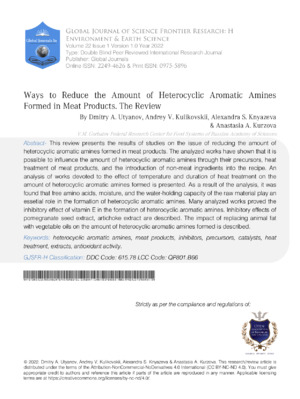
This review presents the results of studies on the issue of reducing the amount of heterocyclic aromatic amines formed in meat products. The analyzed works have shown that it is possible to influence the amount of heterocyclic aromatic amines through their precursors, heat treatment of meat products, and the introduction of non-meat ingredients into the recipe. An analysis of works devoted to the effect of temperature and duration of heat treatment on the amount of heterocyclic aromatic amines formed is presented. As a result of the analysis, it was found that free amino acids, moisture, and the water-holding capacity of the raw material play an essetial role in the formation of heterocyclic aromatic amines. Many analyzed works proved the inhibitory effect of vitamin E in the formation of heterocyclic aromatic amines. Inhibitory effects of pomegranate seed extract, artichoke extract are described. The impact of replacing animal fat with vegetable oils on the amount of heterocyclic aromatic amines formed is described.

Funding

No external funding was declared for this work.

Conflict of Interest

The authors declare no conflict of interest.

Ethical Approval

No ethics committee approval was required for this article type.

Data Availability

Not applicable for this article.

Dmitry A. Utyanov. 2026. \u201cWays to Reduce the Amount of Heterocyclic Aromatic Amines Formed in Meat Products. The Review\u201d. Global Journal of Science Frontier Research - H: Environment & Environmental geology GJSFR-H Volume 22 (GJSFR Volume 22 Issue H1): .

Download Citation

High-quality image depicting methods to cut greenhouse gases in food production, aligned with environmental research.
Journal Specifications

Crossref Journal DOI 10.17406/GJSFR

Print ISSN 0975-5896

e-ISSN 2249-4626

Keywords
Classification
GJSFR-H Classification: DDC Code: 615.78 LCC Code: QP801.B66
Version of record

v1.2

Issue date

April 16, 2022

Language

English

Experiance in AR

The methods for personal identification and authentication are no exception.

Read in 3D

The methods for personal identification and authentication are no exception.

Article Matrices
Total Views: 1562
Total Downloads: 16
2026 Trends
Research Identity (RIN)
Related Research

Published Article

This review presents the results of studies on the issue of reducing the amount of heterocyclic aromatic amines formed in meat products. The analyzed works have shown that it is possible to influence the amount of heterocyclic aromatic amines through their precursors, heat treatment of meat products, and the introduction of non-meat ingredients into the recipe. An analysis of works devoted to the effect of temperature and duration of heat treatment on the amount of heterocyclic aromatic amines formed is presented. As a result of the analysis, it was found that free amino acids, moisture, and the water-holding capacity of the raw material play an essetial role in the formation of heterocyclic aromatic amines. Many analyzed works proved the inhibitory effect of vitamin E in the formation of heterocyclic aromatic amines. Inhibitory effects of pomegranate seed extract, artichoke extract are described. The impact of replacing animal fat with vegetable oils on the amount of heterocyclic aromatic amines formed is described.

Our website is actively being updated, and changes may occur frequently. Please clear your browser cache if needed. For feedback or error reporting, please email [email protected]
×

This Page is Under Development

We are currently updating this article page for a better experience.

Request Access

Please fill out the form below to request access to this research paper. Your request will be reviewed by the editorial or author team.
X

Quote and Order Details

Contact Person

Invoice Address

Notes or Comments

This is the heading

Lorem ipsum dolor sit amet, consectetur adipiscing elit. Ut elit tellus, luctus nec ullamcorper mattis, pulvinar dapibus leo.


High-quality academic research articles on global topics and journals.

Ways to Reduce the Amount of Heterocyclic Aromatic Amines Formed in Meat Products. The Review

Dmitry A. Utyanov
Dmitry A. Utyanov tesst
Andrey V. Kulikovskii
Alexandra S. Knyazeva
Anastasia A. Kurzova

Research Journals





























































