The debate on the hypothesis that massive housing construction is the starting point of economic development has been ongoing since the end of World War II. Proponents of this hypothesis believe that housing serves as an impetus for economic development, and there is practical evidence to support this view. Opponents, however, state that housing is not a cause but a consequence of development. This latter group, in line with mainstream economic models, considers housing as a private consumer good, such as automobile, clothing, food and furniture. While the supply of housing entails enormous economies of scale, the consumption gives rise to interdependence costs. To internalize these costs, economic goods associated with interdependence costs require group or political consideration. Thus, it becomes inappropriate to model a house as a consumer good. The purpose of this article is to show that physical structure alone does not constitute a house. Private and public goods, complementary to housing, which lead to scale economies and elimination of interdependence costs excluded from relevant housing models, produce inadequate definition of a house.
## I. INTRODUCTION
The view that massive housing construction is the starting point of economic growth and development has been in the literature since the end of WW II, when nations were faced with the challenge of providing accommodations for returning veterans. The period also witnessed many nations preparing for independence from their colonial masters. Development models were needed for the new nations. The debate has continued well over seven and a half decades. Some nations that gained independence developed and others remain underdeveloped, yet there is no consensus among social researchers and economists about the significance of land use and housing in the process of development.
Arku (2006) partitions the discussion into a historical perspective and categorizes the debate into opponents, moderates, and proponent. The opponents argue that the concept of housing being considered a source of development was entirely in contrast to the fundamental economic theory. Development in the eyes of earlier twentieth-century economists arises from industrialization through capital accumulations (Harrod, 1939; Domar, 1947; Solow, 1956), and any use of capital for consumer item such as housing would tie up capital meant for economic growth. To these economists, housing is a "non-productive capital durable" and a "social expenditure" that usurps capital available for industrialization.
The proponents are of the view that instead of housing being regarded as a mere "biproduct" or a consequence of economic growth, it should be viewed as a precursor or prerequisite for development and growth (De Soto, 2000; Cohen, 2001). Furthermore, housing investment has a far-reaching impact on economic development as it creates employment, income, saving, stable settlement, and lessens absenteeism (Howenstine, 1957; Strassman, 1985). Thus, housing improvement must not wait until economies attain higher income as opponents of housing investment imply (Bauer, 1955).
The economic significance of housing construction is evident in Southeast Asia countries (Singapore, Hong Kong, South Korea, and Taiwan) who recognized the relevance of residential housing for the masses all through the last six decades and these countries are currently among high-income nations (Phang, 2001). Chen, Guo, and Zhou (2011) carried out empirical studies, using panel data, and found a stable long-run relationship between housing investment and GDP growth in China. Anna Tibaijuka (2013), in her "Building Prosperity: Housing and Economic Development," pursues the debate a little further by noting that housing is almost a public good and regards housing construction to be a spark for national economic development.
# a) The Nature of the Good
Researchers who disagree that land use and housing construction stimulate economic development do so under the premise of the neoclassical economic theory. Under this conceptualization, housing is modeled as a single private consumer product such as clothing, food, furniture, and automobile. It is a private good because it is thought to possess the economic attributes of a private good. These are rivalry and excludability characteristics. The private good rivalry characteristic lies in the fact that once purchased, the quantity of housing available for sale is reduced. While the excludability attribute of housing means that houses provide shelter only to the owner or renter and no one else outside the home simultaneously enjoys the accommodation provided by the house. Under this theoretical framework, housing is a private good, and ownership depends on income and price.
The question now is based on the nature of the good, does housing as a consumer good emit social cost (spillover or negative externalities) on others in the same vicinity, and does it promote social wellbeing to individuals in the same neighborhood (positive externality)? To answer these questions, we must consider not only the physical structure of the house as a shelter, but we must also give factual details of the architectural design of modern houses. It is also imperative to consider the scale economies in the provision of shared complementary private and public goods. A home in the form of a single-family, multiple-family, or apartment has public good attributes compared to clothes, food, automobile, and furniture devoid of collective characteristics. Therefore, if many quasi-public goods are parts of housing, it becomes a theoretical inadequacy to model a house akin to private consumer goods.
Whether or not general housing construction is the starting point of economic development depends on the definition of a house. While opponents of the debate believe housing is a consumer good based on mainstream economic modeling, nonetheless, supporters of the hypothesis that general housing construction is the foundation of industrialization and development have not provided sufficient arguments within economic theories to support their claims. The purpose of this paper is to bridge the gap between opponents and proponents of the debate using the relevant resource reallocation theory. The goal is to improve the indispensability of land use and housing in the process of economic development. Thus, a broadly defined housing scheme should be accepted as the heartbeat of resource reallocations and an engine of economic growth.
## II. THE HOUSING MODELS
Algebraically, individuals maximize their utility (pleasure or wellbeing) in the consumption of housing $(H)$ and composite goods denoted by (C). For individuals $a$ and $b$ whose houses are standing on adjacent land in the same community, their consumption bundle could be expressed in two different models. The first is where housing and all its amenities are perceived as a private consumer good, a physical structure, which makes households $a$ and $b$ independent of one another. The second model identifies interdependency between neighbors $a$ and $b$ due to the presence of quasi-public goods and externalities.
### a) Housing as Independent Private Consumer Goods
Both households $a$ and $b$ maximize the objective functions
$$
U ^ {a} = U ^ {a} \left(H ^ {a}, C ^ {a}\right) \quad and \quad U ^ {b} = U ^ {b} \left(H ^ {b}, C ^ {b}\right) \tag{1}
$$
Subject to the constraint
$$
I^{a} = p_{h} H^{a} + p_{c} C^{a} \text{and} I^{b} = p_{h} H^{b} + p_{c} C^{ ext{b}}
$$
The Langrage function becomes:
$$
\int_ {a} = U ^ {a} \left(H ^ {a}, C ^ {a}\right) + \lambda \left(U ^ {b} - U ^ {b} \left(H ^ {b}, C ^ {b}\right) + J I \left[ I ^ {a} + I ^ {b} - \rho_ {h} \left(H ^ {a} + H ^ {b}\right) - \rho_ {c} \left(C ^ {a} + C ^ {b}\right) \right] \right. \tag {3}
$$
where $p_h$ and $p_c$ are prices of housing (H) and composite goods (C), respectively. $I^a$ and $I^b$ are incomes for households $a$ and $b$ and in stratified income communities, they are in the same income group. The first order condition and subsequent algebraic manipulations, efficiency requires that,
$$
\left[ \delta U^{a} / \delta H^{a} \right] / \left[ \delta U^{a} / \delta C^{a} \right] = \left[ \delta U^{b} / \delta H^{b} \right] / \left[ \delta U^{b} / \delta C^{b} \right] = p_{h} / p_{c} \tag{4}
$$
which could also be expressed as $(\mathsf{MU}_{\mathsf{H}}^{\mathsf{a}}) / (\mathsf{MU}_{\mathsf{C}}^{\mathsf{a}}) =$ $(\mathsf{MU}_{\mathsf{H}}^{\mathsf{b}}) / (\mathsf{MU}_{\mathsf{C}}^{\mathsf{b}}) = p_{h} / p_{c}$. These expressions are positive. In other words, trade efficiency requires that the marginal rate of substitution (MRS) between housing $(H)$ and composite goods $(C)$ are equal for both consumers. In this case, for consumers $a$ and $b$,
$$
MRS_{HC}^{a} = MRS_{HC}^{b} = p_{h}/p_{c}
$$
For the entire community, given production efficiency, social efficiency dictates that,
$$
M R S _ {H C} = M R T _ {H C} \tag {5}
$$
where the term $MRT_{HC}$ represents the marginal rate of transformation between housing (H) and composite goods (C). That is, the tradeoff between society's choice to construct housing or produce composite goods. In economics, it is the simple opportunity costs of housing expressed in terms of composite goods or vice versa.
### b) Housing as Interdependent Political Goods
In Equations (1) through (5) there is a price mechanism that allocates housing and the composite goods, making housing an ordinary consumer item. We could have another model for households $a$ and $b$.
$$
U^{a}=U^{a}(H^{a},C^{a})\quad\text{and}\quad U^{b}=U^{b}(H^{b},H^{a}C^{b})\tag{6}
$$
Equations (1) and (6) are similar but different in that $U^b$, the well-being of the second household is affected by the housing choice of the first household $H^a$. Thus, there is a third item $(H^a)$ in the utility function of consumer $b$, $U^b$. This is the externality item or a spillover effect oozing from the housing choice of household $a$.
The constraint function Equation (2) remains the same and the Langrage becomes:
$$
\int_{a} = U^{a}(H^{a}, C^{a}) + \lambda\left(U^{b} - U^{b}(H^{b}, C^{b}, H^{a}) + \Pi\left[I^{a} + I^{b} - p_{h}(H^{a} + H^{b}) - p_{c}(C^{a} C^{b})\right]\right)\tag{7}
$$
The first order condition and exchange result from (7) becomes,
$$
[\delta U^a / \delta H^a ] / \delta U^a / \delta C^a + [\delta U^b / \delta H^a ] / [\delta U^b / \delta C^b ] = p_h / p_c \tag{8}
$$
As compared to Equation (4), $[\delta U^a /\delta H^a ] / \delta U^a /\delta C^a ] > 0$. $[\delta U^b /\delta H^a ] / [\delta U^b /\delta C^b ] < or > 0$ depending if household a's housing behavior $(\delta U^{b} / \delta H^{a})$ are harmful $[( \delta U ^ { b } / \delta H ^ { a } )$ is negative] to $b$ or beneficial $[( \delta U ^ { b } / \delta H ^ { a } )$ is positive] to household $b$. Let the second term of (8), $[\delta U^b /\delta H^a ] / [\delta U^b /\delta C^b ] = \Omega$. The exchange result between household a and $b$ becomes:
$$
M R S _ {H C} ^ {a} + \Omega \neq M R S _ {H C} ^ {b} \tag {8a}
$$
Equation (4a) is no longer true as indicated in Equation (8a); the marginal rate of substitution between the households and the top-level outcome, the society's marginal rate of transformation is no longer equal as indicated in Equation (9) below.
$$
M R S _ {H C} + \Omega \neq M R T _ {H C} ^ {\flat} \tag {9}
$$
The symbol $\Omega$ in Equation (9) mostly appears in environments as a spillover. Economists refer to it as externalities. Coarse (1960) identifies it as a social cost; and Buchanan and Tullock (1962) calls it interdependence costs. These externalities cumulate to blights. Investors would not move capital to areas that are saturated with blights (Wassmer, 2008). It affects every economic agent, including individuals and firms. Externalities result from improper land use and poorly defined housing. Massive housing construction provides public goods in the community that eliminates the externalities.
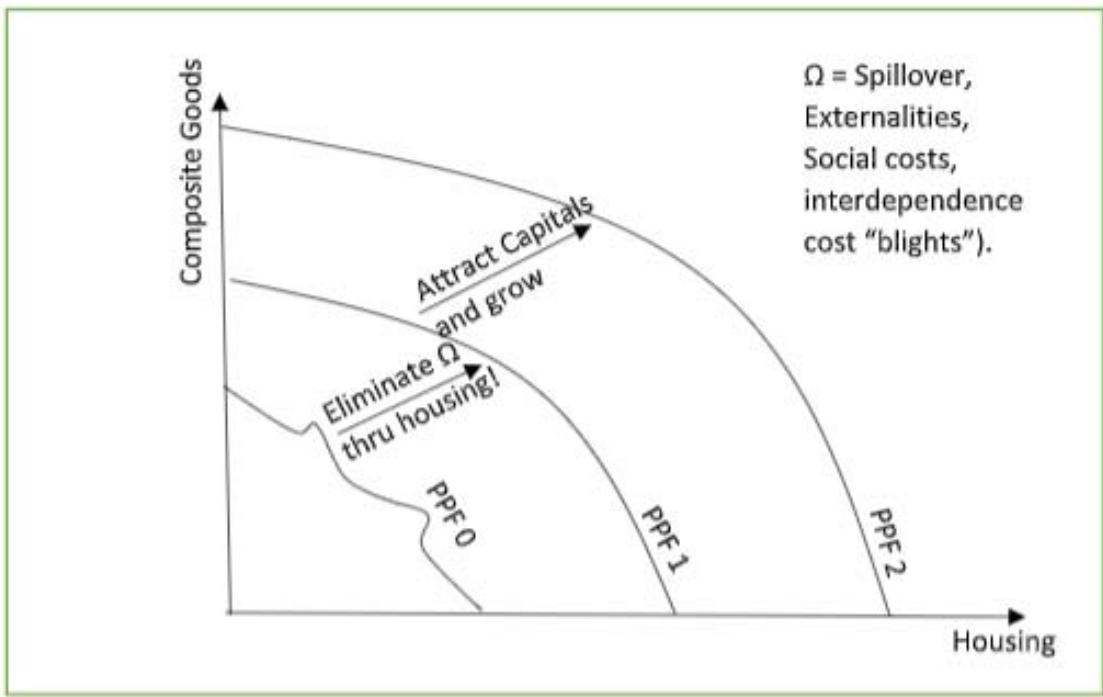 Figure 1: Externalities and Production Possibility Frontiers.
The market cannot allocate externality because it has no price. The government, as representative of the public, eliminates externalities through proper public policy on the use of land. Why land? Because land is a significant economic resource, and externalities occur owing to the sharing of land. The second model is the scenario proponents of debate have in mind. However, housing, externalities and quasi-public goods are separately analyzed in the literature because houses or homes are modeled as economic consumer goods.
As seen in figure 1, many nations of the world are underdeveloped because they are stuck on PPF0. They cannot move to their initial production frontier (PPF1) due to the presence of externalities—inefficient resource allocations. Reallocation of resources requires inclusive housing programs along with essential complementary quasi-public goods, as described in the next section. This would move these societies to efficient PPF1 and attract capital for growth and development (PPF2). PPF0 has an unusual shape because it does not comply with the concept of opportunity cost.
The practice in underdeveloped countries suggests that land use and housing construction are entirely within the choice of the individual; people build as they deem fit with complete disregard to the interdependence costs associated with the use of land and housing. This practice corresponds to the view that housing is a consumer good similar to other private goods.
However, in developed countries, whether in rural areas or big cities, developers authorized by the government in the form of permits construct rows and miles of housing in different sizes and shapes for people to buy according to their income. The land is zoned into industrial, commercial, residential, public parks, schools, etcetera. Residential properties are broken into single and multiple family units as well as apartments. These forms of land use—collectively provided housing scheme—comply with Buchanan and Tolluck's (1962) analysis that some human activities fall within the realm of political rules and other by private economic decision. Therefore, the view that land use and housing development creates the momentum for economic development is equivalent to the conclusion by Enajero (2018) that many, if not all, human activities are both political and economic (public choice).
In other words, a free market based on individual choice is the first best economic resource allocative mechanism. However, on several human activities such as land use and housing, the market mechanism fails in the efficient allocation of resources. When this occurs, the government, an agent of public choice, implements the reallocation of resources—the second-best solution.
## III. HOUSING COMPLEMENTARY GOODS
To determine whether housing constitutes the starting point of economic development, we would have to answer the question, what is a house? There are private and public goods, integral to housing, that yield economies of scale. These quasi-public goods include internal plumbing for drinking water and sewage, electricity, and gas supply. These are known as utilities. Public or collectively consumed goods complementary to housing include walkways, streets, safety (fire and police protection), garbage collection, sanitation, streetlights, parks, library, and K-12 education. These are public goods that cannot be separated from the home. In fact, in choosing a community, potential homebuyers lay more emphasis on the quality of the complementary goods than the physical housing structure.
The efficient use of land by zoning requires residential housing standing in rows or circles, on streets connecting roads and avenues leading to the highways. Revenues generated from taxes imposed on housing are used to finance public goods. Investments in these private and public goods complementary to housing exploit scale economies and would not occur without a well-coordinated neighborhood and regional planning; thus, recognizing community interdependence. While the provision of these housing amenities attracts tourism and capital, the absence creates blights, $(\Omega)$ (Wassmer 2008) that repel the capital needed for industrialization and development. Perhaps, these complementary private and public goods to housing are the social capital lacking in underdeveloped countries discussed extensively in the economic literature (Hanka and Engbers, 2017; Jordan 2020; Khadjavi, et. al 2021; Gao et. al. 2024). If these social capitals complementary to housing, albeit modeled separately in the housing market, are necessary to attract financial and physical capitals, then massive housing construction is inevitably a prerequisite for rapid economic development.
To internalize externalities (spillover effect) as indicated by omega sign $\Omega$ in Equation (9), and provide complementary public goods, public choice prevails over individual choice in housing construction. Collectively provided housing is development of its own in the locality. It is a "catalyst" for faster national economic development because such public choice practice creates a conducive environment and provides the infrastructure for capital productivity and profitability.
### a) Housing and Human Attributes
Besides, the architectural design of the modern ideal home portrays human dignity. At the entrance is a place for visitors to hang a jacket, a hallway leading to the family or living room (parlor), a space for the lady of the house, kitchen, dining room, nursing room, bathroom, and toilets. Others may have a home office, and balcony (Clark, 1986). All members of the household have separate rooms for privacy, and all gather in the dining room and parlor for meals and family meetings, respectively. Thus, the "idealized" and standardized family home portrays economic, aesthetic, sanitary, material, spiritual, and teaches morality and patterned behavior. Attributes that display human virtues are necessary social assets (Wright, 1981).
The human aspects brought about by homeownership are numerous. Housing encourages the household to accumulate savings as the value appreciates over time. These savings are carried forward from generation to generation. The households indirectly learn low time preferences, the human attributes to postpone or spread consumption to the future. The opportunity cost of wealth creation is recognized. It empowers the households to be part of a society, and the tendencies to engage in civil strife and rebellious destruction of properties are reduced (Yew, 2000). Massive housing construction narrows the inequality gap between the wealthy and the poor in any society (Imbroscio, 2023).
### b) Macroeconomic Ties
The view that housing is the building block of economic development also has some macroeconomic implications. Housing supply and demand are accompanied by macroeconomic consequences via the financial sectors. In many economic systems, the proportion of consumer spending carries about $70\%$ of the gross domestic product (GDP). Most of the spending could be linked to housing and housing-related expenditures. The mortgage markets serve as solid supports to the entire financial markets. In today's economies centered on money and banking, the role of mortgages in the financial system cannot be over-emphasized.
Above all, housing and the complementary amenities that completely define a home require low-skilled labor, domestic materials, and low technology that are in abundance in underdeveloped countries. Housing and affiliated goods do not require heavy machinery and high technology. (Spence and Cook, 1973). Thus, a general housing scheme could be a sound macroeconomic policy aimed at providing shelter and reducing high unemployment in developing countries (Graham 1994).
## IV. CONCLUSION
For the past 75 years, there have been debates concerning the impact of massive housing construction on economic development. Supporters think housing should be viewed as a precursor or prerequisite to economic development and growth. Opponents believe housing is a "non-productive capital durable" and a "social expenditure" that usurps capital available for industrialization. This latter group views and models housing equivalent to automobiles, clothes, foods, furniture, and other private goods.
This paper broadly defines a "modern house" to include complementary quasi-public goods. The absence of these private and public goods that are integral to housing results in externalities. The market fails in the allocation of externalities, and the reallocation function of a government necessitates the elimination of externalities by proper land use and housing construction. Therefore, the provisions of these quasi-public goods along with housing eliminate externalities and prepare a nation for capital inflow, industrialization, and development.
It is also shown that housing is much more than the physical structure that provides shelter. It reshapes the household to be an economic agent. Housing encourages the household to accumulate savings as the value appreciates over time. These savings are carried forward from generation to generation. The households indirectly learn low time preferences, the human attribute to postpone or spread consumption to the future. Moreover, since the residents of collectively provided housing enjoy similar public goods and services, social inequality between the rich and the poor is narrowed.
Therefore, the housing complementary private and public goods, albeit, separately discussed extensively from housing in the economic literature, could be considered the social capital lacking in underdeveloped countries. If these social capitals complementary to housing are necessary to attract financial and physical capitals, then, massive housing construction becomes a mandatory prerequisite for rapid economic development.
Generating HTML Viewer...
References
26 Cites in Article
Godwin Arku (2006). The housing and economic development debate revisited: economic significance of housing in developing countries.
C Bauer (1955). The Case for Regional Planning and Urban Dispersal.
J Buchanan,G Tullock (1962). The Calculus of Consent: Logical Foundations of Constitutional Democracy.
Jie Chen,Feng Guo,Aiyong Zhu (2011). The Housing-led Growth Hypothesis Revisited.
C Clark (1986). The American Family Home, 1800-1960.
R Coase (1960). The Problem of Social Cost.
M Cohen (2001). Urban Assistance and the Material World: Learning by Doing at the World Bank.
H De Soto (2000). The Mystery of Capital: Why Capitalism Triumphs in the West and Fails Elsewhere.
E Domar (1947). Expansion and Employment.
S Enajero (2018). Interdependence Costs, Collectivism and Economic Rationale for a Nation: A Reminder to Africa.
Zhiyuan Gao,Lianqing Li,Yu Hao (2024). Resource industry dependence and high-quality economic development of Chinese style: Reexamining the effect of the “Resource Curse”.
Matthew Hanka,Trent Engbers (2017). Social Capital and Economic Development: A Neighborhood Perspective.
R Harrod (1939). An Essay in Dynamic Theory.
J Howenstine (1957). Appraising the Role of Housing in Economic Development.
David Imbroscio (2023). Toward a New Project for Equality and Justice—In Housing, and Beyond: A Rejoinder.
B Jordan (2020). Social Values in Public Policy.
Menusch Khadjavi,Kacana Sipangule,Rainer Thiele (2021). Social Capital and Large-Scale Agricultural Investments: An Experimental Investigation.
Sock-Yong Phang (2001). Housing Policy, Wealth Formation and the Singapore Economy.
Robert Solow (1956). A Contribution to the Theory of Economic Growth.
R Spence,D Cook (1973). Building Materials in Developing Countries.
P Strassman (1985). Employment in Construction: Multicountry Estimates of Costs and Substitution Elasticities for Small Dwellings.
A Tibaijuka (2013). Building Prosperity: Housing and Economic Development.
G Tipple (1994). Employment from housing.
R Wassmer (2008). Causes of Urban Sprawl in the United States: Auto Reliance as Compared to Natural Evolution, Flight from Blight and Local Revenue Reliance.
G Wright (1981). Building the Dream: A Social History of Housing in America.
L Yew (2000). From Third World to First: the Singapore Story: 1965-2000.
No ethics committee approval was required for this article type.
Data Availability
Not applicable for this article.
How to Cite This Article
Samuel E. Enajero. 2026. \u201cWhat Is a House? Exploring the Relationship Between Housing and Economic Development\u201d. Global Journal of Human-Social Science - E: Economics GJHSS-E Volume 24 (GJHSS Volume 24 Issue E1): .
Explore published articles in an immersive Augmented Reality environment. Our platform converts research papers into interactive 3D books, allowing readers to view and interact with content using AR and VR compatible devices.
Your published article is automatically converted into a realistic 3D book. Flip through pages and read research papers in a more engaging and interactive format.
The debate on the hypothesis that massive housing construction is the starting point of economic development has been ongoing since the end of World War II. Proponents of this hypothesis believe that housing serves as an impetus for economic development, and there is practical evidence to support this view. Opponents, however, state that housing is not a cause but a consequence of development. This latter group, in line with mainstream economic models, considers housing as a private consumer good, such as automobile, clothing, food and furniture. While the supply of housing entails enormous economies of scale, the consumption gives rise to interdependence costs. To internalize these costs, economic goods associated with interdependence costs require group or political consideration. Thus, it becomes inappropriate to model a house as a consumer good. The purpose of this article is to show that physical structure alone does not constitute a house. Private and public goods, complementary to housing, which lead to scale economies and elimination of interdependence costs excluded from relevant housing models, produce inadequate definition of a house.
Our website is actively being updated, and changes may occur frequently. Please clear your browser cache if needed. For feedback or error reporting, please email [email protected]
Thank you for connecting with us. We will respond to you shortly.