1. Introduction
The Akan people of Ghana’s Bono Region carry a proverb: “Onipa wu a, na n’asaase su no” ("When a person dies, the earth weeps for them"). In this single image is compressed an entire theology: the human person, the community, and the earth stand in a relationship of mutual moral claim, in which death does not dissolve but intensifies. To be received by the earth in burial is to be honored by that relationship; to be denied burial is to be refused by it. The social, cosmological, and theological stakes of burial in Akan thought are, accordingly, among the highest that can be imagined.
It is within this cultural and theological context that the burial clause of Ecclesiastes 6:3b, "and also he has no burial," speaks with unexpected and profound directness. A recent theological analysis (Gyan, 2026) [1] shows that Qoheleth’s use of the burial motif serves as the theological culmination of Ecclesiastes 6:1–6. It acts as a symbol of covenant breach in Hebrew tradition, a form of social and memorial suppression in the ancient Near Eastern culture, and a signpost pointing toward a final divine judgment beyond Qoheleth’s literary perspective. That study, however, operated principally within a Western biblical hermeneutical framework, drawing on comparative materials from Mesopotamia, Egypt, and Israel. A significant hermeneutical opportunity remains unexplored: the reading of Ecclesiastes 6:3b from within and alongside the funerary theologies of African traditional societies.
The present article develops that opportunity. It argues that Qoheleth’s theology of the unburied dead and the Akan theology of burial share a deep structural grammar that makes them natural and mutually illuminating conversation partners. Both traditions identify the denial of proper burial not as a neutral biographical circumstance but as a theologically laden verdict, a declaration by the community that the deceased stands outside the network of belonging that alone can complete a human life. When this cross-textual dialogue is further illuminated by Ubuntu relational philosophy, the African ethical framework that grounds personhood constitutively in community, the result is a contextual African pastoral theology of burial that speaks with prophetic force into the concrete funerary crises of contemporary sub-Saharan Africa.
The urgency of this study is sharpened by realities that are immediately familiar to anyone ministering in West Africa: hospital mortuaries holding unclaimed bodies for months because families cannot afford burial costs; the elderly poor dying in neglect and left unburied by children who have relocated to urban centres; the bodies of those who died by suicide, of HIV/AIDS, or in social disgrace being denied proper burial rites by communities that regard their deaths as shameful. Ecclesiastes 6:3b, read through an African hermeneutical lens, is not an ancient curiosity but a living prophetic word addressed to each of these situations.
The article employs African Biblical Hermeneutics as its primary methodological framework, following the approach developed by Ukpong, Dube, and West [10, 11, 12], which reads the biblical text in deliberate dialogue with African cultural and religious traditions, treating both as legitimate sources of theological insight. The author’s situated knowledge as an ordained minister of Christ Apostolic Church International in the Berekum Area of the Bono Region of Ghana, the heartland of Akan (Bono subgroup) territory, provides the ethnographic-theological grounding for the analysis. The article proceeds as follows: Section 2 revisits Qoheleth’s burial theology; Section 3 analyses Akan funerary cosmology; Section 4 examines Ubuntu and the unburied dead; Section 5 develops a cross-textual dialogue; Section 6 engages contemporary African funerary crises; Section 7 constructs a contextual pastoral theology of burial; and Section 8 offers a concluding synthesis.
2. Qoheleth’s Burial Theology Revisited
2.1. The Burial Clause in Ecclesiastes 6:3b
The clause וְגַם־קְבוּרָה לֹא־הָיְתָה לּוֹ (w’gam-q’vurah lo-haytah lo "and also he has no burial") appears in a passage that catalogs the apparent blessings of a wealthy man: a hundred children, many years of life, and presumed abundance (Eccl. 6:1–3). Qoheleth’s devastating reversal is that none of these blessings constitute genuine life, because the man’s soul (nephesh) is not satisfied with life’s good things and he dies without burial [1]. The Hebrew syntax places the noun (qevurah) "burial" in a fronted, emphatic position, "and also, a burial, there was not for him," signaling that its absence is not incidental but evaluative [2, 13]. It is the climactic absence, the final stripping away that leaves the man of apparent abundance with literally nothing.
The burial clause occupies a structurally pivotal position within Ecclesiastes 6:1–6, functioning as the bridge between the portrait of the joyless wealthy man (v.3a) and the comparison with the stillborn child, the “nephel” (v.3b–5) [1]. The rhetorical logic is elegant: the unburied man ends in darkness just as the “nephel” begins in darkness. Both arrive at the same destination of obscurity and forgetting, but the man does so after a lifetime of accumulated appearances, making his end qualitatively worse than that of the child who never knew otherwise [14, 3].
2.2. The Threefold Function of the Burial Clause
The previous study (Gyan, 2026) [1] identified three simultaneous levels at which the burial clause operates within the Hebrew theological tradition. Initially, burial on ancestral land in ancient Israel symbolized a covenantal act signifying involvement in God’s community. Phrases like "gathered to his people" and "slept with his fathers" indicate that burial was the ultimate expression of covenantal connection. Conversely, denial of burial was a prophetic curse signifying divine disfavor (cf. Jer. 22:19; Deut. 28:26; 1 Kgs. 14:11), thereby establishing the theological grammar: proper burial = divine favor + covenantal standing; denial of burial = divine judgment + covenantal rupture [8].
Second, as social and memorial erasure: in the ancient Near Eastern world, tombs were the mechanism of communal memory, inscribed with names, genealogies, and accomplishments precisely because burial transferred the deceased from the register of the living to the register of the remembered [9]. The unburied man disappears not only from life but from memory, and this, Qoheleth notes with characteristic irony, despite his hundred children, who in the wisdom tradition were themselves a man’s memorial (cf. Prov. 17:6; Ps. 127:3–5).
Third, as an eschatological signpost: canonically read alongside the New Testament, the burial clause points beyond Qoheleth’s own horizon toward the burial of Jesus as the form of a death that holds resurrection hope (1 Cor. 15:3–4). The man denied burial is denied not only earthly honor but the form of a death that anticipates renewal [6]. These three levels of meaning establish the theological framework that this article now brings into dialogue with African funerary traditions.
3. Burial in Akan Cosmology and African Traditional Religion
3.1. The Akan Understanding of Death and the Person
The Akan understanding of the human person is irreducibly communal and cosmological. The person “onipa” is constituted by multiple components: the “mogya” (blood, received from the mother and establishing clan membership), the “ntoro” or “sunsum” (spirit, received from the father), and the okra (soul, the divine spark given directly by “Onyame”, the Supreme Being) [5, 6]. At death, the okra returns to “Onyame”, while the “sunsum” enters the spirit world (asamando) to take its place among the ancestors (Nsamanfo), provided that death and burial have occurred in a manner consistent with the moral and relational obligations of the person’s life.
Death in Akan cosmology is not the end of the person but a transition, a journey from the world of the living (wiase) to the world of the ancestors (asamando) [7]. The relationship between the living and the ancestors is not severed by death but transformed: the Nsamanfo remain active participants in the life of the community, offering protection, guidance, and moral accountability. This relationship, however, is contingent on the proper performance of death and burial rites. A person who dies without proper burial does not complete the transition; their spirit wanders in a state of cosmological incompleteness, unable to join the Nsamanfo and potentially dangerous to the living community [5].
3.2. Proper Burial as Cosmological Transition
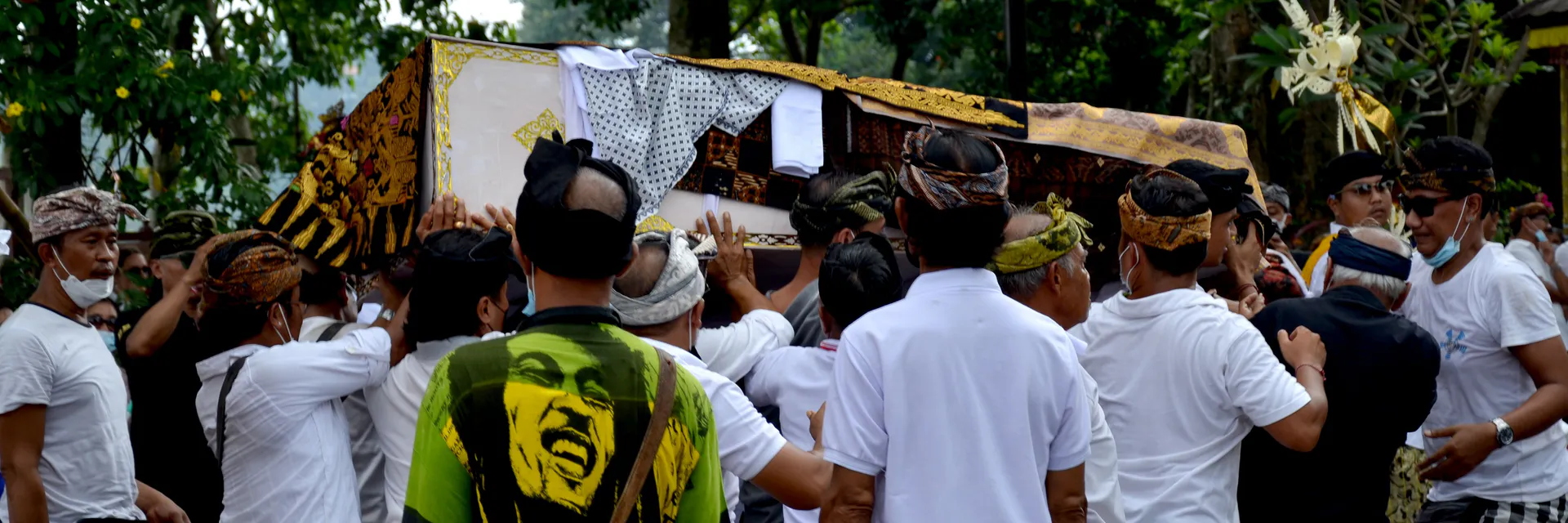
Akan burial rites are among the most elaborate and socially significant events in community life. They are not merely funerary ceremonies but cosmological events in which the community actively participates in the completion of the deceased’s transition from the world of the living to the world of the ancestors. The community’s participation is essential: through collective mourning, ritual observance, and ceremonial burial, the deceased is formally "handed over" to the world of ancestors [6]. To bury a person is to complete them; to refuse burial is to leave them incomplete.
The funeral rites (ayie) in Akan society involve multiple stages: the laying in state (in which the deceased is dressed and displayed for communal viewing and mourning), the funeral celebration (in which the life of the deceased is remembered and honoured through music, libation, and communal gathering), the burial itself (in which the body is placed in the earth), and the final funeral rites (performed weeks or months later to formally conclude the mourning period and welcome the deceased into the ancestor world) [6, 7]. Each stage has theological significance. The laying in state affirms the dignity of the deceased as a person; the funeral celebration constitutes the communal memory that the burial will seal; the burial itself is the cosmological transition; and the final rites complete the process of ancestral incorporation.
Crucially, the quality and character of a person’s funeral reflects and enacts the community’s verdict on the moral standing of their life [6]. A person who lived well and fulfilled their relational and moral obligations receives a funeral that honors their memory and smooths their transition to the ancestor world. A person who lived badly, who failed their community, or who died in disgrace may receive a diminished or disrupted funeral. In the most extreme cases, burial may be refused entirely, leaving the deceased in a state of cosmological homelessness that mirrors, in the Akan imagination, the moral homelessness of their earthly life.
3.3. The Cosmological Consequences of Denial of Burial
The consequences of improper or denied burial in Akan cosmology are severe and extend beyond the individual to the community. A person denied burial cannot join the Nsamanfo; their spirit (saman) wanders in a state of restlessness and incompleteness, known as a saman pa (wandering spirit) that may return to trouble the living [5]. This belief is not peripheral superstition but a central expression of the Akan cosmological conviction that the boundary between the living and the dead is permeable, that the dead remain morally present within the community, and that the community’s failure to complete its obligations toward the dead carries consequences for the living.
This cosmological logic creates a powerful communal obligation toward proper burial. Because the failure to bury has consequences not only for the deceased but for the living community, denial of burial is understood as a form of communal self-harm, a rupture of the relational web that sustains both the living and the dead. The obligation to bury is thus not merely an act of charity toward the deceased but an act of communal self-preservation, an expression of the community’s commitment to its own integrity and flourishing [6, 7].
3.4. The Community as the Agent of Burial Honor
A distinctive feature of Akan funerary theology, one that resonates powerfully with Qoheleth’s burial clause, is the understanding that burial is a communal verdict. The manner of a person’s burial its elaborateness, its social participation, its geographical location, its ritual completeness is determined by the community’s assessment of the deceased’s relational and moral standing. In this sense, burial in Akan thought is not merely what happens to the dead; it is what the community says about the dead [5, 6].
This understanding places the spotlight of moral accountability on the community rather than (or in addition to) the deceased. When Qoheleth states that the wealthy man dies without burial despite his hundred children (Eccl. 6:3b), the Akan reader hears something the Western reader may miss: not merely a biographical detail about the man’s misfortune, but a communal verdict. A hundred children who do not bury their father have made a statement about him, and about themselves. The burial clause is, in this reading, a communal indictment as much as an individual tragedy.
4. Ubuntu and the Unburied Dead
4.1. Ubuntu Relational Ontology
Ubuntu philosophy, articulated systematically by scholars including Mogobe Ramose, Thaddeus Metz, and Drucilla Cornell [17, 18, 19], provides the ontological foundation for understanding why denial of burial constitutes such a profound moral failure in African thought. The core Ubuntu principle, “umuntu ngumuntu ngabantu” ("a person is a person through other persons"), is more than an ethical saying—it is an ontological statement: personhood is not an innate trait but a relational accomplishment, formed through engagement in community life.
Ramose [18] has argued that Ubuntu is best understood not as a set of rules but as a philosophical framework in which being (ubuntu) and human being (umuntu) are inseparable from communal existence (ubuntu). The person who exists in isolation from community is, in Ubuntu terms, not fully human, not because of any biological deficiency but because personhood itself is a communal product, constituted through the web of relationships, obligations, and mutual recognition that community makes possible. To be recognized by community, to be named and known within it, to receive from it and give to it, is to be.
Metz [17] has developed this ontological claim into a systematic ethical framework, arguing that Ubuntu grounds a distinctive account of moral obligations: the primary moral demand is not to maximize individual welfare or to respect individual rights in isolation, but to act in ways that promote community and communal relationships. Actions that fracture community, that exclude persons from the relational web of belonging, are morally wrong not merely because they harm individuals but because they undermine the very fabric within which personhood is constituted.
4.2. Ubuntu and the Obligations of the Living Toward the Dead
Ubuntu’s relational ontology extends into the domain of death in ways that have not been sufficiently theorized in the academic literature. If personhood is constituted through community, then the community’s obligations toward a person do not cease at death; they continue until the community has completed the relational act of burial, the final communal recognition through which the deceased is received into the community of the ancestors [19]. To refuse burial is, in Ubuntu terms, to refuse the final act of recognition that alone completes the person’s communal journey.
This Ubuntu logic illuminates the Akan understanding of burial as cosmological completion. The wandering saman, the spirit of the improperly buried dead, is, in Ubuntu terms, a person who has not been fully recognized, whose communal journey has been left incomplete. The community’s failure to bury is a failure of relational obligation, leaving the person suspended between two worlds, belonging fully to neither. Conversely, the act of burial is the community’s final gift to the person: the gift of completion, of recognition, of incorporation into the community of the remembered dead [18].
Cornell and Muvangua [19] have argued that Ubuntu philosophy demands what they call "the minimum conditions of humanity," a floor of communal recognition below which no person should be allowed to fall. Burial, in this framework, belongs to that floor. Every person, regardless of their moral failures, social status, or manner of death, has a claim on the community to the final act of relational completion that burial represents. This is not a concession to sentimentality but a rigorous philosophical demand rooted in the Ubuntu understanding of what persons owe to one another as constitutively communal beings.
4.3. Ubuntu and the Critique of Legacy Accumulation
Ubuntu philosophy also provides a critical lens for engaging Qoheleth’s portrait of the man with a hundred children who dies without burial. In Ubuntu terms, this man’s tragedy is not simply that he lacked contentment (though Qoheleth clearly indicts this) but that his accumulation of children was a form of quantity without community: biological reproduction without the relational formation that alone constitutes genuine legacy. A hundred children who do not bury their father are a hundred relational failures, a hundred instances in which the person failed to constitute himself as a person-in-community in a way that generated genuine obligation [17].
This Ubuntu critique converges with and deepens Qoheleth’s own argument. Qoheleth indicts the man for the unsatisfied soul; Ubuntu indicts him for the failed community. Both indictments point in the same direction: toward a vision of human flourishing in which quantity of accumulation (children, years, wealth) is subordinate to quality of communal formation. The man who builds community, who forms persons in genuine relationship, who gives and receives within the web of mutual obligation, is the man whose burial will be honored not because he earned it through achievement but because he constituted himself as a person-in-community through the very fabric of his life.
5. Cross-Textual Dialogue: Qoheleth, Akan Cosmology, and Ubuntu
5.1. Convergences: Burial as Communal Verdict
The most profound convergence between Qoheleth’s burial theology and Akan funerary cosmology is the shared understanding that burial is a communal verdict, not merely a biological necessity. In both traditions, the manner of a person’s burial constitutes the community’s final statement about the character and relational standing of that person’s life. The Hebrew prophetic grammar (proper burial = divine favor + covenantal standing; denial of burial = divine judgment + covenantal rupture) finds its Akan counterpart in the understanding that a person’s burial reflects the community’s assessment of whether they fulfilled their relational and moral obligations to the ancestral, living, and future members of the community [8, 6].
This convergence is not incidental. Both traditions operate within what might be called a relational ontology of belonging: the person is understood not as an autonomous individual whose existence is prior to and independent of community, but as a being whose very personhood is constituted through participation in a community of mutual obligation. Death does not dissolve this participation but transforms it, and burial is the communal act through which the transformation is effected and ratified [5, 18]. To deny burial is, in both traditions, to refuse the final act of communal ratification to declare that the deceased does not belong, cannot be received, will not be remembered.
5.2. Convergences: The Weight of a Hundred Children
Both Qoheleth and the Akan tradition place particular emphasis on the relationship between biological reproduction and genuine legacy. Qoheleth’s choice of a hundred children as the supreme marker of the man’s apparent abundance is not arbitrary: in the Hebrew wisdom tradition, children are the primary form of human memorial, the continuation of a person’s name beyond their death (cf. Prov. 17:6; Ps. 127:3–5). The irony is devastating: the man whose hundred children should guarantee his memorial is precisely the man whose burial they fail to perform.
In Akan thought, children (mma) similarly constitute a person’s most significant legacy not merely because they continue the biological line, but because they are the primary agents responsible for performing the funeral and burial rites [6]. A person with many children has, in theory, many agents of memorial completion. The failure of a hundred children to bury their father is therefore, in both traditions, an indictment that cuts in multiple directions simultaneously: it indicts the man for failing to constitute genuine community within his own household, and it indicts the children for their failure of relational and moral obligation. The burial clause is, in both hermeneutical contexts, a communal catastrophe.
5.3. Convergences: The Cosmological Stakes of Denial
A third convergence concerns the cosmological stakes of denial of burial. In the Hebrew prophetic tradition, denial of burial is not merely a social slight but a marker of divine disfavor, a declaration that the person stands outside the covenantal relationship with Yahweh that alone secures genuine belonging [8]. In Akan cosmology, denial of burial leaves the deceased in a state of spiritual restlessness and cosmological incompleteness, unable to join the Nsamanfo and potentially threatening to the living community [7]. In both traditions, the stakes of improper burial extend beyond the social to the theological and cosmological: they concern the person’s ultimate standing within the community of being that transcends the boundaries of earthly life.
Ubuntu philosophy provides the ontological vocabulary for articulating what both traditions are pointing toward: the person who dies without burial has been denied the final act of communal recognition that alone completes their personhood. They remain, in Ubuntu terms, a being whose communal journey is unfinished, neither fully among the living nor fully received by the dead. This is not a metaphysical curiosity but a moral catastrophe, a declaration by the community that this person did not belong [19, 17].
5.4. Critical Divergences and Hermeneutical Reflections
A responsible cross-textual dialogue must also attend to divergences. The most significant concerns the ground of the obligation to bury. In Qoheleth and the broader Hebrew tradition, the obligation to bury is ultimately grounded in the covenantal relationship with Yahweh: proper burial is an expression of participation in God’s redemptive community; denial of burial is a divine judgment. In Akan tradition, the obligation is grounded in cosmological and ancestral relationships: proper burial is necessary for the well-being of the living community as much as for the deceased. These are different though not incompatible grounds.
A Christian African theology of burial, drawing on both traditions, will locate the ground of burial obligation in the doctrine of the imago Dei: every person, having been created in the image of God and received into the community of Christ through baptism or through the universal dignity of creation, has a claim on the community for the final act of recognition that burial represents. This theological grounding is more inclusive than either the Hebrew covenantal framework or the Akan ancestral framework alone, since it extends the obligation of burial beyond the boundaries of covenant community or clan membership to encompass every human person without exception [1, 22].
6. Contemporary African Funerary Crises: A Theological Analysis
6.1. The Unburied Poor: Hospital Mortuaries and the Economics of Death
Across sub-Saharan Africa, a quiet crisis has been unfolding in hospital mortuaries for decades. Bodies of the poor are held for weeks, months, and in some cases years because families cannot afford the costs of burial: mortuary fees, coffins, transportation, ceremonial obligations, and the food and drink customarily provided to mourners. In Ghana’s public hospitals, including those serving the Bono Region, it is not unusual for mortuaries to hold bodies for months at a time, with the deceased’s family negotiating with hospital administration while the dead wait in a state of institutional suspension [7].
Qoheleth’s burial clause speaks with direct prophetic force into this situation. The man who dies without burial in Ecclesiastes 6:3b is a man whose apparent abundance has produced no genuine community, no network of relational obligation sufficient to ensure his burial. The poor man in the hospital mortuary is, in a sense, his economic inverse: not a man of abundance whose legacy has failed, but a man of poverty whose community lacks the material resources to fulfill its relational obligations. However, the theological verdict is the same: both are unburied, both are suspended between worlds, both are denied the final act of communal completion that their dignity as human persons demands [1, 22].
A contextual African pastoral theology of burial must address this economic reality directly. The church in Africa has historically played a significant role in providing burial assistance to the poor, a practice that deserves theological grounding rather than merely institutional perpetuation. The Akan proverb “Onipa wu a, na oman na esuo no” ("When a person dies, it is the community that mourns them") expresses the communal obligation that the church, as the gathered community of Christ, is called to embody and extend. The failure to bury people with low incomes is not merely a logistical failure but a theological one: a failure of the community’s Ubuntu obligation, a rupture of the relational web that constitutes personhood [17, 22].
6.2. Funerary Stigmatization: The Bodies of the Marginalized
A second contemporary crisis concerns what might be called funerary stigmatization: the denial or diminishment of burial rites for persons who died in circumstances regarded as shameful or polluting. In many African communities, persons who died by suicide, of HIV/AIDS, in circumstances of public disgrace, or by violent means that are considered to bring curse upon the family, may be denied full burial rites or buried in diminished, secret, or hurried ways that signal the community’s moral condemnation [7]. In some cases, the bodies of persons considered to have brought curse upon their households are buried outside the family compound or in unconsecrated ground, communicating a cosmological exclusion that mirrors and intensifies the social exclusion that preceded death.
Both Qoheleth’s burial theology and Ubuntu philosophy provide resources for a prophetic critique of funerary stigmatization. Qoheleth’s portrait of the man who dies without burial is, notably, not a portrait of a wicked man: the text does not explain why he lacks burial, and the absence of moral condemnation in the narrative suggests that the burial clause is a verdict on the community’s failure as much as on the man’s character [25, 19]. Ubuntu philosophy, in its insistence on the minimum conditions of humanity, demands that the obligation to bury extend to every person regardless of the manner or circumstances of their death. The community that refuses burial to the stigmatized dead has not upheld its moral standards; it has abandoned its ontological obligations, its Ubuntu [18].
For the African church, this demands a prophetic witness that refuses to participate in the stigmatization of the dead. The pastor who presides over the burial of a person who died by suicide, of AIDS, or in social disgrace performs not merely a pastoral act but a theological one: a declaration that this person belongs, that their death has dignity, that the community of Christ extends its relational completion to those whom other communities have excluded. This is the African Christian pastoral application of Qoheleth’s most disturbing insight: that denial of burial is a judgment not only on the dead but on the community that refuses to bury [1, 26].
6.3. Family Abandonment and the Obligation of the Church
A third crisis concerns the increasing phenomenon of family abandonment of the elderly dead. As African communities have urbanized and extended family networks have been disrupted by migration, economic pressure, and the erosion of traditional communal structures, cases of elderly persons dying in neglect and being left unburied by adult children who have relocated to distant cities have become increasingly common [7]. In Akan terms, this is a catastrophic failure of the mogya obligation, the blood obligation that binds children to parents and demands the performance of funeral and burial rites as a primary filial duty.
Qoheleth’s hundred children who fail to bury their father are not, in this reading, merely a rhetorical device. They are a prophetic anticipation of a social reality that is becoming increasingly familiar across sub-Saharan Africa. The church’s response to this crisis must be both pastoral and structural: pastoral in attending to individual cases of abandoned dead through practical burial assistance and communal mourning; structural in developing theological and institutional frameworks that sustain communal burial obligations amid the disruptions of urbanization and migration [22, 23].
7. Toward a Contextual African Pastoral Theology of Burial
7.1. Foundational Theological Principles
Drawing on the cross-textual dialogue developed in the preceding sections, this article proposes four foundational principles for a contextual African pastoral theology of burial.
First, the Principle of Universal Burial Dignity. Every human person, created in the image of God (imago Dei) and bearing the intrinsic dignity of divine creation, has a claim on the community to a proper burial that cannot be forfeited by the manner of their life or the circumstances of their death. This principle is grounded in the Hebrew theological tradition’s understanding of human dignity, the Akan cosmological conviction that every person (onipa) bears a divine okra given by Onyame, and the Ubuntu ontological claim that every person’s humanity demands communal recognition [8, 6, 17]. The church that refuses burial to any person, regardless of how they lived or died, has misunderstood both the gospel and the deepest wisdom of African tradition.
Second, the Principle of Communal Completion. Burial is not a private act but a communal one: it is the act through which the living community completes its obligations toward the dead and formally receives them into the community of the remembered. This principle, drawn from both Akan funerary theology and Ubuntu relational ontology, challenges any privatization of death and burial that reduces the funeral to a transaction between a family and a funeral parlor. The church, as the gathered community of Christ, is called to be the communal agent of burial completion, the community that ensures that no person among them is left unburied [19, 22].
Third, the Principle of Prophetic Burial Witness. The act of burying the dead, particularly those whom other communities have refused to bury, is a prophetic act, a declaration that this person belongs to the community of Christ and will be received by the earth with honor. This principle is grounded in Qoheleth’s insight that burial is a theological verdict and in the Akan understanding that the quality of a funeral reflects and enacts the community’s moral assessment of the deceased. The church that buries the marginalized dead, the stigmatized, the poor, the abandoned, performs a prophetic counter-verdict that overrides the community’s judgment of exclusion with the church’s declaration of belonging [1, 18].
Fourth, the Principle of Relational Legacy. Qoheleth’s portrait of the man with a hundred children who dies without burial, read through Ubuntu philosophy, issues a summons to a different understanding of legacy: not accumulation (children, years, wealth) but communal formation, the building of genuine relationships of mutual obligation that will survive one’s death and be expressed in the honoring of one’s burial. The church is called to model and teach this understanding of legacy, forming its members in the relational virtues of faithfulness, generosity, presence, and communal obligation that constitute genuine belonging and ensure honored burial [17, 26].
7.2. Practical Ecclesial Implications
These four principles generate several concrete practical implications for African Christian communities. First, churches should establish burial assistance funds and formal institutional mechanisms to ensure that no member of the community, or any person in the community’s care, is denied burial for economic reasons. This is not charity but Ubuntu obligation, the communal extension of the minimum conditions of humanity to every person within the community’s reach [17, 22].
Second, pastors and pastoral carers should develop liturgical resources for the burial of stigmatized persons, those who died by suicide, of AIDS, in disgrace, or by violent means. The absence of appropriate liturgical resources in many African Christian communities has contributed to the practice of funerary stigmatization. A contextual African pastoral theology of burial demands that the church develop rites of burial that are theologically robust, pastorally sensitive, and capable of embodying the prophetic witness that every person’s death deserves dignified communal reception [23, 28].
Third, African Christian communities should engage in theological education that integrates biblical wisdom on burial with Akan funerary cosmology and Ubuntu philosophy, helping members understand the deep convergences between their indigenous wisdom and their biblical heritage. This integration serves both to honor African traditional knowledge as a legitimate theological source and to deepen the community’s understanding of the biblical text by reading it through African eyes [10, 11].
Fourth, the church should advocate prophetically for structural reforms that address the economic barriers to burial: hospital mortuary fee policies that trap the bodies of the poor in institutional limbo; government burial assistance programs for the destitute dead; and family law reforms that enforce filial burial obligations. The prophetic dimension of a contextual African pastoral theology of burial demands that the church speak not only within its own community but to the social and political structures that determine who receives burial and who does not [22, 26].
8. Conclusions
This article has argued that Qoheleth’s theology of the unburied dead (Eccl. 6:3b) and the Akan theology of burial share a deep structural grammar, making them natural and mutually illuminating conversation partners. Both traditions identify the denial of proper burial as a rupture of communal belonging, constituting a theological and cosmological verdict on the relationship between the deceased and their community. When this cross-textual dialogue is illuminated by Ubuntu relational philosophy, which insists that personhood is constituted through community and that the obligations of communal recognition extend beyond death, the result is a contextual African pastoral theology of burial that is both academically rigorous and pastorally actionable.
The reading developed in this article makes three original contributions. First, it is the first sustained cross-textual dialogue between Ecclesiastes 6:3b and Akan funerary cosmology, demonstrating that African Biblical Hermeneutics yields productive new readings of wisdom literature that enrich both the biblical text and the African context. Second, it applies Ubuntu relational ontology to the theology of burial, generating concrete ethical demands grounded in the principles of universal burial dignity, communal completion, prophetic burial witness, and relational legacy, as well as in both African philosophical wisdom and biblical theology. Third, it speaks prophetically into concrete contemporary African funerary crises, including the unburied poor, funerary stigmatization, and family abandonment of the elderly dead, drawing on the convergent wisdom of Qoheleth, Akan tradition, and Ubuntu philosophy.
The Akan proverb with which this article began, “Onipa wu a, na n’asaase su no,” ("When a person dies, the earth weeps for them") expresses a theological conviction that the earth itself is a moral witness to human dignity and its denial. Qoheleth, writing in a very different cultural context, reaches the same conviction through a different route: the man who dies without burial has been denied the earth’s final testimony to his belonging. For the African church, ministering in contexts where the unburied poor, the stigmatized dead, and the abandoned elderly are an increasing pastoral reality, this convergent wisdom is not an academic curiosity. It is a summons: to be the community that ensures the earth weeps for every person, so that no one among them departs this world without the communal recognition that alone completes a human life.
Abbreviations
GJHSS: Global Journal of Human-Social Science
ICC: International Critical Commentary
ESV: English Standard Version
MT: Masoretic Text