I. INTRODUCTION
Johannes Kepler wrote in his book Harmonicis Mundi published in 1619, exactly 400 years ago, that the ratio of the diverging to converging motions of Mars and Jupiter was the only inharmonic ratio in the whole solar system. He found this ratio to be dissonant 18:19. There was no explanation why this ratio is dissonant. Now, 400 years later, it is about time to ask the question: Why?
II. EVIDENCE THAT MARS DIDN'T ORIGINALLY BELONG TO OUR SOLAR SYSTEM
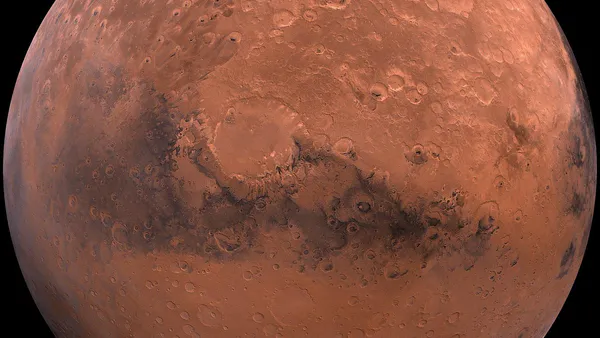
Mars is different from the rest of the planets of our Solar System - it is the only red planet and it is the only planet without volcanic activity and liquid core.
On Mars the ratio of oxygen isotopes is very different from that of the Earth , which points out to different origin.
The ratio of the oxygen isotopes on the Moon is like that of the Earth, which means that the Earth and Moon were probably born together. Interestingly, the ancient Hindu text Rig Veda claims that our Sun (Adytia) gave birth to eight planets, one of which was the Moon orbiting the Earth.
If the Sun gave birth to eight planets and the moon was one of them, the planets orbiting the Sun would be seven. But the planets of our Solar System are eight (because the ninth planet Pluto is no longer considered planet of our Solar System). It seems that Mars indeed didn't originally belong to our Solar System.
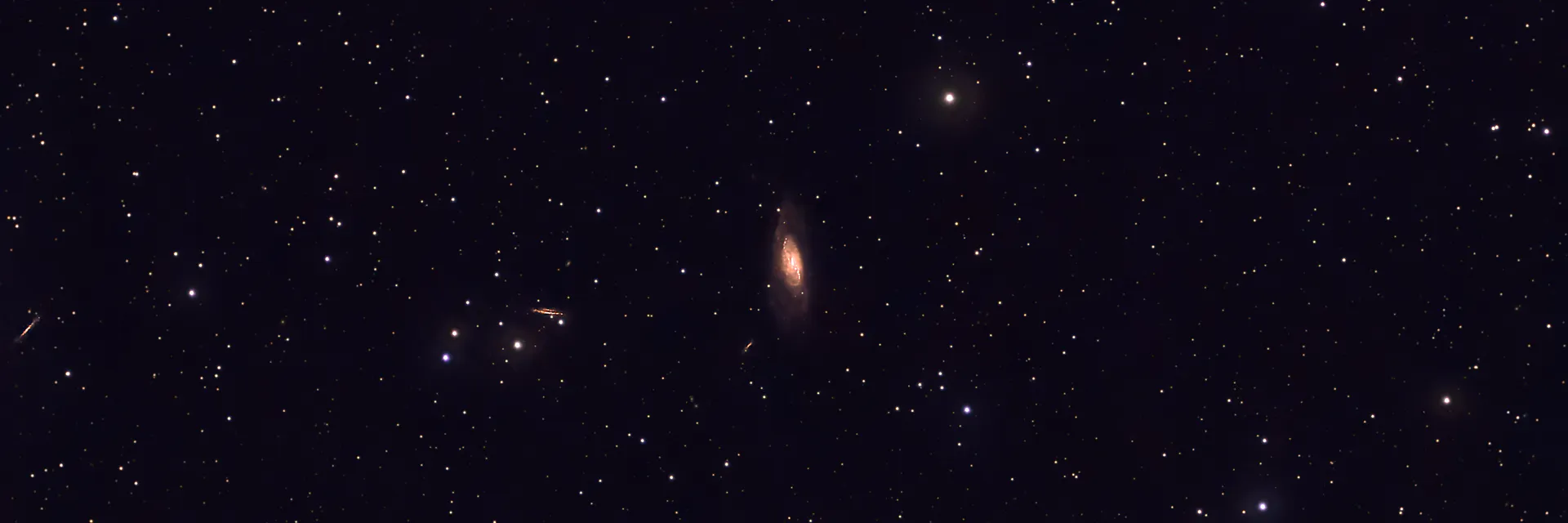
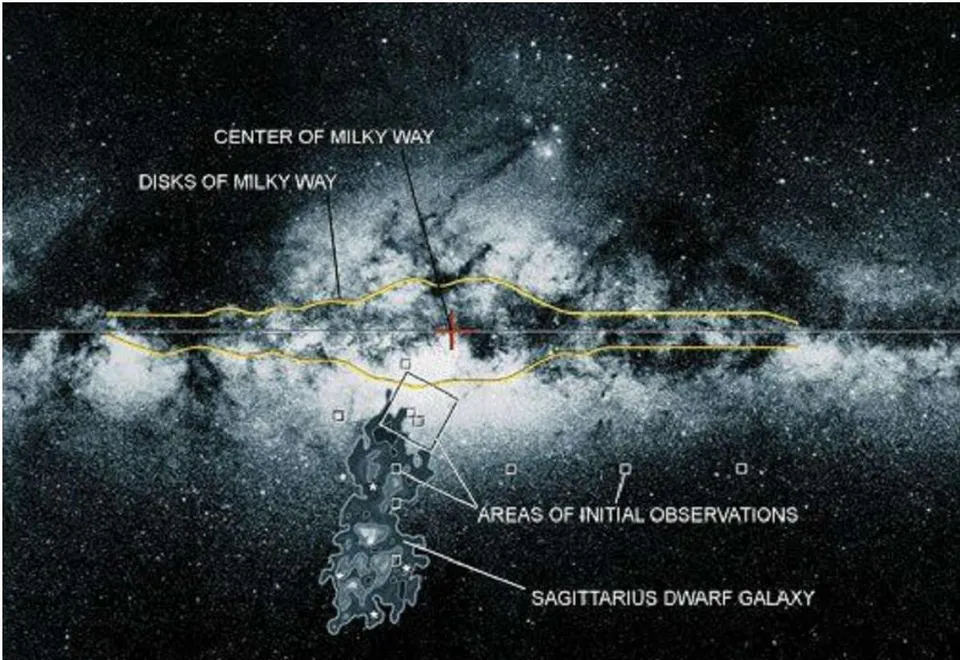
Ancient Hindu texts explain that Mars was sucked into our solar system during conjunction of the planets from the Sagittarius Dwarf Galaxy, when the last was drifting to the center of our galaxy. We can still see in our telescopes the Sagittarius Dwarf Galaxy (its Black Hole and leftover stars) orbiting around the center of our galaxy, while being gradually assimilated (Fig. 1).
A good reason to believe that Mars was indeed sucked into our Solar System is the fact that Mars is stuck between two much bigger planets: the Earth which is 10 times heavier than Mars, and Jupiter which is 318 times heavier than the Earth.
The planet Mars spins around its axis for 24.6 hours, while the Earth spins for 23.9 hours. Since the planetary spinning cranks the magnetic field of the planets, the similar spinning of Mars and the Earth would crank similar magnetic moments and magnetic field. However, while the Earth has a magnetic dipole moment taken as a unit measure 1.000, Mars has none. This is another proof that Mars does not have liquid core - it has completely cooled down.
Dr. Mario Acuna, magnetic field specialist of the NASA's Goddard Space Flight Center, investigated with his team the magnetism of Martian rock samples. They found that Mars did not have magnetic dipole moment or magnetic field; the observed miniscule magnetic dipole moment ( ) was induced by the solar wind. As said, the lack of magnetic field on Mars means that Mars does not have liquid magma any more and the lack of volcanic activity on Mars confirms it.
The table below presents the dipole moments of the planets of our Solar System and their tilts.
| Planets | Mercury | Venus | Earth |
| Magnetic Dipole | 1.000 | ||
| Dipole tilt | - |
| Mars | Jupiter | Saturn | Uranus | Neptune |
| 20,000 | 540 | 48 | 26 | |
| - | 9.6° | 0.7° | 59° | 47° |
9. Dr. Mario Acuna and his team, when investigating samples of different layers of lava from Mars, found different magnetism ranging from a few nano Tesla to as many as 220 nano Tesla. Since lava records the magnetic field when solidifies (because some of its particles become oriented toward the magnetic field), volcanic lava with different magnetism found on Mars means that the magnetic field on Mars was dying gradually and the solidifying lava recorded this.
10. When Mars lost its magnetic field, it lost its ionosphere and there was nothing to shield and protect the planet from the harmful solar radiation.
11. When Mars lost its ionosphere, it lost its atmosphere because the solar wind consisting of ions "gusting to one million miles per hour" blew away the atmosphere . Lack of atmosphere on Mars means lack of favorable conditions for life. (See also the author's book Science Speaks to God, Chapter 3.3.6: Life Is Possible Only on Planets with Liquid Core. )
Dr. Mario Acuna and his team investigated two very large meteorite-impact basins in the southern hemisphere of Mars and didn't find any magnetization in them. This means that the two meteorites hit Mars when the planet didn't have magnetic field any more. Dr. Mario Acuna did some calculations, which indicated that the meteorite impact took place more than 4,000,000,000 years ago. If Mars was already a dead planet 4 billion years ago, Mars is a very old planet – much older than our earth, which is 4,300,000,000 years old.
Some scientists argue that Mars has lost its liquid core because it is 10 times smaller than the Earth. But measurements on Earth show that our Earth cools very slowly - about 100 degrees per billion years. If so, a simple calculation shows that Mars couldn't have lost the heat of its core, if it were the same age as the Earth.
Since the age of our Earth is 4,300,000,000 years, and Dr. Mario Acuna claimed that Mars lost its liquid core and magnetic field more than 4,000,000,000 years ago , Mars couldn't have lost its molten core and magnetic field for 300 million years. Therefore, Mars couldn't have originally belonged to our Solar System. This means that Mars was a cold planet without liquid core long before it was adopted by our Solar System.
Astronomical data collected by Odyssey's Gamma Ray Spectrometer, with Principal Investigator William Boynton of the University of Arizona, brought evidence of lots of ice on Mars, most of it under the surface. This indicates that Mars is an old and cold planet without hot liquid core.
Yes! The Red Planet does not have any more a core of hot red magma because it has completely cooled down. Therefore, Mars is an old and cold planet, probably much older than the rest of the planets of our Solar System, which proves that it didn't originally belong to it.
- Thermal Emission Imaging System (THEMIS) mounted on spacecraft found that "Mars has experienced a series of environmental changes during previous active geological periods". Dr. Philip Christensen of Arizona State University, Principal Investigator of THEMIS claims: "We knew from Mars Global Surveyor that Mars was layered, but these data are the first direct evidence that the physical properties of the layers are different." He concluded: "The history of Mars is staring us in the face in these different layers, and we are still trying to figure it all out".
I think, I have an answer for Dr. Philip Christensen: all recent findings on Mars indicate that Mars is an old planet that had in the past, but it does not have any more magnetic field. The magnetic field on Mars ceased to exist more than 4,000,000,000 years ago, as Dr. Mario Acuna said. This was long before the planet was sucked into our solar system.
III. THE MERGING OF THE SAGITTARIUS DWARF GALAXY TO OUR GALAXY
Our galaxy is warped and this was known before the Hubble telescope was launched into space. Now, with the Hubble telescope in orbit, we have observed numerous interactions of Galaxies. A larger Galaxy will attract a smaller one and will gradually assimilate it. This will leave the larger galaxy warped.
Through the Hubble telescope we know that more than one-half of the Middle-age Spiral Galaxies (like our Milky Way) are warped. Therefore, if our Galaxy is warped, it had swallowed a smaller galaxy in the past.
Jeremy Bailin calculated and compared the moments of our galaxy and the Sagittarius Dwarf Galaxy and proved that there has been interaction between the two in the past. (See also the author's book Science Speaks to God, Chapter 4.1: Our Warped Galaxy and the Disasters Caused on Earth).
The finding of Jeremy Bailin is in full agreement with the ancient Hindu texts, which claim that in the past our galaxy had swallowed the old smaller galaxy called Sagittarius Dwarf. It is called Sagittarius
Galaxy because it projects onto the constellation Sagittarius. The name Dwarf Galaxy means that it consists of dwarf (old) stars that barely shine orbited by old and cold planets (like Mars).
If there was interaction between the two galaxies, and we are now finding that Mars is an old and cold planet, probably Mars was indeed sucked into our Solar System from the Sagittarius Dwarf Galaxy, as the ancient texts said. Since we can see in our telescopes (Fig. 1) the Dwarf Galaxy's Black Hole with the leftover stars still orbiting around the Black Hole of our galaxy when being gradually assimilated, there is no doubt that this was the smaller Galaxy engulfed by our galaxy, which left it warped.
Inca's mythical stories worn us: we need to watch very closely what is going on between the two Black Holes (the Black Hole of our Galaxy and the Black Hole of the Sagittarius Dwarf Galaxy, astronomically known as Sagittarius A and Sagittarius B) because if they merge the life forms in our galaxy may not survive the powerful radiation of the merge. (See the author's book Science Speaks to God, Chapter 2.3: Aren't We Like a Man Discovering at Age 50 He Has a Belly Button? The Mystery of the Second Belly Button).
IV. ANCIENT HINDU TEXTS CLAIM THAT MARS WAS SUCKED FROM THE SAGITTARIUS DWARF GALAXY
The ancient Hindu astronomy Surya Siddhanta claims that when the smaller Sagittarius Dwarf Galaxy was merging to the center of our galaxy, it passed first through its periphery where our Solar System is and during this passage, at conjunction of the planets, the planet Mars was sucked from the Sagittarius Dwarf Galaxy into our Solar system.
The Hindu source Mahabharata says the same - the red planet Mars was sucked into our Solar System from the old Dwarf Galaxy. It was 'installed' during a more or less close conjunction of all planets. The planet Mars was called 'Skanda' ('Scanda'), which in the Sanskrit language means 'the popped out' planet.
Mahabharata specifies that our local Gods, the Pleiadian Gods, orchestrated the merging of the Sagittarius Dwarf Galaxy to the Milky Way. If so, the Sagittarius Dwarf Galaxy was a Pleiadian (Krittika's) buddy. For this reason, in Mahabharata the planet Mars, which was adopted from the Sagittarius Dwarf Galaxy, was called Krittikeya because it was a buddy of Krittika (the Pleiades).
Since the Sagittarius Dwarf Galaxy is a small and old galaxy consisting of old (dwarf) stars that barely shine orbited by old and cold planets without liquid core, it was pictured in ancient myths as a puny old man with a long beard. So, it seems that the old and cold Mars initially belonged to the old Sagittarius Dwarf
Galaxy and was adopted by our Sun as the ancient Hindu texts say.
V. WHEN WAS THE PLANET MARS ADOPTED BY OUR SUN?
According to the ancient Hindu astronomy, Surya Siddhanta, the planet Mars was adopted by our Solar System 2,164,960 years before year 1860 (when the Hindu astronomy was published) or 2,165,100 years before year 2000. According to estimates of Dr. Mario Acuna based on his magnetic calculations, the planet Mars has been dead since 4,000,000,000 years ago. Therefore, Mars was a dead planet long before it was adopted by our Solar System.
VI. CONCLUSION
Since the spinning of each planet creates ring currents in its liquid magma, which cranks the magnetic field of the planet, the fact that Mars does not have magnetic field means that the planet does not have a core of liquid magma any more. Indeed, Mars does not have volcanic activity and the spacecraft's survey found lots of ice under the surface. This indicates that Mars is an old and cold planet. The fact that the ratio of oxygen isotopes on Mars is very different from those of the earth and Moon is another proof that they have different origin.
Ancient Hindu texts claim that Mars was sucked into our Solar System during conjunction of planets from the Sagittarius Dwarf Galaxy, when the last was drifting through the periphery of our galaxy, where our Solar System is. The Black Hole of this galaxy with the leftover stars is still orbiting around the center of our galaxy while being gradually assimilated. All this indicates that Mars has been sucked into our solar system from the old Sagittarius Dwarf Galaxy.