Résumé- Les famines sont presque toujours causées par l'homme, souvent utilisées comme moyen de dissuasion. Depuis l'Antiquité, la nourriture et la faim sont une arme de guerre. Parmi les exemples les plus notoires en Afrique, citons le génocide Herero et Namaqua dans l'Afrique allemande du Sud-Ouest (aujourdhui la Namibia) de 1904 à 1908. Ce fut le premier génocide du XXe siècle. En outre, les famines qui ont suivi au Biafra (Sud-Est du Nigeria, 1967-1969), ou environ 1,5 million de personnes sont mortes de faim, la famine de 1980 en Ouganda, l'une des pires de l'histoire de l'Afrique, où 21% de la population est morte, et la les famines récurrentes en Éthiopie, en Somalie et au Soudan du Sud depuis les années 1990 sont graves dans la mémoire humaine. L'utilisation de nourriture comme arme a été condommée comme crime de guerre par le Statut de Rome de la Cour pénale internationale en 1998. Étant donné que la plupart des pays africains sont des pays les moins avancés (PMA), ce sont eux qui souffriront le plus des conséquences de la guerre de Poutine en Ukraine, en particulier les pauvres d'Afrique. Ils ont déjà subi les conséquences de la sécheresse, de la pandémie de COVID-19 et du terrorismisme islamiste. Leur position déjà affaiblie sera exacerbée par les retombées de l'aggression russe en Ukraine, qui ne fera qu'exacberer la faim et la pauvreté en Afrique. D'autant plus que l'aide internationale au développement risque de souffrir d'une réorientation massive de l'aide vers le réaliment. Enfin et surtout, la guerre de Poutine en Ukraine aura un impact major sur les relations UE-Afrique. Comptetenu des conséquences de la pandémie de Covid-19 pour l'Afrique, cela mettra encore plus à mal la confiance mutuelle entre les deux partenaires. Environ 86% des Africains n'ont pas encore reçu deux doses de vaccin. Un nombre croissant de chefs d'Etat et de gouvernement africains ne voient plus les pays occidentaux comme des partenaires fiables.
I. INTRODUCTION
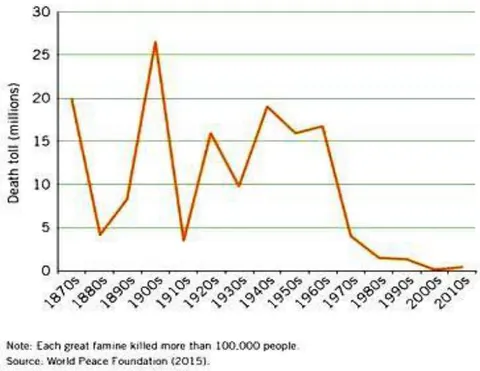
Famines are regularly man-made. During the past century, war and totalitarianism produced more famine deaths than did overpopulation, economic backwardness and climate change (Ó Gráda, 2007). In case an autocrat is interested to reduce the capacity of a group to resist his policies, there may be only a thin line of interpretation separating an intended goal of killing by the intention of elimination through starvation (Conley & de Waal (2020). Notably in Africa, that still is in common perception the continent of crisis, failed states and starvation, famines are often induced by politics, last, but not least, by the power to command food through a variety of market and non-market institutional means (Watts, 1991).
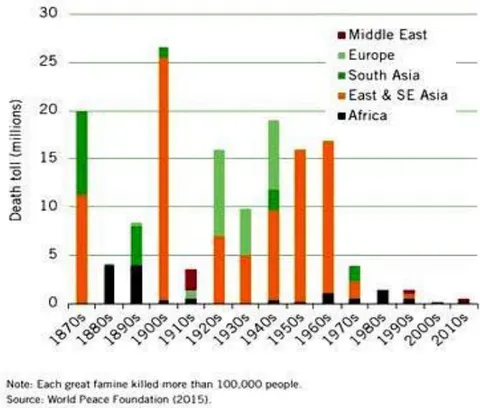
Even food aid has been exploited by ruthless governments to subdue their citizens by leveraging their political support and converting food aid into political power. The highly ritualized grant of food aid may pervert a present-day political and economic order to a rule where it are finally the peasants who go hungry (Phillips, 2009).
In civil war governments and rebels often control humanitarian access. They either permit entry and protect aid workers or they block access. Thereby, aid workers frequently face greater personal dangers as they move in a dangerous terrain of warfare. Under these circumstances, the provision of food aid under riskier conditions can even result in "new families" (Grebmer et al, 2015).
In the following, the main causes and effects of Russia's war in Ukraine as regards famine and economic, political and social development in Africa will be analysed, taking into account the multiple facets of hunger. Also, a succinct review of literature on food as a weapon of war will allow for understanding the serious impact of Russia's war on Africa. The regional focus will be on the Maghreb, Egypt and selected countries of Sub-Saharan Africa. To conclude, Moscow's use of wheat and energy as a geostrategic weapon to handpick African countries for cooperation as well as the EU's alternatives for using Russian and Ukrainian wheat will be outlined.
II. THE IMPACT OF RUSSIA'S UKRAINE WAR ON HUNGER IN AFRICA
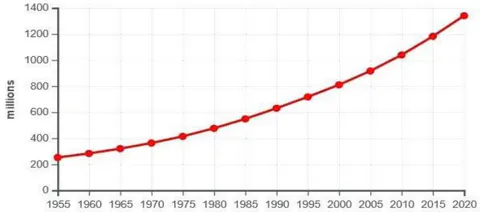
For decades, Africa shows the highest population growth and the largest famine troubles in the world. Its population surpassed one billion in 2009, with a doubling time of 27 years (growth rate of p.a.). At the same time, average agricultural productivity was the lowest worldwide. Moreover, Africa is likely to suffer substantially from climate change (Grotel, et al, 2021).
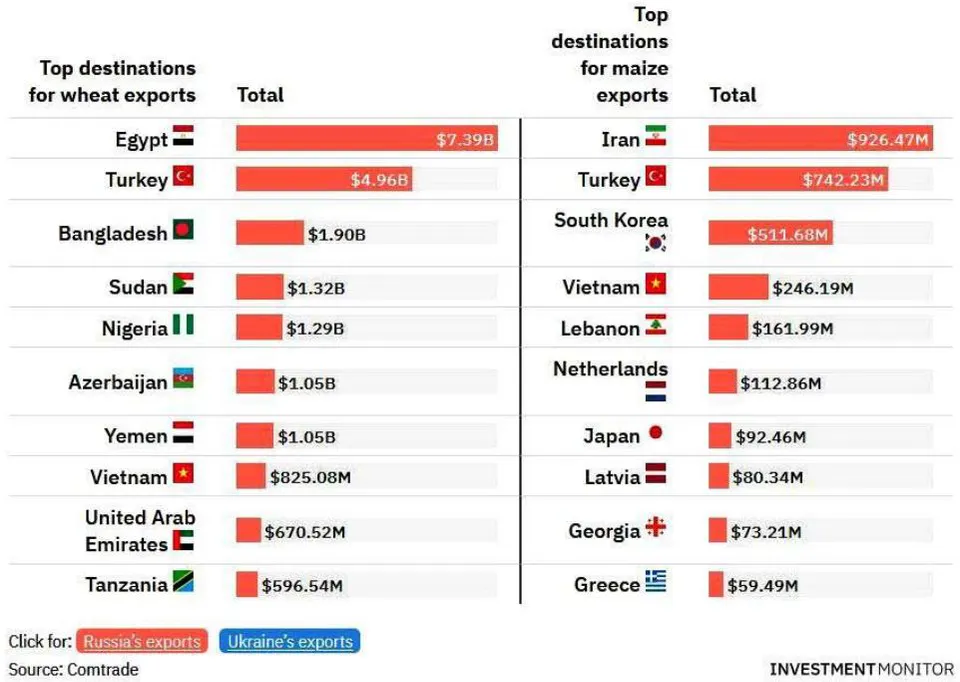
Therefore, African countries are particularly vulnerable because they rely heavily on Russia and Ukraine for their wheat imports. The top African wheat import partners of Russia were Egypt, Sudan and Nigeria (s. Graph 4). In Egypt, a total of US$ 3.02 bn of wheat
was imported in 2019, US 773.4 m from Ukraine. In Ethiopia, where a total of US 142.01 m came from Ukraine and $ 64.77 m from Russia (Leiva, 2022).
Most African countries are Least developed countries (LDCs) that will suffer the hardest in the aftermath of Putin's war in Ukraine, in particular the African poor.1 They had already to bear the consequences of the COVID-19 pandemic and the climate crisis. The spill-over effects of the Russian aggression in Ukraine will increase hunger and poverty even further (Kappel, 2022). Higher energy and food prices, reduced tourism, and potential difficulty accessing international capital markets will increase vulnerability notably in African countries that have
minimal policy space to counter these effects of external shocks (Kammer et al, 2022). The countries progress in reducing the Global Hunger Index scores are lowest in Africa, notably in Sub-Saharan Africa (SSA).
Therefore, South Africa's Daily Maverick news cautioned that the impact of Russia's Ukraine war will "be felt in every village and town of South Africa and the world". African oil- and gas-producing countries, like Nigeria and Angola, might profit from the rising energy prices. Also, with the price of Ukrainian sunflower oil skyrocketing, buyers are switching to palm oil, which hit record highs on futures markets in early March 2022. Palm oil is a staple crop in West Africa (McNair, 2022). Yet, whether the poor and needy will also profit is highly unlikely given the gross inequality and widespread corruption prevailing in these countries1. The cost of food and transport is likely to hit the roof, with knock-on effects on the prices of nearly all other products, pushing up inflation.
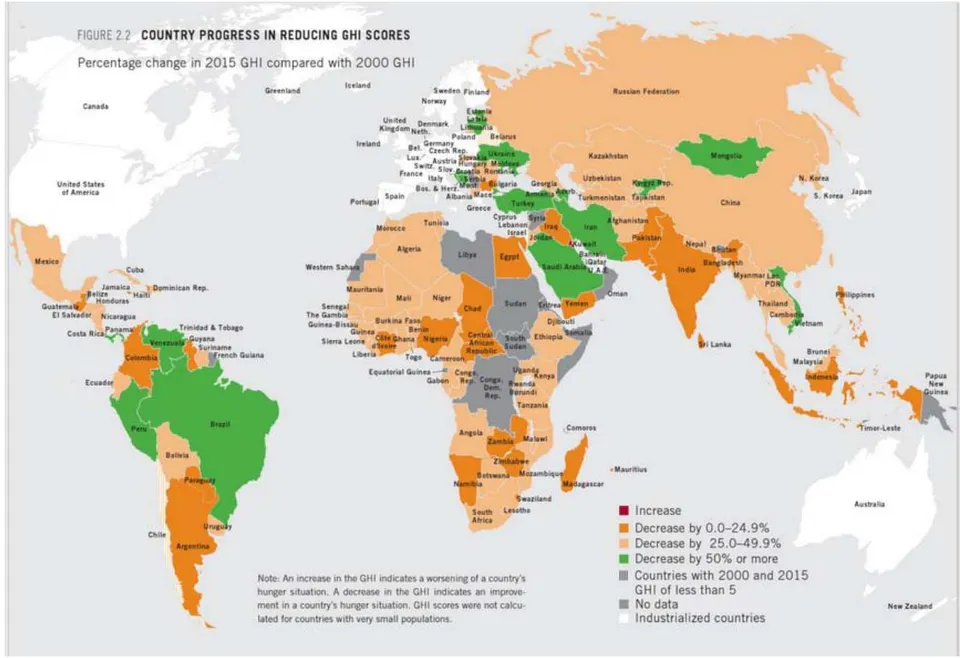
Yet, families are difficult to predict because of the multitude of intervening factors, ranging from agricultural production and trade estimates, market price variability, weather forecasts and conflicts. The two major sources of uncertainty were associated with complex weather phenomena and social and political conflict, with uncertainty in weather forecasts being twice as important as conflict. Case studies from the Hom of Africa revealed that complex weather phenomena were twice as significant as the conflict in food security projection errors (Krishnamurthy et al, 2020). Moreover, the specific land tenure arrangements complicate predictions. Thus, Man-made calamities such as decentralized extensive agricultural, pastoral activities and forest clearing contribute to environmental damages and consequent food shortages. Insecure land tenure often diminishes agricultural productivity which, notably in times of drought, exacerbates famine (Azadi, H. et al, 2021). Pastoralists in East Africa, for example, experience food insecurity more frequently than do non-pastoralists (Coughlan de Perez, et al., 2019).
Especially bread prices are a major driver of political instability.2 Already in the early 2010s, they had triggered the Arab Spring. In North Africa, the Maghreb countries Morocco, Algeria, Tunisia and Libya, as well as Egypt, which all are heavily dependent on wheat, will probably be among the worst affected (Kohnert, 2022). On the other hand, there exists a long-standing close relationship with these countries which is reflected by close military cooperation. The largest African customers of Russian arms, in order of sales, were Egypt, Algeria, Sudan, and Angola. Along with Russia's support to Libyan warlord Khalifa Hifter, the commander
of the Tobruk-based Libyan National Army, this consolidated Moscow's presence along the southern flank of the European members of NATO. Thereby, it opened up Russia's influence in the eastern Mediterranean and enabled it to threaten strategic global junctions like the Suez Canal and Bab al-Mandab Strait at the Gulf of Aden (Nyabiage, 2022a). Therefore, it is not unlikely that Moscow will give these governments preferential treatment also concerning food exports.
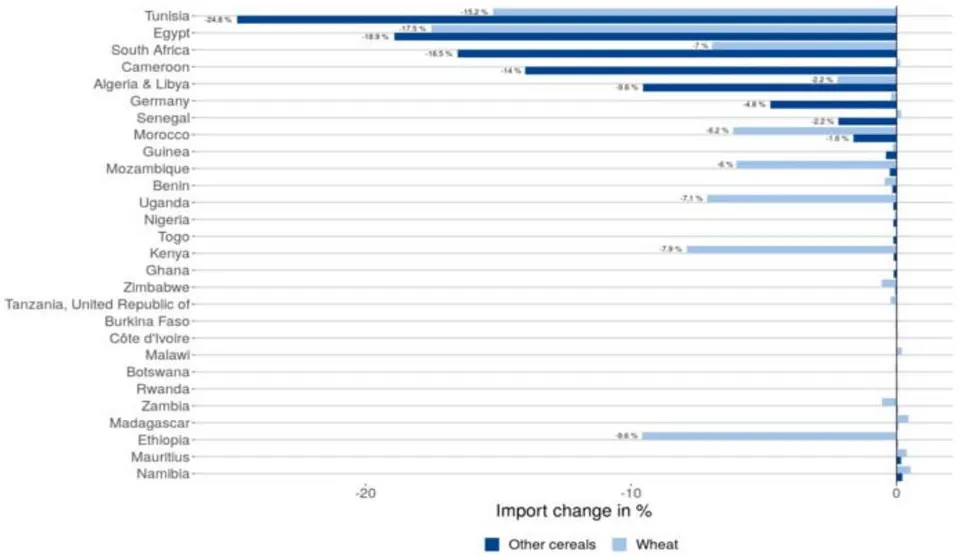
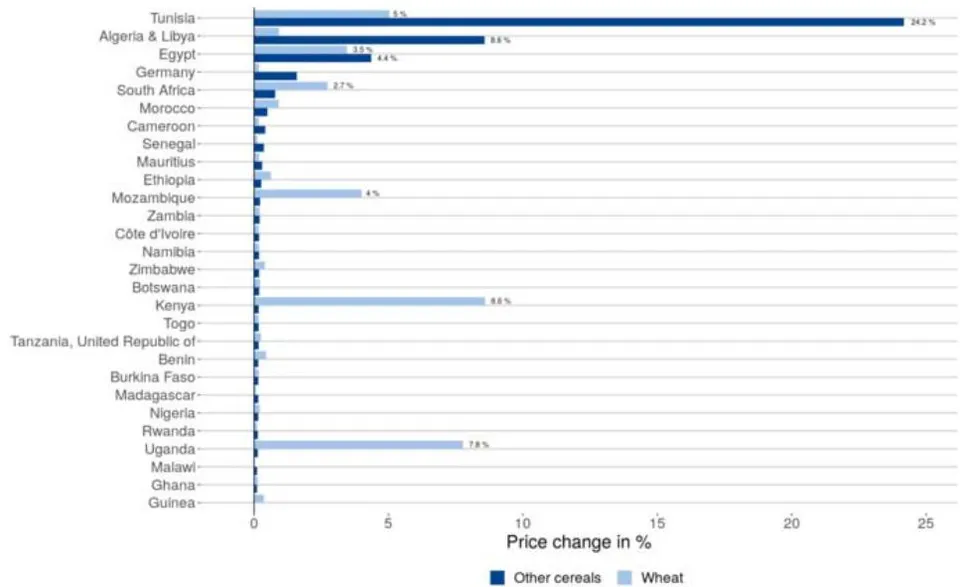
Source: Heidland, et al, 2022
Graph 6: Change in wheat and cereals imports (in%)
Ukrainian trading stop, probable long-term effects
According to model analyses of the Kiel Institute for the World Economy, North African countries would be particularly affected (Heidland, et al, 2022). For example, more than of the wheat consumed in Morocco comes from the Ukraine which is the second-largest exporter of wheat to Africa. Also, Tunisia and Egypt would be hit hard. In Tunisia, wheat imports could permanently fall by more than , while imports of other grains would fall by almost in the simulation. In Egypt, the Ukrainian wheat export shortfall would result in over being imported, and imports of other cereals would decrease by . Cairo asked already the IMF for support in reminiscence of the bloody bread riots during the Arab Spring (Saleh, 2022). South Africa would import less wheat and over less other cereals. Imports of other cereals would be also lower in Cameroon , Algeria and Libya . Wheat imports would drop significantly in Ethiopia , Kenya , Uganda , Morocco , and
Mozambique (-6%) (Heidland, et al, 2022; Schiller, 2022; Kohnert, 2022).
Putin's Ukraine war and the resulting Western sanctions already started to disrupt supply and pushed up prices worldwide, also in Africa. Wheat, corn, sunflower oil and fertiliser are among the products most affected, along with oil, compounding the impact of political instability and drought (Nyabiage, 2022). In Egypt for example, the commodity flow has been already disrupted in March 2022, both by the war and the sanctions against Russia. Before the war, Russia and Ukraine had supplied more than of Egypt's wheat needs for its estimated 102 million citizens, according to the US Department of Agriculture. Egypt buys 12 to 13 million tonnes of wheat annually. Quite aware of political implications, the government of General Abdel Fattah el-Sisi kept its subsidies on bread despite previous pressure from the IMF to drop them (Nyabiage, 2022).
Source: Heidland, et al, 2022
Graph 7: Change in wheat and cereal prices (in%) Ukrainian trading stop, probable long-term effects
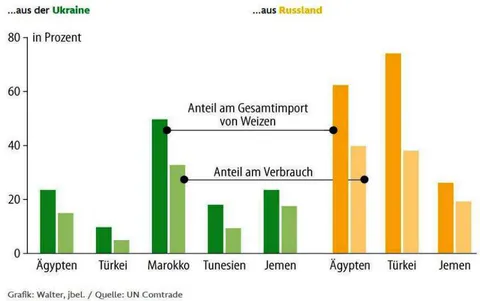
Source: Schiller, 2022
Morocco, a lower-middle-income country, importing over of its energy and half its cereals, is also among the African states most exposed to the crisis. Yet, its impact is difficult to predict, because of the intervening effects of the Corona pandemic, the unsustainable size of public debt and inflationary pressures, which are likely to intensify, especially if the conflict continues (Ali, et al, 2022).
| TOP 10 UKRAINIAN EXPORTS | SHARE OF GLOBAL IMPORTS (%) | SHARE OF UKRAINIAN EXPORTS (%) | TOP 10 RUSSIAN EXPORTS (%) | SHARE OF GLOBAL IMPORTS (%) | SHARE OF RUSSIAN EXPORTS (%) |
| Vegetable oils | 6.7 | 9.3 | UN Special code* | 14.2 | 13.0 |
| Cereals | 6.0 | 20.0 | Manufactured fertilizers | 12.5 | 2.0 |
| Oil and fruit seeds | 3.1 | 5.0 | Coal/coke/ briquettes | 11.6 | 4.0 |
| Iron and steel | 2.3 | 18.8 | Petroleum and products | 10.9 | 45.5 |
| Animal feed | 1.8 | 3.0 | Gas Natural &manufactured | 8.7 | 6.8 |
| Metal ores/ metal scrap | 1.1 | 8.3 | Cork and wood | 8.4 | 1.5 |
Graph 9: Main Ukrainian and Russian exports and their shares of global trade
III. FOOD AS A WEAPON OF WAR
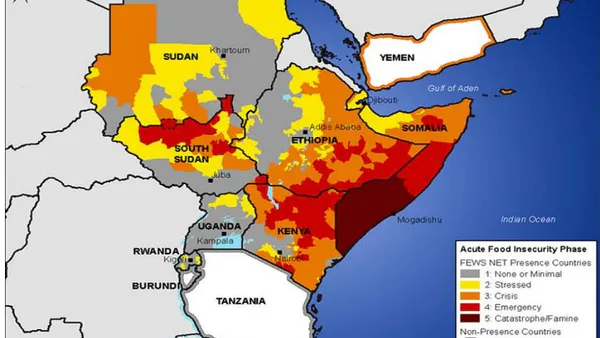
Already irrespectively of the potential effects of Russia's Ukraine war, food and starvation have been used as a weapon of war since Antiquity. The most infamous examples in Africa include the Herero and Namaqua genocide in German South-West Africa (now Namibia) from 1904 to 1908. It was the first genocide of the 20th century. Also, the subsequent famines in South Sudan in 1993, 1998 and 2017, caused by civil war and political unrest, have been engraved in the memory of mankind. Food has become such an inhuman weapon that the Rome Statute of the International Criminal Court of 1998 included it in article 8 (paragraph 25) as a war crime (Rivoal, 2015). Apart from military considerations, food can also be used in conflicts for geopolitical or domestic political purposes such as displacing populations within the same country or intentionally starving parts of its own population. This was for example the case in Ethiopia in 1984 when massive amounts of food aid had been accepted and distributed only in specific parts of the country so that the populations had to move toward these regions (Rivoal, 2015). Similar politics had been used in Southern Sudan in 1993, 1998 and 2017 (Wikipedia) as well as in the famine in Somalia in 1992 connected with the Somali Civil War. An estimated 220,000 - 300,000 people died during this famine (1992 famine in Somalia, Wikipedia). Subsequently, during the East African drought in 2011 which caused a severe food crisis across Somalia, Djibouti, Ethiopia and Kenya, the livelihood of 9.5 million people was threatened. A major reason was that many refugees from southern Somalia had fled to neighbouring Kenya and Ethiopia, where crowded, unsanitary conditions together with severe malnutrition led to a large number of deaths (2011 East Africa drought, Wikipedia).
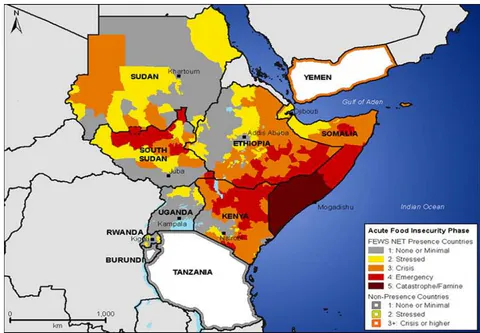
Graph 10: Projection of the 2011 East Africa drought for October-December
It is obvious that conflict is the main cause of persistent severe hunger. However, whether famine and hunger are also major drivers of conflict is less evident (Grebmer, 2015). Often families are portrayed as direct or indirect impact of climate change, for example in the Sahel zone. However, the Sahel droughts are not just an effect of climate change, though it was without question a major cause, but also man-made famines, caused by transhumance and overgrazing, deforestation, and poor land management (McLaughlin & Purefoy, 2005; Eden Foundation, Sweden, 1994:1). Thus, environmental havoc induced land scarcity which itself increased segmentation between and within social groups. Thereby, the self-regulating forces of civil society, e.g. African traditional chiefs, and other domestic social, political and economic institutions were frequently weakened both in the formal and informal sectors. Altogether, these dynamics augmented social grievances, ethnicity and the social exclusion of the 'other'. They generated breakdowns for individuals and social groups, affected by lack of resources, which drove them to engage in violent conflict, as revealed also by case studies of South Africa and Rwanda (Percival, 1995).
Thus, drought, as the initial driver of the crisis, triggered a multitude of responses like crop failure, famine, starvation and often subsequent despotic actions of the rulers to counter political unrest. According to the Bible and the Quran, one of the oldest records of the consequences of great famines in ancient Egypt was that in the time of Joseph (7th – 5th century BCE) when people were enslaved by the Pharaoh's government. It forced its subjects to plough all available fields to preserve its people alive and furnish food. However, whether this allows for the general conclusion of Pitirim Sorokin (1889 – 1968), a renowned Russian-American conservative sociologist in post-war America, that 'calamities have on the whole a more favourable than an unfavourable selective effect on human stock' is highly questionable (Sorokin, 1942).
In the most serious cases, it finally resulted in acute socio-economic and political change like the Arab Spring uprisings in the early 2010s. The repercussions of this enforced change impacted also on other aspects of everyday life, like health issues, increased mortality, a transformation of religious beliefs and a political disorder. For example, the African Christian "Ethiopian" Church which originated already before the colonial conquest, widened its influence. New churches were founded and they increased their independence from established European Churches, notably in areas where African-White relations were strained (Pribyl, et al, 2019).
The early days of colonial rule in Southern Africa were especially prone to gross human rights violations by the Colonialists related to families. Thereby, Africans frequently associated the blights devastating the land with colonial expansion. The Matabele in Rhodesia, for instance, blamed drought, locusts and cattle plague on the establishment of the rule of the British South Africa Company. This was not without reason. The company had requisitioned, before and during the drought of 1895, Matabele cattle which fuelled the tensions up to March 1896. As strategic means of war, the British occupation troops destroyed local grain stores after the failed harvest of 1896, which aggravated the famine even more. During the same time African peasants in South Africa's Langeberg region, already famished by the drought, had been forced to pay hut-tax to the British. The latter's radical approach to stamp out the rampant Rinderpest, which especially threatened the settler farmers, led to further rebellions in summer 1896-97. Rumours and rebellion spread to other regions, including Zululand, Natal and Basutoland (now Lesotho). In 1898, the Venda, who settled close to the South African border with Zimbabwe were subjugated (Pribyl, et al, 2019).
IV. WILL RUSSIA USE WHEAT AND ENERGY AS GEOSTRATEGIC WEAPONS TO HANDPICK AFRICAN
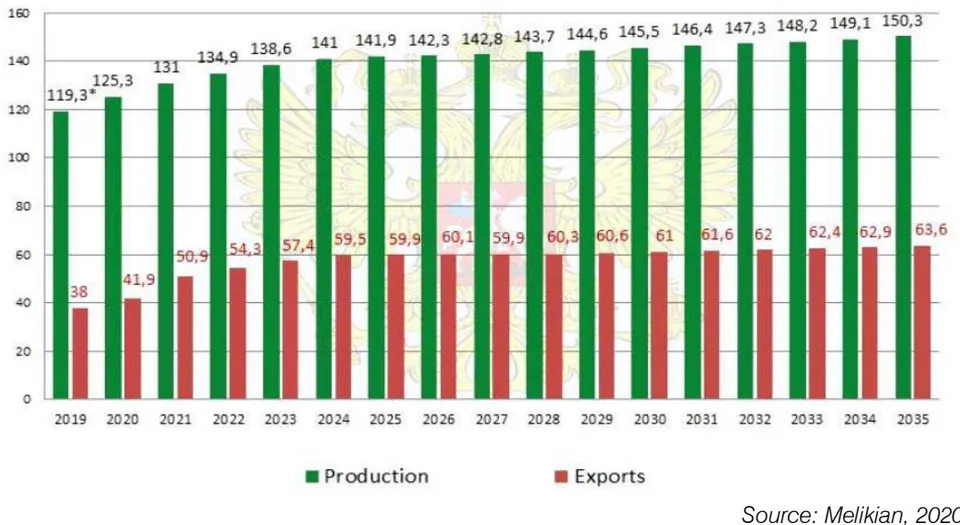
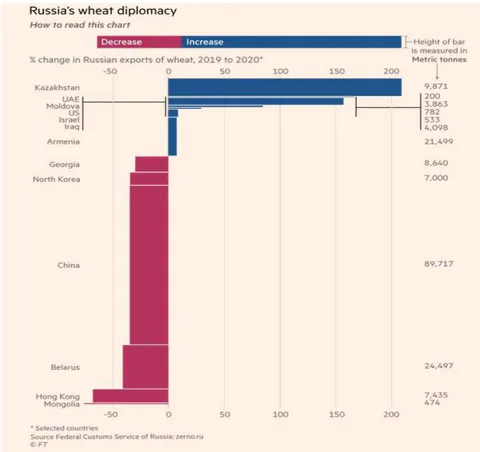
Russia has the potential to destabilize the world over the food issue. However, of its grain exports are exported via Ukrainian ports like Mariupol and Odessa. Russia's bombing of these ports will impact on its exports (Admin, 2022). Regarding the Ukrainian delivery failure because of the war, Russia is also causing food shortages in many countries. Thus, Moscow announced in mid-March 2022 that it would restrict the export of wheat, barley, rye and other grains. African governments could be held to ransom by Moscow because of their high dependency on Russian wheat exports (Admin, 2022).
Moreover, Moscow was looking for new markets. For example, it had sent test batches of wheat and other agricultural products to different countries. Also, it strengthened its position in existing ones, such as countries in North Africa, Turkey and the Middle East. To hedge its 'closed shop', Russia tried to develop not only the ports of the Black Sea but also in the Far East, the Caspian and the Baltic ports (Melikian, 2020; Lu et al, 2022).
To counter this threat, Brussels wants to try to close the global food gap as much as possible. Yet, the EU up to now is a net exporter of wheat. To increase production the EU Commission proposed to set up an aid package for farmers amounting to € 500 m. This, however, is difficult to match with the EU's competing environmental goals and its proposed switch to less intensive agriculture as part of the Green Deal climate and environmental package. As a consequence, about less food would be produced by EU member countries (Admin, 2022). Yet, the German environmental party argues that it would make more sense to limit the consumption of animal foods so that less agricultural land is required for animal feed. According to them, up to of the raw materials produced on agricultural land in Europe end up in tanks or troughs (Admin, 2022).
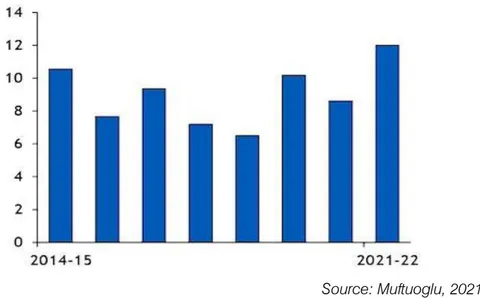
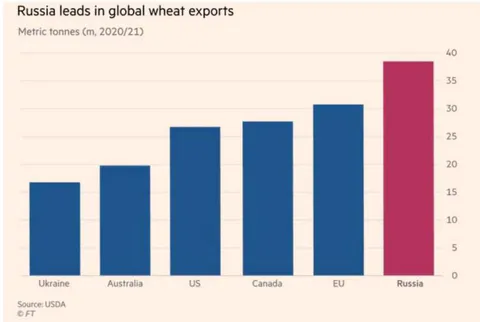
The severe devaluation in the rouble in 2014 as a consequence of US and EU sanctions against Moscow after the annexation of Crimea made its exports cheaper. Also, Russia's counter-sanctions, banning most food imports from the west, further boosted domestic producers with the effect that Russia became the world's biggest wheat exporter, passing the US and Canada for the first time in 2017. Thus, Russian grain became Moscow's new geostrategic weapon, comparable with oil. Putin declared proudly that Russia made its way across Eurasia, Africa, and Latin America as an agricultural export powerhouse, reducing its reliance on energy export, identifying new markets and extending its global diplomatic reach (Astrasheuskaya, 2021).
V. EU'S ALTERNATIVES FOR USING RUSSIAN AND UKRAINIAN WHEAT
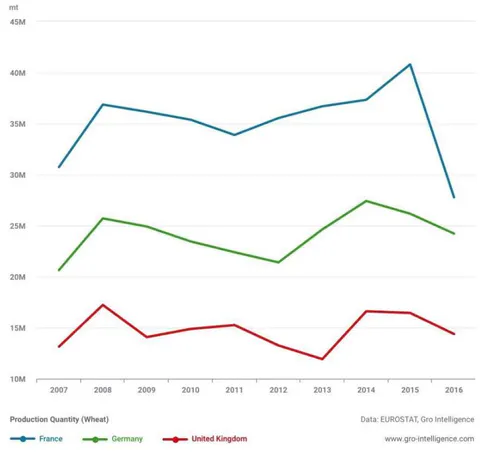
Within the EU, France is the largest producer and exporter of wheat. Inside Western Europe, Britain is the EU's third-largest producer. Up to Brexit, EU wheat exporting countries tended to compete for similar markets and France was the largest exporter to most of the UK's wheat trading partners (Dry Bulk, 2017).
At least for consumers in EU member countries, a simple and effective solution for lacking wheat from the Ukraine and Russia would be available. According to Brussels, an reduction in the use of cereals for animal feed in the EU would save enough wheat to make up for the expected deficit (Greenpeace European Unit, 2022).
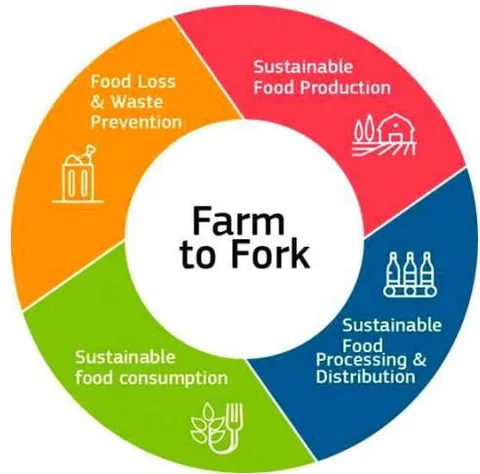
However, this apparently is no short-time fix for all sorrows. To change consumer habits takes a lot of persuading and time, as well as restructuring the agricultural industry that up to now prefers high profits from meat production. Enforcing the polluter pays principle in the EU against the powerful agricultural lobby would be a lengthy and arduous task. As usual, Brussels followed the line of least resistance. In March 2022, the EU Commission, backed by several governments, announced € 500 million in financial aid to farmers facing drawbacks due to the Ukraine war, including special aid for the pork sector to keep prices high. It also wanted to loosen environmental protections in the EU's common agricultural policy and to delay the implementation of key elements of the Green Deal and the Farm to Fork Strategy (Greenpeace European Unit, 2022). In recent years, the European environmentally
orientated catering industry envisaged a policy labelled 'From farm to fork' or 'Farm to table' that allowed certified traceability of fresh meat and eggs by a fair, healthy and environmental-friendly food system. The crusade was based on a social movement that promoted serving local food at restaurants through direct acquisition from the producer. Given the new wheat shortage, the movement might gain additional appeal.
VI. CONCLUSION
The reactions of the countries concerned by Putin's Ukraine war have been mixed. The sanctions of Western powers remained without appreciable effect up to now. How will the countries hit by the supply shortfalls cope with this situation? As for the EU member countries, the response depends to a great deal on their political and economic guidelines already decided well before the war. Germany for example still shies away from stopping Russian gas and oil imports. Different German governments in the past decades had relied too much on good economic relations with Moscow, despite the critical votes of major allies. The controversial Nord Stream 2 gas pipeline from Russia to Germany, running through the Baltic Sea, financed by Gazprom and German and other European energy companies is just an example. Now, Berlin is at pains to reconcile the demands of German environmentalists and of the co-governing German Green Party for an exit from nuclear and fossil-fuel energy with the actual need for timely delivery of energy. France, on the contrary, had relied already before the war on nuclear energy, as well as Britain.
The concerned African countries are in a more difficult situation also because of the indirect repercussions of Russia's aggression. For example, international development assistance for Africa is likely to suffer from a massive diversion of aid into rearmament, away from poverty alleviation (Heywood, 2022). The World Food Programme (WFP) had already reduced rations for refugees and other vulnerable groups in East Africa because of decreased funding and rising food costs. Thus, WFP shipments from the Ukrainian port of Odessa would be affected, which had been destined for West Africa. The Norwegian Refugee Council for West- and Central Africa indicated that some donors were already inclined to cut aid to Burkina Faso by up to to support operations in Ukraine. The UN, for example, is more than US 957 m funding target for assistance in the northern region of Tigray, Ethiopia (Brooke-Holland, 2022). The aftermath of Russia's aggression in Ukraine will impact on current and pre-existing humanitarian crises, including those in Somalia and Ethiopia. In the Tigray region alone, half a million people have died from war and famine in the past 16 months. The WFP procures half of its wheat from Ukraine. Egypt, for example, has reserves that will likely last until June 2022, thereafter costs could skyrocket. David Beasley, WFP director, revealed in March that his institution was already cutting food rations by because of a lack of funding even before the war (McNair, 2022).
As explained above, one of the immediate dangers for Africa will be related to the soaring bread prices that could trigger political instability like in the Arab spring. According to the IMF, global food prices will affect Africans disproportionately. Whereas expenditure on food accounts for of consumer spending in advanced economies, it amounted to up to in SSA. As many as 25 African countries imported more than one-third of their wheat from Russia and Ukraine. Moreover, domestic African agriculture production will be affected by rising fertiliser, pesticide, transport and fuel costs as well as supply-chain disruption. All together this will result in higher production costs and subsequently in higher prices, increasing the pressure on state budgets, including food subsidies (Brooke-Holland, 2022). Other countries like Kenya are also concerned about other impacts the war and financial sanctions on Russia have, for example on Kenya's vital tea industry. Russia is among the top five consumers of its tea, helping Kenya to earn foreign currency (Heywood, 2022). Now it will have to find new outlets for huge quantities of black tea in record time for about US$ 3.5 m of tea initially destined for Russia (Africa Intelligence, 2022).
Last, but not least, Putin's Ukraine war will have a significant impact on It not only encouraged unparalleled shifts in European economic, foreign, and energy policy but led also to greater solidarity within the EU and NATO. However, it may also risk distracting Europe's attention away from Africa. Just a week before Russia's invasion, European and African leaders had mapped out their common future, at the on 17-18 February 2022 in Brussels. A common vision of cooperation at eye level, labelled 'A Joint Vision for 2030', had been outlined. Now the world has changed, raising the stakes of that partnership (McNair, 2022)3. Putin's war, combined with the impact of the _ on Africa, will have repercussions on the mutual trust between the EU and Africa. About 86% of Africans still have to receive two vaccine doses. In Africa and the Middle East, the pandemic has already pushed between 29 million and 43 million people into extreme poverty. Some African leaders do no longer see Western countries as reliable partners, as South African President pointed out at the EU-AU 2022 summit (McNair, 2022).
Footnotes
According to governmental data from 2020, the overall Gini coefficient in Nigeria was 35.1 points as of 2019, based on World Bank estimate, i.e. rank 43 out of 159 (lowest inequality) (statista.com, 2022). Angola ranked 45, South Africa has by far the highest income inequality worldwide (rank 1) (indexmundi.com, 2022). As for corruption, Nigeria ranked 154, Angola 136 and South Africa 70 out of 180 countries; in 2021. Perceived corruption was most pronounced in South Sudan (rank 180) (Corruption Perception Index, Transparency International, 2021): (p.4) ↩