Women and Pregnancies as an Immediate Target against the Obesity Epidemic

1
Dr. Pierre-Yves Robillard
1 Centre Hospitalier universitaire Sud Réunion

Send Message

To: Author

GJMR Volume 21 Issue E3

Article Fingerprint

ReserarchID

O79VH

Women and Pregnancies as an Immediate Target against the Obesity Epidemic Banner
  • English
  • Afrikaans
  • Albanian
  • Amharic
  • Arabic
  • Armenian
  • Azerbaijani
  • Basque
  • Belarusian
  • Bengali
  • Bosnian
  • Bulgarian
  • Catalan
  • Cebuano
  • Chichewa
  • Chinese (Simplified)
  • Chinese (Traditional)
  • Corsican
  • Croatian
  • Czech
  • Danish
  • Dutch
  • Esperanto
  • Estonian
  • Filipino
  • Finnish
  • French
  • Frisian
  • Galician
  • Georgian
  • German
  • Greek
  • Gujarati
  • Haitian Creole
  • Hausa
  • Hawaiian
  • Hebrew
  • Hindi
  • Hmong
  • Hungarian
  • Icelandic
  • Igbo
  • Indonesian
  • Irish
  • Italian
  • Japanese
  • Javanese
  • Kannada
  • Kazakh
  • Khmer
  • Korean
  • Kurdish (Kurmanji)
  • Kyrgyz
  • Lao
  • Latin
  • Latvian
  • Lithuanian
  • Luxembourgish
  • Macedonian
  • Malagasy
  • Malay
  • Malayalam
  • Maltese
  • Maori
  • Marathi
  • Mongolian
  • Myanmar (Burmese)
  • Nepali
  • Norwegian
  • Pashto
  • Persian
  • Polish
  • Portuguese
  • Punjabi
  • Romanian
  • Russian
  • Samoan
  • Scots Gaelic
  • Serbian
  • Sesotho
  • Shona
  • Sindhi
  • Sinhala
  • Slovak
  • Slovenian
  • Somali
  • Spanish
  • Sundanese
  • Swahili
  • Swedish
  • Tajik
  • Tamil
  • Telugu
  • Thai
  • Turkish
  • Ukrainian
  • Urdu
  • Uzbek
  • Vietnamese
  • Welsh
  • Xhosa
  • Yiddish
  • Yoruba
  • Zulu

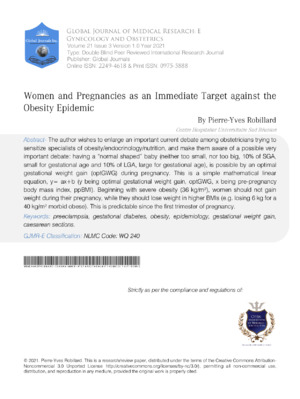
The author wishes to enlarge an important current debate among obstetricians trying to sensitize specialists of obesity/endocrinology/nutrition, and make them aware of a possible very important debate: having a “normal shaped” baby (neither too small, nor too big, 10% of SGA, small for gestational age and 10% of LGA, large for gestational age), is possible by an optimal gestational weight gain (optGWG) during pregnancy. This is a simple mathematical linear equation, y= ax+b (y being optimal gestational weight gain, optGWG, x being pre-pregnancy body mass index, ppBMI). Beginning with severe obesity (36 kg/m²), women should not gain weight during their pregnancy, while they should lose weight in higher BMIs (e.g. losing 6 kg for a 40 kg/m² morbid obese). This is predictable since the first trimester of pregnancy.

Funding

No external funding was declared for this work.

Conflict of Interest

The authors declare no conflict of interest.

Ethical Approval

No ethics committee approval was required for this article type.

Data Availability

Not applicable for this article.

Dr. Pierre-Yves Robillard. 2021. \u201cWomen and Pregnancies as an Immediate Target against the Obesity Epidemic\u201d. Global Journal of Medical Research - E: Gynecology & Obstetrics GJMR-E Volume 21 (GJMR Volume 21 Issue E3): .

Download Citation

Accurate research on women, pregnancies, and obesity, highlighting health impacts and early interventions.
Journal Specifications

Crossref Journal DOI 10.17406/gjmra

Print ISSN 0975-5888

e-ISSN 2249-4618

Keywords
Classification
GJMR-E Classification: NLMC Code: WQ 240
Version of record

v1.2

Issue date

July 22, 2021

Language

English

Experiance in AR

The methods for personal identification and authentication are no exception.

Read in 3D

The methods for personal identification and authentication are no exception.

Article Matrices
Total Views: 2012
Total Downloads: 991
2026 Trends
Research Identity (RIN)
Related Research

Published Article

The author wishes to enlarge an important current debate among obstetricians trying to sensitize specialists of obesity/endocrinology/nutrition, and make them aware of a possible very important debate: having a “normal shaped” baby (neither too small, nor too big, 10% of SGA, small for gestational age and 10% of LGA, large for gestational age), is possible by an optimal gestational weight gain (optGWG) during pregnancy. This is a simple mathematical linear equation, y= ax+b (y being optimal gestational weight gain, optGWG, x being pre-pregnancy body mass index, ppBMI). Beginning with severe obesity (36 kg/m²), women should not gain weight during their pregnancy, while they should lose weight in higher BMIs (e.g. losing 6 kg for a 40 kg/m² morbid obese). This is predictable since the first trimester of pregnancy.

Our website is actively being updated, and changes may occur frequently. Please clear your browser cache if needed. For feedback or error reporting, please email [email protected]
×

This Page is Under Development

We are currently updating this article page for a better experience.

Request Access

Please fill out the form below to request access to this research paper. Your request will be reviewed by the editorial or author team.
X

Quote and Order Details

Contact Person

Invoice Address

Notes or Comments

This is the heading

Lorem ipsum dolor sit amet, consectetur adipiscing elit. Ut elit tellus, luctus nec ullamcorper mattis, pulvinar dapibus leo.

High-quality academic research articles on global topics and journals.

Women and Pregnancies as an Immediate Target against the Obesity Epidemic

Dr. Pierre-Yves Robillard
Dr. Pierre-Yves Robillard Centre Hospitalier universitaire Sud Réunion

Research Journals