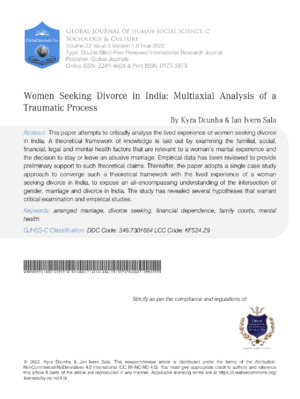
Women Seeking Divorce in India: Multiaxial Analysis of a Traumatic Process

α
Kyra Dcunha
Kyra Dcunha
σ
Jan Ivern Sala
Jan Ivern Sala

Send Message

To: Author

Women Seeking Divorce in India: Multiaxial Analysis of a Traumatic Process

Article Fingerprint

ReserarchID

1SVR3

Women Seeking Divorce in India: Multiaxial Analysis of a Traumatic Process Banner

AI TAKEAWAY

Connecting with the Eternal Ground
  • English
  • Afrikaans
  • Albanian
  • Amharic
  • Arabic
  • Armenian
  • Azerbaijani
  • Basque
  • Belarusian
  • Bengali
  • Bosnian
  • Bulgarian
  • Catalan
  • Cebuano
  • Chichewa
  • Chinese (Simplified)
  • Chinese (Traditional)
  • Corsican
  • Croatian
  • Czech
  • Danish
  • Dutch
  • Esperanto
  • Estonian
  • Filipino
  • Finnish
  • French
  • Frisian
  • Galician
  • Georgian
  • German
  • Greek
  • Gujarati
  • Haitian Creole
  • Hausa
  • Hawaiian
  • Hebrew
  • Hindi
  • Hmong
  • Hungarian
  • Icelandic
  • Igbo
  • Indonesian
  • Irish
  • Italian
  • Japanese
  • Javanese
  • Kannada
  • Kazakh
  • Khmer
  • Korean
  • Kurdish (Kurmanji)
  • Kyrgyz
  • Lao
  • Latin
  • Latvian
  • Lithuanian
  • Luxembourgish
  • Macedonian
  • Malagasy
  • Malay
  • Malayalam
  • Maltese
  • Maori
  • Marathi
  • Mongolian
  • Myanmar (Burmese)
  • Nepali
  • Norwegian
  • Pashto
  • Persian
  • Polish
  • Portuguese
  • Punjabi
  • Romanian
  • Russian
  • Samoan
  • Scots Gaelic
  • Serbian
  • Sesotho
  • Shona
  • Sindhi
  • Sinhala
  • Slovak
  • Slovenian
  • Somali
  • Spanish
  • Sundanese
  • Swahili
  • Swedish
  • Tajik
  • Tamil
  • Telugu
  • Thai
  • Turkish
  • Ukrainian
  • Urdu
  • Uzbek
  • Vietnamese
  • Welsh
  • Xhosa
  • Yiddish
  • Yoruba
  • Zulu

Abstract

This paper attempts to critically analyse the lived experience of women seeking divorce in India. A theoretical framework of knowledge is laid out by examining the familial, social, financial, legal and mental health factors that are relevant to a woman’s marital experience and the decision to stay or leave an abusive marriage. Empirical data has been reviewed to provide preliminary support to such theoretical claims. Thereafter, the paper adopts a single case study approach to converge such a theoretical framework with the lived experience of a woman seeking divorce in India, to expose an all-encompassing understanding of the intersection of gender, marriage and divorce in India. The study has revealed several hypotheses that warrant critical examination and empirical studies.

References

74 Cites in Article
  1. Ida Agra,I Gelgel,I Dharmika (2018). Pressure on socio-cultural towards post-divorce Hindu women in Denpasar city.
  2. Maksuda Akter,Roquia Begum (2012). Mental health problems of women undergoing divorce process.
  3. Mohammad Asoodeh,Shiva Khalili,Manijeh Daneshpour,Masoud Lavasani (2010). Factors of successful marriage: Accounts from self described happy couples.
  4. William Avison,Jennifer Ali,David Walters (2007). Family Structure, Stress, and Psychological Distress: A Demonstration of the Impact of Differential Exposure.
  5. Aniruddha Babar (2016). Adultery Law in India-A‘Saga'of Patriarchy, Prejudice, Discrimination, Legal Betrayal and Injustice against Women.
  6. G Baluja (2016). Review for "Does Financial Literacy Influence Financial Planning? A Study among Working Women in India".
  7. A Barnwell (2018). Durkheim as affect theorist.
  8. Srimati Basu (2006). Playing Off Courts: The Negotiation of Divorce and Violence in Plural Legal Settings in Kolkata.
  9. Srimati Basu (2012). Judges of Normality: Mediating Marriage in the Family Courts of Kolkata, India.
  10. S Bhattacharya (2020). Arguments of Seed-Field Theory in Hinduism: An Examination from The Perspective of Feminist Ontology.
  11. Kallol Bhattacharyya (2020). The sacred relationship between marriage, spirituality and healthy aging in Hinduism.
  12. Dinesh Bhugra,Soumitra Pathare,Renuka Nardodkar,Chetna Gosavi,Roger Ng,Julio Torales,Antonio Ventriglio (2016). Legislative provisions related to marriage and divorce of persons with mental health problems: a global review.
  13. Melvin Black,Wendy Joffee (1978). A LAWYER/THERAPIST TEAM* APPROACH TO DIVORCE.
  14. Andrew Cherlin (2017). Introduction to the Special Collection on Separation, Divorce, Repartnering, and Remarriage around the World.
  15. Pamela Choice,Leanne Lamke (1997). A Conceptual Approach to Understanding Abused Women's Stay/Leave Decisions.
  16. Patrick Corrigan,Deepa Rao (2012). On the Self-Stigma of Mental Illness: Stages, Disclosure, and Strategies for Change.
  17. Rakhi Dandona,G Kumar,R Dhaliwal,Mohsen Naghavi,Theo Vos,D Shukla,Lakshmi Vijayakumar,G Gururaj,J Thakur,Atul Ambekar,Rajesh Sagar,Megha Arora,Deeksha Bhardwaj,Joy Chakma,Eliza Dutta,Melissa Furtado,Scott Glenn,Caitlin Hawley,Sarah Johnson,Tripti Khanna,Michael Kutz,W Mountjoy-Venning,Pallavi Muraleedharan,Thara Rangaswamy,Chris Varghese,Mathew Varghese,K Reddy,Christopher Murray,Soumya Swaminathan,Lalit Dandona (2018). Gender differentials and state variations in suicide deaths in India: the Global Burden of Disease Study 1990–2016.
  18. N Darin (2019). Contemporary Environmental Law Reforms.
  19. John Sullivan (1984). The Equal Access to Justice Act in the Federal Courts.
  20. Sonalde Desai,Lester Andrist (2010). Gender scripts and age at marriage in India.
  21. Arti Dhand (2002). The <i>Dharma</i> of Ethics, the Ethics of <i>Dharma</i>: Quizzing the Ideals of Hinduism.
  22. Rajib Dhar (2013). Intercaste Marriage: A Study from the Indian Context.
  23. Premchand Dommaraju (2016). Divorce and Separation in India.
  24. P Dublish,Y Khan (2022). Impact of Honour Killings in Haryana, India. India.
  25. M Eaton (1986). Justice for Women? Family, Court and Social Control.
  26. Abhijeet Faye,Gurvinder Kalra,Alka Subramanyam,Henal Shah,Ravindra Kamath,Abhijit Pakhare (2013). Study of marital adjustment, mechanisms of coping and psychopathology in couples seeking divorce in India.
  27. Naomi Gerstel (1987). Divorce and Stigma.
  28. Madelyn Gould,David Shaffer,Prudence Fisher,Robin Garfinkel (1998). Separation/Divorce and Child and Adolescent Completed Suicide.
  29. G Gururaj,M Isaac,D Subbakrishna,R Ranjani (2004). Risk factors for completed suicides: a case–control study from Bangalore, India.
  30. Rahul Hajare (2018). Production of Prevalence and Pattern of Substance Abuse Amongst Principal in Private Pharmacy Institutions in a Rural Community, India.
  31. Jeanne Hilton,Tamara Anderson (2009). Characteristics of Women With Children Who Divorce in Midlife Compared to Those Who Remain Married.
  32. S Jacob,S Chattopadhyay (2016). Marriage dissolution in India.
  33. A Jogani (2018). Mediation of matrimonial disputes in India-domestic violence cases: To mediate or not to mediate, SCC Blog.
  34. Shveta Kalyanwala,A Zavier,Shireen Jejeebhoy,Rajesh Kumar (2010). Abortion Experiences of Unmarried Young Women In India: Evidence from a Facility-Based Study in Bihar and Jharkhand.
  35. C Kleinsorge,L Covitz (2012). Impact of divorce on children: Developmental considerations.
  36. D Madara (2020). Impact of divorce on the mental health of the couple.
  37. Emily Mckendry-Smith (2017). “Enjoy the Heat of a Log, and Heed the Advice of the Elders”: Religious, Educational, and Neighborhood Determinants of Parental Influence on Spousal Choice in Nepal.
  38. Pangri Mehta (2016). Religious freedom and gender equality in <scp>I</scp>ndia.
  39. J Mendoza,M Tolba,Y Saleh (2019). Strengthening marriages in Egypt: Impact of divorce on women.
  40. U Misra (2021). Why Do so many Women End up in Bad Jobs?.
  41. F Moorkath,M Vranda,C Naveenkumar (2019). Women with mental illness-an overview of sociocultural factors influencing family rejection and subsequent institutionalisation in India.
  42. Dr. S., M. Sas (2013). Women Objectification in Indonesian Patriarchal Culture (Feminism Approach).
  43. J Myers,J Madathil,L Tingle (2005). Marriage satisfaction and wellness in India and the United States: A preliminary comparison of arranged marriages and marriages of choice.
  44. D Nagasaila (1992). Awards and Grants.
  45. S Nanda (2015). Arranging a marriage in India. Distant mirrors: America as a foreign culture.
  46. C Narayan,D Shikha (2013). Indian legal system and mental health.
  47. Manu Krishnan (2019). Exploring Suicide Trends in India: An Analysis of Recent National Crime Records Bureau Data.
  48. P Pachauri,P Rathi (2018). Socio- economic problems of the Divorced Women in Rural Areas: Sociological Analysis of Shikarpur District.
  49. J Persons,A Jensen (2018). Publishing a single case study.
  50. R Rajamickam,V Paramasivam,K Subramaniam (2012). Hindu marriage and its position in the Malaysian marriage law.
  51. A Rangarao,K Sekhar (2002). Divorce: Process and Correlates A Cross-Cultural Study.
  52. M Rastogi (2006). Dowry and Its Link to Violence Against Women in India: Feminist Psychological Perspectives.
  53. Nancy Rhodes,Eva Mckenzie (1998). Why do battered women stay?.
  54. Stacy Rogers (2004). Dollars, Dependency, and Divorce: Four Perspectives on the Role of Wives’ Income.
  55. Bushra Sabri,Maria Sanchez,Jacquelyn Campbell (2015). Motives and Characteristics of Domestic Violence Homicides and Suicides Among Women in India.
  56. S Shaifali (2009). Love, Lust, and Marriage: Why We Stay and Why We Stray.
  57. B Sharma (2011). Mental and emotional impact of divorce on women.
  58. Indira Sharma,Balram Pandit,Abhishek Pathak,Reet Sharma (2013). Hinduism, marriage and mental illness.
  59. Manish Sharma,Hima Kota (2019). The Role of Working Women in Investment Decision Making in the Family in India.
  60. T Shobha,S Shalini (2015). A study on the perception of women towards financial planning in the city of Bengaluru.
  61. Ch. Ch.Hymavathi,Msk. Msk.Varma (2012). Problems of Women Entrepreneurs in India - Suggestions to Improve.
  62. J Singh,S Jaswal (2021). Marriage practices, decision-making process and contraception use among young married men in rural Odisha, India.
  63. John Snowdon (2019). Indian suicide data.
  64. Shobna Sonpar (2005). Marriage in India: Clinical Issues.
  65. M Srivastava,S Kumar (2021). Journal of Human Rights Law and Practice.
  66. J Thakur (2009). the effect of socioeconomic and demographic factors on divorce in modern India.
  67. Harsha Kumar. K.,Senbagavalli S.,R Ravichandran,Vivek V. Nair (2021). PROSTHETIC REHABILITATION OF A MAXILLECTOMY PATIENT WITH A TITANIUM CLOSED HOLLOW BULB OBTURATOR USING LOST WAX BOLUS TECHNIQUE - A CASE REPORT.
  68. Tnn (2021). Rajkot: Man suspects ex-wife of affair, stabs her to death.
  69. J Trivedi,H Sareen,M Dhyani (2009). Psychological aspects of widowhood and divorce.
  70. S Vanka,M Kumari (2008). Sustaining Democracy Within the Family Through Family Courts.
  71. L Waite,D Browning,W Doherty,M Gallagher,Y Luo,S Stanley (2002). Does divorce make people happy? Findings from a Study of Unhappy Marriages.
  72. Javeria Waseem,Rutaba Muneer,Syeda Hoor-Ul-Ain,Rutaba Tariq,Anam Minhas (2020). Psychosocial determinants of divorce and their effects on women in Pakistan: a national review.
  73. R Yin (2014). Case study research.
  74. M Zineldin (2019). TCS is to blame: The impact of divorce on physical and mental health.

Funding

No external funding was declared for this work.

Conflict of Interest

The authors declare no conflict of interest.

Ethical Approval

No ethics committee approval was required for this article type.

Data Availability

Not applicable for this article.

How to Cite This Article

Kyra Dcunha. 2026. \u201cWomen Seeking Divorce in India: Multiaxial Analysis of a Traumatic Process\u201d. Unknown Journal GJHSS-C Volume 22 (GJHSS Volume 22 Issue C3): .

Download Citation

Women seeking divorce in India, multiaxial analysis of traumatic processes.
Issue Cover
GJHSS Volume 22 Issue C3
Pg. 23- 33
Journal Specifications
Keywords
Classification
GJHSS-C Classification: DDC Code: 346.7301664 LCC Code: KF524.Z9
Version of record

v1.2

Issue date

June 23, 2022

Language
en
Experiance in AR

Explore published articles in an immersive Augmented Reality environment. Our platform converts research papers into interactive 3D books, allowing readers to view and interact with content using AR and VR compatible devices.

Read in 3D

Your published article is automatically converted into a realistic 3D book. Flip through pages and read research papers in a more engaging and interactive format.

Article Matrices
Total Views: 1729
Total Downloads: 51
2026 Trends
Related Research

Published Article

This paper attempts to critically analyse the lived experience of women seeking divorce in India. A theoretical framework of knowledge is laid out by examining the familial, social, financial, legal and mental health factors that are relevant to a woman’s marital experience and the decision to stay or leave an abusive marriage. Empirical data has been reviewed to provide preliminary support to such theoretical claims. Thereafter, the paper adopts a single case study approach to converge such a theoretical framework with the lived experience of a woman seeking divorce in India, to expose an all-encompassing understanding of the intersection of gender, marriage and divorce in India. The study has revealed several hypotheses that warrant critical examination and empirical studies.

Our website is actively being updated, and changes may occur frequently. Please clear your browser cache if needed. For feedback or error reporting, please email [email protected]

Request Access

Please fill out the form below to request access to this research paper. Your request will be reviewed by the editorial or author team.
X

Quote and Order Details

Contact Person

Invoice Address

Notes or Comments

This is the heading

Lorem ipsum dolor sit amet, consectetur adipiscing elit. Ut elit tellus, luctus nec ullamcorper mattis, pulvinar dapibus leo.

High-quality academic research articles on global topics and journals.

Women Seeking Divorce in India: Multiaxial Analysis of a Traumatic Process

Kyra Dcunha
Kyra Dcunha
Jan Ivern Sala
Jan Ivern Sala

Research Journals