Women’s Empowerment through F-Commerce During the COVID-19 Pandemic: A Qualitative Study in Bangladesh

α
Halima Haque
Halima Haque
α Jahangirnagar University Jahangirnagar University

Send Message

To: Author

Women’s Empowerment through F-Commerce During the COVID-19 Pandemic: A Qualitative Study in Bangladesh

Article Fingerprint

ReserarchID

3L64H

Women’s Empowerment through F-Commerce During the COVID-19 Pandemic: A Qualitative Study in Bangladesh Banner

AI TAKEAWAY

Connecting with the Eternal Ground
  • English
  • Afrikaans
  • Albanian
  • Amharic
  • Arabic
  • Armenian
  • Azerbaijani
  • Basque
  • Belarusian
  • Bengali
  • Bosnian
  • Bulgarian
  • Catalan
  • Cebuano
  • Chichewa
  • Chinese (Simplified)
  • Chinese (Traditional)
  • Corsican
  • Croatian
  • Czech
  • Danish
  • Dutch
  • Esperanto
  • Estonian
  • Filipino
  • Finnish
  • French
  • Frisian
  • Galician
  • Georgian
  • German
  • Greek
  • Gujarati
  • Haitian Creole
  • Hausa
  • Hawaiian
  • Hebrew
  • Hindi
  • Hmong
  • Hungarian
  • Icelandic
  • Igbo
  • Indonesian
  • Irish
  • Italian
  • Japanese
  • Javanese
  • Kannada
  • Kazakh
  • Khmer
  • Korean
  • Kurdish (Kurmanji)
  • Kyrgyz
  • Lao
  • Latin
  • Latvian
  • Lithuanian
  • Luxembourgish
  • Macedonian
  • Malagasy
  • Malay
  • Malayalam
  • Maltese
  • Maori
  • Marathi
  • Mongolian
  • Myanmar (Burmese)
  • Nepali
  • Norwegian
  • Pashto
  • Persian
  • Polish
  • Portuguese
  • Punjabi
  • Romanian
  • Russian
  • Samoan
  • Scots Gaelic
  • Serbian
  • Sesotho
  • Shona
  • Sindhi
  • Sinhala
  • Slovak
  • Slovenian
  • Somali
  • Spanish
  • Sundanese
  • Swahili
  • Swedish
  • Tajik
  • Tamil
  • Telugu
  • Thai
  • Turkish
  • Ukrainian
  • Urdu
  • Uzbek
  • Vietnamese
  • Welsh
  • Xhosa
  • Yiddish
  • Yoruba
  • Zulu

Abstract

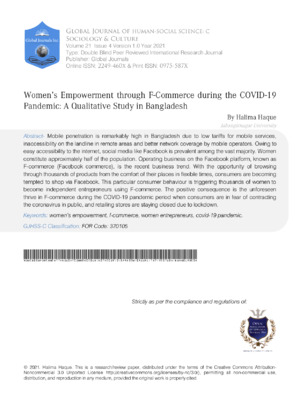
Mobile penetration is remarkably high in Bangladesh due to low tariffs for mobile services, inaccessibility on the landline in remote areas and better network coverage by mobile operators. Owing to easy accessibility to the internet, social media like Facebook is prevalent among the vast majority. Women constitute approximately half of the population. Operating business on the Facebook platform, known as F-commerce (Facebook commerce), is the recent business trend. With the opportunity of browsing through thousands of products from the comfort of their places in flexible times, consumers are becoming tempted to shop via Facebook. This particular consumer behaviour is triggering thousands of women to become independent entrepreneurs using F-commerce. The positive consequence is the unforeseen thrive in F-commerce during the COVID-19 pandemic period when consumers are in fear of contracting the coronavirus in public, and retailing stores are staying closed due to lockdown.

References

20 Cites in Article
  1. (1996). International Labour Organization (ILO).
  2. Mashruha Zabeen,H Ara,N Sarwar (2013). F-Commerce in Bangladesh: “Venit, Vidit, Vicit”.
  3. (2021). Leading Countries in Facebook Users and Internet Users; Facebook is Normative Among the Wired Populations.
  4. Naila Kabeer (1999). Resources, Agency, Achievements: Reflections on the Measurement of Women's Empowerment.
  5. (2020). WHO Coronavirus Disease (COVID-19) Dashboard.
  6. Ashraful Islam (2020). COVID-19 Lockdown Increases Domestic Violence in Bangladesh.
  7. N Kabeer (2005). Gender equality and women's empowerment: A critical analysis of the third development millennium goal 1.
  8. Ruth Alsop,Nina Heinsohn (2005). Measuring Empowerment in Practice: Structuring Analysis and Framing Indicators.
  9. Robert Elliott,Ladislav Timulak (2021). Why a generic approach to descriptive-interpretive qualitative research?.
  10. (2020). Speech at the GSMA 2018 Mobile World Congress, Barcelona, Spain.
  11. Napoleoncat (2021). Facebook users in Bangladesh June -2021.
  12. (2021). Cybercrime and Cybercriminals.
  13. (2019). Development of Bangladesh through SMEs Financing: A Case Study on IDLC Finance Limited.
  14. Leonard Chusmir,Dorothy Moore,Janet Adams (1990). Research on working women: A report card of 22 journals.
  15. (2003). ILO Declaration on Fundamental Principles and Rights at Work.
  16. M Jethwa,C Mishra (2016). A Study on Status of Women Entrepreneur in E-commerce Environment in India.
  17. Jasmine Jaim (2021). Exist or exit? Women business‐owners in Bangladesh during COVID‐19.
  18. Albina Amin (2018). Women Entrepreneurship and SMEs of Online Clothing Business in Dhaka City.
  19. Tahsina Tabassum (2018). Facebook-Based Women Entrepreneurship in Bangladesh: Opportunities and Challenges.
  20. Arafatul Islam (2020). Bangladesh: More women create online businesses during pandemic.

Funding

No external funding was declared for this work.

Conflict of Interest

The authors declare no conflict of interest.

Ethical Approval

No ethics committee approval was required for this article type.

Data Availability

Not applicable for this article.

How to Cite This Article

Halima Haque. 2021. \u201cWomen’s Empowerment through F-Commerce During the COVID-19 Pandemic: A Qualitative Study in Bangladesh\u201d. Global Journal of Human-Social Science - C: Sociology & Culture GJHSS-C Volume 21 (GJHSS Volume 21 Issue C4): .

Download Citation

Women empowerment through E-commerce COVID-19 Bangladesh.
Issue Cover
GJHSS Volume 21 Issue C4
Pg. 25- 35
Journal Specifications

Crossref Journal DOI 10.17406/GJHSS

Print ISSN 0975-587X

e-ISSN 2249-460X

Keywords
Classification
GJHSS-C Classification: FOR Code: 370105
Version of record

v1.2

Issue date

August 23, 2021

Language
en
Experiance in AR

Explore published articles in an immersive Augmented Reality environment. Our platform converts research papers into interactive 3D books, allowing readers to view and interact with content using AR and VR compatible devices.

Read in 3D

Your published article is automatically converted into a realistic 3D book. Flip through pages and read research papers in a more engaging and interactive format.

Article Matrices
Total Views: 1958
Total Downloads: 894
2026 Trends
Related Research

Published Article

Mobile penetration is remarkably high in Bangladesh due to low tariffs for mobile services, inaccessibility on the landline in remote areas and better network coverage by mobile operators. Owing to easy accessibility to the internet, social media like Facebook is prevalent among the vast majority. Women constitute approximately half of the population. Operating business on the Facebook platform, known as F-commerce (Facebook commerce), is the recent business trend. With the opportunity of browsing through thousands of products from the comfort of their places in flexible times, consumers are becoming tempted to shop via Facebook. This particular consumer behaviour is triggering thousands of women to become independent entrepreneurs using F-commerce. The positive consequence is the unforeseen thrive in F-commerce during the COVID-19 pandemic period when consumers are in fear of contracting the coronavirus in public, and retailing stores are staying closed due to lockdown.

Our website is actively being updated, and changes may occur frequently. Please clear your browser cache if needed. For feedback or error reporting, please email [email protected]

Request Access

Please fill out the form below to request access to this research paper. Your request will be reviewed by the editorial or author team.
X

Quote and Order Details

Contact Person

Invoice Address

Notes or Comments

This is the heading

Lorem ipsum dolor sit amet, consectetur adipiscing elit. Ut elit tellus, luctus nec ullamcorper mattis, pulvinar dapibus leo.

High-quality academic research articles on global topics and journals.

Women’s Empowerment through F-Commerce During the COVID-19 Pandemic: A Qualitative Study in Bangladesh

Halima Haque
Halima Haque Jahangirnagar University

Research Journals