Women’s Perception of Air Pollution and Associated Health Hazard Aspects – A Study in Low-Income Urban Space in Bangladesh

1
Aziza Hena
Aziza Hena
2
Sharmin Jahan
Sharmin Jahan
3
Sabrina Nasrin Sujana
4
Sheikh Nayem Siddique

Send Message

To: Author

GJHSS Volume 22 Issue C1

Article Fingerprint

ReserarchID

1LXFD

Women’s Perception of Air Pollution and Associated Health Hazard Aspects – A Study in Low-Income Urban Space in Bangladesh Banner
  • English
  • Afrikaans
  • Albanian
  • Amharic
  • Arabic
  • Armenian
  • Azerbaijani
  • Basque
  • Belarusian
  • Bengali
  • Bosnian
  • Bulgarian
  • Catalan
  • Cebuano
  • Chichewa
  • Chinese (Simplified)
  • Chinese (Traditional)
  • Corsican
  • Croatian
  • Czech
  • Danish
  • Dutch
  • Esperanto
  • Estonian
  • Filipino
  • Finnish
  • French
  • Frisian
  • Galician
  • Georgian
  • German
  • Greek
  • Gujarati
  • Haitian Creole
  • Hausa
  • Hawaiian
  • Hebrew
  • Hindi
  • Hmong
  • Hungarian
  • Icelandic
  • Igbo
  • Indonesian
  • Irish
  • Italian
  • Japanese
  • Javanese
  • Kannada
  • Kazakh
  • Khmer
  • Korean
  • Kurdish (Kurmanji)
  • Kyrgyz
  • Lao
  • Latin
  • Latvian
  • Lithuanian
  • Luxembourgish
  • Macedonian
  • Malagasy
  • Malay
  • Malayalam
  • Maltese
  • Maori
  • Marathi
  • Mongolian
  • Myanmar (Burmese)
  • Nepali
  • Norwegian
  • Pashto
  • Persian
  • Polish
  • Portuguese
  • Punjabi
  • Romanian
  • Russian
  • Samoan
  • Scots Gaelic
  • Serbian
  • Sesotho
  • Shona
  • Sindhi
  • Sinhala
  • Slovak
  • Slovenian
  • Somali
  • Spanish
  • Sundanese
  • Swahili
  • Swedish
  • Tajik
  • Tamil
  • Telugu
  • Thai
  • Turkish
  • Ukrainian
  • Urdu
  • Uzbek
  • Vietnamese
  • Welsh
  • Xhosa
  • Yiddish
  • Yoruba
  • Zulu

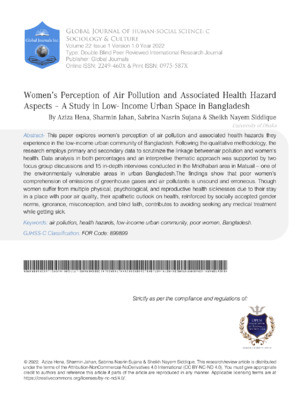
This paper explores women’s perception of air pollution and associated health hazards they experience in the low-income urban community of Bangladesh. Following the qualitative methodology, the research employs primary and secondary data to scrutinize the linkage betweenair pollution and women’s health. Data analysis in both percentages and an interpretive thematic approach was supported by two focus group discussions and 15 in-depth interviews conducted in the Mridhabari area in Matuail -one of the environmentally vulnerable areas in urban Bangladesh.The findings show that poor women’s comprehension of emissions of greenhouse gases and air pollutants is unsound and erroneous. Though women suffer from multiple physical, psychological, and reproductive health sicknesses due to their stay in a place with poor air quality, their apathetic outlook on health, reinforced by socially accepted gender norms, ignorance, misconception, and blind faith, contributes to avoiding seeking any medical treatment while getting sick.

Funding

No external funding was declared for this work.

Conflict of Interest

The authors declare no conflict of interest.

Ethical Approval

No ethics committee approval was required for this article type.

Data Availability

Not applicable for this article.

Aziza Hena. 2026. \u201cWomen’s Perception of Air Pollution and Associated Health Hazard Aspects – A Study in Low-Income Urban Space in Bangladesh\u201d. Unknown Journal GJHSS-C Volume 22 (GJHSS Volume 22 Issue C1): .

Download Citation

Women’s Pollution Pollution Health Hazard.
Issue Cover
GJHSS Volume 22 Issue C1
Pg. 47- 54
Journal Specifications
Keywords
Classification
GJHSS-C Classification: FOR Code: 899899
Version of record

v1.2

Issue date

February 28, 2022

Language

English

Experiance in AR

The methods for personal identification and authentication are no exception.

Read in 3D

The methods for personal identification and authentication are no exception.

Article Matrices
Total Views: 1753
Total Downloads: 32
2026 Trends
Research Identity (RIN)
Related Research

Published Article

This paper explores women’s perception of air pollution and associated health hazards they experience in the low-income urban community of Bangladesh. Following the qualitative methodology, the research employs primary and secondary data to scrutinize the linkage betweenair pollution and women’s health. Data analysis in both percentages and an interpretive thematic approach was supported by two focus group discussions and 15 in-depth interviews conducted in the Mridhabari area in Matuail -one of the environmentally vulnerable areas in urban Bangladesh.The findings show that poor women’s comprehension of emissions of greenhouse gases and air pollutants is unsound and erroneous. Though women suffer from multiple physical, psychological, and reproductive health sicknesses due to their stay in a place with poor air quality, their apathetic outlook on health, reinforced by socially accepted gender norms, ignorance, misconception, and blind faith, contributes to avoiding seeking any medical treatment while getting sick.


Our website is actively being updated, and changes may occur frequently. Please clear your browser cache if needed. For feedback or error reporting, please email [email protected]
×

This Page is Under Development

We are currently updating this article page for a better experience.

Request Access

Please fill out the form below to request access to this research paper. Your request will be reviewed by the editorial or author team.
X

Quote and Order Details

Contact Person

Invoice Address

Notes or Comments

This is the heading

Lorem ipsum dolor sit amet, consectetur adipiscing elit. Ut elit tellus, luctus nec ullamcorper mattis, pulvinar dapibus leo.

High-quality academic research articles on global topics and journals.

Women’s Perception of Air Pollution and Associated Health Hazard Aspects – A Study in Low-Income Urban Space in Bangladesh

Aziza Hena
Aziza Hena
Sharmin Jahan
Sharmin Jahan
Sabrina Nasrin Sujana
Sheikh Nayem Siddique

Research Journals