
I. INTRODUCTION
According to Orimalade (1995), a computer is an electronic machine or a set of machines which accepts raw data given to it in a specific format carries out some operations on the data and produces results in a particular way as information for:
- Signals to control some other machines
- Decision making
- Input into other machines
Adekunle (2003) adds that, a computer can be a machine or device under the control of a stored program which can take data in an agreed form, treat that data and supply the results as information in a specific form.
Computer is culled from the word compute which connotes calculate. Computers can be seen as a device which is capable of performing arithmetic and logical operations with ease within a short time. Computers can quickly process and save information and data for effective use. Since the invention of software, computers can now be used by social scientists apart from engineers and mathematicians. As a result Information Technology was then used to replace the name computer. The handling and processing of data using devices electronically is the work of Information Technology. NCET (1995), suggests that Information Technology creates an environment for the handling of text and images including figures, graphs, instructions, sound and music processing the data by configuring, sorting, saving, retrieving, examining, displaying and transferring then into information for communication purposes.
Oloruntoba (1997) additionally defines computer as an electronic machine which works under the influence of instructions saved in its memory. This machine according to Oloruntoba (1997) can accept data input, manipulate it with given instructions and produce results and save the results for future use.
Rana in 2009 suggest that the key to successful revolution of information services is the use of Information Communication Technology. The use of Information Communication Technology is abundant but particularly in changing existing hard copy information within the whole stages of saving, retrieval and distribution. Information Communication Technology offers commercial growth to the urban and deprived societies. One of the benefits of Information Communication Technology is that, it increases productivity and makes business more effective even though the effect of the growth of the economy is not going to be the same everywhere. Information Communication Technology has the ability to reach out to low level income earners. This is so because mobile phones can now be owned by individuals that duel in the developing countries especially rural areas.
Information Communication Technology has now become the major platform for the dissemination of gigabytes of information to both public and private individuals living in both urban and rural areas. For decades information relating to finance, education, health, entertainment was not available to rural population as a result of the absence of connectivity both satellite and digital. The potential of wireless technologies has now influenced economic and social lives at different levels of rural activities. Current trends in the advancement of Information Communication Technology with regards to generation (5G) internet connectivity are optimising performance and decision making within the various aspects of human endeavour. This has created business innovation, transformed public lifestyles Christine Zhen-Wei Qiang, (2009).
II. STATEMENT OF PROBLEM
In this study, the adverse setbacks of Information and Communication Technologies broadly would the centre of discussion. There is no question to the fact that Information and Communication Technologies devices affect the way employees of Twifo Atti-Morkwa District conduct their daily work activities since majority of staff of the district assembly are computer literates.
Yet the district assembly do not realise the maximum benefit of the use of Information and Communication Technologies within the district.
III. OBJECTIVE(S) AND SCOPE
The main objective of this study is to:
Find the impact of Information and Communication Technologies on work output at Twifo Atti-Morkwa District Assembly.
Determine the effect of ICT at Twifo Atti-Morkwa District Assembly's day to day activities and the speed of work
Reveal the accuracy of work output by the use of Information and Communication Technologies at Twifo Atti-Morkwa District Assembly's and the time it takes for processing a large amount of data
Uncover the relationship that exist between work output, qualifications, promotions, and work performance based on the skill level, accuracy of work done, level of impact on work output, and the training of staff of Twifo Atti-Morkwa District Assembly.
IV. RESEARCH QUESTIONS
What is the duration of data processing by staff of Twifo Atti-Morkwa District Assembly's?
What is the swiftness level of employees at the use of ICT resources?
At what level of impact does ICT have on the activities of employees at Twifo Atti-Morkwa District Assembly's?
Is there any connection between work output level, qualification, promotion and performance at Twifo Atti-Morkwa District Assembly's?
V. LIMITATION OF THIS STUDY
This paper does not go beyond the boundaries of Twifo Atti-Morkwa District Assembly. This is because there is little time and funds available for the researcher to do the study.
VI. DELIMITATION OF THIS STUDY
This study should have been extended to the whole Central region in the country. As a result of limited resources and funds of the researcher he could not get there. Additionally the researcher was working with limited time and without sponsorship therefore the studies was restricted to only Twifo Atti-Morkwa District Assembly.
VII. LITERATURE REVIEW
Development in Ghana largely depends on the nation's ability to drastically reduce poverty by creating wealth. The ability for a large population of the country to produce wealth sustainably guarantees the country's developmental status. The United Nations Commission on Science and Technology Development (UNCSTD) in partnership with IDRC projected five growth indicators that concentrated on the improvement of the quality of livelihood in June 1996. These indicators according to Cred and Mansell, (1998) include health, education, governance, technology and income. Considering these five crucial indicators of national development, Information Communication Technology can assist society to achieve all the five developmental indicators in Ghana. Information Communication Technology can only be useful only if they contribute to eradicating poverty through improved schooling and health.
The access to timely information is salient for the better use, equitable sharing of resources, and the raising of participation in decision making process.
Information Communication Technologies has created the foundation for the existence of mankind from onset. According to Ndukwe, (2002), man has therefore been looking at ways of improving the processing of Information and Communication to prospective individuals irrespective of geographical location, proximity and time. The access to timely, national and global information is a prerequisite for surviving in this information age. For any nation to grow and to continue to exist in this rapidly changing global environment, Information and Communication Technologies should be the foundation. As a result there is the challenge for experts to take up a host of challenges such as reliable infrastructure, skilled human capital, open governance and other important capacity building issues.
Computing and Technology are the two main branches within the heart of technology. The technologies of computing include computer system, electronic mail, internet, and mobile phone and fax machine.
VIII. COMPUTERS
Originally computers are used by scientists for number calculation purposes. This usefulness was seen in offices and industries. Madu (2000), states that recently, computers is being used in homes and schools regularly for various tasks such as homework, letters, research, exams, assignment and applications for easing obligations.
Computers are normally put to several uses according to Fapohunda, (1999). These include letter and report writing, book printing, newspaper production, picture making, magazine production, drawing of diagrams, handling statistics, mathematics and financial records. Computers can additionally be used for traffic lights control, flying of planes, making and playing of music and music videos, sending instant messages anywhere around the globe.
IX. INTERNET
X. THE E-MAIL
XI. MOBILE PHONES
The mobile phone is defined as the telephone system that can move or easily be moved quickly from one place to another Bittner (1989). Mobile phones have now been advanced into smart phones which are currently the tools for shaping the changing the globe. Mobile phones were initially owned by only the rich, business executives and affluent in society who lived luxury lives. The impact of smart phones on the economy of countries, businesses, students, homes and schools is huge. The use of information communication technologies has now been limited to smart phones in the society. The presence of technology according to Marcelle (2000) has been the basis of change in societal development. Ghana and other African countries for instance have had enormous growth in its economy, political spheres, culture etc.
Tiemo (2006), states that the importance of information cannot be overemphasised. For decisions to carried out, there need to be planning with the need for information. There are approximately of Ghanaians who need information in order to make better decisions with regard to the right food and water. Child care, family planning, the control and prevention of epidemic could be possible with timely information and the use of information communication technologies. The gathering and dissemination of information worldwide can be made possible through the use of current information communication devices playing a very crucial role. According to Oji-Okoro (2006) the use of mobile phones by individuals enables the communication with family and loved ones, clients and business partners. Large businesses can maximum profits through the use of smart phones and telecommunication services. Governments increase revenues through the use of communication technologies to receive taxes and duties. Smart phones have additionally become a means of providing livelihood for the jobless communities who are unemployed.
XII. THE FAX MACHINE
The tele facsimile systems permit the transaction of images such as photos, printed pictures, maps, drawings and their reproduction on a paper to a remote receiver. The fax machine is not new in the technology circles. Since the advent of smart phones, microelectronics and other digital imaging technologies communication technologies there has been a sharp drop in its usage according to O'Brien, (1999). Any form of document, either handwritten or document that contains images, diagrams, graphs, charts or typed text can be sent at a very fast pace at a very low cost. The fax machine system is mostly present in companies and offices.
XIII. METHODOLOGY
The bar and pie chart will be used for data analysis. The bar chart is a type of graph where values are represented with rectangular bars. Frequency or value is represented by the corresponding height of the bars. The respective bars are spaced to create a clear and different category of frequency. The bar length is the difference between each value. In qualitative variables, bar charts are used to displays sets of data.
Pie charts on the other hand are circles with divisions that signify the various variables available. Pie charts are also used in qualitative analysis to display sets of data.
XIV. DATA ANALYSIS
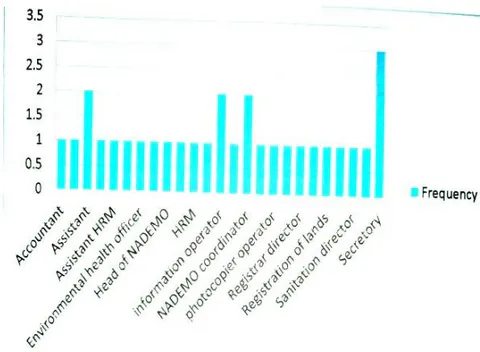
According to the graph above, of respondents are secretaries, are assistant to the various positions. of each of the respondents are NADEMO coordinators and information operators respectively. The least number of positions are Human Resource Managers, Accountants, Sanitation officers, Registrar, Director, Registrar of Lands, Head of NADEMO and a photocopier operator each representing according to the above figure.
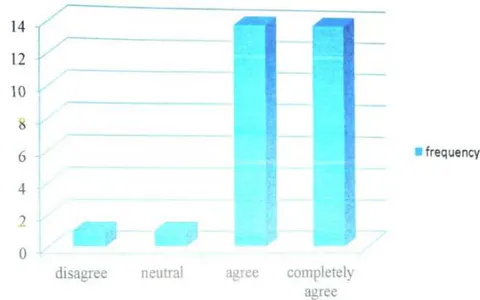
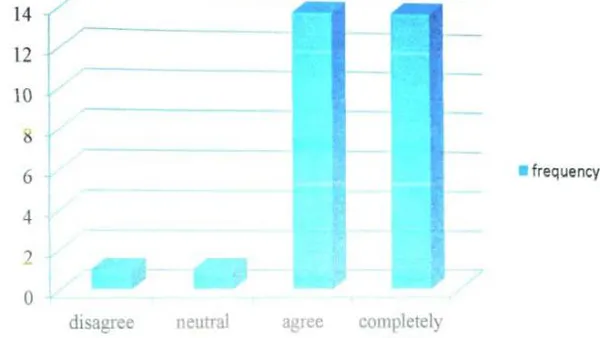
According to the graph above, 14 respondents representing respondents agree and completely agree that computers help them to work effectively. of respondents from various sections disagree and another also disagree that computers help them to work effectively. Another of the respondents stay neutral.
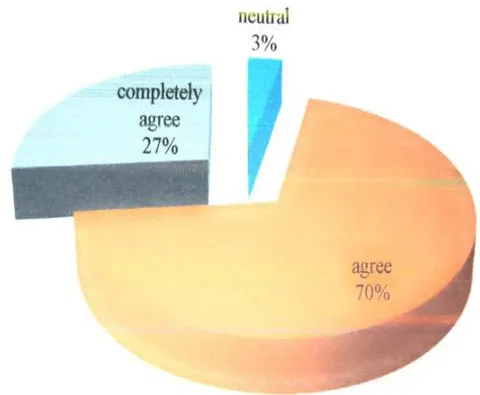
The graph in figure 2, 14 respondents representing respondents agree and completely agree that computers help them to work effectively. of respondents from various sections disagree and another also disagree that computers help them to work effectively. Another of the respondents stay neutral. According to the above figure, 21 respondents representing of respondents agree that working with certain information communication technology equipment such as computers and its accessories increase work output of the district assembly. Staff who also completely agree to this scenario is whereas of respondents are impartial.
XV. DISCUSSIONS OF FINDINGS
According to the graph in figure 1, of respondents are secretaries, are assistant to the various positions. of each of the respondents are NADEMO coordinators and information operators respectively. The least number of positions are Human Resource Managers, Accountants, Sanitation officers, Registrar, Director, Registrar of Lands, Head of NADEMO and a photocopier operator each representing according to the above figure.
According to figure 3, 21 respondents representing of respondents agree that working with certain information communication technology equipment such as computers and its accessories increase work output of the district assembly. Staff who also completely agree to this scenario is whereas of respondents are impartial.
The study made use of descriptive statistical tool chats were used to describe the simulated data. Further analysis was made using the objectives of the study stated earlier in this research.
From the above analysis it was deduce that staff of Twifo Atti-Morkwa District Assembly possess the requisite knowhow and skills in using information communication technology resource at the assembly.
There is a proportional relationship that exists between work output, qualification, promotion and performance at Twifo Atti-Morkwa District Assembly.
XVI. CONCLUSION AND RECOMMENDATIONS
A Relative percentage of staff do not have personal computers. Access to internet by staff of Twifo Atti-Morkwa District Assembly was mainly at public cyber café compared to other sources. Information Communication Technology has hugely assisted employees in the major areas of upgrading of knowledge and work output.
Twifo Atti-Morkwa District Assembly management should make accessible free, adequate training opportunity available to employees. Such opportunities should be focused on staff ICT areas of need identified in this research. With regards to the everyday change in technology, staff training a continuous development programme and not a one-shot programme and must be put in place to ensure that employees of the assembly is continuously improved within the information communication technology jurisdiction. The assembly should be funded adequately by government in order for ICT facilities available to function effectively thereby granting access to staff. It is additionally recommended that more studies need to be done with this jurisdiction for the development of Twifo Atti-Morkwa District Assembly.