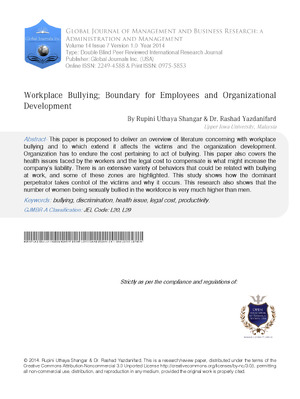
Workplace Bullying; Boundary for Employees and Organizational Development

Rupini Uthaya Shangar
Dr. Rashad Yazdanifard
Upper Iowa University Upper Iowa University

Send Message

To: Author

Workplace Bullying; Boundary for Employees and Organizational Development

Article Fingerprint

ReserarchID

B78Y8

Workplace Bullying; Boundary for Employees and Organizational Development Banner

AI TAKEAWAY

Connecting with the Eternal Ground
  • English
  • Afrikaans
  • Albanian
  • Amharic
  • Arabic
  • Armenian
  • Azerbaijani
  • Basque
  • Belarusian
  • Bengali
  • Bosnian
  • Bulgarian
  • Catalan
  • Cebuano
  • Chichewa
  • Chinese (Simplified)
  • Chinese (Traditional)
  • Corsican
  • Croatian
  • Czech
  • Danish
  • Dutch
  • Esperanto
  • Estonian
  • Filipino
  • Finnish
  • French
  • Frisian
  • Galician
  • Georgian
  • German
  • Greek
  • Gujarati
  • Haitian Creole
  • Hausa
  • Hawaiian
  • Hebrew
  • Hindi
  • Hmong
  • Hungarian
  • Icelandic
  • Igbo
  • Indonesian
  • Irish
  • Italian
  • Japanese
  • Javanese
  • Kannada
  • Kazakh
  • Khmer
  • Korean
  • Kurdish (Kurmanji)
  • Kyrgyz
  • Lao
  • Latin
  • Latvian
  • Lithuanian
  • Luxembourgish
  • Macedonian
  • Malagasy
  • Malay
  • Malayalam
  • Maltese
  • Maori
  • Marathi
  • Mongolian
  • Myanmar (Burmese)
  • Nepali
  • Norwegian
  • Pashto
  • Persian
  • Polish
  • Portuguese
  • Punjabi
  • Romanian
  • Russian
  • Samoan
  • Scots Gaelic
  • Serbian
  • Sesotho
  • Shona
  • Sindhi
  • Sinhala
  • Slovak
  • Slovenian
  • Somali
  • Spanish
  • Sundanese
  • Swahili
  • Swedish
  • Tajik
  • Tamil
  • Telugu
  • Thai
  • Turkish
  • Ukrainian
  • Urdu
  • Uzbek
  • Vietnamese
  • Welsh
  • Xhosa
  • Yiddish
  • Yoruba
  • Zulu
Font Type
Font Size
Font Size
Bedground

Abstract

This paper is proposed to deliver an overview of literature concerning with workplace bullying and to which extend it affects the victims and the organization development. Organization has to endure the cost pertaining to act of bullying. This paper also covers the health issues faced by the workers and the legal cost to compensate is what might increase the company’s liability. There is an extensive variety of behaviors that could be related with bullying at work, and some of these zones are highlighted. This study shows how the dominant perpetrator takes control of the victims and why it occurs. This research also shows that the number of women being sexually bullied in the workforce is very much higher than men.

References

37 Cites in Article
  1. Axel Klein,Suzanne Martin (2011). Two dilemmas in dealing with workplace bullies – false positives and deliberate deceit.
  2. Bradley John Olson,Debra Nelson,Satyanarayana-Parayitam (2006). Managing aggression in organizations: what leaders must know.
  3. J Alsever (2008). How to handle a workplace bully.
  4. Anna Shuttle,Worth (2004). Managing workplace stress: how training can help.
  5. Anni Townend (2008). Understanding and addressing bullying in the workplace.
  6. R Breden (2013). Performance management or bullying? Retrieved.
  7. Kadiri, Maureen,Olanrewaju, Lawal,Mmom, Chinedu,Nwondah, Chigozie (2012). Impacts of Pandemics on Healthcare Workers in Teaching Hospitals in Rivers State, Nigeria: Perspective from Healthcare Workers’ Experience during Pandemics.
  8. Carey (2008). Fear in the workplace: the bullying boss.
  9. Claudia (2010). Workplace bullying and its impact on productivity.
  10. Dan Riley,Deirdre Duncan,John Edwards (2011). Staff bullying in Australian schools.
  11. Dwayne Devonish (2013). Workplace bullying, employee performance and behaviors.
  12. Gordon (2013). What are the effects of workplace bullying?.
  13. Gordon (2014). Unknown Title.
  14. (2014). 6 Reasons why workplace bullies target people.
  15. Jill Poulston (2008). Hospitality workplace problems and poor training: a close relationship.
  16. John Dumay,Lisa Marini (2012). Bullying in context: a risk management perspective.
  17. Kane (2014). Dealing with bullying, harassment or abuse in the workplace.
  18. S Kapadia (2013). Favoritism strains workplace morale, harms agency performance.
  19. S Lebowitz (2013). What's behind a rise in workplace bullying?.
  20. S Lebowitz (2013). Bullies vs bffs: why hostile workplaces are destroying productivity.
  21. Linda Too,Michael Harvey (2012). TOXIC" workplaces: the negative interface between the physical and social environments.
  22. D A Lublin (2012). How to strike back against workplace bullying.
  23. Margaret Vickers (2009). Bullying, disability and work: a case study of workplace bullying.
  24. Mary Thomas (2005). Bullying among support staff in a higher education institution.
  25. Unknown Title.
  26. Bruce Bower (2014). Humans & society: Bullying linked to poor mental health: Being picked on worse threat than child abuse, study suggests.
  27. Martin Beirne,Paul Hunter (2013). Workplace bullying and the challenge of pre‐emptive management.
  28. Uggen Mclaughlin,Blackstone (2012). Sexual harassment, workplace authority, and the paradox of power.
  29. Melanie Bryant,Donna Buttigieg,Glennis Hanley (2009). Poor bullying prevention and employee health: some implications.
  30. Michael Sheehan,John Griffiths (2011). Understanding the context of workplace health management as it relates to workplace bullying.
  31. Randi Sims,Peng Sun (2012). Witnessing workplace bullying and the Chinese manufacturing employee.
  32. Raymond Lee,Céleste Brotheridge (2011). Sex and position status differences in workplace aggression.
  33. H Steven,Gary Appelbaum,Krishan Semerjian,Mohan (2012). Workplace bullying: consequences, causes and controls (part two).
  34. H Steven,Gary Appelbaum,Krishan Semerjian,Mohan (2012). Workplace bullying: consequences, causes and controls (part one).
  35. Suzanne Phibbs (2009). Hidden Health Hazards in Women's Work.
  36. (2014). Psychological impact of workplace bullying.
  37. (2012). Mental health harm.

Funding

No external funding was declared for this work.

Conflict of Interest

The authors declare no conflict of interest.

Ethical Approval

No ethics committee approval was required for this article type.

Data Availability

Not applicable for this article.

How to Cite This Article

Rupini Uthaya Shangar. 2014. \u201cWorkplace Bullying; Boundary for Employees and Organizational Development\u201d. Global Journal of Management and Business Research - A: Administration & Management GJMBR-A Volume 14 (GJMBR Volume 14 Issue A7).

Download Citation

Journal Specifications

Crossref Journal DOI 10.17406/GJMBR

Print ISSN 0975-5853

e-ISSN 2249-4588

Version of record

v1.2

Issue date
October 4, 2014

Language
en
Experiance in AR

Explore published articles in an immersive Augmented Reality environment. Our platform converts research papers into interactive 3D books, allowing readers to view and interact with content using AR and VR compatible devices.

Read in 3D

Your published article is automatically converted into a realistic 3D book. Flip through pages and read research papers in a more engaging and interactive format.

Article Matrices
Total Views: 4456
Total Downloads: 2316
2026 Trends
Related Research
Our website is actively being updated, and changes may occur frequently. Please clear your browser cache if needed. For feedback or error reporting, please email [email protected]

Request Access

Please fill out the form below to request access to this research paper. Your request will be reviewed by the editorial or author team.
X

Quote and Order Details

Contact Person

Invoice Address

Notes or Comments

This is the heading

Lorem ipsum dolor sit amet, consectetur adipiscing elit. Ut elit tellus, luctus nec ullamcorper mattis, pulvinar dapibus leo.


High-quality academic research articles on global topics and journals.

Workplace Bullying; Boundary for Employees and Organizational Development

Rupini Uthaya Shangar
Rupini Uthaya Shangar <p>Upper Iowa University</p>
Dr. Rashad Yazdanifard

Research Journals