Yoruba Orature: The Fundamental Basis for Teaching Yoruba Numeral

α
Àransi Ayoọla Oladunnnke

Send Message

To: Author

Yoruba Orature: The Fundamental Basis for Teaching Yoruba Numeral

Article Fingerprint

ReserarchID

5UE0F

Yoruba Orature: The Fundamental Basis for Teaching Yoruba Numeral Banner

AI TAKEAWAY

Connecting with the Eternal Ground
  • English
  • Afrikaans
  • Albanian
  • Amharic
  • Arabic
  • Armenian
  • Azerbaijani
  • Basque
  • Belarusian
  • Bengali
  • Bosnian
  • Bulgarian
  • Catalan
  • Cebuano
  • Chichewa
  • Chinese (Simplified)
  • Chinese (Traditional)
  • Corsican
  • Croatian
  • Czech
  • Danish
  • Dutch
  • Esperanto
  • Estonian
  • Filipino
  • Finnish
  • French
  • Frisian
  • Galician
  • Georgian
  • German
  • Greek
  • Gujarati
  • Haitian Creole
  • Hausa
  • Hawaiian
  • Hebrew
  • Hindi
  • Hmong
  • Hungarian
  • Icelandic
  • Igbo
  • Indonesian
  • Irish
  • Italian
  • Japanese
  • Javanese
  • Kannada
  • Kazakh
  • Khmer
  • Korean
  • Kurdish (Kurmanji)
  • Kyrgyz
  • Lao
  • Latin
  • Latvian
  • Lithuanian
  • Luxembourgish
  • Macedonian
  • Malagasy
  • Malay
  • Malayalam
  • Maltese
  • Maori
  • Marathi
  • Mongolian
  • Myanmar (Burmese)
  • Nepali
  • Norwegian
  • Pashto
  • Persian
  • Polish
  • Portuguese
  • Punjabi
  • Romanian
  • Russian
  • Samoan
  • Scots Gaelic
  • Serbian
  • Sesotho
  • Shona
  • Sindhi
  • Sinhala
  • Slovak
  • Slovenian
  • Somali
  • Spanish
  • Sundanese
  • Swahili
  • Swedish
  • Tajik
  • Tamil
  • Telugu
  • Thai
  • Turkish
  • Ukrainian
  • Urdu
  • Uzbek
  • Vietnamese
  • Welsh
  • Xhosa
  • Yiddish
  • Yoruba
  • Zulu

Abstract

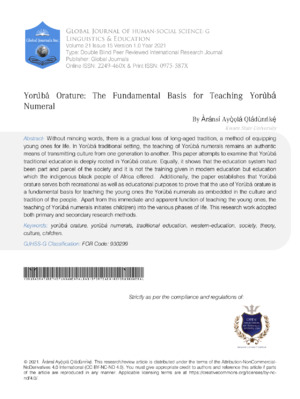
Without mincing words, there is a gradual loss of long-aged tradition, a method of equipping young ones for life. In Yorùbá traditional setting, the teaching of Yorùbá numerals remains an authentic means of transmitting culture from one generation to another. This paper attempts to examine that Yorùbá traditional education is deeply rooted in Yorùbá orature. Equally, it shows that the education system had been part and parcel of the society and it is not the training given in modern education but education which the indigenous black people of Africa offered. Additionally, the paper establishes that Yorùbá orature serves both recreational as well as educational purposes to prove that the use of Yorùbá orature is a fundamental basis for teaching the young ones the Yorùbá numerals as embedded in the culture and tradition of the people. Apart from this immediate and apparent function of teaching the young ones, the teaching of Yorùbá numerals initiates child(ren) into the various phases of life. This research work adopted both primary and secondary research methods.


References

15 Cites in Article
  1. W Abímbọ́ ; Lá (1969). PART II EVOLUTIONARY AND GENETIC ASPECTS OF CRIMINALITY.
  2. T Awoniyi (1975). Ọ mọ lúàbí: The Fundamental Basis of Yorùbá Education : in Abímbó ̣ lá.
  3. Helen Callaway (1975). Indigenous Education in Yoruba Society.
  4. H Ennis Robert (1969). Logic in Teaching.
  5. A Fafunwa,Babs (1975). Education in the Mother Tongue: A Nigerian Experiment. The Six-Year (Yorùbá Medium) Primary Education Project at the University of Ifẹ̀ , Nigeria.
  6. A Falokun (1991). Basic Mathematical Operations on Natural, Numbers in Primary School Mathematics and Language of Classroom Instruction.
  7. Ade Fajana (1966). Educational Policy in Nigerian Traditional Society.
  8. Ronald Hyman,T (1970). Ways of Teaching.
  9. J Jọ Layẹ Mi (2002). Education Ethnicity and National Integration in Nigeria Secondary Schools.
  10. George Kneller,F (1971). Foundations of Education.
  11. W Lester (1957). An Introductory Survey.
  12. L Longmore (1959). The Dispossessed: A Study of the Sex-Life of Beauty Women in Urban Areas in and around Johannesburg Jonathan. Cape and Thirty.
  13. S S Obidi (1997). Indigenous Education in Yorùbá Society: The Teaching of Yorùbá Language and Oral Literature.
  14. F A Olowookere (2002). Perception of African Students to Yorùbá Language in Nigeria Secondary School.
  15. O Olajubu (1978). The Use of Yorùbá Folktales as a Means of Moral Education.

Funding

No external funding was declared for this work.

Conflict of Interest

The authors declare no conflict of interest.

Ethical Approval

No ethics committee approval was required for this article type.

Data Availability

Not applicable for this article.

How to Cite This Article

Àransi Ayoọla Oladunnnke. 2022. \u201cYoruba Orature: The Fundamental Basis for Teaching Yoruba Numeral\u201d. Global Journal of Human-Social Science - G: Linguistics & Education GJHSS-G Volume 21 (GJHSS Volume 21 Issue G15): .

Download Citation

Yorùbá numeral teaching approach for language learners and educators focusing on foundational skills.
Issue Cover
GJHSS Volume 21 Issue G15
Pg. 33- 39
Journal Specifications

Crossref Journal DOI 10.17406/GJHSS

Print ISSN 0975-587X

e-ISSN 2249-460X

Keywords
Classification
GJHSS-G Classification: FOR Code: 930299
Version of record

v1.2

Issue date

January 15, 2022

Language
en
Experiance in AR

Explore published articles in an immersive Augmented Reality environment. Our platform converts research papers into interactive 3D books, allowing readers to view and interact with content using AR and VR compatible devices.

Read in 3D

Your published article is automatically converted into a realistic 3D book. Flip through pages and read research papers in a more engaging and interactive format.

Article Matrices
Total Views: 2032
Total Downloads: 901
2026 Trends
Related Research

Published Article

Without mincing words, there is a gradual loss of long-aged tradition, a method of equipping young ones for life. In Yorùbá traditional setting, the teaching of Yorùbá numerals remains an authentic means of transmitting culture from one generation to another. This paper attempts to examine that Yorùbá traditional education is deeply rooted in Yorùbá orature. Equally, it shows that the education system had been part and parcel of the society and it is not the training given in modern education but education which the indigenous black people of Africa offered. Additionally, the paper establishes that Yorùbá orature serves both recreational as well as educational purposes to prove that the use of Yorùbá orature is a fundamental basis for teaching the young ones the Yorùbá numerals as embedded in the culture and tradition of the people. Apart from this immediate and apparent function of teaching the young ones, the teaching of Yorùbá numerals initiates child(ren) into the various phases of life. This research work adopted both primary and secondary research methods.

Our website is actively being updated, and changes may occur frequently. Please clear your browser cache if needed. For feedback or error reporting, please email [email protected]

Request Access

Please fill out the form below to request access to this research paper. Your request will be reviewed by the editorial or author team.
X

Quote and Order Details

Contact Person

Invoice Address

Notes or Comments

This is the heading

Lorem ipsum dolor sit amet, consectetur adipiscing elit. Ut elit tellus, luctus nec ullamcorper mattis, pulvinar dapibus leo.

High-quality academic research articles on global topics and journals.

Yoruba Orature: The Fundamental Basis for Teaching Yoruba Numeral

Àransi Ayoọla Oladunnnke

Research Journals