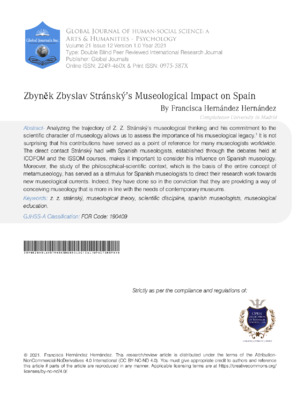
Zbynek Zbyslav Stransky’s Museological Impact on Spain

α
Francisca Hernández Hernández
α Universidad Complutense de Madrid Universidad Complutense de Madrid

Send Message

To: Author

Zbynek Zbyslav Stransky’s Museological Impact on Spain

Article Fingerprint

ReserarchID

5X28G

Zbynek Zbyslav Stransky’s Museological Impact on Spain Banner

AI TAKEAWAY

Connecting with the Eternal Ground
  • English
  • Afrikaans
  • Albanian
  • Amharic
  • Arabic
  • Armenian
  • Azerbaijani
  • Basque
  • Belarusian
  • Bengali
  • Bosnian
  • Bulgarian
  • Catalan
  • Cebuano
  • Chichewa
  • Chinese (Simplified)
  • Chinese (Traditional)
  • Corsican
  • Croatian
  • Czech
  • Danish
  • Dutch
  • Esperanto
  • Estonian
  • Filipino
  • Finnish
  • French
  • Frisian
  • Galician
  • Georgian
  • German
  • Greek
  • Gujarati
  • Haitian Creole
  • Hausa
  • Hawaiian
  • Hebrew
  • Hindi
  • Hmong
  • Hungarian
  • Icelandic
  • Igbo
  • Indonesian
  • Irish
  • Italian
  • Japanese
  • Javanese
  • Kannada
  • Kazakh
  • Khmer
  • Korean
  • Kurdish (Kurmanji)
  • Kyrgyz
  • Lao
  • Latin
  • Latvian
  • Lithuanian
  • Luxembourgish
  • Macedonian
  • Malagasy
  • Malay
  • Malayalam
  • Maltese
  • Maori
  • Marathi
  • Mongolian
  • Myanmar (Burmese)
  • Nepali
  • Norwegian
  • Pashto
  • Persian
  • Polish
  • Portuguese
  • Punjabi
  • Romanian
  • Russian
  • Samoan
  • Scots Gaelic
  • Serbian
  • Sesotho
  • Shona
  • Sindhi
  • Sinhala
  • Slovak
  • Slovenian
  • Somali
  • Spanish
  • Sundanese
  • Swahili
  • Swedish
  • Tajik
  • Tamil
  • Telugu
  • Thai
  • Turkish
  • Ukrainian
  • Urdu
  • Uzbek
  • Vietnamese
  • Welsh
  • Xhosa
  • Yiddish
  • Yoruba
  • Zulu

Abstract

Analyzing the trajectory of Z. Z. Stránský’s museological thinking and his commitment to the scientific character of museology allows us to assess the importance of his museological legacy. 1 It is not surprising that his contributions have served as a point of reference for many museologists worldwide. The direct contact Stránský had with Spanish museologists, established through the debates held at ICOFOM and the ISSOM courses, makes it important to consider his influence on Spanish museology. Moreover, the study of the philosophical-scientific context, which is the basis of the entire concept of metamuseology, has served as a stimulus for Spanish museologists to direct their research work towards new museological currents. Indeed, they have done so in the conviction that they are providing a way of conceiving museology that is more in line with the needs of contemporary museums.

References

69 Cites in Article
  1. Alonso Fernández (1999). Luis: Introducción a la nueva museología.
  2. Mikel Asensio,Castro,; Yone,Cristina Villar,Ana Cabrera,Elena Pol (2012). Asistencia oficial para el desarrollo.
  3. Ayuntamiento De Barcelona (1979). Llibre Blanc dels Museus.
  4. Ayuntamiento De Barcelona (1981). Els Museus de Catalunya. Aproximació a la seva problemática. Un exemple concret: els Museus de Penedes.
  5. Ayuntamiento De Barcelona (1984). Els Museus de Catalunya. Criteris per a l´organizatciò del patrimonio museistic del país.
  6. Xavier Ballbé (1993). Cultural Assets and the New Professional: The Experience of the Escola Europea in Barcelona.
  7. Bellido,Antonio Blanco (2005). La renovación museológica en España durante los años setenta.
  8. Manel Miró I Alaix (2009). Martos, Marta, Herramientas para la gestión turística del patrimonio cultural. Gijón: Ediciones Trea, 2016.ISBN: 978‑84‑9704‑906‑1.
  9. Rosario Carrillo (1983). Methodologie Museologique et Formatión Professionele. Methodologie of Museologie and Professional Training.
  10. Carrillo De San,Rosario Segundo (1988). Symposium Museology and Developing Countries -Help or Manipulation? Hyderabad-Varanasi-New Delhi.
  11. Carta De Coro (1999). Museología, Filosofía e Identidad en América Latina y el Caribe. VIII Encuentro Regional.
  12. Bernard Deloche (2001). El museo virtual.
  13. Pavel Konečný,Tamara Kovandová,Janka Zabořil,Jakub Rytíř (2006). Useknuté matematické kyvadlo – znovu.
  14. Olaia Fontal (2003). La Educación Patrimonial: Teoría y Práctica en el Aula, el Museo e Internet.
  15. Olaia Fontal Merillas,Sofía Marín Cepeda (2015). La educación patrimonial en España: necesidades e ilusiones para la próxima década.
  16. Dolors Forrellad I Domènech (1984). Current acquisition policy and its appropriateness for tomorrow needs.
  17. Dolors Forrellad I Domènech (1984). À propos des auteurs.
  18. Dolors Forrellad I Domènech (1985). The implications for the work of museums. Symposium Originals and Substitutes in Museums.
  19. Dolors Forrellad I Domènech (1987). Basic papers. Society-museology-museums: Development trends Symposium, Museology and Museums Helsinki-Espoo.
  20. García Ceballos,Silvia (2015). Un proyecto de arte contemporáneo con personas mayores.
  21. Javier Gómez Martínez (2006). Dos Museologías. Las Tradiciones Anglosajona y Mediterránea: diferencias y contactos.
  22. Hernández,Francisca Hernández (2002). El patrimonio cultural: la memoria recuperada.
  23. Hernández,Francisca Hernández Unknown Title.
  24. José Cano De Gardoqui García (2006). "Imágenes de la liturgia medieval. Planteamientos teóricos, temas visuales y programas iconográficos", de Ángel Pazos-López.
  25. Hernández,Francisca Hernández (2006). The museological discourse and critical interpretation of History. Museology -A field of Knowlwdge.
  26. Hernández,Francisca Hernández (2016). Documentary Sources of Museology: Reflections and Perspectives. Museology exploring the concept of MLA (Museums-Libraries-Archives).
  27. Francisca Hernández,Jesús Lorente (2016). Zbyněk Zbyslav Stránský and Spanish museology.
  28. Jesús-Pedro Lorente (2003). Museología crítica y Arte contemporáneo.
  29. Pedro Lorente,Jesús (2010). Los estudios de Museología en las universidades españolas.
  30. Jesús Lorente,Pedro (2012). Manual de historia de la Museología.
  31. Pedro Lorente,Jesús (2016). Nouvelles tendances de la muséologie.
  32. María Torres,Teresa (2002). Historia de la documentación museológica: La gestión de la memoria artística.
  33. Domènec Miquel I Serra,Eulalia Morral I Romeu (1981). Performing Interdisciplinarity.
  34. Miquel I Serra Domènec,; García,Andrea; Morral I Romeu,Eulalia (1984). Objects de musée: Criteres de Selection. Quelques reflexions.
  35. D Miquel I Serra,Eulalia Morral I Romeu (1985). Typology of substitutes.
  36. Miquel I Serra Domènec,; Morral I Romeu,Eulalia (1986). Contributions to the colloquium on Identity.
  37. Miquel I Serra Domènec,; Morral I Romeu,Eulalia (1986). Comments and views on basic papers presented in ISS nº 10.

  38. Miquel I Serra Domènec,; Morral I Romeu,Eulalia (1987). Contributions to the symposium.
  39. Miquel I Serra Domènec,; Morral I Romeu,Eulalia (1987). Comments and views on basic papers presented in ISS 12.

  40. Miquel I Serra,Domènec (1989). Contributions to the symposium. La Museologie et les Institutions Museales comme Agents Actifs de Changement. Symposium Forecasting -A Museological Tool? Museology and Futurology.
  41. Eulalia Morral I Romeu (1987). The museum and development -inside and outside. Trends observed and forecasted.
  42. Eulalia Morral I Romeu (1989). Muséologie, futur. Quelques réflexions héterodoxes. Symposium Forecasting -A Museological Tool? Museology and Futurology.
  43. Óscar Corral (2017). L'actualité de la muséologie en Espagne et la definition du musée.
  44. Sara López (2015). El concepto de Interpatrimonios. Intercambio cultural como resumen de la inclusión social en el patrimonio para el colectivo sordo. La configuración de espacios comunes entre culturas en los espacios museísticos.
  45. Soledad Pérez Mateo (2016). Cuando la casa museo tiene su hortus conclusus. Una puesta en valor del patrimonio natural de las casas museo en España.
  46. Concha Rodá (2015). Stratégie digitale au musée: besoins, tendances, défis.
  47. Gloria Romanello (2015). Des études de publics pour quoi faire ? L’utilisation des outils de connaissance des publics dans la gestion des musées et centres d’art contemporain en Espagne et en France.
  48. Gloria Romanello (2017). #iononmilasciofregare, #Iwontgetscrewedover Cultural heritage: Time for street-art agents. The Predatory Museum.
  49. (1994). Cursos Internacionales de Verano de Museología (ISSOM) en su Octava sección: Museología Especializada, que se celebrarán del 9 al 23 de septiembre de 1994 en la Universidad de Masaryk.
  50. Vinos Sofka (2002). Guía de excursión de campo. II taller regional para geoparques mundiales de la Unesco en América Latina y el Caribe 2019 al área del geoparque volcán del Ruiz, aspirante Unesco.
  51. Tomislav Šola (1982). International museology I:.
  52. S Šola Tomislav (1997). Essays on Museums and their Theory.
  53. Tomislav Šola (2007). La définition du musée: étendue et motifs. Vers une rédefinition du musée.
  54. Boris Majić,Ivana Šola,Saša Likić,Iva Juranović Cindrić,Gordana Rusak (2015). Characterisation of Sorbus domestica L. Bark, Fruits and Seeds: Nutrient Composition and Antioxidant Activity.
  55. Zbyněk Stránský (1980). Museology-science or just practical museum work?.
  56. Zbyněk Stránský (1980). Museology as a science.
  57. Zbyněk Stránský (1981). The theory of systems and museology. Interdisciplinarity in museology.
  58. Zbyněk Stránský (1983). Symposium Museum-Territory-Society. New Tendencies/New Practices.
  59. Zbyněk Stránský (1986). Commentaires et points de vue sur les mémoires de base présentés dans I'ISS no 10.
  60. Zbyněk Stránský (1987). Breaking down the topic. What are the right questions? Symposium Museology and Museums.
  61. Zbyněk Stránský (1989). Basic papers. Symposium Forecasting -A Museological Tool? Museology and Futurology.
  62. Peter Milo,Tomáš Tencer,Michal Vágner,Michaela Prišťáková,Igor Murín (1993). Geophysical Survey of the Hillfort Staré Zámky near Brno-Líšeň, Czech Republic.
  63. Peter Milo,Tomáš Tencer,Michal Vágner,Michaela Prišťáková,Igor Murín (1995). Geophysical Survey of the Hillfort Staré Zámky near Brno-Líšeň, Czech Republic.
  64. Pavel Konečný,Tamara Kovandová,Janka Zabořil,Jakub Rytíř (2005). Useknuté matematické kyvadlo – znovu.
  65. J Terradas,Écologie (1983). Environnement, Education. Le role des musées.
  66. Gloria Romanello (2017). #iononmilasciofregare, #Iwontgetscrewedover. Cultural heritage: Time for street-art agents. (Center for the Study of Culture, Politics and Society Faculty of Economy and Business, University of Barcelona). The Predatory Museum.
  67. Aa Vv,Patrimonio El,Histórico (2010). REFLEXIONES SOBRE LOS ACTUALES PROBLEMAS DE LA JUSTICIA.
  68. Ventosa,Silvia Muñoz Museums Real or Virtual? Museology and Presentation: Original or Virtual? ICOFOM Study Series, 2002, 33 b.
  69. Carreño,J Francisco (2005). Curso de Museología.

Funding

No external funding was declared for this work.

Conflict of Interest

The authors declare no conflict of interest.

Ethical Approval

No ethics committee approval was required for this article type.

Data Availability

Not applicable for this article.

How to Cite This Article

Francisca Hernández Hernández. 2021. \u201cZbynek Zbyslav Stransky’s Museological Impact on Spain\u201d. Global Journal of Human-Social Science - A: Arts & Humanities GJHSS-A Volume 21 (GJHSS Volume 21 Issue A12): .

Download Citation

Analyzing scholarly articles on musicology, music education, and music history from a global academic journal.
Issue Cover
GJHSS Volume 21 Issue A12
Pg. 21- 34
Journal Specifications

Crossref Journal DOI 10.17406/GJHSS

Print ISSN 0975-587X

e-ISSN 2249-460X

Keywords
Classification
GJHSS-A Classification: FOR Code: 190409
Version of record

v1.2

Issue date

October 22, 2021

Language
en
Experiance in AR

Explore published articles in an immersive Augmented Reality environment. Our platform converts research papers into interactive 3D books, allowing readers to view and interact with content using AR and VR compatible devices.

Read in 3D

Your published article is automatically converted into a realistic 3D book. Flip through pages and read research papers in a more engaging and interactive format.

Article Matrices
Total Views: 2112
Total Downloads: 947
2026 Trends
Related Research

Published Article

Analyzing the trajectory of Z. Z. Stránský’s museological thinking and his commitment to the scientific character of museology allows us to assess the importance of his museological legacy. 1 It is not surprising that his contributions have served as a point of reference for many museologists worldwide. The direct contact Stránský had with Spanish museologists, established through the debates held at ICOFOM and the ISSOM courses, makes it important to consider his influence on Spanish museology. Moreover, the study of the philosophical-scientific context, which is the basis of the entire concept of metamuseology, has served as a stimulus for Spanish museologists to direct their research work towards new museological currents. Indeed, they have done so in the conviction that they are providing a way of conceiving museology that is more in line with the needs of contemporary museums.


Our website is actively being updated, and changes may occur frequently. Please clear your browser cache if needed. For feedback or error reporting, please email [email protected]

Request Access

Please fill out the form below to request access to this research paper. Your request will be reviewed by the editorial or author team.
X

Quote and Order Details

Contact Person

Invoice Address

Notes or Comments

This is the heading

Lorem ipsum dolor sit amet, consectetur adipiscing elit. Ut elit tellus, luctus nec ullamcorper mattis, pulvinar dapibus leo.

High-quality academic research articles on global topics and journals.

Zbynek Zbyslav Stransky’s Museological Impact on Spain

Francisca Hernández Hernández
Francisca Hernández Hernández Universidad Complutense de Madrid

Research Journals