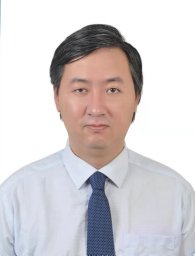

Bio
Dr. Shanzhen Gao (also known as Weizheng Gao) is a dedicated researcher and academic affiliated with Elizabeth City State University and Virginia State University. His work spans a wide range of disciplines including applied cryptography, coding theory, combinatorics, graph theory, algorithms, and complexity. Dr. Gao has contributed to the literature with notable papers such as "Constructing Classic Graphs in Graph Theory Using Python and Generative AI: A Case Study in Computational Visualization and Prompt Engineering" and "Sharp Choice Number Thresholds for Complete Bipartite Graphs." He is an active reviewer for the Global Journal of Computer Science and Technology (GJCST) and has mentored multiple scholars while leading several research projects. His expertise in discrete mathematics, computer networks, and artificial intelligence continues to drive innovative research in computational visualization and prompt engineering.
Experience
Editors Role
Reviewer
GJCST
0 -Research
Constructing Classic Graphs in Graph Theory Using Python and Generative AI: A Case Study in Computational Visualization and Prompt Engineering
This study explores the construction of several classic graphs in graph theory through Python programming, offering a hands-on computational approach to understanding their mathematical properties. The selected graphs-including the Wagner, Desargues, Herschel, Möbius-Kantor, Franklin, truncated icosahedral, and triangular grid graphs-are chosen for their historical significance and structural complexity. Using Python’s turtle graphics module, each graph is visualized through trigonometric and geometric logic, illustrating core concepts such as regularity, symmetry, Hamiltonicity, and planarity. In addition to manual code development, the study integrates generative AI, specifically ChatGPT, to reproduce graph constructions via prompt engineering. This dual approach showcases the educational potential of AI-assisted programming and reinforces algorithmic thinking. The work aims to bridge the gap between theoretical graph concepts and their algorithmic applications. It provides a replicable methodology that enhances student engagement, supports active learning, and promotes interdisciplinary exploration across mathematics, computer science, and education.
