
I. INTRODUCTION
Literature is geared towards enhancing the aptitudes of students in an all-inclusive, balanced and unified way, on all sides of the physical, spiritual, intellectual and emotional facets, to produce a well-balanced human being with a remarkable cognitive ability and great social morals. The study of Literature-in-English is pivotal to critical thinking abilities, and for the realisation of the multifaceted potential of the English language as a means of communication. Globally, there has been a growing concern about the academic performance of students in Literature-in-English as a subject (Romerhausen, 2013), and Ghanaian students are no exception. According to Ward, Stoker, & Murray-Ward (1996), academic performance is the degree to which a student has accomplished his or her short or long-term educational goals. Thus, every student has his or her goals, whether short-term or long-term, and achieving these will mean they have attained better academic performance. Students studying literature as a subject in the various senior high schools in Ghana are now faced with a huge challenge concerning performance in their external examination, the West African Secondary School Certificate Examination (WASSCE).
Improvement in the quality of education has been considered one of the major operational factors creating a country's pervasive growth. It is no wonder that in Ghana, many educational policies, such as free education, double-track system, and common core curriculum, introduced in recent years, are all geared towards improving the quality of teaching and investing in human resources.
Again, in educational planning, students' academic performance improvement is regarded as part of the primary objectives. Ultimately, the academic performance of students is deemed as one of the crucial criteria for assessing the quality of education. Hence, academic performance is currently a great concern for all stakeholders of education: parents, school administrators, government, teachers, and students, among others. Several studies have been conducted to ascertain the factors that account for the differences in performance or achievements among students (Ikpi, Enya, & Johnny, 2014). Among such factors identified are the quality of teachers and their experiences, instructional materials, teaching methods, and the type of school and location.
Similarly, studies have shown that students who receive motivation to improve upon their prior or impending performance tend to do better academically than those who have lower or no motivation (Barry & Rhonda, 2011). This is to say that students' performance is well linked to the output or quality of the teachers and the methods of teaching. Hence, the teacher's methods of teaching are highly regarded as essential determinants of students' performance, achievement and interest.
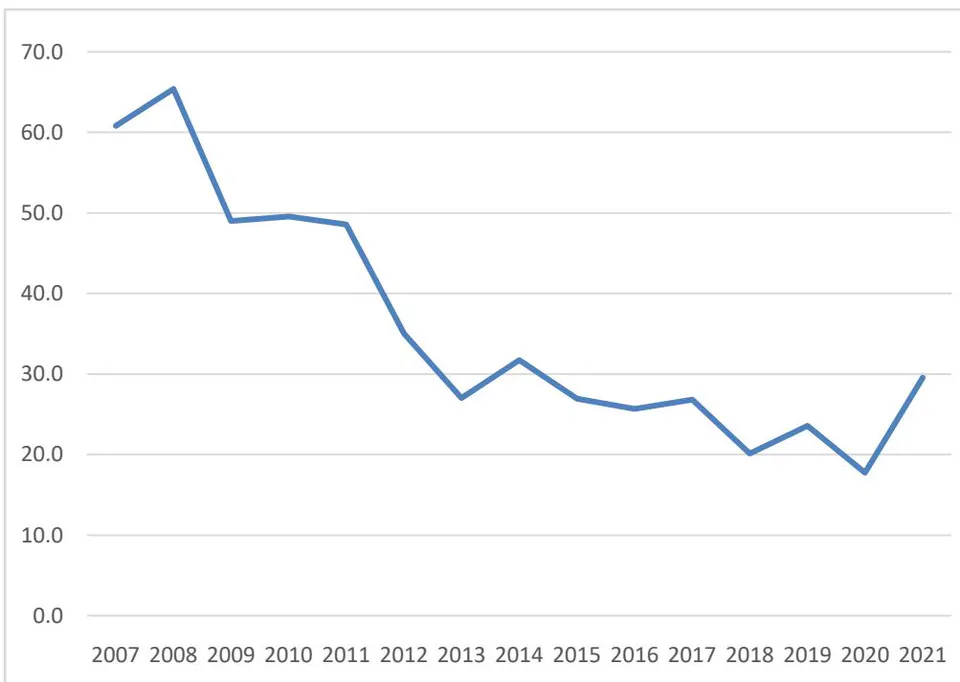
It is significant to state that the problem of underperformance in Literature-in-English at the high school level has taken up a worrying position in the Ghanaian educational system. The national students' performance has taken a downward trend. The disturbing picture of students' performance is depicted in Table 1 and Figure 1. Students' performance took a nosedive from 2010 to 2020, with the worst result in 2020, where less than of the candidates passed the exam. In 2020, only 2 (0.004%) students obtained a grade of A, and 25,191 (55.9%) obtained a grade of F9. This is the current state of students' performance in Literature-in-English. It can also be gleaned from Table 1 that from 2012 to 2021, the percentage of students passing has not exceeded . This indicates that about of the students failed the subject.
| Year | Percentage of passes A1-C6 |
| 2007 | 60.8 |
| 2008 | 65.4 |
| 2009 | 49.0 |
| 2010 | 49.6 |
| 2011 | 48.6 |
| 2012 | 35.0 |
| 2013 | 27.0 |
| 2014 | 31.8 |
| 2015 | 27.0 |
| 2016 | 25.7 |
| 2017 | 26.8 |
| 2018 | 20.1 |
| 2019 | 23.6 |
| 2020 | 17.7 |
| 2021 | 29.6 |
The West African Examinations Council (WAEC) has identified diction and other literary devices used in the area of poetry, a tall list of poems, and the students' low proficiency in English Language, as some of the main reasons for the poor performance of students in Literature-in-English in the West African Senior School
Certificate Examination (Daily Graphic online, Dec. 2023). Students' abysmal academic performance is often attributed to a lack of teachers, inadequate teaching resources and a weak foundation of students from the early years of schooling (Amua-Sekyi & Nti, 2015). It is established that the role teaching methods play in developing students' interest and enthusiasm for various subjects in the classroom (Ripollés & Blesa, 2024). The teaching methods employed in teaching literature-in-English go a long way in influencing students' interest. In the context of an English as a second language classroom, pedagogical methods are critical to boost interest in the subject (Munna & Kalam, 2021). There are very few studies that examine the pedagogical techniques of teachers and students' academic performance. Currently, in many senior high schools, the number of students reading literature in English has reduced because of poor performance. On the other hand, it looks as if there are signs that point to some unknown factors that may be accountable for the declining performance in literature in English. As a preliminary investigation, this study aims to find out Ghanaian high school students' perceptions of the influence of pedagogical factors on the teaching and learning of Literature-in-English.
More so, in Ghana, it was discovered that Arthur, Owusu, Arhin, and Asiedu-Addo(2018)conducted a study on the role of pedagogical factors in predicting Ghanaian students' interest in mathematics. Their study revealed three constructs which made up the Ghanaian teachers' teaching methods: Systematic Teaching (ST), Traditional Teaching Methods (TTM), and Effective Teaching Material (ETM). They maintained that the teacher's systematic manner of presenting content and the effective use or integration of teaching materials highly influence students' interest in mathematics. Consequently, they concluded that students' interest is significantly predicted by pedagogical factors.
It can be noted that there is seemingly no study on literary pedagogy as a determinant of students' performance in the Ghanaian context. This serves as the gap in research which this study seeks to fill. Hence, this study is different from what has already been discussed above, and it will serve as a significant literature on literary pedagogy and contribute greatly to providing knowledge to Ghanaian teachers of literature about how they can motivate, develop interest and increase students' performance in the subject. Based on the purpose of the study, two research questions were formulated to guide the study.
What are the high school students' perceptions of the influences of pedagogical factors on the teaching and learning of Literature-in-English?
How do the principal components extract influence the interest of students in Literature-in-English?
II. THEORETICAL FRAMEWORK
The performance of students in Literature-in-English is influenced by various factors, including pedagogical approaches, student perceptions, and contextual variables. This framework draws upon constructivist and socio theories, adapted to the context of Literature-in-English education in Ghana. It integrates these perspectives to understand the complex interplay between pedagogy, learner characteristics, and sociocultural factors influencing Ghanaian high school students' performance and perceptions regarding the subject.
a) Constructivist Theory
Constructivist theory is based on observation and scientific study of how individuals learn. According to Bereiter (1994), individuals develop their understanding and knowledge of the world through experiencing and reflecting on those experiences. In the broadest sense, constructivism means encouraging students to use active techniques (interviews, real-world problem solving) to create more knowledge and then to reflect on and talk about what they are doing and how their understanding is changing. When a learner encounters new information, he compares it with his previous ideas and experiences. The conclusion the learner can arrive at is twofold: maybe changing what he believes, or discarding the new information as irrelevant. In any case, we are active creators of our knowledge. To do this, we must probe, explore, and assess what we know.
The teacher ensures that he/she understands the students' preexisting conceptions, and guides the activity to address them and then build on them (Oliver, 2000). The teacher's ability to identify students' prior relevant knowledge will enhance the teacher's lesson preparation and help in the selection of the appropriate teaching method and teaching and learning materials.
The constructivist theory emphasises the active role of learners in constructing their understanding, which is fundamental to this study. According to Boadu et al. (2020), constructivist approaches in Ghanaian classrooms encourage students to explore, question, and construct their interpretations rather than passively receiving information. This aligns with the broader educational goal of fostering critical thinking and independent learning. These are key ingredients for students studying literature in English. The subject deals with how to appreciate poems and analyse texts for themes, etc. This foundational theory does not encourage passive attitudes towards the learning of literature in English.
Teachers are to provide challenging tasks that encourage students to own their learning. This will help students to identify areas of strength and need. These tasks offer students the chance to set their own personal goals. When students become responsible for their learning, it can have a positive effect on stemming the decline in performance. Constructivism requires students to be active participants in the learning process. Broadly speaking, students can be active participants in the learning process by exploring their environment and seeking to find the implications of their experiences (Boghossian, 2006).
b) Socio-Cultural Theory
The sociocultural theory of cognitive development explores the influence the world has on an individual's development. It asserts that learning is a mostly social process whereby development occurs through interactions with people who possess more knowledge or skill than the learner (Cherry, 2022).
Vygotsky established this theory of learning, believing that parents, teachers, peers, caregivers, and society at large influence an individual's cognitive development. Learning at its root involves interacting with others around you. Vygotsky asserted that learning is a cultural phenomenon, with children from different cultures embracing different styles of learning (Cherry, 2022). According to Vygotsky, learning is a process of acquiring knowledge, beliefs, and problem-solving strategies through interactions with what he termed "more knowledgeable others (McLeod, 2020).
It is through our interactions with others that we make sense of the information we encounter. It is an inherently social process, one in which we depend on others to help us understand the world. Social learning thus precedes individual development and is unique to the individual. Sociocultural theory encourages cooperative learning among students. The teacher is to use several methods to integrate cooperative learning into teaching and learning literature in literature-in-English. Adade (2014) discusses how socio-cultural factors and motivation influence language competence among Ghanaian students. This theory suggests that students' learning experiences are deeply embedded in their cultural and social environments, which can significantly impact their engagement and performance in Literature-English. In the Ghanaian context, this requires investigating the influence of students' cultural backgrounds, languages, and social interactions within the classroom on their engagement with literature-in-English. Also, storytelling, traditional songs, and proverbs can be incorporated into the teaching of literature in English since most students are familiar with these cultural practices.
The socio-cultural theory emphasises learning through association, which is based on interactions students have among themselves. The teacher can activate this theory in the classroom by utilising group work. Here, students are encouraged to work in teams on given assignments. This brings cross-fertilisation of ideas and promotion of reasoning skills among the team members. Literature-in-English requires this type of pedagogical approach. Students can greatly benefit from this approach, where ideas are shared freely, and this produces an atmosphere of growth. This can lower the declining performance.
c) Review of related works
Literature is considered as the source of gaining knowledge into all aspects of human life from diverse cultures. (Marhasi, 2012) However, to study literature successfully, Marhasi argues that one must have a full grasp of language. And in the case of Literature-in-English, one must have "a good command of English" (Marhasi, 2012, p.34), which is a prerequisite to the study of Literature-in-English. Marhasi's argument holds for the study of Literature as a subject in any language. To fully appreciate and have a full grasp of the study, it is required that the learner have mastery of the language the literature is written. This implies that language and literature are interrelated, and one needs a full grasp of the language of the literature to succeed in the study of that particular literature. Marhasi's argument is authentic and re-echoes the arguments raised by the earlier researchers on the study of literature. For instance, Lee (1970), cited in Sage (1987), states that:
It is in literature that the resources of the language are most fully and skillfully used. It seems to follow that literature should enter into the language study of those who are to use the language with the greatest possible skill and effect (p.6).
Collie and Slater (1987) are of the view that studying literature is a sure way for students to improve their language. Similarly, Carter and Walker (1989) affirm by adding that since literature itself is language and endowed with rich metaphors that not only add to the language but also engage students with critical thinking concepts, it can serve well for language learning. In addition, literature can present authentic language to its learners and by authentic, Collie and Slater (1987) explain by saying that literary works are authentic because they are not arranged specifically for a language teaching situation.
In addition, more recent researchers like Damor (2023) add to the usefulness of the study of literature by highlighting on literature's connection to cultural studies, heritage and identities. For instance, Damor argues that if students study literature from other cultures and in the language of those cultures, such students gain insight into the new culture through the study of its literature. But this happens only after they have gained mastery of the language.
So far, the arguments made by these researchers show that for one to study literature successfully, one must first have mastery of the language the literature is written in. However, several studies prove that students' performance in literature are dwindling although the subject is taught in the language they speak officially and use in formal teaching and learning. Several studies have been conducted as to why this is so. For instance, Stern (1991) alludes to the use of traditional methods or approaches in the teaching of literature as the cause of low students' performance in literature. She maintains that the decline in teachers' interest in researching teaching literature is the main reason why the traditional approach to teaching literature is still in use.
Studies have shown that only surveys have been conducted on literary pedagogy. Prominent amongst them is that of Akyel and Yalcin (1990). This survey was conducted in Turkey to investigate the existing condition of literature teaching in the departments of English of five (5) selected private high schools in Istanbul. The following areas were specifically investigated in this study:
- Goals of the teachers,
- Students' reactions to the specific contributions of prose fiction, drama and poetry, in developing linguistic and communicative competence,
- Students' reaction to text selection,
- Classroom techniques used, and
- Teacher and student evaluations of the program.
From this survey, it was discovered that the techniques often adopted by teachers of literature lead to teacher-centred activities in literature classrooms. Such include: offering background information on the author and his work, individual reading and asking questions on the text. On the contrary, it was reported that students preferred discussions or debates on the meaning and interpretations of literary texts to teacher-centred activities. Their request was to be given lots of writing activities to improve their composition skills and independent research.
Another survey conducted by Hirvela and Boyle (1998) also looked at students' attitudes towards the study of literature courses. It was observed that students' needs are often neglected, which was similar to the findings of Akyel and Yalcin (1990). The use of communicative methods of teaching literature was very limited.
Furthermore, Mustakim, Mustapha and Lebar's (2014) study on approaches in teaching literature aimed at identifying the techniques employed by teachers in teaching Contemporary Children's Literature Programme to upper primary school. This study was conducted in Malaysia using classroom observations and interviews as research instruments. They evaluated the approaches of five ESL teachers teaching Year five (5) pupils and examined the many difficulties encountered by the teachers in the teaching of literature. Their findings revealed that the incorporation of literary elements in the classroom was minimal, and teachers lacked creativity and fully utilised the modules provided by the Curriculum Development Centre.
Likewise, Adhikari (2019), in his study, "Literature in the Language Classroom: Roles and Pedagogy," provides a theoretical perspective to the pedagogical dimension of literature in the language classroom in general and the ESL/EFL classroom in particular. The study was primarily on key publications in the field and the experiences of the researcher in English language education. He maintains that literary pedagogy should be student-centred, exploratory, collaborative and integrative. He adds that it is equally of high significance that the teaching methods seek to activate students' inner resources, enrich their content and language, and provide them with the opportunity to consolidate what they have learned from texts. Hence, concluding that the conjunction of literary texts and activation activities can stimulate inner resources such as interest, motivation and memory.
d) Literary Pedagogies
According to Wallek and Warren (1984), approaches to teaching literature are distinguished into intrinsic and extrinsic. The focus of the intrinsic approach is mainly on the linguistic features and form of the text. Under this approach, a text is categorised into grammatical, lexical, structural and cultural levels. Whereas the extrinsic approach seeks to delve much deeper into the historical, political, or social happenings which make up the context of the text.
On the contrary, Lima (2005) presents intuitive and syntactic analysis as the two key approaches to the teaching of literature. By these approaches, the texts' literary and cultural aspects are relegated. They prefer occurrences such as language organisation and readers' responses. The readers' spontaneous response to the text is the focus of the intuitive analysis approach, thereby demystifying literature and linking it to real-life experiences of individuals. The Syntactic analysis approach, however, investigates the linguistic features and organisation of the text.
Carter and Long (1991) stated that there are three models in the teaching of literature: (1) The Cultural Model which views literature as a teacher-centred source of facts where the teacher delegates knowledge and information to students, (2) The Language Model which allows teacher to employ strategies used in language teaching to deconstruct literary texts to serve specific linguistic goals, and (3) The Personal Growth Model where the focus is on a particular use of language in a text and a specific cultural context. These models have been incorporated in various approaches to the teaching of literature. There are six approaches to the teaching of literature. They are the (1) Language-Based Approach, (2) Paraphrastic Approach, (3) Information-Based Approach, (4) Personal-Response Approach, (5) Moral-Philosophical Approach, and (6) Stylistic Approach. Each of these approaches is related to the teaching of the Contemporary Children's Literature (CCL) Programme in classroom instruction.
e) Cross-Cultural Pedagogy
The pedagogy of literature in Ghana operates at a dynamic and frequently controversial intersection of cultures. It is shaped by a colonial past that enforced
Western literature and critical methodologies, a postindependence initiative to forge a unique national and African identity, and contemporary challenges posed by globalisation and changing educational policy. An analysis of literature pedagogy in Ghana reveals a complicated interaction between inherited Eurocentric frameworks and local African knowledge systems and teaching methodologies. The students' cultural backgrounds, values, and life experiences significantly influence their comprehension and perception of a literary book. (Gates, 2000; Amoako & Otchere, 2024).
The origin of formal literary instruction in Ghana is closely tied to British colonialism. The basic paradigm was the British "Cambridge School" system, intended to cultivate a literate African class capable of serving in the colonial administration (Amuah, 2013). This system was intrinsically cross-cultural in its implementation, resulting in a cultural disjunction between the Ghanaian learner and the literary text. The curriculum was primarily focused on the works of Shakespeare, Dickens, Wordsworth, and other notables of English literature. The objective was cultural integration, promoting a respect for English "civilisation" and its literary accomplishments (Al-Tamimi, 2012). The pedagogy was predominantly focused on texts and examinations. It prioritised rote memorisation, summary composition, and the replication of "standard" critical analyses supplied by the instructor or study materials. This methodology, frequently referred to as the "New Criticism" model, concentrated solely on the text, detaching it from its social, historical, and, crucially, the students' cultural context (Yankson, 1994).
The teaching of literature in a foreign context has engendered a phenomenon of "cultural alienation," wherein Ghanaian pupils examine themes like 'love' in Romeo and Juliet or the 'social classes' in Pride and Prejudice, which possess minimal direct reference to their daily realities (Adeyemi, 2020). This legacy created a significant path dependency, the consequences of which are still experienced today. The period after Ghana's 1957 independence saw a deliberate initiative to decolonise the curriculum. This was an element of a wider Pan-African intellectual movement spearheaded by prominent individuals such as Kwame Nkrumah, the inaugural president of Ghana. A strategic initiative was undertaken to incorporate works by African and African diaspora authors. The novels of Chinua Achebe (Things Fall Apart), the dramas of Ama Ata Aidoo (The Dilemma of a Ghost), and the poetry of Kofi Awoonor became essential components of the literature curriculum (Okrah, Ampadu, & Yeboah, 2020). This served as an essential cross-cultural correction, offering students literary reflections of their own realities, histories, and societal issues. Nevertheless, studies demonstrate that the teaching frequently did not progress in tandem with the evolving canon. The instructional approaches employed for teaching Achebe often mirror those utilised for Shakespeare, emphasising story, character, and topic primarily to facilitate success in standardised assessments such as the West African Senior School Certificate Examination (WASSCE) (Ojaide, 1997 & Amuah, 2013). The capacity of these writings to promote profound cultural critique, identity development, and engagement with oral traditions has largely been overlooked. The dominant educational paradigm in many Ghanaian literary courses remains teacher-centred and focused on knowledge transmission. We shall emphasise certain essential cross-cultural discrepancies within Ghana's primarily communal and oral culture.
The educator is regarded as the primary source of knowledge, whereas student engagement is frequently restricted to the absorption and retention of interpretations (Fredericks, Blumenfield, & Paris, 2004). This contrasts with the interactive, dialogic essence of many indigenous Ghanaian educational settings, exemplified by storytelling sessions where audiences engage actively through call-and-response. Ghana possesses a profound legacy of oral literature, encompassing folktales, proverbs, appellations, and poetry. This huge pool of cultural information is systematically ignored within the academic literary curriculum.
Amuah (2013) argues that prioritising written texts diminishes indigenous knowledge systems and overlooks an educational approach that is naturally engaging and culturally meaningful for students. The high-stakes nature of the WASSCE examination shapes classroom practices. Teaching is limited to "teaching to the test," focusing on formulaic essay formats and expected questions, thereby reducing opportunities for creative interpretation, personal reactions, and critical analysis (Amissah & Brew-Hammond, 2023). The exam-oriented culture suppresses the cross-cultural dialogue that literature is particularly well placed to foster.
III. METHODS
a) Research Design, Sampling, and Participants
The descriptive design was employed in this study. The descriptive design was the most appropriate because it describes individuals or conditions by studying them as they are in nature (Creswell, 2014). This design does not allow for the manipulation of variables, but rather reports them as they are. This study aimed to report the exact issues in the teaching and learning of English literature in senior high school classrooms in Ghana. The survey was constructed to develop an understanding of the construct "pedagogical factors in the teaching and learning of literature-in-English" in its varying dimensions. All nine senior high schools from the Kumasi Metropolis were purposively sampled based on the school's location and availability of literature-in-English teachers. The collection of participant data from a purposive sample provides a numeric description of trends, attitudes, or opinions of the population under study (Creswell, 2014). The form two students who participated in the study were randomly selected. Forms one and three were exempted from this because the Form one students had just been admitted, and Form three students were also preparing to write their end-of-school examination. These reasons made the Form Two students the available participants for this study. The necessary ethical clearance was obtained from each head of the school. The literature-in-English teachers facilitated the collection of data by explaining the study to the students for them to consent before questionnaires were distributed to those who agreed to participate in the study.
b) Instrument
The authors modified the Teachers' Teaching Methods Questionnaire (TTMQ) to collect data on students' views about the pedagogy deployed in their various literature in English classrooms. The items in the instrument were adopted and modified to suit the context of literature-in-English language. The instrument used the five-point Likert scale type with responses ranging from strongly agree 5 to strongly disagree 1.
An expert in questionnaire design was tasked to review the instrument. The expert aligned the items with the research questions and enhanced the clarity of the item wording. The final instrument was piloted to check understanding and vagueness, and fix any errors that would be due to framing and development of the items. After the pilot testing, the instrument was reviewed based on the results. The piloting of the instrument was administered to 100 students who were not part of the main study. The internal consistency for each construct was determined using intercorrelation and Cronbach's alpha. The Cronbach alpha value for 24 items that measured the teachers' teaching methods questionnaire (TTMQ) was.832.
During the administration of the teachers' teaching methods questionnaire (TTMQ), participants and their teachers were briefed on the study's objectives and the importance of providing honest responses. It was emphasised that the study serves academic goals and was intended to benefit the school, teachers, and students. The students were guaranteed that their replies would be treated as confidential, and their identities would remain anonymous. In addition, they were required to sign the consent form and were informed that they had the option to withdraw from the study at any moment without facing any negative repercussions.
It took 7 weeks to collect the data from the selected schools. Out of the 620 participants enrolled in the selected schools, 601 were available to provide their responses. This shows a response rate for this study. Students were encouraged to respond to the survey items based on their individual experiences in their various literature in English classrooms. Permission was sought from the heads of the schools, and the literature teachers helped in the data collection. To ensure fairness during the data collection, researchers were present in each of the participating schools. All ethical issues were strictly followed in the data collection and its use.
c) Data Analysis
To help understand the structural patterns coming from students' responses to the influence of pedagogical factors influencing the teaching and learning of literature in English, an exploratory factor analysis was conducted. Before starting the factor analysis, data were inspected to ensure suitability for factor analysis.
The Kaiser-Meyer-Olkin Measure of Sampling Adequacy and Bartlett's Test of Sphericity were used to assess the suitability of the data for factor analysis (Dziuban and Shirley, 1974). Exploratory factor analysis (EFA) was first performed unrotated, using maximum likelihood extraction and eigenvalues greater than 1. PCA was used as the first step in an EFA to decide upon the number of factors to extract. An EFA was performed using the principal component analysis and oblique rotation. The oblique rotation was selected because pedagogical factors are likely to be correlated. The minimum factor loading criterion was set to 0.40. The communality of the scale, which indicates the amount of variance in each dimension, was also assessed to ensure acceptable levels of explanation. The results show that all communalities were over 0.50.
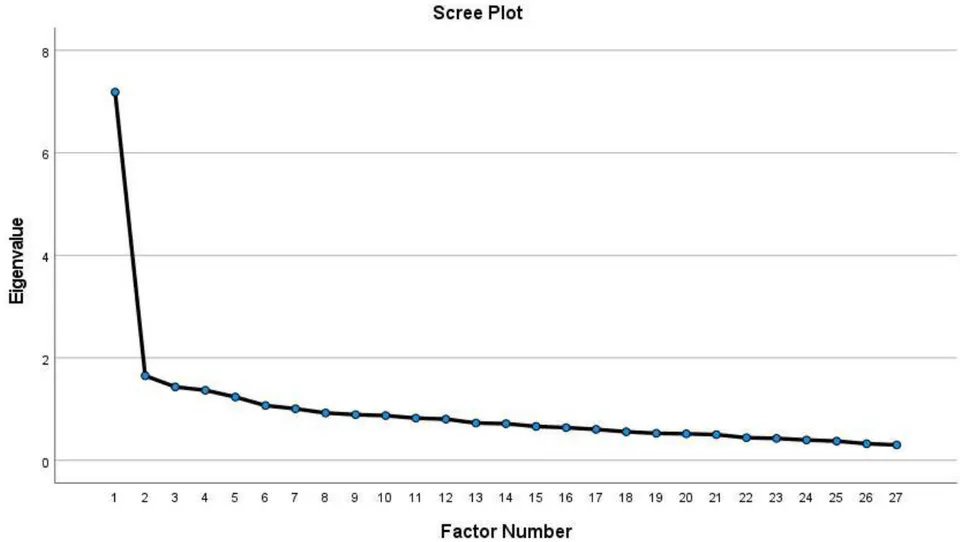
An important step in assessing the overall significance of the correlation matrix is Bartlett's Test of Sphericity, which measures the probability that the correlation matrix contains significant correlations among some of its components. The results were significant, ( ), indicating its suitability for factor analysis. The Kaiser-Meyer-Olkin measure of sampling adequacy (MSA), shown in Table 3, indicates the appropriateness of the data for factor analysis and was.91, which Hutcheson & Sofroniou (1999) describe as 'marvellous'. The scree plot for the analysis is presented in Figure 2. The plot clearly shows that the curve dramatically drops after the first two factors and begins to flatten just after the next five factors. Data with MSA values above 0.800 are generally considered suitable for factor analysis. Additionally, a preliminary analysis was conducted to obtain eigenvalues for each factor. To determine the optimal factor structure, Monte Carlo PCA for parallel Analysis and the scree plot (see Figure 2) were employed. The results supported a three-factor solution, explaining of the variance, with eigenvalues surpassing the corresponding criteria for a random data set of the same size (24 variables 601 participants). Factors with loadings below 0.4 were disregarded as they did not represent significant values (Field, 2013). During the initial EFA, three items—"AP5: Uses real-life experiences to explain difficult concepts," "AP6: Gives challenging assignments," and "SM7: Uses effective teaching materials"—failed to load significantly onto any dimension. Consequently, these items were removed from further analysis.
The authors repeated the EFA without including these items. The results of this new analysis confirmed the 3-dimensional structure theoretically defined in the research (see Table 4). The Kaiser-Meyer-Olkin MSA was 0.93. The three dimensions explained a total of of the variance among the items in the study. Bartlett's Test of Sphericity proved to be significant, and all communalities were over the required value of 0.50. The three factors identified as part of this EFA aligned with the theoretical proposition in this research. Factor 1 includes items SM1 to M7, referring to Knowledge of representations of subject matter (SM). Factor 2 gathers items SM2 to RDR6, which represent Assessment practices (AP). Finally, Factor 3 includes items PR2 to PR6, referring to Pedagogical approaches (PA). Factor Loadings are presented in Table 4.
IV. RESULTS
The result of the demographic characteristics of the participants is presented in Table 2.
| Age | Frequency | Percentage |
| 15 and below | 9 | 1.5 |
| 16-18 | 581 | 96.7 |
| 19-21 | 10 | 1.6 |
| 22 and above | 1 | .2 |
| Gender | Frequency | Percentage |
| Male | 231 | 38.3 |
| Female | 370 | 61.7 |
| Total | 601 | 100% |
| KMO and Barlett's Test | ||
| Kaiser-Meyer-Olkin measure of sampling adequacy | .908 | |
| Barlett's Test of Sphericity | Approx. chi-square | 4890.634 |
| df | 351 | |
| Sig. | .000 | |
Out of the total participants, 231 (38.3%) were males and 370 (61.7%) were females. This confirms the perception that females dominate the study of reading subjects like literature-in-English. The ages of the respondents ranged from 15 to 22 years.
Demographic information about the participants can be seen in Table 2.
Table 4 presents the skewness and kurtosis of the items, along with the item wording, mean scores, and standard deviations.
a) Factors Influencing Students' Performance in Literature-in-English
The results of the descriptive statistics showing the factors influencing students' performance in Literature-in-English are presented in Table 4.
| Item | Mean | Standard Deviation | Skewness | Kurtosis | |
| SM1 | Ensures course objectives are met | 4.032 | 1.0743 | -1.267 | 1.215 |
| SM2 | Develops the course systematically | 4.049 | 1.0387 | -1.144 | .894 |
| SM3 | Outlines major points clearly | 4.352 | .8554 | -1.711 | 3.569 |
| SM4 | Provides examples and case studies | 4.334 | .8798 | -1.655 | 3.038 |
| SM5 | Explains concepts clearly | 4.3 | .8987 | -1.587 | 2.844 |
| SM6 | Gives me a deeper understanding of the concepts he/she teaches | 4.083 | 1.1129 | -1317 | 1.124 |
| AP 1 | Ensures there is coordination between what is taught in Literature class and the Literature exercises given | 3.940 | 1.1453 | -1.004 | .257 |
| AP4 | Assesses us in knowledge and skills at the start of a lesson | 3.951 | 1.1.0997 | -1.029 | .468 |
| PA 1 | Getting us to read text aloud | 4.125 | 1.1962 | -1.331 | .757 |
| PA4 | Using student-centred group activities (debates, discussions) | .479 | 1.1320 | -.990 | .230 |
| PA5 | Using vocabulary-building exercises | .611 | 1.0921 | -1.077 | .460 |
| PA6 | Using linguistic investigation activities at word, sentence, and discourse level | .598 | 1.2213 | -.444 | -0.664 |
| PA7 | Writing exercises using the text as a model (paraphrasing, rewriting, cloze exercises) | .448 | 1.1498 | -.784 | -0.15 |
| PA8 | Combining different methods of teaching (Information-based, student-centred, language-based) | .769 | 1.1052 | -1.118 | 0.571 |
| AP 7 | Gives at least two class tests before the end-of-term exams | .702 | 1.4050 | -.86 | -.626 |
| AP 8 | Returns marked scripts before the next test | .643 | 1.4199 | -.894 | -.556 |
| AP9 | Makes corrections on exam scripts before they are returned | .589 | 1.2662 | -1.073 | .084 |
| AP2 | Focuses on examinations, rather than the content of the syllabus | .620 | 1.4406 | .242 | -1.314 |
| AP3 | Uses the traditional method of chalk (or whiteboard marker) and talks to teach | .702 | 1.2959 | -1.075 | .037 |
| PA3 | Using teacher-centred text comprehension (guided questions, informative background lectures). | .476 | 1.5563 | 4.078 | 60.001 |
b) Research Question One
Table 5 presents the factor structure and loadings, reliability coefficients (i.e., Cronbach's alpha), and variance explained. A three-factor structure was identified to understand students' perceived influence of pedagogy on teaching and learning of literature-in-English. Factor 1, which was termed as Subject matter knowledge of teachers, centred on six items that imply that students perceive that their teacher's subject matter knowledge was very important to help them learn literature in English. The students perceived that the subject matter knowledge of teachers serves as a source of boosting their interest in the subject. Also, teachers' subject matter knowledge has a way of motivating students to learn.
Factor two was termed assessment practices. This factor was made up of five items. It indicates that the assessment practices employed by teachers in teaching literature-in-English language influence students to learn. Finally, factor three was termed pedagogical approaches. The third factor was made up of four items. Students indicated that the pedagogical methods teachers use impact the learning of literature in English. Also, teachers' use of a variety of pedagogical methods activates students' interest in literature in English.
| Items | Factors | |||
| Subject Matter Knowledge | Assessment Practices | Pedagogical Approaches | ||
| SM5 | Explains concepts clearly | .681 | ||
| SM2 | Develops the course systematically | .640 | ||
| SM1 | Ensures course objectives are met | .618 | ||
| SM3 | Outlines major points clearly | .618 | ||
| SM6 | Gives me a deeper understanding of the concepts he/she teaches | .589 | ||
| SM4 | Provides examples and case studies | .515 | ||
| AP3 | Uses the traditional method of chalk (or whiteboard marker) and talks to teach | .702 | ||
| AP 7 | Give at least two class tests before the end-of-term exams | .702 | ||
| AP 8 | Returns marked scripts before the next test | .643 | ||
| AP2 | Focuses on examinations, rather than the content of the syllabus | .620 | ||
| AP9 | Makes corrections on exam scripts before they are returned | .589 | ||
| PA 1 | Getting us to read text aloud | .769 | ||
| Combining different methods of teaching (Information-based, student-centred, language-based) | .769 | |||
| Using vocabulary-building exercises | .611 | |||
| PA6 | Using linguistic investigation activities at the word, sentence, and discourse levels | .598 | ||
| Variance explained% | 18.76 | 10.84 | 10.24 | |
| Reliability | 0.85 | 0.73 | 0.62 | |
c) Research Question Two
The factor loadings from Table 5 provide the specific factors capable of influencing students' perception of the teaching and learning of literature-in-English language. The extracted factors suggest that students' perceptions are largely influenced by teachers'
subject matter knowledge (mastery of the subject), assessment practices employed in the classroom and pedagogical approaches; these factors are capable of creating a conducive environment for the teaching and learning of literature-in-English language.
The results indicate that the students prefer their teachers to teach literature-in-English language using a "combination of different methods of teaching" (student-centred, information-based and language-based) as to the teacher-centred approach. Larsen-Freeman (1986), supports this finding stating that the general pattern in modern-day methodology is for the teaching to be learner-centred. By this approach, the teacher serves as a guide in the learning process and the learners assume some responsibility for the direction of the learning and bear the ultimate responsibility for how much learning takes place. Calvo (2007) observes that the learner-centred approach to language teaching regards the teaching-learning process from the point of view of the learner and pays special attention to the needs of the learner. Additionally, it targets the characteristics of learners, and it appears to be efficient and popular in second-language teaching and learning classrooms.
The systematic literature-in-English language teacher is the teacher who meets the course objectives, develops a unique blend of teaching methods that is most appropriate for the students based on the characteristics of the group of students, outlines major points in each lesson clearly for students, provides examples and case studies and finally provides a deeper understanding for students. The effective teacher provides effective teaching and learning materials and can coordinate what is taught in the classroom with exercises, focusing not only on examinations but also on delivering the curriculum requirements for the course to increase interest and understanding of concepts in literature-in-English.
The third factor, known as teaching methods, does not contribute to building student interest in Mathematics. The traditional chalk and board method was found to contribute insignificantly to building students' interest in Mathematics. This finding requires a new dimension to teaching Mathematics in Ghana, other than the traditional chalk and board method, which, although it cannot be eradicated, yet, the introduction of new techniques of teaching will improve the students' interest.
V. DISCUSSIONS
Three factors loaded below 0.4; as such, they were suppressed. The suppressed three factors were—using real-life experiences, giving challenging assignments, and reading materials. Unfortunately, students strongly disagreed with all three because they are not being used by teachers teaching literature. This indicates a huge flaw in the teaching and learning of literature-in-English in most Ghanaian high school classrooms.
These three factors that have been taken out, therefore, introduce an anomaly in the teaching of literature-in-English. Firstly, it is an indisputable fact that real-life experiences are relevant in the teaching of literature. This is because, when a literary text being studied is fiction, it is important to understand that writers of fiction hardly ever write in a vacuum. For instance, Ben-Daniels, Essuman, and Brempong (2020) posit that the African writer has a duty as not just an entertainer, but a historian and a grassroots activist. They argue that Africa's complex history, for instance, is always reflected even in the fiction writers create. This is because, intentionally or unintentionally, writers could graft historical elements into their work. They delineate that this is so because the African writer has always been burdened by Africa's history of slavery, colonialism, neocolonialism, coup d'etat, among others. A typical example is Chinua Achebe's novel, Anthills of the Savannah. Although Achebe's setting in the novel is geographically fictitious, his subject matter of coups and his setting of the time frame in the early 60s to 70s are synonymous with the historical period of coups across West Africa. Therefore, if a novel like Anthills of the Savannah is being taught, the learners must be acquainted with the historical background that has served as a resource material for the author. The learners' knowledge of the historical period of the novel will help them better understand the text and contribute meaningfully to the teaching and learning process. A much closer to home example is Amma Darko's novel, Faceless (1996). The subject matter of streetism, which features heavily in the narrative, is a prevalent challenge in Ghana's metropolitan areas. Female head porters, that is, women who carry goods on their heads in exchange for money, are part of the human work force of Ghanaian markets. Although the story is pure fiction, a character like Fofo, a street child and head porter, is an accurate representation of a section of the diverse labour force in Ghanaian markets. Her story as a young female head porter sleeping in the streets is a commonly heard story on the radio. As such, when Ghanaian students are presented with real-life situations either through listening to radio programs discussing the issue or visiting the marketplace on a study tour, they are placed in a better position to understand and critically appreciate the text.
It is for this reason that it is advised that teachers begin the teaching and learning process with the learners from the known to the unknown. Real-life experiences are part of the resource materials of the 'known' in the teaching and learning process.
Again, Ben-Daniels' novel, Mimosa (2015), although a work of fiction, unfolds its plot around the historical unfortunate event of the collapse of the
Melcom store in Accra, which occurred on November of 2012. Therefore, to teach the text, the students must be allowed to share their opinions on the real or historical events of the Melcom disaster. Talking about the real-life disaster and researching it would afford the students a deeper understanding of the fictitious events of the novel. By so doing, students are encouraged to explore their analytic and interpretative skills of texts to the fullest. If students are allowed to share real-life experiences of others that they have read or heard, or their own experiences in connection with a text, understanding and interest for the subject and the text under study is created. As teachers, we cannot overlook the fact that understanding and interest in the subject can boost students' performance.
assignments to monitor the progress and learning difficulties of students in order to inform future pedagogical skills and other learning goals.
Thirdly, giving students reading materials and reading assignments is very important. It is not enough for a student to read only the required text by which he or she would be examined. Debrah and Baah (2023), in their research on reading culture in pre-tertiary technical institutions in Ghana, observed that students' reading was limited to their course materials. If a student's reading is focused only on the text for examination, then such a student would be limited in his or her interpretation and analysis of text in literature. The teacher must introduce students to related texts. For instance, when teaching a text, the teacher should draw examples from other texts that share similar subject matter, themes, and style. This helps students broaden their knowledge base, and it equally heightens their power of imagination. As literature teachers, we must expose students to the world. This is because, through the study of literature, one can see and understand the world from multiple viewpoints. After all, irrespective of how widely or narrowly one has read, it does not change the fact that there exists one literature or the other for every aspect of human life and existence. The existence of genres like speculative fiction, supernatural fiction, and thriller novels, among many others, shows the diverse artistic representations of literature.
a) Implications for Teaching and Learning of Literature-in-English
These findings highlight critical implications for teaching and learning of Literature-in-English at the senior high school level in Ghana. Students have weak foundations in the English language. Addressing the pedagogical approaches, assessment practices and subject matter knowledge of teachers is essential to improve teaching and learning of Literature-in-English.
Teachers are to use a student-centred learning approach. The study highlights the importance of using a combination of teaching methods, including student-centred learning approaches and the use of real-life examples in teaching. Teachers should incorporate group activities and discussions to engage students. Also, integrating real-life experiences into lessons can make literature more relatable and interesting for students. Teachers should encourage students to connect literary texts with their own experiences and contemporary events.
Teachers should provide regular and varied assessments, including class tests and assignments, to help students prepare better for exams. It is expedient that teachers score tests and deliver quick, detailed feedback to students to help them understand their mistakes and improve their learning.
Teachers' deep understanding of the subject matter is essential to boost students' interest in the subject. Professional development programmes should be organised to enhance teachers' teaching skills. Teachers should focus on explaining literary concepts clearly and systematically, using examples and case studies to deepen students' understanding. Assignments that challenge students to think critically and analyse texts beyond classroom discussions can enhance their analytical skills and interest in literature. Providing students with a variety of reading materials, including related texts and supplementary readings, can broaden their literary knowledge and improve their interpretative skills.
For all of the above to work effectively, reading as a practical subject needs to be introduced during the pre-school and early childhood education years of students. Reading as a subject means that after every teaching and learning of phonics, the students are given a book to take home and read. On return to school, teachers must assess learners on their reading by asking them to narrate the simple plot of the book and also read to the class. Also, students must be given a short passage to read and then answer short questions on the passage. This ensures that the students develop a love for reading and can read from an early age. The students can also understand and answer questions on the text they have read from an earlier age. Such assignments and learning strategies help in the development of comprehension skills.
b) Innovative Idea
We are proposing this framework to be used in the teaching of literature in English. The framework for teaching literature in English is shown in Figure 3. The framework displays a seamless workflow of the interaction between learning theories, integrative principles, pedagogical approaches, implementation strategies and extensions. The framework explains how to design, deliver, and evaluate literature-in-English lessons that involve students as active participants within a rich and stimulating social environment.
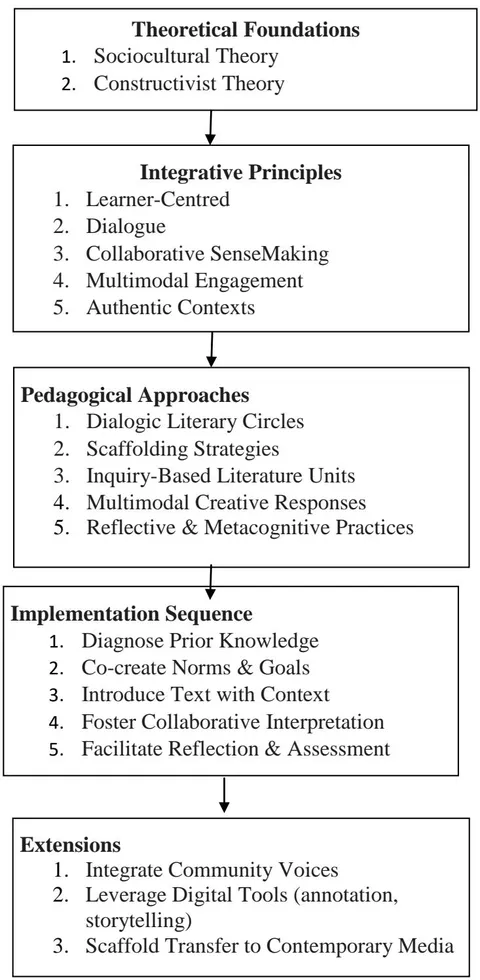
Both socio-cultural and constructivist theories emphasise that students construct their own knowledge and understanding; the former highlights learning through interactions with more knowledgeable peers, cultural tools and historical contexts, while the latter focuses on the learner's internal cognitive processes. Integrative principles address essential practical steps for teaching literature-in-English in the classroom.
Learner-centred dialogue: Positions students' lived experiences and cultural backgrounds as entry points for text exploration. Collaborative sense-making uses group discussions, literature circles, and peer review to co-construct meaning. Multimodal engagement uses dramatic, digital, and written responses to deepen comprehension. Authentic contexts connect texts to historical, community, or contemporary events to heighten relevance.
Pedagogical approaches outline specific instructional methods for teaching literature in English, with accompanying examples. Dialogic Literary Circles: Small groups select a novel or poem. Rotate roles (discussion leader, connector, summariser, illustrator). Convene the entire class to share group insights and challenge interpretations. Scaffolding Strategies: Use character webs, theme matrices, and plot timelines. - Question Prompts: "How does this scene mirror your own experiences?" "What might the author want us to imagine?" Inquiry-Based Literature Units: Begin with an open-ended question (e.g., "What makes a protagonist?"). Research historical and cultural backgrounds using primary documents, interviews, and multimedia. Multimodal Creative Responses: - Visual: Draw comic-style reinterpretations of key scenes. - Dramatic: Script and perform a critical vignette or modern adaptation. - Digital: Create a narrated slideshow or podcast episode analysing motifs. Reflective and Metacognitive Practices: Include reading journals and daily entries on confusion, surprises, and personal connections. Learning Logs: Document strategies that helped decode difficult language or imagery.
Implementation Sequence: Diagnose Prior Knowledge - Conduct a quick survey on favourite stories, cultural traditions, and previous thematic explorations. Co-Create Norms and Goals: Develop a class contract for respectful dialogue, active listening, and risk-taking. - Set reading targets and personal learning objectives. Introduce Text with Context: Use multimedia (images, music, maps) to situate the work historically and culturally. Foster Collaborative Interpretation: Rotate through literary circles; host full-class debates on contested meanings. Facilitate Reflection and Assessment: Use rubrics co-developed with students that value critical thinking, creativity, and collaboration. - Hold one-on-one conferences to discuss portfolios and next steps.
Extensions discuss how to provide students with out-of-the-classroom experiences and knowledge by reaching out to the larger community. These approaches are to guide students to have firsthand experiences of what they have learnt in their classrooms and also to enable them to think outside the box. Integrate local community voices: Invite authors, elders or cultural practitioners to share oral traditions related to the text. Leverage technology: use collaborative annotation tools (e.g., Hypothesis) or digital storytelling platforms. Scaffold transfer: Ask students to apply literary lenses to contemporary media (songs, films, social media narratives.
Finally, weaving sociocultural scaffolds, constructivist inquiry, and diverse pedagogical strategies, this framework transforms literature classrooms into dynamic spaces where students co-author meaning and grow as critical, creative thinkers.
VI. CONCLUSION
The findings of this study underscore the critical role of pedagogical factors in shaping students' performance in Literature-in-English at the senior high school level in Ghana. The study identified three key areas where pedagogical practices significantly influence student outcomes: the use of real-life experiences, the provision of challenging assignments, and the availability of diverse reading materials. Unfortunately, these elements are currently underutilised in many classrooms, contributing to the declining performance in Literature-in-English.
To address these gaps, teachers must adopt a more student-centred approach, integrating real-life examples and encouraging active participation through challenging assignments. Research shows that incorporating real-life experiences in teaching can enhance students' understanding and engagement (Almuhammadi, 2017). Additionally, providing challenging assignments has been found to improve students' critical thinking and problem-solving skills (Amua-Sekyi & Nti, 2015). Furthermore, diverse reading materials can broaden students' literary knowledge and foster empathy and cultural understanding (Dewi & Asrifan, 2024).
Professional development programs for teachers are essential to equip them with the necessary skills and knowledge to implement these strategies effectively. Studies indicate that ongoing professional development can significantly improve teaching practices and student outcomes (Lombardi, 2024)
Furthermore, the study emphasises the importance of introducing literature studies at the primary education level to establish a solid foundation and cultivate a love for reading from an early age. Early exposure to literature has been shown to enhance cognitive and language development, as well as critical thinking skills (Widyastuti, Andriyanti, Nurhayati, 2024).
To conclude, enhancing pedagogical practices in literature-in-English is crucial for improving student performance. The findings of this study give literature-in-English teachers a strong basis to improve their pedagogical skills. Teacher education stakeholders should increase the content for training pre-service teachers on pedagogical approaches. Additionally, teachers should receive regular, tailor-made professional development on pedagogical approaches.
VII. LIMITATIONS AND SUGGESTIONS FOR FUTURE RESEARCH
The use of literature-in-English teachers in data collection has the potential to produce socially desirable responses from the students. This could introduce biases into the study. However, the assurance of anonymity and confidentiality of their responses, coupled with the presence of the researchers in the various schools for the data collection, helps to reduce the probability of this problem occurring. Also, data were collected in only one region in Ghana, thereby limiting the generalisability of the findings. Notwithstanding, this study has provided some compelling evidence. Future research should consider increasing the sampling size by extending it beyond one region and using qualitative data to provide more insight into the issue.
Declarations
Ethical Approval
Ethical approval was sought from the Head of each senior high school before data collection commenced. Following this approval, the Head of the English department was asked by the Head of the institution to supervise the data collection alongside department members. Respondents' consent was obtained, and only willing students were permitted to participate in the data collection.
Competing Interests
We declare that there are no competing interests, whether financial or personal.
Authors' Contributions
Jonathan Essuman
Conceptualisation of the article, literature review, theoretical framework, development of the data collection instrument, proofreading, editing, and managing the data collection process.
Faith Ben-Daniels
Literature review, theoretical framework, discussion, proofreading, editing, and drafting the conclusion and recommendations.
Ato Kwamina Arhin
Development of the data collection instrument, theoretical framework, data analysis, discussion of results and findings, drafting the conclusion and recommendations, and proofreading and editing.
Funding
No funding was received.
Availability of Data and Materials
Data is available and can be accessed upon request via a Google link.