The cost ratio of steel to concrete exceeding 100 in most of the RCC structures, alternative materials for replacing steel are underway to develop a sustainable built environment. Bamboo has been in housing industry since time memorial as a standalone structural member for lighter loads of roofing and wall cladding units. It has been tested for its use as reinforcement in OPC based cement concrete structures replacing steel reinforcement with appreciable performance while requiring serious attention on serviceability and durational aspects. The alkali activated low calcium fly ash & slag-based concrete with steel reinforcement as structural components cured at ambient temperature (RGPC) are being popularized in the most consumed sector of concrete construction industry.
## I. PREVIOUS RESEARCH WORK
From the early research groups of $21^{\mathrm{st}}$ century it was observed that low calcium fly ash based geopolymer concrete (GPC) develops strength in proportion to the amount of heat or steam supplied during its early stage of polymerization. Although fly ash-based GPC has appreciable structural skills, but heat/steam curing requirement had become the major limiting factor in further developing the in-situ applications of reinforced geopolymer concrete (RGPC) structural elements. Further research made it more suitable for ambient curing using fly ash - slag based GPC which develops significant early strength and very good structural skills superior to OPC based RCC applications [13][16][19]. This way the research entered into a broader area of in situ applications of Reinforced Geopolymer Concrete.
The shortage of river sand was mitigated by using crushed granite stone powder known as manufactured sand (M-sand). Use of mixture of M- sand $80\%$ and River sand $20\%$ as fine aggregate in GPC & RGPC produced a more satisfying in situ concrete. [6][10]
Alkali activated fly ash-slag based geopolymer concrete cured at ambient temperature became more suitable and produced more satisfying steel reinforced structural application. These steel RGPC elements had inbuilt strength characters to produce attractive ductility compared to OPC based RCC structural components.[13]
The cost ratio of steel to concrete kept on increasing due to heavy urbanization and national economy. The research on development of alternate reinforcing elements started as early as 1970's with bamboo reinforced cement concrete. Bamboos belong to the class of Bambusoideae which are orthotropic materials with more strength along the fiber directions with variations in its density along thickness. Several researchers have produced valuable material feedback on Bamboo Reinforced Cement Concrete (BRCC) while still a major research work on development of Bamboo Reinforced Geopolymer Concrete (BRGPC) is yet to be seen. [12][2]
Structural parameters which have influence on the performance of Bamboo in OPC based cement concrete (CC) environment are studied and their mitigating solutions are proposed which are also applicable in case of alkali activated geopolymer concrete.
### a) Biodegradability of Bamboo in Cement Concrete Environment
Bamboo, like timber, is vulnerable to biodegradability due to insects and fungal attack. Bamboo like timber may also become weak when attacked by insects and fungus when improper conservation conditions prevail. Insect attack is mainly due to starch content with humidity more than 15 to $20\%$ affecting physical and mechanical properties. Several preservatives are used to protect the properties like Modified Boucherie Method, Boucherie Method, leave transpiration, immersion, impregnation. [2] Preservative treated bamboo reinforced concrete have performed well against aggressive environmental steel corrosions in RCC elements.
### b) Water Absorption
Study on several species of bamboo on water absorption have resulted in increase in dimensions up to $7\%$ within a span 7 days [2] This may also cause micro to macro cracks in cured concrete. But when bamboo is used inside the geopolymer concrete environment with the surface treatment using geopolymer paste, it has less chance of water absorption due to ambient curing i.e., no water curing. In addition to this the presence of sodium silicate in binder solution of geopolymer concrete, with which the splints were pretreated, also works as a better water proof coating on the surface of splint.[27] These reinforced concrete structural components, used for lighter to medium loads in housing industry, are always surface treated with waterproof plasters, have lesser chances of moisture absorption during their serviceability life.
### c) Bond Strength
One of the primary factors of RCC design is perfect bond between reinforcement and concrete during the entire serviceability life of the structure. But in bamboo reinforced concrete elements the dimensional changes of bamboo due to moisture and temperature influence, swelling, shrinking and differential thermal expansion are seen at different stages of serviceability life. Various preservative treatments have resulted in different degrees of success. The impermeability conditions can be enhanced using coatings of geopolymer paste in steel wire wrapped bamboo reinforcements.
### d) Moisture Content
Most of the concrete develop micro pores inside the concrete which is a greater source of moisture entry into concrete from surrounding environment and affect bamboo performance in flexural & bond. The voids inside the concrete can be minimized by using proper amount of binder solution and compaction by using prescribed vibrator which may reduce pores significantly. Geopolymer concrete manufactured with adequate workability will have excellent moisture resistance.
### e) Mechanical Properties
Most of the species of bamboo improve their strength after a period of air dry with moisture content as major influencing variant. The density of bamboo varies from place-to-place ranging from 500 to $800\mathrm{kg} / \mathrm{m}^3$ while most of the Indian Bamboo have an average density around $614\mathrm{kg} / \mathrm{m}^3$.[15] The strength parameters of bamboo are comparable with mild steel, but it needs special treatment due to other issues. Few types of bamboo develop high tensile strength of $370\mathrm{MPa}$ while most of the Indian types develop tensile strength a round $250\mathrm{MPa}$ and compressive strength around 80 to $100\mathrm{MPa}$ without and with nodes respectively, Modulus of elasticity in the range of 20 GPa to 40 GPa. There are also few species of bamboo with modulus of elasticity around $2.5 \times 10^{6}$ psi compared to steel $2.5 \times 10^{6}$ Mpa.
### f) Pozzolanic Activity
The pozzolanic activity of geopolymer concrete during its polymerization has more chances of developing bond with bamboo splints (vertically cut sections used as splints) apart from using mild steel-based binding wire wrapped on bamboo splints to be used as flexural reinforcement. The bamboo surface is to be treated with binder solution of geopolymer concrete to activate silica present in epidermis (in cellular level) of the bamboo splint to contribute to pozzolanic reaction. This will provide better bond with concrete and bamboo splint surfaces [2].
### g) Swelling & Shrinkage
These are associated with change in moisture content of the bamboo reinforcement. The presence of binding wire controls the swelling while shrinkage will be under control if proper pretreatment chemicals are used.
### h) Ductility
Geopolymer concrete has more ductility post cracking compared to OPC based steel reinforced cement concrete. Bamboo possesses ductility comparable with steel rebars and therefore when GPC with SWBS with prior chemical treatment will enhance ductility of composite.
### i) Deflections & Cracks
Much depends on the structural forces acting and the design flexibility\ safety factors used in BRGPC. Bamboo is known to deflect much and produce cracks in OPC based concrete environment. But use of binding wire wrapped bamboo splints in compression zone of a flexural element with appropriate safety factors for bamboo stresses, will be effective in controlling the deflection associated issues.
### j) Water Tightness
With the increase in moisture content above $30\%$ the bamboo splints show slight reduction in the mechanical properties while the bamboo relatively transits from brittle behavior to ductile behavior. Chemically treated bamboo splints show more water tightness during their service life.[2]
### k) Thermal Compatibility
The thermal coefficients of bamboo are different in two directions because of which the dimensional changes occur in both directions affecting bond strength. The use of binding wire wrapped bamboo splints control the increase in dimensional changes and effective in transferring temperature stresses to binding wire.
### i) Durability
The durability of BRGPC elements mainly depends on the continued bond over the years to come while the pure bamboo structures last for 15 to 20 years of life. Humberto C. Lima found 60 cycles of wetting and drying in solution of calcium hydroxide and tap water did not decrease the bamboo tensile strength neither the Young's Modulus [26]. However, the BRGPC structural elements may be sandwiched with small diameter steel rebar & wrapped with binding wire - for minimum serviceability conditions and duration to ensure continued service life. Further research is required in this regard.
### j) Creep
Bamboo has the tendency to creep under sustained tensile loads, but creep resistance will increase if bamboo splints are used in compression zone also. Much depends on basic properties, design safety factors used and orientation of the bamboo splints/culms.
### k) Temperature Resistance
Although steel and concrete have significant resistance to temperature\fire without degrading their properties, but the bamboo starts degrading its properties above 50 Degrees C. However prior thermal treatment helps to reduce biodegradability while partially reducing mechanical properties.
### l) Bamboo Reinforced GPC Joints in Frames
For larger spans more than 6 meter or so and for lighter to medium structural loads the bamboo splint detailing inside the concrete, especially anchoragement length and development length, depends on the way boundary conditions are created/assumed. Steel reinforcements/flats sandwiched with bamboo reinforcements at the specific location can provide adequate joint strength. Further research is required in this regard.
II. MATERIAL PROPERTIES AND MIX PROPORTIONS
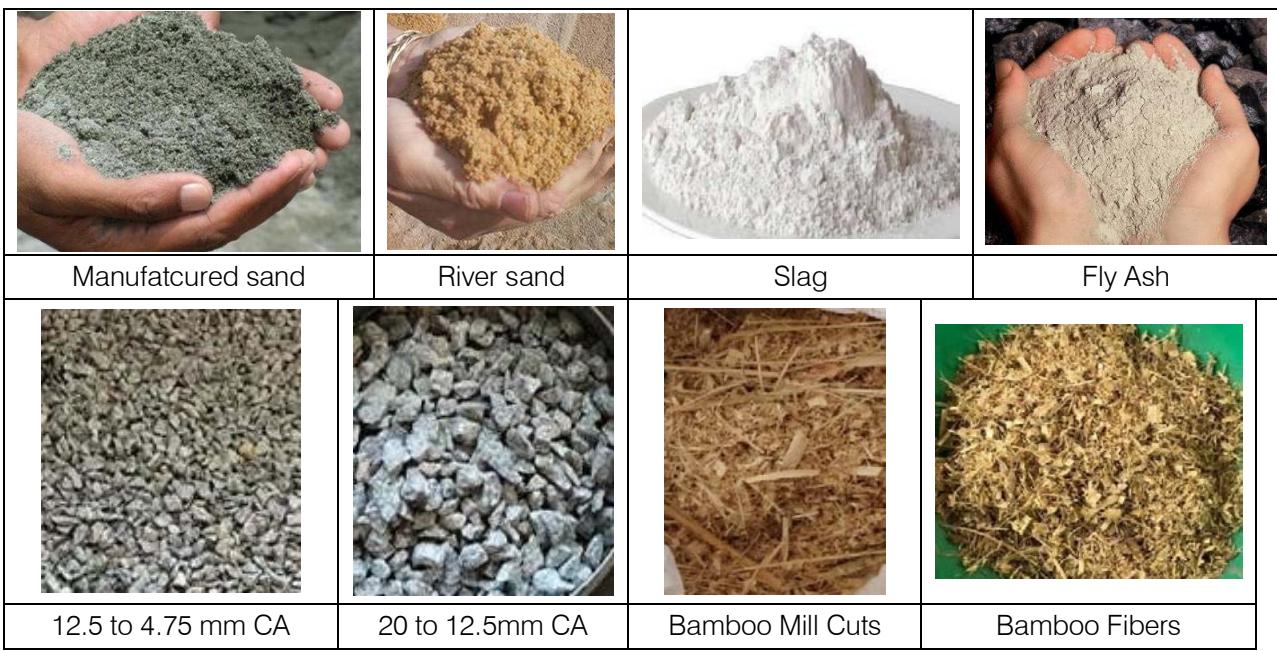
Manufactured Sand: Angular & rough texture need more water. Moisture is not held. Develops more strength compared to river sand. Silt content is zero. Granite compressive strength 100 to 250 Mpa and E = 20 to 70 GPa. M-Sand, crushed from granite stone, having Sp.gr 2.45, Fineness Modulus (F.M) 2.70.
River Sand: Smoother texture needs less water. Moisture is trapper between particles. Develops less strength compared to manufactured sand. Silt may vary from 5 to $20\%$. Sandstone compressive strength 20 to170 Mpa. E =20 GPa River Sand of sandstone origin having F.M 2.62 confirming to Zone III of IS 383-1970 are used.
Fly Ash: used in this work collected from Raichur thermal power plant in Karnataka has sp.gr 2.15, Silicon dioxide (SiO2) $61.98\%$, Aluminum oxide (Al2O3) $26.06\%$, Calcium oxide (Cao) $3.05\%$. Slag: is procured from Jindal Steel Plant Bellary, Karnataka has sp.gr 2.62, Silicon dioxide (SiO2) $33.88\%$, Aluminum oxide (Al2O3) $18.02\%$, calcium oxide (Cao) $34.98\%$.
Coarse Aggregates: of granite origin of sizes $20 \mathrm{~mm},$ $12.5 \mathrm{~mm} \& 4.75 \mathrm{~mm}$ having water absorption $0.5\%$ by weight at room temperature (16 to 28 degree).
Sodium Silicate (Na2 Sio3): The sodium silicate solution used is of A53grade with Si02-to-Na20 ratio by mass of 2, i.e., Si02 = 29.4%, NaZO = 14.7% & water = 55.9%.
Sodium Hydroxide (NaoH): of $97\%$ purity and sodium silicates with $\mathrm{Na}_2\mathrm{O} = 14.7\%$, $\mathrm{SiO}_2 = 29.412\%$, water $= 59.9\%$ by mass are used to form Alkaline Activator Solution using ratio $\mathrm{Na}_2\mathrm{SiO}_3 / \mathrm{NaoH} = 2.5$.
Alkaline Activator Solution (AAS): is prepared 24 hours before mixing of concrete. To get 1 liter of SHS of 8 Molarity, 255 Sodium Hydroxide pallets in gms are added with 745 gms of water. Super Plasticizer: Sulphonated Naphthalene based super plasticizer i.e Conplast SP430 DIS distributed by FOSROC- Bengaluru is used.
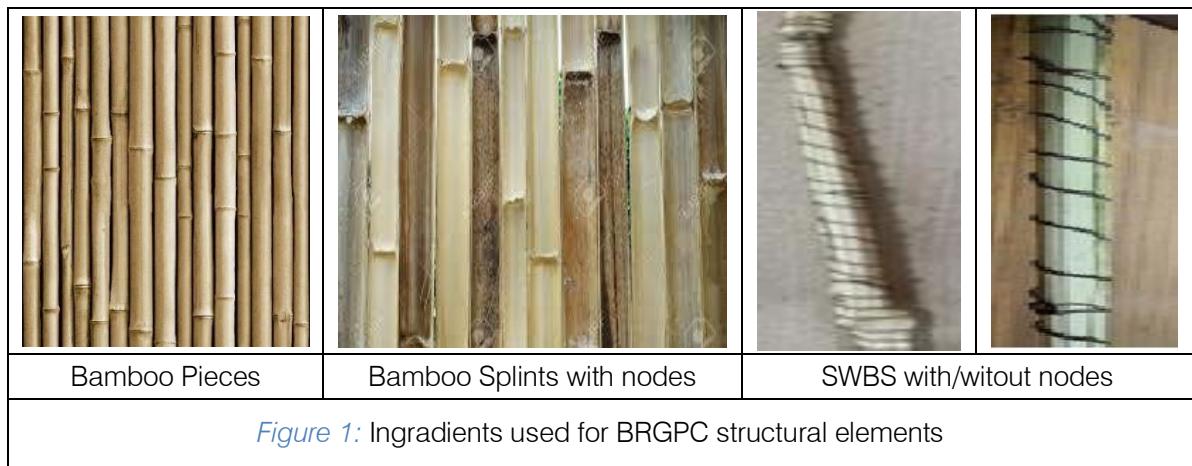
Bamboo: Locally available Bamboos used for general applications are selected for the present research work. These samples provide information that will help to further carry out research work from the same source as they are commonly available. The Bamboo logs with three successive knots are cut into slender. These slenders are further cut to form in to splints as shown in the figure 1.
- Binding Wire used for Bamboo Splints: Locally available and used for normal RCC works of building construction binding wire from mild steel are used to prepare bamboo splints as shown in figure (1).
<table><tr><td colspan="4">Table 1: Mix Proportions for Geopolymer Concrete</td></tr><tr><td>S.N.</td><td>Materials</td><td>Wt kg</td><td>Specifications</td></tr><tr><td>1</td><td>Fly ash</td><td>276</td><td>70% of total fly ash</td></tr><tr><td>2</td><td>GGBS (30%)</td><td>120</td><td>30% of total fly ash</td></tr><tr><td>3</td><td>20mm to 12mm size CA</td><td>451</td><td>35% of total CA</td></tr><tr><td>4</td><td>12mmto 4.75mm CA</td><td>451</td><td>35% of total CA</td></tr><tr><td>5</td><td>4.75mm & downsizes</td><td>389</td><td>30% of total CA</td></tr><tr><td>6</td><td>River sand</td><td>111</td><td>20% of total FA</td></tr><tr><td>7</td><td>M-sand</td><td>444</td><td>80% of total FA</td></tr><tr><td>8</td><td>Sodium Hydroxide of 8M</td><td>45</td><td>97% purity (26.20%)</td></tr><tr><td>9</td><td>Sodium Silicate (Na2sio3)</td><td>113</td><td>Na2O14.7%, SiO229.4%</td></tr><tr><td>10</td><td>Super plasticizer</td><td>3.6</td><td>SP430DIS (1.5%)</td></tr><tr><td>11</td><td>Extra water</td><td>4.0</td><td>Potable water</td></tr><tr><td></td><td colspan="3">NOTATIONS; FA: Fine Aggregates, CA: Coarse Aggregates</td></tr></table>
### A. Tests on GPC Cubes with Bamboo Fibers
The mix design used for preparing geopolymer concrete cubes is detailed in the Table 1. Use of slag made the ambient curing develop early strength. Use of $80\%$ and $20\%$ combination of M-Sand and River sand provided good workable concrete along with strength.[6][10]
The aspect ratio of bamboo fibers and their diameter play a major role in influencing the mechanical properties of bamboo fiber reinforced geopolymer concrete. Bamboo fibers used in the GPC cubes and cylinders are tested for their compressive strength (CS) and tensile strength (TS). The bamboo cuts containing natural sizes from SAW mills were procured and segregated from larger sized pieces and fibers and used in GPC cubes, cylinders and flexural beams. Most of the fibers were with aspect ratio ranging from 40 to 60 with diameter lesser than $1\mathrm{mm}$.
<table><tr><td colspan="7">Table 2: Compressive Strength of Bamboo Fiber (BF) – GPC cubes</td></tr><tr><td>Specimen Number</td><td>%age of BF</td><td>Weight of cube (kg)</td><td>Average weight (kg)</td><td>Failure Load (kN)</td><td>Compressive Strength (Mpa)</td><td>Average Compressive Strength (Mpa)</td></tr><tr><td>1</td><td rowspan="3">0%</td><td>8.028</td><td rowspan="3">7.96</td><td>660</td><td>29.33</td><td rowspan="3">27.7</td></tr><tr><td>2</td><td>7.686</td><td>600</td><td>26.67</td></tr><tr><td>3</td><td>8.156</td><td>610</td><td>27.11</td></tr><tr><td>1</td><td rowspan="3">5%</td><td>7.52</td><td rowspan="3">7.63</td><td>670</td><td>29.78</td><td rowspan="3">29.78</td></tr><tr><td>2</td><td>7.58</td><td>620</td><td>27.56</td></tr><tr><td>3</td><td>7.79</td><td>720</td><td>32</td></tr><tr><td>1</td><td rowspan="3">10%</td><td>7.72</td><td rowspan="3">7.51</td><td>500</td><td>22.2</td><td rowspan="3">23.73</td></tr><tr><td>2</td><td>7.35</td><td>480</td><td>21.3</td></tr><tr><td>3</td><td>7.46</td><td>600</td><td>27.7</td></tr></table>
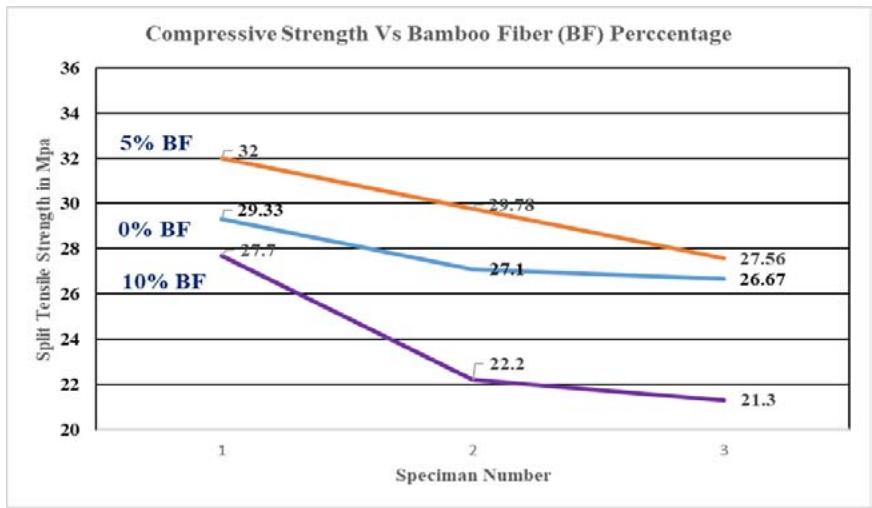
These fibers were air dried in open air inside the room before being used in GPC cubes. The compaction of cubes was achieved using VB Vibrator which resulted in bamboo fibers being forced to interconnect the remaining voids inside the concrete. Two percentages of fibers were tried i.e $5\%$ and $10\%$ of the weight of the binder material i.e fly ash and slag. For the mix proportion (Table 1) the average compression strength (CS) of control cubes ( $0\%$ fibers) after 7 days of room temperature curing was $27.7 \, \text{Mpa}$ but with bamboo fibers at $5\%$ the average CS increased to $29.78 \, \text{MPa}$ which is increased by $7.5\%$. But with $10\%$ fibers average CS dropped to a lower value of $23.73 \, \text{Mpa}$ resulting in reduction of CS by $14.3\%$ indicating an optimum fiber dosage occurring well before $5\%$. The green weights of each cube before CS test indicate the possible reduction in CS because higher percentage of fibers reduce the content of binder solution/concrete. During the ambient curing period of GPC cubes for 7 days, the bamboo fibers did not undergo any degradation instead increased the CS.
The relation between CS and TS of control specimen of cubes and cylinders of GPC is nearly an etablished theory[6][10] and follow BIS Code IS456-2000 observations i.e for CS of 27.7 MPa the TS developed 3.93 Mpa following the relation TS = 0.7/CS. The split tensile strength of cylinders with BF at $5\%$ and $10\%$ show serious reduction in strength compared to control specimen. The reduction is nearly $17.2\%$ for $5\%$ fibers and $62.8\%$ for $10\%$ of fibers. These test results indicate that the optimum dosage of the selected fibers is at far lesser than $5\%$.
<table><tr><td colspan="7">Table 3: Split Tensile Strength of BF- GPC Cylinders</td></tr><tr><td>Specimen</td><td>%age of</td><td>W (kg)</td><td>Ave.wt</td><td>F Load</td><td>Split tensile</td><td>Avg split</td></tr><tr><td>1</td><td rowspan="3">0%</td><td>12.278</td><td rowspan="3">12.26</td><td>315</td><td>4.45</td><td rowspan="3">3.931</td></tr><tr><td>2</td><td>12.234</td><td>275</td><td>3.89</td></tr><tr><td>3</td><td>12.272</td><td>245</td><td>3.46</td></tr><tr><td>1</td><td rowspan="3">5%</td><td>11.952</td><td rowspan="3">11.85</td><td>225</td><td>3.183</td><td rowspan="3">3.253</td></tr><tr><td>2</td><td>11.782</td><td>215</td><td>3.041</td></tr><tr><td>3</td><td>11.802</td><td>250</td><td>3.536</td></tr><tr><td>1</td><td rowspan="3">10%</td><td>10.454</td><td rowspan="3">10.65</td><td>50</td><td>0.7073</td><td rowspan="3">1.46</td></tr><tr><td>2</td><td>10.644</td><td>150</td><td>2.122</td></tr><tr><td>3</td><td>10.862</td><td>110</td><td>1.556</td></tr></table>
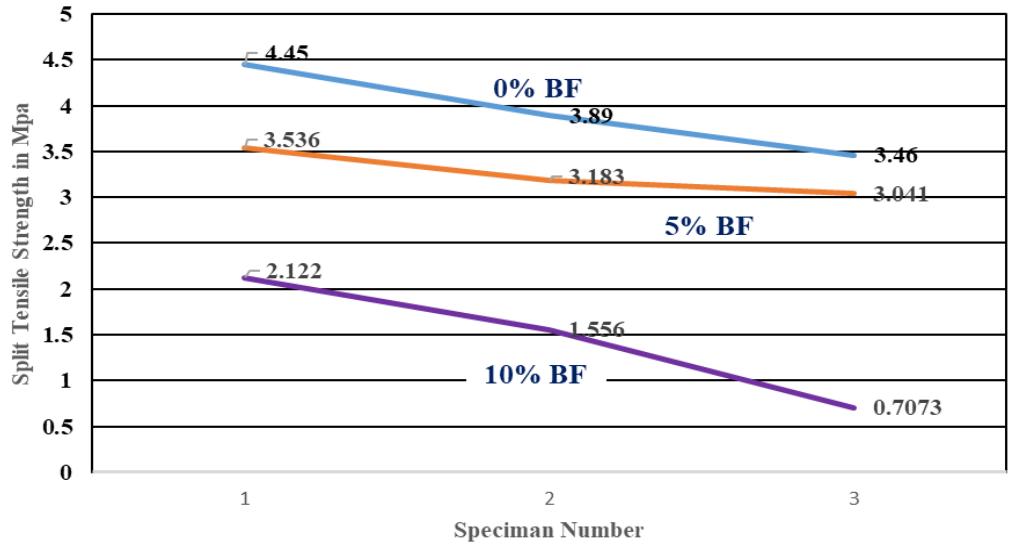
Split tensile Strength Vs Bamboo Fiber (BF) Percentage
Steel fibers up to $1.5\%$ with aspect ratio around 60 provide excellent TS to geopolymer concrete [6][10][13]. But with bamboo fibers up to $10\%$ the relation between CS & TS in GPC is seriously affected with the coefficient varying from 0.3 to 0.75. The alternate way to use BF is to partially use steel fibers along with BF so that the loss of TS is brought back into material by steel fibers. This needs further research on this.
# B. Axial Tensile Test on Bamboo Splints
Bamboo culms and splints help to provide tensile strength to concrete similar to steel reinforcements. The splints (longitudinally cut bamboo sections) have better bond strength than with the culms (small diameter full cross section bamboo specimen). The axial tensile strength of splints of $300\mathrm{mm}$ length with anchoring length of $150\mathrm{mm}$ on both ends are tested with one node and without any node in UTM.
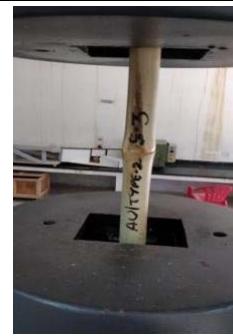
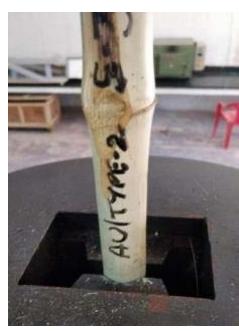
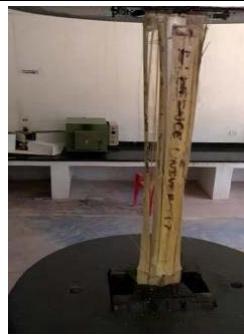 Figure 2: Bamboo Culms and Splints
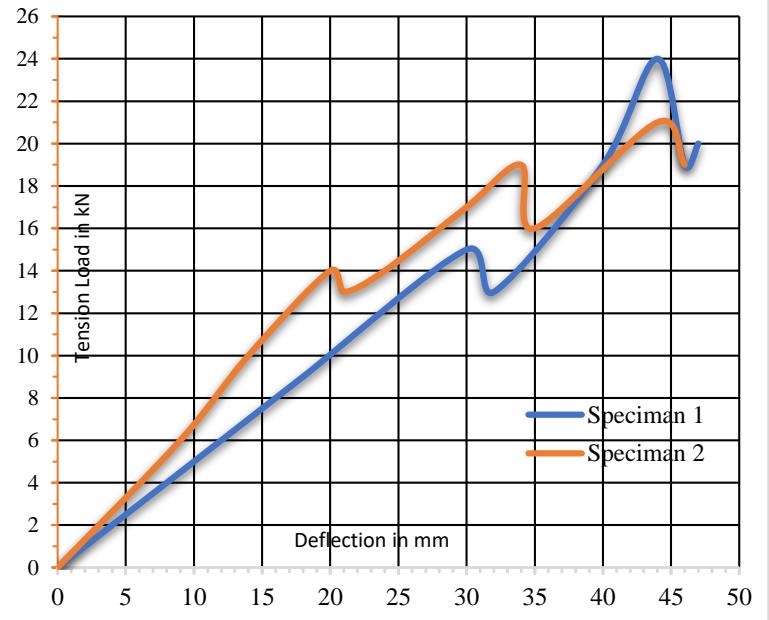
The splint without node have taken load 24.65 kN with 131.2 Mpa as tensile strength (average) while that with node developed 127.8 Mpa as average tensile strength. As seen in the figure 3, the failure of splints followed linearity up to yield points. The splints with node show three different slopes while without node show two slopes exhibiting more deflections at same load than splint with node. The bamboo specimen with node has more ductility but has less tensile strength. The bamboo specimen without node has less ductility but carry more load compared to specimen with node.
<table><tr><td colspan="4">Table 4: Tensile Test on Bamboo Splints – Specimen A</td></tr><tr><td>SI. N</td><td>PARAMETERS</td><td>Without Node</td><td>With Node</td></tr><tr><td>1</td><td>Length (mm)</td><td>300</td><td>300</td></tr><tr><td>2</td><td>Width (mm)</td><td>10.8</td><td>10.9</td></tr><tr><td>3</td><td>Thickness (mm)</td><td>15.4</td><td>17.9</td></tr><tr><td>4</td><td>Peak load (kN)</td><td>21.3</td><td>25.8</td></tr><tr><td>5</td><td>Tensile strength (N/mm2)</td><td>128.1</td><td>132.2</td></tr><tr><td>6</td><td>Weight of bamboo (Kg)</td><td>0.080</td><td>0.090</td></tr><tr><td>7</td><td>Density (Kg/m3)</td><td>802</td><td>769</td></tr></table>
<table><tr><td colspan="4">Table 5: Tensile Test on Bamboo Splints – Specimen B</td></tr><tr><td>1</td><td>Length (mm)</td><td>300</td><td>300</td></tr><tr><td>2</td><td>Width (mm)</td><td>10.5</td><td>10.8</td></tr><tr><td>3</td><td>Thickness (mm)</td><td>15.4</td><td>16.7</td></tr><tr><td>4</td><td>Peak load (kN)</td><td>20.6</td><td>23.47</td></tr><tr><td>5</td><td>Tensile Strength (N/mm2)</td><td>127.4</td><td>130.1</td></tr><tr><td>6</td><td>Weight of bamboo (Kg)</td><td>0.076</td><td>0.080</td></tr><tr><td>7</td><td>Density (Kg/m3)</td><td>783</td><td>740</td></tr></table>
<table><tr><td colspan="4">Table 6: Tensile Test on Bamboo Culms – Specimen C</td></tr><tr><td>SI. N</td><td>PARAMETERS</td><td>Without Joint</td><td>With Joint</td></tr><tr><td>1</td><td>Length (mm)</td><td>300</td><td>300</td></tr><tr><td>2</td><td>Inner diameter (mm)</td><td>22</td><td>13.5</td></tr><tr><td>3</td><td>Outer diameter (mm)</td><td>33.3</td><td>30.5</td></tr><tr><td>4</td><td>Failure Load (kN)</td><td>59.8</td><td>67.6</td></tr><tr><td>5</td><td>Tensile strength (N/mm2)</td><td>121.8</td><td>115.0</td></tr><tr><td>6</td><td>Weight of bamboo (Kg)</td><td>0.22</td><td>0.25</td></tr><tr><td>7</td><td>Density (Kg/m3)</td><td>747</td><td>709</td></tr></table>
Tension Test on Bamboo Specimen B
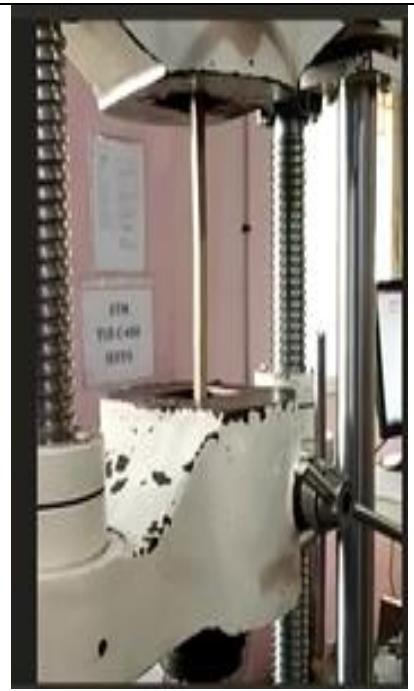 Figure 3: Load vs deflection of Bamboo splints
## C. Load Tests on Bamboo Fiber (BF) Reinforced GPC Beams
To assess the strength of bamboo fiber in plain GPC beams, specimens were cast of size 100mmx 100 mm x 500mm length with bamboo fibers at $0\%$, $5\%$ and $10\%$ of binder contents i.e., fly ash and GGBS. These plain GPC beams with bamboo fibers are ambient cured for 7 days and tested in UTM for single point central load. The details load testing and their failure loads are noted in Table 7. These failures are characterized by brittle failures under the load point at mid span with a crack widening gradually with no other cracks near supports. The failure loads increased from $7.5\mathrm{kN}$ at $0\%$ to $9\mathrm{kN}$ for $5\%$ BF. But with the addition of $10\%$ BF made the plain GPC beam fail at much lower load $6.45\mathrm{kN}$ as shown in table 7. These tests further confirm the pattern of split tensile strength and suggest the optimum dosage of bamboo fibers is around $5\%$.
<table><tr><td colspan="4">Table 7: 7-Day Load Testing of Bamboo Fiber (BF) Reinforced GPC specimen</td></tr><tr><td>Load Details</td><td>0% BF</td><td>5% BF</td><td>10% BF</td></tr><tr><td>W(kg)</td><td>11.9</td><td>11.3</td><td>10.9</td></tr><tr><td>Breakage Load (kN)</td><td>5.5</td><td>6.6</td><td>4.8</td></tr><tr><td>Peak Load (kN)</td><td>7.5</td><td>9</td><td>6.45</td></tr></table>
## D. Load Tests on Plain Bamboo Splint Reinfoced GPC Beams
Here GPC sections of size $100\mathrm{mm} \times 100\mathrm{mm} \times$ 500 mm length with 3 plain bamboo splints as reinforcement were tested for a single point central load. The size of the splint used were of $15\mathrm{mm} \times 10\mathrm{mm}$. There was no reinforcement for shear. The beams were ambient cured for 7 days and tested. The test results as shown in Table 8, exhibit flexural behavior with appearance of first crack under the load and then gradual appearance of hair cracks near support. The peak load was marginally in line with yield load while the stresses in splints and concrete developed were around 50 to 65 Mpa and 10 to 15 Mpa respectively and the beam failed much before reaching their full capacity. The failure is mainly attributed to lack of bond strength between bamboo and surrounding concrete. From flexural failure point of view the beams did not reach their full peak load but failed at an early load when the bond between bamboo and concrete lost.
# E. Load Tests on Steel Wire Wrapped Bamboo Splint (SWBS) as Reinfocements in
In these set of beams the splints were wrapped with the normal binding wire – normally used for RCC works, with adequate anchoragement at splints ends as shown in figure 4. The size of the test beams $100\mathrm{mm} \times 100\mathrm{mm} \times 500\mathrm{mm}$ length. The bottom cover for these splints provided was $20\mathrm{mm}$. The beams were ambient cured for 7 days and load tested for mid span single point load. The test results are tabulated in the Table 8. The results show flexure failure of beams similar to plain splint reinforced GPC beams with an increased load carrying capacity. The deflections were more than the
plain splint beam tests. The beams failed well before reaching their peak stresses in concrete and bamboo, due to loss of bond between splints and concrete. However, the increased failure load indicates enhanced bond strength due to binding wire.
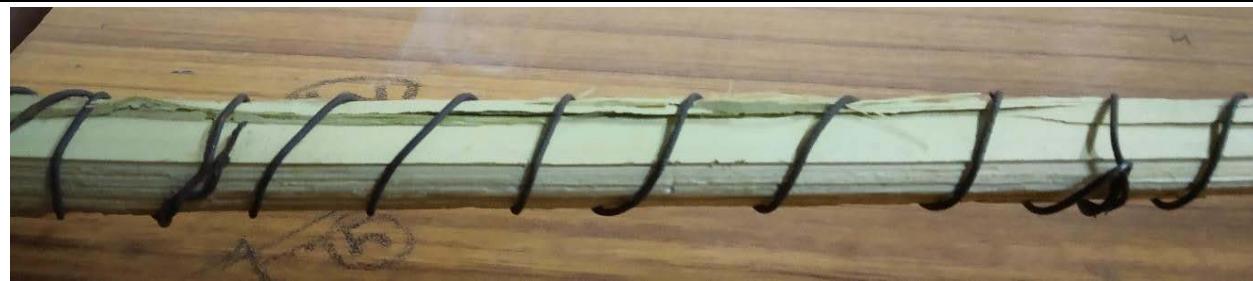
Bamboo splints wrapped with binding wire
Table 8: 7-day Load Testing of Bamboo Splints as Reinforcements in GPC Beams
<table><tr><td>Load -Deflection Details</td><td>FB1</td><td>FB2</td><td>FB3</td><td>Average Value</td></tr><tr><td>W (Kg)</td><td>10.9</td><td>11.2</td><td>11.8</td><td>11.50 kg</td></tr><tr><td>Breakage Load (kN)</td><td>4.8</td><td>5.3</td><td>5.8</td><td>5.3 kN</td></tr><tr><td>Yield Load (kN)</td><td>11.6</td><td>12.5</td><td>13.5</td><td>12.5 kN</td></tr><tr><td>Deflection at Yield Load (mm)</td><td>3.2</td><td>2.4</td><td>4.1</td><td>3.2mm</td></tr><tr><td>Peak Load (kN)</td><td>12.6</td><td>13.5</td><td>14.8</td><td>13.6 kN</td></tr><tr><td>Max. Deflection (mm)</td><td>5.8</td><td>6.4</td><td>7.2</td><td>6.5 mm</td></tr></table>
Table 9: Load Testing of steel wire wrapped bamboo splints as Reinforcement in GPC
<table><tr><td>Load -Deflection Details</td><td>FB1</td><td>FB2</td><td>FB3</td><td>Average Value</td></tr><tr><td>W (Kg)</td><td>11.2</td><td>11.6</td><td>12.2</td><td>11.67 kg</td></tr><tr><td>Breakage Load (kN)</td><td>5.4</td><td>6.20</td><td>6.8</td><td>6.13 kN</td></tr><tr><td>Yield Load (kN)</td><td>13.1</td><td>14.4</td><td>15.8</td><td>14.43kN</td></tr><tr><td>Deflection at Yield Load (mm)</td><td>3.8</td><td>3.1</td><td>4.8</td><td>3.9mm</td></tr><tr><td>Peak Load (kN)</td><td>14.6</td><td>16.2</td><td>17.4</td><td>16.07 kN</td></tr><tr><td>Max. Deflection (mm)</td><td>6.2</td><td>7.1</td><td>7.9</td><td>7.07 mm</td></tr></table>
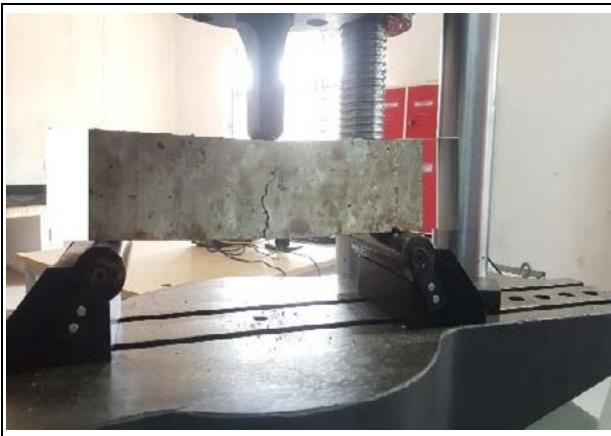
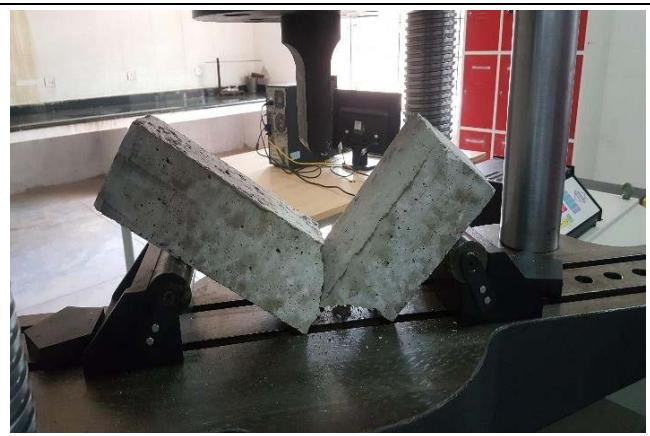
Figure 4: Single Point Load Testing on BFRGPC Specimen
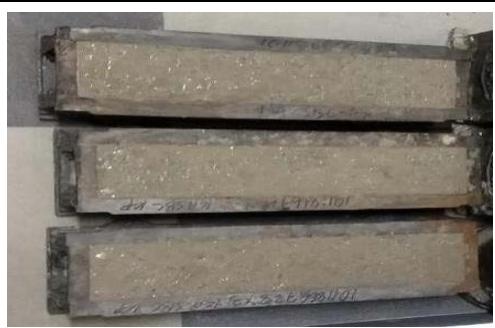 BRGPC specimen
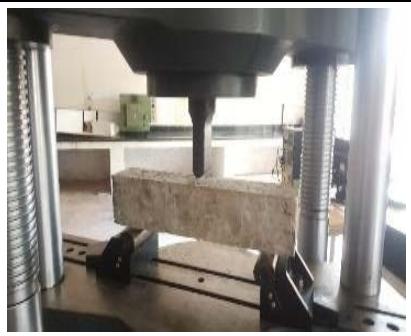
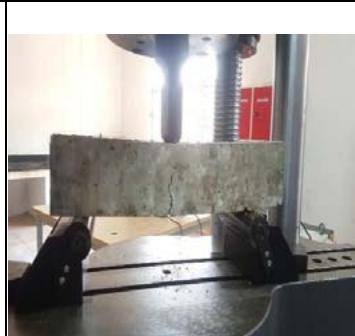
Single Point Load Testing Figure 5: One point load testing of BRGPC sections
## III. DISCUSSION AND CONCLUSIONS
This work helps in minimizing the standalone issues of bamboo as reinforcement in geopolymer concrete. As there are nearly 2000 species of bamboo, the strength & other properties of bamboo vary vastly due to so many influencing parameters like moisture content, age, species type, size & location etc. To use bamboo from a particular location as reinforcement the properties needs to be studied frequently to arrive at most common and frequent values to be used in design with appropriate design safety factors and further develop design guidelines.
Some Species of Indian Bamboo are comparable with mild steel having tensile strength up to 250MPa with internode distance of 300 mm to 500 mm or so. Bamboo with nodes are the reinforcements required to be used in flexural elements of beams, slabs, and columns. Bamboo splints of sectional sizes 16 to 20 mm are best suited as reinforcements as they provide better bond with geopolymer concrete.
The use of bamboo fibers fill up the micro voids in the concrete and increase the direct crushing strength but excess fibers partially develop the bond with concrete and thus reduce the strength. This is also evident in bamboo fiber reinforced geopolymer concrete plain beams. The reduction in split tensile strength due to bamboo fibers is due to inadequate bond with geopolymer concrete when the splitting force is applied. Therefore, use of bamboo fibers in concrete needs careful consideration and attention on optimum percentage along with proper design parameters of aspect ratio and diameter.
Here in the present study the bamboo splints were wet coated with geopolymer slurry before placing inside the concrete to avoid water absorption from the surrounding environment. The geopolymer concrete needs water for workability purpose therefore absorption of water by bamboo has negligible effect on concrete strength development. The use of binding wire to bamboo splints helps in minimizing swelling, shrinkage, and creep related issues while increasing the bond strength significantly.
Two types of GPC beams were tested with bamboo splints, with and without binding wire, as flexural reinforcements but without any shear reinforcements. Addition of binding wire wrapped splints increased the load carrying capacity of the beams by 15 to $20\%$ but the stresses in concrete and splints did not reach their peak values as the beams failed well before due to inadequate bond strength. From the load testing details it is observed that only 40 to $50\%$ of the bond strength is developed at breakage point and around $60\%$ at failure stage.
There are other inexpensive and effective methods to improve the bond strength to allow the bamboo to develop full bond with concrete like using higher yield strength binding wires, using sandwiched rebar of less diameter with bamboo splints, covering bamboo splint with light gage steel mesh, using staggered small cuts in bamboo at designed spacing and so on.
With the proper moisture content retention and protection, the biodegradability of bamboo may be prevented and the life of bamboo reinforced geopolymer concrete elements may have life of 15 to 20 years. More works on these are required to make bamboo a user-friendly reinforcement and formulate relevant design codes.
With this following conclusion can be drawn on use of bamboo products in alkali activated flay ash slag based geopolymer concretes.
1. From the present research work it can be concluded that the steel binding wires wrapped bamboo splints in alkali activated geopolymer concrete are the better solution to replace steel reinforcement. This has many structural, serviceability and economic benefits.
2. Bamboo splints with binding wires wrapped - provide better bond with geopolymer concrete than bamboo culms as reinforcement. And thus, they satisfy the long-term requirement of continued bond with concrete for flexural members.
3. The tested bamboo splints have a tensile strength of 130 Mpa at $18\%$ moisture content. These type of bamboo species are suitable for lighter loads of housing industry.
4. Use of bamboo fibers have the same effect on geopolymer concrete as any other fiber with OPC based ordinary concrete Bamboo fibers increase the compressive strength of geopolymer concrete composite by 7.5 to $10\%$, but beyond 2.5 to $5\%$ addition of fibers will affect the compressive strength.
5. Depending upon the species type, aspect ratio and diameter of bamboo fibers, the split tensile strength of GPC is influenced which have definite relations with compressive strength.
6. The plain bamboo splints wrapped with binding wire pre-treated with geopolymer paste can be used as reinforcements in geopolymer concrete environment without much water absorption related issue and develop enhanced bond strength due to polymerization.
7. Closely spaced binding wire wrapped splints increase the load carrying capacity of flexural elements by more than 15 to $20\%$ because of the improved bond strength, compared to plain splints reinforced sections. This may be more for other species and types. Further research is required in this regard.
8. As plain bamboo culms and splints are vulnerable to biodegradability, treatment to preserve and protect the moisture contents needs top priority.
9. Bamboo provides the better opportunity to use as reinforcements in concrete. With proper care, treatment, and maintenance the life of bamboo reinforced sections can be more than 15 to 20 years. Further research is required in this regard.
### ACKNOWLEDGEMENTS
- The authors wish to express their grateful feelings and thank the management of Alliance University for their kind support while investigating this research work.
- The authors also wish to thank Dhanush PV, Anji Reddy K, Lohit R, Kiran S - Undergrad scholars of Alliance University.
- The authors also wish to thank the staff of Civil & Mechanical Engineering department for supporting the present work.
Generating HTML Viewer...
References
27 Cites in Article
K Ghavami (2005). Bamboo as reinforcement in structural concrete elements.
N Mahantesh (2021). Performance Evaluation of Reinforced Geopolymer Concrete as Earthquake Resistant Composite.
Prem Kumar,& Vasugi,V (2020). Bamboo materials in cement, geopolymer and reinforced concrete as sustainable solutions for better tomorrow.
Ali Awaludin,Viki Andriani (2014). Bolted Bamboo Joints Reinforced with Fibers.
S Dr,Kavitha (2022). Bamboo Fiber as a Reinforcement Material in Concrete.
A Ruy,Sá Ribeir (2016). Geopolymer-bamboo composite -A novel sustainable construction Material.
N Mahantesh (2022). Performance Evaluation of River Sand & Manufactured Sand in Sun Heat Cured Fiber Reinforced Fly ash -Slag Based Geopolymer Concrete with Varied Percentage of Total Aggregates.
N Mahantesh (2022). Development of Optimum mix content of river sand for M sand, Fly Ash -Slag based geopolymer concrete cured at ambient temperature.
Dinie Awalluddin,Mohd Mohd Ariffin,Yusof Ahmad,Nor Zamri,Mohd Abdullah,Rafiza Abd Razak,Han-Seung Lee,Jitendra Singh (2022). Bond Behavior of Deformed Bamboo (Bambusa vulgaris) Embedded in Fly Ash Geopolymer Concrete.
Ghavami K (1995). Ultimate load behaviour of bamboo-reinforced lightweight concrete beams.
N Mahantesh,K Amarnath,B Raghuprasad (2017). Ductility Of fly ash - slag based reinforced geopolymer concrete elements cured at room temperature..
Anil Shastry,Sujatha Unnikrishnan (2017). Investigation on Elastic Properties of Bamboo and Behavior of Bamboo Reinforced Concrete Beams.
Sujatha Unnikrishnan (2017). Investigation on Elastic Properties of Bamboo and Behavior of Bamboo Reinforced Concrete Beams.
N Mahantesh,K Amarnath,B Raghuprasad (2017). Ductility Of fly ash - slag based reinforced geopolymer concrete elements cured at room temperature..
Jennifer Gottron,Kent Harries,Qingfeng Xu (2014). Creep behaviour of bamboo.
Adom-Asamoah Mark (2011). A comparative study of Bamboo reinforced concrete beams using different stirrup materials for rural construction.
N Mahantesh (2017). Strength and Deformation Behaviour of Reinforced Geopolymer Concrete Flexural Elements.
Moses Ogunbiyi (2015). Comparative Analysis of The Tensile Strength of Bamboo and Reinforcement Steel Bars as Structural Member in Building Construction INTERNATIONAL.
Laura Cáceres,Daisy Yoo,Caroline Hummels (1993). HCI Pluriversal Framework for Ancestral Medicine App in Bogota: Asset-Based Design Case Study.
Bhavna Sharma,Ana Gatóo,Michael Ramage (2015). Effect of processing methods on the mechanical properties of engineered bamboo.
Ankit Singh,Mehra (2016). Performance and Durability Evaluation of Bamboo Reinforced Cement Concrete Beams.
Arpit Sethia,Vijay Baradiya (2014). Experimental investigation on behaviour of bamboo reinforced concrete member.
Chen Chen,Haitao Li,Assima Dauletbek,Feng Shen,David Hui,Milan Gaff,Rodolfo Lorenzo,Ileana Corbi,Ottavia Corbi,Mahmud Ashraf (2022). Properties and Applications of Bamboo Fiber–A Current-State-of-the Art.
Humberto C Lima (2008). Durability analysis of bamboo as concrete reinforcement.
E Francis,Paul Brink,Rush (1966). Bamboo reinforced concrete construction.
No ethics committee approval was required for this article type.
Data Availability
Not applicable for this article.
How to Cite This Article
Dr. Mahantesh N B. 2026. \u201cSteel Wire Wrapped Bamboo – As a Sustainable Reinforcement in Alkali Activated Fly Ash-Slag based Concrete\u201d. Global Journal of Research in Engineering - E: Civil & Structural GJRE-E Volume 22 (GJRE Volume 22 Issue E2).
Explore published articles in an immersive Augmented Reality environment. Our platform converts research papers into interactive 3D books, allowing readers to view and interact with content using AR and VR compatible devices.
Your published article is automatically converted into a realistic 3D book. Flip through pages and read research papers in a more engaging and interactive format.
Our website is actively being updated, and changes may occur frequently. Please clear your browser cache if needed. For feedback or error reporting, please email [email protected]
Thank you for connecting with us. We will respond to you shortly.