I. INTRODUCTION
To achieve the Sustainable Development Goal 4(SDG 4) and the educational development Education Ministry of Bangladesh undertook important activities such as supplying of books up to secondary level, education aids, foods, play items, post disaster counseling etc. The Compulsory Primary Education Act was been approved in 1990. Primary education is free and compulsory for all children up to class 5.
In Bangladesh, the education system has been divided into 3 levels (6). The primary education is the five years of schooling from grade 1 to grade 5. The secondary education starts from 6 to grade 10 which is completed by the Secondary Board Examination S.S.C. (School Secondary Certificate). The Higher Secondary Certificate (HSC) is the third level of public education ends at grade twelve.
Due to flat and low-lying geography all most every year Bangladesh is encountered with different disasters (like Surge, cyclone, flood, salinity, water logging, river erosion, drought, earthquake etc) which lead to vulnerable situations (1-4).
II. LITERATURE REVIEW
According to Bangladesh Educational Statistics 2018 reports, 14269 educational institutions are found in disaster prone area. 1131 primary schools, 7240 secondary school, 547 school & college, 1355 college and 3996 madrasahs were affected by different disaster. Among them 758 were government institutions 13511 were non-government institutions.
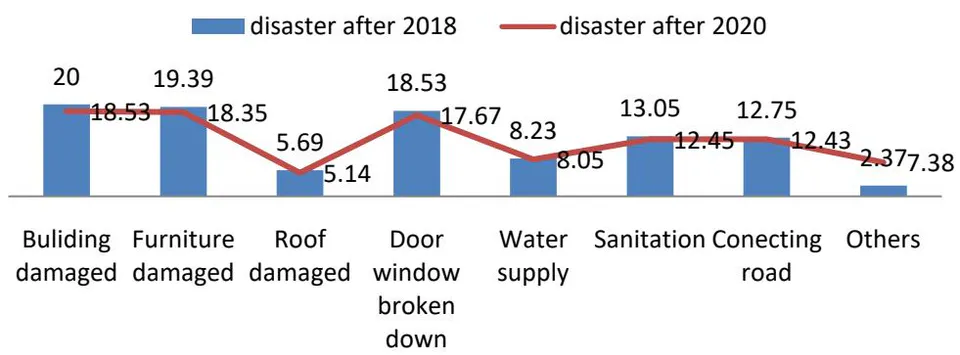
Banbeis, 2018 data reported that,5315 educational institutions did not able to recover the losses on buildings, 5153 on furniture, 1513 on roof damaged, 4925 on door window broken down, 2188 on water supply, 3468 on sanitation, 3382 on connecting roof and 630 other losses did not able to recover after disaster.
- The losses on educational materials and losses that the institution did not able to recover.
- The comparison between the irregular attendance of boys and girls in the institution after disaster.
- The comparison between the irregular attendance of male and female teachers in the institution after disaster.
- The current status of evaluation report done and sent by the institution for long term disaster risk management.
III. DATA AND METHODOLOGY
This study data has been extracted data from the Bangladesh Education Statistics 2018 and on Bangladesh Education Statistics 2020. The number of institutions is recorded in disaster prone area. The institutions are primary school (govt.), junior secondary school (non-govt.), secondary school (govt. and non-govt.), school and college (govt. and non-govt.), college (govt. and non-govt.), madrasah (govt. and non-govt.). The number of observations in each institution is recorded. Using this information overall percentage is estimated for each category.
IV. STATISTICAL ANALYSIS AND RESULTS
a) Damages loss that the institution did not able to recovery
Climate change and disaster causes many hazard to educational institution. According to the survey 2020 data, buildings and furniture are damaged. doors and windows are broken down. Though disaster causes damages water supply, sanitation, connecting road, losses are declining compare to the disaster after 2018. To diminish this percentage government is working and taking different measures before, during and after disaster in the disaster prone area.
b) Partially/fully damage assessment of educational materials
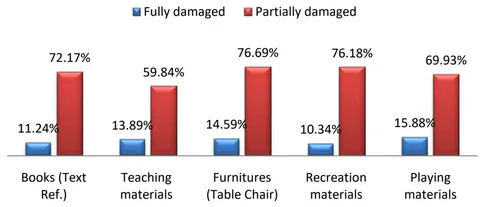
Loss of educational materials is common incident during the disaster. According the survey data, books, teaching material,
14.59% furniture, 10.34% recreational materials, 15.88% playing materials are fully damaged. 72.17% books, 59.84% teaching material, 76.69% furniture, 76.18% recreational materials, 69.93% playing materials are partially damaged after disaster 2020.
c) Reasons for irregular attendance of the student
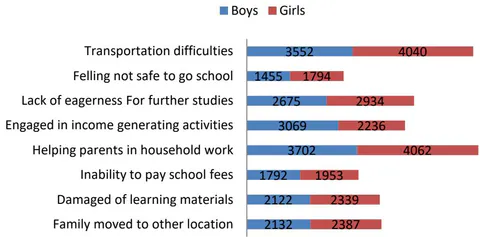
Irregular attendance of students and teachers are the common phenomenon after disaster. Students become irregular because of family moved to other location, inability to pay school fees, damaged of learning materials, helping parents in household work, engaged in income generating activities, lack of eagerness for further studies, felling not safe to go school, transportation difficulties etc. In very situations girls are more likely to irregular than boys. Girls frequently go through in vulnerable situations after disaster.
d) Reasons for irregular attendance of the teachers
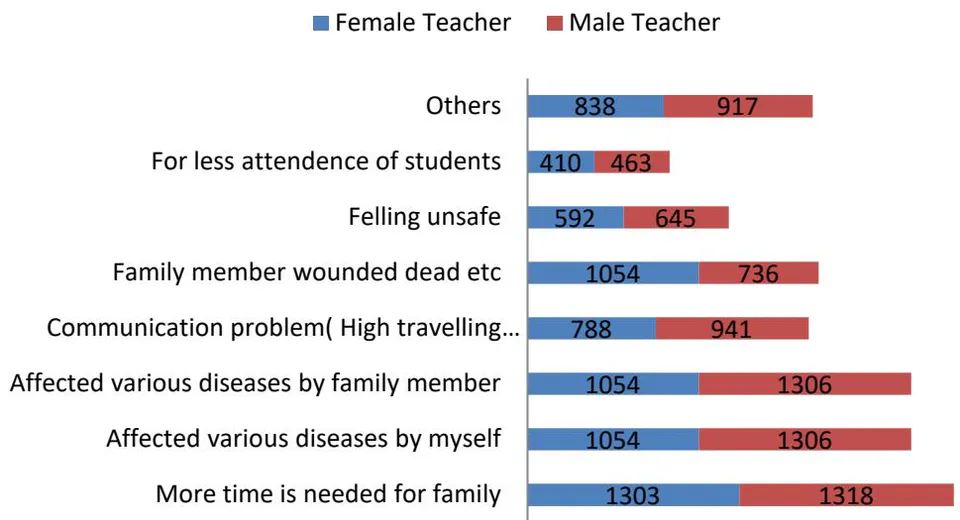
Teachers are also found irregular after disaster due to more time is needed for family, affected various diseases by myself, affected various diseases by family member, communication problem(High travelling cost), felling unsafe, for less attendance of students,family member wounded dead etc. Most of the cases male teachers are more likely to irregular than female teachers.
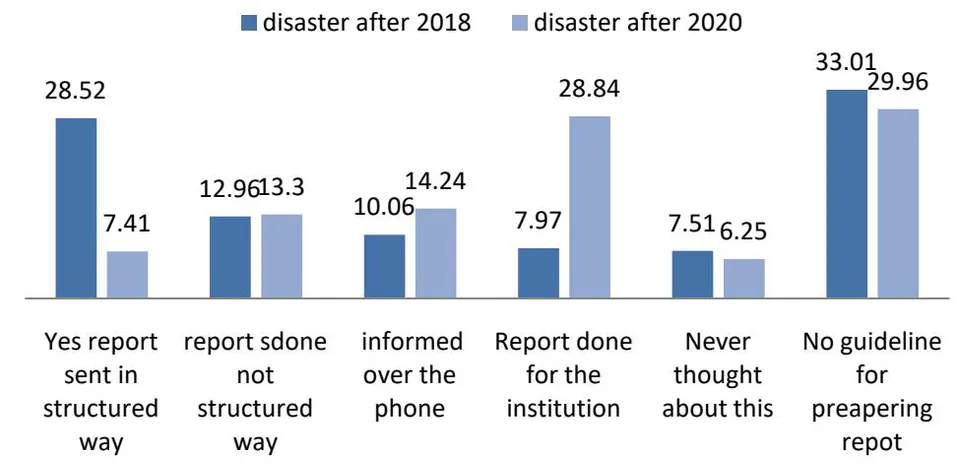
e) Evaluation report for long term disaster threats
Evaluation report is essential for long term disaster risk management. After disaster 2020, for institution reports are done and sent in structured way, reported for the institution, had no guide line for preparing reports. While reports are done and had no guide line for preparing reports after disaster 2018.
V. RECOMMENDATION
Education is disrupted after the disaster. Some remedies are needed to take to overcome this circumstance.
- Parents should have been aware to support their children's education.
- Transportation facility should be improved immediately after disaster prone area for improving regular attendance of both teachers and students.
- Institutions should be aware disaster risk management to minimize the losses.
- Institutions should have been given guideline to maintain evaluation report in a structured way sending to the specific authority.
VI. CONCLUSION
Though for the last few decades, Bangladesh has substantial progress in disaster preparedness and taken significant steps to disaster risk reduction, every year education is disrupted after the disaster. This research intends to highlight the ongoing effect of disaster on education. The loss of teaching materials is a common occurrence during disaster. Books, teaching materials, furniture are fully damaged or partially damaged. This study found that girl students are more likely to irregular than boys and female teachers are more likely to irregular than male teachers because of their family, environment, communications etc. For achieving sustainable development awareness should be taken in community levels and emphasis should be given to on the evaluation report done and sent by the institution for minimizing long term disaster threats.