The purpose of this study was to establish principals’ attitudes towards guidance and counselling services and maintenance of discipline in secondary schools. It further sought to establish whether principals’ gender, age, training, teaching and administrative experiences have any effect on their attitudes. Questionnaires, Interview and observation schedules were used to collect data. The researcher used Spearman Brown Prophecy to determine the research instruments’ reliability which 0.95. Split-half method was used to determine the Coefficient of Internal Consistency whose values varied between 0.00 and +1.00. The closer the value was to +1.00, the stronger the congruency measure whose value was 0.9 and above hence were reliable. Two-tailed T-test and One Way analyses of Variance (ANOVA) were used to analyze data whose results showed that 24.4% of the principals were conversant with the objectives of guidance and counselling services.
## I. INTRODUCTION
The overall running, control, tone maintenance, the general development of school education and all-round standards in secondary schools is the ultimate responsibility of the principals. They are particularly charged with the responsibility of fostering the right atmosphere for child growth and development as observed by Mbithi (1974). Principals must constantly be in touch with all school activities, whether academic or co-curricular although they may delegate some of their many responsibilities to other members of staff. In essence, Mbithi (1974) further notes that the principal is held responsible in case of the failure of any activity or service in school.
According to Rono (2019) and Roeber (1955:26), the Ministry of Education views the school principal as a key player in initiating and organizing good guidance and counselling services. They emphasized how important it is for principals to have positive attitudes towards school guidance and counselling by stating that, any service in the school, whether new or old needs the acceptance and leadership of the school administrator. Without his or her approval and continued support, any service will wither on the vine because teachers and students sense and frequently adopt the administrator's attitude towards it.
Principals' attitudes towards guidance and counselling services in schools significantly influence the attitudes of those others who are involved either as recipients, for example, students or as promoters as in the case of teachers. The principal can produce an atmosphere of cooperative enterprise through the attitude he or she has towards the services. Therefore, principals become role models to be emulated by both teachers and students. Wanjohi (2016) noted that, in secondary schools where the principals had a positive attitude towards guidance and counselling services, for example, Alliance Boys High School, Starehe Boys' Centre, Mang'u High School, Nairobi School, Lenana High School, among others, there happened to be positive responses from students towards it and therefore, they do not experience alarming cases of students' indiscipline.
## II. THE CONCEPT OF GUIDANCE AND COUNSELLING
Provision of guidance and counselling services in Kenyan schools was formally started in the 1970s. This was as a result of the (1967) and (1968) careers conference reports which were followed by the establishment of Guidance and Counselling Unit in the Ministry of Education in July, (1971). Before this year (1971), guidance and counselling services in schools mainly concentrated on career guidance which was almost entirely based on the voluntary efforts of teachers who somehow felt motivated to provide it. In secondary schools, guidance and counselling services were started to cater for students with social, personal, psychological, educational and vocational problems.
A handbook for school guidance and counselling providers was produced in (1971) and revised later in (1973) following the inception of guidance and counselling unit in the Ministry of Education. In the handbook, school principals' responsibilities in the provision of guidance and counselling services were enumerated and they were, according to the handbook, required to select competent and committed teacher - counsellors and establish guidance committees to organize and coordinate the services in their respective schools, provide time and facilities needed for the service and precisely define areas of responsibility for teacher - counsellors. As noted by Lytton, (2018), students with personal problems can be a severe problem to the school management and can have a disruptive effect on other children. With this in mind, principals cannot afford to ignore guidance and counselling in their schools.
## III. THE CONCEPT OF INDISCIPLINE IN SCHOOLS
According to Education Act Cap 212 of the Laws of Kenya, corporal punishment was used as a way of dealing with indiscipline in schools. In this act, corporal punishment was inflicted only after a full inquiry on the offender and offence had been made and was administered by the principal or teacher to whom it had been delegated by the principal. It was not to be inflicted in the presence of other students. A record of every corporal punishment administered was to be properly documented showing the name and age of the student, the offence committed, the number of strokes inflicted and by whom. This kind of punishment, as a way of maintaining discipline became unpopular and at times caused riots and therefore it was outlawed in April 25th 2001 by the government of Kenya.
In Kenya, many secondary schools in the past have been involved in strikes that have led to mass destruction of property worth millions of shillings. Meru County, for example, had secondary school students going on strike. In (1991), it witnessed the most shocking, senseless and ghastly incident at St. Kizito Mixed Secondary School where tragedy resulted into the death of nineteen (19) girls, seventy one (71) rape cases and four (4) boys being jailed for manslaughter as was reported by Mwokia, (2004) and Mwenda (2005). It was an incident that primarily involved students both as the assailants and as the victims as noted by Daddeya, et al. (2006). From the Kenya Television Network facts on file of 18th October (2021), it was reported that violent practices such as burning of dormitories, drug abuse and rape by students is not a new phenomena in Kenya.
According to Farsur Hassan (2019), failure to comply with safety standards, collapse of guidance and counselling programs and increased permissiveness by society are some of the top reasons stakeholders in education have blamed for the perennial unrest in schools that has caused massive loss of property. The reasons given for current disturbances and students' grievances are not entirely new but have not been fixed despite having been flagged in the past. As observed by Moenga (2021), whereas exam phobia has been associated with students' unrest in the past, the only new factor is the congestion in schools, which has been witnessed since the government introduced the 100 percent transition from primary schools but failed to expand the infrastructure.
According to the Kenya Secondary Schools Heads Association and the Kenya Union for Post-Primary Education Teachers, the congestion has made it harder for teachers to enforce discipline amid stiff competition for resources. However, the principal secretary for Basic Education Julius Jwan (2021) sees it as bigger societal problem. "The student unrest could be symptomatic of challenges in and out the school system. Education is not doomed but we must reexamine the place of boarding schools as observed by Malovah (2018). The public is also contributing to learners' behavior. How are students expected to resolve issues amicably when they see adults resorting to violence?" he said in response to a Nation reader's question.
## IV. REPORT OF NATIONAL ASSEMBLY COMMITTEE
The latest is the Report on the Inquiry into the Wave of Students' Unrest in Secondary Schools in Kenya in Term II, (2021). The document was prepared by the Education and Research Committee of the National Assembly that was chaired by Julius Melly. According to that parliamentary report that was tabled in September (2021), causes of students' indiscipline include limited professional Guidance and Counselling in schools, increased permissiveness and a Laissez-faire approach in the society, failure to address indiscipline among transferred learners, exam stress, promises of exam leakage and a long second term. The committee also identified lack of communication between parents, teachers and learners, over strictness at home and school, and lack of proper training of school managers.
Most secondary school students are at the adolescent stage of development. Makinde (2016: p.17) states that adolescence is a delicate period when boys and girls are faced with special needs and problems. When the needs of this age are not adequately provided for, problems of indecision, uncertainty; ambiguity, conflicts, instability, unpredictability perhaps leading to delinquency, alcoholism, career muddle and hindered heterosexuality may surface. As Makinde stated, students in Kenyan secondary schools have many problems. There are students with problems of alcoholism, drug abuse, sex perversion, reading disabilities, students born out of wedlock and students who lack parental love and care according to Rono, (2019).
A report to the British council on "drug - abuse - problem - solving approach for Nyamira secondary schools' teacher counsellors" held in Nyamira Technical High School in 2002 revealed that drug abuse was a problem in most learning institutions. The workshop deemed it necessary to train teacher-counsellors who were to take more time with girls and boys on guidance and counselling matters. Many schools in Nyamira County in the recent years have been reported as having many cases of indiscipline that were blamed on lack of adequate provision of guidance and counselling services to students. For example, according to Mugiro, O. (2021 p.21). Alarming Unrest in Schools- the Standard Newspaper, p.16, Kibonyora High School was closed after three dormitories were burnt and most of the school buildings' windows were smashed by students who were demanding that they should be allowed to eat meat throughout a week. Akira, J. (2021, September 18) Standard Newspaper, p.21 also reported that Gekando Secondary school students destroyed school property worth thousands of shillings because majority of them had been sent home for fees by the principal.
Besides, Opala, K. (2021, May 31) the Daily Nation Newspaper, P.19 reported that Nyabanswa boarding school students had access to drugs despite the fact that they were confined within the compound during the school term. Drugs for example, bhang, are smuggled into the school compound and hidden without the notice of the school administration. Towards the end of September, as reported by Opala, K. (2021, September 30) the Daily Nation Newspaper, P.22, Nyansongo Boys High School students frog-marched their principal and raped his wife in his presence on allegations that they lacked freedom of expression in the school.
Strikes and fights in schools suggest that students have social, psychological and educational problems which can effectively be alleviated by adequate provision of guidance and counselling services. There is need for students to be listened to, be understood well and then be guided out of their straining circumstances. Moreover, unrest in schools in the country is a pointer to the fact that there is something grossly wrong with the administration of most schools. Discipline promotes individual growth and development, it creates a free conducive atmosphere for interaction, makes learners have confidence in decision making and generally it has a great bearing to the learners' performance in their national examinations as noted by Norwich, (2020). This observation therefore shows that discipline, which can be brought about by principals' positive attitudes on provision of guidance and counselling services, is the backbone of all activities carried out in schools. Schools are expected to produce adults who can be responsible citizens capable of making major decisions on problems affecting their lives and who can contribute largely to their communities' development.
It is worthwhile to note that, in Nyamira County, there were rampant cases of school drop-outs, truancy and alcoholism as was observed by Mukura (2014). This calls for guidance and counselling services in the schools to help individuals be more useful to themselves and their societies. This can only be realised if principals develop positive attitudes towards it. Various studies have been done on administrative tasks and administrative problems facing secondary school principals. Most of these studies, for example, Ogenga (2018), Migora (2019), among others, looked at the challenges faced by school administrators and recommended guidance and counselling as the most preferred method of alleviating problems arising from students. It is therefore based on these recommendations that this study was carried out.
## V. OBJECTIVES OF THE STUDY
The study sought to achieve the following objectives;
1. Assess the attitudes of principals' towards provision of guidance and counselling and maintenance of discipline in their schools.
2. Establish whether principals' gender and age, have any effect on their attitudes towards provision of guidance and counselling services and on maintenance of discipline in school.
3. Explore the extent to which principals' academic qualification affect their attitudes towards provision of guidance and counselling services and on maintenance of discipline in schools.
4. Establish whether principals' training, teaching and administrative experiences have any effects on their attitudes towards provision of guidance and counselling services and on maintenance of discipline in schools.
## VI. HYPOTHESES OF THE STUDY
The following null hypotheses were formulated for this study:
- $H_{0}1$: There is no significant relationship between principals' attitudes towards Guidance and Counselling services and maintenance of discipline in their schools.
- $H_{o}2$: There is no significant relationship between principals' attitudes towards provision of Guidance and Counselling services, maintenance of discipline and their gender, age, teaching experience, and his or her administrative experience.
- $H_{0}3$: There is no significant relationship between principals' academic qualifications and their attitudes towards provision of Guidance and Counselling services and maintenance of discipline in secondary schools.
- $H_{o}4$: There is no significant relationship between principals' teaching and administrative experiences and their attitudes towards provision of Guidance and Counselling services and maintenance of discipline in secondary schools.
## VII. RESEARCH METHODOLOGY
This section of the study details the research methodology which is the blueprint that guided the collection and analysis of data. It describes the research design, Targeted Population, Research Instruments and also how the Validity and Reliability of the Instruments used were tested. This study employed both qualitative and quantitative methods in an Ex-Post Facto design. Kerlinger, (1986) defines an Ex-Post Facto design as being a system of empirical inquiry in which the scientist does not have direct control over independent variables because their manifestations have already occurred or because inherently they cannot be manipulated.
Independent variables such as age, sex, teaching experience, administrative experience, training, teacher-counsellors' qualifications and principals' and students' attitudes towards guidance and counselling services were investigated in retrospect for the possible relationship to and effect on dependent variable, that is, maintenance of discipline in schools. Besides, this design was used because the study intended to explore into possible causes and effects in relationship among the above given variables which in nature cannot be manipulated by the researcher. Kerlinger, then further says that, this design is recommended for educational and social research under which this research belongs.
### a) Target Population
Nyamira County had 166 secondary schools which existed either as mixed boarding, mixed day, and single gender boarding and day schools. The study used a total of eighty (80) principals to complete the questionnaires and also to provide information through interview and observation schedules. All the respondents were secondary school principals of schools in Nyamira District drawn from both public and private schools.
### b) Research Instruments
Data for this study was collected from respondents using principals' questionnaire, interview and observation schedules. The questionnaire was divided into three major sections. Section 1 sought background information on the principal and school. There were nine (9) items that sought information on the principal's gender, age, academic qualifications, teaching experiences and administrative experience.
Section 2 had items on principal's attitude towards guidance and counselling while Section three (3) sought data on the importance of guidance and counselling services in facilitating school discipline.
### c) Validity of Instruments
Content validity was done by using the results of the pilot study. The researcher therefore had the instruments appraised and amended by two experts in the area of study. Piloting enhanced the dependability, accuracy and adequacy of the instruments since the responses from the respondents indicated whether the instruments measured what they purported to measure. Through pilot study, ambiguities in the questions asked were done away with before the actual study was carried out.
### d) Reliability of the Instruments
In establishing the reliability of the instruments, the researcher used Spearman Brown Prophecy whose formula is as shown below:
Reliability $= 2\frac{\text{Reliability of } \frac{1}{2}r}{1 + \text{Reliability of } \frac{1}{2}r}$
$$
Reliability = 2 \frac{\text{Reliability of} \frac{1}{2}r}{1 + \text{Reliability of} \frac{1}{2}r}
$$
The reliability for the principal's questionnaire was then found to be 0.95. The researcher used the split- half method to determine the Coefficient of Internal Consistency or reliability coefficient whose values varied between 0.00 and $+1.00$. The closer the value was to $+1.00$, the stronger was the congruency measure as observed by (Adamms, 2006). Therefore, charging from the above calculation, the questionnaire was found to have a value of 0.9 and above which is closer to $+1.00$ implying that the instrument was reliable.
## VIII. LITERATURE REVIEW
This section presents a literature review by various scholars and the Equity Theory of Work Motivation to which the study is anchored and which therefore is relevant to the stated research hypotheses. Besides, the literature reviewed mainly focuses on the themes developed from the objectives of the study.
As observed by Farmer, 2005, Theory has been both celebrated and condemned in educational practice and research. Many proponents have argued that theory allows and even forces us to see the big picture and makes it possible for us to view our practice and our research from a broader perspective than envisioned from the murky trenches of our practice. This broader perspective helps us make connections with the work of others, facilitates coherent frameworks and deeper understanding of our actions, and perhaps most importantly, allows us to transfer the experience gained in one context to new experiences and contexts as noted by Flores, (2020).
This study was guided by the Equity Theory of Work Motivation. According to this theory which was developed by Festinger in the early 20th century, people prefer using objective criteria for comparison, but in the absence of this they compare themselves with other persons having similar ability and opinions. The theory argues that, a major input into job performance and satisfaction is the degree of equity or inequity that people perceive in their work situations. In addition to being rewarded for their performance, people also want those rewards to be fair and relative to what others receive. This need for fair treatment is the basis of equity theory. It further states that inequity is an uncomfortable condition that will result in the person taking some action. The objective of the action to be taken therefore would be to create or restore a condition of perceiving equity.
In the school situation, the study established that there was such inequities and possibly that was one of the reasons why strikes were rampant as was observed by Nkinyangi (2020). Most secondary schools in urban areas for example, Nairobi city, Nakuru, Kisumu city, Mombasa and many others were staffed well with highly qualified teachers compared to schools in remote areas. This made students feel they were neglected by the government and preferred burning their schools in order to attract the attention of those in-charge in the government. Besides this, in most schools used for this study, prefects were given powers to punish other students and they seemed to be highly protected by school administrations, a situation which therefore resulted into cases of indiscipline. It is therefore based on this background knowledge on the theory that the researcher reviewed relevant literature for this study.
The researcher gathered literature based on the themes developed from the study's objectives. The main theme of the study being the determination of principals' attitudes towards provision of guidance and counselling services in schools and how it could be used to maintain discipline, it was therefore vital to gather literature on the concepts of attitude and discipline. A total of 20 papers fulfilled the inclusion criteria which was established for this study in terms of the publications source, that is, academic journals, the nature of the studies, in this case, empirical studies and the relevance of the topic under investigation.
## IX. DATA COLLECTION AND ANALYSIS PROCEDURE
Data for this survey was collected by the researcher himself who undertook the exercise by administering the structured questionnaire, observation and interview schedules to all respondents in the whole county. This resulted in the generation of primary data which was needed for the study to progress well. Participants' full consent was sought before their participation in the study. A total of eighty (80) principals provided complete information regarding the study.
When visiting the schools, the researcher tried to create rapport with the principals and had an opportunity to explain to them the purpose of the study and how they were to respond to the questionnaires which were administered on the same day to the principals who filled them after the researcher's instructions, were collected immediately and arrangements made to re-visit the schools and collect those of the principals who did not prefer answering them on that same day. Interview and observation schedules were also carried out two weeks after principals filled their questionnaires.
The researcher in this study analyzed data using tables and percentages. This was done in order to make the researcher get to know how respondents were distributed across the county. The researcher calculated percentages, Pearson Correlation Coefficient to establish research instruments' reliability whose final coefficient index was 0.93 and he also calculated participants' responses on educational decisions and problems related to provision of guidance and counselling services.
## X. STUDY FINDINGS AND DISCUSSIONS
The researcher analyzed principals' attitudes towards various aspects of guidance and counselling. Which were: need for guidance and counselling services to students in schools, importance of guidance and counselling service to schools, role of principals in guidance and counselling service and training of principals in guidance and counselling. This was found necessary, since it is possible for principals to be positive in their attitude towards certain aspects of guidance and counselling and depict negative attitude or uncertainty in other areas. Each item of the attitude scale was followed by five responses which ranged from Strongly Agree to Strongly Disagree. For positively worded statements, responses were scored as follows; $\mathsf{SA} = 5$, $\mathsf{A} = 4$, $\mathsf{UD} = 3$, $\mathsf{D} = 2$, $\mathsf{SD} = 1$. A score of three (3) indicated neutral response. The table given below reflects principals' attitudes towards the need for guidance and counselling in schools:
Table 1: Need for guidance and counselling according to principals N = 80 Principals
<table><tr><td rowspan="2">Statements</td><td colspan="5">Responses</td><td>Total and percentage</td></tr><tr><td>SA</td><td>A</td><td>U</td><td>D</td><td>SD</td><td></td></tr><tr><td rowspan="2">1. Guidance and counselling services are essential in schools</td><td>F 35</td><td>37</td><td>-</td><td>8</td><td>-</td><td>80</td></tr><tr><td>% 43.8</td><td>46.2</td><td>-</td><td>10.0</td><td>-</td><td>100.0</td></tr><tr><td rowspan="2">2. Students in my school do not need guidance and counselling services</td><td>F -</td><td>8</td><td>-</td><td>37</td><td>35</td><td>80</td></tr><tr><td>% -</td><td>10.0</td><td>-</td><td>46.3</td><td>43.8</td><td>100.0</td></tr><tr><td rowspan="2">3. Guidance and counselling need to be Intensified in schools.</td><td>F 40</td><td>32</td><td>-</td><td>6</td><td>2</td><td>80</td></tr><tr><td>% 50.0</td><td>40.0</td><td>-</td><td>7.5</td><td>2.5</td><td>100.0</td></tr></table>
From the information given in table 1 above, 72 principals who translate to $90\%$ of the respondents indicated that guidance and counselling services are essential in schools as opposed to only 8 of them forming $10\%$ who said the service was not essential. Therefore both male and female principals support the need for guidance and counselling in schools. These results therefore were in agreement with the findings of Turamuti (2015) and Amukoba (2017) that guidance and counselling services were seriously needed in schools. When asked on the role it plays in the development of their students, their responses were as indicated in table 2 below:
Table 2: Role of guidance and counselling services to schools according to principals N = 80 Principals
<table><tr><td rowspan="2"></td><td rowspan="2">Statement</td><td colspan="5">Responses</td><td rowspan="2">Total frequency and percentage</td></tr><tr><td>SA</td><td>A</td><td>U</td><td>D</td><td>SD</td></tr><tr><td>1</td><td>It assists students in self-understanding.</td><td>F 30% 37.5</td><td>40 50.0</td><td>2 2.5</td><td>7 8.8</td><td>1 1.3</td><td>80 100.0</td></tr><tr><td>2</td><td>It does not improve discipline in my school.</td><td>F 44% 55.0</td><td>-</td><td>-</td><td>32 40.0</td><td>4 5.0</td><td>80 100.0</td></tr><tr><td>3</td><td>It is meant for bright students only.</td><td>F 35% 43.8</td><td>3 3.8</td><td>-</td><td>10 12.5</td><td>32 40.0</td><td>80 100.0</td></tr><tr><td>4</td><td>It informs students about vocational opportunities.</td><td>F 31% 38.8</td><td>32 40.0</td><td>7 8.8</td><td>8 10.0</td><td>2 2.5</td><td>80 100.0</td></tr><tr><td>5</td><td>It is not useful to students with learning difficulties.</td><td>F 8% 10.0</td><td>30 37.5</td><td>-</td><td>20 25.0</td><td>22 27.5</td><td>80 100.0</td></tr></table>
The table indicates that, majority of principals who were 70 in number and who formed $70\%$ confirmed that guidance and counselling services in schools help in making students understand who they are hence they approach their future from a focused perspective as opposed to $30\%$ of them who did not see its significance. Besides, 44 principles who formed $55\%$ indicated that it does not improve discipline in their schools leaving only $45\%$ of them in support. What this means is that, a slight majority of the principals did not know how to use guidance and counselling services to improve discipline in their schools. However, it is important to note that they all knew that it is important to students both strong and weak academically. These findings tally with the opinion held by Howden and Dowson (1973) that the guidance programme concerns pupils of all academic levels. They further observed that even the academically bright students have complicated choices to make and must not be deprived of the guidance they need.
Oketchikor and Ngomba (2019) expressed concern that personal and psychological counselling were being ignored. In their study, an attempt was made to find out which area guidance and counselling services received the highest preference and indicated in order of importance, personal and psychological counselling was ranked most important with $54.9\%$ score. Educational guidance was ranked second $39.2\%$ and vocational guidance was the last with only $5.9\%$. The findings of their study therefore, agreed with the sentiments expressed by the vice-chancellor of the University of Nairobi 21st June (2020) that lack of proper career guidance in schools was taking its toll on university admissions.
In regard to guidance and counselling's usefulness to students with learning difficulties, the study showed that thirty eight (38) respondents who represented $47.5\%$ indicated that it does not help students with learning difficulties while 42 of them who formed $52.5\%$ of the respondents said that guidance and counselling is useful to students with learning difficulties. More reading materials on guidance and counselling need to be provided to all schools regularly so that principals can establish how important this service is to all categories of students. The study established that majority of principals know that provision of guidance and counselling services is important to students and this therefore called for their total support so that students can reap maximum benefits resulting from this service.
The study sought to establish whether principals' personal qualities such as their gender and age, have any effect on their attitudes towards provision of guidance and counselling services and on maintenance of discipline in schools and given in table 3 below were their responses;
Table 3: Age of principals by gender N = 80 Principals
<table><tr><td rowspan="2">Principals</td><td colspan="4">Age in years</td><td rowspan="2">Total</td></tr><tr><td>35-40</td><td>41-46</td><td>47-53</td><td>54 and over</td></tr><tr><td>Males</td><td>12</td><td>26</td><td>14</td><td>3</td><td>75</td></tr><tr><td>Females</td><td>3</td><td>2</td><td>-</td><td>-</td><td>5</td></tr><tr><td>Total</td><td>15</td><td>28</td><td>14</td><td>3</td><td>80</td></tr></table>
As shown in Table 3 above, fifteen principals (15) who represent $19.00\%$ were aged thirty eight (38) years while thirty one (31) principals were aged forty two (42) years which represented $39\%$ of the total number used for this study. As evidenced in the table, forty eight (48) principals were aged between thirty five (35) and forty six (46) years. The study thus revealed that majority of them who were 48 in number were young energetic administrators whose morale for work was still very high hence, they were capable of ensuring full implementation of guidance and counselling program in their schools as a way of moulding their learners' character and behaviour and also as a way of ensuring maintenance of discipline in their schools. It is an age category that is expected to be result oriented hence the need to have positive attitudes towards provision of Guidance and counselling services as shown in table 4 given below.
Table 4: Principals' attitudes towards guidance and counselling according to their gender N = 80 Principals
<table><tr><td rowspan="2"></td><td rowspan="2" colspan="2">Gender of principals</td><td colspan="4">Responses</td></tr><tr><td>SA</td><td>A</td><td>D</td><td>Total</td></tr><tr><td>1.</td><td colspan="2">Females F%</td><td>56.25</td><td>-</td><td>-</td><td>56.3</td></tr><tr><td>2</td><td colspan="2">Males F%</td><td>3037.5</td><td>3746.25</td><td>810.00</td><td>7593.8</td></tr><tr><td>3</td><td colspan="2">Total F%</td><td>3543.75</td><td>3543.75</td><td>10.00</td><td>80100.0</td></tr></table>
According to table 4 above, both male and female principals showed a favourable attitude towards guidance and counselling. Majority of them (72) representing $90\%$ of the total number were positive that students need guidance and counselling services. Principals had a role to play in the programme, allocation of time, room and support of others was essential and that guidance and counselling was important in students' lives. Table 5 given below shows principals' attitudes towards guidance and counselling by their academic qualifications.
The study sought to explore the extent to which principals' academic qualification affect their attitudes towards provision of guidance and counselling services and maintenance of discipline in schools and findings are presented in the table below;
Table 5: Academic qualifications of principals $\mathrm{N} = {80}$ Principals
<table><tr><td>Academic qualifications</td><td>F</td><td>Percentage</td></tr><tr><td>M.Ed</td><td>2</td><td>3.8</td></tr><tr><td>B.Ed</td><td>30</td><td>28.8</td></tr><tr><td>BA/PGDE</td><td>10</td><td>15.0</td></tr><tr><td>B.SCI/PGDE</td><td>12</td><td>12.5</td></tr><tr><td>Diploma</td><td>23</td><td>37.5</td></tr><tr><td>S1</td><td>3</td><td>2.5</td></tr><tr><td>Total</td><td>80</td><td>100.0</td></tr></table>
Source: Self
Information provided in table 5 revealed that all principals used by the study were qualified teachers. Their academic qualifications ranged from S1 to Master's Degree in Education. Majority of principals, who were thirty (30) in number, representing $38\%$ of the total population, had a Bachelor of Education (B.Ed.) degree. This category was followed closely by principals who had a Diploma certificate as their highest academic qualification. There were twenty three (23) principals representing $29\%$ of the total population under this category. Besides this, 12, 10, 3 and 2 principals representing $15\%$, $13\%$, $04\%$ and $03\%$ respectively had a Bachelor of Science (B.SCI) degree, a Post - Graduate Diploma in Education (/PGDE), Bachelor of Arts Degree (BA), Secondary Teacher 1 (S1) and Master of Education (M-Ed) degree as their highest academic qualifications.
The analysis of data collected indicated that, fifty four (54) principals who represented $67.5\%$ of the total population had a university degree. Besides, the study also showed that principals in the county were no-longer pursuing master's degrees perhaps because of their demanding administrative tasks. The study established that their academic qualifications did not in any way affect their attitudes towards guidance and counselling services.
According to data collected, the study revealed that twenty (20) principals $(25\%)$ of the total number used for the study had a teaching experience of between five (5) to ten (10) years. Fifteen (15) principals $(19\%)$ of the total number had teaching experience of between eleven (11) to fifteen (15) years while thirty (30) principals representing $38\%$ of the total number had teaching experiences of between sixteen (16) to twenty (20) years. Only fifteen (15) principals out of eighty (80) had a teaching experience of between twenty one (21) to thirty (30) years which represented $19\%$ of the total number as illustrated in Table 6 below.
Table 6: Teaching experience of principals N = 80 Principals
<table><tr><td>Experience in years</td><td>F</td><td>Percentage</td></tr><tr><td>< 5 – 10</td><td>20</td><td>25.0</td></tr><tr><td>11-15</td><td>15</td><td>18.8</td></tr><tr><td>16-20</td><td>30</td><td>37.5</td></tr><tr><td>21-30</td><td>15</td><td>18.8</td></tr><tr><td>Total</td><td>80</td><td>100.0</td></tr></table>
## Source: Self
The study therefore revealed that sixty (60) principals who represent $75\%$ of the total number of principals involved in the study had a teaching experience of over eleven (11) years. Only very few had a teaching experience of between five (5) to ten (10) years. It therefore suffices to say that secondary schools in Nyamira County were headed by principals who had a wealth of teaching experience hence were capable of ensuring maintenance of discipline in their schools. The study findings showed majority of them held provision of guidance and counselling services favourably in their schools.
Principals can acquire new and positive attitudes towards guidance and counselling through direct exposure which in this case can be deliberate training in guidance and counselling, despite the fact that many attitudes are acquired during childhood as a result of home influences. Attitudes are not only learnt but can be changed, modified and developed throughout one's life as observed by Mitchevel (2016) and this can be done in a variety of ways which include: through direct experience with the attitude object; through force or legislation and through a person receiving new information either through mass media or from other people that can produce changes in the cognitive component of the individual's attitude. Changes in the cognitive component influence changes
in the affective and behavioural components. Table 7 below shows principals' responses to their training in guidance and counselling.
Table 7: Training of principals in guidance and counselling N = 80 Principals
<table><tr><td rowspan="2"></td><td rowspan="2">Statement</td><td colspan="5">Responses</td><td>Total Frequency and percentage</td></tr><tr><td>SA</td><td>A</td><td>U</td><td>D</td><td>SD</td><td>%</td></tr><tr><td>1.</td><td>I need to be trained so as to acquire appropriate skills.</td><td>F 34% 42.5</td><td>31 38.8</td><td>- -</td><td>10 12.5</td><td>5 6.3</td><td>80 100.0</td></tr><tr><td>2.</td><td>Success in providing guidance and counselling does not necessarily depend on a trained counsellor.</td><td>F 6% 7.5</td><td>2 2.5</td><td>- -</td><td>37 46.3</td><td>35 43.8</td><td>80 100.0</td></tr><tr><td>3.</td><td>Trained principals have positive attitudes towards it.</td><td>F 52% 65.0</td><td>20 25.0</td><td>- -</td><td>8 10.0</td><td>- -</td><td>80 100.0</td></tr><tr><td>4.</td><td>Guidance and counselling service are not successful in my school because I am not trained</td><td>F 36% 45.0</td><td>30 37.5</td><td>- -</td><td>12 15.0</td><td>2 2.5</td><td>80 100.0</td></tr></table>
According to table 7 above, fifty two (52) respondents representing $81.3\%$ of the total number of principals involved in the study indicated that training in guidance and counselling skills contributed to positive attitude towards it. This conforms with Triandis (2006) who noted that attitudes are learnt through direct exposure to the attitude object. Therefore the success of guidance and counselling was dependent upon a trained counsellor. In essence this points out that training is a necessary ingredient to successful guidance and counselling services. Only fifteen (15) respondents which translates to $18.8\%$ of the respondents used for this study felt training was not important. This was an indication that majority had a positive attitude towards guidance and counselling in schools.
In response to statement number 2 and 3 in the table above, seventy two (72) respondents which translates to $90.1\%$ of the entire population indicated that training is important so as to attain needed guidance and counselling skills. A very small percentage $(10.0\%)$ expressed favourable attitude to the negative statement. Besides, seventy two (72) respondents representing $90\%$ of the population used in the study indicated that trained principals have positive attitudes towards guidance and counselling. Here, principals therefore regard training as very important in order for one to have positive attitude. Only $10\%$ of the principals did not regard training as important.
In response to the fourth (4th) statement under this subheading, sixty six (66) respondents representing $82.5\%$ of the population used in the study expressed favourable attitude to the statement. That is to say, provision of guidance and counselling services was not successful in schools because principals themselves were not trained in it which means that, albeit students were aware of it and principals and teachers were providing it to the students, they did not regard themselves as professionals in the discipline hence they were limited in the way they were providing it. Only fourteen (14) principals representing only $17.5\%$ of the population expressed their unfavourable response. It is therefore important to note here that, the findings of this study have clearly shown that there is desire for principals' training in guidance and counselling skills so that they are able to provide the service adequately and effectively in their schools.
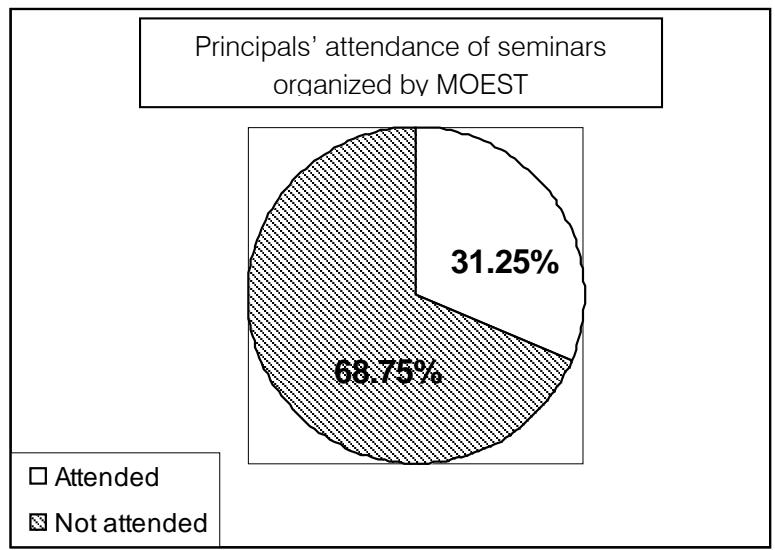
According to Baroki (2019) and Murkor (2020) one of the principles of guidance and counselling is that, it should be carried out by professionally trained personnel. These findings concur with the view expressed by Wahome (2017) and Tumuti (2019) that principals and teacher-counsellors have no training for the job except probably for the course they took during their undergraduate or diploma training. The researcher, further attempted to establish whether principals attended seminars or workshops organized by the Guidance and Counselling Unit of the Ministry of Education. Figure 1 below presents the results obtained:
Source: Self Figure 1: Principals' attendance of seminars organized by guidance and counselling unit of MOEST
The most unfortunate finding was that majority of principals, $68.75\%$ had never attended any seminar organized by the Guidance and Counselling Unit of the Ministry of Education. It is unfortunate because, this unit in the ministry is responsible for organizing seminars, workshops and in-service courses for principals and counsellors to update them on the development in counselling in order to cope with changing times, yet little is seen or known of them. Majority of the respondents $(68.8\%)$ indicated that there was need for principals to be trained in guidance and counselling skills. They stressed that their training in these skills was absolutely necessary and long overdue. The few who had trained, indicated that they were trained by non- governmental organizations, for example, Uncle Tom-Choose Freedom Institution, ADRA-Kenya-UEAB, Amani Centre, Oasis Counselling Centre and Family Planning Association in Kenya.
On their administrative experiences, data collected indicated that ten (10) principals who represented $13\%$ of the total number of respondents had administrative experience of between two (2) to five (5 years) while seven (7) principals $(09\%)$ had administrative experience of between six (6) to ten (10) years. Twenty four (24) principals $(30\%)$ of the total population had administrative experience of between eleven (11) to fifteen (15) years as illustrated in Table 7 below:
Table 8: Principals' administrative experience N=80 Principals Source: Self
<table><tr><td>Experience in years</td><td>Males F</td><td>Females F</td><td>%</td></tr><tr><td>2-5</td><td>10</td><td>-</td><td>12.5</td></tr><tr><td>6-10</td><td>15</td><td>3</td><td>22.5</td></tr><tr><td>11-15</td><td>20</td><td>2</td><td>27.5</td></tr><tr><td>16-20</td><td>26</td><td>-</td><td>32.5</td></tr><tr><td>21-25</td><td>2</td><td>-</td><td>2.5</td></tr><tr><td>26-30</td><td>2</td><td>-</td><td>2.5</td></tr><tr><td>Total</td><td>75</td><td>5</td><td>100.0</td></tr></table>
Table 8 above therefore indicates that fifty (50) principals who represent $63\%$ of the total population had administrative experience of between eleven (11) years to 30 years. It is further worth noting that fifteen (15) principals who constitute $23\%$ had administrative experience of between six (6) to ten (10) years. Principals who headed secondary schools of Nyamira County at the time the study was being carried out had a rich administrative experience which could be used to ensure a successful provision of guidance and counselling services. It was established that those who had served for long as principles had a positive attitudes towards guidance and counselling in their schools.
## XI. RESULTS OF TESTING THE
### HYPOTHESES
To determine whether there was a significant difference between principals' attitudes towards provision of guidance and counselling and their personal characteristics of gender, age, administrative and teaching experiences, a two tailed t-test and one-way, analysis of variance was used. ANOVA was used to test the five null hypotheses using the T-test formula given below:
$$
T = X_1 - X_2 \sqrt{(n_1 - 1)^2 s_1^2 + (n_2 - 1)^2 S_2^2 / n_1 + n_2 - 2}
$$
X1 = Mean of sample 1
X2 = Mean of sample 2
N1 = Sample 1
N2 = Sample 2
N1 + n2 - 2 + degree of freedom
Analysis of variance is a statistical procedure used to examine whether the observed differences for variance between more than two samples can be attributed to chance or whether they indicate actual differences among the means of the populations sampled, that is, is the difference statistically significant? (Freud 2006:357). Analysis is also known as F-test (Schuttle, 1999:146).
The hypotheses test was made at 0.005 level of significance and if the computed F-ratio was smaller than the critical value, the null hypothesis was accepted and rejected only if F-ratio was greater than the critical value. Alternatively, when P-value was less than the specified alpha of 0.05, the null hypothesis was rejected and accepted if P-Value was 0.05 or larger, (Sanders, 2007 P.397). Both approaches were used in rejecting or accepting the hypotheses. In testing null hypotheses Ho1:, Ho1:b, Ho1:c, Ho1:d, Ho2, Ho3, and Ho4 a T-test of significance of the difference between two sample means according to Best K, (1989:271), was used. A computer program, SPSS/PC + (Statistical Package for
Social Sciences) was used in analyzing the data. For open-ended questions, the researcher looked at the responses given to each question in the three questionnaires and in the interview schedule and grouped them according to the number of times a given response was given by all the respondents. The researcher then analyzed them using frequencies and percentages.
The one way analysis of variance (ANOVA) was used to test significant differences in principals' attitude towards guidance and counselling in relation to their age, teaching and administrative experience. Analysis of variance was also used to test for significant difference between principals' attitude in schools of different sexes. The 0.05 level of significance was used to accept or reject each of the hypotheses. A t-test of two independent samples was used to test significant difference between principals' attitude towards guidance and counselling and principals' gender; and their attitudes towards the programme. Results for the tested hypothesis catered for objective two which sought to establish whether principals' personal qualities influenced their attitude towards provision of guidance and counselling services and on maintenance of discipline in schools.
### a) Hypothesis 1b
HO: There is no significant difference between principals' age and their attitude towards guidance and counselling and maintenance of discipline in their schools.
H1: The age of the principals' has a significant effect on their attitude towards guidance and counselling and maintenance of discipline in their schools. The results of analysing this hypothesis are presented on table 9 below.
Table 9: Analysis of variance for principals' attitude towards guidance and counselling by their age N=80 Principals
<table><tr><td>Source of variables</td><td>DF</td><td>Sum of squares</td><td>Mean of squares</td><td>F-ratio</td><td>FP 10</td></tr><tr><td>Between groups</td><td>14</td><td>.1258</td><td>0.0315</td><td>.5364</td><td>.7097</td></tr><tr><td>Within groups</td><td>66</td><td>2.6977</td><td>0.0586</td><td></td><td></td></tr><tr><td>Total</td><td>80</td><td>2.8235</td><td></td><td></td><td></td></tr></table>
The critical value obtained in the table was 2.59. The critical value of 2.59 exceeded the F-ration of.536. Therefore, the null hypothesis was accepted. This indicated that there was no significant difference between principals' attitude towards guidance and counselling and their age. Principals in all age categories of 35-40, 41-45, 46-50, and over 50 depicted similar attitude towards guidance and counselling. The effect of age was not statistically significant. Therefore, the alternative hypothesis was rejected.
Table 10: Mean score and standard deviation of principals' attitude towards guidance and counselling by age. N=80 Principals
<table><tr><td>Age category</td><td>N</td><td>Mean</td><td>SD</td></tr><tr><td>35-40</td><td>15</td><td>3.80</td><td>.447</td></tr><tr><td>41-45</td><td>44</td><td>3.95</td><td>.242</td></tr><tr><td>46-50</td><td>10</td><td>3.94</td><td>.208</td></tr><tr><td>Over 50</td><td>11</td><td>4.00</td><td>.000</td></tr><tr><td>Total</td><td>80</td><td>3.94</td><td>.23</td></tr></table>
As table 25 above indicates, the mean score for the respondents increases as their age increases. For example, principals of age category 35-40 years have a mean score of 3.80 which is the lowest, while principals of over 50 years of age have a mean score of 4.000 which is the highest. However, principals of various age groups indicated a positive attitude towards guidance and counselling in that their mean score showed that they were in agreement with the attitude items set.
### b) Hypothesis 1c
HO: There is no significant difference between principals' attitude towards guidance and counselling and their teaching experience.
H1: Principals' teaching experience does influence principals' attitude towards guidance and counselling and maintenance of discipline. Table 26 shows analysis of variance for principals' attitude towards guidance and counselling and maintenance of discipline.
Table 11: Analysis of variance for principals' attitude towards guidance and counselling and their teaching experience N=80 Principals
<table><tr><td>Source of variation</td><td>DF</td><td>Sum of squares</td><td>Mean of squares</td><td>F-ratio</td><td>F-Prob'</td></tr><tr><td>Between groups</td><td>15</td><td>.2872</td><td>.0574</td><td>1.018</td><td>.4178</td></tr><tr><td>Within groups</td><td>65</td><td>2.5364</td><td>.0564</td><td></td><td></td></tr><tr><td>Total</td><td>80</td><td>2.8235</td><td></td><td></td><td></td></tr></table>
In table 11 above, the computed F-ratio of 1.018 was smaller than the critical value of 3.24; the null hypothesis was thus accepted. This indicated that there was no significant difference in principals' attitude towards guidance and counselling influenced by their teaching experience. Any difference is due to chance and therefore not significant. The null hypothesis tested stated that there was no significant difference between principals' attitudes towards guidance and counselling and their teaching experience. The alternative hypothesis which stated that principals' teaching experience influenced their attitude towards guidance and counselling was therefore rejected. In table 12, the mean score and standard deviation of principals' attitudes towards guidance and counselling is presented:
Table 12: The mean score and standard deviation of principal's attitude towards guidance and counselling by their teaching experience N=80 Principals
<table><tr><td>Teaching experience</td><td>N</td><td>Mean</td><td>SD</td></tr><tr><td>1-5</td><td>2</td><td>4.000</td><td>.000</td></tr><tr><td>6-10</td><td>20</td><td>3.81</td><td>.404</td></tr><tr><td>11-15</td><td>15</td><td>4.00</td><td>.000</td></tr><tr><td>16-20</td><td>30</td><td>4.00</td><td>.000</td></tr><tr><td>21-25</td><td>6</td><td>3.90</td><td>.316</td></tr><tr><td>Over 25</td><td>7</td><td>4.00</td><td>.000</td></tr><tr><td>Total</td><td>80</td><td>3.94</td><td>.237</td></tr></table>
By looking at the means in table 12 given above, principals of different teaching experiences showed a positive attitude towards guidance and counselling in that their mean score indicated agreement to the attitude items. Though principals with teaching experience of 6 - 10 years and 21 - 25 years showed a slightly lower mean, the difference was too low to be of any significant value. Given in the table below is analysis of variance for principals' attitude towards guidance and counselling and their administrative experiences.
Table 13: Analysis of variance for principals' attitude towards guidance and counselling and administrative experience N=80 Principals
<table><tr><td>Source of variance</td><td>DF</td><td>Sum of squares</td><td>Mean squares</td><td>F-r</td><td>F-prob'</td></tr><tr><td>Between groups</td><td>4</td><td>.3463</td><td>.0866</td><td>1.3457</td><td>.2709</td></tr><tr><td>Within groups</td><td>48</td><td>2.4444</td><td>.0643</td><td></td><td></td></tr><tr><td>Total</td><td>52</td><td>2.7907</td><td></td><td></td><td></td></tr></table>
The computed F-ratio of 1.345 was smaller than the critical value of 2.61. This led to the acceptance of the null hypothesis that stated that: there was no significant difference between principals' attitude towards guidance and counselling and their administrative experience. Thus, the differences were due to chance or sampling error and not due to different administrative experiences. Table 14 given below presents the means and standard deviation of principals' attitude towards guidance and counselling and their administrative experience.
Table 14: The mean score and standard deviation of principals' attitude towards guidance and counselling and their administrative experience N=80 Principals
<table><tr><td>Administrative experience</td><td>N</td><td>Mean</td><td>SD</td></tr><tr><td>Less than 2</td><td>4</td><td>3.75</td><td>.500</td></tr><tr><td>2-5</td><td>10</td><td>3.94</td><td>.235</td></tr><tr><td>6-10</td><td>06</td><td>4.00</td><td>.000</td></tr><tr><td>11-15</td><td>23</td><td>4.00</td><td>.000</td></tr><tr><td>16-20</td><td>24</td><td>3.75</td><td>.500</td></tr><tr><td>Over 21</td><td>13</td><td>4.00</td><td>.000</td></tr><tr><td>Total</td><td>80</td><td>3.91</td><td>.257</td></tr></table>
According to table 14 given above, the average mean was 3.91. Principals with administrative experience of less than 1 year and 16-20 years had a mean score of 3.75 which was slightly below the overall mean of 3.91. The table also indicates that principals with a few years administrative experience, that is 5 years and below, were rated lower in their attitude towards guidance and counselling. Principals who have stabilized in their administration were rated higher in their attitude towards guidance and counselling with the exception of 16-20 years category. This could probably be explained by the fact that none of the principals in this category had been trained in guidance and counselling skills.
## XII. CONCLUSION
Having analyzed and interpreted the findings obtained from the data collected, it was concluded that principals' attitude towards provision of guidance and counselling services was not influenced by their personal qualities such as age, gender, teaching, training and administrative experiences. Besides that, it was also concluded that training of principals in guidance and counselling skills was not only essential but also urgent since majority of them $(96.3\%)$ were not trained. It was established that training had a significant effect on the principals' and students' attitudes towards guidance and counselling.
The study's findings also led to the conclusion that guidance and counselling services were not given the seriousness they deserved. In virtually all the schools, resource materials and facilities were inadequate if not lacking. For example, students' records were availed in only $9.5\%$ of the schools, and only $26\%$ of the schools had a few reference materials while stationery was only availed in $16\%$ of the schools. Moreover, time for guidance and counselling was not specific, since it depended on the availability of the principals and teacher-counsellors. The findings of the study necessitated the conclusion that principals who participated in the study regarded guidance and counselling as a contemporary way of dealing with indiscipline in schools hence it would therefore be a suitable alternative to the use of the cane.
## XIII. RECOMMENDATIONS
- Considering the study's findings and conclusions, the following recommendations were made:
1. Principals and teachers should be trained and oriented in guidance and counselling objectives and techniques through regular in-service courses, seminars and workshops.
2. It was further recommended that the courses should be of reasonable duration so that they can learn comprehensively matters pertaining guidance and counselling. These recommendations were made in view of the fact that $96.3\%$ of the respondents were of the opinion that training in guidance and counselling skills contributed to positive attitude towards the programme. As Triandis (1971) stated, attitudes are learnt. Therefore, training of principals and teachers was considered crucial in enhancing their attitude and development of the programme.
3. It is also recommended that the guidance and counselling unit of the Ministry of Education should play a more prominent role in training, advising, coordinating and evaluating guidance and counselling programme in schools. This recommendation was based on the fact that very few principals and teachers had attended seminars organized by guidance and counselling unit.
Generating HTML Viewer...
References
37 Cites in Article
P Adamms (2006). Understanding Research methodology.
J Akira (2021). Students are sent home after strike.
Kamauhellen Wambui,Pro. Ondigi,Dr. Babusa. (2017). MATUMIZI YA VISAIDIZI VYA UFUNDISHAJI MSAMIATI WA KISWAHILI KATIKA SHULE ZA MSINGI ZA UMMA, KAUNTI YA KISUMU MASHARIKI, KENYA..
Baroki (2019). The nature and cause of job motivation.
W Best (1989). Research in Education.
B Daddeya,C Broon (2006). The Forty-nine percent Majority Reading.
Farmer (2005). Guidance in action; Ideas and innovation for school counsellor.
Emmanuel Rwagasana,Githae Wanyona,Titus Kivaa (2019). Evaluation of Risk Management Practices in Construction Projects in Rwanda.
Flores (2020). Counselling and Guidance and Exploration.
Freud (2006). Help seeking, self-esteem and achievement motivation. Attribution analysis.
Dowson Howden (1973). A survey of students' Attitude towards counselling at predominantly black university.
Jwan (2021). Implementation of Guidance and Counselling programmes.
F Kerlinger (1983). Foundations of behavioural research 2 nd Indian reprint.
B Lytton (2018). Management theories in Practice.
Makinde (2016). Help seeking, self-esteem and achievement motivation. Attribution analysis.
Malovah (2018). Basic counselling skills in a counsellor.
D Mbiti (1974). Foundations of school administration.
Mitchevel (2016). Hurd, Archer W. Costs and Other Problems in Schools of Nursing. Richmond, Virginia: Bureau of Educational Research and Service, Medical College of Virginia, 1951.
Migora (2019). Clients' perceptions of counsellor experience, attractiveness and trustworthiness: initial impact of counsellor status and weight.
O Mugiro (2014). Hodder-Williams, Ralph Wilfred, (31 Jan. 1890–11 July 1961), Lieutenant-Colonel (Home Guard); publisher; President, Matthew Hodder Ltd; Chairman, The Lancet, Ltd, University of London Press Ltd; Director: English Universities Press Ltd; Brockhampton Press Ltd.
Murkor (2020). Guidance and Counselling Programme in Need.
Juma Edward Masinde,Lister Onsongo,Catherine Mwenda (2005). Factors Associated with Alcohol and Substance Abuse Among Youths in Kenya.
Kamauhellen Wambui,Pro. Ondigi,Dr. Babusa. (2004). MATUMIZI YA VISAIDIZI VYA UFUNDISHAJI MSAMIATI WA KISWAHILI KATIKA SHULE ZA MSINGI ZA UMMA, KAUNTI YA KISUMU MASHARIKI, KENYA..
Wachuka Njoroge (2020). Patients’ Perception of Quality Laboratory Service in Kenyan Laboratories.
W Norwhich (2020). Principles of Discipline in schools.
Martin Kiome,Judith Kimiywe,Eunice Njogu (2018). Child Spacing, Breastfeeding and Introduction of Complementary Feeding of Children 6-59 Months in Kakuzi, Kiambu County, Kenya.
Ngomba Oketchikor (2019). The role of teachers and administration in school counselling.
K Opala (2021). Drug Trafficking in Schools.
P Roeber (1955). Educational organizations in Problems.
Rono (1989). The Role of the teachercounsellor in school counselling.
Sanders (2007). Fundamentals of Guidance.
Schuttle (1999). Counselling: An Interpersonal Influence Process.
Tumuti (2019). Discipline Pupil Management.
R Onzago,S Kiama,J Mbaria,D Gakuya,C Githiji,Z Rukenya (2015). Analgesic activity of aqueous extract of Vernonia hymenolepis (A. Rich) a traditional medicine plant used in Kenya for toothache.
H Triandas (2006). Attitudes and Attitude Change.
Emily Wahome,Willy Kiboi (2005). Nutritional Knowledge and Nutritional Status of Diabetes Type 2 Patients in Kikuyu Mission Hospital, Nairobi, Kenya.
K Wanjohi (2016). A study to investigate perception of the role of the counsellor in secondary schools in Nyeri.
No ethics committee approval was required for this article type.
Data Availability
Not applicable for this article.
How to Cite This Article
Dr.Ouru John Nyaegah. 2026. \u201cPrincipals’ Attitudes on Guidance and Counselling Services and Maintenance of Discipline in Secondary Schools of Nyamira County, Kenya.\u201d. Global Journal of Management and Business Research - A: Administration & Management GJMBR-A Volume 22 (GJMBR Volume 22 Issue A4).
Explore published articles in an immersive Augmented Reality environment. Our platform converts research papers into interactive 3D books, allowing readers to view and interact with content using AR and VR compatible devices.
Your published article is automatically converted into a realistic 3D book. Flip through pages and read research papers in a more engaging and interactive format.
Our website is actively being updated, and changes may occur frequently. Please clear your browser cache if needed. For feedback or error reporting, please email [email protected]
Thank you for connecting with us. We will respond to you shortly.