Con este objetivo se estudiaron 29 poblaciones de esta especie distribuidas en cuatro transectos Norte - Sur. Especímenes de D. pseudoobscura capturados mediante atracción con frutas en fermentación, se transportaron al laboratorio donde con cada hembra se constituyó una isolínea y de cada una se extrajo una larva de la que se obtuvieron las glándulas salivales que una vez teñidas pusieron de manifiesto los cromosomas politénicos en los que se identificaron en forma individual la(s) inversiones portadas en el tercer par cromosómico, de esta forma un total de 3439 cromosomas fueron analizados.
Se identificaron 17 inversiones diferentes y en cada población el número de ellas varió entre tres y once. Para cada localidad se calcularon las frecuencias relativas de cada inversión y con ellas se determinó para cada transecto la presencia o ausencia de gradientes en los diferentes transectos, la presencia de gradientes sólo se pudo observar entre dos o tres poblaciones aledañas pero la clara manifestación de un gradiente a lo largo del correspondiente transecto en ningún caso fue evidente. Nuestros resultados son similares con estudios previos en poblaciones de EEUU. Un mecanismo que explique las substituciones de inversiones de norte a sur permanece aún sin explicación.
I. INTroduCCioN
a presencia en forma natural de inversiones cromosómicas es un fenómeno detectado indirectamente por Sturtevant en 1917 y ampliamente distribuido en el género Drosophila. Más de la mitad de las especies del género hasta ahora analizadas para ello son polimórficas en uno o más de sus brazos cromosómicos. Esos polimorfismos muestran una interesante diferenciación geográfica, siendo la primera especie que se estudió a este respecto y probablemente la más estudiada Drosophila pseudoobscura, para una revisión detallada ver Dobshanzky y Powell (1975) y Powell (1992). Esta especie es polimórfica para el tercer par de cromosomas y presenta una distribución geográfica que abarca la Columbia Británica en Canadá, todo el Oeste de Estados Unidos, México, Guatemala y una pequeña colonia en las cercanías de Bogotá en Colombia (Dobshansky et al. 1963), habita principalmente bosques de coníferas, bosques mixtos de árboles de climas templados y alturas comprendidas desde el nivel del mar hasta 3000 msnm.
El polimorfismo cromosómico de esta especie, según se observa en el tercer par de cromosomas politénicos consta de 40 inversiones paracéntricas hasta el momento descritas. El grado de polimorfismo en poblaciones naturales a lo largo del territorio mexicano ha sido reportado por varios autores entre los que tenemos: Dobshanzky (1939, 1948), Dobshanzky y Epling (1944), Dobshanzky et al. (1975), Guzmán et al. (2005), Levineet al. (1995), Olvera et al. (1979, 2005) y Salceda et al. (2007a, b).
Otro aspecto concerniente a la distribución geográfica de las inversiones se refiere a la presencia o ausencia de clines o gradientes geográficos, cambios direccionales graduales en la frecuencia relativa de las inversiones en localidades adyacentes. La presencia de estos gradientes se ha puesto de manifiesto en varias especies de Drosophila, por ejemplo los estudios en poblaciones europeas de D. suboscura realizados por Krimbas y Loukas (1986), Krimbas (1992, 1993) y los de Dobshanzky y Epling (1944) en poblaciones estadounidenses y mexicanas de D. pseudoobscura. Otros estudios de esta especie en poblaciones mexicanas con referencia a la presencia de gradientes geográficos son los de Guzmán et al. (1993, 2005), Olvera et al. (2005) y Salceda y Espinoza-Velázquez (2006 a, b), los tres primeros se refieren a gradientes Este-Oeste en tanto que los dos últimos a variación microgeográfica.
Ahora bien, considerando que en las poblaciones norteñas, según los autores antes mencionados, prevalecen las inversiones denominadas ST, AR y CH y en las del Sur las más frecuentes son TL, CU y SC, nosotros asumimos que el mecanismo que permite esta substitución es la presencia de gradientes Norte-Sur, con esta idea en mente decidimos analizar esa posibilidad utilizando datos referentes a las frecuencias relativas de varias inversiones presentes diferentes poblaciones naturales de esta especie dentro del territorio mexicano y adecuándolas a diferentes transectos Norte-Sur.
II. MaTEriAleS Y MetodoS
Durante los años 2000-2004 se obtuvieron muestras de D. pseudoobscura en 29 localidades distribuidas a lo largo de la mayor parte del territorio mexicano ocupado por esta especie. Los sitios se agruparon en cuatro regiones que se corresponden con cuatro transectos Norte-Sur a saber: transecto "A" incluye longitudes transecto "B" de 97o -98° 59' W; transecto "C" - 101°- 59' W y transecto"D" W, en las tablas 1-4 se muestran estas agrupaciones y se incluyen los nombres de los sitios, frecuencias relativas de cada una de las inversiones más frecuentes en la localidad y el tamaño de la muestra.
Las agrupaciones se de esta manera para facilitar el análisis de los datos y de forma tal que se tuvieran pocos grupos representativos (transectos) y que cada uno de ellos contuviera el mayor número de localidades posible y que compartieran condiciones (meridianos) geográficas semejantes esperando que esta forma de agrupación fuese la mejor opción para analizar y comparar la información recabada.
Para la captura de las moscas se realizaron viajes de colecta con duración de una semana por localidad y a las distancias desde el laboratorio al sitio de colecta y además para asegurar un tamaño de muestra apropiado, sin embargo, las muestras fueron de tamaño variable. Las moscas se capturaron usando como trampas 25-30 botes de plástico que contenían frutas en fermentación, principalmente plátanos, y distribuidas en el sitio de colecta de forma tal que se cubriese una mayor superficie. Cuando las moscas empezaban a visitar las trampas se realizaron rondas de colecta cada 15-20 minutos, las colectas se efectuaron por las mañanas desde la salida del Sol hasta las 9.00 h y por las tardes desde las 17.00 h hasta que la oscuridad impedía la colecta; las moscas fueron atrapadas con la ayuda de una red entomológica y de toda la captura se separaban, con la ayuda de un microscopio estereoscópico, aquellas pertenecientes a la especie D. pseudoobscura se colocaban en frascos homeopáticos con alimento fresco en grupos de 20-30 individuos por frasco, hembras y machos por separado para prevenir una posible doble inseminación y así se guardaban para su traslado al laboratorio en Salazar, el resto de las moscas capturadas se liberaban.
Una vez en el laboratorio las hembras fueron colocadas individualmente en un frasco de cultivo con alimento fresco donde se incubaron por una semana, en aquellos casos en que la muestra fue pequeña se utilizaron los machos para ello cada macho fue cruzado individualmente con 2-3 hembras una cepa de laboratorio de constitución cromosómica conocida ya sea EP/EP (Estes Park) o TL/TL (Tree Line).
Una semana después, cuando las larvas comenzaban a reptar en la superficie del medio, los adultos se transfirieron a un nuevo frasco de cultivo con alimento fresco para servir como reserva y al cultivo original se le añadieron unas gotas de una solución concentrada de levadura viva para asegurar una buena nutrición de las larvas en crecimiento y así obtener larvas saludables con glándulas salivales grandes y consecuentemente cromosomas politénicos grandes que facilitarían su observación e interpretación. Al aparecer larvas del tercer estadio, de cada cultivo se extrajo una larva la cual bajo el microscopio se disecó, se le extrajeron las glándulas salivales mismas que se tiñeron por 3-5 minutos con una solución de lactoaceto-orceina y se procedió a realizar el aplastamiento que permite la expansión de los cromosomas y listos para su observación y determinación del cariotipo correspondiente de cada larva así tratada; las determinaciones cariotípicas se hicieron con la ayuda de un atlas fotográfico así como con las figuras publicadas por Dobshanzky y Epling (1944), Kastritsis y Crumpacker (1966, 1967) y Olvera et al. (1979).
Después de terminadas las determinaciones de cada colecta se calcularon las frecuencias relativas de cada inversión presente en cada localidad y con ellas se elaboraron las tablas correspondientes. El medio empleado para el mantenimiento de los cultivos fue el de uso común en el laboratorio consistente en una mezcla de harina de maíz-agar-azúcar-levadura, los cultivos se mantuvieron a temperatura constante de y a una humedad relativa de .
III. RESULTADOS
Considerando las 29 localidades muestreadas, un total de 3439 terceros cromosomas fueron analizados, estos son los datos a los que haremos referencia.
En todo el estudio se encontraron 16 diferentes inversiones incluyendo una nueva aún no descrita, estas inversiones fueron previamente descritas por Dobshanzky y Epling (1944) y Olvera et al. (1979) a fin de identificarlas sus nombres son Tree Line (TL), Cuernavaca (CU), Santa Cruz (SC), Estes Park (EP), Olympic (OL), Hidalgo (HI), PikesPeak (PP), Chiricahua (CH), Standard (ST), Arrow Head (AR), Tarasco (TA),
Ozumba (OZ), Iztaccíhuatl (IZ) y Páztcuaro (PA) aquí listados en orden descendiente de su abundancia global en este estudio y presentados en las Tablas 1-4 y Figuras 1-4. Los datos aquí analizados muestran evidencias para diferencias de las frecuencias relativas de las inversiones cromosómicas entre algunas de las localidades muestreadas. También es importante mencionar que no todas las inversiones están presentes en todas las poblaciones puesto que el número de ellas en cada sitio varió de tres a once por localidad. Tomando esto en cuenta en las tablas sólo se indican las frecuencias relativas de las seis inversiones más representativas e incluyendo las restantes bajo la denominación de "OTRAS".
IV. DIsCusion
Primeramente debemos señalar que en la mayoría de las poblaciones de D. pseudoobscura hasta ahora estudiadas con respecto al polimorfismo cromosómico exhiben un patrón de distribución de las inversiones en el que un par de inversiones son las responsables de hasta un de la muestra y que constituyen el par dominante, en el que a lo largo de un ciclo anual alternan su abundancia, y el restante 10.5 representado por tres, cuatro o más inversiones presentes en esa población; las poblaciones a las que ahora nos referimos muestran en general ese mismo tipo de patrón con algunas peculiaridades inherentes a cada una de ellas.
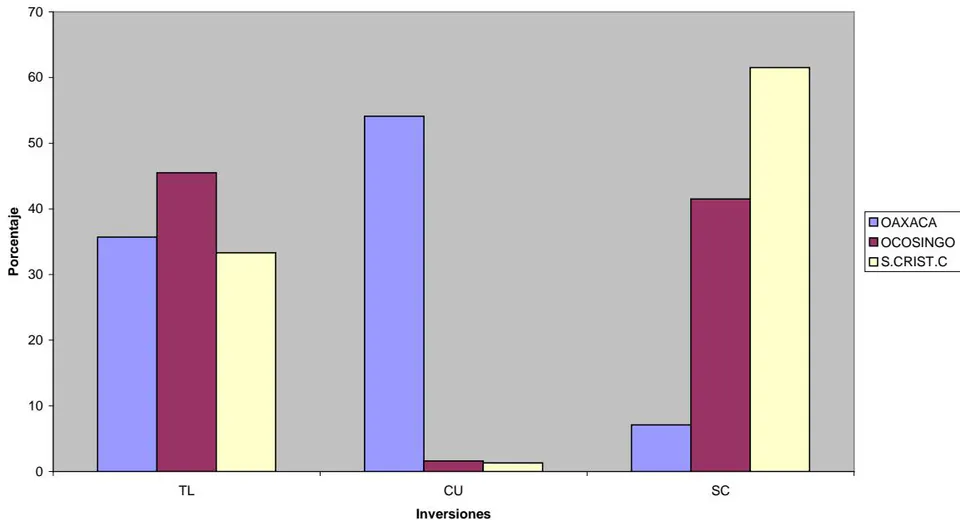
Mostraremos ahora cómo se comportan en cada grupo las frecuencias relativas de la inversiones; en el transecto "A" encontramos 4-5 inversiones diferentes y de ellas la inversión TL fue la más abundante y constituyendo el par dominante con la inversión CU esto en la localidad Oaxaca que en este transecto es la norteña, pero conforme nos dirigimos al Sur en Ocosingo esta inversión CU es reemplazada por la SC la que siguiendo al Sur alcanza su máxima frecuencia en San Cristóbal de las Casas donde el par dominante es TL-SC, los arreglos cromosómicos EP y OA complementan la constitución cromosómica de estas tres localidades, la información se presenta en la Tabla 1 y Figura 1.
Tabla 1 Frecuencias relativas de inversiones de Drosophila pseudoobscura encontradas en el transecto "A. (TreeLine TL; Cuernavaca CU; Santa Cruz SC; Estes Park EP; Olympic OL; Oaxaca OA; tamaño de muestra
| TL | CU | SC | EP | OA | n | |
| Oaxaca | 35.7 | 54.1 | 7.1 | 2.0 | 1.0 | 98 |
| Ocosingo | 45.5 | 1.6 | 41.5 | 9.8 | 1.6 | 123 |
| S.C.Casas | 33.3 | 1.3 | 61.5 | 3.9 | --- | 78 |
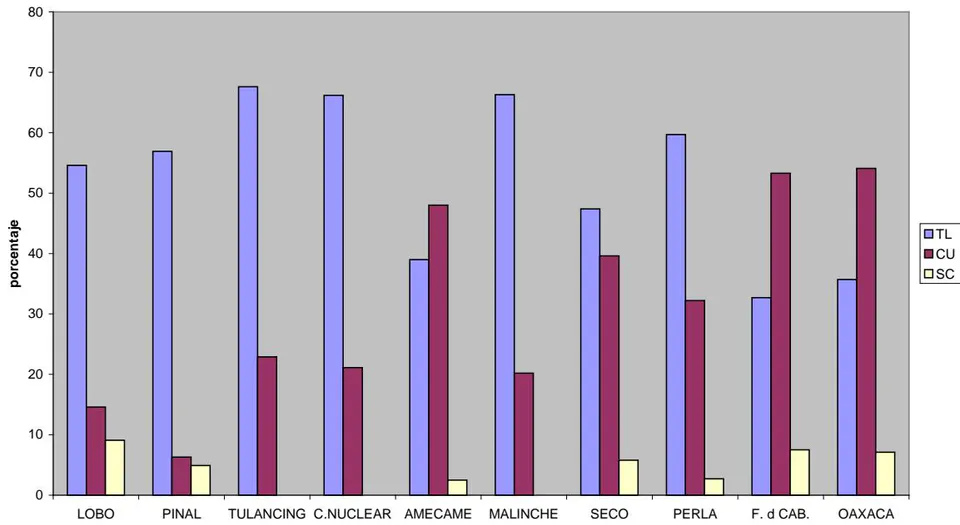
Transecto "B", en esta zona observamos un promedio de seis inversiones diferentes, de ellas sólo TL y CU, que se complementan mutuamente como par dominante, pero mostraron algunos cambios en frecuencia al desplazarnos de Norte a Sur, estos cambios no fueron consistentes en una dirección como para constituir un gradiente, probablemente debido a diferentes fechas de colecta entre sitio y sitio; el resto de las inversiones no sufrieron cambios considerables manteniendo sus frecuencias relativas a niveles bajos. Su representación se presenta en la Tabla 2 y Figura 2.
Tabla 2: Frecuencias Relativas de Inversiones de Drosophila Pseudoobscura Encontradas en El Transecto "B". (Símboloscomoentabla 1)
| TL | CU | SC | EP | OL | OA | others | n | |
| Lobo | 54.6 | 14.6 | 9.1 | 1.8 | 12.7 | 1.8 | 5.4 | 55 |
| Pinal | 56.9 | 6.3 | 4.9 | --- | 25.0 | --- | 7.0 | 144 |
| Tulancingo | 67.6 | 22.9 | --- | 6.3 | 2.5 | 0.4 | 0.4 | 240 |
| C. Nuclear | 66.2 | 21.1 | --- | 12.7 | --- | --- | --- | 71 |
| Amecameca | 39.0 | 48.0 | 2.5 | 8.0 | 1.0 | 1.5 | --- | 200 |
| Malinche | 66.3 | 20.2 | --- | 9.0 | 1.1 | 2.3 | 1.1 | 89 |
| Seco | 47.4 | 39.6 | 5.8 | 5.2 | 1.4 | 0.4 | 0.2 | 515 |
| Perla | 59.7 | 32.2 | 2.7 | 4.7 | 0.7 | --- | --- | 149 |
| F. de Caballo | 32.7 | 53.3 | 7.5 | 0.9 | 1.9 | 2.8 | 0.9 | 107 |
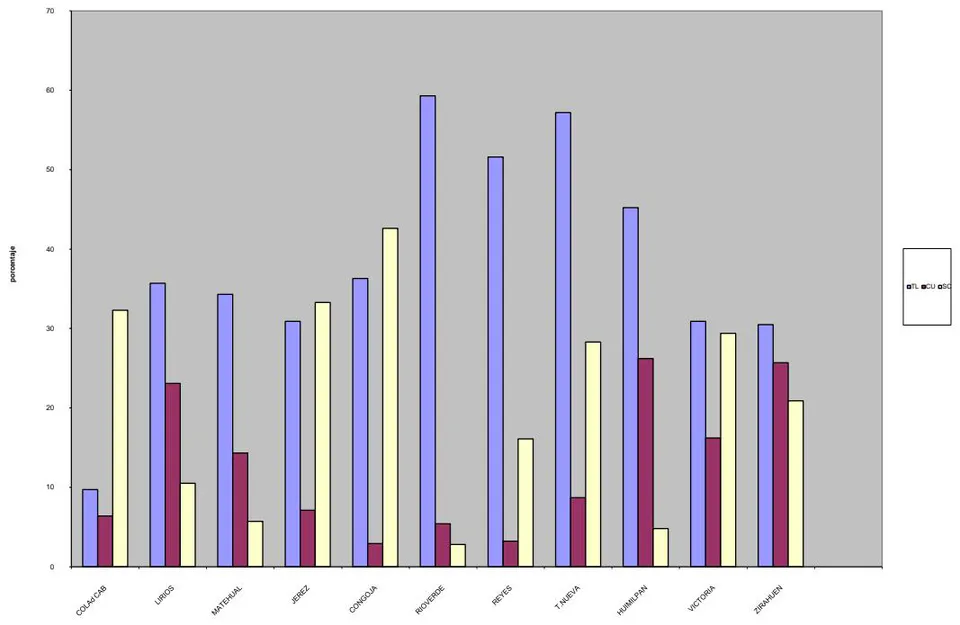
En el transecto "C" encontramos según la población entre seis y once inversiones diferentes, este tramo presentó cambios notorios conforme nos desplazamos de Norte a Sur, así en la población más norteña las inversiones SC, EP y PP demostraron ser las más abundantes pero al dirigirse al Sur esa condición cambia y fueron substituidos por los arreglos cromosómicos TL, CU y OL, más al Sur ocurre una nueva substitución y las inversiones dominantes son TL, CU y SC luego la secuencia SC es substituida por SC por lo que finalmente en las poblaciones sureñas predominan las inversiones TL, CU y SC; en todos los casos existieron los contribuyentes menores representados por tres o cuatro inversiones. (Tabla 3 y Figura 3).
Tabla 3 Frecuencias Relativas de Inversiones de Drosophila Pseudoobscura Encontradas en el Transecto "C". (Símboloscomoen tabla 1)
| TL | CU | SC | EP | OL | OA | PP | others | n | |
| C. de Caballo | 9.7 | 6.4 | 32.3 | 22.6 | --- | 9.7 | 19.4 | --- | 31 |
| Lirios | 35.7 | 23.1 | 10.5 | 5.6 | 23.8 | 1.4 | --- | --- | 143 |
| Matehuala | 34.3 | 14.3 | 5.7 | 14.3 | 20.0 | --- | 8.6 | 2.9 | 35 |
| Jerez | 30.9 | 7.1 | 33.3 | 11.9 | 2.4 | 4.8 | --- | 9.6 | 42 |
| Congoja | 36.3 | 2.9 | 42.6 | 2.1 | 4.6 | 2.6 | --- | 9.1 | 240 |
| Río Verde | 59.3 | 5.4 | 2.8 | 7.6 | 22.4 | 1.0 | --- | 1.6 | 317 |
| Reyes | 51.6 | 3.2 | 16.1 | 6.5 | 22.6 | --- | --- | --- | 31 |
| T. Nueva | 57.2 | 8.7 | 28.3 | --- | 10.9 | --- | --- | --- | 46 |
| Huimilpan | 45.2 | 26.2 | 4.8 | 4.8 | 14.3 | 2.4 | --- | 2.4 | 42 |
| Victoria | 30.9 | 16.2 | 29.4 | 1.5 | 2.9 | 7.4 | --- | 11.8 | 68 |
| Zirahuén | 30.5 | 25.7 | 20.9 | 10.5 | 2.9 | 9.5 | --- | --- | 105 |
Frecuencias relativas de las inversiones dominantes en el transecto "C"
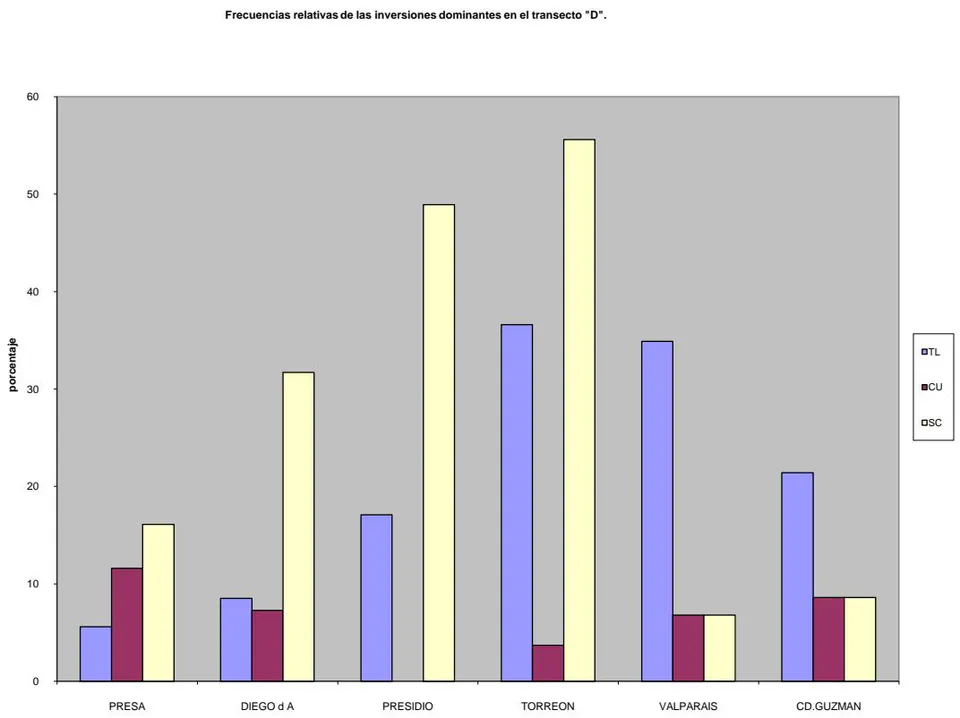
En el transecto "D" encontramos como componentes principales en las poblaciones más norteñas las inversiones TL, SC y OL las cuales en la porción media fueron substituidos por los arreglos cromosómicos SC y CH y al finalizar el transecto en las poblaciones sureñas ocurre un incremento de la inversión TL y las cinco restantes presentan valores muy similares entre si pero alejados de TL, según se observa en la Tabla 4 y figura 4.
Tabla 4: Frecuencias Relativas de Inversiones de Drosophila Pseudoobscura Encontradas en el Transecto "D". (SímboloscomoenTabla 1)
| TL | CU | SC | EP | OL | OA | CH | others | n | |
| Torreón | 36.6 | 11.6 | 16.1 | 9.8 | 16-1 | --- | --- | 9.8 | 112 |
| Presidio | 17.1 | 7.3 | 31.7 | --- | 4.9 | --- | 26.8 | 12.1 | 41 |
| Diego de A. | 8.5 | --- | 48.9 | 6.4 | 2.1 | --- | 19.2 | 14.8 | 47 |
| Presa | 5.6 | 3.7 | 55.6 | --- | --- | --- | 18.5 | 16.8 | 54 |
| Valparaíso | 34.9 | 6.8 | 6.8 | 2.7 | 3.4 | 5.5 | --- | 8.3 | 146 |
| Cd. Guzmán | 21.4 | 8.6 | 8.6 | 5.7 | 1.4 | 2.9 | --- | 1.4 | 70 |
Esta breve descripción de los cambios diferenciales que ocurren en cuanto a las frecuencias relativas de las diferentes inversiones incluidas en cada transecto, fácilmente visibles en las tablas, muestran cuan complicada es la respuesta de cada inversión a las condiciones ambientales de cada localidad, lo que en consecuencia, el poder determinar la presencia de un gradiente Norte-Sur es difícil, en efecto nosotros no lo encontramos en ninguno de los transectos.
Se sabe que los gradientes observados para la frecuencia relativa de las diferentes inversiones de esta y otras especies de Drosophila, como otra característica, pueden ser considerados como un claro ejemplo de selección en respuesta a los cambios diferenciales del medio ambientePowell (1990) y aunque en las poblaciones aquí estudiadas no encontramos una clara evidencia de la presencia de gradientes en la dirección Norte-Sur, al menoscuando consideramos un transecto en su totalidad, puesto que ocasionalmente en algunas secciones de un transecto dado y dirigiéndonos al Sur de una localidad a la siguiente, fue posible observar lo que pudiera mostrar una posible tendencia en cambios direccionales, por ejemplo, el transecto "A" claramente muestra un gradiente en el cual la inversión CU es substituida gradualmente por la inversión SC y en contraste en el transecto "B" nunca notamos evidencia de una tendencia de este tipo y siempre se presentaron sus componentes principales, las inversiones TL y CU con valores similares; en tanto en el transecto "C" si bien no observamos tendencia gradual de cambios en esa dirección si pudimos notar que ciertas inversiones fueron substituidas por otras, por ejemplo, PP y EP fueron substituidas, debido al cambio en sus frecuencias relativas al presentarse incrementos para las inversiones TL, SC o bien OL; por último en el transecto "D" se observó que los componentes dominantes en las poblaciones norteñas, TL, SC y CU conforme nos dirigimos al Sur hubo una substitución de la inversiones TL y CU por la inversión CH esto en las poblaciones medias del transecto para que en las poblaciones sureñas nuevamente fuesen dominantes TL, CU y SC.
Finalmente, debemos mencionar que la presencia de gradientes ha sido obserbada en varias especies de Drosophila y que la dirección en que ocurren depende de la especie estudiada, así, Levitan (1990) encontró gradientes Este-Oeste en poblaciones de D. robusta, de igual forma lo hicieron Dobshanzky y Epling (1944) en poblaciones de D. pseudoobscura en Estados Unidos y lo mismo ocurrió con las poblaciones mexicanas de esta especie estudiadas por Guzmán et al. (1993, 2005) y Olvera et al. (2005). Por su parte Krimbas (1990) reportó un caso interesante en D. subobscura donde encontró tres tipos de gradiente: Norte-Sur, Este-Oeste y centrales-marginales. Por su parte Soulé (1973) quien estudió la presencia de gradientes en 16 especies de Drosophila observó que en 15 de ellas existe gradiente central-marginal. En D. persimilis, especie hermana de D. pseudoobscuray quienes conviven en buena parte de su distribución geográfica, Dobshanzky y Epling /1944) y Powell (1990) demostraron que la primera especie muestra gradientes Norte-Sur pero curiosamente no lo hace en la dirección Este-Oeste.
En las 29 localidades que nos ocupan para la búsqueda de gradientes Norte-Sur no fue posible encontrar una clara evidencia de ello, sin embargo, estas mismas poblaciones en la mayoría de los casos presentaron gradientes Este-Oeste como se demostró en poblaciones de Estados Unidos.
Por lo anterior asumimos que la presencia de gradientes Norte-Sur no es el factor que ha permitido la substitución de inversiones del Norte por las del Sur es decir el cambio de las inversiones ST, AR y CH predominantes en el Norte por las inversiones TL, CU y SC que prevalecen en el Sur. También debemos considerar que un posible factor que intervino en nuestro estudio es la amplitud de los transectos por nosotros considerados es bastante amplia, dos grados de longitud, y que la organización de los transectos fue en cierta forma azarosa según se hicieron las colectas, por lo que si aún se quiere analizar este fenómeno habrá que tener cuidado en que las poblaciones estén exactamente sobre el mismo meridiano y separadas entre ellas por distancias apropiadas.
De todas formas mostramos que las poblaciones mexicanas de ésta especie se comportan de manera similar a las de Estados Unidos con respecto a ésta característica, ausencia de gradientes Norte-Sur, y queda abierta la pregunta de cual(es)es(son) el(los) mecanismo(s) que han permitido la substitución de unas inversiones por otras específicamente ST, AR y CH por TL, CU y SC.
AGraDECimIENTOS
Se agradece el apoyo constante de las autoridades del ININ durante el desarrollo proyecto. También se agradece al CoNACyT su apoyo financiero concedido al autor mediante convenio 31736-N. Se extienden los agradecimientos a la M.C. Yolanda Citlali Guerrero Carbajal por su constante animosidad así como la lectura y comentarios al manuscrito.