## I. INTRODUCTION
In the paper 'A New Approach to Quantum Gravity'[1], we suggest a new theory of noncommutative quantum gravity, give the propagator of graviton, solve the difficulty of the Feynman integral divergence, and give evidence to prove that this theory is classical equivalent to the general theory of relativity. In the paper 'Noncommutative Quantum Gravity and Symmetry of Klein-Gordon Equation'[2], we discuss the multiple-graviton system with self-interaction and find the symmetry of Klein-Gordon equation related to noncommutative quantum gravity.
In section 2, we give a brief review of noncommutative quantum gravity theory suggested in the paper[1] and paper[2].
In section 3, from the theory of noncommutative quantum gravity, we calculate the metric of multiple-graviton system in momentum space, then find the deviation of metric from the inverse square law caused by self-interaction of gravitons. As an example, it can explain dark matter and the Pioneer anomaly.
## II. A BRIEF REVIEW OF QUANTUM GRAVITATIONAL FIELD WITH SELF-INTERACTION
In this section, we briefly review the theory of noncommutative quantum gravity suggested in the paper 'A New Approach to Quantum Gravity'[1] and the theory of the multiple-graviton system with self-interaction suggested in the paper 'Noncommutative Quantum Gravity and Symmetry of Klein-Gordon Equation'[2].
Since the introduction of the uncertainty principle into the general theory of relativity, we get a wave packet $\xi^i (x,r)$ approximate to the Dirac $\delta$ -function. It can be explained as a semiclassical graviton. The free field equation is
$$
\partial^ {\mu} \partial_ {\mu} \xi^ {i} = 0 \tag {2.1}
$$
From the free field equation, we obtain Green's function $\tilde{G}^i (k)$ as follows
$$
\tilde {G} ^ {r} (k) = - \frac {1}{(k ^ {r}) ^ {2}} \cdot \delta \Big (k ^ {r} - \frac {i}{l _ {P}} \Big)
$$
$$
\tilde {G} ^ {\theta} (k) = - \frac {1}{\left(k ^ {\theta}\right) ^ {2}} \tag {2.2}
$$
$$
\tilde{G}^\phi(k) = -\frac{1}{(k^\phi)^2}
$$
$$
\tilde{G}^{t}(k) = -\frac{1}{\omega^{2}} \cdot \delta\Big(\omega - \frac{i}{t_{P}}\Big)
$$
According to the properties of the Dirac $\delta$ -function, we just need to give singularity on the integral paths without calculating specific integrals when calculating the Feynman diagrams. So that the difficulty of divergence of the Feynman integral over large virtual momenta of graviton has been solved. By calculating the energy-momentum tensor of the gravitational field itself, we give strong evidence to prove that the quantum theory established in the paper[1] is classically equivalent to the general theory of relativity.
In the paper[2], we discuss the case of multiple-graviton. We used both two orthogonal coordinate systems $x^{\mu}$ and $X^{\mu}$, then the local inertial system becomes
$$
\xi^ {i} (x, r) \rightarrow \xi^ {\alpha} (x, X) = X + C ^ {\alpha} (x) \exp \left(- \frac{| X |}{| L _ {P} (x) |}\right) \tag{2.3}
$$
If there is no self-interaction of gravitons, the local inertial system at point $x$ is
$$
\left. \lambda (\xi^ {\alpha}) = \xi^ {\alpha} (x, X) \right| _ {X = 0} \tag {2.4}
$$
Due to the ductility of gravitons, gravitons elsewhere in a multi-graviton system will act on a point $x$ together. The effect of the self-interaction of all other graviton on the point $x$ is
$$
\begin{array}{l} \Delta \xi^ {\alpha} = X + \int d ^ {4} l \xi^ {\alpha} \bigl ((x + l), | l | \bigr) \\= X + \int d ^ {4} l \left(C ^ {\alpha} (x + l) \cdot \exp \left(- \left| \frac{l}{L _ {P} (x + l)} \right|\right)\right) \tag{2.5} \\\end{array}
$$
Then the true local inertial system at point $x$ can be written as follows
$$
\left. \lambda \left(\xi^ {\alpha}\right) = \xi^ {\alpha} (x, X) \right| _ {X = 0} + \Delta \xi^ {\alpha} \tag {2.6}
$$
This is a brief review. More details can be found in the paper[1] and the paper[2].
## III. DEVIATION OF METRIC FROM INVERSE SQUARE LAW
If there is no self-interaction of gravitons, the local inertial system $\xi^{\alpha}$ is determined by the field $C^\mu (x)$. From Eq.(2.6) we can get the metric tensor $g_{\mu \nu}[\xi ]$ of the gravitational field as follows
$$
\begin{array}{l} g _ {\mu \nu} [ \xi ] = \left. \frac {\partial \xi^ {\alpha} (x , X)}{\partial x ^ {\mu}} \right| _ {X = 0} \cdot \left. \frac {\partial \xi^ {\beta} (x , X)}{\partial x ^ {\nu}} \right| _ {X = 0} \cdot \eta_ {\alpha \beta} \\= \int d ^ {4} k d ^ {4} k ^ {\prime} \left[ - k _ {\mu} k _ {\nu} ^ {\prime} \cdot \left(C ^ {\alpha} (k) \exp (i k x) - (C ^ {\alpha} (k)) ^ {*} \exp (- i k x)\right) \right. \\\left. \cdot \left(C _ {\alpha} \left(k ^ {\prime}\right) \exp \left(i k ^ {\prime} x\right) - \left(C _ {\alpha} \left(k ^ {\prime}\right)\right) ^ {*} \exp \left(- i k ^ {\prime} x\right)\right) \right] \tag {3.1} \\= \int d ^ {4} k d ^ {4} k ^ {\prime} \left[ \right. - k _ {\mu} k _ {\nu} ^ {\prime} \cdot \left[ C ^ {\alpha} (k) C _ {\alpha} (k ^ {\prime}) \exp \left[ i (k + k ^ {\prime}) x \right] + \left(C ^ {\alpha} (k)\right) ^ {*} \left(C _ {\alpha} (k ^ {\prime})\right) ^ {*} \exp \left[ - i (k + k ^ {\prime}) x \right]\right. \\\left. \left. - C ^ {\alpha} (k) \left(C _ {\alpha} \left(k ^ {\prime}\right)\right) ^ {*} \exp \left[ i \left(k - k ^ {\prime}\right) x \right] - \left(C ^ {\alpha} (k)\right) ^ {*} C _ {\alpha} \left(k ^ {\prime}\right) \exp \left[ - i \left(k - k ^ {\prime}\right) x \right] \right] \right] \\\end{array}
$$
Due to the self-interaction of gravitons, the local inertial system $\lambda (\xi^{\alpha})$ of any point in the gravitational field is Eq.(2.6). By the free field equation (3.1), we have
$$
\begin{array}{l} C^\alpha(x+l) = \int d^4k \left(C^\alpha(k) \exp(ik(x+l)) + (C^\alpha(k))^* \exp(-ik(x+l))\right) \\= \int d^4k \left(C^\alpha(k) \exp(ikx) \exp(ikl) + (C^\alpha(k))^* \exp(-ikx) \exp(-ikl)\right) \tag{3.2} \end{array}
$$
Then we get
$$
\begin{array}{l} \frac{\partial (\Delta \xi^ {\alpha})}{\partial x ^ {\mu}} = \int d ^ {4} l d ^ {4} k \left(i k _ {\mu} C ^ {\alpha} (k) \exp (i k x) \exp \left(\frac{\pm i k L _ {P} (k) - 1}{| L _ {P} (k) |} \cdot | l |\right) \\- i k _ {\mu} \left(C ^ {\alpha} (k)\right) * \exp (- i k x) \exp \left(\frac{\mp i k L _ {P} (k) - 1}{| L _ {P} (k) |} \cdot | l |\right)\right) \tag{3.3} \\= \int d ^ {4} k \left(\frac{2 | L _ {P} |}{1 \mp i k L _ {P}} i k _ {\mu} C ^ {\alpha} (k) \exp (i k x) - \frac{2 | L _ {P} |}{1 \pm i k L _ {P}} i k _ {\mu} \left(C ^ {\alpha} (k)\right) * \exp (- i k x)\right) \\\end{array}
$$
For the true local inertial system $\lambda (\xi)$ in Eq.(2.6), the metric $g_{\mu \nu}[\lambda (\xi)]$ can be written as follows
$$
\begin{array}{l} g _ {\mu \nu} [ \lambda (\xi) ] = \frac {\partial \lambda (\xi^ {\alpha})}{\partial x ^ {\mu}} \frac {\partial \lambda (\xi^ {\beta})}{\partial x ^ {\nu}} \eta_ {\alpha \beta} \\\equiv g _ {\mu \nu} [ \xi ] + g _ {\mu \nu} ^ {(1)} + g _ {\mu \nu} ^ {(2)} \tag {3.4} \\\end{array}
$$
where $g_{\mu \nu}[\xi]$ is shown in Eq.(3.1), $g_{\mu \nu}^{(1)}$ is the first-order term of the Plank length-time $L_P$, $g_{\mu \nu}^{(2)}$ is the second-order term of $L_P$. $g_{\mu \nu}^{(1)}$ and $g_{\mu \nu}^{(2)}$ can be written as follows
$$
\begin{array}{l} g _ {\mu \nu} ^ {(1)} = \int d ^ {4} k d ^ {4} k ^ {\prime} \left[ - k _ {\mu} k _ {\nu} ^ {\prime} \cdot \left[ \left(\frac {2 | L _ {P} |}{1 \mp i k L _ {P}} + \frac {2 | L _ {P} |}{1 \mp i k ^ {\prime} L _ {P}}\right) C ^ {\alpha} (k) C _ {\alpha} (k ^ {\prime}) \exp [ i (k + k ^ {\prime}) x ] \right. \right. \\+ \left(\frac {2 | L _ {P} |}{1 \pm i k L _ {P}} + \frac {2 | L _ {P} |}{1 \pm i k ^ {\prime} L _ {P}}\right) \left(C ^ {\alpha} (k)\right) ^ {*} \left(C _ {\alpha} \left(k ^ {\prime}\right)\right) ^ {*} \exp \left[ - i \left(k + k ^ {\prime}\right) x \right] \\- \left(\frac {2 | L _ {P} |}{1 \mp i k L _ {P}} + \frac {2 | L _ {P} |}{1 \pm i k ^ {\prime} L _ {P}}\right) C ^ {\alpha} (k) \left(C _ {\alpha} \left(k ^ {\prime}\right)\right) ^ {*} \exp \left[ i \left(k - k ^ {\prime}\right) x \right] \\\left. \left. - \left(\frac {2 | L _ {P} |}{1 \pm i k L _ {P}} + \frac {2 | L _ {P} |}{1 \mp i k ^ {\prime} L _ {P}}\right) \left(C ^ {\alpha} (k)\right) ^ {*} C _ {\alpha} \left(k ^ {\prime}\right) \exp \left[ - i (k - k ^ {\prime}) x \right] \right] \right] \\\end{array}
$$
$$
\begin{array}{l} g _ {\mu \nu} ^ {(2)} = \int d ^ {4} k d ^ {4} k ^ {\prime} \left[ - k _ {\mu} k _ {\nu} ^ {\prime} \cdot \left[ \left(\frac {2 | L _ {P} |}{1 \mp i k L _ {P}} \cdot \frac {2 | L _ {P} |}{1 \mp i k ^ {\prime} L _ {P}}\right) C ^ {\alpha} (k) C _ {\alpha} (k ^ {\prime}) \exp [ i (k + k ^ {\prime}) x ] \right. \right. \\+ \left(\frac {2 | L _ {P} |}{1 \pm i k L _ {P}} \cdot \frac {2 | L _ {P} |}{1 \pm i k ^ {\prime} L _ {P}}\right) \left(C ^ {\alpha} (k)\right) ^ {*} \left(C _ {\alpha} \left(k ^ {\prime}\right)\right) ^ {*} \exp \left[ - i \left(k + k ^ {\prime}\right) x \right] \\- \left(\frac {2 \left| L _ {P} \right|}{1 \mp i k L _ {P}} \cdot \frac {2 \left| L _ {P} \right|}{1 \pm i k ^ {\prime} L _ {P}}\right) C ^ {\alpha} (k) \left(C _ {\alpha} \left(k ^ {\prime}\right)\right) ^ {*} \exp \left[ i \left(k - k ^ {\prime}\right) x \right] \\\left. - \left(\frac {2 | L _ {P} |}{1 \pm i k L _ {P}} \cdot \frac {2 | L _ {P} |}{1 \mp i k ^ {\prime} L _ {P}}\right) \left(C ^ {\alpha} (k)\right) ^ {*} C _ {\alpha} \left(k ^ {\prime}\right) \exp \left[ - i \left(k - k ^ {\prime}\right) x \right] \right] \tag {3.5} \\\end{array}
$$
The gravitational effect of self-interaction of gravitons can be as follows
$$
\begin{array}{l} \Delta g _ {\mu \nu} = g _ {\mu \nu} [ \lambda (\xi) ] - g _ {\mu \nu} [ \xi ] \tag {3.6} \\= g _ {\mu \nu} ^ {(1)} + g _ {\mu \nu} ^ {(2)} \\\end{array}
$$
From Eq.(3.5) we can see, if the gravitational source is very strong, the energy-momentum $k^\mu$ of the excited graviton is very strong, then the self-interaction effect of gravitons can not be ignored. If the gravitational source is weak, the effect of self-interaction of gravitons can be ignored compared with the inverse square law. This is similar to the development from Galilean transformation to Lorentz transformation: the stronger the gravitational source, the stronger the energy-momentum $k^\mu$ of the excited gravitons, and the stronger the gravitational effect of the self-interaction of gravitons. As we mentioned in paper[2], if the energy-momentum of the excited graviton reaches $k_\mu = \frac{1}{|L_P|}$, the gravitational effect of self-interaction is infinite, that is a black hole. It is another relativity theory related to the inverse square law of gravity. May be it can explain the Pioneer anomaly: the gravitational effect of self-interaction of gravitons pulls the probe towards the sun, although the gravitational effect is extremely weak.
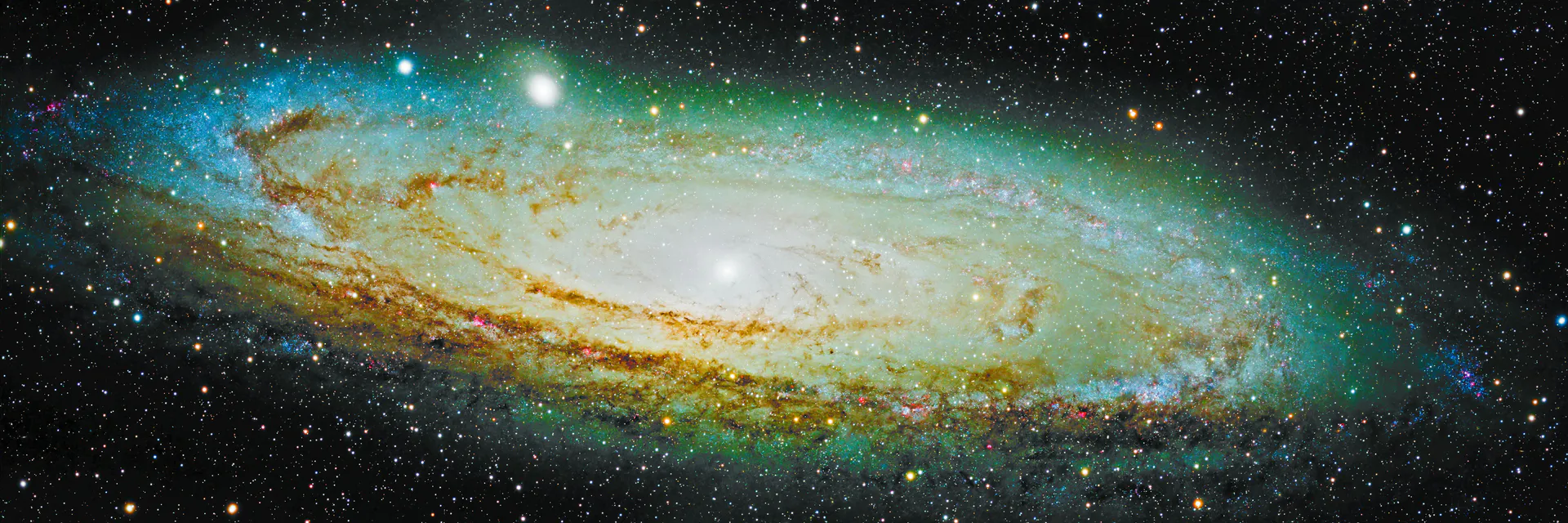
Let's discuss dark matter. We know that there are extremely strong gravitational sources in galaxies, such as massive black holes, therefore, the gravitational field in the galaxy is formed by the graviton with extremely strong energy-momentum, so the self-interaction effect of gravitons can not be ignored. The gravitational effect generated by this self-interaction was previously explained to come from dark matter. There is no dark matter, and the gravitational effect of dark matter can be explained by the self-interaction of gravitons. This is actually a quantum effect. This is actually a quantum effect. When the gravitational source field is extremely strong, the energy-momentum of graviton is extremely strong, so this effect is also extremely strong. Therefore, in the past, we could only use the gravitational field of dark matter to explain this effect. To explain the gravitational effect of dark matter, we let that the gravitational effect of $\Delta g_{\mu \nu}$ is equivalent to the gravitational effect of dark matter. The quantity of dark matter is calculated according to its gravitational effect, but graviton can directly produce gravitational effect, therefore, as a candidate for dark matter, if the self-interaction of gravitons is required to produce the same gravitational effect as dark matter, its corresponding mass-energy is far less than that of dark matter used as the gravitational source.
## IV. CONCLUSION
The viewpoint of this paper can be interpreted in this way: the metric $g_{\mu \nu}[\xi]$ shown in Eq.(3.1) corresponds to the inverse square law, but the true metric is $g_{\mu \nu}[\lambda(\xi)]$ shown in Eq.(3.4). It is different from the modify theory of gravity. The inverse square law is correct and does not require modification. It determines the gravitational field equation. The difference is that the inverse square law ignores the self-interaction of the gravitational field. The self-interaction of the gravitational field causes the additional gravitational effect that increases with the strength of the source field. For galaxies and even galaxy clusters with extremely strong gravitational source, compared with the inverse square law, the self-interaction effect of gravitons cannot be ignored. In fact, the gravitational effect of dark matter is equivalent to the gravitational effect produced by self-interaction of gravitons. The interpretation of the self-interaction of gravitons as dark matter is also consistent with current observations and experiments such as another cluster collision in what's called the Bullet Cluster, and graviton also conforms to all the known properties of dark matter. Therefore, the self-interaction of gravitons can replace the theory of dark matter. Deviation from Inverse Square Law is can also explain the Pioneer anomaly.
Generating HTML Viewer...
References
2 Cites in Article
Gang Lee (2020). A New Approach to Quantum Gravity.
Noncommutative Quantum Gravity and Symmetry of Klein-Gordon Equation.
No ethics committee approval was required for this article type.
Data Availability
Not applicable for this article.
How to Cite This Article
Gang Lee. 2026. \u201cNoncommutative Quantum Gravity and Dark Matter\u201d. Global Journal of Science Frontier Research - A: Physics & Space Science GJSFR-A Volume 23 (GJSFR Volume 23 Issue A4): .
Explore published articles in an immersive Augmented Reality environment. Our platform converts research papers into interactive 3D books, allowing readers to view and interact with content using AR and VR compatible devices.
Your published article is automatically converted into a realistic 3D book. Flip through pages and read research papers in a more engaging and interactive format.
Our website is actively being updated, and changes may occur frequently. Please clear your browser cache if needed. For feedback or error reporting, please email [email protected]
Thank you for connecting with us. We will respond to you shortly.