Globally, breast cancer has become a health priority due to its increasing incidence. Understanding the knowledge attitude and practice of breast cancer screening services is an essential step. The aim of this study is to determine the knowledge and practice of breast cancer screening among women in Enugu South. A descriptive cross sectional research design was adopted for the study. The study population for this study consisted of adult women aged 15 years at Enugu South LGA. A multistage random sampling technique was used in recruiting a total of 396 participants that participated in the study. A structured questionnaire was used for the study and Statistical Package for Social Science (SPSS) version 23.0 was used for the analysis of the study. Results from the study showed that 34.0% of the women were in the age range of 45-49 years. Good knowledge of breast cancer screening was observed in majority (85.6%) of the women. From the study 40.3% of the respondents had reportedly undergone breast cancer screening. The finding of the study revealed that the commonest factor affecting their practice of breast cancer screening was ‘distance to facility’ (19.3%).
## I. INTRODUCTION
Globally in a publication by World Health Organization (WHO) (2016) breast cancer screening is an important practice in preventing breast cancer. Breast cancer is reported to be the second most common cancer in the world and, by far, the most frequent cancer among women with an estimated 1.67 million new cancer cases diagnosed in 2012 (25% of all cancers) (WHO, 2014). It ranked as the fifth cause of death from all cancers and the second most common cause of female cancer-related mortality worldwide (WHO; 2014; Abdel-Aziz et al., 2017; Diab et al., 2018).
Studies have shown a reduction of breast cancer screening has a steady increase in the incidence of breast cancer in Nigeria from 15.3 per 100,000 in 1976 to 33.6 per 100,000 in 1992 to 52.1 per 100,000 in 2012 (Cancer Research, 2017; Olasehinde et al., 2017; Hanson et al., 2019; El Bcheraoui et al., 2015). Globally, there is a regional variability in the incidence rates of this disease ranging from 27 per 100 000 in African and Middle Eastern countries to 96 per 100 000 in Western Europe and it is, also, the most frequent cause of cancer mortality among women in the less developed regions and the second in the developed countries (Aminisani et al., 2016; National Cancer Institute, 2019; WHO, 2013). In developed countries, however, mortality from breast cancer has been on the decline despite the higher incidence of breast cancer. This is a result of early detection through organized screening programs and effective treatment modalities (Olasehinde et al., 2017; Hanson et al., 2019; El Bcheraoui et al., 2015).
Breast cancer mortality has fallen considerably after the introduction of breast cancer screening in the western countries (WHO, 2013; Cancer Research, 2017). However, the screening is unavailable or less utilized (if available) in the developing countries where the majority of breast cancer deaths are occurred (Pierz et al., 2020; WHO, 2019; Keten et al., 2014; Aminisani et al., 2016).
There is growing evidence that the knowledge of breast cancer screening is more aggressive in Nigeria than in the United States and Europe, including an earlier age of onset and a higher incidence of basal-like and HER2-enriched subtypes of the disease (Ojewole et al., 2017; Sung et al., Rosenberg & Jemal, 2019; Keten et al., 2014). When detected early and treated promptly, these cancers have a high cure rate in a well-resourced high-functioning health system (Pruitt et al., 2020). The aetiology of breast cancer is not well known (American Cancer Society, 2018). However, several risk factors have been shown to impact an individual's risk of developing breast cancer and their ultimate prognosis. These well-established risk factors include older age, family history, oral contraceptives, null parity, hormone replacement therapy, and early menarche, late first full-term pregnancy, late menopause, dense breast tissue, and tobacco smoking (Sung, Siege, Rosenberg & Jemal, 2019; Diab et al., 2018). Breast cancer is curable when detected at an early stage. Women with early stage disease have an excellent prognosis with a $100\%$ five years survival rate for stage 0 and I, while those with metastatic disease at diagnosis have a five years survival of around $20\%$, so it is important for women to be aware of the importance of early detection through screening (Diab et al., 2018).
According to a report by Federal Ministry of Health in Nigeria (2015) early recognition and detection of Breast Cancer can play a significant role in reducing cancer morbidity and mortality as it gives more treatment options and increases survival rate if diagnosed early. Early detection of BC can be achieved by one of the following screening methods: breast self-examination (BSE), clinical breast examination (CBE), and mammography (Breast Cancer Now, 2019; Cancer Research, 2017; American Cancer Society, 2017). Although BSE alone is inadequate for early detection of BC, it is recommended by the American Cancer Society as an option for women starting from the early 20s of age as a method for breast awareness and early recognition and detection of BC. Unlike mammography and CBE, BSE does not require hospital visit and expertise, and it is cheap, simple, and non-invasive method that can performed by women themselves at home (Agodirin et al., 2017). According to American Cancer Society (2018) recommendations, women should be aware how their breasts usually feel and report any breast changes without delay to their healthcare providers. Several previous studies have shown that female students had poor awareness and negative attitudes concerning BC and BSE. Such negative indicators continue to be present as a recent descriptive study among women in a community found that those women to have inadequate knowledge regarding BC and BSE $(45.5\%)$, fairly positive attitudes $(56.3\%)$, and low frequent practice of BSE $(37.5\%)$ (Ojewole et al., 2017; Nwaneri et al., 2017; Cancer Research, 2017; Denny et al., 2012).
Worldwide, many interventional studies have been conducted to increase knowledge of BC screening and practice of BSE among women (Keten et al., 2014; CDC, 2019; Anderson et al., 2018). For instance, a study by Abdel-Aziz et al (2017) evaluated the effectiveness of a breast health awareness program on knowledge of BC and BSE practice among women in Rural Nigeria based on the health belief model. The study revealed that the educational intervention had a positive impact on increasing BC knowledge among the participants. Similar findings were revealed among some young Nigerian women and Saudi women (Abdel-Aziz et al., 2017). Therefore, all recommendations were to increase the level of the women's knowledge about BC and emphasize the importance of increasing BC awareness and promoting the practice of BSE for early detection of breast abnormalities (Hanson et al., 2019; El Bcheraoui et al., 2015; Agodirin et al., 2017). Early detection and prompt attention as a result of adequate knowledge and awareness about breast cancer and screening methods go a long way in reducing the associated high mortality rate (Elobaid et al., 2014; Aduayi et al., 2016; Keten et al., 2014).
Recent findings from a Nigerian Breast Cancer Study show that the majority of patients have advanced stage at diagnosis than has been reported in other populations (Arisegi et al., 2019; Dodo et al., 2016; Akande et al., 2015). This underscores the need for systems-level interventions to downstage breast cancer in Nigeria (Dodo et al., 2016; Akande et al., 2015; Pruitt et al., 2020). The causes of late-stage diagnosis are complex and, in addition to aggressive molecular subtypes, include lack of access to comprehensive screening and preventive care as well as social and cultural factors such as alternative healing, financial concerns, and lack of education (Breast Cancer Now, 2019; Pierz et al., 2020; Akande et al., 2015). Delayed diagnosis of breast cancer in Nigeria has been well documented and has a significant impact on breast cancer morbidity and mortality. Improved awareness campaigns and better understanding of the causes of delay in care is critical to develop relevant and effective screening measures. It is due to this that the current study aimed to investigate the knowledge and practice of breast cancer screening among women in Enugu South, Nigeria
## II. METHODS
### a) Study Setting
Enugu South is a Local Government Area of Enugu State, Nigeria. Its headquarters are in the town of Uwani. It has an area of $67\mathrm{km}^2$ and a population of 198,723 at the 2006 census. The postal code of the area is 400. The geographic coordinates of Enugu South is given as $5^{\circ}57'40''\mathrm{N}$ $8^{\circ}42'39''\mathrm{E}$. The people of Enugu South are majorly farmers. Enugu South is a major producer of banana and plantain for the Nigerian market. It is known for the Christianity and Igbo speaking. The major occupations include agriculture and granite, quorite, and laterite mining and trading. The main agricultural food crops are cassava, yam, black beans, and cocoyam. The cash crops are palm nuts and cashew nuts. Pottery is another occupation.
### b) Study Design
This study adopted a cross-sectional study using a quantitative method of data collection on the knowledge and practice of breast cancer screening among women at Enugu South.
### c) Study Population
The study population for this study consisted of adult women aged 15 years at Enugu South LGA. The estimated population of women is 11,407.
### d) Inclusion Criteria
This study includes;
i. All women aged 15 years and above at Enugu South who gave in their consent for the study.
ii. Any individual who volunteered to provide information vital to the research among women at Enugu South.
### e) Exclusion Criteria
This study excludes;
i. Any woman aged 15 years and above at Enugu South who refuses to give in her consent for the study.
ii. Any woman aged 15 years and above at Enugu South who is sick, psychologically malnourished, disabled and on admission to the hospital during the time of data collection of the study.
### f) Sample Size
The sample size for this study is 406 (see appendix A)
### g) Sampling procedure
A multistage random sampling technique was used. The procedure was as follows: Stage 1: Selection of Communities; Simple random sampling was used to select 5 Communities from the total number of communities in Enugu South LGA. Stage 2: Selection of Villages: Two villages each were selected from each of the five selected communities. Also Systematic random sampling was once more is used to select households on each street to give every household an equal chance of selection. This would be done by the researcher. Finally, simple random sampling was used to select 3 females of reproductive age (15 years and above) in each household giving a total of 406 respondents.
### h) Instrument for Data Collection
A self administered semi structured questionnaire was used for the study on the knowledge and practice of breast cancer screening among women at Enugu South. The questionnaire was designed for simplicity and assimilation by the respondents.
### i) Validity of the Instrument
The research instrument being the questionnaire which was used for data collection was developed by researcher and submitted to the project supervisor as well as two experts from department of public health for face validity and proper scrutiny in order to ensure that the questionnaire met the objectives of study.
### j) Reliability of Instrument
Reliability of the instrument was determined using test retest method. Copies of the questionnaire were given to some women outside the area of study by the researcher because this area for reliability testing shared similar characteristics with Enugu South LGA that was used for the study. Chrombach alpha test was used to test for the reliability coefficient of the questionnaire.
### k) Method of Data Collection
Data was obtained using a self administered based semi structured questionnaire. This was done with the aid of Two (2) field assistants who were hired and trained to aid the researcher in the data collection process. The purpose of the research was explained face to face to the respondents before distribution of the questionnaires to them.
### i) Method of Data Analysis
The Statistical Package for the Social Sciences (SPSS) was used in the analysis of the data gotten from the study. Results were expressed in percentages, frequencies, tables and charts (Descriptive Statistics). Chi square test was then used to analyze the hypothesis of the study $p = (0.05)$.
### j) Ethical Consideration
A letter of introduction and ethical clearance was obtained from the Department of Nursing Sciences, University of Nigeria Nsukka before the research was conducted. The purpose of the research was explained to each respondent and verbal informed consent obtained from them before inclusion into the study. Also, anonymity of the respondents was also assured and ensured. The confidentiality of the information they gave was also be maintained.
## III. RESULTS
A total of Four hundred and six (406) copies of questionnaires were distributed for the study and three hundred and ninety-six (396) questionnaires were retrieved and they were properly filled and crosschecked for correctness and were used for the purpose of the analysis.
### a) Socio-demographic Characteristics
From table 1 below, it was posited that $34.0\%$ (135) of the women represented age groups between 45-49, $30.3\%$ (120) of the women were 50 years and above, $21.4\%$ (85) of the respondents were 35-44 years of age, $8.2\%$ (32) were aged 25-34, and $6.1\%$ (24) aged 15-24 years. $63.2\%$ (250) of the women were of lgbo origin, $29.1\%$ (115) reported 'others', $5.1\%$ (20) Yoruba, and $2.7\%$ (11) Hausa/Fulani. $66.9\%$ (265) of the respondents were Christians, $14.7\%$ (58) listed religions not included in the options but label 'others', $11.4\%$ (45) Traditional and $6.9\%$ (28) Muslim. $35.9\%$ (142) of the women had a child, $8.9\%$ (35) had two children, $26.6\%$ (105) had 3 children and above, and $28.7\%$ (113) had no children. Concerning the education level of the respondents, $39.0\%$ (154) had attained tertiary education, $28.9\%$ (115) for secondary education levels, $22.1\%$ (88) had attained primary education levels and just $9.9\%$ (39) had informal education levels. Students among the respondents totaled $24.7\%$ (98), $25.2\%$ (100) were civil servants, $23.9\%$ (95) 'farmers', $5.9\%$ (23) identified as traders, and $20.3\%$ (80) 'others'. $35.8\%$ (142) reported 'yes' concerning monthly income satisfaction, while $64.2\%$ (254) of the women said "no". $42.8\%$ (169) of the respondents were single, $35.2\%$ (139) married, $16.5\%$ (65) separated, and $5.6\%$ (22) widowed. When the women were asked about their household level of income, $16.5\%$ (65) reported income above 100,000, $20.9\%$ (83) between 2,000-10,000, $10.2\%$ (40) earned from 11,000-30,000, $2.9\%$ (11) 1-1,000, $19.9\%$ (79) listed 'other' income levels, $18.6\%$ (74) earned figures from 61,000-100,000, and $11.0\%$ (44) from 31,000-60,000. $47.4\%$ (188) of the respondents affirmed they had a health plan at a healthcare center, while $52.6\%$ (208) reported they did not.
Table 1: Socio Demographic Characteristics of the Women
<table><tr><td>Characteristics</td><td>Frequency (n=396)</td><td>Percentage (%)</td></tr><tr><td>Age</td><td></td><td></td></tr><tr><td>15-24</td><td>24</td><td>6.1</td></tr><tr><td>25-34</td><td>32</td><td>8.2</td></tr><tr><td>35-44</td><td>85</td><td>21.4</td></tr><tr><td>45-49</td><td>135</td><td>34.0</td></tr><tr><td>50 and Above</td><td>120</td><td>30.3</td></tr><tr><td>Total</td><td>396</td><td>100</td></tr><tr><td>Ethnicity</td><td></td><td></td></tr><tr><td>Igbo</td><td>250</td><td>63.2</td></tr><tr><td>Hausa/Fulani</td><td>20</td><td>5.1</td></tr><tr><td>Yoruba</td><td>11</td><td>2.7</td></tr><tr><td>Others</td><td>115</td><td>29.1</td></tr><tr><td>Total</td><td>396</td><td>100</td></tr><tr><td>Religion</td><td></td><td></td></tr><tr><td>Christianity</td><td>265</td><td>66.9</td></tr><tr><td>Muslim</td><td>28</td><td>6.9</td></tr><tr><td>Traditional</td><td>45</td><td>11.4</td></tr><tr><td>Others</td><td>58</td><td>14.7</td></tr><tr><td>Total</td><td>396</td><td>100</td></tr><tr><td>Number of Children (Parity)</td><td></td><td></td></tr><tr><td>None</td><td>113</td><td>28.7</td></tr><tr><td>1</td><td>142</td><td>35.9</td></tr><tr><td>2</td><td>35</td><td>8.9</td></tr><tr><td>3 and above</td><td>105</td><td>26.6</td></tr><tr><td>Total</td><td>396</td><td>100</td></tr><tr><td>Education level</td><td></td><td></td></tr><tr><td>Informal education</td><td>39</td><td>9.9</td></tr><tr><td>Primary</td><td>88</td><td>22.1</td></tr><tr><td>Secondary</td><td>115</td><td>28.9</td></tr><tr><td>Tertiary</td><td>154</td><td>39.0</td></tr><tr><td>Total</td><td>396</td><td>100</td></tr><tr><td>Occupation</td><td></td><td></td></tr><tr><td>Student</td><td>98</td><td>24.7</td></tr><tr><td>Farmer</td><td>95</td><td>23.9</td></tr><tr><td>Trader</td><td>23</td><td>5.9</td></tr><tr><td>Civil servant</td><td>100</td><td>25.2</td></tr><tr><td>Others</td><td>80</td><td>20.3</td></tr><tr><td>Total</td><td>396</td><td>100</td></tr><tr><td>Marital Status</td><td></td><td></td></tr><tr><td>Married</td><td>65</td><td>16.5</td></tr><tr><td>Single</td><td>169</td><td>42.8</td></tr><tr><td>Separated</td><td>22</td><td>5.6</td></tr><tr><td>Widowed</td><td>139</td><td>35.2</td></tr><tr><td>Total</td><td>396</td><td>100</td></tr><tr><td>Household level of Income</td><td></td><td></td></tr><tr><td>1-1,000</td><td>83</td><td>20.9</td></tr><tr><td>2,000-10,000</td><td>11</td><td>2.9</td></tr><tr><td>11,000-30,000</td><td>40</td><td>10.2</td></tr><tr><td>31,000-60,000</td><td>44</td><td>11.0</td></tr><tr><td>61,000-100,000</td><td>74</td><td>18.6</td></tr><tr><td>Above 100,000</td><td>65</td><td>16.5</td></tr><tr><td>Others</td><td>79</td><td>19.9</td></tr><tr><td>Total</td><td>396</td><td>100</td></tr><tr><td>Are you satisfied with your monthly income?</td><td></td><td></td></tr><tr><td>Yes</td><td>142</td><td>35.8</td></tr><tr><td>No</td><td>254</td><td>64.2</td></tr><tr><td>Total</td><td>396</td><td>100</td></tr><tr><td>Do you have a Health plan at any healthcare Center?</td><td></td><td></td></tr><tr><td>Yes</td><td>188</td><td>47.4</td></tr><tr><td>No</td><td>208</td><td>52.6</td></tr><tr><td>Total</td><td>396</td><td>100</td></tr></table>
### b) Knowledge of Breast cancer screening among Women
From table 2 below, majority of the respondents $85.6\%$ (339) demonstrated knowledge of breast cancer screening, while $14.4\%$ (57) denied. For example (see figure 1. below), $23.0\%$ (87) of the respondents reported 'newspaper/magazines' as their sources of information on breast cancer screening, $19.0\%$ (75) said "Tv/radio programs", $18.9\%$ (75) reported social media, $3.8\%$ (15) health practitioners, $14.9\%$ (59) parents/family, $11.4\%$ (45) school, and $9.0\%$ (36) reported sources not listed but label 'others'. $40.3\%$ (159) of the women affirmed they had been part of a breast cancer screening, $32.5\%$ (129) reported 'no', and $27.3\%$ (108) were not sure. Respondents who accepted to have undergone breast cancer screening reported to have done so between 6 months to a year (26.4%), 24.4% (39) reported 'longer than a year', 21.9% (35) said "4-6 months", 14.8% (23) reported 2-3 months, and 12.6% (20) reported in less than a month. 52.5% (208) of the women affirmed that mammography is a method used to screen for breast cancer, while 47.5% (188) replied "no". Women in Enugu-South accepted that breast self examination is encouraged as part of a breast education program, while 15.3% (60) said "no". When the respondents were asked if lump swelling under armpit, bleeding or discharge and nipple retraction is a warning sign of breast cancer, majority agreed (78.8%), while 21.2% (84) reported otherwise.
Table 2: Knowledge of Breast cancer screening among Women
<table><tr><td>Variables</td><td>Frequency (n=396)</td><td>Percentage (%)</td></tr><tr><td>Have you heard about Breast cancer screening?</td><td></td><td></td></tr><tr><td>Yes</td><td>339</td><td>85.6</td></tr><tr><td>No</td><td>57</td><td>14.4</td></tr><tr><td>Total</td><td>396</td><td>100</td></tr><tr><td>What is your source of information?</td><td></td><td></td></tr><tr><td>School</td><td>45</td><td>11.4</td></tr><tr><td>Parents/Family</td><td>59</td><td>14.9</td></tr><tr><td>Social Media</td><td>75</td><td>18.9</td></tr><tr><td>TV/Radio programs</td><td>75</td><td>19.0</td></tr><tr><td>Health Practitioners</td><td>15</td><td>3.8</td></tr><tr><td>Newspaper/Magazines</td><td>91</td><td>23.0</td></tr><tr><td>Others</td><td>36</td><td>9.0</td></tr><tr><td>Total</td><td>366</td><td>100</td></tr><tr><td colspan="3">Have you been part of a Breast Cancer Screening Program</td></tr><tr><td>Yes</td><td>159</td><td>40.3</td></tr><tr><td>No</td><td>129</td><td>32.5</td></tr><tr><td>Not sure</td><td>108</td><td>27.3</td></tr><tr><td>Total</td><td>396</td><td>100</td></tr><tr><td colspan="3">If Yes, when was that?</td></tr><tr><td>Not Yet</td><td>0</td><td>0</td></tr><tr><td>less than a month</td><td>20</td><td>12.6</td></tr><tr><td>2-3 months</td><td>23</td><td>14.8</td></tr><tr><td>4-6 months</td><td>35</td><td>21.9</td></tr><tr><td>6 months to a year</td><td>42</td><td>26.4</td></tr><tr><td>longer than a year</td><td>39</td><td>24.4</td></tr><tr><td>Total</td><td>159</td><td>100</td></tr><tr><td colspan="3">Mammography is a method used to screen for breast cancer</td></tr><tr><td>Yes</td><td>208</td><td>52.5</td></tr><tr><td>No</td><td>188</td><td>47.5</td></tr><tr><td>Total</td><td>396</td><td>100</td></tr><tr><td colspan="3">Breast self examination is encouraged as part of a breast education program</td></tr><tr><td>Yes</td><td>336</td><td>84.7</td></tr><tr><td>No</td><td>60</td><td>15.3</td></tr><tr><td>Total</td><td>396</td><td>100</td></tr><tr><td colspan="3">Lump swelling under armpit, bleeding or discharge and nipple retraction is a warning sign of breast cancer</td></tr><tr><td>Yes</td><td>312</td><td>78.8</td></tr><tr><td>No</td><td>84</td><td>21.2</td></tr><tr><td>Total</td><td>396</td><td>100</td></tr></table>
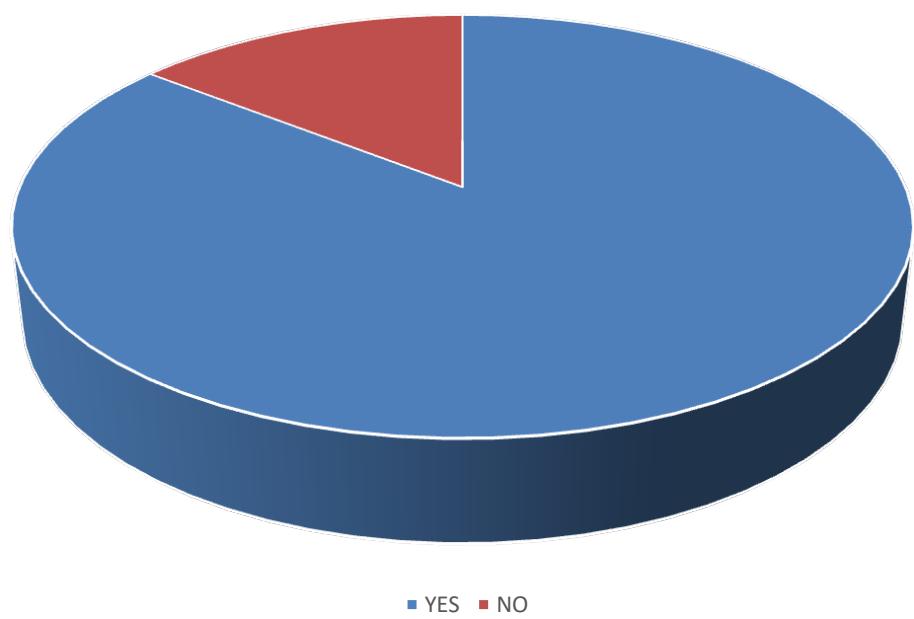
AWARENESS OF BREAST CANCER SCREENING Fig.1: Awareness of Breast Cancer Screening
### c) Practices of Breast Cancer Screening among Women
From table 3 below, majority of the respondents reportedly demonstrated their approval to undergo breast cancer screening if offered a chance (92.5%), while $7.5\%$ (30) denied. $53.9\%$ (214) of the respondents reported 'Yes' when they were asked if they had been advised by a physician to screen the breast prior to the time of this investigation, $26.4\%$ (105) could not remember, and $19.7\%$ (78) said "No". $47.0\%$ (186) of the respondents had not screened for breast cancer or any infection relating to the breast before filling the questionnaire, $36.3\%$ (144) replied "Yes", and $16.7\%$ (66) reportedly could not remember. $32.7\%$ (47) of the respondents who reported 'yes' said they last screened for periods longer than a year, $24.6\%$ (35) reported 4-6 months ago, $18.1\%$ (26) said "6 months to a year", $16.6\%$ (24) reported 'in less than a month', and $8.0\%$ (12) reported 2-3 months ago. When they were asked concerning reasons for breast cancer screening, over half of the women $(57.3\%)$ reported 'for prevention', $18.1\%$ (26) explained that they were presented with symptoms, $16.6\%$ (24) just decided to go for the examination, and $8.0\%$ (12) as a result of cases in the family respectively. $85.4\%$ (338) of the women had never had an abnormal test result in breast cancer screening, while $14.4\%$ (58) reported 'Yes'.
Table 3: Practices of Breast Cancer Screening among Women
<table><tr><td>Variable</td><td>Frequency (n=396)</td><td>Percentage (%)</td></tr><tr><td>Do you Practice breast cancer screening if offered a chance?</td><td></td><td></td></tr><tr><td>Yes</td><td>366</td><td>92.5</td></tr><tr><td>No</td><td>30</td><td>7.5</td></tr><tr><td>Total</td><td>396</td><td>100</td></tr><tr><td>Have any physician advised you to screen the breast before?</td><td></td><td></td></tr><tr><td>Yes</td><td>214</td><td>53.9</td></tr><tr><td>No</td><td>78</td><td>19.7</td></tr><tr><td>Cannot Remember</td><td>105</td><td>26.4</td></tr><tr><td>Total</td><td>396</td><td>100</td></tr><tr><td colspan="3">Have you screened for breast cancer or any infection relating to the breast before?</td></tr><tr><td>Yes</td><td>144</td><td>36.3</td></tr><tr><td>No</td><td>186</td><td>47.0</td></tr><tr><td>Cannot Remember</td><td>66</td><td>16.7</td></tr><tr><td>Total</td><td>396</td><td>100</td></tr><tr><td colspan="3">If YES when was that?</td></tr><tr><td>less than a month</td><td>24</td><td>16.6</td></tr><tr><td>2-3 months</td><td>12</td><td>8.0</td></tr><tr><td>4-6 months</td><td>35</td><td>24.6</td></tr><tr><td>6 months to a year</td><td>26</td><td>18.1</td></tr><tr><td>longer than a year</td><td>47</td><td>32.7</td></tr><tr><td>Total</td><td>144</td><td>100</td></tr><tr><td colspan="3">What was your reason for the breast cancer screening?</td></tr><tr><td>Presented with symptoms</td><td>26</td><td>18.1</td></tr><tr><td>Cases in the family</td><td>12</td><td>8.0</td></tr><tr><td>For prevention</td><td>82</td><td>57.3</td></tr><tr><td>Just decided to go for the examination</td><td>24</td><td>16.6</td></tr><tr><td>Total</td><td>46</td><td>100</td></tr><tr><td colspan="3">Have you ever had abnormal test result in Breast cancer screening?</td></tr><tr><td>Yes</td><td>58</td><td>14.6</td></tr><tr><td>No</td><td>338</td><td>85.4</td></tr><tr><td>Total</td><td>46</td><td>100</td></tr></table>
### d) Factors Influencing the Practice of Breast Cancer Screening among Women
Table 4 below demonstrated the factors affecting the practice of breast cancer screening practice among women in the study. $19.3\%$ (82) reported distance to facility, $18.7\%$ (79) said "family/husband acceptance", $13.8\%$ (58) reported lack of information, $13.3\%$ (56) financial constraints, $11.3\%$ (48) behavior of health workers, $10.0\%$ (42) cultural related factors, and $0.5\%$ (2) said "religious factors".
Table 4: Factors Influencing the Practice of Breast Cancer Screening among Women
<table><tr><td>Variable</td><td>Frequency (n=396)</td><td>Percentage (%)</td></tr><tr><td colspan="3">Which of the following related as possible factors affecting your Utility of Breast cancer screening</td></tr><tr><td>Distance to facility</td><td>82</td><td>19.3</td></tr><tr><td>Cultural related factors</td><td>42</td><td>10.0</td></tr><tr><td>Family/Husband Acceptance</td><td>79</td><td>18.7</td></tr><tr><td>Financial Constraints</td><td>56</td><td>13.3</td></tr><tr><td>Lack of Information</td><td>58</td><td>13.8</td></tr><tr><td>Religious Factors</td><td>2</td><td>0.5</td></tr><tr><td>Behavior of Health workers</td><td>48</td><td>11.3</td></tr></table>
### e) Association between the knowledge of Breast cancer screening and the Socio demographic characteristics of females
Table 5 below showed the results for the test of a statistically significant association between sociodemographic characteristics and knowledge of breast cancer screening among women in Enugu South Local Government Area, Enugu State. There was a statistically significant association between age of women and knowledge of breast cancer screening $(p = 0.010)$. Given the association between marital status of women and knowledge of breast cancer screening among women in the study population $(p = 0.300)$, there was no significant association. On the hypothesis between number of children (parity) and knowledge of breast cancer screening among women in primal population, There was also a statistically significant association $(p = 0.0008)$. Given the association between level of income of women and knowledge of breast cancer screening in the study population, there was a statistically significant association $(p = 0.0092)$. There was a statistically significant association between level of education and knowledge of breast cancer screening in the study population $(p = 0.0327)$. Finally, there was no statistically significant association between occupation and knowledge of breast cancer screening in the study population $(p = 0.127)$.
Table 5: Association between the knowledge of Breast cancer screening and the Socio demographic characteristics of females
<table><tr><td rowspan="2">Socio Demographics</td><td colspan="2">Knowledge of Breast cancer screening</td><td rowspan="2">X2</td><td rowspan="2">P-value</td><td rowspan="2">Decision</td></tr><tr><td>Yes (%)</td><td>No (%)</td></tr><tr><td>Age</td><td>84.8%</td><td>15.2%</td><td>12</td><td>0.010</td><td>S</td></tr><tr><td>Marital Status</td><td>53.7%</td><td>46.3%</td><td>2.0</td><td>0.300</td><td>NS</td></tr><tr><td>Number of Children (Parity)</td><td>69.7%</td><td>29.3%</td><td>3.332</td><td>0.0008</td><td>S</td></tr><tr><td>Level of income</td><td>95.8%</td><td>4.2%</td><td>8.57</td><td>0.0092</td><td>S</td></tr><tr><td>Level of Education</td><td>70.1%</td><td>29.9%</td><td>17</td><td>0.0327</td><td>S</td></tr><tr><td>Occupation</td><td>59.5%</td><td>40.5%</td><td>1.97</td><td>0.127</td><td>NS</td></tr></table>
f) Association between the knowledge of Breast cancer screening and the Practice of breast cancer screening among women at Enugu South
Table 6 below showed the results for the test of a statistically significant association between knowledge of breast cancer screening and practice of breast cancer screening among women. There was a statistically significant association between good knowledge and practice of breast cancer screening among women $(p = 0.0032)$.
Table 6: Association between the knowledge of Breast cancer screening and the Practice of breast cancer screening among women at Enugu South
<table><tr><td rowspan="2">Practice of breast cancer screening</td><td colspan="2">knowledge of breast cancer screening</td><td rowspan="2">X2</td><td rowspan="2">P-value</td><td rowspan="2">Decision</td></tr><tr><td>Good Knowledge (%)</td><td>Poor Knowledge (%)</td></tr><tr><td>Yes</td><td>89.0%</td><td>11.0%</td><td rowspan="2">1.9376</td><td rowspan="2">0.0032</td><td rowspan="2">Sig</td></tr><tr><td>No</td><td>32.8%</td><td>67.2%</td></tr></table>
## IV. DISCUSSION
Findings of this study respect to the socio demographic characteristics of the respondents, $34.0\%$ of the women were in the age range of 45-49 years and this is comparable to findings of Ogunkorode et al. (2017) which showed that $35\%$ of the population studied was between the ages of 45-49 years. Also, observation from this study showed that majority of the participants in the breast cancer screening survey were Christians $(66.9\%)$ and of Igbo origin $(63.2\%)$. This is justified given the study was conducted in the south-eastern part of Nigeria predominated by people of Igbo and Christian origin. A similar study conducted in the South-eastern region of Nigeria suggested similar findings regarding the predominance of Christians and Igbo people (Azubuike et al., 2018).
Good knowledge of breast cancer screening was observed in majority (85.6%) of the women. The high level of knowledge was also observed in studies according to Ogunkorode et al. (2017) and Okoronkwo et al. (2015) where majority, of the respondents had good knowledge about breast cancer. However this as in contrast to the level of knowledge reported among students in Turkey where low knowledge level was reported (Hanson et al., 2019). In the study, $23.0\%$ of the women listed newspaper/magazines as their source of information on breast cancer screening. This could be due to some campaigns and awareness on breast cancer screening on mainstream media. Additionally, $40.3\%$ of the respondents had reportedly undergone breast cancer screening. This is however in contrast with a study by Aminisani et al. (2016) conducted in Uganda. Another study conducted by Bcheraoui et al. (2015) suggested lower figures concerning participation in breast cancer screening. From this study, it was revealed that $52.5\%$ of the women affirmed that mammography is a method used to screen for breast cancer and $78.8\%$ correctly reported that lump swelling under armpit, bleeding or discharge and nipple retraction is a warning sign of breast cancer. A publication by Diab et al. (2018) revealed figures which corroborate this finding and this is also in agreement with the finding of Akande et al. (2015) where majority of the students were well informed about mammography as a screening method for breast cancer. This was also observed by Kamińska et al. (2015) and finding is similar to the results of another study conducted. From the study $92.5\%$ of the women demonstrated their approval to utilize breast screening services if offered a chance these points out the lack of access towards breast cancer screening among respondents. A previous study by Diab et al. (2018) suggested similar findings among respondents in a Kenyan study. $53.9\%$ of the women accepted they had been advised by a physician to screen the breast prior to the time of this investigation. A study by Poehls (2019) corroborates this finding and demonstrated that physicians actively sensitized their female patients on breast cancer screening. This study revealed that $85.4\%$ of the women had never had an abnormal test result in Breast cancer screening as supported by several studies (Kanaga et al., 2011; Karabay et al. 2018; Al-Hussami, 2014).
The finding of the study revealed that the commonest factor affecting their practice of breast cancer screening was 'distance to facility' (19.3%). This goes in consistence with a study by Poehls (2019) on the practice of breast cancer screening screenings. Another study by Hedge et al. (2018) in agreement to this finding and suggests that 26.6% of women who underwent breast cancer screenings listed affecting factors such as financial constraints, followed by distance to facility.
Findings from this study regarding the association between Socio-demographic characteristics and practice of Breast cancer screening among women revealed that Age is significantly associated with practice of breast cancer screening screening among women $(p = 0.010)$. Study shows that older women groups utilized breast cancer screening relative to younger groups. This goes in line with a study by Hedge et al. (2018) which found age to be associated with practice of breast cancer screening $(p = 0.00271)$. Further investigation into the study demonstrated that marital status is not significantly associated with the practice of breast cancer screening $(p = 0.300)$. This goes in line with a report published by Al-Amri (2015) that there was no significant association. This implies that women who wanted to utilize screenings did, irrespective of their marital status. Although certain studies suggested some women did not participate in screening exercises due to permission/acceptance from their husbands (Chigbu et al., 2017; Nnebue et al., 2018). Also, from the study among women in Enugu South, it was posited that there was a significant association between number of children (Parity) and practice of breast cancer screening among women in the study population $(p = 0.0008)$. Few studies support this finding (Adejumo et al., 2018; Chigbu et al., 2017; Nnebue et al., 2018; Olasehinde et al., 2017). Considering the hypothesis between level of income of women and practice of breast cancer screening, there a significant association $(p = 0.0092)$. This goes in consistence to a previous study by Al-Amri (2015). This signifies that women with better level of income were more likely to utilize breast cancer screening services. This study also indicates that women with higher level of education were significantly involved in breast cancer screening than those with low levels of education. Women without any formal education level hardly came in for screening. This indicates that more enlightened a person is, the more likely they were to undertake breast cancer screenings. Hence level of education of women and practice of breast cancer screening are significantly associated $(p = 0.0327)$. A preceding study by Al-Amri (2015) confirms this finding. Findings of this study showed an association between knowledge of breast cancer screening and practice of breast cancer screening among female women $(p = 0.00532)$. This implies that women who were well informed know the importance and would easily seek breast cancer screening as opposed to those who lacked information. A study by Poehls (2019) corroborates this finding on the association between knowledge of breast cancer screening and practice of breast cancer screening.
## V. CONCLUSION
Breast cancer is a major health concern and remains the most common malignancy in women worldwide. In this study, It was seen that age, educational level, level of income, marital status and knowledge were all related with practice of breast cancer screening among the women in Enugu South. Findings from this study establish that even though a number of women showed considerable knowledge of breast cancer screening, several others were deficient of relevant information. Women need to be encouraged to perform BCS regularly and earnestly report any abnormality to the health care providers since they generally showed willingness to participate if afforded an opportunity. Also, perceived factors affecting breast cancer screening practices such as distance to facilities must be put into consideration to ease uptake. Emphasis must be made on the importance and effectiveness of breast cancer screening. Also Policies must be implemented to accommodate low income earners and encourage breast cancer screening.
### APPENDIX A
Sample size determination
The sample size will be determined using the Yamene formula (1967) for sample size determination.
$$
n = \frac{N_{-}}{1 + N e^{2}}
$$
Where:
n is the desired sample size
N is the population size (11,407) e is margin of error (0.05)
Therefore,
$$
n = \begin{array}{c} N _ {-} \\1 + N e ^ {2} \end{array}
$$
$$
\frac{1 1 , 4 0 7}{1 + 1 1 4 0 7 * (0 . 0 5) ^ {2}}
$$
$$
\frac {1 1 , 4 0 7}{2 9 . 5 1 7 5}
$$
$$
n = 3 8 6. 4 4 8 = 3 8 6
$$
Furthermore, to account for $5\%$ Non Response Rate, (i.e. $95\%$ response rate)
### n = n/expected response rate
$$
\begin{array}{c} 3 8 6 \\\hline 0. 9 5 \end{array}
$$
$$
n = 4 0 6. 3 1 5 7 \dots \dots \dots \dots \dots \dots \dots \dots \dots \dots \dots \dots \dots \dots \dots \dots \dots \dots \dots \dots \dots \dots \dots \dots \dots \dots \dots \dots \dots \dots
$$
i.e the total sample size for the study would be 406.
#### APPENDIX B
Questionnaire on the Knowledge and Practice of Breast Cancer Screening among Women in Enugu South, Enugu, Nigeria
#### SECTION A: SOCIO DEMOGRAPHIC CHARACTERISTICS OF WOMEN
1. What is your age range? (a) 15-24 [](b) 25-34 [](c) 35-44 [](d) 45-49 [](e) above 50 []
2. What is your Religion? (a) Christianity [](b) Muslim [](c) Traditional [](d) Others (Please Specify)
3. Ethnicity (a) Igbo [](b) Hausa [](c) Yoruba [](d) Fulani [](e) Others (please specify)
4. Marital status (a) Married [](b) Single [](c) Separated [](d) Widowed []
5. Education level (a) No formal education [](b) Primary [](c) Secondary [](d) Tertiary []
6. Your occupation: (a) Artisan e.g Carpenter, Hairdresser, Tailor, Driver [](b) Civil servant e.g Teacher [](c) Self-employed e.g Trader, Photographer [](d) Unemployed [](e) Professionals e.g. Doctor, Nurse, Lawyer, Accountant [](f) Others (please specify)
7. What is your Level of Income (a.) 1-1,000 [](b.) 2,000-10,000 [](c.) 11,000-30,000 [](d.) 31,000-60,000 [](e) 61,000-100,000 [](f) above 100,000 [](g) others (specify).
8. Number of children (Parity) (a.) None [](b.) 1 [](c.) 2 [](d.) 3 [](e) 4 and above []
9. Are you satisfied with your monthly income? (a) Yes [](b) No [](c) Somehow []
10. Do you have a Health plan at any healthcare Center? (a) Yes [](b) No []
#### SECTION B: KNOWLEDGE OF BREAST CANCER SCREENING AMONG WOMEN
INSTRUCTION: Please tick (v) the correct options besides each question and also fill in the spaces provided where appropriate with the correct options.
11. Have you heard about Breast Cancer Screening? (a) Yes [](b) No []
12. What is your source of information on breast cancer Screening? (a) School [](b) Parents/family [](c) Social media [](d) Tv/radio programs [](e) Health practitioner i.e nurse, doctor, auxiliary health personnel etc. [](f) news papers/ magazines [](l) others(please specify)
13. Have you been part of a Breast Cancer Screening Program (a) Yes [](b) No [](c) Not Sure []
14. When was that? (a) Not Yet [](b) less than a month [](c) 2-3 months [](d) 4-6 months [](e) 6 months to a year [](f) longer than a year[]
15. Mammography is a method used to screen for breast cancer (a) Yes [](b) No []
16. Breast self examination is encouraged as part of a breast education program (a) Yes [](b) No []
17. Lump swelling under armpit, bleeding or discharge and nipple retraction is a warning sign of breast cancer (a) Yes [](b) No []
#### SECTION C: PRACTICES OF BREAST CANCER SCREENING AMONG WOMEN
18. Do you Practice breast cancer screening if offered a chance?
a) Yes [](b) No []
19. If No to Question (25) Why?
20. Have any physician advised you to screen the breast before? (a) Yes [](b) No [](c) Cannot Remember
21. Have you screened for breast cancer or any infection relating to the breast before? (a) Yes [](b) No [](c) Cannot Remember
22. If YES when was that? (a) less than a month [](b) 2-3 months [](c) 4-6 months [](d) 6 months to a year [](e) longer than a year[]
23. What was your reason for the breast cancer screening? (a) Presented with symptoms [](b) Cancer cases in the family [](c) for prevention [](d) Just decided to go for the examination [](f) Others (please specify)
24. Have you ever had abnormal test result in breast cancer screening? (a) Yes [](b) No []
#### SECTION E: FACTORS INFLUENCING THE PRACTICE OF BREAST CANCER SCREENING AMONG WOMEN
Please tick (v) the correct options that related as possible factors influencing yourpractice of breast cancer screening in the spaces provided in the Table below.
<table><tr><td>S/N</td><td>Factors</td><td>Yes</td><td>No</td></tr><tr><td>1.</td><td>Family/Husband Acceptance</td><td></td><td></td></tr><tr><td>2.</td><td>Cultural related factors</td><td></td><td></td></tr><tr><td>3.</td><td>Distance to facility</td><td></td><td></td></tr><tr><td>4.</td><td>Financial Constraints</td><td></td><td></td></tr><tr><td>5.</td><td>Lack of Information</td><td></td><td></td></tr><tr><td>6.</td><td>Religious Factors</td><td></td><td></td></tr><tr><td>7.</td><td>Behavior of Health workers</td><td></td><td></td></tr></table>
Thank You
INSTRUCTION: Please tick (v) the correct options besides each question and also fill in the spaces provided where appropriate with the correct options.
Generating HTML Viewer...
References
133 Cites in Article
M Abdel-Aziz,G Shaimaa,B Baher,O Amin,H Tarek,I Tawfik,N Al-Gadeeb,P Mohammed,N Baqir,A Alhassar,I Abdullah,C Al-Ramadan,N Ali,T Al-Helal,J Mohammed,D Alkhalaf,O Eman,G Hussain (2017). Perceived barriers to breast cancer screening among Saudi women at primary care setting in Northern Nigeria.
P Adejumo,J Aluko,O Oluwatosin (2018). Awareness Of Breast Cancer Screening Among Female Undergraduate Students Of University Of Ibadan, Nigeria.
Davies Adeloye,Olaperi Sowunmi,Wura Jacobs,Rotimi David,Adeyemi Adeosun,Ann Amuta,Sanjay Misra,Muktar Gadanya,Asa Auta,Michael Harhay,Kit Chan (2018). Estimating the incidence of breast cancer in Africa: a systematic review and meta-analysis.
Victor Aduayi,Adedeji Onayade,Olufunso Aduayi,Macellina Ijadunola (2016). Willingness to accept preventive bilateral mastectomy among women in rural and urban communities in South-Western Nigeria.
J Agbonifoh (2016). Communicating Security Awareness Among Management of Tertiary Institutions in 21st Century in Rivers State.
S Agodirin,G Rahman,S Olatoke,A Durojaiye (2017). Pattern of Breast Cancer Referral to Palliative Care and the Complimentary Role of a Palliative Care Unit in A Resource-Limited Country.
N Akande,F Halimat,V Jumai,U Olafimihan,Y Bola,U Bamidele,C Oyinloye,E Olalekan,O Ibikun (2015). A five year audit of mammography in a tertiary hospital, North Central Nigeria.
Ali Al-Amri (2015). Clinical presentation and causes of the delayed diagnosis of breast cancer in patients with pregnancy associated breast cancer.
Mahmoud Al-Hussami,Ruqayya Zeilani,Omar Alkhawaldeh,Lubna Abushaika (2014). Jordanian Women's Personal Practices Regarding Prevention and Early Detection of Breast Cancer.
Abdullah Alkhenizan,Aneela Hussain,Adher Alsayed (2013). The sensitivity and specificity of screening mammography in primary care setting in Saudi Arabia..
Arwa Alsaraireh,Muhammad Darawad (2019). Impact of a Breast Cancer Educational Program on Female University Students’ Knowledge, Attitudes, and Practices.
(2017). Breast Cancer facts and figures Recommendations for early detection of breast cancer.
(2018). Breast Cancer facts and figures Recommendations for early detection of breast cancer.
Janhavi Venkataraman,Kefah Mokbel (2019). Key breast cancer highlights from the 2025 American Society of Clinical Oncology (ASCO) Annual Meeting.
Nayyereh Aminisani,Rojin Fattahpor,Saeed Dastgiri,Mohamad Asghari Jafarabadi,Hamid Allahverdipour (2016). Determinants of breast cancer screening uptake in Kurdishwomen of Iran.
B Anderson,C Yip,R Smith,R Shyyan,S Sener,A Eniu,J Harford (2018). Guideline implementation for breast healthcare in low-income and middle-income countries: Overview of the Breast Health Global Initiative Global Summit 2007.
S Anwar,G Tampubolon,M Van Hemelrijck,S Hutajulu,J Watkins,W Wulaningsih,Pilar Research,Network (2018). Determinants of cancer screening awareness and participation among Indonesian women.
M Arisegi,A Sarafadeen,U Grema,A Bukar,S Singh,O Ahmed,O Idris,F Falaki,M Bello (2019). Knowledge of breast cancer and practice of breast self-examination among female National Youth Service Corps members in a Northern Nigeria State.
Muluken Azage,Gedefaw Abeje,Alemtsehay Mekonnen (2013). Assessment of Factors Associated with Breast Self-Examination among Health Extension Workers in West Gojjam Zone, Northwest Ethiopia.
Samuel Azubuike,Colin Muirhead,Louise Hayes,Richard Mcnally (2018). Rising global burden of breast cancer: the case of sub-Saharan Africa (with emphasis on Nigeria) and implications for regional development: a review.
Mollie Barnard,Caroline Boeke,Rulla Tamimi (2015). Established breast cancer risk factors and risk of intrinsic tumor subtypes.
K Birhane,M Alemayehu,B Anawte,G Gebremariyam,R Daniel,S Addis Unknown Title.
W Negash (2017). Practices of breast selfexamination and associated factors among female debre berhan university students.
Adriana Bluekens,Roland Holland,Nico Karssemeijer,Mireille Broeders,Gerard Den Heeten (2012). Comparison of Digital Screening Mammography and Screen-Film Mammography in the Early Detection of Clinically Relevant Cancers: A Multicenter Study.
Jack Cuzick (2018). Future possibilities in the prevention of breast cancer: Breast cancer prevention trials.
(2019). Chapter 6. Surgery And Staging Of Your Breast Cancer.
Graham Colditz,Kari Bohlke (2019). Preventing breast cancer now by acting on what we already know.
Breastcancer,Org (2018). Family History of Breast Cancer Dramatically Increases Risk of Cancer in Other Breast. Risk factors.
H Brewer,M Jones,M Schoemaker,A Ashworth,A Swerdlow (2017). Family history and risk of breast cancer: an analysis accounting for family structure.
Ana Lohmann,Marguerite Ennis,Sara Taylor,Pamela Goodwin (2017). Metabolic factors, anthropometric measures, diet, and physical activity in long-term breast cancer survivors: change from diagnosis and comparison to non-breast cancer controls.
L Richardson,S Rim (2018). Cancer-Related News from the CDC: Breast Cancer Screening Among US Women Age 50 to 74.
(2018). Breast Cancer.
Chibuike Chigbu,Azubuike Onyebuchi,Tonia Onyeka,Boniface Odugu,Cyril Dim (2017). The impact of community health educators on uptake of cervical and breast cancer prevention services in Nigeria.
Cleaveland Clinic (2019). Breast anatomy.
(2012). Menarche, menopause, and breast cancer risk: individual participant meta-analysis, including 118 964 women with breast cancer from 117 epidemiological studies.
A Cooper (2011). T-Cell Immunotherapies for Treating Breast Cancer.
Lynette Denny,Rose Anorlu (2012). Cervical Cancer in Africa.
Seham Diab,Iman Wahdan,Ensaf Abdel Gawwad,Sunny Sallam (2018). Mammography Screening Utilization Behavior among Egyptian Female Employees in Alexandria.
Aisha Dodo,Peter Sykes,Colin Powell (2016). Exploring the Barriers to Breast and Cervical Cancer Screening in Nigeria: A Narrative Review.
U Ebubedike,E Umeh,S Anyanwu (2018). Mammographic findings of breast cancer screening in patients with a positive family history in Iyienu, Southeast Nigeria.
Charbel El Bcheraoui,Mohammed Basulaiman,Shelley Wilson,Farah Daoud,Marwa Tuffaha,Mohammad Almazroa,Ziad Memish,Mohammed Al Saeedi,Ali Mokdad (2015). Breast Cancer Screening in Saudi Arabia: Free but Almost No Takers.
Yusra Elobaid,Tar Aw,Michal Grivna,Nico Nagelkerke (2014). Breast Cancer Screening Awareness, Knowledge, and Practice among Arab Women in the United Arab Emirates: A Cross-Sectional Survey.
Natalie Engmann,Marzieh Golmakani,Diana Miglioretti,Brian Sprague,Karla Kerlikowske (2017). Population-Attributable Risk Proportion of Clinical Risk Factors for Breast Cancer.
(2015). Breast carcinoma presentation, diagnosis, and staging: An update form the National Cancer Data Base.
G Ginsberg,J Lauer,S Zelle,S Baeten,R Baltussen (2012). Cost effectiveness of strategies to combat breast, cervical, and colorectal cancer in sub-Saharan Africa and South East Asia: mathematical modelling study.
D Grande (2018). breast cancer risk factors.
Brian Haas,Vivek Kalra,Jaime Geisel,Madhavi Raghu,Melissa Durand,Liane Philpotts (2013). Comparison of Tomosynthesis Plus Digital Mammography and Digital Mammography Alone for Breast Cancer Screening.
A Hackshaw,E Paul (2013). Breast self-examination and death from breast cancer: a meta-analysis.
V Hanson,A El-Kader,T Gad,R Ilesanmi (2019). Practice and Barriers of Breast Self-Examination among Women in a Rural Community in South Western, Nigeria.
P Hegde,J Pande,H Adly,P Shetty,A Jayakumari (2018). Breast Cancer Risk factor awareness and utilization of screening program: A cross-sectional study among women in the Northern Emirates.
Marzena Kamińska,Tomasz Ciszewski,Karolina Łopacka-Szatan,Paweł Miotła,Elżbieta Starosławska (2015). Breast cancer risk factors.
K Kanaga,J Nithiya,M Shatirah (2011). Awareness of breast cancer and screening procedures among Malaysian women.
Onder Karabay,Mustafa Hasbahceci,Huseyin Kadioglu (2018). Impact of breast cancer awareness month on detection of breast cancer in a private hospital.
J Katz,A Patel (2019). Defining and Identifying Patients at High-Risk for Breast Cancer.
H Keten,F Yıldırım,S Ölmez,D Hüseyin,M Çelik (2014). Knowledge, attitudes and behavior about breast cancer in women presenting to Early Cancer Diagnosis, Screening and Education Centre in Kahramanmaraş, Turkey.
A Khalili,M Shahnazi (2010). Breast cancer screening (breast self-examination, clinical breast exam, and mammography) in women referred to health centers in Tabriz, Iran.
D Kindig (2017). Understanding population, health terminology.
Thomas Kolb,Jacob Lichy,Jeffrey Newhouse (2002). Comparison of the Performance of Screening Mammography, Physical Examination, and Breast US and Evaluation of Factors that Influence Them: An Analysis of 27,825 Patient Evaluations.
H Makanjuola,B Samira,N Popoola,O Abiodun,M Oludara (2014). Radiation therapy: a major factor in the five-year survival analysis of women with breast cancer in Lagos, Nigeria.
M Marmot,D Altman,D Cameron,J Dewar,S Thompson,M Wilcox (2013). The benefits and harms of breast cancer screening: an independent review.
Mayo Clinic (2018). Invasive Lobular Carcinoma.
Mayo Clinic (2019). Breast cancer: causes.
Tracey Mccready,Dot Littlewood,Jane Jenkinson (2015). Breast self‐examination and breast awareness: a literature review.
S Mcdonald,D Saslow,M Alciati (2014). Performance and Reporting of Clinical Breast Examination: A Review of the Literature.
S Mcleod (2018). Socio-cognitive theory of psychosocial development.
N Nafissi,M Saghafinia,M Motamedi,M Akbari (2012). A survey of breast cancer knowledge and attitude in Iranian women.
(2019). Breast Cancer Screening.
Fon Nde,Jules Assob,Tebit Kwenti,Anna Njunda,Taddi Tainenbe (2015). Knowledge, attitude and practice of breast self-examination among female undergraduate students in the University of Buea.
Chinomnso Nnebue,Uche Umeh,Prince Ekezie,Gift Ekeh,Augustine Ekpe,Emmanuel Okodo (2018). Breast Cancer Awareness, Knowledge and Screening Uptake among Female Secondary Schools Teachers in Owerri, Nigeria.
A Nwaneri,E Osuala,P Okpala,A Emesowum,P Iheanacho (2017). Knowledge and awareness of breast cancer among rural women in Umuowa Orlu local government area Imo State, South East, Nigeria.
H Obajimi,O Millicent,M Ajayi,O Ikeoluwapo,C Oluwasola,O Abideen,F Adedokun,O Babatunde,K Adeniji-Sofoluwe,T Adenike,O Mosuro,T Soyemi (2013). Level of awareness of mammography among women attending outpatient clinics in a teaching hospital in Ibadan, South-West Nigeria.
Agatha Ogunkorode,Lorraine Holtslander,June Anonson,Johanna Maree (2017). COMMENTARY: Promoting Early Detection of Breast Cancer and Care Strategies for Nigeria.
M Ojewole,C Foluso,N Muoneke (2017). Factors Predicting the Utilization of Breast Cancer Screening Services among Women Working in a Private University in Ogun State, Nigeria.
Peter Okebukola,William Brieger (2016). Providing Universal Health Insurance Coverage in Nigeria.
I Okoronkwo,P Ejike-Okoye,A Chinweuba,A Nwaneri (2015). Financial barriers to utilization of screening and treatment services for breast cancer: An equity analysis in Nigeria.
Olalekan Olasehinde,Carla Boutin-Foster,Olusegun Alatise,Adewale Adisa,Oladejo Lawal,Akinbolaji Akinkuolie,Abdul-Rasheed K. Adesunkanmi,Olujide Arije,Thomas Kingham (2017). Developing a Breast Cancer Screening Program in Nigeria: Evaluating Current Practices, Perceptions, and Possible Barriers.
M O'mahony,H Comber,T Fitzgerald,M Corrigan,E Fitzgerald,E Grunfeld,M Flynn,J Hegarty (2017). Interventions for raising breast cancer awareness in women.
Babatunji Omotara,Shuaibu Yahya (2012). Awareness, Attitude and Practice of Rural Women regarding Breast Cancer in Northeast Nigeria.
E Osaro (2016). Challenges and outcome of management of breast cancer in Abakaliki, South East Nigeria.
E Ossai,B Azuogu,I Ogaranya,A Ogenyi,D Enemor,M Nwafor (2019). Predictors of practice of breast self-examination: A study among female undergraduates of Ebonyi State University, Abakaliki, Nigeria.
Amanda Pierz,Thomas Randall,Philip Castle,Adebola Adedimeji,Charles Ingabire,Gallican Kubwimana,Francois Uwinkindi,Marc Hagenimana,Lydia Businge,Francoise Musabyimana,Athanase Munyaneza,Gad Murenzi (2020). A scoping review: Facilitators and barriers of cervical cancer screening and early diagnosis of breast cancer in Sub-Saharan African health settings.
Uwe Poehls,Carolin Hack,Marius Wunderle,Stefan Renner,Michael Lux,Matthias Beckmann,Peter Fasching,Naiba Nabieva (2019). Awareness of breast cancer incidence and risk factors among healthy women in Germany: an update after 10 years.
Liese Pruitt,Stella Odedina,Imaria Anetor,Tolulope Mumuni,Helen Oduntan,Adeyinka Ademola,Imran Morhason-Bello,Temidayo Ogundiran,Millicent Obajimi,Oladosu Ojengbede,Olufunmilayo Olopade (2020). Breast Cancer Knowledge Assessment of Health Workers in Ibadan, Southwest Nigeria.
Daniel Bell,Andrew Murphy (2019). Radiological Society of North America.
Linda Rainey,Daniëlle Van Der Waal,Yvonne Wengström,Anna Jervaeus,Mireille Broeders (2018). Women’s perceptions of the adoption of personalised risk-based breast cancer screening and primary prevention: a systematic review.
Jennifer Rusby,Riaz Agha (2017). Nipple and Breast Anatomy.
Selda Secginli,Nursen Nahcivan,Gussun Gunes,Ritin Fernandez (2017). Interventions Promoting Breast Cancer Screening Among Turkish Women With Global Implications: A Systematic Review.
J Seely,T Alhassan (2018). Screening for Breast Cancer in 2018—What Should We be Doing Today?.
I Sestak,J Cuzick (2015). Update on breast cancer risk prediction and prevention.
Mary Suh,Julius Atashili,Eunice Fuh,Vivian Eta (2012). Breast Self-Examination and breast cancer awareness in women in developing countries: a survey of women in Buea, Cameroon.
Yi-Sheng Sun,Zhao Zhao,Zhang-Nv Yang,Fang Xu,Hang-Jing Lu,Zhi-Yong Zhu,Wen Shi,Jianmin Jiang,Ping-Ping Yao,Han-Ping Zhu (2017). Risk Factors and Preventions of Breast Cancer.
Hyuna Sung,Rebecca Siegel,Philip Rosenberg,Ahmedin Jemal (2019). Emerging cancer trends among young adults in the USA: analysis of a population-based cancer registry.
Matthew Webb,Daniel Kopans,Blake Cady (2014). Reply to A failure analysis of invasive breast cancer: Most deaths from disease occur in women not regularly screened.
Who (2013). Cancer. Breast cancer Prevention and Control.
Who (2019). Prevention And Control of Breast Cancer.
(2016). Cervical Cancer.
Martin Yaffe,James Mainprize (2011). Risk of Radiation-induced Breast Cancer from Mammographic Screening.
K Yaro,N Yakse (2013). Challenges and prospects of empowering rural women in Nigeria.
Stephanie Wong,Natasha Stout,Rinaa Punglia,Ipshita Prakash,Yasuaki Sagara,Mehra Golshan (2017). Breast cancer prevention strategies in lobular carcinoma in situ: A decision analysis.
What is your age range?.
Linda Darwish (2017). “When your heart is touched, it’s not a decision”.
L Adegova,V Baybakov,T Yevtushenko,V Stepura,L Bogomolnaya (2020). FEVER THROUGH THE EYES OF HOMEOPATHY DOCTOR (LITERATURE REVIEW).
Ronit Pinchas Mizrachi,Dan Bouhnik (2025). The parity paradox: does number of children (parity) influence breast cancer mortality across the life course?.
Sally Wolfe (1979). Do You Have Any Lemons?.
B: Knowledge Of Breast Cancer Section,Screening (null). Figure 3: Proportion of correct responses for the control (CO) and experimental (EX) groups for the knowledge assessment for each question..
Daniel Hammett,Laura Martin,Izuu Nwankwọ (2023). Preamble.
Daphne Johnson,Elizabeth Ransom (2023). What the School Asks of Parents.
(2014). Moving from Social Media Monitoring to Social Media Intelligence.
(2012). Changing and Canceling Programs.
Janet Good (1975). Current Personnel Development and the Nurse Practitioner.
Scott Burchill (2012). You have been indoctrinated (oh yes you have).
(null). Figure 11: Percentage of stations with more than 3 dry months and more than 6 dry months each year..
No ethics committee approval was required for this article type.
Data Availability
Not applicable for this article.
How to Cite This Article
David Chinaecherem Innocent. 2026. \u201cKnowledge and Practice of Breast Cancer Screening among Women in Enugu South, Nigeria\u201d. Global Journal of Medical Research - F: Diseases GJMR-F Volume 23 (GJMR Volume 23 Issue F1).
Explore published articles in an immersive Augmented Reality environment. Our platform converts research papers into interactive 3D books, allowing readers to view and interact with content using AR and VR compatible devices.
Your published article is automatically converted into a realistic 3D book. Flip through pages and read research papers in a more engaging and interactive format.
Our website is actively being updated, and changes may occur frequently. Please clear your browser cache if needed. For feedback or error reporting, please email [email protected]
Thank you for connecting with us. We will respond to you shortly.