
The 1995, German passive house was accepted in marketplace because the built system could be duplicated as it was demonstrated. In this case, saving from the elimination of expensive boiler were used to improve the level of thermal insulation and air tightness. These developments led to acceptance of a few points from building science [2-4], namely: (1) any building is a system, (2) a design team should work together starting with the conceptual stage, (3) heat, air, and moisture flows are not separable, and their interactions must be recognized, (4) excellent air tightness and a high-level of thermal insulation are required in all climates.
By the year 2021 the building science community accepted four effects of passive house approach [4-7]: (1) dwellings with high air tightness and a high-level of thermal insulation require cooling in the summer even in cold climates. (2) reliance solely on the passive house approach in energy conservation leads to diminishing returns (3) energy efficiency can be further improved only when the building is integrated with solar energy and ground thermal storage (4) changing the current ventilation type is needed to reduce transmission of SARS-CoV2 (covid 19).
Thus, starting this review paper, one must consider that indoor environment in buildings is affected by two different but interacting subsystems: (a) factors related to mechanical devices producing heat, coolth, ventilation, and (b) structure of the building. Furthermore, one knows that climate can be defined as stochastic or cyclic but rarely as steady state.
I. INTRODUCTION TO THE NATURE-CENTERED CLUSTER OF BUILDINGS
The objective of this paper is to show that a significant market disruption must take place in the US construction industry and the sooner it takes place, the better is for our society. This is a socioeconomic statement that needs to be supported with facts and technical details, but our position statement may be easier understood if we start our discussion from the viewpoint of nature. After all, the nature-centered analogy is now often used in human activities.
a) Insight into the instincts of social insects
As children, we were told how well ants collaborate in building their stacks. Yet, scientists explain the same statement with help of statistics and state that straws are pulled when there is a larger number of ants on one side. We, therefore, will talk about different social insects, namely termites. Termites in Africa, build tall structures above ground, a sort of a chimney by using air buoyancy change with temperature to draw air from the underground channels. The hot outdoor air enters a system of underground channels to be cooled ("pre-conditioned") and is being sucked to the inner area of the mound. In the middle of the mound, termites are able to keep temperature constant within plus or minus one degree despite of huge outdoor temperature swings between day and night.
This phenomenon is well known, but the fact that Mexican termites can use cooling from evaporation of the surface absorbed water are less known. While roof cooling with water ponds is used in hot weather construction, the phase change of thermally driven water in materials, as yet, has not been commercialized in the construction. Thus, Mexican termites (Figure 1) are still ahead of us.
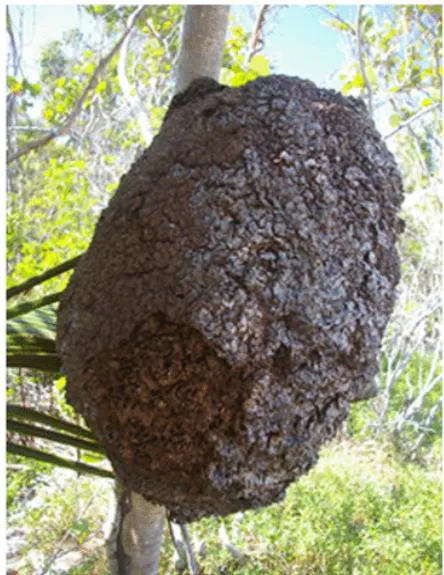
![Figure 1: Mexican termites maintain constant temperature inside the center of mound while ambient conditions vary dramatically. The axis of the mound indicates an afternoon time of heat flow reversal (see explanation in Figure 2). Figure 2: Sealed moist specimen of aerated concrete is placed under a constant temperature difference and its position is reversed at time zero to highlight the significance of the phase change [6].](https://doc.globaljournals.org/zrep91_61529/ocr/images/derivatives/70/704fa15725be8ff74fc2f216c51c0bac0db256ae8adb35c24de0b282a9d31b41.webp)
Interim Conclusion: Both the African and Mexican termites use interaction of different physical phenomena:
(1) Thermal buoyancy of air above ground sucks air from the underground channels and the thermal mass of the mound combined with it porous structure reduces radiative heat transfer (thermal insulation) protecting the cold air from heating during its passage, though the mound. (2) High air humidity and presence of water absorbed to the strains of fibrous material used for the mound structure combined with change of thermal gradient at a given time. Thermal gradient drives water in one direction and in afternoon in the other to provide a convective cooling by evaporation of water.
We could continue this review with analysis of many other cases such as the fur on a polar bear, feather on a duck or the structure of a human foot, but we believe that our conclusion is already clear, namely nature always uses a holistic approach.
b) The
Solar energy, in the form of shortwave radiation (because of the high temperature source) is about 1000 W/m2. Soil, exposed to sun for some time becomes dry (and good insulator) while moist soil will dissipate the heat by downward movement of water vapor. In regions with high frequency of solar radiation the depth of solar energy penetration is much larger than in those regions where cloudy days prevail.
The Earth's atmosphere absorbs heat from the earth's surface but the air temperature is reduced by about per each of distance from the surface of the earth. It means that in a clear night, the earth and building surfaces are re-radiating energy to the sky in the form of a longwave radiation (low temperature source).
Now, how are we told about the nature in the engineering school. Thinking about three terms that we have most frequently heard during our engineering education, we might say: (1) steady state, (2) superposition of phenomena and (3) linear dependence. Translating these terms into a plain English, it means that we disregard effects of time, or interaction between phenomena and we approximate functional relations with a constant first derivative of the function. Then, when working in applied physics, we have learned that "steady state" means an apparent equilibrium between energy or mass flows in opposite directions [6]. We have also learned that during the cycling of weather, some neglected interactions may cumulate errors that after some time can overweight the initial situation, and that exponential or logarithmic processes are more frequent than linear [2, 8]. In effect, all issues related to climate can be defined as stochastic or cyclic but seldom as the steady state [6].
c) Can our system become a nature-centered man-made system?
Differences between logistics of the traditional construction and structures of social insects are large: when buildings are constructed, they are supposed to function without modifications (it is not true, but people think so), buildings are operated with constant indoor climatic conditions, their efficiency is calculated using steady state approximations. Several individually designed components, each optimized to their own standards and controls, are put together and assembled into a building. With other words, our construction represents fragmentation that disregards conditions of use and seldom addresses adaptation to the climate [6].
The energy performance of buildings has recently been improved by introduction of IDP (integrated design protocol) [3] and BIM (building information program) but those measures are still insufficient. Taking average total energy use in small houses as 100 percent, the dwellings in multi-unit residential housing show in field 25 – higher energy use primarily caused by poor handling of air flows in high-rise buildings [9-11]. With optimized ventilation, the energy use per unit area should be lower in the multiple unit buildings.
Ecological, Thermo-Active (ETA) system [12,13] considers building as a system operating under transient outdoor and indoor conditions and uses adaptable indoor climate approach. This contrasts the current pattern of construction. Furthermore, the ETA uses field monitoring data and may use simple artificial neural network (ANN) models to assist in HVAC optimization. i.e., improvement based on actual performance data in contrast to parametric analysis made with uncalibrated energy models. Note that during the execution of High Environmental Performance house project [14s -16s] we have calibrated two energy models with initial differences about of and were able to use these models for further analysis.
The main reason for using the ANN characterization [17s - 20s] of the building is a reduction of effort. A "gray" model needs less information to characterize building structure and the increased volume of data for statistical handling is not a problem as HVAC performance must be characterized over all seasons in a full year. Note that energy ratings in the first year of the building operation are preliminary. In summary, the next generation of building technology discussed in this paper, expands the passive house [21, 22] with a vision of nature centered system.
II. THE HISTORY OF ECOLOGICAL, THERMOACTIVE SYSTEMS
In this section we will discuss four already published building cases:
- Hungarian demonstration of active thermal insulation (ATI) technology [13]
- US test house called GEST (geo-solar exergy storage and technology) [23s,24s]
- Canadian multi-stage construction process in Atelier Rosemont, Montreal [25]
- Japanese thermo-active system in the "Shogakukan" building in Tokyo [12]
allowing us to generalize lessons derived from these investigations.
a) Hungarian demonstration of active thermal insulation (ATI) technology
A term "active" thermal insulation was introduced by some people to highlight presence of a heat source or sink in the system. While in physics, presence of source or sink does not affect performance of the insulation, in a common language one use it to contradict the term "passive" that is used in energy conservation. Tamas Barkanyi patented in 2012 components for active insulation of buildings that provides a direct hydraulic linkage between two heat exchangers, one placed in the ground and the second one in the building exterior enclosure. For this reason, we use the term thermo-active system to replace the active insulation while using the existing terminology.
The concrete house used for demonstration, was built with a raised, livable attic space forming the second floor. The floor area was , wall area 573 and area of hydronic tubing in walls and roof was . Thermal storage was designed as a separate construction and placed under the building as shown in Figure 3.
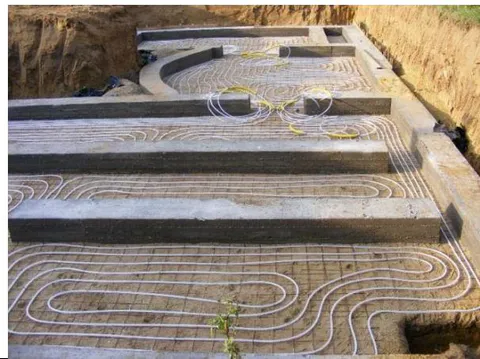
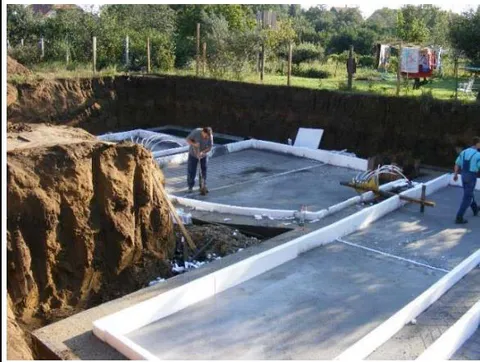
The total length of tubing in the heat storage was with 11 independent links to walls and roof. An electrical pump works continuously pushing glycol through diameter tubing that is placed with a typical distance of between lines. Temperatures on entry and return to both wall and storage heat exchangers are recorded in 20 seconds intervals.
In addition to the hydronic heating/cooling there is a mechanical ventilation system with capacity of with heat recovery ventilator. Preconditioning of ventilation air is achieved by long, wide ground air heat exchanger placed on depth and water to water heat pump (Model: NIBE 1140) is used as a secondary source of heating and cooling. There are 10 solar panels on the roof ( total area of panels) to heat domestic hot water and the energy storage that is located under the building.
The calculated energy use for the building is 144.5 kWh/(m2·y) and primary non-renewable energy is 12.1 kWh/(m2·y). Methodology of monitoring of and modeling is discussed by Kisilewicz et al [13]. Overall heat transfer coefficient was calculated there about 0.070 W/(m2·K) in winter of the analyzed year, while without the contribution of thermal storage the wall had the U-value 0.28 W/(m2·K).
Interim Conclusion: In the moderately cold climate of Hungary, a direct linkage between the ground source thermal storage under the house with heat exchanger located in about of the wall and roof area and loading it with summer solar energy has significantly reduced the winter energy need but an additional heat pump was needed on the air supply line to satisfy energy requirement for the house.
b) US demonstration, GEST (geo-solar exergy science and technology) house
The Geo-solar Exergy Storage and Technology (GEST) was built in 2011 in Central New York to demonstrate that a dramatic reduction of purchased energy can be obtained without the implementation of a heat pump [23s]. This was accomplished by retrofitting the building envelope with a "dynamic skin" coupled to the ground heat exchanger. (Here the word "dynamic" skin or "ground coupled dynamic" wall represents the same concept of additional heat source as active thermal insulation).
Large thermal mass at the ground heat storage and large surface areas of the heat exchangers located in the exterior envelope of the building can provide low-grade energy to mitigate both diurnal and seasonal temperature changes in a building in a cold, northern climate. The review of design details shows how one can modify the technology to allow reduction of energy while maintaining a good indoor climate in the northern and southern climates.
Earth/Water heat exchangers:
Summer:
Transfer heat from solar panels to ground for storage,
Exchange heat between liquid moderated GCD wall and ground.
Winter:
- Transfer from ground to basement for dynamic wall temperature control.
Figure 4: Transfer of energy from solar panels to ground thermal energy storage. (Note GCD = ground coupled dynamic wall)
Two of many tested setups are shown in Figures 4 and 5. Figure 4 shows liquid (glycol solution) operated heat exchange from solar panels to insulted ground storage and from ground storage directly to the building in the winter. This set up was simple to operate and effective. Conversely, air transfer shown in Figure 5 required a sophisticated control to operate and showed stratification of temperature in vertical direction by as much as during a cold winter day.
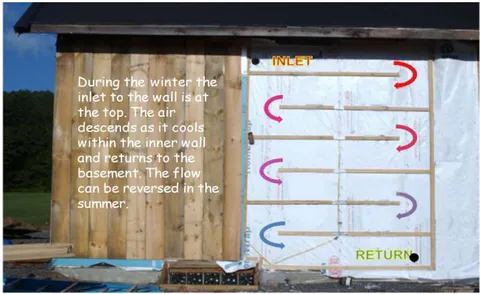
Interim Conclusions: This test house was used for different investigations, such a direct linkage between a horizontal, shallow, heat exchanger and the wall or using air convective, forced air heat exchanger. A hydronic ground heat exchanger with water sourced heat pump were the preferred options [24s].
c) Multistage construction in Atelier Rosemont cluster, Montreal, Canada
Two previous sections focused on the key to the next generation technology, namely an underground thermal energy storage. This section discusses the other side of the coin, namely economics. As retrofitting is needed for slowing the climate change rate one must understand why all the whole progress in construction takes place in new buildings construction and noting happens in retrofitting.
Traditionally, retrofitting is based on the return-on-investment thinking. Yet, as building performance and repair costs are unknown, the economic calculation is made on one item at the time leading us to the inefficiencies discovered in 1970s weatherization programs. The break-through came from designers of a Montreal settlement "Atelier Rosemount" [25] that created a new economic model of retrofitting process. By planning the construction process in several stages and starting from the least expensive initial building and going through retrofitting stages until reaching zero energy building, they combined new construction and retrofitting. These designers introduced a risk-free mortgage system for all stages following the first one.
Let us identify critical decisions in their process.
Design the process of retrofitting to zero energy level and select number of construction stages. The minimum is two but if the cost of the next stage is too high make it three or four. Set the period of first mortgage short e.g., less than 10 years. Stage 1 of construction or retrofitting must satisfy the code and standards and your investment conditions.
Perform stage 1 of the new construction or retrofitting and pay the mortgage from your specific mortgage account. You will continue the same payment when the stage one and subsequent stages are completed. You will re-mortgage the property when you reached zero energy level.
When the stage one is completed, use the physical value of the property as the basis for the next step (re-mortgage and payment on anniversary, add second mortgage, extend the mortgage payment to increase the rate of saving in your mortgage saving account.
When you have sufficient funding available, perform the stage 2 of your construction or retrofitting. If you have reached reduction of the space heating/ cooling, ventilation, and air conditioning cost, you have achieved the needed objectives. If not continue to stage 3 and with the next stage.
The actual case in Montreal Canada, re-financing case lasted 10 years when the difference between the cost of servicing the capital investment and the actual payment was growing with time allowing to perform improvements to the building settlement that in the current system of construction would
require 30 or 50 years of simple return on investment.
With other words, this model of financing combined leasing the energy cost to the owners of the properties and bank. This approach permitted achieving zero energy for social housing! The Montreal project was designed for completion in 10 years and when completed it satisfied both the economic requirements of the bank and the technical requirements of the society giving the project a win-win-win to the owners, society, and bank. We are giving the specific details of the economic model because in some countries, some community, or user-friendly banks (Sweden in 1960s, the US now) are giving a lower interest rate to schemes involving the property improvements.
Figure 6 shows the buildings to which different stages of energy reductions that were applied from 2008 (0% of total energy reduction) to 2018 (92% of total energy reduction) [25].
- Stages of improvements from 2008 to 2018 in Atelier Rosemount, Montreal.
- High Performance enclosure, common water loops, solar wall resulted in reduction of total energy use per square meter and year.
- Gray water power pipes, increased total reduction in energy use to .
- Heat pump heating (planned with horizontal heat exchanger), increased the total reduction to .
- Renewable 1: Evacuated solar panels for hot water, increased the total reduction to .
- Renewable 2: Photovoltaics bring the total energy reduction in 2018 to .
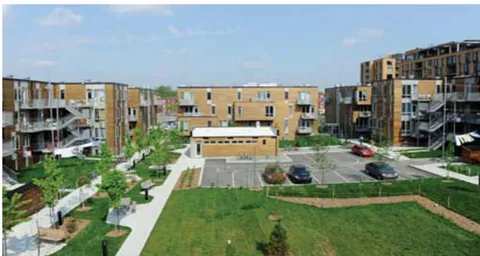
Some issues related to installation of water-to water heat pump in this project did not work. A horizontal heat exchanger was not used in Hungarian and Canadian projects, therefore, the design of shallow, horizontal, underground, heat exchanger require more research. Yet, despite of different time and locations the same magnitude of the passive measure impact is observed in the US, Hungary, and Japan (next section), namely we see that passive measures may reduce total energy by .
Interim Conclusions: The new economic model developed in this project is a key to the next generation technology. The unwritten effect of this economic model is that the difference between new buildings and retrofitting disappears.
d) Thermo-active system in the Shogakukan building in Tokyo, Japan In 2020, Shogakukan was awarded with a first place in the ASHRAE Technology Award that recognized outstanding achievements in innovative design of buildings for occupant comfort, indoor air quality, and energy efficiency in a Shogakukan building in Tokyo, Japan [12]. A special box-like construction of the floor replaced a suspended ceiling construction, and a hydronic radiant cooling was installed in the ceiling. The exhaust air from the room was used to cool the floor making an additional cooling system. Post-occupancy optimization of the HVAC (he second requirement of EQM technology) was completed in 2018 and energy used by the building for cooling was reduced to . This building used the adaptive climate approach for air temperature. The night temperature was initially . It was increased to in the morning and during the period from 9:00 to 15:00 allowed to increase up to . Note that the layer of exterior thermal insulation in Shogakukan was very thick, namely 450 mm, because the water cooling was only of the total cooling load.
Note that in residential building one can go to more than 90 percent of heating load being taken by the hydronic system. As one of co-authors was a project manager in 2006/7 NY project (High Environmental House [14s]), knowing a long response time of the hydronic system, an additional, rapid response air heating system was designed. Yet, this air system was never used during the full year monitoring period.
b) Summary of the reviewed Ecological, Thermo-Active Systems
Today, the functional definition of a building system includes both solar panels and ground thermal storage. For this reason, the GEST (geo-solar exergy storage and technology) was selected for a PhD thesis [23s]. To be brief, we refer to a few of our network publications during the last 15 years. We started with a research project [14s - 16s] called High Environmental Performance (HEP) house, carried out in years 2005-2008, with objective to determine the level of energy saving possible without using renewable energy in a cold climate. The project demonstrated that reduction in energy use in comparison to New York energy code was achievable without renewables. The lessons from the HEP project and the thesis [23s] justified introduction of a second air gap between the old and new construction [26]. This air gap can function as source of sink for thermal energy and water and becomes a key to interior renovation.
While next few years were focused on materials and moisture performance side [27s-32s], the concept of the construction system was developed in a preliminary series of papers [33 - 35] and final concept description [36- 38] under the name of environmental quality management (EQM) technology. Another important research that was incorporated in the EQM technology analyzed such aspects as comfort [39 - 41], retrofitting practice [42 - 45], computer modeling [46 -49] and significance of air gap [50].
The other co-author participated in years of research and tests of ground thermal storage in Cracow that resulted in a few basic rules for design of ventilation system [36]. An important recommendation from this source is that to optimize air intake effect one must use two independent type of air intake for ventilation. It explains why one can observe differences in efficiency of a single source used for heating and ventilation in Hungarian test house [51].
Montreal project is interesting not only because it introduces a new economic model, but also because it deals with a full district of 3-story houses. They differ in many respects, some are luxurious with cross ventilation between north and south, other are social buildings of the city and yet an average energy reduction without renewable sources of energy is 60 percent. Note that in this project care was taken about many details typically not considered in a standard construction, e.g., heat recovery from hot water pipes when delivering it to the gray water container. Secondly such a high percentage is only possible when one considers a cluster of buildings with significant volume of soil surrounding buildings and well controlled ventilation system.
Note that the Montreal project broke the boarders between new construction and retrofitting and between a single building and a cluster of buildings. In conclusion of this paper, we will provide a new environmental definition of the building as an ecological system.
III. NEXT GENERATION OF ECOLOGICAL
AFFORDABLE RETROFITTING SYSTEMS
Using an example of patented ETA (Ecological, Thermo-Active Systems) we have introduced a broader concept of generic EQM (Environmental Quality Management). The six main characteristics of the next generation of these ecological and affordable buildings are:
Use of all technical measures from passive house approach
We recommend moderate requirements for thermal transmission e.g., U-value 0.25 for walls and air tightness e.g., on assembly (75 Pa difference) or , measured in situ (50 Pa difference). Practical experience showed that this type of criteria, used during 1990s, were easy to achieve and economically justified.
- Use of solar panels, heat pumps and ground thermal storage
We recommend using hybrid solar panels, and electrical water-sourced heat pumps (HP) coupled with ground storage, in all climates. A split-level HP coupled with large indoor thermal mass can also be used. Generally, in cold and moderate climates we use of two water tanks, inground exterior, cold water tank and interior hot water tank. Sometimes, the gray water is also used as lower terminal of HP. In hot climates, shallow exterior water tank requires special design to increase heat dissipation.
Use of a hybrid, flow through, ventilation system
We recommend preconditioning of ventilation air either in a ground heat exchanger or through coil immersed in water tank. Such a system of mechanical ventilation is required for all residential buildings in all climates that provides either a flow through instead of dilution or dilution with additional M13 filtration. Research experience from California indicates that the rate of ventilation must be adjustable. For coping with air-borne viruses, one recommends the range from 0.3 to 3.0 air change per hour. Furthermore, as optional solution one may generate air pressure gradient in a habitable space. Yet to do it, one must have a moisture management system that drying moisture from the existing walls. (Note that the practical details of such a system requires more research).
Use of a two-stage construction process
To alleviate a conflict between society and investor we propose a two-stage construction process. In the first stage one achieves performance level possible for the selected initial cost while the second stage continues to optimize cost for the selected performance level. In the first stage the building is completed at a minimum performance level that is acceptable to both the building code and the investor. The designer predicts continuation to zero energy level that may be initiated a few years later.
At this stage we have no more practical experience from the buildings already constructed. Yet we propose two additional characteristics for EQM (ETA) technology:
Use of adaptable indoor climate
This approach implies:
- (a) That to control thermal mass contribution to the indoor climate the hydronic heating/ cooling tubing must be placed on the interior side of thermal mass of the building. It is also recommended that the total thermal mass should be sufficient to achieve thermal lag time between 12 and 16 hours. These controls, combined with dynamic operation of thermal storage would reduce or eliminate peak loads.
- (b) Adjust the capacity of thermal storage for the use of technology in relation to building type and climate.
Until now, simple individual controls were used in all discussed cases, but lessons from GEST house indicate significance of optimization of the HVAC system.
- Capability of post-construction HVAC optimization
A concept of field monitoring and modeling for HAC optimization has been evaluated with Modular Statistical Software and simple artificial neural network (ANN) models [17s -20s]. These or similar models will be used to calibrate energy models used for optimization of HVAC performance.
An EQM/ETA technology was assembled from the best pieces of proven and tested solutions and while some issues need yet to be developed, it has been tested in a few countries. Is there any problem in introducing it to the marketplace?
There is no problem in terms of business; sooner or later we will get there. Yet, right now we need to institute a major and rapid action against climate change and retrofitting existing buildings is one of the best practical solutions for a rapid action, so the problem is of a different nature.
The problem is that the currently used, passive house technology, was demonstrated in Canada during year 1978 i.e., two generations ago. An adage says that human being is a creature of habits and humans also need slogans in addition to daily bread.
Thus, in search for the solution we must go back, exactly for 100 years, to the time of Dale Carnegie.
IV. UNDERSTAND BEFORE YOU SIMPLIFY OR SIMPLIFY TO UNDERSTAND
Scientists always had to understand the complexity of many interacting factors before that could derive measures controlling one specific aspect of the matter. So, the statement "understand before you simplify", described well the scientific method of analysis. Yet after the WWI a trend, exemplified by books of Dale Carnegie (how to win your friends) appeared in public. One would focus on one or a few selected critical issues, often taken out of context, and use them to represent the complex situation. We call this action, simplify to understand.
With time, this trend to easy simplification replaced the scientific method of examination in journalism and politics. While Einstein, supposedly said "make it simple but not simplified, not any people knew where the border between simple and simplified is. As a next generation of people learn the simplified picture of science or technology, we now have proliferation of semi-educated engineers, who may have only a narrow range of their specialty.
Let me give some examples from the construction area. In the last 4 decades we had spent huge amounts of taxpayers' money on weatherization programs, solar panel installation, now on heat pumps. All of them are based on good intention and one single factor at the time while buildings are like a sieve, when clogged in one place -water goes to another. Politicians always talk about renewable energy, and this is correct but before you put icing on the cake you need to have a cake. In 2008 we showed in NY that after increase of the design requirements for 30 years we still had of energy loss that could be eliminated by a better design. But design was limited by the cost of design.
Today small houses are OK but actual energy performance of multiple residential buildings has not been improved for last 30 years. At the same time politicians promise that soon our buildings will be zero energy and zero emission. This a dangerous schism between the good wishes and the construction practice.
V. ARE CONSTRUCTION MARKETS READY FOR DISRUPTION?
Speaking for American market one may say with a degree of certainty – yes, the marketplace is ready for disruption. Samuel Raskin in his seminal course on Housing 2.0 [52] lists four types of crises:
- Affordability of housing slowly diminishing over last two decades became drastically reduced in effect of COVID
- Retirements of skilled workers and lack of their replacements in trades
- Growing productivity gap between other manufacturing branches of industry and stagnated construction (the gap is now about in the US)
- Digitalization, construction is slow to accept digital processing and off-site manufacturing e.g., off-site construction is less than in the US while more than in Sweden.
Those are not new factors. They would not cause the scientific revolution, but a background necessary, as taught by S. Kuhn [53], that together with the urgency of social response to dangers brought by the climate change and public realization that inadequate type of ventilation system in residential buildings and luxury cruise ships multiplied the spread of COVID 19 pandemics. Traditional ventilation systems relied on dilution while ventilation used in hospitals uses flow through (flushing) the air. Furthermore, it becomes clear that a slow air movement is needed in all dwellings in all climates and opening windows (except in the cross ventilation) will not provide such effect.
There is also a difference between an expected and real energy performance of buildings. Thermal resistance of material slab is defined as a ratio between a steady difference of temperatures on its both surfaces and heat flux through the slab. So, it you take an average temperature difference on the wall surfaces, area of exterior enclosure, and total energy used for space heating you should get something comparable with the average thermal resistance of the walls. Yet expressed in this way effective index is smaller than the laboratory measured thermal resistance of the walls (roof is much higher than walls). The approximation in this comparison is huge but we make it to highlight how little we know about differences between the actual and estimated exchange of air in large residential buildings. Yet, national standards of most countries continue increasing the required nominal (laboratory) thermal resistance and nominal air tightness of walls".
There is also one new market consideration in the globalized economy, digitized and optimized construction systems are easily to export and penetrate to those market that are unwilling to participate in the post-covid reconstruction. Thus, it is not a question if the construction market is to be disrupted but the question if the market changes will benefit the investor alone or the investor and the society.
VI. A NATIONAL RETROFITTING PROGRAM, A WIN-WIN-WIN IN MAKING
Published in 2008 white paper [54] quoted a United Nations report:
"The good news is we have got a huge source of alternative energy all around us. It is called energy conservation, and it is the lowest cost new source of energy that we have at hand. Since 1973 alone, improvements in energy efficiency resulted in a reduction of our daily energy use, which is the same as discovering 25 extra million barrels of oil equivalent every single day. Clearly saving energy is like finding it".
.](https://doc.globaljournals.org/zrep91_61529/ocr/images/derivatives/a0/a0deed4069d3f7c1ab52431be282dc28bc6455c30ed592b7ed27497e8202ace0.webp)
Figure 6 showed building as usual (BAU) and with assumption that all new buildings will have energy reduction and concluded that we must reduce the energy use in all existing buildings by before 2030.
In 2022 we may say that we are on all right with new construction; but retrofitting is a dramatic failure. Of course, a progressive approach was used for new construction it was ignored in retrofitting of existing buildings.
The 2008 white paper stated:
"At the far end there is an AIA commitment to achieve a 2030 carbon neutral future. There is a chasm that must be bridged if the goals are to be achieved and there is confusion on how we can accelerate the process of renewal. Despite the large amount of knowledge and industrial know-how available, we realize that the old vision has ceased to be valid. We need to create a new vision because the stakes are high."
Yet, 14 years later, we do not have the vision because construction is not a priority in any of the industrial countries. Yet, each of these countries are fully committed to slowing the climate change, We need to design such a program in the context socio-economic changes in our society and review the role of buildings in this program.
a) A vision for the next generation of retrofitting technology
It has been established that a combination of passive measures with solar engineering and geothermal heat storage is necessary for low energy housing in all climates. The significance of the individual components will vary with climate and socio-economic conditions of the country but the demonstration house in Hungary showed that there is no one component that will satisfy all the needs for energy and both the source of energy (sun) and storage of energy (geothermal) are equally valid in different countries. Obviously in the extreme cases our energy handling is strictly opposite. In cold climate one deals with heavily insulated seasonal thermal storage while in the hot climate one deals with ground as means of energy dissipation in the heat pump technology.
We are dealing with the industrial revolution. The first was based on steam generated by burning the second of coal, the second on use of other fossil fuels, the third used power plants for manufacturing electricity and the current revolution uses distributed sources of electricity and computer power to control the system. In this revolution buildings changed their role from the biggest users of electricity they become the biggest producers of electricity.
The changing role of building also requires a change in paradigm of thinking. Sustainability involves harmony between different aspects of the environment, society, and economy. The broadening of the scope of considerations affects the field of the building science in
North America (building physics in Europe). Now, in the quest of improving building performance, the building science merges concepts of passive houses with solar engineering and integrates building shell with mechanical services, but the focus is still missing. The focus of the building science must be reestablished on occupants. In doing so, one will combine indoor environment with aspects such as energy efficiency, ventilation, indoor air quality or thermal comfort with durability of the shell and affordability or resilience of building on the other side.
The methods of building evaluation are also refocused because today we pay attention to interactions between different functions of the building. Now, eenvironmental design process comprise of five steps:
We address passive measures and factors affecting indoor environment such as temperature, indoor air quality, acoustics, daylight, illumination, hot and sewer water management, aesthetics and building resilience in disaster situations.
We integrate heating, cooling, ventilation, solar means for energy generation and geothermal storage thorough the building automatic control systems.
Parallely, we perform an economic analysis to determine the level of investment for the initial building design or the initial stage of retrofitting. For example, one must decide to what extent should photovoltaics be included in stage one.
Finally, we design monitoring and recording of information provide the design and cost for stage 2 of new construction or retrofitting and develop a comprehensive operational manual for the building.
During the first year of data collection, we optimize HVAC, develop model of energy for the building and verify the carbon emission and other critical elements in the operational manual.
In this work we define a zero-carbon building (ZCB) as: "A zero carbon building is a highly energy-efficient building in which carbon-free renewable energy or high-quality carbon offsets are used to counterbalance the annual carbon emissions from building materials and operations so that with time, it offsets the carbon emissions embodied in the original construction process. Without an accepted ZCB definition, one cannot analyze the building as a system and without a verified carbon emission during the operation of the building the carbon calculations are not realistic. To minimize the GHG emissions from the generation of electricity requires re-evaluation of the way we do modeling and the way we design the building operation. As today decarbonization is not included in the cost calculations, one must be prepared for inclusion of decarbonization in the next generation of buildings. For this reason, we postulate rethinking the fundamentals of the retrofitting technology.
b) A
During 2021 Climate Conference it became clear that the establishment perpetuates the old thinking while young people demand a new approach to mitigate the impact of climate change. The authors also believe that it is time to replace the old approach to buildings, where hundred pieces were designed separately, and someone had to assemble them, with a new, holistic approach.
We see technical progress in hydronic systems based on electric heat pumps and hybrid solar panels, we see that next field of building automatics will be to link controls for operation of HVAC and modification of air distribution systems with smart buildings, but we also see that unless we create broad public-private educational programs with demonstration of a new generation of retrofitting we will get nowhere.
Currently, it appears that the is a scientific vacuum in the field of environmental engineering in construction. By default, the codes and standards took the lead. Yet, code and standards are created to normalize already proven and accepted technology and we still have not achieved any public and acceptable consensus. As during last decade of the previous century research has been redirected to serve industrial competition, no country today has a building science organization capable of providing lead. Many countries, however, made commitments to slow the climate change and there is a strong need for a paid action. It appears inevitable that solutions used in 1980s must be used again.
In that time, we had no illusion about the inability of the old approach to sever the socioeconomic needs and creating national programs of public-private mixture with a strong component of building consensus via education and field demonstrations appeared normal. Programs like R-2000 in Canada, Building America in the US, Japan-Canada joint forum for introduction of increased thermal insulation in Japan were very successful in involving brad public participation.
While the change in environmental control is urgently needed, this change requires understanding of building is a system and this part must come from the scientific community. This vision must have occupant in control of indoor environment and design focused on the system while materials will be judged upon fulfilling the requirements for assembly and subsystems. Yet, builders listen only to their clients and if public is not convinced that these issues are critical to climate change, nothing will happen. We had significant IEA annex [55] and student thesis work [56] that had only minor impact. Meadows [57] produced a list of most important factors that modifies people motivation. On the first place he lists transcending paradigms an on the last (11th place) numbers, parameters such as subsidies, taxes, or standards. She defined transcendent paradigms
"The shared ideas in the minds of society, the great big unstated assumptions, constitute that society's paradigm, or deepest set of beliefs about how the world works. These beliefs are unstated because it is unnecessary to state them - everyone already knows them"....
and criticized the sustainability research
"Notice, however, that most of the current sustainability research...is focused on the least effective leverage points like the economic aspects.... politicians believe that sustainability is mainly an economic problem. So, "Numbers"... and parameters such as subsidies, taxes, and standards become the focus.
Change from the current dealing with retrofitting as a matter of payback time to the critical step in slowing climate change may appear as being trivial, while we believe that this change of thinking paradigm should motivate all involved in building science to mobilize the public and explain to politicians that the importance of post-covid changes in technology. In doing so the society wins new market of retrofitting created by two-stage construction process, dramatic reductions of energy savings and carbon emission, reduction of SARS-CoV-2 rate of domestic infection spread (if ventilation is overhauled), and significant job creation market and occupants gain better living conditions. This review shows that it is not the gas emission or the energy saving but that an emerging holistic vision that must be communicated to the broad public. The only way to accelerate the green revolution is not through green materials but through a broad public-private programs of education and demonstration about the need for reinvesting into the next generation of retrofitted buildings.
c) The need for action
While this paper is about the way we deal with technology rather than about technology itself, the repeated question that comes to mind is why it is so difficult to start from the first principle rather than continue the small increments that we were doing for the whole life until now.
So, let us reiterate the key issues that we have highlighted in the paper. We define the near zero energy building as a system that must comprise of solar panels and geothermal energy storage. Solar panels may be on the roof, built in walls or located somewhere else. The geothermal storage can be under the building, near to the foundation or somewhere else, e.g., be a part of district water heating. The building may supply energy to, or receive energy from, the smart grid or even be independent of the grid. Thus, the border between the building and a cluster of buildings became vague. Furthermore, an optimization of the building cluster is easier with local district heating if one deals with a cold climate.
To alleviate conflict between investor and the society, we have introduced the two-stage construction approach. This causes the border between new construction and retrofitting to disappear. Now you can see that the scientific revolution takes place in construction precisely as described by Kuhn [53]. We can also see how building science by placing stress on mechanically ventilated air gap facilitated a concept of double-glazed cavity in which air goes up and down to achieve facade cooling with summer load reduction or how a broader analysis of the Hungarian demonstration house [51] showed winter energy saving of of the total energy.
We do not question the technology role in changing our perception of reality. We only question that technology alone works too slow. To achieve changes that we talk about, it may take two generations instead of two years. If we really want to slow the climate change, we must right now create a national, public-private initiative for a mass retrofitting with an occupant wellbeing in center of the holistic and sustainable vision of built environment.