INTRODUCTION
Schools and communities are generally spaces where people encounter and become aware of a variety of different beings. People can demonstrate care and compassion for others and can also act and grow without being controlled by the desires of others. However, at present, it does not appear to be such a space in Japan.
The movie "Spirted Away" (2001), for example, suggests this. The main character, Chihiro, an ordinary girl from a middle-class family in Japan suddenly found herself lost in a strange world inhabited by gods. At first, she was only concerned with helping herself and her family. As she engaged with others, she became aware of a higher purpose of living. In this process, she took care of the loneliness of a character (Kaonashi or faceless) who lost their social identity and got desires bloated and aggressive. At the end of the movie, she cared for the restoration of the river god, wounded by human activity. Her concern shifted from the stage of self and family to the resolution of more universal issues such as loneliness and environmental destruction. She did not achieve a given agenda, showing care and compassion, but found her own agenda and acted on it.
The movie suggests what opportunities should be given to children today. Schools and communities are not a space to fulfill the desires of others but to restore self-awareness and compassion for others. It is to be a place to engage with others and society that has been damaged by loneliness, environmental pollution, and so on. In other words, children need a process of emancipation to the wider outside world while engaging with others. This process can be called the Social and Emotional Learning (SEL) as Goleman & Senge (2010) describe:
If after a while she is just following the teacher's goals for what she should learn and not thinking much about her own goals, she can develop an attitude that school is all about other people's agendas - and fail to tap her inner reservoir of motivation and engagement...In the school years, the equivalent is "good learning" - being engaged with what feels important, what we are enthused by, and building the skills and constructs that we can get better at as we progress (Loc:93-99).
The factory model of education enforces students to compete to arrive at the only correct answer as quickly as possible. Through the modernization process in Japan, schools deliberately built a highly homogeneous society and sustained it for economic efficiency. The school system controls every detail of a student's life even today in the 21st century1. One of the reasons for this is that Japanese school education emphasizes "intellectual, moral, and physical education" at the same time. The system is originally set up so that children can grow up in a well-balanced manner2. Ironically, the above problem is caused by Japan's longstanding adoption of whole-child education, including physical and mental development, as opposed to Anglo-Saxon culture, which emphasized cognitive skills as a criterion for selecting outstanding students. The Japanese students, who have been expected to realize the agenda prepared by their teachers for more than 12 years3 , are at a loss when they are told to "freely choose a theme" when they enter university. Freedom is the most painful for the mindset that it is natural to have choices prepared in advance. Cognitive skills are examined in university entrance examinations in Japan, while the children are educated for non-cognitive skills that are the outcome of SEL at schools. If social and emotional skills can be developed more than cognitive skills in lifelong learning (Cunha & Heckman 2007; Cunha, Heckman & Schennach 2010) after university graduation, then universities should ensure SEL as the last chance in the formal educational institutions.
From the above concerns in this article, we focus on virtual communication in Japanese university education with the following research questions:
What conditions are necessary to make SE skills possible in formal university education in Japan, while the skills are considered difficult to develop in formal education?
How can Japanese students be freed from social norms by encountering themselves and the different others? Even though their mindset has been shaped by the whole education including SEL, they are educated by the norms set by others.
I. THEORETICAL FRAMEWORK AND RESEARCH METHODS
a) SEL in Japan
Originally, social skills and emotional skills were thought of as two separate things. In the 1990s, Goleman proposed the idea of emotional intelligence, and the idea of integrating both were expanded. CASEL, an American educational organization founded in 1994, defines SEL as follows:
Social and emotional learning (SEL) is an integral part of education and human development. SEL is the process through which all young people and adults acquire and apply the knowledge, skills, and attitudes to develop healthy identities, manage emotions and achieve personal and collective goals, feel, and show empathy for others, establish, and maintain supportive relationships, and make responsible and caring decisions. (CASEL 2021: 1)
CASEL highlights the five core areas: self-awareness, self-management, social awareness, relationship skills, and responsible decision-making, and says SEL is the" missing piece" in education. The SEL program has been shown to reduce violence and bullying, increase pro-social behaviors such as liking school and improving attendance, and even improve academic performance. OECD (2015) has been working on SEL in formal, nonformal, and informal settings for skill development, as it conducted a series of research on the Social Outcomes of Learning project (2005-
2010). They show that these skills can be viewed as learning outcomes for a well-functioning society and that they need to be addressed from the earliest stages of development.
The SEL-specific contents are not particularly new to school education. Elias (1999) and Sprenger (2020) introduce activities in subject lessons and social learning such as role-play, debate, art, and volunteer activities are common as SEL. At the same time, as diversity are more visible, the development of interpersonal relationships such as care, respect, and compassion can surely contribute to the prevention of problem and to well-being in a multicultural society as Elias shows:
Having a multicultural perspective requires SEL skills, and neither can be conveyed didactically. Both the perspective and skills become developed through guided, lived experience, even in schools that may appear to be lacking diversity -- at least on the surface4.
In Japan, SEL has also emphasized the prevention of student's problematic behavior (Watanabe 2015, Koizumi 2016), but it also develops the good character among the children (Ikesako, & Miyamoto 2015). However, the current state of school education in Japan nurtures children to be good at conforming to others so that they do not engage in deviant behavior in groups. Therefore, one of the major factors that undermine the attractiveness of learning in schools is the class environment neglects the consistency between the cognitive and non-cognitive aspects.
In the case of university students, they received enough evaluation in goal achievement but less in collaborative work and emotion management. They studied hard for entrance examinations, but their classmates were competitors for the selections among themselves under the pressure of being the same as others.
One of the approaches to free the students is the multicultural co-learning class (MCC) in universities in Japan. According to Suematsu (2019), MCC is defined as "a multicultural learning experience in which learners from different languages and cultural backgrounds share, understand, and accept diverse ways of thinking through meaningful interaction, and create new values through the reinterpretation of the self." The sense of "multicultural learning" is important for the Japanese youth because they must recognize the variety of cultures, meaning not only nationalities and languages but also ethnicities, genders, occupations, and hobbies as multi-layered individuals. It is difficult to see the invisible aspects of cultures for the Japanese students who experienced standardized social norms. For example, food, fashion, and festival are easier to see but values and meanings of behavior are not clear enough at a glance (Sakamoto et al 2017). MCC aims to create a support for mutual learning among learners from multicultural backgrounds. When Japan expanded accepting international students as a national policy, most universities, as a part of university reform, actively opened their gates to welcome them from all over the world. However, they had a common problem: Although both Japanese and international students want to communicate, they can hardly talk and develop friendships. MCC has been a solution to the problem.
University MCC sets the goal to develop a multilayered understanding of such differences and commonalities that are difficult to see in the invisible parts of culture. There are many conditions for MCC. The presence of "others" is an important condition. Others do not necessarily mean other nationalities but bring some difficulty in understanding mental dilemmas. When the students work on a group task, they must have a common target in order to make the invisible expose. This article uses a case in which the students encounter others, meet the outer world through their dialogues, and transform their inner world.
b) Research Method
In 2020, online university education spread rapidly with the start of the COVID-19 pandemic. While the advantages of online classes without spatial restrictions were enormous, the Japanese students were of course very dissatisfied with little face-to-face interaction. For students interested in international exchange, in particular, the fact that multicultural opportunities such as study abroad and the arrival of international students in Japan had been halted was discouraging enough. As an alternative, virtual exchanges were actively developed at many universities.
In this study, the first author conducted a multicultural communication class in which sixteen undergraduate students took part in 2021. All the students agreed with this study's purpose and cooperation with clear written statements. The three multicultural communication events with non-Japanese students aimed to provide an opportunity to reflect the Japanese students themselves. The final report was required for responding to their experiences in talks about social issues with others, most impressive thing, and their own explanation about multicultural understanding.
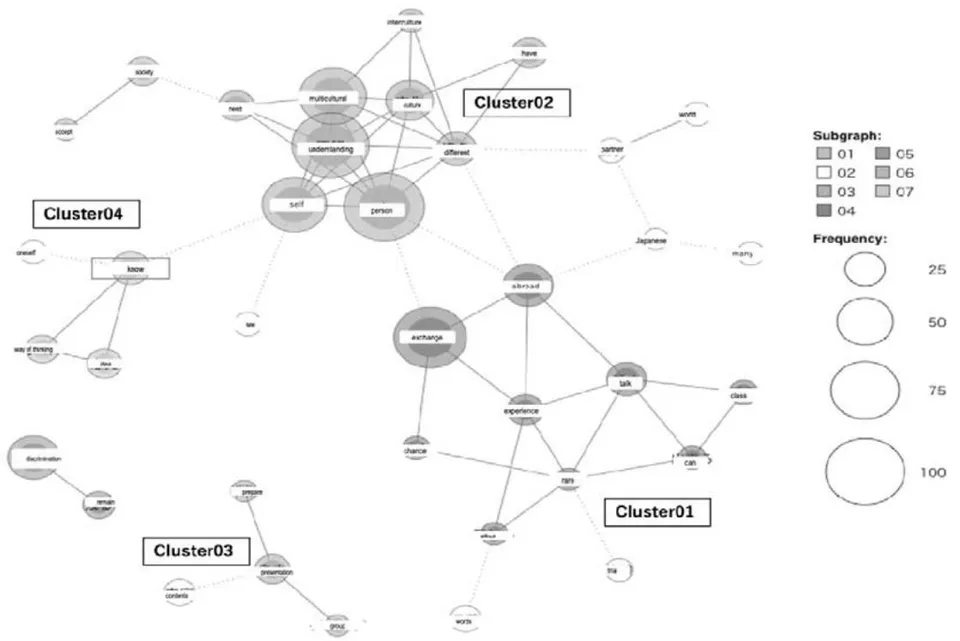
In order to catch the changes in the mindset of the Japanese natives, their responses in three events and required final report were coded by KH coder application5. The coded results were shown as networks of texts with high or low relationships among the words.
The larger the bubble becomes, the deeper the relationship between the words is shown.
II. CASE STUDY: ONLINE COLLABORATIVE LEARNING
a) Target Practice
The illustrated case here is online multicultural communication in Japanese between native speakers and international learners of Japanese as a second language. Changes in the mindset among the Japanese students were the focus after MCC practice. The target Japanese were not often connected with international students because of their low English skills. They needed to challenge the communication events to overcome their hesitation and low confidence. This MCC course was designed for undergraduate students with fifteen 90-minute-units (Figure 1). First one-third of fifteen units focused on self-awareness, the second for the meet-up with the Vietnamese students, and the final for MCC and reflection. The Japanese students picked up one of the Sustainable Development Goals (SDGs) to know better about the outer world by communicating with others. The instructor of this course played a facilitator role in these participatory classes, while the instructor intervened, when necessary, as illustrated below. The course formats are as follows:
Figure 1: 15-Unit Course Contents
| Topic | Main Activities | |
| 1 | Introduction | "Do&Be Cross", Icebreaking |
| 2 | Workshop | Each student shared one slide on the theme "What promotes multicultural understanding? |
| 3 | Workshop | Each student shared one slide on the theme "Lack of multicultural understanding." /Watch "Blue Eyes - Brown Eyes" by Jane Elliott |
| 4 | Reflection | Reflection and sharing on "Blue Eyes, Brown Eyes" |
| 5 | Select a theme | Students to choose their own themes based on their interests in the SDGs. |
| 6 | Preparation for a meeting with a Vietnamese univ. (1) | Lecture: The Rapid Increase in the Number of Japanese-Language Learners in Vietnam and Its Background/Current Status of Vietnamese Technical Interns in Japan/Working in groups |
| 7 | Preparation for a meeting with a Vietnamese univ. (2) | Lecture: Businesses between Vietnam and Japan/Assign roles for the exchange meeting. /Working in groups |
| 8 | Preparation for a meeting with a Vietnamese univ. (3) | Lecture: Contemporary History of the U.S., Vietnam, and Japan/Assign roles for the exchange meeting. /Working in groups |
| 9 | 1st Meet-up | Exchange session with students from a Vietnamese university |
| 10 | Preparation for Meet-ups (1) | Reflection/Lecture: The Pitfall of Cross-Cultural Understanding//Working in groups |
| 11 | Preparation for Meet-ups (2) | Lecture: Shifting the Paradigm from Intercultural to Multicultural/Read picture books: "Les Papas de Violette"/If you come to earth"/Working in groups |
| 12 | Preparation for Meet-ups (3) | Assign roles for the exchange meeting/Working in groups |
| 13 | 2nd Meet-up | Exchange session with students from multiple universities |
| 14 | 3rd Meet-up | Exchange session with students from multiple universities |
| 15 | Reflection | Video Reflection on Meet-up (2) and (3)/Final Reflection |
The first activity was that the students chose one tree out of four (Figure 2). They made a peer work after they identified themselves as one tree based on their comprehension among the four types. The four trees represented these characteristics:
Subjective and positive: Deeply rooted in the earth, its thick trunk grows straight, and its leaves are vigorous.
Objective and positive: The trunk and the roots are thin, but it grows straight.
Subjective and negative: The trunk is bent in the middle, and the leaves are thick and unbalanced in only one direction.
Objective and negative: The trunk is thin and the leaves have fallen off. No branches have grown.
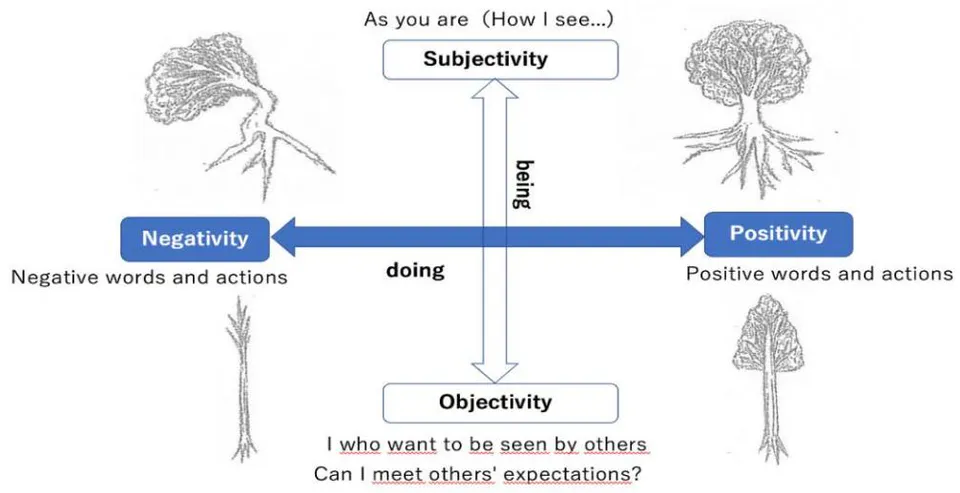
Although there were no correct answers, they chose one and found their check their inner world for a moment. Trees can be interchangeable when their mood changes as like tree under the good or bad weather. Trees do not stand alone on the ground, but they move like talking in the wind. The second unit let the student choose one picture showing "accelerator of multicultural understanding" after this inner work[^6]. In the third unit, "lack of multicultural understanding." The fourth unit was discussion among the students after watching the documentary "Blue Eyes, Brown Eyes". Sprenger (2020) introduces this film as an SEL activity, even though it was produced by Jane Elliott and well-
known today as a traditional experimental lesson for multicultural understanding.
The present course firstly saved time to imagine the children's emotions in this "Blue Eyes, Brown Eyes" classes, while the Japanese university students reviewed Four Trees at the first unit. Student's discussions went on and two controversial opinions emerged. One was critical against the "Blue Eyes, Brown Eyes" practice because they wondered whether or not Elliott had a right to hurt trust among the children there. The other opinion was positive for the Elliott's practice because higher order recognition or meta recognition occurred among the children because this practice turned their mindset to ideal situation of no discrimination instead of binary relationships. The students discussed the justification of the practice based on these two opinions, and one student pointed out how weak the children were in the society. It was a good point to share among the students because they must reflect on the social norms around themselves. When they found similarities and differences between the different perspectives, the instructor led them enjoy their feelings. They finally chose one topic from the 17 SDGs by themselves to talk with the Vietnamese students at the Unit 6.
b) Preparing and Holding the Meet-up with Others
i. More Imagination Needed
There were two significant points to explain here. One was how the instructor had to intervene their questions to ask for the Vietnamese students. The Japanese students prepared questions from the sixth to eighth units to ask at 9th unit of the first meet-up, shown in Figure 1 above, and would share them with the Vietnamese counterpart because they would learn Japanese vocabulary prior to the class.
The first draft questions were, however, so indistinct that the instructor had to warn the risk of miscommunication. For example, "Tell me about the measures against the Covid-19" and "Are schools different between north and south in Vietnam?" were too wide and pointless for the Vietnamese to answer. Without any explanations, "Have you ever got discriminated? "and "Send us a photo of a dirty street" were surprisingly meaningless and even rude to ask. The instructor must have explained the purpose of the meet-up as MCC because some students, as like other ordinary Japanese people, internalize being Japanese as something valuable more than being Vietnamese. The instructor asked the students about expressions of questions and expectations of responses. The students finally developed questions for the meet-up (Figure 3) through this process. This process was important to develop their imagination toward the other people.
Figure 3: Questions Prepared for Online Meet-up with Vietnamese (9th Unit)
| Topic | Questions |
| Health and Welfare | What do you care about measures against Covid-19 in public place? |
| Community | For better living in a city, we have strong noise and garbage problem. Our city has detailed rules for garbage separation. Is there a garbage or noise problem in your city? What kind of rules do you have? |
| Inequality/Discrimination | Asian hate become a serious issue in the USA. Do the Vietnamese feel the hate against the Asian if visit the USA or European countries? |
ii. Building Comfortable Space
The second intervention was for an emotional sudden change of the topic. The students started to avoid the question about their own background and ignored a presence of the minority. The group was planning to talk about "Asian Hate" with multi-national units for 13th and 14th after a successful meeting with the Vietnamese students at ninth unit. However, they did not want to discuss "Asian Hate" but changed to "Transgender" because they were shocked by personal experiences shared in the ninth.
As reviewing the experiences among Japanese students only, two comments influenced the rest of the group members. One student was embarrassed with the personal story from a Vietnamese student who experienced severe discrimination when travelled abroad. Another student was shocked to learn that Vietnamese were being fought over by locals for no reason. These negative stories were shared in the whole class, but the instructor positively took this opportunity as a safe environment for them to talk anything.
However, the reality was opposite. They started to plan to discuss "Transgender" instead of "Asian Hate" because American and European students would join the discussion for the next times. They explained they could talk about "Asian Hate" within Asian people but not with non-Asians. The instructor had to point out there would be a possible presence of transgender persons in the discussion no matter what conditions. If it were difficult to talk about Asian issues with non-Asian people, how could the topic transgender possible to choose as some might be transgender? Did transgender people feel good as a topic target? The students took a moment to think about this but kept the topic simply because they did not want to talk about Asian issues with Americans and Europeans. This is limitation of the instructor's intervention.
III. FINDINGS AND DISCUSSIONS
a) Emerged Co-occurrence Network
The Japanese students made three meet-ups with students who learn Japanese. They interacted with
Vietnamese students in the first session and with students from universities in several countries in the second and the third sessions (Figure 4). The original design was from bilateral to multicultural interactions, but they found the first session with many the Vietnamese who had variety of experiences. Therefore, all the three sessions were multicultural environments for a good MCC practice.
Figure 4: Three Multicultural Online Meet-ups
| Units | Counter-part | Number of guests | Motivation and backgrounds of the guests | Topic | Format |
| 9th, Meet-up (1) | Vietnam | 11 | Volunteers | Gender, Education, Inequality, Health & Welfare, Community | Zoom, two times breakout rooms |
| 13th, Meet-up (2) | US, UK, Canada, Korea, | 13 | Volunteers in a short program of Japanese lesson | The Olympic Games in the Covid-19 pandemic | Zoom main room only |
| 14th, Meet-up (3) | US, UK, Canada, Korea, China | 12 | Volunteers in a short program of Japanese lesson | Barrier-free in public space, Universal design in the world, Transgender | Zoom main room only |
Following the text analysis of the three sessions, the final report written by the Japanese students are introduced and discussed here. The first session had many symbolic words such as Japan and Vietnam as well as their topics, including discrimination and gender in the Zoom breakout rooms. The total word count was 1728 and identified words were 426 in the emerged co-occurrence network. The second and third sessions had wider range of wording and networks. The typical cluster such as Japan and countries, the discussion topics including the Olympic Games appeared. The total was 7807 and the identified 983.
The main analysis was their final report. The emerged co-occurrence network shows four clusters (Figure 5). The final report included the changes of their mindset in their talks about social issues with others, most impressive thing, and their own explanation about multicultural understanding. From the total 10,292 words and identified 1,1866, the clusters which had three words, or more were found.
b) Text Analysis
i. Cluster 1: Difficult but Valuable Communication
The first cluster shows the difficulty of communication and positive attitude of the students. The Japanese students never knew "plain Japanese" and we can see its necessity in MCC. The students commented "Topics were somehow too difficult to talk about. We might be able to deepen our friendship without the serious topics in chatting." This type of comment is common in MCC, especially in the process of social and emotional activities because the participants wanted to avoid uncomfortable space. At the same time, other students were impressed by the guest students because they seriously talked about the issue in their foreign language.
ii. Cluster 2: Multicultural Understanding
This cluster indicates that the students did not have enough time to review their experience at the meta level because they concentrated on the management of the meet-ups. The co-occurrence network for the meet-ups did not show their comments but the final report shows their reflections. Some wrote about their good experiences in multicultural understanding. Others wrote their viewpoints were limited and wrong for superior being as the Japanese to the others.
iii. Cluster 3: Preparation and Presentation
The cluster suggests the insight of otherness. MCC practices often focus on non-native speakers, but the Japanese students found their challenges and less preparedness for the meet-ups. This is something they found their inner and outer worlds as a lesson. Working with others seemed to be important to them.
iv. Cluster 4: Important Communication
This co-occurrence network produced the final report not the meet-ups. They wrote in their final report that the guests had their own opinions, comparing to the Japanese who tend to be the similar to friends. Working with others brought a comparative perspective to the socially tapped Japanese.
c) Insights from SEL
The present study focused more on social and emotional skill development by conducting a MCC practice. This one course might not be enough to make a meaningful change in the students7. However, the students seemed to start to take themselves differently from the socially and traditionally expected mindset.
i. Inner Change of Students
The three meet-ups made the students reflect their own issues through group activities, especially the imagination to others and emotional attachment with own body. Cognitive feedback or knowledge-extrapolated reflect from the outworld also promoted reframing of their mindset. The group kept the topic "Transgender" abandoning "Asian Hate" with non-Asian counterparts but found themselves an effort for smooth communication, meaning they saved a social norm that no difficulty in interaction with others is valued in
Japanese society. When writing the report, painful experiences in communication were often common after all sessions. One student wrote:
It was heartbreaking to listen to the class. I think this was inevitable because the topic was about discrimination. However, I was born in a time and place where I did not feel much discrimination based on skin color or birth, so the various experiences stuck with me at every turn. My challenge now is that I need to look at foreign people and others without prejudice. I want to be conscious of communicating with them as if they are equal people, I am meeting for the first time.
Another student mentioned how social pressure controlled the Japanese youth:
If someone disagrees with me, I cannot express that I disagree with their opinion. My own challenge is that I think too much about how other people think of me. I would like to be able to express myself more.
There was the student shared how imagination and feeling toward other people, especially, the social minorities in the nearby environment. This meant multicultural scene does not necessarily need international participation:
One of the members of this course talked to me about his minority sexuality. It was very impressive to be able to talk to someone from overseas, but I was very moved by the fact that this person confided in me and tried to make the discussion more profound. Through this lecture, I realized that there are many diverse kinds of people even among those close to me within the same university... You may discover a new side to them... I was reminded that this ordinary thing is the most important.
They wrote they wanted to change themselves, not for obtaining cognitive skill to win others but for finding themselves. They projected themselves into one of the four Trees at the beginning of the course without strong social pressure and found again their own changes to be after the course. Interestingly, some students wrote about "Blue Eyes, Brown Eyes" practice after they received the unit about two months ago, saying "all children should receive the lessons like that, and people grow up with compassion."
This inner change always suggests a back-and-forth between the cognitive and the non-cognitive skills. The activity that occurs in the inner world is difficult to see from the outside, but it is thought to be occurring simultaneously or without the students' awareness. When this is viewed as non-formal education, meaningful learning to the learners themselves is the one that has legitimacy, not someone else's evaluation (Maruyama 2020). The Japanese students could overcome the state of being trapped with external social norms by keep learning the meaningful things for themselves.
ii. Change with Outer World
In this course the students chose discussion topics from SDGs to communicate for sustainable futures with other students beyond national borders. The development of the topic questions and preparation of comfortable spaces by the students, assuming the background of the others, were related to the social and emotional skills as working with others and managing emotions. The course goal was to help the students realize that they are not isolated in an increasingly fragmented society, and to gain experience that would lead to hope for the future through gradual solidarity with others who are different from them. Some students were proactive about social issues, while others were not. The first meet-up and online communication on a serious topic with someone in other countries put the Japanese students under a lot of pressure because uncertainty was not usual in the Japanese school environment.
The students did not satisfy with the three meetings because each time was limited within 90 minutes and all the Japanese contents were not transmitted properly. In general, even among the native Japanese speakers take time to have an open discussion between the people meeting for the first time. These situations can be interpreted as "superficial" communication (Sakamoto 2017).
However, some expressed hope for more increased and continued communications after this 15-unit course. They wanted to listen to more voice of the guests and have more time to comment back. The figure of foreign students talking about social issues in Japanese as a foreign language stirred the emotions of Japanese students. The results of the co-occurrence network showed that the Vietnam-Japan was simplified for the Japanese students as Japan or non-Japan, but the final report results indicated multicultural even beyond nationalities and binaries. The students gained insights that they could become aware not only of visible attributes such as country, but also of invisible cultural differences embedded in the individual.
This is a wake to the outer world. There are people from many different countries, with various levels of Japanese. Among them, we aim to "interact with them as one person" (Tokumaru et al., 2008). We believe that we were able to draw the students' attention to something difficult to make them aware of. It is important to find whether or not students will sustain their awareness of "empathy in social issues" and "from cross-cultural to multicultural" after this course. MCC is one of the footholds for this purpose. Beyond the others in MCC, there is local communities and the wider global community as the outer world. There will be not only the visible world, but also places like the world where the gods live, where Chihiro in "Spirted Away" got lost. That is also connected to the growth of their inner world. The experience of working together with others, even online was a valuable experience for the students.
IV. CONCLUSION
We have studied the necessary conditions for the Japanese students to develop their social and emotional skills in formal education as well as how the students free themselves from the social norms. The conditions varied but important one was the safe space to express their own ideas, even they were different from others, and to recognize their mindset through working with others. They went through dialogues with themselves, as the inner world, with others as the outer world, and most importantly with back and forth between the two in honest emotion and body.
The "good" Japanese children receive more positive evaluations at school, and they internalize its values, legitimated by social norms. Where SEL occurs is not only at school but also at home and in the community. The shortcut to becoming a "good" child is to follow the social norms presented by the adults in Japanese society. The "good child" standard changes to the cognitive aspect at higher grade in school. In other words, students with good score become "good children," and this is the strongest motivation for high school students to learn before the university entrance examinations. In addition, SE skills are frequently regarded as important "score" for their examinations. This means the competency, combinations of cognitive and non-cognitive skills, accelerates the selective competition among the children. Education Sociologist Honda (2005) already pointed out this phenomenon as hyper-meritocracy in Post-Modern Japanese Society.
The whole education is justified in Japan as an ironical social norm. By nature, humans choose activities to build a good society, but the product of that activity itself becomes like a living creature and dominates the humans who created it (Maruyama 2022). Sending people into the mold of "business as usual" even in the 21st century when change and diversity are becoming stronger, if building a perfect human is the final goal of education here. Multicultural co-learning class (MCC) practice can push social and emotional learning (SEL) ahead of the dichotomic, useful or useless and normative or not, perspective of learning in Japan.
ACKNOWLEDGEMENT
This study was partly supported by KAKENHI (21K00641 and 20H01645).
Footnotes
In the name of education, even in high schools, there is intense pressure on children's bodies such as uniform, underwear color, shoe color, hair color and length, and hairstyle. In many schools, participation in after-school club activities, which should be voluntary, is almost compulsory for all students. (p.1) ↩
Basic Law of Education articles 1 and 2 show the purpose of education and targets of education. Article 2 explains the development of children based on the harmony of the intellectual, moral, and physical education by the school. Retrieved from https://www.mext. go.jp/b_menu/shingi/chousa/shotou/053/gaiyou/attach/1286153.htm on 2022/5/1 (p.1) ↩
in undergraduate course) (3) Formats: In-person at computer room. (p.3) ↩
https://www.edutopia.org/blog/how-sel-can-help-students-gain-multicultural-perspective-maurice-alias (p.2) ↩
A freeware for quantitative content analysis or text mining, developed by Dr. Koichi Higuchi. For more details, visit his website: http://khcoder.net/en/ (p.3) ↩
The volume of Japanese characters can be understood as the half size of English wordings. Thus, word count 10,000 in Japanese may stand for 20,000 words in English. (p.6) ↩
Japanese universities provide 120 to 140 credits for students to graduate. This case course provides two credits as other general courses do. (p.7) ↩